Best Data Analytics Degree Programs
Compare 180+ accredited Data Analytics programs, with net price after aid, graduation rates, earnings and debt from IPEDS and the U.S. College Scorecard.

Florida Atlantic University's data analytics majors pay an average net price of $8,752 a year; Columbia University's pay $21,590. Both award a bachelor's degree in data analytics, and the shared name hides real gaps in cost, format and first-year earnings.
Programs share one credential name, the Bachelor of Science (B.S.) in Data Analytics, even though they sit in business schools, statistics departments and information colleges. A BBA in business analytics, a B.S. in applied statistics and a data science degree compete for the same postings.
Employers hiring entry-level analysts read portfolios, not program titles; SQL, statistics and capstone work carry more weight than the department name.
Key Points
- Florida Atlantic University posts the lowest average net price here: $8,752.
- Rankings draw on federal College Scorecard and IPEDS data, not reputation surveys.
- Capstones, internships and SQL skills outweigh a bigger school name with employers.
Best Data Analytics Schools Ranked: Our Top 10
This year's list runs from Ivy League engineering schools to regional public campuses, and it mixes campus, online and hybrid formats so you can compare like with like. Each entry explains how the school structures its analytics credential and what kind of student it tends to suit.
Columbia University in the City of New York
#1New York, NY · ~$22,000/yr (est.)
Best for: Engineering-minded students who want rigorous math
Columbia's analytics route runs through Columbia Engineering, where the B.S. in Decision Science and Data Analytics is taught in industrial engineering and operations research. The curriculum leans quantitative, with optimization, simulation and machine learning sitting alongside a substantial nontechnical requirement that keeps students writing and presenting. Admission is highly selective, and the school's overall graduation rate is 96%.
- Major open to the Classes of 2029 and 2030
- Earlier classes must consult an IEOR advisor
- 15 points of technical electives, 6 at IEOR 3000 level or above
- 27-point nontechnical requirement plus 3 points of management electives
- Coursework spans optimization, simulation, statistics and machine learning
- AP credit can count toward nontechnical electives
University of Pennsylvania
#2Philadelphia, PA · $29,000/yr (est. net price)
Best for: Working adults finishing a degree online
Penn's Bachelor of Applied Arts and Sciences in Data Analytics and Social Sciences pairs statistics and data programming with social science coursework, delivered through Penn LPS Online. Thirty course units include a senior portfolio course, and the analytics concentration lets students shape six social science courses with an advisor. The school's overall graduation rate is 97%.
- 30 course units: 8 foundational, 12 concentration, 8 electives
- Full-time students finish in about three years; part-time about six
- Data Analytics concentration pairs statistics with six social science courses
- Up to 3 of the social science courses can transfer
- Senior portfolio course required in one of the final two terms
- Up to 4 foundational and 8 elective course units may transfer
The University of Texas at Austin
#3Austin, TX · ~$20,000/yr (est.)
Best for: Business-track students who prefer a BBA
At UT Austin, analytics is taught as business: the Business Analytics major sits in the Red McCombs School of Business under Information, Risk, and Operations Management and leads to a Bachelor of Business Administration. Students share a core with accounting, finance, management information systems, supply chain and marketing majors, so the degree reads as a business credential with an analytics spine. The school's overall graduation rate is 89%, and about a quarter of applicants are admitted.
- Leads to a Bachelor of Business Administration, not a B.S.
- Housed in the Department of Information, Risk, and Operations Management
- One of several majors inside the Red McCombs School of Business
- Shares a business core with accounting, finance and MIS majors
San Jose State University
#4San Jose, CA · ~$14,000/yr (est.)
San José State's B.S. in Information Science and Data Analytics comes out of the information school tradition rather than business or mathematics, so the emphasis falls on organizing data and putting it to use: analytics, visualization, big data, digital curation and knowledge management. An online completion pathway serves students arriving with substantial prior college credit, and online students earn the same degree as on-campus students. The school's overall graduation rate is 69%.
- Focus on what a person can do with an app, not how the app works
- Career options include analytics, visualization, big data and digital curation
- Online completion pathway generally expects 60 transferable semester units
- Up to 70 semester units may transfer from community colleges
- Minimum 2.0 GPA for the online pathway, with fall and spring starts
New Jersey Institute of Technology
#5Newark, NJ · $20,000 – $38,000/yr (est.)
NJIT's analytics concentration is really a mathematics degree: the B.S. in Mathematical Sciences with an Applied Statistics and Data Analysis Concentration runs 120 credits through probability, regression, multivariate distributions, statistical computing in SAS and R, and time series. A two-course statistics and statistical learning capstone closes the program, and co-op work experience earns degree credit. The school's overall graduation rate is 73%.
- 120 credits with a two-course statistics and statistical learning capstone
- Sequence includes regression, multivariate distributions and applied time series
- Statistical computing coursework in SAS and R
- Co-op Work Experience I and II earn degree credit
- Full-time load is 12 credits; electives need faculty advisor approval
University of Connecticut
#6Storrs, CT · ~$25,000/yr (est.)
UConn's B.S. in Business Data Analytics is a School of Business degree delivered at the Hartford, Stamford and Waterbury regional campuses rather than at Storrs. The major is compact: 18 credits of OPIM coursework covering database management and two analytics courses, plus upper-level business electives, with an optional Financial Technology concentration. The school's overall graduation rate is 83%.
- Open only to students at the Hartford, Stamford and Waterbury campuses
- 18 credits of major courses, starting with Business Database Management
- Business Data Analytics I and II are both required
- Optional Financial Technology concentration built from two approved courses
- 2.0 GPA required across all OPIM courses; core courses must be in residence
- Up to six credits of graduate coursework may apply
University of Delaware
#7Newark, DE · $15,000 – $20,000/yr (est.)
Delaware's Business Analytics major sits in the Alfred Lerner College of Business and Economics and is STEM-designated, which matters both for international students and for the technical depth of the coursework. Students choose a concentration from accounting, economics, finance, management, marketing, hospitality or operations management, then finish with a business analytics capstone. The school's overall graduation rate is 81%.
- STEM-designated major, with an honors degree available
- Seven concentration options, from accounting to hospitality
- Coursework covers programming, statistics, visualization and communication
- Business Analytics Capstone required in the sample curriculum
- Named career paths include data analyst and business systems analyst
Purdue University
#8West Lafayette, IN · ~$15,000/yr (est.)
Purdue's B.S. in Data Analytics, Technologies and Applications is a Purdue Polytechnic Institute major, so it leans applied: collecting, processing and interpreting data, backed by statistical methods, machine learning and computing. Graduates are tracked into data analyst, data architect, data engineer and data scientist roles, and the university reports 14 straight years of frozen tuition. The school's overall graduation rate is 83%.
- Taught at West Lafayette through the Purdue Polytechnic Institute
- Coursework in statistical methods, machine learning and computing
- Career paths span data analyst, data architect and data engineer
- Transfer applicants need a 3.2 GPA, a coding course and calculus I
- Prerequisite courses must be completed at B- or better
University of South Carolina
#9Columbia, SC · ~$23,000/yr (est.)
South Carolina's B.S. in Data Analytics is interdisciplinary, drawing faculty from mathematics and statistics and from computer science and engineering. Every student pairs the major with an 18-hour minor or second major in a field that generates data, such as biology, economics or geography, so the degree carries a built-in application area. The school's overall graduation rate is 79%.
- 120 credits, including 24 hours of major coursework
- Requires an 18-hour minor or second major in a data-generating field
- Major courses include Big Data Analytics and Visualization Tools
- Ethics in data analysis is part of the program
- C or higher within two attempts required in math, computer science and statistics
- Final 30 credit hours must be completed in residence
Florida Atlantic University
#10Boca Raton, FL · $4,900 – $17,000/yr (est.)
Florida Atlantic's B.S. in Data Science and Analytics requires 120 credits and a 21-credit common core that runs from Tools for Data Science through a capstone, which can be an approved project, a research experience or a written thesis. Students pick one of three 21-credit concentrations: natural sciences, engineering, or business. The school's overall graduation rate is 63%.
- 120 credits: 48 in major requirements and at least 45 upper-division
- Three concentrations: natural sciences, engineering, or business
- 21-credit common core ends in a Data Science Capstone
- Capstone may be an approved project, research experience or thesis
- Major courses require a grade of C or better
Cost & outcomes by school
Federal data for the highest-earning Data Analytics programs, independent of the ranking above. Earnings are this field's bachelor's graduates four years after completing where the Scorecard reports them, else the school's undergraduate median.
| School | Net price / yr | Grad rate | Earnings | Debt | Grads/yr | Format |
|---|---|---|---|---|---|---|
| Bentley University MA | $37,930 | 87% | $120,959 | $25,023 | 10 | Campus |
| University of Pennsylvania PA | $28,699 | 97% | $111,371 | $15,715 | 402 | Online |
| Columbia University in the City of New York NY | $21,590 | 96% | $102,491 | $21,500 | — | Campus |
| Bucknell University PA | $40,766 | 86% | $93,807 | $27,000 | 99 | Campus |
| University of San Francisco CA | $41,431 | 70% | $89,812 | $23,000 | 37 | Campus |
| Clarkson University NY | $30,305 | 75% | $89,696 | $26,000 | 11 | Campus |
| Case Western Reserve University OH | $41,190 | 87% | $87,989 | $24,000 | — | Campus |
| Fordham University NY | $44,338 | 82% | $85,569 | $24,300 | 92 | Campus |
| New Jersey Institute of Technology NJ | $16,504 | 73% | $84,276 | $21,000 | 33 | Campus |
| University of Portland OR | $28,210 | 80% | $82,804 | $21,370 | — | Campus |
| Virginia Polytechnic Institute and State University VA | $24,953 | 86% | $81,698 | $21,500 | — | Campus |
| Syracuse University NY | $38,793 | 84% | $79,164 | $26,000 | 143 | Campus |
Sources: U.S. Department of Education. Net price, graduation rate, earnings and debt: College Scorecard (earnings and debt for this field's bachelor's graduates where reported, else school-wide); graduates: IPEDS. A dash means no figure is reported.
Cost, debt & payoff
Median earnings of this field's bachelor's graduates (4 yrs after completing, else the school's undergraduate median) vs. their median federal loan debt · U.S. College Scorecard
Across these programs the median graduate earns about $56,416 and finishes with roughly $23,250 in debt — a ratio that clears a common rule of thumb (keep debt below first-year salary). Net price and debt vary widely school to school, so check the per-school figures in the table above before you shortlist.
How We Ranked Bachelor's Degree in Data Analytics Programs
Beyond reputation, how do you actually compare bachelor's degree programs in data analytics?
Our rankings start with federal data, not opinion surveys. The figures behind the list come from the U.S. Department of Education's College Scorecard and the Integrated Postsecondary Education Data System (IPEDS), public datasets anyone can download at no cost.
The Factors We Weigh
- Earnings after completion: median pay for graduates of the specific program, measured after they leave.
- Median federal debt at completion: what borrowers actually took on to finish the degree.
- Average net price after aid: what students pay once grants and scholarships are counted.
- Graduation and retention rates: whether enrolled students stay and finish.
- Format flexibility: online, campus, and hybrid delivery, so working adults are not penalized for their schedules.
Program-Level vs. Institution-Wide
Two kinds of numbers sit side by side, and they answer different questions. Program-level figures describe only the people who completed this data analytics degree. Institution-wide figures describe every undergraduate at the school, across all majors. A strong program inside a school with a modest overall graduation rate can still be a sound investment, and the reverse is just as true.
What the Numbers Cannot Tell You
Net price averages students who receive aid; it is not a quote for your household, so run the calculator at each school before you apply. Earnings are medians from the latest Scorecard snapshot, which lags the job market by a year or two. Use both as a starting point for comparison, then check internship placement and where recent graduates actually landed.
Online vs. Campus vs. Hybrid Data Analytics Degrees
Format is the first real tradeoff: flexibility to study around a job, or structured access to labs, faculty office hours and employers near campus.
What the ranked programs offer
Most of the programs ranked here are campus-based, including Columbia, UT Austin, NJIT, UConn, Delaware, Purdue, South Carolina and Florida Atlantic. The University of Pennsylvania's Data Analytics and Social Sciences degree is delivered online with full-time and part-time tracks, and San Jose State's Information Science and Data Analytics degree is available in both campus and online formats.
Asynchronous versus synchronous delivery
Asynchronous courses post lectures, labs and assignments you complete on your own schedule, within a deadline window. Western Governors University runs its B.S. Data Analytics this way: fully online and self-paced, with students expected to clear at least 12 competency units per six-month term.1 That structure suits working adults who code at night. Synchronous delivery schedules live class meetings at set times, which suits students who want to ask questions in real time and prefer a fixed weekly rhythm. Before you enroll, confirm which model a program uses, since "online" alone does not tell you.
Transfer credit and tuition math
Degree-completion and online programs are usually the most generous with prior credit. Southern New Hampshire University accepts up to 90 credits toward its 120-credit B.S. in Data Analytics (about 75 percent), with at least 30 credits earned at SNHU2; at $354 per credit, that can drop an estimated $42,480 program to roughly $10,620 in tuition, though eligibility depends on how your coursework maps to degree requirements. WGU sets no fixed transfer maximum and instead reviews transcripts individually, and associate degree holders usually qualify for upper-division standing. Purdue Global also awards credit for eligible prior coursework, including community college work.3
Residency still drives cost at public campuses: Purdue charges $9,992 in state against $28,794 out of state, and UT Austin $11,688 against $44,908. Private online providers typically charge one rate regardless of where you live, so ask whether an online section uses flat pricing or residency tiers.
Career changers and part-time students usually choose online or hybrid formats; first-time freshmen who want internships, research and nearby recruiting are better served on campus.
Related Articles
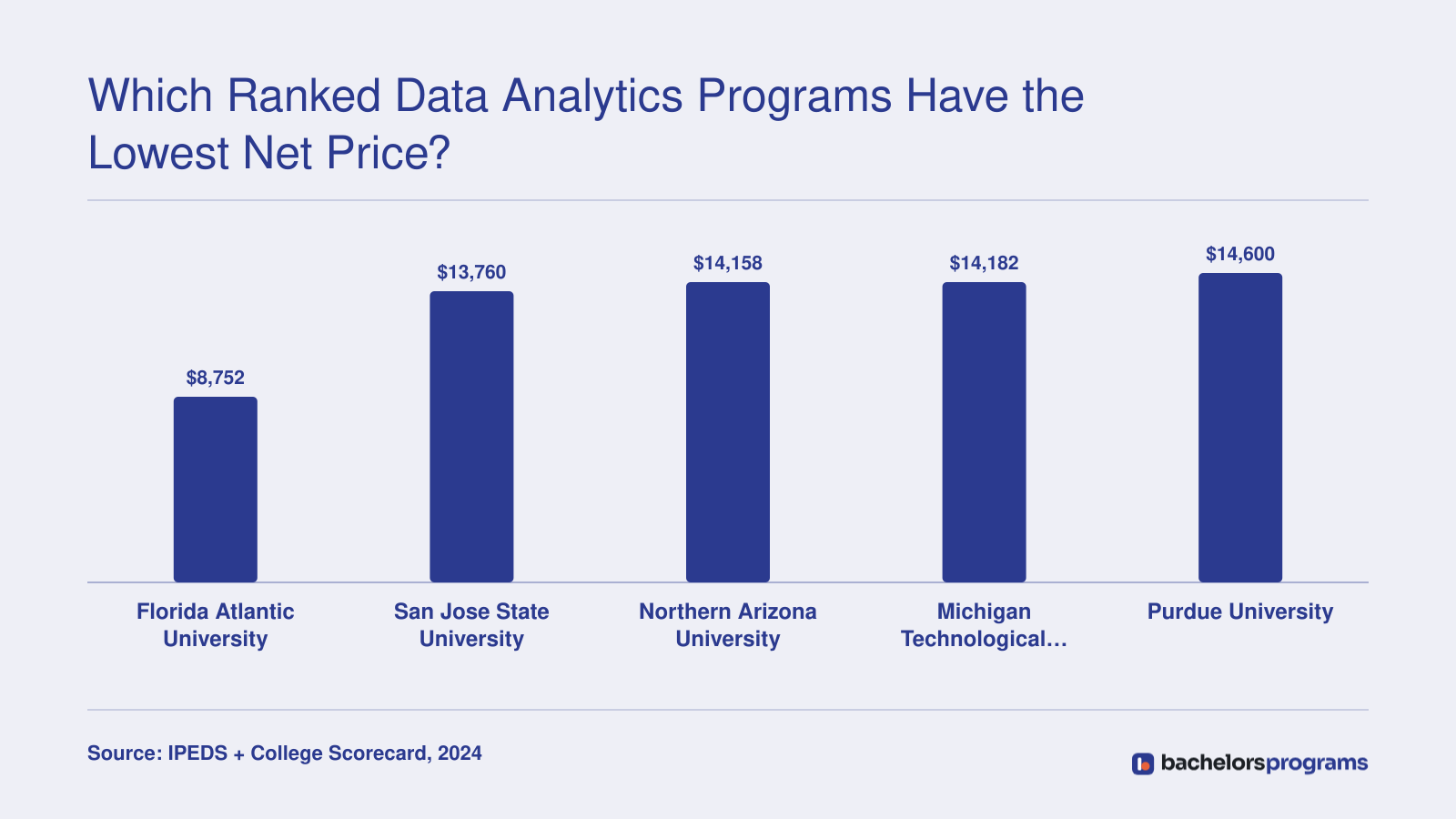
Which Ranked Data Analytics Programs Have the Lowest Net Price?
Florida Atlantic University has the lowest average net price among the ranked schools at $8,752 a year. San Jose State University, Northern Arizona University, Michigan Technological University and Purdue University follow, between $13,760 and $14,600. All five are public universities. San Jose State is the only school in this chart that offers its data analytics bachelor's both online and on campus, while the others are campus-based. Each figure is an institution-wide average net price after grants and scholarships, not a program-specific cost, and your actual price will vary with family income.
Industry Certifications That Pair Well With Your Degree
A bachelor's degree in data analytics proves you understand statistics, data management and analysis. A certification shows an employer you can use the specific tool their team runs every day. Some B.S. in Data Analytics programs build certification prep into coursework or cover exam vouchers, so ask admissions whether yours does. Treat any credential below as a supplement to your degree, not a replacement for it, and match your choice to the tools named in the entry-level job postings you plan to apply for.
| Certification | Issuer | Format / Exam | Approx. Cost | Best For |
|---|---|---|---|---|
| Google Data Analytics Professional Certificate | Self-paced online program with interactive content, discussion prompts, quizzes and activities. No separate certification exam. | $49 per month after a 7-day free trial (U.S. and Canada) | Beginners preparing for junior or associate data analyst roles | |
| Microsoft Certified: Power BI Data Analyst Associate (PL-300) | Microsoft | Proctored exam | $165 U.S. exam fee | Candidates building Power BI data analysis and reporting skills |
| Tableau Certified Data Analyst | Salesforce / Tableau | Single two-hour proctored exam, taken online | $250 per attempt | Tableau-centered analyst work. Tableau recommends at least six months of hands-on product experience before testing. |
| SAS Certified Specialist: Base Programming Using SAS 9.4 | SAS | 40 to 45 multiple-choice and short-answer questions in 135 minutes, administered by SAS and Pearson VUE | $180 exam fee | Analysts who need SAS programming for reports, data manipulation and transformation, and managing SAS data |
Data Analytics vs. Data Science vs. Statistics Degrees
The best degree for data analytics depends on your goal. A data analytics degree suits hands-on analyst roles, data science suits machine learning and modeling, statistics suits inference and graduate study, and business analytics suits business-facing decision work. Credential type matters too: a B.S. usually requires more math and programming, while a B.A. allows more electives and a broader liberal arts core, though structures vary by school.
| Factor | Data Analytics | Data Science | Statistics | Business Analytics |
|---|---|---|---|---|
| Math prerequisites | Calculus I and II, applied linear algebra, statistics and business statistics | Calculus II and linear algebra | Calculus I and II for entry, then Calculus III and matrix methods | Brief Calculus is the first required math course |
| Programming depth | Python, R and Python analytics, data structures and algorithms | Deepest: Python, R, database programming, data mining and machine learning | Algorithms and data structures in Python, plus two languages with data-science packages | Lighter: emphasis on data management and solution development, no universal language requirement |
| Typical credential | B.S. in the example program, though a B.A. may exist at some schools | B.S. is common; a B.A. may be offered as a co-major at some schools | B.S., often with extra computation, modeling and theory | B.S. in the example program (120 credit hours) |
| Core focus | Programming, databases, visualization, business intelligence, machine learning and an applied capstone | Applied statistics, modeling, linear algebra, data mining and machine learning | Probability, statistical theory, modeling and computation | Data warehousing, dimensional modeling, visualization and predictive analytics |
| Orientation | Applied and interdisciplinary, linking tools to business projects | Mathematical and computational | Theory- and inference-oriented | Business-facing and decision-oriented |
| Typical first jobs | Data analyst, business intelligence analyst, reporting analyst | Junior data scientist, data analyst, machine-learning analyst | Statistical analyst, research analyst, quantitative analyst | Business analyst, operations analyst, reporting analyst |
| Fit without a strong CS or math background | Good fit: applied and project-based, but expect calculus and Python | Most demanding: heavy coding and math from the start | Challenging: calculus sequence required, best for math-confident students | Most approachable: lighter math entry point and business context |
Data Analytics programs by state
Compare Data Analytics programs on the data that matters
Explore more Computers & IT majors or browse every field of study.
All Computers & IT programs Browse every field of study