Best Accounting Schools in Michigan
Compare 39 accredited Accounting programs in Michigan at 33 colleges, with net price after aid, graduation rates, earnings and debt from IPEDS and the U.S. College Scorecard.
A bachelor's degree in accounting typically takes 120 credits, but a Michigan CPA license requires 150 semester hours. That 30-credit gap shapes how students plan their degrees.
Michigan offers several routes: large public universities such as Michigan State and Wayne State, private colleges such as Hillsdale and Andrews, and online options from Michigan-based schools. The common credential is the Bachelor of Science (B.S.) in Accounting, though many programs award a business degree with an accounting major.
Whichever school a student picks, the extra credits remain part of the plan.
Key Points
- Hillsdale College ranks first, ahead of Michigan State and Michigan Tech.
- In-state public tuition runs about $15,190 to $19,123 a year.
- Michigan CPA licenses come from the State Board of Accountancy through LARA.
Best Bachelor's in Accounting Schools in Michigan: Our Top 10
Hillsdale College takes the top spot in our list of the best bachelor's degree in accounting programs in Michigan, with Michigan State University and Michigan Technological University close behind. All ten schools award a bachelor's degree in accounting on campus, and institution-wide graduation rates across the group run from about 58% to 90%. Published net prices after aid at the public universities here fall between roughly $9,100 and $19,700 a year.
Hillsdale College
#1Hillsdale, MI · $30,000 – $35,000/yr (est.)
Best for: Liberal arts minded future accountants
A small private liberal arts college in Hillsdale where accounting is offered as both a major and a minor inside a broad liberal arts framework. Coursework covers tax law, auditing, and financial interpretation, and students are expected to round out the major with supporting work in a foreign language, science, or mathematics. The Accounting Honor Society recognizes top students, and a campus speaker series brings executives in to talk leadership and business. It is the most selective school on this list and posts the highest graduation rate of the ten.
- Offered as both a major and a minor
- Coursework covers tax law, auditing, and financial interpretation
- Requires supporting work in a foreign language, science, or math
- Accounting Honor Society recognizes academic excellence
- Executive speaker series brings business leaders to campus
Michigan State University
#2East Lansing, MI · $16,000 – $44,000/yr (est.)
Best for: Future CPAs wanting a big campus
Michigan State's Eli Broad College of Business awards a Bachelor of Science in Accounting that requires 120 credits, only 19 of them in a tightly sequenced accounting core that runs from the introductory course through auditing and accounting systems. Students must hold a 2.0 GPA across major courses, and the university writing requirement is met inside the accounting sequence itself. Adding Accounting 308 and the government and not-for-profit course puts graduates on the path to Michigan CPA eligibility. It is one of the largest and most established accounting programs in the state, with an admissions rate near 85%.
- 120 total credits, with 19 in the accounting major
- 2.0 GPA required across major courses
- Sequence runs ACC 250, 300, 301, 321, 341, 411 and 331
- Accounting 308 is required for Michigan CPA eligibility
- Writing requirement met through Accounting 301 and 331
- Housed in the Eli Broad College of Business
Michigan Technological University
#3Houghton, MI · $10,000 – $15,000/yr (est.)
Best for: Analytics-focused future accountants
A STEM university in Houghton where the Bachelor of Science in Accounting leans hard into analytics, pairing auditing, tax, and cost management with hands-on work in data tools and artificial intelligence. The AACSB-accredited business school offers an 18-credit data analytics concentration and the option to build a second major with roughly 32 additional credits. The program reports a 92% placement rate, with more than 400 employers recruiting on campus and graduates heading to Fortune 500 companies, tech startups, and public accounting firms. Accounting cohorts are small, so students get seminar-style attention from faculty.
- AACSB-accredited business school
- STEM-focused curriculum with analytics and AI tools
- Program reports a 92% job placement rate
- More than 400 employers recruit on campus
- Dual major option adds about 32 credits
- Program reports the second-highest CPA pass rates in Michigan
- 18-credit concentration in data analytics
- Combines accounting, information systems, and mathematics
- Includes statistical programming coursework
- Same 92% job placement rate as the core program
Andrews University
#4Berrien Springs, MI · $10,000 – $15,000/yr (est.)
A private Seventh-day Adventist university in Berrien Springs, in the southwest corner of the state, offering a BBA in Accounting through a business school accredited by IACBE. The curriculum pairs core business coursework with financial reporting, forensic accounting, and cloud-based systems and AI-driven analytics, and a Crowe on Campus arrangement gives students paid internships that carry class credit and often convert to full-time offers. Every student gets a personalized four-year study plan, and the small cohort means close advising from faculty.
- IACBE-accredited School of Business
- Paid Crowe on Campus internship carries class credit
- Covers financial reporting, forensic accounting, and cloud systems
- Personalized four-year study plans
- AI-driven analytics built into the curriculum
University of Michigan-Dearborn
#5Dearborn, MI · ~$9,000/yr (est.)
The Dearborn campus of the University of Michigan offers a 120-credit BBA in accounting with rolling admissions, so applications are reviewed throughout the year rather than against one hard deadline. The degree layers 29 credits of business prerequisites and a 37-to-38-credit core under 21 credits of accounting major courses covering cost accounting, federal income taxation, auditing, and corporate finance. Students get discounted access to online CPA prep, the Bloomberg Finance Lab, and study abroad options in Italy and Taiwan. The Go Blue Guarantee can cover tuition for high-achieving in-state students from qualifying backgrounds.
- 120 credits: 29 prerequisites, 37 to 38 core, 21 in the major
- Rolling admissions reviewed throughout the year
- UWorld CPA prep available at up to 50% off
- Bloomberg Finance Lab access for finance coursework
- Study abroad options in Italy and Taiwan
- Go Blue Guarantee can cover tuition for qualifying in-state students
University of Detroit Mercy
#6Detroit, MI · ~$15,000/yr (est.)
A private Catholic university in Detroit where accounting sits inside a B.S. in Business Administration, so majors take 30 credits of accounting coursework on top of a 27-to-30-credit business core. Students can add one of 12 concentrations in areas such as finance, business intelligence, business law, and sports management, and the major is structured to qualify graduates to sit for the Uniform CPA exam. The program reports job placement above 95%, and a mentor drawn from the business community supplements academic advising. Volunteer Income Tax Assistance work gives students real client experience before they graduate.
- 30 credits of accounting coursework
- 27 to 30 credit business core
- 12 concentration options, including business intelligence and sports management
- Program reports job placement above 95%
- VITA tax preparer experience with real clients
- Business mentor assigned for career planning
Wayne State University
#7Detroit, MI · ~$13,000/yr (est.)
Wayne State's Mike Ilitch School of Business in Detroit offers a B.S. in Accounting that balances accounting theory with practice across intermediate financial accounting, managerial accounting, taxation, accounting systems, and data analytics. A capstone course assesses command of the discipline before graduation, and a B.A. option adds foreign language study for students aiming at international work. The school also runs a post-bachelor accounting certificate for graduates who need more credits for CPA eligibility. Sitting in the state's largest city, it draws recruiters from public accounting, corporate, and government employers.
- 120 credits with a required capstone
- Covers intermediate financial accounting, taxation, and data analytics
- B.A. option adds foreign language proficiency
- Prepares students for public, corporate, or governmental accounting
Grand Valley State University
#8Allendale, MI · $15,000 – $20,000/yr (est.)
Grand Valley State University's BBA in Accounting builds on a shared business core in communication, analysis, and management, then lets students choose between individual and entity taxation and between internal and external auditing. Up to six credits of internship or research can count toward the degree, and internships are strongly encouraged. The School of Accounting recently redesigned its introductory financial and managerial courses around feedback from West Michigan employers and runs a discovery program that brings high school students from economically disadvantaged districts into the field. It awards more accounting bachelor's degrees than any other school on this list.
- AACSB accredited
- 120 total credit hours
- Ethics course required
- Choose individual or entity taxation and internal or external auditing
- Up to six credits of internship or research count toward the degree
- Prepares for CPA and CMA exams
- Suggested four-year course sequence
Oakland University
#9Rochester Hills, MI · $9,000/yr (est. net price)
Oakland University's accounting bachelor's is one of a handful of Michigan programs accredited by AACSB in both business and accounting, a distinction the school says only five Michigan institutions hold. Coursework spans auditing, cost management, financial analysis, information systems, policy, and taxation, with hands-on projects and research experiences built in. A combined bachelor's and master's pathway lets strong students start graduate work early, with the GMAT waived for high achievers. Its net price after aid is the lowest among the ten schools here.
- AACSB accredited in both business and accounting
- Covers auditing, cost management, taxation, and information systems
- Internships, projects, and research experiences built in
- Combined bachelor's and master's path with a GMAT waiver
Western Michigan University
#10Kalamazoo, MI · $15,000 – $20,000/yr (est.)
Western Michigan's BBA in Accountancy carries supplemental AACSB accreditation in accounting and can be paired with a Master of Science in Accountancy so students reach the 150 credit hours CPA licensure requires in five years. Students work in small classes with award-winning faculty, and internships plus a 10-day study abroad in Ireland add experience beyond the classroom. Beta Alpha Psi and NABA chapters are active on campus, and the department has awarded $283,000 in scholarships. The program reports a 99% placement rate, with graduates hired by PwC, Deloitte, and BDO.
- Supplemental AACSB accreditation in accounting
- Five-year BBA to MSA path reaches 150 CPA credit hours
- Beta Alpha Psi and NABA chapters on campus
- 10-day study abroad in Ireland for credit
- Department has awarded $283,000 in scholarships
- Program reports a 99% job placement rate
- Internships with Big 4 firms
Cost & outcomes by school
Federal data for the highest-earning Accounting programs, independent of the ranking above. Earnings are this field's bachelor's graduates four years after completing where the Scorecard reports them, else the school's undergraduate median.
| School | Net price / yr | Grad rate | Earnings | Debt | Grads/yr | Format |
|---|---|---|---|---|---|---|
| Michigan State University MI | $19,680 | 81% | $96,093 | $22,500 | 159 | Campus |
| Oakland University MI | $9,120 | 58% | $82,699 | $22,292 | 71 | Campus |
| Central Michigan University MI | $17,597 | 59% | $80,551 | $28,125 | 47 | Hybrid |
| Grand Valley State University MI | $16,317 | 67% | $80,153 | $21,823 | 131 | Campus |
| University of Michigan-Dearborn MI | $9,492 | 58% | $78,969 | $21,750 | 40 | Campus |
| Walsh College MI | — | — | $78,902 | $19,092 | 52 | Hybrid |
| Albion College MI | $14,301 | 62% | $78,221 | $27,000 | 7 | Campus |
| Adrian College MI | $25,368 | 48% | $77,588 | $27,000 | 3 | Campus |
| Alma College MI | $20,694 | 63% | $77,001 | $27,000 | 9 | Campus |
| Aquinas College MI | $16,626 | 65% | $76,274 | $23,000 | 5 | Campus |
| Michigan Technological University MI | $14,182 | 68% | $74,373 | $24,990 | 23 | Campus |
| Wayne State University MI | $12,766 | 58% | $73,940 | $19,735 | 118 | Campus |
Sources: U.S. Department of Education. Net price, graduation rate, earnings and debt: College Scorecard (earnings and debt for this field's bachelor's graduates where reported, else school-wide); graduates: IPEDS. A dash means no figure is reported.
Cost, debt & payoff
Median earnings of this field's bachelor's graduates (4 yrs after completing, else the school's undergraduate median) vs. their median federal loan debt · U.S. College Scorecard
Across these programs the median graduate earns about $71,311 and finishes with roughly $23,125 in debt — a ratio that clears a common rule of thumb (keep debt below first-year salary). Net price and debt vary widely school to school, so check the per-school figures in the table above before you shortlist.
How We Ranked Michigan's Bachelor's Degree in Accounting Programs
Two Michigan accounting programs can quote the same tuition and still leave you with very different debt and job prospects, so the ranking weighs what happens after you enroll as heavily as what you pay to get in.
What Counts
Every program is compared on four things: what it costs, how its graduates fare, whether students finish, and whether you can attend on campus, fully online or in a hybrid format. Cost and earnings figures come from federal sources, chiefly the College Scorecard and IPEDS, the same data sets families can check themselves.
Accreditation, Read Carefully
AACSB accreditation comes in two layers, and the difference matters. Central Michigan University holds separate accounting accreditation. Grand Valley State University, Michigan State University and Western Michigan University are listed with both business and accounting accreditation.1 Michigan Technological University, the University of Michigan-Dearborn, the University of Michigan-Flint and Eastern Michigan University carry AACSB business accreditation, and their directory listings do not show a separate accounting designation.2
What the Numbers Cannot Tell You
Net price and graduation rate are institution-wide averages covering everyone at the university, not just accounting majors, so treat them as context rather than a verdict on any single program.
Most Affordable Bachelor's in Accounting Schools in Michigan
These Michigan public universities post the lowest average net price for a bachelor's degree in accounting among the schools we track, based on 2024 U.S. Department of Education data from IPEDS and the College Scorecard. Net price is the average annual cost that aid recipients at a public institution actually paid after grants and scholarships. It is not a quote for every student, and your own figure will depend on family income and the aid you receive. For budget-minded students, sticker price and net price can point in different directions. Saginaw Valley State University has the lowest in-state tuition here but the highest net price. The University of Michigan-Flint has the lowest net price and is the only hybrid option in the table. Oakland University and the University of Michigan-Dearborn, both ranked on this page, keep average net price under $9,500 a year.
| School | City | In-State Tuition and Fees | Average Net Price After Aid | Format |
|---|---|---|---|---|
| University of Michigan-Flint | Flint | $14,704 | $7,007 | Hybrid |
| Ferris State University | Big Rapids | $14,778 | $8,624 | Campus |
| Oakland University | Rochester Hills | $15,262 | $9,120 | Campus |
| University of Michigan-Dearborn | Dearborn | $15,640 | $9,492 | Campus |
| Saginaw Valley State University | University Center | $12,930 | $10,775 | Campus |
Online and Hybrid Bachelor's in Accounting Options at Michigan Schools
An online accounting bachelor's and a campus-based one lead to the same credential, but they structure your week very differently. Michigan schools offer both, along with hybrid formats.
What Online and Hybrid Look Like in Practice
Northwood University runs its accounting bachelor's both in person and online, and online students work through the university's digital platform while campus students attend class on site. Walsh College in Troy teaches its Bachelor of Accountancy online, in remote synchronous sessions, or on ground.1
Remote synchronous sections meet at set times, which suits students who want live instruction and hard deadlines. Fully online courses let you work through material on your own schedule, though some programs still require a proctored exam or an occasional campus visit. Confirm the specifics before you enroll.
Accelerated Routes to the 150 Credit Hours
- Northwood University: Students may finish the bachelor's in three years and spend the final year on a master's, and the university states graduates earn all CPA credits before graduation, online or on campus.
- Walsh College: FastTrack Two Degrees in Two Years compresses the timeline, and the Master of Accounting lets students reach up to 150 credit hours.
- Western Michigan University: A five-year path to both the B.B.A. and M.S.A. by dual-enrolling in the M.S.A. while finishing the undergraduate degree.
- Michigan Technological University: An accelerated master's adds about one year, with 24 credits beyond the bachelor's and up to 6 undergraduate credits counting toward it.2
Two Checks Before You Enroll
- CPA-path fit: Michigan requires 150 credit hours for licensure, so ask whether the online version covers the accounting courses the exam requires and where the extra credits come from.
- Price by location: Online students are sometimes billed a different per-credit rate than in-state campus students, so get the online rate in writing.
Admissions for Michigan Accounting Bachelor's Programs: GPA, Test Policy and Transfer Credit
Admission to an accounting bachelor's program in Michigan usually works in two steps. First you are admitted to the university, then you meet any requirements the business school sets before you formally enter the accounting major. At most of the schools ranked here, the first step is not the hard part.
How Selective Are These Schools?
Hillsdale College is the clear outlier, admitting about 21% of applicants. University of Michigan-Dearborn sits in the middle at roughly 56%. Michigan State, Wayne State, Grand Valley State, Oakland and Western Michigan each admit about 81% to 88% of applicants. Michigan Tech is the most open at about 92%. Grades still matter, but a solid B student has realistic options across the state.
GPA and Test Policies
Michigan State University publishes the clearest policy. Freshman applicants can apply test-optional, and SAT or ACT scores are not required for admission or for admission scholarship review.1 MSU lists a 2.00 minimum undergraduate GPA and expects international applicants to show the equivalent of 2.5 or higher.1 Treat that figure as a floor, not a target. We could not confirm a published minimum GPA or current test policy for the other schools here, so check each admissions page before you apply.
Transfer Credit and the Michigan Transfer Agreement
The Michigan Transfer Agreement (MTA) lets community college students complete a general education block, generally at least 30 credits, that participating four-year schools accept toward their own general education requirements.3 MSU participates and requires a grade of 2.0 or better in each MTA course.1 To be admitted as a transfer, MSU asks for a cumulative GPA of 2.5 or higher and at least 24 transferable credits earned after high school.2 Applicants with fewer credits must also send final high school transcripts. Test scores remain optional for transfers.2
Getting Into the Accounting Major
Some business schools add a second gate. At MSU, freshman applicants are reviewed for direct admission to the business college.4 Accounting appears as a "business preference" during that review, and no extra application step is required.4 Elsewhere, ask whether you must complete prerequisite courses or reach a minimum business GPA before you can declare accounting. UM-Dearborn, for example, lists prerequisite courses for its accounting BBA.
What a B.S. in Accounting Costs in Michigan: Tuition, Net Price and State Aid
What does an accounting bachelor's degree cost in Michigan?
Published Tuition vs. Net Price
At the public universities ranked here with published figures, in-state tuition runs from about $15,190 to $19,123 a year. Net price after grants and scholarships is much lower, from about $9,120 to $14,182. Andrews University, a private university ranked here, lists tuition of $35,056 but reports a net price near $12,547. Published tuition is the sticker price before aid, while net price reflects what a typical first-year student pays after federal, state and institutional grants. Private colleges often post high tuition and then discount it heavily, so compare net price rather than the headline number.
Michigan State Aid
Three state programs matter for Michigan residents:
- Michigan Achievement Scholarship: up to $5,500 a year, $27,500 lifetime, for five years.1 It requires a high school diploma or equivalency in 2023 or later, a Student Aid Index of $30,000 or less, Michigan residency since July 1 of the prior year, and full-time enrollment within 15 months of graduation.3 The award includes a $2,500 minimum plus up to $3,000 in last-dollar support, so the full amount depends on eligible costs and other aid. The 2026-27 application deadline is Aug. 6, 2027.2
- Michigan Competitive Scholarship: up to $1,500 a year for tuition and mandatory fees, with at least half-time enrollment, financial need, a 1200 SAT score and a 2.0 cumulative GPA.4
- Tuition Incentive Program: for students with Medicaid coverage for 24 months within a 36-month window between age 9 and high school graduation.5 It starts with tuition assistance at participating Michigan community colleges; Michigan does not publish a single universal dollar amount for the bachelor's phase.
Stack aid carefully. Because the Achievement Scholarship is last-dollar, ask each financial aid office how outside scholarships will affect it before you accept an award package.
Related Articles
Accounting Careers and CPA Licensure in Michigan
A Certified Public Accountant (CPA) license is issued in Michigan by the State Board of Accountancy through the Department of Licensing and Regulatory Affairs (LARA), and it is the credential that separates licensed accountants from the broader field.1 Michigan requires 150 semester hours for the CPA license, which is more than the roughly 120 hours in a typical accounting bachelor's degree.
What LARA Requires
- Education: At least 150 semester hours, including a bachelor's degree or higher with an accounting concentration.1 That includes 24 semester hours of accounting coursework (accounting information systems, auditing and attestation, cost or managerial accounting, financial accounting and reporting, governmental or fund accounting, and taxation) and 24 semester hours of general business coursework.
- Exam: The Uniform CPA Examination, administered through NASBA's CPA Examination Services. It has three core sections (AUD, FAR, REG) plus one discipline section (BAR, ISC, or TCP). You need a 75 on each.
- Experience: At least 2,000 qualifying hours over one to five calendar years, verified by a licensed CPA.1 Public practice, government, industry, and academia can all count.
- Other: Applicants must be at least 18 and of good moral character.3
Michigan sources describe the exam completion window differently. One LARA-based licensing guide cites 18 months from the first test session, while the Michigan Association of CPAs describes a rolling 30-month period.2 Confirm the current rule with LARA before you schedule your first section.
Bridging From 120 to 150 Hours
Most bachelor's graduates reach 150 hours by adding undergraduate credits after the degree, taking extra accounting or business courses, or enrolling in a school's combined bachelor's and master's track if one is offered. Many students sit for the exam once they meet the 120-hour eligibility threshold and finish the remaining hours before applying for the license. Check each school's advising office for how its coursework maps to LARA's categories.
Wages and Where the Jobs Are
The Bureau of Labor Statistics reports a national median annual wage of $81,680 for accountants and auditors (May 2024).4 That is a federal occupational wage for all workers in the field, not the earnings of recent graduates from any school on this page, so do not compare it directly with college-reported graduate earnings. Michigan and metro-level figures differ, so check BLS state data for the current local number.
Employment concentrates in the Detroit area, home to the auto industry, and in Grand Rapids, with its mix of manufacturing, healthcare, and financial firms. Lansing and other cities add government and public-sector roles.
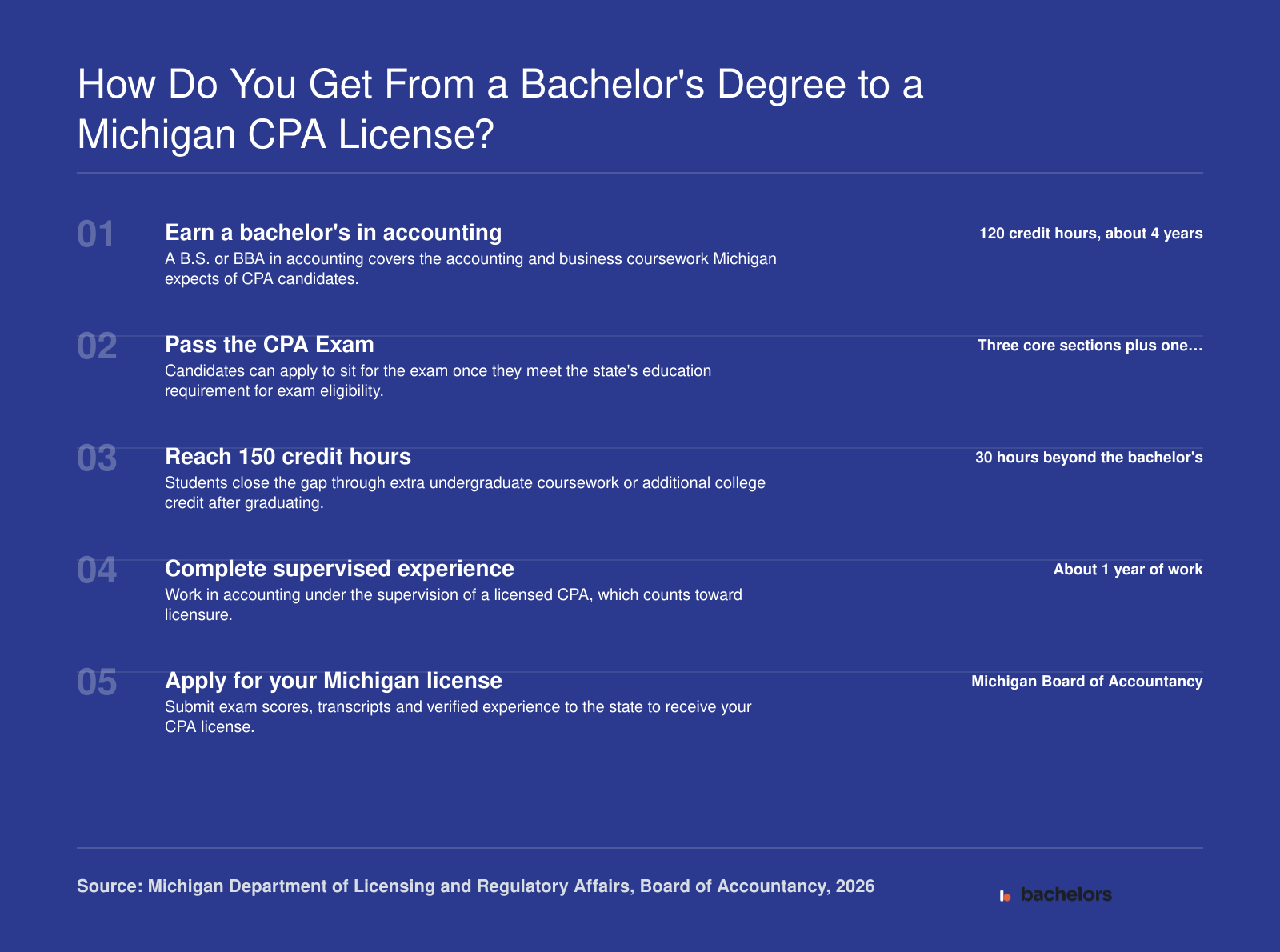
How Do You Get From a Bachelor's Degree to a Michigan CPA License?
A bachelor's degree in accounting is the first step toward a CPA license in Michigan. The path below shows the usual order, from coursework to the final license application with the state.
Common Questions About Accounting Schools in Michigan
These answers cover the questions Michigan accounting students ask most. Policies change by school and by year, so confirm details with each admissions office and with the Michigan Department of Licensing and Regulatory Affairs before you plan around them.
What is the best accounting school in Michigan?
How many credit hours do you need to become a CPA in Michigan?
Do Michigan accounting schools require the SAT or ACT?
Can community college credits transfer toward a bachelor's degree in accounting in Michigan?
Compare Accounting programs on the data that matters
Explore more Business & Management majors or browse every field of study.
All Business & Management programs Browse every field of study