Best Business Degree Programs in Michigan
Compare 86 accredited Business programs in Michigan at 41 colleges, with net price after aid, graduation rates, earnings and debt from IPEDS and the U.S. College Scorecard.
Most published rankings of Michigan business schools measure MBA programs, not the bachelor's degrees that account for the bulk of undergraduate enrollment. That mismatch matters when a flagship research university, a regional public and a private college can all award the same BBA at very different prices and outcomes.
In Michigan, the choice usually comes down to three tiers: Ann Arbor and East Lansing flagships, regional publics such as Grand Valley State and Oakland, and private colleges like Hope and Cleary.
Net price after aid, graduation rates and graduate earnings separate them more than brochure language does.
Key Points
- University of Michigan business graduates report $93,674 median earnings one year out.
- Michigan CPA licensure requires 150 semester hours, more than a typical bachelor's.
- At Alma, Hope and Cleary, residency doesn't change tuition.
Best Business Bachelor's Programs in Michigan: Top 10 for 2027
The University of Michigan is the strongest undergraduate business option in the state on the measures we track: a 93% school-wide graduation rate, an average net price near $13,100 for in-state students, and median program earnings of $93,674 one year after graduation and $144,654 four years out. Its Ross BBA pairs a cohort core of roughly 80 students with a required capstone and 16 to 18 credits of business electives. The ten programs below cover campus, online, and hybrid formats; net price figures are sector-average estimates after aid, not a quote for any individual student.
University of Michigan
#1Ann Arbor, MI · $18,000 – $61,000/yr (est.)
Best for: High-achieving students wanting small cohort classes
The Ross School of Business runs a 120-credit BBA on campus in Ann Arbor, with a cohort core of about 80 students, a required senior capstone, and 16 to 18 credits of business electives. It leads this group on outcomes: a 93% school-wide graduation rate and median program earnings of $93,674 one year after graduation and $144,654 four years out. In-state tuition is $17,736 and average net price after aid is $13,138.
- 120 total credits: 62 in Ross, 54 across U-M, 4 elective
- 16 to 18 credits of business electives, or 6 to 7 classes
- Capstone required in the senior winter term
- Core classes run in a cohort of about 80 students
- Week-long entrepreneurial challenge and annual Signature Learning Experience
- Optional Global Semester Exchange
- Inclusive Leaders Pathway spans all four years
- Prerequisites include Economics 101, calculus, and fourth-semester language proficiency
Michigan State University
#2East Lansing, MI · $16,000 – $44,000/yr (est.)
Best for: Students planning to work in Michigan
The Eli Broad College of Business, on campus in East Lansing, awards a 120-credit management degree with a 15-credit concentration, a capstone, and a Tier II writing requirement. The undergraduate business degree moved to a Bachelor of Science in Business in fall 2025, and Broad reports 99% placement for its 2025 class, with 87% completing internships. The school-wide graduation rate is 81%, in-state tuition is $16,458, average net price after aid is $19,680, and median program earnings are $71,253 one year after graduation and $91,187 four years out.
- 120 credits, including a 15-credit major field concentration
- 2.00 GPA minimum in the concentration
- Management 460 serves as the capstone
- Tier II writing requirement
- Two programs: management or human resource management
- Three minors: entrepreneurship and innovation, retail management, sports business
- Concentration coursework in staffing, compensation, negotiation, and international management
Grand Valley State University
#3Allendale, MI · $15,000 – $20,000/yr (est.)
Best for: Students who want credit for internships
Grand Valley State's Seidman College of Business delivers a 120-credit Bachelor of Business Administration on campus in Allendale, built on a 36-credit business core, 9 credits of upper-division electives, and a capstone in year four. Students may apply up to 6 hours of internship and independent research credit toward the degree. The school-wide graduation rate is 67%, in-state tuition is $15,140, average net price after aid is $16,317, and median program earnings are $57,760 one year after graduation and $79,324 four years out.
- 120 total credits
- 36 credits of required business courses
- 9 credits of upper-division business electives
- Up to 6 hours of internship and research credit
- Capstone required in year four
- One ethics course required
- Non-business requirements include spreadsheets and business statistics
- Offered by the Seidman College of Business
Andrews University
#4Berrien Springs, MI · $10,000 – $15,000/yr (est.)
Andrews University offers a fully online, asynchronous Bachelor of Science in Business Administration from its Berrien Springs campus, which lets students across Michigan and elsewhere study year round without relocating. The 120-credit degree includes 39 credits in the major and entry points in August, January, and May. The school-wide graduation rate is 72%, tuition is $35,056 at $490 per credit, and average net price after aid is $12,547.
- 120 credits, delivered fully online and asynchronously
- 39 credits in the major
- $490 per credit tuition, plus a distance degree fee
- 2.5+ high school GPA or GED required for admission
- ACT or SAT scores required for recent U.S. high school graduates
- Entry dates in August, January, and May
- $30 application fee
- Business ethics taught from a Christian Adventist perspective
University of Detroit Mercy
#5Detroit, MI · ~$15,000/yr (est.)
The University of Detroit Mercy awards a 120-credit Bachelor of Science in Business Administration on its Detroit campus, with 13 business core courses, 4 business electives, and 12 concentration options. Classes run during daytime, evening, and weekend hours, and students can use co-op placements, a Financial Markets Lab, and an accelerated five-year BS and MBA path. The school-wide graduation rate is 67%, tuition is $32,946, average net price after aid is $15,232, and median program earnings are $37,972 one year after graduation and $89,540 four years out.
- 120 semester hours, including 13 business core courses
- 12 concentration options, among them accounting, finance, and international business
- Daytime, evening, and weekend class scheduling
- Co-op opportunities and a Financial Markets Lab with a real stock portfolio
- Accelerated five-year BS and MBA option
- An international business course is required
- Grounded in Jesuit and Mercy traditions
Hope College
#6Holland, MI · $27,000/yr (est. net price)
Hope College's business degree, on campus in Holland, gives students a broad foundation across the functional areas and lets them add a finance, human resources, or marketing concentration rather than requiring one up front. Class sizes are modest and advising is built around career exploration and vocational discernment. The school-wide graduation rate is 80%, tuition is $41,970, average net price after aid is $27,182, and median program earnings are $45,590 one year after graduation and $65,755 four years out.
- Foundational coursework across all business functional areas
- Concentrations in finance, human resources, or marketing, not required
- Modest class sizes with personalized advising
- Emphasis on critical thinking and vocational discernment
- Christian worldview integrated into the curriculum
- On-campus program in Holland, Michigan
University of Michigan-Dearborn
#7Dearborn, MI · ~$9,000/yr (est.)
The University of Michigan-Dearborn admits every freshman and transfer student directly into its AACSB-accredited College of Business, so students do not compete for entry after their sophomore year. The BBA runs on campus in Dearborn with concentrations in growing fields such as information systems, business analytics, and supply chain management, plus internships and practice-based projects with Detroit-area employers. The school-wide graduation rate is 58%, in-state tuition is $15,640, average net price after aid is $9,492, and median program earnings are $57,102 one year after graduation and $76,606 four years out.
- AACSB-accredited College of Business
- Freshmen and transfer students admitted directly to the BBA
- Concentrations include information systems, business analytics, and supply chain management
- Internship program available
- Flexible pace for traditional students and working adults
- Access to the iLabs research institute
- College established in 1959
Wayne State University
#8Detroit, MI · ~$13,000/yr (est.)
Wayne State's Mike Ilitch School of Business awards both a Bachelor of Arts and a Bachelor of Science in Business Administration on its Detroit campus, each at 120 credits with a capstone and a cooperative education program. Students reach professional standing at a 2.50 GPA and choose from six major areas, with double majors and a law minor available. The school-wide graduation rate is 58%, in-state tuition is $15,190, and average net price after aid is $12,766.
- 120 credits, with 40 credits of foundation coursework
- 2.50 GPA required for professional standing
- Foreign language requirement for the B.A.
- Strategic management capstone
- Cooperative education program, graded S/U with no academic credit
- Last 30 credits must be completed at Wayne State
- Double major option and an entrepreneurship certificate
Oakland University
#9Rochester Hills, MI · $9,000/yr (est. net price)
Oakland University's School of Business Administration offers a 124-credit Bachelor of Science in Business Administration with a General Management major on campus in Rochester Hills, allowing 11 credits of business electives for customization. The program covers leadership, organizational behavior, human resources, operations, finance, and marketing, with a C minimum in required courses. The school-wide graduation rate is 58%, in-state tuition is $15,262, average net price after aid is $9,120, and median program earnings are $62,359 one year after graduation and $84,052 four years out.
- 124 credit program
- General Management major with 11 credits of business electives
- Business pre-core and core required before the major
- Coursework in leadership, organizational behavior, human resources, and operations
- Managerial finance and marketing fundamentals included
- Minimum C grade required in required courses
- At least 31 credits must come from the School of Business Administration
Aquinas College
#10Grand Rapids, MI · ~$17,000/yr (est.)
Aquinas College awards a Bachelor of Science in Business Administration on its Grand Rapids campus, combining a business core with concentrations in international business, management, and marketing. Students gain hands-on experience through internships, case studies, and field trips to Fortune 500 companies, with small classes and an emphasis on ethical decision-making. The school-wide graduation rate is 65%, tuition is $40,218, average net price after aid is $16,626, and median program earnings are $44,913 one year after graduation and $74,404 four years out.
- Concentrations in international business, management, and marketing
- Internships, case studies, and real-world projects
- Field trips to Fortune 500 companies
- Small class sizes with dedicated faculty
- Emphasis on business ethics
- Built on a liberal arts foundation
- Career networking events and graduate school preparation
Cost & outcomes by school
Federal data for the highest-earning Business programs, independent of the ranking above. Earnings are this field's bachelor's graduates four years after completing where the Scorecard reports them, else the school's undergraduate median.
| School | Net price / yr | Grad rate | Earnings | Debt | Grads/yr | Format |
|---|---|---|---|---|---|---|
| Kettering University MI | $34,660 | 71% | $94,823 | $27,000 | 596 | Campus |
| University of Michigan MI | $13,138 | 93% | $83,648 | $19,500 | 20,096 | Campus |
| Michigan Technological University MI | $14,182 | 68% | $78,198 | $24,990 | 2,674 | Campus |
| Walsh College MI | — | — | $72,081 | $16,217 | 484 | Hybrid |
| University of Detroit Mercy MI | $15,232 | 67% | $71,030 | $23,250 | 2,162 | Campus |
| Lawrence Technological University MI | $32,918 | 61% | $69,151 | $27,000 | 742 | Campus |
| Michigan State University MI | $19,680 | 81% | $67,253 | $23,250 | 19,242 | Campus |
| Northwood University MI | $27,232 | 63% | $63,075 | $20,842 | 1,190 | Campus |
| University of Michigan-Dearborn MI | $9,492 | 58% | $59,649 | $22,500 | 2,738 | Campus |
| Madonna University MI | $17,755 | 60% | $59,058 | $23,000 | 878 | Campus |
| Albion College MI | $14,301 | 62% | $58,799 | $27,000 | 920 | Campus |
| Oakland University MI | $9,120 | 58% | $58,612 | $22,750 | 5,984 | Campus |
Sources: U.S. Department of Education. Net price, graduation rate, earnings and debt: College Scorecard (earnings and debt for this field's bachelor's graduates where reported, else school-wide); graduates: IPEDS. A dash means no figure is reported.
Cost, debt & payoff
Median earnings of this field's bachelor's graduates (4 yrs after completing, else the school's undergraduate median) vs. their median federal loan debt · U.S. College Scorecard
Across these programs the median graduate earns about $54,739 and finishes with roughly $24,475 in debt — a ratio that clears a common rule of thumb (keep debt below first-year salary). Net price and debt vary widely school to school, so check the per-school figures in the table above before you shortlist.
What Sets These Michigan Bachelor's Programs Apart
The differences between Michigan business bachelor's programs show up on a ledger far more than in a viewbook. What you actually pay after financial aid, how many students stay to a diploma, and what graduates report earning separate schools that otherwise read almost identically.
The distinguishing factors are concrete: net price after grants and scholarships, graduation rate, earnings for graduates of the specific program, median debt at completion, and the selectivity of the incoming class.
Two caveats matter when you read those numbers. Graduation rate, net price, and median debt are school-wide figures, so treat them as context for the institution rather than a guarantee about one major. Earnings are reported at the program level and are labeled with their time window, usually a year or a few years past graduation, which makes them an early-career signal rather than a lifetime forecast.
Every school here is in Michigan, and the options span traditional campus programs and fully online formats. All of them award a bachelor's degree.
Which Michigan Business Schools Hold AACSB Accreditation
AACSB accreditation comes from AACSB International, a global business-education accreditor, and is awarded to a school's business programs after peer review. For undergraduates, it signals that the business college has met outside standards for curriculum, faculty qualifications and continuous improvement. It is not required for a business degree or for most business-related jobs, but some employers and graduate programs do weigh it.
Ranked Schools in the AACSB Directory
The AACSB Accredited Schools Directory lists these schools from this page as accredited:
- Central Michigan University
- Grand Valley State University
- Lawrence Technological University
- Michigan State University
- Saginaw Valley State University
- University of Michigan-Flint
- Wayne State University
- Western Michigan University
The list is directory-based, not a full map of Michigan business-school accreditation. The other schools here did not appear in the directory results we checked. That does not tell you whether they hold a different accreditation or none, so ask each school directly.
ACBSP and IACBE
ACBSP and IACBE are separate business accrediting bodies, and some schools choose them instead of AACSB. We could not confirm which Michigan schools hold either one, so no school here is labeled with either.
Check Before You Apply
Accreditation status can change. Confirm each school's current standing in the AACSB directory before you apply, and check the accreditor's own listing if a school names ACBSP or IACBE.
The Cheapest Bachelor's in Business Programs in Michigan
These Michigan business bachelor's programs carry the lowest average net price (what students actually paid after grants and scholarships), according to 2024 IPEDS and College Scorecard data from the U.S. Department of Education. Published in-state and out-of-state tuition and fees appear alongside. Every school in this lowest-cost group is a public university, and no private college reached it in the federal data. University of Michigan-Flint posts the lowest net price at $7,007, while Ferris State University charges out-of-state students the same tuition as Michigan residents.
| School | City | Average Net Price (After Aid) | In-State Tuition and Fees | Out-of-State Tuition and Fees |
|---|---|---|---|---|
| University of Michigan-Flint | Flint | $7,007 | $14,704 | $28,320 |
| Ferris State University | Big Rapids | $8,624 | $14,778 | $14,778 |
| Oakland University | Rochester Hills | $9,120 | $15,262 | $23,188 |
| University of Michigan-Dearborn | Dearborn | $9,492 | $15,640 | $32,896 |
| Saginaw Valley State University | University Center | $10,775 | $12,930 | $30,450 |
Online and Hybrid Business Bachelor's Options at Michigan Schools
Online business bachelor's degrees do exist in Michigan, though most of the highest-profile programs are still campus-based. Andrews University is the clearest online example among the ranked schools: its BS in Business Administration is asynchronous, with August, January, and May entry dates. University of Michigan, Michigan State, Grand Valley State, Hope College, Wayne State, Oakland, and Aquinas are campus programs. Davenport University and Ferris State University, both in our directory, offer online and on-campus routes.
Formats Available
- Fully online: Andrews, plus Davenport's Applied Business and BBA in Management and Ferris State's BBA.
- Hybrid or mixed: Davenport's BBA in Management can be taken online, on campus, or as a mix, in 7-week or 15-week courses.2
- Evening and weekend: University of Detroit Mercy schedules its business administration courses in daytime, evening, and weekend slots.
- Degree completion: Ferris State's pathway requires 48 transferable semester credits for admission.3 Davenport's Applied Business accepts up to 60 credits from an associate's degree, which it says leads to finishing in two years.1
Who Each Format Suits
Working adults usually do best with asynchronous online study or shorter 7-week courses, since both lower the weekly time commitment. Transfer students should look first at the completion tracks at Davenport and Ferris State. At University of Michigan-Dearborn, transfers can bring in C-or-better coursework, but must finish at least 30 credits there, including the final 30, and reach 120 credits overall. Its catalog does not describe an online or evening format.
Confirm Before You Apply
Ask each school whether online students pay in-state tuition or a separate online rate, and whether any fees apply. Andrews, for example, notes a distance degree fee. Also ask about on-campus requirements, start dates, and how many transfer credits will count toward your degree.
Related Articles
Admission Requirements for Michigan Business Bachelor's Programs
Starting as a first-year and transferring in from a community college are two routes into the same Michigan business degree, and the rules differ sharply at each.
Entering as a First-Year
What is the acceptance rate for the University of Michigan business school? The University of Michigan admits about 15.6% of applicants school-wide, but that figure covers the whole university, not the Ross School of Business alone. Ross uses a separate business-school application.1 About 80% of each BBA class enters as high school seniors through Preferred Admission, so a spot at the university does not guarantee a spot in the business program.2
Ross has been test-optional for first-year applicants since the 2025 cycle.3 It publishes no minimum GPA or SAT/ACT score.3 Reviewers weigh achievement, course rigor, extracurriculars, and essays.
GPA and Test Policy Elsewhere
Published details are patchy. Andrews University lists a 2.5+ GPA and required ACT/SAT scores for its online BS in Business Administration. Wayne State University lists a 2.50 GPA for admission to its business programs, and Michigan State University's program page cites a 2.0 GPA minimum. For Grand Valley State, Hope College, Detroit Mercy, Michigan-Dearborn, Oakland, and Aquinas, the program pages we reviewed publish no GPA or test policy, so confirm with each admissions office rather than assume.
Transfer Credit and the Michigan Transfer Agreement
The Michigan Transfer Agreement (MTA) is a statewide framework that lets community-college students carry a block of general education credit into a participating four-year school. It helps most where schools accept it for general education, and Wayne State also notes articulation agreements with community colleges and a rule that the last 30 credits be completed on campus.
Ross is stricter. It requires exact U-M course equivalents, and finishing the MTA does not prove you have met its prerequisites. External transfer rules include:
- Credit cap: up to 45 credits count toward the 120 needed for the BBA.4
- Grades: C or better to transfer and apply toward degree requirements.5
- Timeline: applications run February 15 to March 31, with coursework finished by June 1.4
- Seats: about 5% of each class, with preference for Michigan community-college residents.2
- Enrollment: three continuous full-time fall-winter years after transfer.4
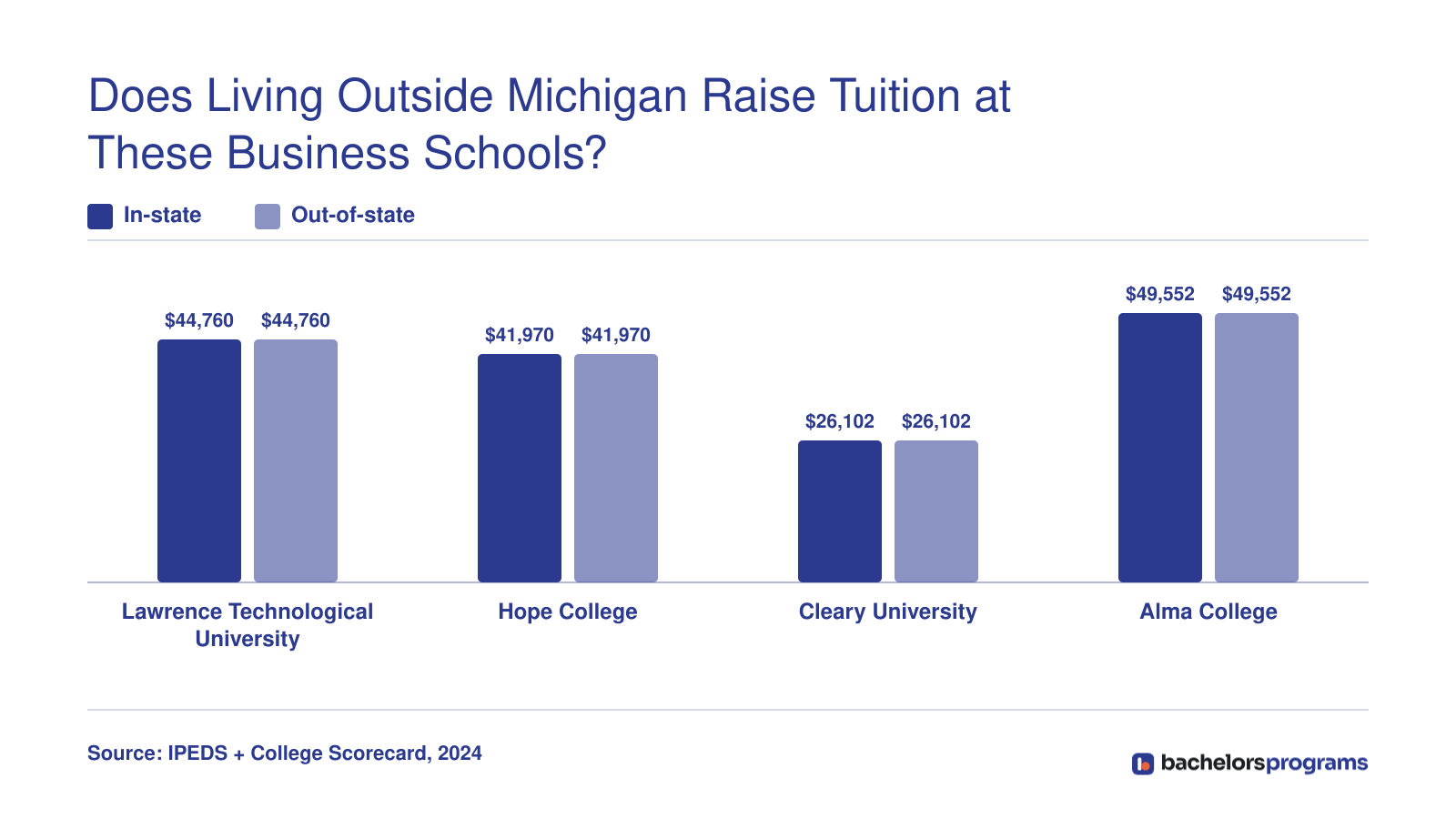
Does Living Outside Michigan Raise Tuition at These Business Schools?
At the private Michigan schools charted here, residency does not change the bill: the largest in-state vs. out-of-state gap is $0. Alma College, Lawrence Technological University, Hope College and Cleary University each charge every student the same tuition and fees, from $26,102 at Cleary to $49,552 at Alma. If you live outside Michigan, a private school's sticker price is the same one Michigan residents see. Your real cost comes down to aid, so compare net price rather than residency.
Michigan CPA Licensure at a Glance
Compare Business programs on the data that matters
Explore more Business & Management majors or browse every field of study.
All Business & Management programs Browse every field of study