Best Accounting Schools in North Carolina
Compare 42 accredited Accounting programs in North Carolina at 39 colleges, with net price after aid, graduation rates, earnings and debt from IPEDS and the U.S. College Scorecard.

Accounting is one of the few business degrees in North Carolina that leads directly to a license, and the standard credential is the Bachelor of Science in Accounting. The degree runs about 120 credit hours; the CPA is a second gate, with three licensure routes approved by the state board since Jan. 1, 2026, each requiring a 75 on every exam section.
The tension is price against outcome. In-state tuition at a public campus runs near $7,000 a year; a private university can charge $40,000 or more. Yet graduates of several public programs earn above $70,000 four years out, a spread that tracks accreditation and net price more closely than prestige.
Key Points
- Fayetteville State University posts the lowest net price: $7,892 after aid.
- Since 2026, North Carolina recognizes three routes to CPA licensure.
- Appalachian State's BSBA in Accounting runs 100% online across 120 credits.
Best Accounting Schools in North Carolina: Our Top 10 Ranked Bachelor's Programs
If you want the short answer, NC State's Poole College of Management leads this list on the strength of its accounting curriculum, its new 3+1 pathway to a master's degree, and graduate earnings that outpace most of the state. Below are ten North Carolina bachelor's programs, each profiled for what the school does well for accounting majors and how its graduates fare after finishing.
North Carolina State University at Raleigh
#1Raleigh, NC · $9,000 – $33,000/yr (est.)
Best for: High-achievers eyeing an accelerated master's
North Carolina's largest public university, and its Poole College of Management anchors one of the state's most recognized accounting pipelines. The B.S. in Accounting pairs a broad business core with financial and managerial accounting, taxation, auditing and analytics, and a new 3+1 pathway lets qualified students reach a master's degree in about four years. Schools offering this program have overall graduation rates near 85%, and accounting graduates report median earnings of about $56,600 one year after finishing, rising to roughly $83,700 four years out.
- 120 credit hours, including a full business core
- Coursework in financial and managerial accounting, taxation and auditing
- Data analytics and accounting information systems built into the curriculum
- Prepares graduates to sit for the CPA exam
- Accelerated Master of Accounting option adds one year, not two
- New 3+1 bachelor's-to-master's pathway launched in 2026
- Career paths include controller, financial analyst and internal auditor
Appalachian State University
#2Boone, NC · $8,000 – $25,000/yr (est.)
Best for: Transfer students wanting online flexibility
Appalachian State combines an AACSB-accredited business school with a mountain-campus setting in Boone and one of the state's more flexible accounting offerings. Undergraduates can pursue the accounting major on campus or complete the BSBA in Accounting online, where public accounting and managerial accounting tracks are available. The university graduates about 75% of students overall, and accounting graduates report median earnings near $55,700 one year after completion and about $85,600 four years out.
- AACSB International accredited through the Walker College of Business
- No minor required alongside the accounting major
- Coursework in cost accounting, income taxation, and accounting systems and control
- Internships and direct employer connections
- Business Career Services offers coaching and resume reviews
- Accelerated bachelor's-to-master's pathway available
- Online BSBA with a public accounting concentration
- Multiple eight-week term starts each year
- Capstone course required for completion
- Accepts prior learning credit and at least 24 transfer credits
- 2.3 GPA minimum for admission
- Big 4 firms recruit graduates
- Preparation for the CPA exam built into the curriculum
- Online BSBA with a managerial accounting concentration
- Graduates' CPA pass rate exceeds national and North Carolina averages
- Internships plus an annual accounting networking event
- Study abroad and international business coursework available
University of North Carolina at Charlotte
#3Charlotte, NC · $15,000 – $20,000/yr (est.)
Best for: Charlotte-area students targeting corporate finance
UNC Charlotte's Belk College of Business sits in the state's largest metro and feeds directly into Charlotte's banking and finance employers. The B.S. in Accounting starts students in a pre-accounting track before they advance to upper-division coursework in financial reporting, auditing and taxation. The university graduates about 69% of students overall, and accounting graduates report median earnings around $50,900 one year after finishing, near $76,700 four years out, with median debt around $22,500.
- 120 credit hours, starting in a pre-accounting track
- 2.5 GPA required in progression courses to enter the major
- Internship credit available through approved placements
- Business Honors Program for high-achieving majors
- Coursework in financial reporting, auditing, taxation and managerial accounting
- CPA licensure requires 30 additional credits beyond the degree
Wake Forest University
#4Winston-Salem, NC · $25,000 – $30,000/yr (est.)
Wake Forest is the selective private option on this list, with a small accountancy cohort inside a university that graduates about 89% of its students. Accounting majors complete a paid, 10-week professional internship in their senior year, and coursework spans intermediate accounting, taxation, auditing and accounting ethics. The degree is built to feed a one-year Master of Science in Accountancy, and graduates land at large public accounting firms and in banking, consulting and investment banking.
- Paid 10-week professional internship during senior year
- Coursework in intermediate accounting, taxation, auditing and accounting ethics
- Accounting information systems and a management simulation capstone
- Lays groundwork for the one-year Master of Science in Accountancy
- Accountancy minor added for 2025-26
- Wake Accounting Society and other student clubs
East Carolina University
#5Greenville, NC · ~$16,000/yr (est.)
East Carolina's College of Business has held AACSB accreditation since 1967 and offers a 120-credit accounting degree with a 24-hour accounting concentration plus a leadership and professional development sequence. Coursework reaches into fraud examination, governmental accounting and internal auditing, which suits students aiming at corporate, government or internal audit work. The university graduates about 63% of students overall, and accounting graduates report median earnings near $48,400 one year out and about $79,400 four years out.
- AACSB accredited since 1967
- 120 semester hours including a 24-hour accounting concentration
- 36-hour business core plus 9 hours of leadership and professional development
- C or better required in accounting courses; 2.0 GPA in the concentration
- Electives in fraud examination, governmental accounting and internal auditing
- Business Scholars Award is a renewable four-year merit scholarship
Western Carolina University
#6Cullowhee, NC · ~$13,000/yr (est.)
Western Carolina offers a compact accounting major of 21 credit hours inside a 120-credit B.S.B.A. on a Cullowhee campus serving the western mountains. Admission to the major requires a 2.2 GPA, and at least 60 of the 120 hours must come from outside the College of Business, so students leave with a broader academic base than a narrow accounting sequence provides. The university graduates about 60% of students, and accounting graduates report median earnings around $40,600 one year after finishing and about $61,300 four years out.
- 120 credit hours with 21 hours in the accounting major
- 36 hours in the business foundation plus 18 credits of general electives
- 2.2 GPA required for admission to the major
- At least 60 hours must come from outside the College of Business
- Summer school can shorten time to completion
- $30 graduation fee applies after 90 earned hours
North Carolina A & T State University
#7Greensboro, NC · ~$11,000/yr (est.)
North Carolina A&T is a historically Black university in Greensboro whose Willie A. Deese College of Business and Economics houses the accounting degree. The program emphasizes interpreting and communicating financial information, with instruction built around practical scholarship in a student-focused environment. The university graduates about 57% of students overall, and accounting graduates report median earnings near $50,700 one year out and about $77,900 four years out.
- Housed in the Willie A. Deese College of Business and Economics
- Focus on interpreting and communicating financial information
- Innovative instruction paired with practical scholarship
- Diverse, inclusive, student-focused learning environment
- Prepares graduates for accounting, finance and management careers
University of Mount Olive
#8Mount Olive, NC · ~$19,000/yr (est.)
Mount Olive is a small private university in Wayne County whose Tillman School of Business holds ACBSP accreditation and runs a transfer-friendly accounting concentration. Students can petition for experiential learning credit, take a spring accounting internship, and volunteer preparing tax returns through the VITA program. The university graduates about 52% of students, and accounting graduates report median earnings around $43,000 one year after finishing and about $60,000 four years out.
- ACBSP accredited Robert L. Tillman School of Business
- Free application
- Experiential learning credit available for prior learning
- Spring accounting internship for upper-level students
- Volunteer tax preparation through the VITA program
- Eligible to sit for CPA, CIA, CMA, CFP, CFE and EA exams
- Expedited path to the MBA
University of North Carolina Asheville
#9Asheville, NC · $10,000 – $15,000/yr (est.)
UNC Asheville pairs a liberal arts environment with a B.S. in Accounting that leans on small classes and faculty mentorship. Built-in internships, service learning and IRS VITA work put students in front of real returns and real clients before graduation, and consulting partnerships with local businesses add project experience. The university graduates about 54% of students, and accounting graduates report median earnings near $53,700 one year out and about $69,500 four years out.
- Coursework in auditing principles, time value of money, financial planning and tax law
- Built-in internships and service learning
- IRS Volunteer Income Tax Assistance program participation
- Small classes with faculty mentorship
- Study abroad and undergraduate research options
- Consulting partnerships with local businesses
Campbell University
#10Buies Creek, NC · $25,000/yr (est. net price)
Campbell is a private university in Buies Creek whose business school turns accounting into a practical toolkit spanning accounting, taxation, business law and communication. Tax-season internships, VITA participation and an active Accounting Club connect students with firms, and a 4+1 option adds an MBA. The university graduates about 61% of students, and accounting graduates report median earnings around $50,800 one year after completion and about $69,700 four years out.
- 4+1 option to earn an MBA alongside the bachelor's degree
- Tax-season internships for academic credit
- IRS VITA program participation
- Active Accounting Club that connects students with firms
- Coursework in business law, business communication and critical thinking
- Career paths include forensic accountant and IRS revenue agent
Cost & outcomes by school
Federal data for the highest-earning Accounting programs, independent of the ranking above. Earnings are this field's bachelor's graduates four years after completing where the Scorecard reports them, else the school's undergraduate median.
| School | Net price / yr | Grad rate | Earnings | Debt | Grads/yr | Format |
|---|---|---|---|---|---|---|
| Elon University NC | $41,555 | 84% | $105,707 | $20,000 | 65 | Campus |
| High Point University NC | $38,707 | 74% | $99,053 | $24,575 | 27 | Campus |
| Queens University of Charlotte NC | $30,857 | 61% | $88,292 | $25,000 | 2 | Campus |
| Appalachian State University NC | $16,836 | 75% | $85,580 | $19,590 | 98 | Campus |
| North Carolina State University at Raleigh NC | $17,303 | 85% | $83,689 | $18,500 | 137 | Campus |
| East Carolina University NC | $15,739 | 63% | $79,351 | $22,323 | 110 | Hybrid |
| Wake Forest University NC | $28,719 | 89% | $78,158 | $21,500 | 43 | Campus |
| North Carolina Central University NC | $15,359 | 42% | $78,048 | $25,000 | 13 | Campus |
| North Carolina A & T State University NC | $10,846 | 57% | $77,940 | $26,216 | 27 | Campus |
| University of North Carolina at Charlotte NC | $15,435 | 69% | $76,690 | $21,937 | 178 | Campus |
| Belmont Abbey College NC | $24,639 | 47% | $74,698 | $25,982 | 7 | Campus |
| Wingate University NC | $20,748 | 46% | $73,805 | $24,813 | 24 | Campus |
Sources: U.S. Department of Education. Net price, graduation rate, earnings and debt: College Scorecard (earnings and debt for this field's bachelor's graduates where reported, else school-wide); graduates: IPEDS. A dash means no figure is reported.
Cost, debt & payoff
Median earnings of this field's bachelor's graduates (4 yrs after completing, else the school's undergraduate median) vs. their median federal loan debt · U.S. College Scorecard
Across these programs the median graduate earns about $65,599 and finishes with roughly $24,624 in debt — a ratio that clears a common rule of thumb (keep debt below first-year salary). Net price and debt vary widely school to school, so check the per-school figures in the table above before you shortlist.
Most Affordable Bachelor's in Accounting Programs in North Carolina
Federal IPEDS and College Scorecard data (2024) show that the lowest net prices for a bachelor's degree in accounting in North Carolina belong to public universities, led by Fayetteville State University at $7,892 a year after aid. North Carolina A & T State University and UNC Asheville earn places in our top 10, while Fayetteville State and UNC Pembroke appear in our directory. Net price covers the full cost of attendance (tuition, housing, books and fees) minus grants and scholarships, so it runs higher than in-state tuition, and the gap between the two is a useful estimate of living costs.
| School | City | Sector | Format | In-State Tuition and Fees | Average Net Price After Aid | Out-of-State Tuition and Fees |
|---|---|---|---|---|---|---|
| Fayetteville State University | Fayetteville | Public | Campus (online completion option) | $4,353 | $7,892 | $8,353 |
| University of North Carolina at Pembroke | Pembroke | Public | Hybrid | $3,648 | $10,260 | $7,648 |
| North Carolina A & T State University | Greensboro | Public | Campus | $6,813 | $10,846 | $20,673 |
| University of North Carolina Asheville | Asheville | Public | Campus | $7,501 | $12,250 | $24,849 |
Online and Hybrid Bachelor's in Accounting Options at North Carolina Schools
Online delivery is now standard rather than a fallback in North Carolina accounting programs, but the programs carrying that label differ sharply.
Fully Online Options
Appalachian State's BSBA in Accounting runs 100% online and asynchronous across 120 credits, and it is built for students arriving with at least 24 transferable college credits.1 Montreat's B.S. in Accounting is also fully online: 120 credits delivered in eight-week sessions across spring, summer and fall, with completion taking one to four years depending on how much credit transfers in.2
Campus and Combined Formats
NC State's Accounting (B.S.) is offered online and on campus with flexible full- or part-time pacing across 120 credits, and at least half of the required major coursework must be completed at NC State. East Carolina is listed for both campus and online delivery, and Campbell's accounting program is tagged as online. Others, including UNC Charlotte, Wake Forest, Western Carolina, NC A&T, UNC Asheville and Mount Olive, are verified as campus-based programs. NC Wesleyan's page names a B.S. in Accounting but does not spell out the delivery format, so ask directly.
Transfers, Accreditation and the Fine Print
A 2+2 route, where you finish two years at a North Carolina community college and two at a university, is common in principle but not always formalized. None of these program pages spells out an accounting-specific 2+2 agreement, and residency rules like NC State's cap how much of the major you can finish elsewhere.
Whatever format you pick, confirm three things before you enroll: whether the business school holds AACSB accreditation (some hold ACBSP instead), whether any exams or residencies must be completed in person, and whether online tuition is priced differently from the campus rate.
Admissions for a Bachelor's Degree in Accounting in North Carolina
Before comparing North Carolina State University at Raleigh, Appalachian State University or UNC Charlotte, open each school's undergraduate admissions page and read its published minimum GPA and test-optional policy. That page governs admission to the university. It does not always settle admission to the accounting major.
Two Sets of Rules
At some North Carolina schools the accounting program sits inside a college of business, and the major carries its own application, deadline or progression GPA. Check the business school's admission page and the academic catalog for those program-specific rules, then confirm the deadline with a department advisor. A university acceptance letter is not the same as a seat in the accounting major. If a page does not publish a minimum GPA or a test policy, ask admissions directly rather than assuming either way.
Where to Verify
- GPA and testing: Read the first-year requirements page, then confirm which test scores, if any, are required for your entry year.
- Transfer credit: Use the registrar's equivalency tool or transfer guide, then ask an admissions counselor to confirm the credit in writing before you apply.
- Separate application: Ask the business school whether accounting requires a second application, a portfolio or a higher GPA after the sophomore year.
- Career context: The U.S. Bureau of Labor Statistics Occupational Outlook Handbook covers accountant and auditor duties and education, while AICPA and the North Carolina Association of CPAs explain licensure and accounting education.
Confirm Before You Apply
Policies change by year and by program. Work through four items, GPA, test policy, transfer credits and any separate application, and verify each with admissions or a business school advisor before you submit anything.
Cost of a Bachelor's Degree in Accounting in North Carolina
Accounting programs at North Carolina's public universities are inexpensive for residents. The gap between in-state and out-of-state rates is wide, and published tuition covers only part of the bill.
Published Tuition vs. Net Price
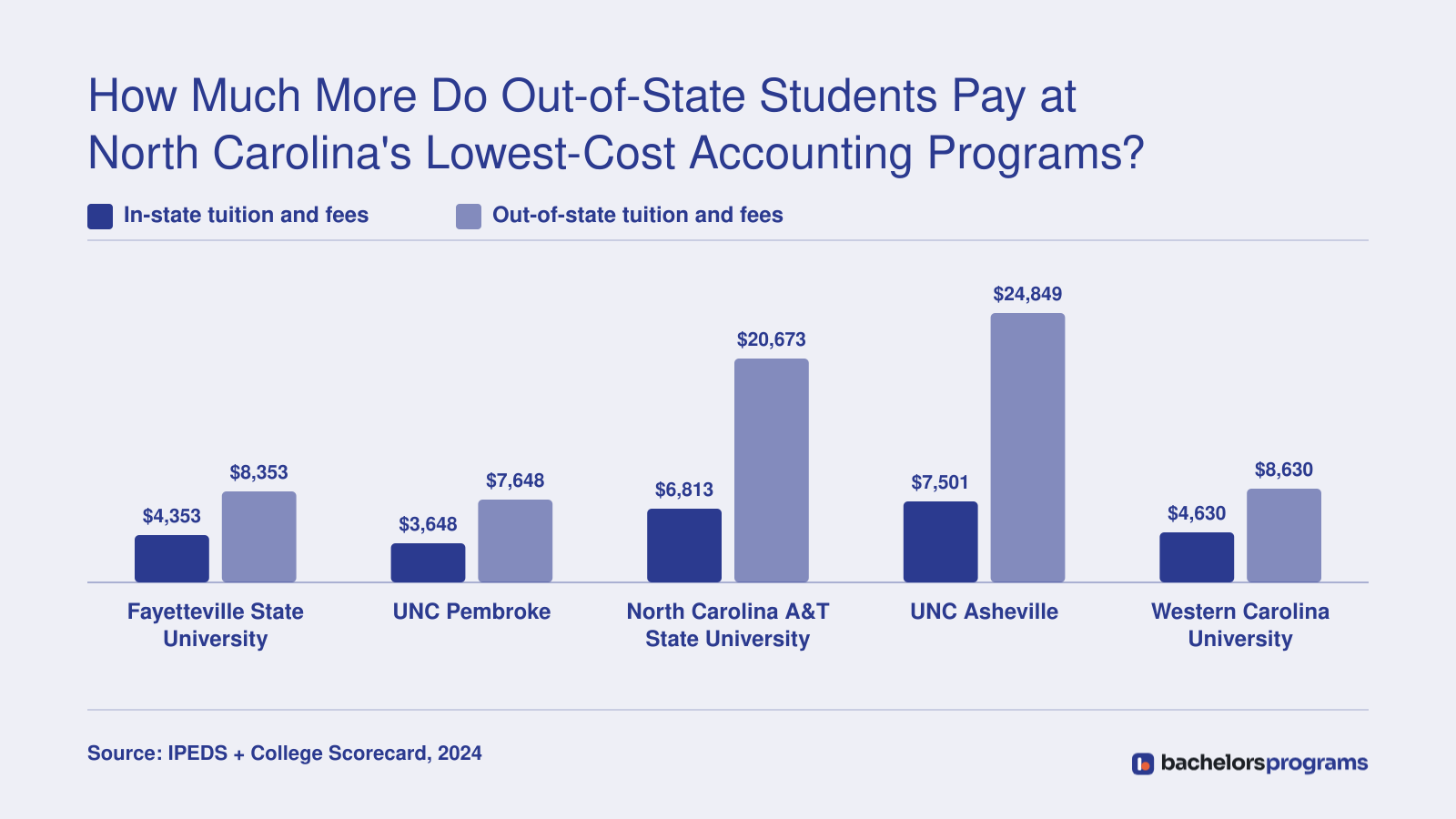
At the lowest-cost campuses, annual in-state tuition and fees range from $3,648 at UNC Pembroke to $4,630 at Western Carolina, with Fayetteville State at $4,353. Out-of-state students at those same schools pay $7,648 to $8,630. At larger public universities the spread grows: North Carolina A&T charges $6,813 in state versus $20,673 out of state, and East Carolina charges $7,361 versus $23,638.
Average net price after grants can run higher than tuition because it also counts housing, books and living costs. Fayetteville State's average net price is $7,892, Western Carolina's is $13,315 and UNC Charlotte's is $15,435. Budget from net price, not tuition alone.
North Carolina Aid That Lowers the Bill
- NC Promise: Elizabeth City State, Fayetteville State, UNC Pembroke and Western Carolina take part in this UNC System program.2 Resident undergraduates pay $500 per semester in tuition, and nonresidents entering in 2026 pay $3,500 per semester.1 Part-time students pay a prorated rate by credit hour.2 These are tuition rates only. Fees, housing and books cost extra.2
- NC Need-Based Scholarship: This is the state's main need-based grant for North Carolina students. Award amounts and eligibility rules are set each year, so confirm current figures with your school's financial aid office. Filing the FAFSA is the standard first step for any need-based aid.
- Campus scholarships: UNC Pembroke and UNC Asheville both advertise scholarships open to accounting students.
Ways to Cut Your Total Cost
- Start at a community college: Earn an approved Associate in Arts or Associate in Science and follow the Transfer Guide for accounting at your target UNC school. Under the Comprehensive Articulation Agreement (revised Spring 2026), you can transfer at the junior level with general education requirements satisfied.3 Courses need a C- or better, and admission to a specific campus or business major is not guaranteed.3
- Choose an NC Promise campus: Resident tuition of $1,000 a year is the lowest rate available at any public accounting program in the state.
- Keep in-state status: Out-of-state tuition can triple your bill at larger public universities.
How Much More Do Out-of-State Students Pay at North Carolina's Lowest-Cost Accounting Programs?
At the public universities with the lowest-cost bachelor's in accounting programs, residency changes the bill. Fayetteville State, UNC Pembroke and Western Carolina add about $4,000 a year for nonresidents, while North Carolina A&T and UNC Asheville roughly triple their in-state rate. Private colleges generally charge one tuition price regardless of residency, so the in-state advantage applies mainly at public schools.
Related Articles
North Carolina CPA Licensure at a Glance
Accounting Careers and the CPA Path in North Carolina
Becoming a CPA in North Carolina starts with a bachelor's degree in accounting, but the license takes more than graduation. The North Carolina State Board of CPA Examiners requires candidates to be at least 18, complete an accounting concentration, pass the Uniform CPA Examination with at least 75 on each section, and document supervised experience before applying.
How Do I Become a CPA in North Carolina?
The route has four main steps. First, earn a bachelor's degree with an accounting concentration, including at least 24 semester hours of accounting coursework and courses in at least 8 of the Board's 10 fields of study. Second, reach 150 semester hours under the 150-plus-one-year pathway. Many bachelor's degrees fall short of 150 credits, so students add undergraduate accounting or business courses, a second major or minor, or summer terms. Undergraduate coursework alone can supply them; a master's degree is not required.
Third, pass the Uniform CPA Examination with a score of at least 75 on each section. Fourth, complete one year of full-time experience under an active CPA, defined as at least 30 hours per week for 52 weeks. The Board's bachelor's-plus-two-years pathway trades the extra credits for a second year of supervised experience. Alternatives include four years of accounting experience without CPA supervision or four years of qualifying college teaching. Applicants also complete the NCACPA accountancy law course. The Board does not impose a rigid order on education, exam, and experience, but all requirements, including experience, must be finished before you apply.
Where Accounting Graduates Work in North Carolina
Graduates commonly take audit or tax roles at public accounting firms, join corporate accounting and finance departments, or move into banking and financial services in Charlotte. Raleigh and the Triangle add corporate, technology, and professional-services employers. Nationally, the Bureau of Labor Statistics projects accountant and auditor employment to grow 5% from 2025 to 2035, faster than average.
What Accountants and Auditors Earn in North Carolina
Charlotte pays accountants well above the national median of $83,680, and the metro employs about 16,820 accountants and auditors.
Compare Accounting programs on the data that matters
Explore more Business & Management majors or browse every field of study.
All Business & Management programs Browse every field of study