Best Computer Science Schools in North Carolina
Compare 44 accredited Computer Science programs in North Carolina at 26 colleges, with net price after aid, graduation rates, earnings and debt from IPEDS and the U.S. College Scorecard.

North Carolina's tech employment concentrates in two places: the Research Triangle, where UNC Chapel Hill, NC State and Duke sit within a short drive of one another, and Charlotte's banking corridor. That split shapes the decision. A bachelor's degree in computer science from a Triangle research university carries recruiting weight a regional public cannot match, while in-state tuition at a public campus runs a fraction of Duke's sticker price.
Depending on the campus, the degree is awarded as a Bachelor of Science (B.S.) or a Bachelor of Arts (B.A.) in Computer Science. ABET status, admissions gates and net price move enough between campuses to change the math.
Key Points
- In-state tuition stays under $9,000 at UNC Chapel Hill and NC State.
- High Point gained ABET accreditation in 2025, UNC Pembroke in 2026.
- UNC Chapel Hill admits CS majors only after students complete COMP 210.
Top 10 Schools for a Bachelor's Degree in Computer Science in North Carolina
North Carolina's strongest computer science programs cluster in three metros: the Research Triangle, Charlotte and the Triad, with a few strong regional publics filling out the rest of the state. Every school below awards a Bachelor of Science or Bachelor of Arts in Computer Science, and several offer formal concentrations in artificial intelligence, cybersecurity or game development. Each entry focuses on what the school is actually known for, not just its overall reputation.
University of North Carolina at Chapel Hill
#1Chapel Hill, NC · ~$12,000/yr (est.)
Best for: Research-minded students near Research Triangle
UNC Chapel Hill is the state's flagship campus, and its computer science department sits minutes from Research Triangle Park employers in Chapel Hill. The major runs 62 credit hours and admits students competitively after they finish COMP 210, so most declare in their second year. Faculty take part in national AI collaborations, including the NSF AI Institute for Engaged Learning shared with NC State, which gives undergraduates a route into active research labs.
- 62 credit hour major with core data structures and algorithms coursework
- Admission to the major after completing COMP 210
- Minimum 2.000 GPA and 45 credit hours completed at UNC
- Combined B.S. to M.S. degree option for eligible students
- Research, internship, study abroad and honors opportunities
North Carolina State University at Raleigh
#2Raleigh, NC · $9,000 – $33,000/yr (est.)
Best for: Engineering students wanting industry capstone projects
NC State runs one of the largest engineering-centered computer science departments in the state from its Centennial Campus in Raleigh. The B.S. requires 121 credits and admits students through the CODA process after the engineering first-year curriculum, with formal concentrations in artificial intelligence, cybersecurity and game development. Industry-sponsored Senior Design projects and a College of Engineering AppliedAI initiative give students early exposure to applied work.
- ABET accredited by the Computing Accreditation Commission
- 121 credit hours, including 12 credits of CSC restricted electives
- Admission through the CODA change-of-degree application after the first year
- Semester-long, industry-sponsored Senior Design capstone
- Undergraduate starting salaries average over $86,000
- 21 credit hours of cybersecurity-focused coursework
- Cybersecurity Scholarship for Service available to eligible students
- Dedicated concentration capstone project
- Track graduates report average starting salaries above $75,000
- Electives in artificial intelligence, data science and social computing
- Prepares students for AI-focused graduate research
- Pairs with the department's applied AI coursework for underclassmen
- Coursework in game design, graphics and interactive systems
- Industry-sponsored senior project in a team setting
- Formal concentration listed on the official transcript
Duke University
#3Durham, NC · ~$30,000/yr (est.)
Best for: High-achieving students pursuing AI research
Duke is a private research university in Durham that enrolls a small, highly selective undergraduate class. The B.S. in Computer Science offers concentrations in software systems, data science, and AI and machine learning, and a new Mathematics for Artificial Intelligence course arrives in 2026. With a 5-to-1 student-faculty ratio, undergraduates regularly join faculty labs or use the 4+1 pathway into graduate study.
- Tracks: Software Systems, Data Science, AI and Machine Learning
- Core coursework in algorithms, data structures, operating systems and databases
- New Mathematics for Artificial Intelligence course launching in 2026
- 4+1 program and graduation with distinction available
- Research and independent study with faculty
University of North Carolina at Charlotte
#4Charlotte, NC · $15,000 – $20,000/yr (est.)
UNC Charlotte sits in the state's largest banking and technology job market and graduates several hundred computer science majors each year. The B.S. in Computer Science with a Cybersecurity concentration pairs a common CS core with security coursework and requires 15 elective credits outside the department's own course prefixes. Co-op semesters, the CCI Honors Program and a defined transfer pathway make it a practical choice for community college graduates.
- Cybersecurity concentration within the B.S. in Computer Science
- Transfer and current students need a 2.5 GPA and a C or better in prior CS courses
- 15 elective credits must carry a prefix outside ITSC, ITCS and ITIS
- Progression requires a 2.0 GPA and no more than three attempts per major course
- Co-op semesters, 49ership and internship programs available
- CCI Honors Program available to eligible majors
Davidson College
#5Davidson, NC · ~$17,000/yr (est.)
Davidson is a small liberal arts college north of Charlotte where the computer science major is deliberately compact: 10 courses, four of them core requirements. Students take discrete structures, data structures, computer organization and analysis of algorithms, then choose electives across systems, applications and theory. The scale suits students who want close faculty contact and a broad liberal arts base alongside technical depth.
- 10 courses: four core, five electives and one mathematics course
- Core includes Discrete Structures, Data Structures, Computer Organization and Algorithms
- Electives span machine learning, operating systems, graphics and cryptology
- Honors program and a computer science minor available
Appalachian State University
#6Boone, NC · $8,000 – $25,000/yr (est.)
Appalachian State is a public university in Boone with an ABET-accredited B.S. in Computer Science and a strong reputation across western North Carolina. The curriculum covers programming, algorithms and software development on top of a full general education core. The department publishes eight-semester plans, runs tutoring and student clubs, and the university holds an institutional transfer agreement with McDowell Technical Community College.
- ABET accredited by the Computing Accreditation Commission
- Curriculum covers programming, algorithms and software development
- Published eight-semester sample plan of study for majors
- Internships, scholarships and student computing clubs available
- Housed in Anne Belk Hall on the Boone campus
Wake Forest University
#7Winston-Salem, NC · $25,000 – $30,000/yr (est.)
Wake Forest is a private university in Winston-Salem that awards computer science as both a Bachelor of Arts and a Bachelor of Science. Beginners can start with CSC 111 and 112, and the major asks for a 2.0 GPA in major courses rather than prior programming experience. Electives reach into AI, security, graphics, databases and software engineering, and transfer credit is accepted only in limited cases.
- Offered as both a Bachelor of Arts and a Bachelor of Science
- 2.0 GPA required in major courses to graduate
- No prior programming experience required; CSC 111 and 112 start beginners
- Transfer credit accepted only in limited cases
- Electives in AI, security, graphics, databases and software engineering
University of North Carolina Wilmington
#8Wilmington, NC · $7,000 – $24,000/yr (est.)
UNC Wilmington offers a B.S. in Computer Science along two routes: an ABET-accredited Systems option and an Applied option that adds an 18-credit concentration. Concentrations range from artificial intelligence and security to digital arts and software engineering, and several of them also earn a minor. Core plus concentration totals 73 to 78 credit hours, and students must hold a 2.00 GPA across major courses.
- Two options: Systems (ABET accredited) and Applied
- Applied option adds an 18-credit application concentration
- Concentrations include AI, Digital Arts, Security and Software Engineering
- Core plus concentration totals 73 to 78 credit hours
- 2.00 GPA required across major courses, including CSC courses
- Several concentrations also earn a minor
East Carolina University
#9Greenville, NC · ~$16,000/yr (est.)
East Carolina University in Greenville offers an ABET-accredited B.S. in Computer Science through its College of Engineering and Technology. The curriculum builds a mathematics and science foundation alongside software development, teamwork and professional ethics. Freshmen need eligibility for MATH 1065, while transfer students and those changing majors need a 2.5 GPA.
- ABET-accredited Bachelor of Science program
- Freshmen need eligibility for MATH 1065 and MATH 2121 or 2171
- Change-of-major, transfer and second-degree students need a 2.5 GPA
- Strong mathematics and science foundation alongside software development
- Prepares students for professional employment or graduate study
Western Carolina University
#10Cullowhee, NC · ~$13,000/yr (est.)
Western Carolina University in Cullowhee offers an ABET-accredited B.S. in Computer Science that bundles a mathematics minor and an optional cybersecurity minor. Students can add a Data Science concentration and follow published eight-semester plans with transfer-friendly advisement worksheets. Graduates move into software development, systems administration, database administration and analyst roles.
- Includes a mathematics minor as part of the degree
- Data Science concentration available; cybersecurity minor is optional
- ABET-accredited program with defined student outcomes
- Prepares graduates for software development, systems and database roles
- Eight-semester plans and transfer student resources published
Cost & outcomes by school
Federal data for the highest-earning Computer Science programs, independent of the ranking above. Earnings are this field's bachelor's graduates four years after completing where the Scorecard reports them, else the school's undergraduate median.
| School | Net price / yr | Grad rate | Earnings | Debt | Grads/yr | Format |
|---|---|---|---|---|---|---|
| Duke University NC | $29,612 | 97% | $195,809 | $13,500 | 393 | Campus |
| University of North Carolina at Chapel Hill NC | $11,655 | 91% | $137,047 | $13,500 | 430 | Campus |
| Wake Forest University NC | $28,719 | 89% | $115,493 | $20,549 | 59 | Campus |
| North Carolina State University at Raleigh NC | $17,303 | 85% | $113,478 | $20,500 | 386 | Campus |
| North Carolina A & T State University NC | $10,846 | 57% | $105,342 | $25,750 | 78 | Campus |
| East Carolina University NC | $15,739 | 63% | $98,406 | $24,750 | 85 | Campus |
| Appalachian State University NC | $16,836 | 75% | $97,670 | $22,500 | 111 | Campus |
| Winston-Salem State University NC | $13,479 | 47% | $94,298 | $30,721 | 7 | Hybrid |
| University of North Carolina at Charlotte NC | $15,435 | 69% | $93,037 | $21,504 | 841 | Campus |
| University of North Carolina Wilmington NC | $20,109 | 71% | $88,219 | $23,980 | 102 | Campus |
| Western Carolina University NC | $13,315 | 60% | $86,853 | $27,000 | 32 | Campus |
| University of North Carolina at Greensboro NC | $10,965 | 56% | $86,372 | $24,403 | 124 | Campus |
Sources: U.S. Department of Education. Net price, graduation rate, earnings and debt: College Scorecard (earnings and debt for this field's bachelor's graduates where reported, else school-wide); graduates: IPEDS. A dash means no figure is reported.
Cost, debt & payoff
Median earnings of this field's bachelor's graduates (4 yrs after completing, else the school's undergraduate median) vs. their median federal loan debt · U.S. College Scorecard
Across these programs the median graduate earns about $86,853 and finishes with roughly $24,235 in debt — a ratio that clears a common rule of thumb (keep debt below first-year salary). Net price and debt vary widely school to school, so check the per-school figures in the table above before you shortlist.
Most Affordable Computer Science Bachelor's Programs in North Carolina
These public universities in our directory offer a bachelor's degree in computer science at the lowest average net price, according to 2024 IPEDS and College Scorecard data from the U.S. Department of Education, and they are listed from lowest to highest net price. Elizabeth City State University has the lowest average net price after aid at $6,364, while the University of North Carolina at Pembroke charges the lowest in-state tuition and fees at $3,648. Compare net price with graduation rate: North Carolina A & T State University and the University of North Carolina at Greensboro cost a few hundred dollars more per year but report graduation rates above 56 percent.
| School | City | In-State Tuition and Fees | Out-of-State Tuition and Fees | Average Net Price | Graduation Rate |
|---|---|---|---|---|---|
| Elizabeth City State University | Elizabeth City | $6,536 | $10,536 | $6,364 | 43.5% |
| Fayetteville State University | Fayetteville | $4,353 | $8,353 | $7,892 | 38.5% |
| University of North Carolina at Pembroke | Pembroke | $3,648 | $7,648 | $10,260 | 43.5% |
| North Carolina A & T State University | Greensboro | $6,813 | $20,673 | $10,846 | 57.2% |
| University of North Carolina at Greensboro | Greensboro | $7,661 | $24,012 | $10,965 | 56.3% |
Related Articles
B.S. vs. B.A. in Computer Science and Why ABET Accreditation Matters
Two North Carolina programs have added ABET accreditation recently: High Point University announced its in October 2025,1 and UNC Pembroke's coverage begins October 2, 2026.
B.S. or B.A.
A Bachelor of Science is the more technical route. Expect heavier math and science, deeper coursework in algorithms and systems, and a structure aimed at software engineering, research, or graduate study. A Bachelor of Arts is built for flexibility. It leaves room to pair computing with another field, such as business, design, or the sciences. UNC Charlotte offers both: its B.S. has six concentrations and its B.A. has three, with the B.A. structured to combine with other programs. Wake Forest, Elon, and Meredith also offer both degrees.
What ABET Accreditation Signals
ABET's Computing Accreditation Commission reviews whether a program meets professional standards for curriculum and outcomes. Employers often treat it as a quality marker, it can matter for government and defense-adjacent roles, and graduate programs look at it when reviewing applicants.
The research confirms ABET-accredited B.S. programs at NC State, NC A&T, UNC Greensboro2, UNC Pembroke, and High Point University. Program pages at Appalachian State, UNC Wilmington, East Carolina, and Western Carolina also describe their B.S. degrees as ABET accredited. UNC Charlotte's ABET status for either degree was not established in the sources reviewed, so confirm it with the department. No B.A. in computer science was confirmed as ABET accredited.
No State License Required
North Carolina does not license computer science graduates, so no board exam stands between you and a job. That puts the weight on accreditation, your portfolio, internships, and demonstrated skills.
NC State vs. UNC Chapel Hill vs. UNC Charlotte: Which Is Better for Computer Science?
All three are reasonable picks; the right one depends on whether you want a large engineering pipeline, a selective public flagship, or a metro campus plugged into Charlotte's banking and finance technology sector.
The numbers side by side
- UNC Chapel Hill: admits roughly 15% of applicants, graduates about 91% within six years, and carries an in-state net price near $11,655 after aid. Median earnings a decade after students first enrolled sit around $72,200.
- NC State: admits about 42%, graduates about 85%, and lands near $17,303 in-state net price. Median earnings a decade out are roughly $68,758, and the program reports starting salaries for its undergraduates averaging over $86,000.
- UNC Charlotte: admits about 80%, graduates about 69%, and comes in near $15,435 in-state net price, with median earnings a decade out around $57,289.
Who should pick which
NC State fits students who want a large, ABET-accredited engineering college with heavy industry recruiting and senior design work sponsored by employers. UNC Chapel Hill rewards strong applicants who want the most selective public option and the highest graduation rate of the three. UNC Charlotte is the practical pick for students who value access, co-op semesters with full-time work, and proximity to Charlotte employers, at the cost of a lower completion rate.
Pick NC State for the engineering pipeline, UNC Chapel Hill for selectivity and prestige, and UNC Charlotte for access plus a Charlotte tech market.
Questions to Ask Yourself
Do you want direct admission to computer science, or are you comfortable applying to the major later?
Would you rather pay in-state public prices or weigh a private school's net price after aid?
Is an ABET-accredited B.S. important for the roles you want, or does a B.A. paired with another field fit better?
Admissions for a Bachelor's in Computer Science: GPA, Test Policy, and Transfer Credit
Direct Admit or Secondary Application?
The materials we reviewed show that UNC Chapel Hill does not admit freshmen directly into computer science. Students apply to the department each semester after finishing COMP 210 and one of COMP 283, MATH 381 or STOR 315, with at least a C in COMP 210 and the discrete-math course. The Fall 2026 and Spring 2027 cycle opened October 5, 2026, with a December 2, 2026 request deadline.
NC State routes admission to its computer science major through its CODA application process. UNC Charlotte requires a 2.5 GPA for the major, plus a Change of Major Workshop. East Carolina University lists a 2.5 GPA for change-of-major and transfer applicants. Wake Forest lists a 2.0 GPA requirement. For Duke and Davidson, we found no CS-specific admission gate, so confirm with each department.
Test Policy and GPA
UNC Chapel Hill waives the SAT or ACT for applicants with a weighted GPA of 2.8 or higher for 2026-2027.1 Below that, applicants need an ACT of 17 or an SAT of 930.1 We found no published typical freshman GPA for the CS major at UNC Chapel Hill, and no test policy or CS-specific freshman GPA for NC State or UNC Charlotte. Check their admissions pages directly.
What Is UNC Chapel Hill's Computer Science Acceptance Rate?
The university-wide admit rate is about 15 percent. That figure describes admission to the university, not to the major. The department runs its own application after prerequisites, and we found no published CS acceptance rate. Treat the major as competitive and plan a backup.
Transfer Pathways
NC State asks for at least 24 transferable college credits, including required coursework and a competitive GPA for the major. UNC Charlotte also asks for 24 transferable credits, a 2.5 GPA for computer science, and a 2.0 cumulative minimum.2 UNC Chapel Hill transfers may skip testing at a weighted 2.8 GPA, but CS courses usually need department re-evaluation using syllabi, and community college credit is not guaranteed to count. Meeting requirements never guarantees admission. Before enrolling at a community college, ask a university advisor which courses will count toward the CS major.
Questions to Ask Yourself
Will you qualify for North Carolina in-state tuition, and how much does that change your sticker price?
Do you have a North Carolina need-based grant or scholarship you could stack with institutional aid?
Does a program's graduate debt and earnings fit the loan amount you are willing to take on?
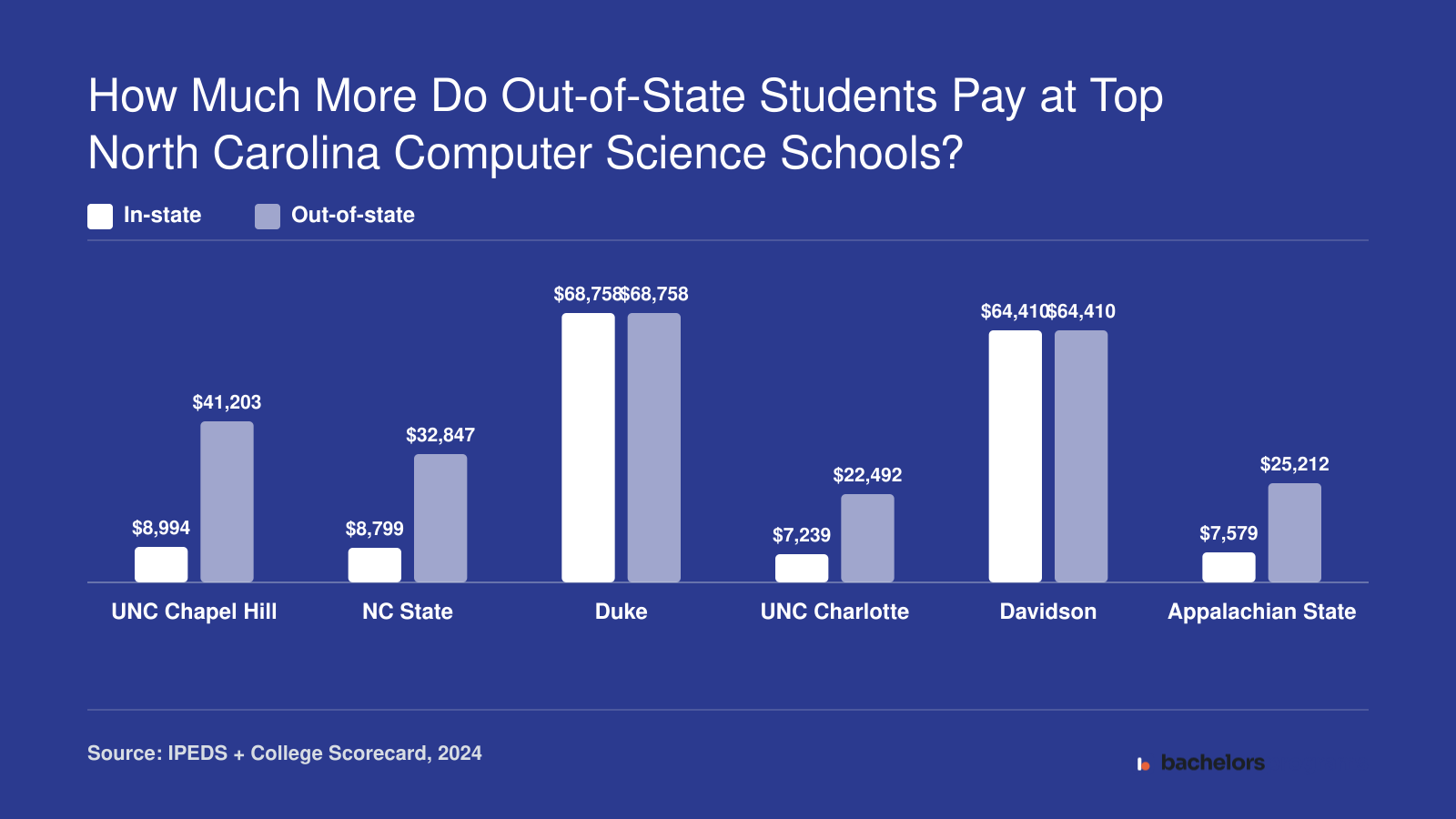
How Much More Do Out-of-State Students Pay at Top North Carolina Computer Science Schools?
At UNC Chapel Hill, NC State, UNC Charlotte and Appalachian State, North Carolina residents pay under $9,000 a year in tuition and fees, while out-of-state students pay roughly three to four and a half times as much. Duke and Davidson are private, so every student sees the same sticker price, above $64,000. Net price after aid is far lower than these published figures: $11,655 at UNC Chapel Hill, $17,303 at NC State and $29,612 at Duke.
Common Questions About Computer Science Schools in North Carolina
These answers draw on the rankings, tuition figures and admissions data used elsewhere on this page. Where the underlying data is unclear, we say so instead of guessing.
What is the best college for computer science in North Carolina?
What are the cheapest computer science colleges in North Carolina?
What is the acceptance rate for UNC Chapel Hill computer science?
Is an ABET-accredited computer science degree necessary to get a tech job?
Compare Computer Science programs on the data that matters
Explore more Computers & IT majors or browse every field of study.
All Computers & IT programs Browse every field of study