Best Business Degree Programs in North Carolina
Compare 110 accredited Business programs in North Carolina at 50 colleges, with net price after aid, graduation rates, earnings and debt from IPEDS and the U.S. College Scorecard.

A flagship business school and a regional campus can both hand you a bachelor's in business administration, but the admit rate, the price, and the delivery format are very different. North Carolina offers the full spread: large public universities, private colleges, and online programs at NC-based schools.
Every program here is a bachelor's degree, and outcome figures such as earnings and net price come from College Scorecard. Charlotte and Raleigh anchor the job market, so where you study often shapes where you land your first role.
Key Points
- UNC Chapel Hill admits roughly 15 percent of applicants.
- AACSB accredits the business school itself, separate from SACSCOC's institution-wide review.
- Charlotte outpays Raleigh in business roles, especially for accountants.
Best Business Bachelor's Programs in North Carolina, Ranked for 2027
Ten North Carolina business schools, from a 15 percent admit rate in Chapel Hill to regional campuses that admit most applicants and a fully online option in Charlotte. Each entry below is about what a student actually gets: a degree path that finishes on schedule and leaves room to take a first job without carrying heavy debt.
University of North Carolina at Chapel Hill
#1Chapel Hill, NC · ~$12,000/yr (est.)
Best for: High-achieving students eyeing elite finance recruiting
Kenan-Flagler admits students into the business major after prerequisite coursework, so the degree pairs a liberal arts base with a 27-credit business core and room for areas of emphasis. School-wide, 91 percent of students graduate within six years and about 15 percent of applicants are admitted, the most selective profile in this group. Qualified high school seniors can lock in assured enrollment before they arrive, and business majors pay an additional $1,000 per semester in fees on top of standard tuition.
- Bachelor of Science in Business Administration at Kenan-Flagler
- 27 credit hours of core business courses plus electives
- 120 credit hours to graduate, including at least 45 in residence at UNC
- Program admission required; minimum 2.000 GPA
- Median earnings four years after completion: $135,874
- Median debt among program graduates who borrowed: $14,339
North Carolina State University at Raleigh
#2Raleigh, NC · $9,000 – $33,000/yr (est.)
Best for: Supply chain and operations focused students
Poole College of Management builds the business administration degree around core functions, then lets students add a concentration in finance or operations and supply chain management. Coursework leans on project work and internships with industry partners, and the university graduates 85 percent of its students within six years with an admit rate near 42 percent. It is the largest program in the top three by volume, conferring more than 800 business administration bachelor's degrees.
- Bachelor of Science in Business Administration through Poole College of Management
- Tracks: Finance; Operations and Supply Chain Management
- Core coursework in finance, marketing, operations, and analytics
- Project-oriented courses and internships with industry partners
- Median earnings four years after completion: $84,349
- Median debt among program graduates who borrowed: $20,000
Appalachian State University
#3Boone, NC · $8,000 – $25,000/yr (est.)
Best for: Cost-conscious students seeking an in-state public option
Walker College of Business offers a BSBA with ten concentration options and an in-state price low enough to make it the cheapest public route to an AACSB-accredited business degree in this group. School-wide, about 75 percent of students finish within six years, and roughly 90 percent of applicants are admitted. The college also runs a management track for students who cannot relocate to Boone.
- Bachelor of Science in Business Administration with 10 concentration options
- 18-hour lower-level core plus a 19-hour upper-level core and capstone
- 27 to 39 semester hours of major requirements; no minor required
- Declaration requires 45 hours and a 2.6 cumulative GPA
- Median earnings four years after completion: $64,932
- Median debt among program graduates who borrowed: $21,497
- Management track with a general business concentration
- Coursework in leadership, interpersonal skills, business tools, and ethics
- Prepares students for supervisory and management roles
- Transfer credits accepted; accelerated master's option available
- Human resources concentration inside the management track
- Specialized HR courses on top of the core business curriculum
- Honors option requires a 3.4 GPA and a sophomore year application
- Innovation and entrepreneurship concentration inside the management track
- Concentration pairs management courses with entrepreneurship center resources
- Emphasis on sustainable business practices and hands-on projects
University of North Carolina at Charlotte
#4Charlotte, NC · $15,000 – $20,000/yr (est.)
Belk College of Business runs its business administration bachelor's entirely online, aimed at working professionals and transfer students who arrive with junior standing already in hand. Students can finish the 45-credit major in about two years, and the college has added a School of Entrepreneurship and Innovation with an undergraduate entrepreneurship certificate. School-wide, 69 percent of students graduate within six years and about 80 percent of applicants are admitted.
- Bachelor of Science in Business Administration delivered fully online
- 45-credit major; transfer students can finish in about two years
- Requires junior standing (60 credits) and a 2.7 GPA
- Undergraduate entrepreneurship certificate through the School of Entrepreneurship and Innovation
- Median earnings four years after completion: $70,654
- Median debt among program graduates who borrowed: $22,285
University of North Carolina Wilmington
#5Wilmington, NC · $7,000 – $24,000/yr (est.)
Cameron School of Business gives students a common business core and then more than 15 concentrations, so the degree can bend toward accounting, finance, marketing, or supply chain work. The school pairs that flexibility with a mentorship network and global study options, and its school-wide graduation rate sits near 71 percent with an admit rate around 64 percent. It is also among the larger programs here, conferring well over 600 business administration bachelor's degrees.
- More than 15 concentrations after a common business core
- Cameron School of Business is AACSB accredited
- Core spans accounting, finance, marketing, management, analytics, and law
- CEN mentorship network and global study options
- Median earnings four years after completion: $75,512
- Median debt among program graduates who borrowed: $21,500
East Carolina University
#6Greenville, NC · ~$16,000/yr (est.)
The College of Business awards an AACSB International accredited BSBA with six concentrations spanning accounting, finance, management information systems, marketing, and supply chain management. Students declare after 45 semester hours and eight prerequisite courses, and the college supports them with a Bureau of Business Research and a small business resource center. Work-integrated learning is a real selling point: students can earn academic credit while working with startups and corporations.
- Six concentrations including accounting, finance, MIS, marketing, and supply chain
- BSBA and BS in entrepreneurship hold AACSB International accreditation
- Declaration needs 45 semester hours and a 2.5 GPA with C- or better in eight courses
- Students can earn academic credit working with startups and corporations
- Median earnings four years after completion: $64,723
- Median debt among program graduates who borrowed: $22,750
Elon University
#7Elon, NC · ~$42,000/yr (est.)
Love School of Business teaches a small-class, experience-heavy BSBA where internships, case competitions, and faculty-guided projects are built into the degree. The school is AACSB accredited and offers accelerated 3+1 dual degree options, study abroad, and domestic Study USA terms. School-wide, 84 percent of students graduate within six years and about two thirds of applicants are admitted, at a private price with scholarships available.
- Bachelor of Science in Business Administration at the Love School of Business
- AACSB accredited, with small classes and faculty mentorship
- Tracks: Business Analytics, Entrepreneurship and Innovation
- Internships, case competitions, and faculty-guided projects built into the degree
- Accelerated 3+1 dual degree options plus study abroad and Study USA
- Business Fellows selective cohort and Porter Center career coaching
University of North Carolina at Greensboro
#8Greensboro, NC · $11,000/yr (est. net price)
Bryan School of Business and Economics runs the business administration major in both campus and online formats, with seven-week online terms that suit students balancing a job. School-wide, 56 percent of students graduate within six years and roughly 89 percent of applicants are admitted, so the program is one of the more accessible routes to an AACSB-accredited business degree in the state. It also offers an accelerated master's pathway for students who want to keep going.
- Bachelor of Science in Business Administration, minimum 120 credit hours
- Common business core plus 18 to 21 hours in the major
- Tracks: Human Resources
- AACSB accredited business school
- Median earnings four years after completion: $56,225
- Median debt among program graduates who borrowed: $25,000
- Business studies concentration with a customizable course plan
- Seven-week course format with experiential learning and internships
- Partnerships with major companies and international exchange options
- Management concentration taught on campus
- Leadership, organizational behavior, and cross-cultural management courses
- Internship placements with corporate partners such as Bank of America
North Carolina A & T State University
#9Greensboro, NC · ~$11,000/yr (est.)
The Willie A. Deese College of Business and Economics houses a BS in Management with a business administration focus, built on accounting, finance, marketing, and organizational behavior coursework. As an HBCU with an admit rate near 50 percent, it is the most selective of the smaller public options in this group, and 57 percent of students graduate within six years school-wide. Graduates move into general management, human resources, operations, government, and nonprofit roles.
- BS in Management with a business administration focus
- Coursework in accounting, finance, marketing, operations, and organizational behavior
- Department of Management sits in the Willie A. Deese College of Business and Economics
- Median earnings four years after completion: $60,863
- Median debt among program graduates who borrowed: $29,425
Meredith College
#10Raleigh, NC · ~$22,000/yr (est.)
Meredith is a private women's college in Raleigh whose business administration degree requires 57 to 60 credit hours and a mandatory internship, with small classes and an AACSB-accredited curriculum. Students can add accounting, human resource management, or marketing concentrations, join the Broyhill Business Fellows Program, or stay an extra year for an accelerated MBA. School-wide, 70 percent of students graduate within six years and about 74 percent of applicants are admitted.
- 57 to 60 credit hours with a required internship
- Tracks: Accounting, Human Resource Management, Marketing
- AACSB accredited; small classes and a liberal arts foundation
- Broyhill Business Fellows Program for leadership development
- 4+1 accelerated MBA option
- Median earnings five years after completion: $56,889
- Median debt among program graduates who borrowed: $23,500
Cost & outcomes by school
Federal data for the highest-earning Business programs, independent of the ranking above. Earnings are this field's bachelor's graduates four years after completing where the Scorecard reports them, else the school's undergraduate median.
| School | Net price / yr | Grad rate | Earnings | Debt | Grads/yr | Format |
|---|---|---|---|---|---|---|
| Wake Forest University NC | $28,719 | 89% | $78,158 | $21,500 | 3,090 | Campus |
| Elon University NC | $41,555 | 84% | $74,545 | $20,500 | 3,416 | Campus |
| University of North Carolina at Chapel Hill NC | $11,655 | 91% | $72,200 | $14,000 | 14,766 | Campus |
| North Carolina State University at Raleigh NC | $17,303 | 85% | $68,758 | $20,121 | 13,534 | Campus |
| High Point University NC | $38,707 | 74% | $61,389 | $24,575 | 2,276 | Campus |
| Queens University of Charlotte NC | $30,857 | 61% | $57,673 | $25,000 | 604 | Campus |
| University of North Carolina at Charlotte NC | $15,435 | 69% | $57,289 | $21,500 | 12,800 | Online |
| East Carolina University NC | $15,739 | 63% | $55,146 | $22,750 | 9,648 | Campus |
| University of North Carolina Wilmington NC | $20,109 | 71% | $54,967 | $19,500 | 7,880 | Campus |
| Campbell University NC | $24,516 | 61% | $54,886 | $22,500 | 1,392 | Campus |
| Wingate University NC | $20,748 | 46% | $52,649 | $25,000 | 1,098 | Campus |
| Appalachian State University NC | $16,836 | 75% | $51,836 | $20,231 | 9,198 | Campus |
Sources: U.S. Department of Education. Net price, graduation rate, earnings and debt: College Scorecard (earnings and debt for this field's bachelor's graduates where reported, else school-wide); graduates: IPEDS. A dash means no figure is reported.
Cost, debt & payoff
Median earnings of this field's bachelor's graduates (4 yrs after completing, else the school's undergraduate median) vs. their median federal loan debt · U.S. College Scorecard
Across these programs the median graduate earns about $46,220 and finishes with roughly $25,000 in debt — a ratio that clears a common rule of thumb (keep debt below first-year salary). Net price and debt vary widely school to school, so check the per-school figures in the table above before you shortlist.
Why AACSB Accreditation Matters When Choosing an NC Business School
AACSB accreditation is a seal on the business school itself, not on the university that houses it. Regional accreditation, from SACSCOC in North Carolina, covers the whole institution and makes federal aid available. AACSB peer reviewers go further, examining a business school's faculty qualifications, curriculum, and how well students actually learn. About 1,100 business schools worldwide hold it, and 194 hold the extra accounting designation.
What It Tells Employers and Grad Schools
A résumé screener or an MBA admissions committee reads AACSB as outside proof the program was vetted by business educators. It carries the most weight in accounting, where separate accreditation (held by NC State, UNC Chapel Hill, UNC Charlotte, and UNC Greensboro) is uncommon.
How to Verify a School
Search the institution by name in the AACSB accredited school directory; each entry reads "Business" or "Business & Accounting." Chapel Hill, NC State, Charlotte, Greensboro, Wilmington, UNC Pembroke, North Carolina Central, Appalachian State, East Carolina, and Fayetteville State appear with business accreditation, though the rest show business accreditation only, with no separate accounting listing. Where a school is absent from the directory, confirm its status with admissions before applying.
Our ranking weighs net price, graduation rate, program-level earnings and debt, and accreditation, using federal completion, earnings, and student-debt data alongside the AACSB directory.
Most Affordable Business Bachelor's Programs in North Carolina
These North Carolina business bachelor's programs carry the lowest average net price after grants and scholarships, sorted from least to most expensive using 2024 IPEDS and College Scorecard data from the U.S. Department of Education. Sticker tuition and net price do not always line up. The University of North Carolina at Pembroke posts the lowest in-state tuition and fees at $3,648, helped by NC Promise, while Elizabeth City State University, also an NC Promise school, has the lowest net price at $6,364. North Carolina A & T State University and the University of North Carolina at Greensboro, both in Greensboro, pair net prices near $11,000 with the highest graduation rates and four-year business graduate earnings in this group.
| School | City | Program | Format | In-State Tuition and Fees | Average Net Price | Graduation Rate | Median Earnings 4 Years After Graduation (Business Bachelor's) |
|---|---|---|---|---|---|---|---|
| Elizabeth City State University | Elizabeth City | Business Administration | Online | $6,536 | $6,364 | 44% | $49,903 |
| Fayetteville State University | Fayetteville | Bachelor of Business Administration | Campus | $4,353 | $7,892 | 38% | $48,094 |
| University of North Carolina at Pembroke | Pembroke | Bachelor of Science in Business Administration | Hybrid | $3,648 | $10,260 | 44% | $55,233 |
| North Carolina A & T State University | Greensboro | BS Management, Business Administration | Campus | $6,813 | $10,846 | 57% | $60,863 |
| University of North Carolina at Greensboro | Greensboro | Business Administration | Online and campus | $7,661 | $10,965 | 56% | $56,225 |
Online, Hybrid, and On-Campus Business Bachelor's Formats at NC Schools
Yes. You can earn a business bachelor's from a North Carolina-based school without coming to campus, though fully online routes are program-specific rather than uniform across every business school.
Fully Online and Hybrid Routes
UNC Charlotte delivers its Bachelor of Science in Business Administration 100% online, with spring, summer, and fall start dates. UNCG splits its BBA by concentration: Business Studies and Human Resources are fully online, while Management stays on campus. ECU offers a business administration degree-completion route that students can pursue online or face-to-face, with concentrations from accounting to supply chain management.
North Carolina Central, UNC Pembroke, Fayetteville State, William Peace, and Gardner-Webb also list online business bachelor's options. Gardner-Webb's completion route requires at least 48 transfer credits, so it suits students arriving with prior college work.
What Changes Online
Online study is not automatically cheaper, and the difference varies by school. UNC Charlotte publishes separate online per-credit rates for residents ($189.48) and nonresidents ($864.73). UNCG lists $235.21 per credit online versus $326.55 on campus. Ask each admissions office whether the online track awards the same degree as the campus version. At UNC Charlotte and UNCG, the online concentrations sit within the same BBA or BSBA framework, but availability by concentration matters.
Related Articles
Getting in: GPA, Test Policies, and Transfer Routes for NC Business Bachelor's Programs
In North Carolina, the community college route is often a more predictable way into a business bachelor's program than competing for a first-year seat at a flagship.
GPA and Test Policy: What Schools Publish
Standards diverge sharply. Appalachian State's BSBA requires a 2.6 GPA, East Carolina's a 2.5, and UNC Charlotte's online BSBA a 2.7 with junior standing. UNC-Chapel Hill publishes no numeric minimum for its Kenan-Flagler entry routes; the reported SAT range of 1350 to 1530 and ACT range of 30 to 34 for admitted students are profiles, not cutoffs. Where a business program publishes no test-required or test-optional statement, confirm directly with admissions before assuming scores are optional.
The CAA Transfer Path
The revised Comprehensive Articulation Agreement, effective Spring 2026, covers the Associate in Arts and Associate in Science. Courses passed with a C- or better transfer, the general education block is waived, and students enter at junior standing. It includes a Transfer Assured Admissions Policy, but that guarantees a seat in the UNC System, not in a competitive business major. Work the business Transfer Guide to line up equivalents.
Credits, Prerequisites, and Odds
Kenan-Flagler's Direct Admit Transfer requires 60 credits and two years at another two- or four-year institution; its prerequisites, including MATH 152 or STOR 113, STOR 155, ECON 101 and BUSI 100, should mostly be finished before the first UNC semester, with BUSI 100 done inside it.1 UNC System policy calls for a preliminary transfer-credit evaluation within 15 business days of admission and official transcripts. Chapel Hill admits roughly 15% of first-year applicants and NC State about 42%; Appalachian State, East Carolina and UNC Greensboro admit close to 90%.
What a Business Bachelor's Really Costs in North Carolina
Published tuition tells you little about what a North Carolina business degree costs, because aid and living expenses pull the real figure away from the sticker price. Treat every number here as approximate. Net price is an average for a school's students, not a quote for you.
Tuition vs. Net Price
At UNC Chapel Hill, in-state tuition and fees run about $8,994, while the average net price after aid is about $11,655. NC State shows roughly $8,799 against $17,303, and Appalachian State about $7,579 against $16,836. Net price covers more than tuition, which is why it can sit above the sticker figure at public schools.
Private schools flip the pattern. North Carolina Wesleyan lists tuition near $35,736, yet its average net price is about $17,432 once institutional aid is applied.
North Carolina Aid
- NC Promise: In-state undergraduates at Elizabeth City State, Fayetteville, UNC Pembroke, and Western Carolina pay $500 per semester. Enrollment is the only eligibility requirement.1 The published sources do not say whether fees or housing are included.
- Next NC Scholarship: In 2025-26, families with income up to $80,000 and a Student Aid Index up to 7,500 qualified for at least $5,000 a year at UNC System campuses. Residents with need must enroll in at least six credit hours,2 and the FAFSA is the only application.
- NC Need-Based Scholarship: This supports residents at private North Carolina colleges, with a Student Aid Index up to 15,000 and no prior bachelor's degree.3 Awards vary until funds run out. In 2025-26, 15,304 students shared more than $95.9 million, so meet each school's priority deadline.3
Debt
Program-level borrowing is modest at the flagships. UNC Chapel Hill business graduates carry median debt near $14,239, or about $151 a month. NC State graduates carry about $19,500, or roughly $207 a month.
Business Careers and Salaries in North Carolina: Charlotte, Raleigh, and Beyond
North Carolina's two largest business job markets grew at different speeds over the past year: Raleigh-Cary faster, Charlotte slower but still carrying an outsized concentration of finance work.
Matching Concentrations to Metros
Charlotte remains the state's banking and finance center. In May 2025 the metro employed 116,030 people in business and financial operations, 8.5% of local jobs against 6.8% nationally, at a mean of $99,630 a year. Accountants and auditors there numbered 16,820, with a location quotient of 1.33 and mean pay of $101,910. Management analysts held 8,000 jobs at a mean of $110,850, and financial and investment analysts averaged $56.35 an hour.
Raleigh and the Triangle lean toward technology, life sciences, and state government. Raleigh-Cary total nonfarm employment reached 783,200 in September 2026, up 2.3% over the year, a faster pace than Charlotte's 1.8% gain on 1,407,000 jobs. Marketing and management tracks feed both markets; accounting and finance tracks point hardest at Charlotte.
Keeping Two Sets of Numbers Apart
Federal program-level earnings figures, which look at graduates one to four years after completion, describe what alumni of a particular business program actually earned. BLS wage data describes pay for a whole occupation across a metro. Read them as separate signals, not as a prediction of your first offer.
Licensure
Most business roles require no license at all. CPA-track accounting is the exception: the North Carolina State Board of CPA Examiners sets the education, exam, and experience requirements, so confirm the current rules before you plan a credit load.
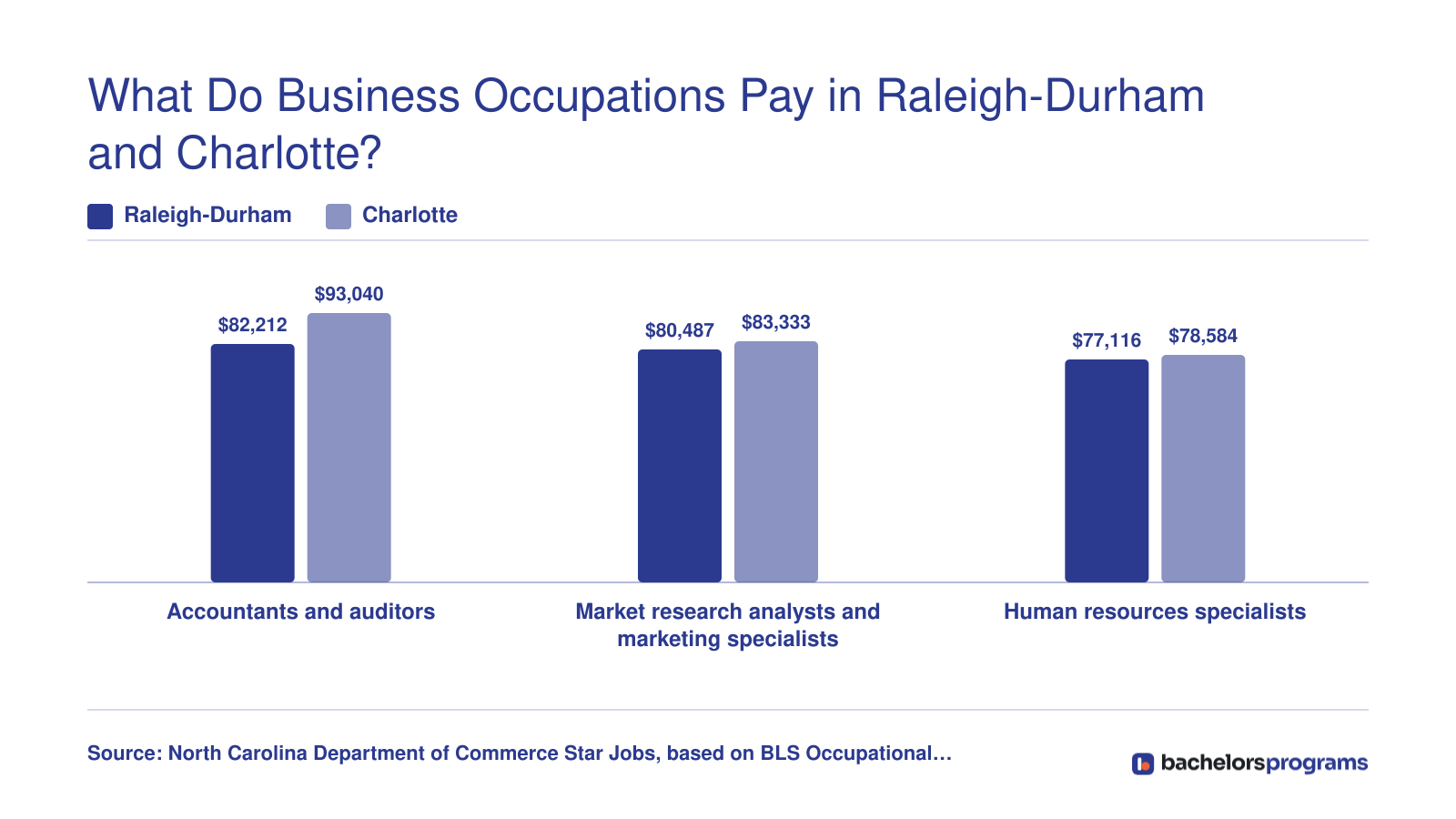
What Do Business Occupations Pay in Raleigh-Durham and Charlotte?
North Carolina wage figures for business roles are reported by region, not as a single statewide median, so the chart compares the state's two largest business hubs. Charlotte pays more in each occupation shown, with the widest gap for accountants and auditors. Management analysts, not charted because no Charlotte figure is reported, earn a median of $100,210 in Raleigh-Durham.
Quick Answers on Studying Business in North Carolina
These short answers pull together the main findings from this page on rankings, cost, formats, licensing, and transfer routes. Figures are the most recent available for 2026, so confirm current numbers with each school before you apply.
What is the best business school in North Carolina?
What is the cheapest business degree program in North Carolina?
Can you earn a business degree online from a school based in North Carolina?
Do you need a license to work in business in North Carolina?
Does starting at a North Carolina community college save money on a business bachelor's?
Compare Business programs on the data that matters
Explore more Business & Management majors or browse every field of study.
All Business & Management programs Browse every field of study