Best Criminal Justice Schools in North Carolina
Compare 30 accredited Criminal Justice programs in North Carolina, with net price after aid, graduation rates, earnings and debt from IPEDS and the U.S. College Scorecard.

Two routes lead into North Carolina law enforcement: Basic Law Enforcement Training with no degree, or a four-year bachelor's degree in criminal justice first. The degree is the usual path into policing, corrections, probation and courts work, and the common credential is the Bachelor of Science (B.S.) in Criminal Justice, though some schools award a B.A. or a differently named major.
The real tension is cost against payoff. Public universities such as Elizabeth City State and Fayetteville State carry lower net prices, while private colleges often offer smaller classes and internship placements. Starting salaries for officers and probation staff rarely differ by school, so what you pay matters as much as where you enroll.
Key Points
- Elizabeth City State's average annual net price is $6,364, the lowest here.
- Appalachian State, UNC Charlotte and Fayetteville State offer online criminal justice degrees.
- North Carolina's Basic Law Enforcement Training doesn't require a bachelor's degree.
Best Bachelor's in Criminal Justice Schools in North Carolina: Our Top 10
North Carolina offers ten strong options for a bachelor's degree in criminal justice, from large public research universities to small private colleges with internship-rich curricula. The schools below range from fully online completion programs to campus-based degrees with crime scene investigation and homeland security tracks. Each entry highlights what that school does best so you can compare fit quickly before digging into cost and admissions.
Appalachian State University
#1Boone, NC · $8,000 – $25,000/yr (est.)
Best for: Working adults wanting a fully online option
Appalachian State runs its Bachelor of Science in Criminal Justice through the Department of Government and Justice Studies, with classes at the Boone and Hickory campuses and a fully online option. Students pair the major with a required minor, and popular choices include chemistry, geography and anthropology. The university holds an R2 research classification and has been named a top five innovation school for nine consecutive years.
- Available at the Boone and Hickory campuses and fully online
- Minor required; popular choices are chemistry, geography and anthropology
- Core includes Theories of Crime and Justice and Criminal Law
- Accelerated bachelor's to master's option begins graduate work early
- R2 research classification and a top five innovation ranking
- Students can join the American Correctional Association
University of North Carolina at Charlotte
#2Charlotte, NC · $15,000 – $20,000/yr (est.)
Best for: Charlotte-area students eyeing crime analytics
UNC Charlotte offers a 120-credit Bachelor of Arts in Criminal Justice with 40 hours in the major, available on campus and online. The department runs an honors program with a thesis, a mediation program and a Pre-Law Society active since 1985. A crime analytics minor and an early entry path to a master's give students room to specialize.
- 120 total credits, 40 of them in the major
- 2.0 GPA required overall and in major courses
- Honors program with a thesis option
- Up to 15 transfer credits for an A.A.S. in a criminal justice discipline
- Internships offered in fall, spring or summer
- Crime Analytics minor and an early entry path to a master's
Western Carolina University
#3Cullowhee, NC · ~$13,000/yr (est.)
Best for: Community college transfers in criminal justice
Western Carolina's Bachelor of Science in Criminal Justice is one of the university's largest majors and can be completed residentially or fully online, full-time or part-time. Undergraduates take part in internships, study abroad and faculty-sponsored research, and present work at state and national conferences. Graduates move into policing, courts, corrections, emergency management, victim services and private security.
- Residential or fully online, full-time or part-time
- Community college Criminal Justice Technology credits may transfer in
- Internships, study abroad and faculty-sponsored research
- Faculty hold MA/MS or PhD degrees
- One of the university's largest majors
- Students present research at state and national conferences
Campbell University
#4Buies Creek, NC · $25,000/yr (est. net price)
Campbell University's Bachelor of Arts in Criminal Justice Administration requires at least 37 hours in the discipline and blends police, courts and corrections with criminology, victimology and policy analysis. Pre-Law, Homeland Security and Law Enforcement tracks let students shape the degree, and internships are required. A Washington semester places students in congressional and federal agency roles.
- At least 37 hours of coursework in the discipline
- Internships required, with sites near the state capital
- Tracks in Pre-Law, Homeland Security and Law Enforcement
- Washington semester as a congressional aide or agency intern
- Coursework in criminology, victimology and policy analysis
North Carolina A & T State University
#5Greensboro, NC · ~$11,000/yr (est.)
North Carolina A&T State University offers the Bachelor of Science in Criminal Justice on campus and fully online, with 34 credit hours of core coursework that include a required internship. The department is the largest major in its college and the only one that runs from bachelor's through doctoral study. A forensic science certificate in crime scene investigation sits inside the degree.
- 120 credits, with 34 in core coursework including an internship
- 2.0 GPA required in the major
- Fully online option for working and post-traditional students
- Forensic Science certificate in crime scene investigation
- 15 credit hours of criminal justice electives
- Largest major in its college; bachelor's through doctoral study
Gardner-Webb University
#6Boiling Springs, NC · ~$18,000/yr (est.)
Gardner-Webb University's Bachelor of Science in Criminal Justice Administration requires 36 hours in the major and covers cybercrime, homeland security, terrorism and intelligence alongside ethics and multicultural communication. Students complete an internship or field experience in a criminal justice agency, and study abroad is available. An online version of the degree serves students who need a more flexible schedule.
- 36 hours in the major, 120 hours overall
- Online version requires 30 hours in the major
- Internship or field experience in a criminal justice agency
- Coursework in cybercrime, homeland security, terrorism and intelligence
- Study-abroad opportunities available
- Minors can be in psychology, sociology, accounting or science
Elizabeth City State University
#7Elizabeth City, NC · $5,000 – $10,000/yr (est.)
Elizabeth City State University awards a bachelor's degree in criminal justice with a Crime Scene Investigation concentration, blending criminal law, juvenile justice, criminal evidence and criminological theory. Minors in Pre-Law, Criminal Justice and Juvenile Justice sit alongside the major. A 2+2 online completion route, built with regional community colleges, lets associate degree holders finish without relocating.
- Crime Scene Investigation concentration
- Coursework in criminal evidence, juvenile justice and criminal law
- Minors in Pre-Law, Criminal Justice and Juvenile Justice
- 2+2 fully online completion built with regional community colleges
- Criminal Justice Club and Alpha Phi Sigma honor society
- Simulations, internships and community initiatives
Catawba College
#8Salisbury, NC · $15,000 – $20,000/yr (est.)
Catawba College's Bachelor of Arts in Administration of Justice is an on-campus, multidisciplinary major drawing on politics, law enforcement, corrections, sociology, psychology and chemistry. Internships are required, with placements at regional law firms, the Rowan County court system and area police and sheriff's departments. Incoming majors may qualify for an additional department scholarship, and the college recommends conversational Spanish for the job market.
- Multidisciplinary major spanning politics, psychology and chemistry
- Internship requirement at law firms, county courts and police departments
- Additional $2,500 Politics Department Scholarship for incoming majors
- Interpersonal Behavior concentration available
- Conversational Spanish recommended for workplace competitiveness
- Ranked fourth among Best Regional Colleges in the South
Fayetteville State University
#9Fayetteville, NC · $4,400 – $8,000/yr (est.)
Fayetteville State University's Bachelor of Science in Criminal Justice requires 120 credit hours, with 82 in criminal justice and a required sequence in criminological theory and ethics. Upper-division courses run face to face or through an online degree completion option, and transfer students can apply up to 90 credits. Electives such as white collar crime, victimology and comparative criminal justice let students tailor the degree.
- 120 credits, with 82 in criminal justice courses
- Up to 90 transfer credits accepted; 30 must be taken at FSU
- Online Degree Completion for upper-division coursework
- Criminological theory and criminal justice ethics required
- Electives include white collar crime and victimology
- Described by the university as the first criminal justice program in the state
University of North Carolina at Pembroke
#10Pembroke, NC · ~$10,000/yr (est.)
UNC Pembroke offers a Bachelor of Arts in Criminal Justice that students can complete fully online or in person, with focus areas in forensics, sociology and substance abuse. Coursework covers criminal law, special populations in the justice system, evidence-based practices and reform in policing, courts and corrections. Three scholarships are reserved for criminal justice majors, and transfer agreements with North Carolina community colleges smooth the path in.
- Fully online or in person
- Focus areas in forensics, sociology and substance abuse
- Three scholarships reserved for criminal justice majors
- Coursework on evidence-based practices and justice reform
- Transfer agreements with North Carolina community colleges
- Online students transfer in all general education requirements
Cost & outcomes by school
Federal data for the highest-earning Criminal Justice programs, independent of the ranking above. Earnings are this field's bachelor's graduates four years after completing where the Scorecard reports them, else the school's undergraduate median.
| School | Net price / yr | Grad rate | Earnings | Debt | Grads/yr | Format |
|---|---|---|---|---|---|---|
| High Point University NC | $38,707 | 74% | $65,607 | $24,575 | 46 | Campus |
| Wingate University NC | $20,748 | 46% | $62,075 | $27,000 | 23 | Campus |
| Belmont Abbey College NC | $24,639 | 47% | $60,235 | $26,000 | 19 | Campus |
| Greensboro College NC | $17,882 | 46% | $56,598 | $25,607 | 5 | Campus |
| Western Carolina University NC | $13,315 | 60% | $55,903 | $21,430 | 129 | Online or campus |
| Appalachian State University NC | $16,836 | 75% | $55,474 | $18,066 | 120 | Online or campus |
| Guilford College NC | $22,270 | 46% | $54,209 | $27,000 | 13 | Campus |
| Strayer University-North Carolina NC | — | 33% | $53,916 | $41,562 | 42 | Online |
| University of North Carolina at Charlotte NC | $15,435 | 69% | $53,738 | $20,749 | 170 | Online or campus |
| Methodist University NC | $24,704 | 44% | $53,072 | $27,000 | 18 | Online or campus |
| Brevard College NC | $23,509 | 49% | $51,834 | $25,000 | 24 | Campus |
| Gardner-Webb University NC | $17,674 | 55% | $51,709 | $24,580 | 19 | Online or campus |
Sources: U.S. Department of Education. Net price, graduation rate, earnings and debt: College Scorecard (earnings and debt for this field's bachelor's graduates where reported, else school-wide); graduates: IPEDS. A dash means no figure is reported.
Cost, debt & payoff
Median earnings of this field's bachelor's graduates (4 yrs after completing, else the school's undergraduate median) vs. their median federal loan debt · U.S. College Scorecard
Across these programs the median graduate earns about $50,590 and finishes with roughly $25,823 in debt — a ratio that clears a common rule of thumb (keep debt below first-year salary). Net price and debt vary widely school to school, so check the per-school figures in the table above before you shortlist.
How We Ranked North Carolina Criminal Justice Schools
A criminal justice ranking is only useful if it reflects what a degree costs and what it pays, not how often a school turns up in a brochure.
What Feeds the Order
The list draws on federal College Scorecard data and weighs four things: net price after grant aid, graduation rate, field-specific earnings and typical debt, and whether a program runs on campus, online or as a hybrid. Earnings and debt are field-specific, so they show what a school's criminal justice graduates earn a few years out and how much they borrowed along the way.
What the Numbers Do and Don't Cover
Net price and graduation rate are institution-wide averages. They describe a whole college, not the criminal justice department, so treat them as context and give more weight to the field-specific earnings figure.
A school may also advertise its place in a national U.S. News ranking. Those lists use a different method and measure different things, so we do not blend them into this order.
Use the ranking to build a shortlist, then confirm current cost, format and admissions details with the schools that fit your plans.
Most Affordable Bachelor's in Criminal Justice Programs in North Carolina
These public universities have the lowest average annual net price (what students pay after grants and scholarships) among the schools ranked here for a bachelor's degree in criminal justice. Elizabeth City State University has the lowest net price at $6,364, while the University of North Carolina at Pembroke has the lowest in-state tuition and fees at $3,648. Figures come from U.S. Department of Education IPEDS and College Scorecard data (2024), and the earnings column shows the median pay of each school's criminal justice bachelor's graduates one year after finishing.
| School | Location | Average Annual Net Price | In-State Tuition and Fees | Out-of-State Tuition and Fees | Graduation Rate | Median Earnings, 1 Year After Graduation |
|---|---|---|---|---|---|---|
| Elizabeth City State University | Elizabeth City, NC | $6,364 | $6,536 | $10,536 | 43.5% | $29,778 |
| Fayetteville State University | Fayetteville, NC | $7,892 | $4,353 | $8,353 | 38.5% | $29,016 |
| University of North Carolina at Pembroke | Pembroke, NC | $10,260 | $3,648 | $7,648 | 43.5% | $35,553 |
| North Carolina A & T State University | Greensboro, NC | $10,846 | $6,813 | $20,673 | 57.2% | $32,152 |
| Western Carolina University | Cullowhee, NC | $13,315 | $4,630 | $8,630 | 60.3% | $38,682 |
Online and Hybrid Bachelor's in Criminal Justice at North Carolina Schools
Who Offers What
Appalachian State, UNC Charlotte, Western Carolina, North Carolina A & T, Gardner-Webb, Elizabeth City State, Fayetteville State and UNC Pembroke list both campus and online delivery. Campbell and Catawba are campus-based. North Carolina Central also offers its B.S. in Criminal Justice online.
Course Format and Term Length
Asynchronous courses let you work through lectures and assignments on your own schedule within weekly deadlines. Scheduled online courses meet live at set times. Few schools spell out which they use, so ask an advisor before enrolling.
Term length matters for pacing. A&T runs 8-week terms with multiple start dates and describes its online program as on-demand learning. NCCU offers both 16-week and accelerated 8-week online courses. Eight-week terms let you take fewer classes at once and finish more quickly, while 16-week terms spread the work out.
Residency and Cost
None of the program pages reviewed describes a physical residency requirement. A&T lists on-campus networking as optional. Some schools do have credit rules: NCCU requires the last 30 semester hours at NCCU, and Fayetteville State requires 30 hours there, with upper-division courses offered online or face-to-face. At UNC Pembroke, major coursework is online, but online students must transfer all general education requirements to stay on track.1
Online students at North Carolina schools still pay that school's tuition rates. UNC Charlotte also charges distance-education fees for fully online classes. Check each school's online rate page before comparing totals.
Who Online Suits Best
Online study fits working officers who need flexibility around shifts. It also suits transfer students. A&T expects entrants to bring at least 24 transfer credits, and Fayetteville State accepts up to 90.
Related Articles
Admission Requirements for a Bachelor's Degree in Criminal Justice in North Carolina
Getting into a North Carolina criminal justice program depends less on test scores than on your GPA and how much college credit you bring with you.
GPA and Test Policy
Program pages at UNC Charlotte and North Carolina A & T State University each list a 2.0 GPA minimum for the criminal justice degree. The other top-ranked schools, including Appalachian State, Western Carolina, Campbell, Gardner-Webb, Elizabeth City State, Catawba, Fayetteville State and UNC Pembroke, publish no minimum GPA on their program pages that we could find. We also could not confirm a current SAT or ACT policy for these schools, so check with each admissions office before you apply rather than assuming test-optional. Selectivity varies widely: admit rates run from about 50 percent at North Carolina A & T to about 93 percent at UNC Pembroke.
Transfer Credit and the Articulation Agreement
The North Carolina Comprehensive Articulation Agreement lets a community college student who completes a qualifying associate degree transfer to a UNC System university with junior standing.1 It guarantees neither a seat at a particular campus nor a place in a capacity-limited major, and it does not promise that every criminal justice course counts toward the major.
School policies differ a great deal:
- Fayetteville State: accepts up to 90 transfer credits, but 30 credit hours must be completed at the university.
- UNC Charlotte: lists up to 15 transfer credits for an A.A.S., a far tighter cap.
- Elizabeth City State: offers a 2+2 online degree completion pathway and community college transfer partnerships.
- UNC Pembroke: has transfer agreements with North Carolina community colleges, and online students can transfer general education credits.
Practical Tips
- Finish the degree first: apply with an A.A. or A.S. in hand so the agreement applies and you enter as a junior.
- Get credit decisions in writing: confirm before enrolling how each course counts toward the criminal justice major, not just general education.
- Ask about residency rules: a required number of hours at the university can lengthen your timeline even when many credits transfer.
Questions to Ask Yourself
Would starting at a North Carolina community college and transferring save you enough to justify the extra planning?
Does your target university accept your associate degree credits toward the criminal justice major itself?
Do you want to begin a law enforcement career sooner, or finish the four-year degree first?
Questions to Ask Yourself
Do you want a sworn law enforcement job, or a non-sworn role such as probation, victim advocacy or court administration?
Are you aiming for a municipal police department, a sheriff's office, or a state or federal agency?
Will you use the degree mainly for promotion, a specialist unit or later law school?
Do you need a program that fits around a current job in the field?
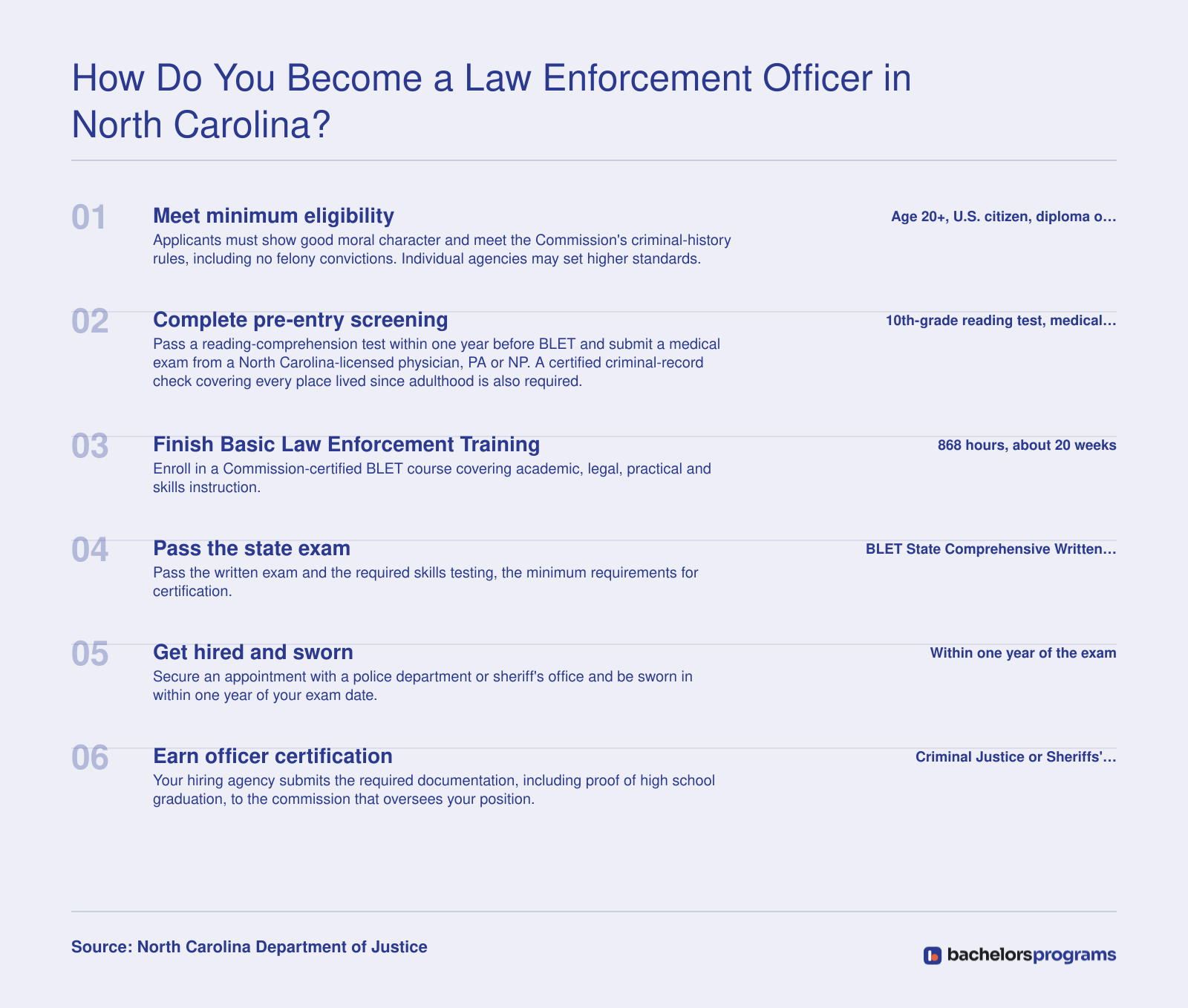
How Do You Become a Law Enforcement Officer in North Carolina?
North Carolina sets officer entry rules through two state bodies: the NC Criminal Justice Education and Training Standards Commission and the NC Sheriffs' Education and Training Standards Commission. A bachelor's degree is not required to enter Basic Law Enforcement Training (BLET), where the minimum is a high school diploma or GED. A bachelor's degree in criminal justice can still strengthen your application with hiring agencies and support later advancement.
Common Questions About Criminal Justice Degrees in North Carolina
These answers draw on the school pages, recruiting information, and 2026 ranking data used throughout this guide. Check each school or agency directly before you commit to a plan.
What is the best college for criminal justice in North Carolina?
Do you need a bachelor's degree to become a police officer in North Carolina?
Can you get a bachelor's degree in criminal justice online in North Carolina?
What can you do with a bachelor's degree in criminal justice in North Carolina?
Compare Criminal Justice programs on the data that matters
Explore more Criminal Justice & Law majors or browse every field of study.
All Criminal Justice & Law programs Browse every field of study