Best Accounting Schools in Pennsylvania
Compare 95 accredited Accounting programs in Pennsylvania at 85 colleges, with net price after aid, graduation rates, earnings and debt from IPEDS and the U.S. College Scorecard.

What does a Pennsylvania accounting degree cost? Published tuition at the schools ranked here runs from roughly $10,800 to $68,700 a year, and that spread matters less than the state's credit rule: Pennsylvania lets you sit for the Uniform CPA Exam at 120 semester credits, 30 below the 150-credit threshold most states use.
A bachelor's degree in accounting, usually the Bachelor of Science (B.S.) in Accounting, meets the degree requirement. The 24 semester credits in accounting and business subjects are where planning goes wrong. Compare on total cost and credit structure, not sticker price.
Key Points
- Penn State World Campus and Saint Francis University offer online accounting bachelor's.
- Pennsylvania's CPA Exam requires 120 credits, including 24 in accounting and business.
- Nationally, accountants and auditors earned a median $80,420 in May 2025.
Best Bachelor's in Accounting Schools in Pennsylvania: Our Top 10
The 10 schools below all award a bachelor's degree in accounting, and they run from large public research universities to small private business colleges. Institution-wide graduation rates at these schools range from about 71% to 97%, and admission rates from roughly 5% to 89%, so the list covers a wide spread of selectivity and cost.
University of Pennsylvania
#1Philadelphia, PA · $29,000/yr (est. net price)
Best for: High-achievers targeting elite finance careers
The University of Pennsylvania runs its accounting bachelor's degree through the Wharton School, making it the most selective option on this list at roughly 5% of applicants admitted. The program requires 37 course units and pairs core financial accounting with electives in forensic analytics, mergers and acquisitions, and taxes and business strategy. Wharton's recruiting reach into consulting, investment banking and public accounting is the widest in the state, and the school's institution-wide graduation rate sits near 97%.
- Capstone required within the 37 course units
- Forensic analytics coursework available
- Mergers and acquisitions course offered
- Taxes and business strategy course
- Climate and financial markets course
- Accounting for entrepreneurs elective
- Independent study and cross-disciplinary options
- Global business communication coursework
Grove City College
#2Grove City, PA · ~$22,000/yr (est.)
Best for: Faith-driven students wanting CPA preparation
Grove City College is a small Christian liberal arts college in western Pennsylvania that teaches accounting from a Christ-centered business core. Its roughly 72% admission rate and lower sticker price make it one of the more accessible private options here, and accounting faculty bring real-world CPA and CMA experience. The college reports a 99% job placement rate for accounting graduates and ranked third in Pennsylvania for first-time CPA pass rates in 2024, about 12% above the national average.
- ACBSP-accredited accounting program
- 69 total credit hours in the major
- Four-year program with two concentration options
- Tracks: CPA exam concentration; nonprofit and corporate accounting
- Prepares students for CPA, CMA and CFP exams
- Internships with national and regional CPA firms
- Double major option in Finance or Business Analysis
- CFP Board certified financial planning minor
Pennsylvania State University
#3University Park, PA · ~$33,000/yr (est.)
Best for: Internship-seekers wanting national recruiting exposure
Penn State's Smeal College of Business awards a Bachelor of Science in Accounting at University Park and runs two undergraduate accounting programs. Admission is moderately selective at roughly 61% of applicants, and Smeal is a national recruiting school for major corporations and major public accounting firms. Students can continue into an integrated five-year option that awards both the bachelor's and a master's degree, and the undergraduate program satisfies the academic requirements to sit for the CPA exam.
- Bachelor of Science in Accounting
- Integrated bachelor's and master's degree option
- Heavy campus recruiting for accounting majors
- National recruiting school for major corporations
- Coursework in interpreting financial data for decision-makers
- Accounting clubs and student organizations
University of Pittsburgh-Pittsburgh
#4Pittsburgh, PA · ~$30,000/yr (est.)
The University of Pittsburgh's College of Business Administration awards a BSBA in Accounting, and the major is compact at eight courses totaling 24 credits. Students must earn a C or better in the core accounting courses before advancing, and courses run on a rotating schedule, so sequencing matters. Admission is moderately selective at about 58%, and accounting majors can join the Accounting Association and Beta Alpha Psi for firm contact and peer support.
- 24 credit hours across eight accounting courses
- C or better required to advance in accounting
- Two Intermediate Financial Reporting courses
- 18 credits of accounting major coursework
- Accounting courses run on a rotating schedule
- Accounting Association and Beta Alpha Psi chapters
- Advising support for the 150-credit CPA pathway
Villanova University
#5Villanova, PA · $40,000 – $45,000/yr (est.)
Villanova University's accounting major sits in the Villanova School of Business and leads to a Bachelor of Business Administration rather than a B.S. Admission is selective at roughly 27%, and the school reports nearly 100% of accounting graduates placed in full-time roles by graduation. The curriculum covers auditing, fraud, consulting and taxation, and many students pair the degree with a master's in accounting or taxation to reach the 150 credits Pennsylvania licensure calls for.
- Four required accounting courses plus two electives
- Leads to a Bachelor of Business Administration
- Nearly 100% of graduates placed by graduation
- Careers in auditing, fraud, consulting and taxation
- Dual degree paths with Master of Accounting or Master of Business Taxation
- CPA readiness built into advising for the 150 credit requirement
West Chester University of Pennsylvania
#6West Chester, PA · $20,000 – $25,000/yr (est.)
West Chester University is the most affordable four-year public option on this list, with lower in-state tuition and a campus in the Philadelphia suburbs. The AACSB-accredited Bachelor of Science in Accounting covers financial and cost accounting, auditing, federal taxation and accounting information systems across 120 credit hours. Admission is accessible at about 78%, and students can add an interdisciplinary minor in white collar crime or an accelerated route to a master's in applied statistics.
- AACSB-accredited accounting program
- 120 total credit hours
- Courses in auditing, federal taxation and cost accounting
- Accounting information systems coursework
- Capstone business policy course required
- Interdisciplinary minor in white collar crime
- Accelerated BS to MS in Applied Statistics pathway
Saint Joseph's University - Philadelphia
#7Philadelphia, PA · ~$30,000/yr (est.)
Saint Joseph's University offers its accounting major through the Haub School of Business, which holds AACSB accreditation for accounting. The Philadelphia campus puts students inside the city's accounting market, and the program adds a Certificate of Competence in SAP R/3 plus an ethics thread running through the coursework. Admission is accessible at roughly 89% with rolling admissions and a test-optional policy, and graduates are hired by Deloitte, EY, KPMG and PwC.
- AACSB-accredited accounting program
- Four required accounting courses plus two electives
- Certificate of Competence in SAP R/3 included
- Ethics perspective across accounting coursework
- Accounting Society speaker series and firm networking
- Five-year bachelor's to MBA or MS track
- Test-optional policy with rolling admissions
- Graduates hired by Deloitte, EY, KPMG and PwC
Bucknell University
#8Lewisburg, PA · ~$41,000/yr (est.)
Bucknell University teaches accounting inside its Freeman College of Management as a Bachelor of Science in Business Administration in Accounting & Financial Management. It is the second most selective private option on this list after Penn, admitting about 29% of applicants, and accounting majors regularly beat national first-attempt CPA pass rates. Select juniors and seniors help run a Student Managed Investment Fund worth about $3.6 million, and most students intern with top-tier firms before senior year.
- BSBA in Accounting & Financial Management
- First-attempt CPA pass rates above national averages
- Student Managed Investment Fund of about $3.6 million
- Capstone applies portfolio management and accounting
- Internships with top-tier accounting firms
- Job offers often arrive before senior year
- Liberal arts core alongside business coursework
Immaculata University
#9Immaculata, PA · ~$24,000/yr (est.)
Immaculata University is a small private Catholic university in Chester County with an ACBSP-accredited Bachelor of Science in Accounting. Classes are small, with a 12-to-1 student-faculty ratio and a business lab built on real financial data, and admission is accessible at about 86%. Students can finish in three years through an accelerated option, add an optional 150-credit CPA track, and intern with firms such as Ernst & Young.
- ACBSP-accredited accounting program
- 126 total credit hours
- Optional 150-credit CPA track
- Three-year accelerated completion option
- 12:1 student-faculty ratio
- Business lab using real-world financial data
- Prepares students for CPA, CMA and CFP exams
- Internship placements including Ernst & Young
Saint Francis University
#10Loretto, PA · $24,000/yr (est. net price)
Saint Francis University is a small Catholic Franciscan school in Loretto that offers its Bachelor of Science in Accounting both on campus and fully online. The program is IACBE-accredited, students can add a concentration in business analytics or entrepreneurship or double major in finance, analytics or management information systems, and faculty hold CPA and CMA credentials. Admission is accessible at about 77%, and an annual Accounting & Finance Consortium Interview Day connects students with employers.
- IACBE-accredited accounting program
- Offered on campus and 100% online
- Concentrations in business analytics or entrepreneurship
- Prepares students for CPA, CMA and CFE exams
- Annual Accounting & Finance Consortium Interview Day
- Double major options in finance, analytics or MIS
- Small classes with CPA and CMA faculty
Cost & outcomes by school
Federal data for the highest-earning Accounting programs, independent of the ranking above. Earnings are this field's bachelor's graduates four years after completing where the Scorecard reports them, else the school's undergraduate median.
| School | Net price / yr | Grad rate | Earnings | Debt | Grads/yr | Format |
|---|---|---|---|---|---|---|
| Bucknell University PA | $40,766 | 86% | $130,990 | $26,881 | 21 | Campus |
| Lehigh University PA | $36,931 | 88% | $125,874 | $23,179 | 52 | Campus |
| Villanova University PA | $43,756 | 92% | $120,207 | $25,858 | 122 | Campus |
| University of Pennsylvania PA | $28,699 | 97% | $111,371 | $15,715 | 20 | Campus |
| Muhlenberg College PA | $28,905 | 82% | $105,494 | $27,000 | 21 | Campus |
| Drexel University PA | $38,509 | 78% | $100,317 | $27,167 | 195 | Campus |
| University of Scranton PA | $32,568 | 80% | $93,677 | $27,000 | 32 | Campus |
| Saint Joseph's University - Philadelphia PA | $29,689 | 79% | $93,585 | $24,560 | 61 | Campus |
| Susquehanna University PA | $28,819 | 82% | $92,279 | $27,000 | 26 | Campus |
| Pennsylvania State University PA | $32,875 | 86% | $88,192 | $25,218 | 273 | Online |
| Pennsylvania State University-Penn State Erie-Behrend College PA | $24,558 | 44% | $88,192 | $25,218 | 27 | Campus |
| Mercyhurst University PA | $19,444 | 60% | $86,596 | $25,305 | 7 | Campus |
Sources: U.S. Department of Education. Net price, graduation rate, earnings and debt: College Scorecard (earnings and debt for this field's bachelor's graduates where reported, else school-wide); graduates: IPEDS. A dash means no figure is reported.
Cost, debt & payoff
Median earnings of this field's bachelor's graduates (4 yrs after completing, else the school's undergraduate median) vs. their median federal loan debt · U.S. College Scorecard
Across these programs the median graduate earns about $69,898 and finishes with roughly $25,218 in debt — a ratio that clears a common rule of thumb (keep debt below first-year salary). Net price and debt vary widely school to school, so check the per-school figures in the table above before you shortlist.
Most Affordable Accounting Schools in Pennsylvania
These Pennsylvania schools post the lowest average net price after aid for a bachelor's degree in accounting in our data, drawn from 2024 U.S. Department of Education figures (IPEDS and College Scorecard). Net price is an average for aided students, measured for in-state students at public schools and for all aided students at private ones, so treat it as a benchmark rather than a quote; your cost depends on family income and the aid you receive. The comparison also shows how much aid narrows the gap: Indiana University of Pennsylvania, the lone public school in this group, has by far the lowest sticker price at $11,380 in-state, yet private Holy Family University comes in lower after aid at $13,143, and every private school here cuts its published price by roughly a quarter to nearly two-thirds once aid is applied.
| Rank | School | City | Sector | Program | Average Net Price After Aid | Published Tuition and Fees | Median Earnings 1 Year After Graduation (Accounting) |
|---|---|---|---|---|---|---|---|
| 1 | Holy Family University | Philadelphia | Private nonprofit | Accounting, B.A. | $13,143 | $35,330 | $47,059 |
| 2 | Indiana University of Pennsylvania | Indiana | Public | Accounting, B.S. | $16,804 | $11,380 in-state; $16,297 out-of-state | $49,454 |
| 3 | Waynesburg University | Waynesburg | Private nonprofit | Accounting (bachelor's) | $18,235 | $30,480 | N/A |
| 4 | York College of Pennsylvania | York | Private nonprofit | Accounting (bachelor's) | $18,556 | $25,588 | $56,583 |
| 5 | La Salle University | Philadelphia | Private nonprofit | Accounting (BSBA) | $19,409 | $37,800 | $54,772 |
Online and Hybrid Bachelor's in Accounting Options at Pennsylvania Schools
Among the schools ranked here, Pennsylvania State University (through World Campus) and Saint Francis University offer a fully online path to a bachelor's degree in accounting. The other ranked schools deliver the degree on campus. Penn State World Campus charges $644 per credit for students with 59 or fewer total credits and $692 per credit at 60 or more for 2026-27, and it states there is no location-based tuition, so Pennsylvania residents and out-of-state students pay the same online rate. Its transcript and diploma do not distinguish online from on-campus study. For transfer credit, Penn State says the credits you still need will vary based on what transfers in, and Saint Francis positions its online option for working adults, so transfer students should confirm credit limits with each school before applying.
| School | Program | Format | Total Credits | Published Tuition |
|---|---|---|---|---|
| University of Pennsylvania | Accounting, BS | Campus | N/A | $68,686 per year (tuition and fees) |
| Grove City College | BS in Accounting | Campus | N/A | $21,700 per year (tuition and fees) |
| Pennsylvania State University (World Campus) | Bachelor of Science in Accounting | 100% online | 120 | $644 to $692 per credit online (2026-27); $20,644 per year in-state on campus |
| University of Pittsburgh-Pittsburgh | Accounting, BSBA | Campus | N/A | $21,926 per year in-state (tuition and fees) |
| Villanova University | Accounting | Campus | N/A | $67,776 per year (tuition and fees) |
| West Chester University of Pennsylvania | Bachelor of Science in Accounting | Campus | 120 | $10,775 per year in-state (tuition and fees) |
| Saint Joseph's University - Philadelphia | Accounting Major | Campus | N/A | $53,260 per year (tuition and fees) |
| Bucknell University | Accounting & Financial Management | Campus | N/A | $67,812 per year (tuition and fees) |
| Immaculata University | Accounting, B.S. | Campus (face-to-face classes) | 126 | $29,330 per year (tuition and fees) |
| Saint Francis University | Accounting, B.S. | Campus and 100% online | N/A | $44,000 per year (tuition and fees) |
Admissions for a Bachelor's Degree in Accounting in Pennsylvania
Getting into an accounting program in Pennsylvania ranges from roughly a 5% acceptance rate to nearly open enrollment, so your GPA and test scores matter far more at some schools than others.
Selectivity at a Glance
- More selective: University of Pennsylvania (about 5%), Villanova University (about 27%) and Bucknell University (about 29%).
- Mid-range: Pennsylvania State University (about 61%) and University of Pittsburgh-Pittsburgh (about 58%).
- More open: Grove City College (about 72%), Saint Francis University (about 77%), West Chester University of Pennsylvania (about 78%), Immaculata University (about 86%) and Saint Joseph's University - Philadelphia (about 89%).
GPA, Tests and Credit Policies
Pennsylvania State University is the clearest on GPA. First-year students entering the accounting major in 2026-2027 need a 3.10 cumulative GPA, and applicants between 2.60 and 3.09 may be admitted if space is available.1 Its degrees require at least 120 credits,2 and faculty may require up to 24 major credits to be completed in the college.
The University of Pennsylvania publishes no GPA minimum or test-optional policy in the sources we reviewed. It generally considers transfer credit only for the introductory accounting courses (ACCT 1010 and 1020). Saint Joseph's University and Marywood University both describe themselves as test optional. Marywood also lists SAT/ACT among its application materials and requires 120 credits for its accounting degree.3
For the remaining schools, we found no published GPA floor, test policy or transfer cap in the sources reviewed. Treat that as unknown, not as "no requirement," and confirm with each admissions office.
Tips for Transfer Students
- Get credits mapped in writing. Ask the accounting department which community college courses, such as introductory financial and managerial accounting, count toward the major and which count only as electives.
- Protect your grades in entry courses. Programs such as Pitt's require a C or better to advance in accounting, and Penn State's major has a GPA threshold. A single weak grade can block entry.
- Check residency rules early. Many programs require a set number of major credits at the receiving school, which can lengthen your timeline if you transfer late.
Cost of an Accounting Degree in Pennsylvania: Tuition, Net Price and State Aid
Published tuition and average net price diverge sharply at many Pennsylvania schools, which makes sticker price a poor filter for building your shortlist.
Published tuition versus net price
Among the public universities here, West Chester University charges the lowest in-state tuition at roughly $10,775, with Penn State at about $20,644 and the University of Pittsburgh at roughly $21,926 for Pennsylvania residents. Average net price, the average student's cost after grants and scholarships, lands at about $23,331 at West Chester, $30,434 at Pitt and $32,875 at Penn State.
Private institutions post much higher list prices but discount heavily. Saint Francis University lists tuition near $44,000 yet averages about $23,526 net, and Immaculata University averages roughly $24,258. Saint Joseph's University discounts from roughly $53,260 to about $29,689. At the high end, Villanova averages around $43,756 and Bucknell about $40,766. Grove City College keeps its published tuition unusually low for a private college at roughly $21,700.
The PA State Grant and other state aid
The PA State Grant, administered by PHEAA, is need-based and reaches a maximum of $6,000 for 2026-20271, though actual awards vary with financial circumstances, school, enrollment level and available funding. You generally need to be a Pennsylvania resident (adults typically must have lived in the state for 12 consecutive months before the filing deadline, not counting time enrolled in college2), enrolled at least half-time at six or more semester credits in a program of at least two academic years, and without a prior bachelor's degree.3 Programs at schools outside Pennsylvania must deliver at least half their instruction in a classroom.
File the FAFSA first, then the state application. First-time applicants at four-year colleges and all renewal applicants face a May 1, 2026 deadline; community college applicants have until August 1, 2026, and summer-term aid closes September 1, 2026.4 Reconsideration for missing documents runs to April 1, 2027. Conditional eligibility typically appears in your PHEAA account in May.2
Grant recipients may also qualify for the PA State Work-Study Program, and students who were in foster care at 16 or older can apply for FosterEd/Chafee funds.5
Verify before you budget
Net price figures are averages across all aided students, not a quote. Run each school's own net price calculator with your family's numbers before comparing offers.
AACSB Accreditation and CPA Pass Rates at Pennsylvania Schools
AACSB accredits business schools as a whole. A smaller group of those schools also earns a separate, more demanding accounting accreditation that reviews the accounting program on its own. In the AACSB directory, Villanova University holds both, while the other schools below either show business accreditation only or could not be confirmed in the records we reviewed. We found no NASBA or school-published first-time CPA pass rates that include cohort size and year for these bachelor's programs, so treat claims such as "above the national average" as marketing until a school shares how many graduates sat for the exam and when. Even published rates need caution: a program with only a few dozen test-takers can swing sharply from year to year, which makes small-cohort rates hard to compare across schools.
| School | Bachelor's Program | AACSB Status (Directory) | Other Accreditation (School-Reported) | CPA Pass-Rate Information |
|---|---|---|---|---|
| Villanova University | Bachelor of Business Administration, Accounting | Business and separate accounting accreditation | N/A | No published first-time rate with cohort size and year found |
| Pennsylvania State University | B.S. in Accounting | Business accreditation; separate accounting accreditation not shown in listing reviewed | N/A | No published first-time rate with cohort size and year found |
| University of Pittsburgh-Pittsburgh | B.S. in Business Administration, Accounting | Business accreditation; separate accounting accreditation not shown in listing reviewed | N/A | No published first-time rate with cohort size and year found |
| West Chester University of Pennsylvania | B.S. in Accounting | Business accreditation; separate accounting accreditation not shown in listing reviewed | N/A | No published first-time rate with cohort size and year found |
| Susquehanna University | B.S. in Accounting | Business accreditation; separate accounting accreditation not shown in listing reviewed | N/A | No published first-time rate with cohort size and year found |
| Saint Joseph's University - Philadelphia | Accounting Major | School states it is AACSB accredited; not confirmed in directory records we retrieved | N/A | No published first-time rate with cohort size and year found |
| University of Pennsylvania | B.S. in Accounting | Not confirmed in directory records we retrieved | N/A | No published first-time rate with cohort size and year found |
| Grove City College | B.S. in Accounting | Not confirmed in directory records we retrieved | ACBSP | School claims No. 3 in Pennsylvania and a rate 12% above the national average; no cohort size or year given |
| Bucknell University | Accounting and Financial Management | Not confirmed in directory records we retrieved | N/A | School says first-attempt rate is above national averages; no figure, cohort size or year given |
| Immaculata University | B.S. in Accounting | Not confirmed in directory records we retrieved | ACBSP | No published first-time rate with cohort size and year found |
| Saint Francis University | B.S. in Accounting | Not confirmed in directory records we retrieved | IACBE | No published first-time rate with cohort size and year found |
Pennsylvania's CPA Education Requirements: 120 vs. 150 Credits
Pennsylvania's State Board of Accountancy requires 120 semester credits before you can sit for the Uniform CPA Exam, and at least 24 of those credits must fall in accounting, auditing, business law, economics, technology, finance, or tax.1 An accounting bachelor's degree usually covers both numbers, which is why it remains the standard starting point in the state. Those 24 credits do not have to be undergraduate work, and they do not have to be accounting courses alone; the Board accepts the broader subject mix above.4
Two Paths to a License
Exam eligibility is not licensure, and this is where the 120 and 150 figures diverge. Under the 120-credit pathway, you need a bachelor's degree, 120 total credits, the 24 subject credits, and 24 months (3,200 hours) of qualifying experience. Under the 150-credit pathway, you need a bachelor's degree or higher, 150 total credits, the same 24 credits, plus 12 additional credits in accounting, auditing, or tax, and only 12 months (1,600 hours) of experience.1
Those extra 12 sit on top of the 24 and cannot be satisfied with business law or finance coursework. No second degree is required to reach 150.2 Students get there through extra semesters, an integrated bachelor's-to-150 arrangement, or graduate coursework in accounting or taxation.
What Counts as Experience
Qualifying work can happen in public accounting, government, business, or academia.3 It must fall within the 60 months immediately before you apply, and a CPA currently licensed in Pennsylvania or another jurisdiction must verify it.3
Confirm Before You Enroll
Ask the State Board directly, not only the admissions office, whether a program's required courses map onto the 24-credit category and, if you are aiming at the 150 route, onto the extra 12. Course titles vary from school to school, and a quick syllabus review now beats discovering a gap after you have already registered for senior year.
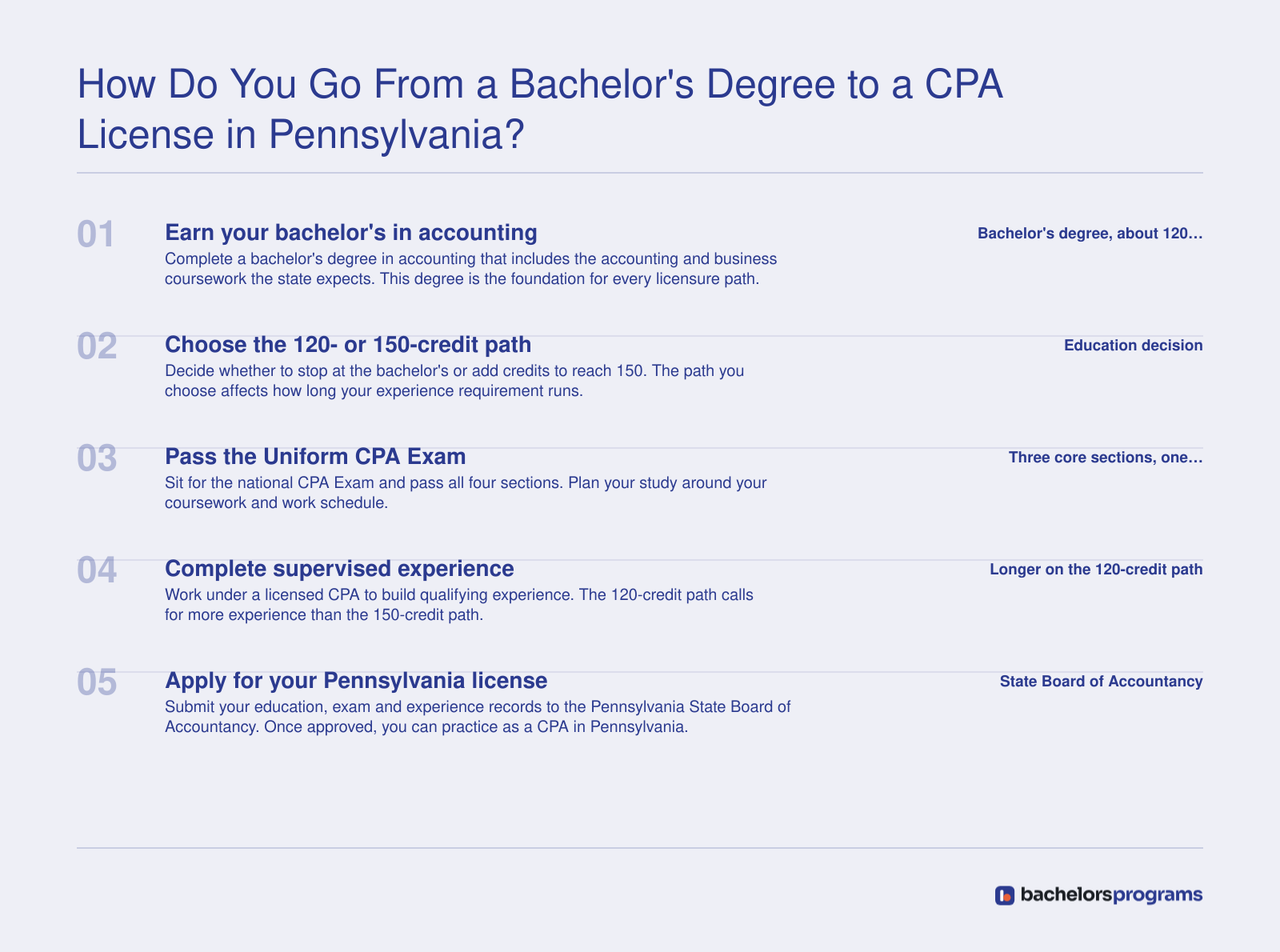
How Do You Go From a Bachelor's Degree to a CPA License in Pennsylvania?
A Pennsylvania CPA license follows a set order: education, exam, experience and then the license application. Your choice of the 120-credit or 150-credit path shapes how much supervised work you need before you apply.
Accounting Careers and Salaries in Pennsylvania
The Bureau of Labor Statistics counts about 1.45 million accountants and auditors nationwide at a median annual wage of $80,420 as of May 2025, while its Occupational Outlook Handbook reports a higher job count and median for the same year, so read these figures as a range rather than one fixed number, and keep in mind they describe all working accountants, not the earnings of recent graduates shown earlier on this page. The Pennsylvania Department of Labor and Industry publishes statewide and metro wage estimates, including for the Philadelphia-Camden-Wilmington and Pittsburgh areas, but accountant-specific employment and wage figures for Pennsylvania and those metros were not available for this update, so the table below shows national data only. Graduates commonly start at Big Four and regional public accounting firms, in corporate finance departments, or in government roles, and earning the CPA license covered in the licensure section is generally what opens the path to senior, manager and partner-track positions.
| Area | Employment | Median Annual Wage |
|---|---|---|
| United States (BLS Occupational Employment and Wage Statistics, May 2025) | 1,449,500 | $80,420 |
| United States (BLS Occupational Outlook Handbook, May 2025) | 1,595,200 | $83,680 |
Related Articles
Compare Accounting programs on the data that matters
Explore more Business & Management majors or browse every field of study.
All Business & Management programs Browse every field of study