Best Business Degree Programs in Pennsylvania
Compare 205 accredited Business programs in Pennsylvania at 105 colleges, with net price after aid, graduation rates, earnings and debt from IPEDS and the U.S. College Scorecard.

The real tradeoff in a Pennsylvania business bachelor's is price against payoff. University of Pennsylvania management graduates earn a median of $91,443 one year out, at a net price of $28,699 a year. Holy Family University costs far less after aid, $13,143, and its business graduates start near $49,870.
Flexibility matters too. Temple University's Fox School offers an online BBA path at $23,005 in tuition for Pennsylvania residents, while most programs here remain campus-based.
Published tuition rarely settles the question. Holy Family lists $35,330 before aid, more than double what the average aided student actually pays.
Key Points
- Temple's online Business Management BBA charges Pennsylvania residents $23,005 in tuition.
- Pennsylvania's CPA exam requires 24 semester credits in accounting-area subjects.
- Net price after grants often sits well below sticker tuition.
Best Business Bachelor's Programs in Pennsylvania: Our Top 10
These ten programs are ordered by our own program-level rankings for business bachelor's degrees in Pennsylvania, drawn from completion and cost data across the state's public and private institutions. Each card carries an approximate net price after aid, the graduation rate for the school as a whole rather than the business major alone, published earnings where federal data reports them, and the program's format. The lowest net prices and the highest earnings are broken out separately below.
University of Pennsylvania
#1Philadelphia, PA · $29,000/yr (est. net price)
Best for: Consulting-bound students wanting a national network
Wharton anchors business education at Penn, and the undergraduate Management BS is built for students aiming at general management and leadership roles rather than a single functional specialty. The degree pairs 33 Wharton course units with four management courses beyond the core, adds a senior capstone and a two-semester language requirement, and requires breadth across three Wharton departments. Graduates typically target management posts in firms or advisory roles with consulting organizations, and Philadelphia's corporate and consulting base sits at the doorstep.
- 37 course units: 33 in Wharton plus 4 MGMT units beyond the core
- Senior capstone plus the leadership journey courses
- Two semesters of a foreign language required
- Three course units with substantial cross-cultural content
- Three upper-level units from Wharton departments outside the concentration
- Five unrestricted elective course units
- Requirements set for students entering Fall 2026 and later
Bucknell University
#2Lewisburg, PA · ~$41,000/yr (est.)
Best for: Business majors wanting a liberal arts setting
The Freeman College of Management at Bucknell runs a BSBA with five majors, from Accounting and Finance to Markets, Innovation & Design, and it lets Management & Organizations students add concentrations in entrepreneurship, global management or sustainability. The setting is a small liberal arts university in Lewisburg, where business coursework sits alongside a broad general education and encouraged study abroad. Classes stay small and the curriculum blends core business fundamentals with room to specialize.
- Five majors, including Accounting, Finance and Business Analytics
- Management & Organizations tracks in Entrepreneurship and Global Management
- Also HR Management and Managing for Sustainability concentrations
- Study abroad and international internships encouraged
- Language and Cultural Immersion Scholars Program available
- Business electives open to non-majors
Saint Joseph's University - Philadelphia
#3Philadelphia, PA · ~$30,000/yr (est.)
Best for: Values-driven students seeking a Jesuit business education
Saint Joseph's Haub School of Business teaches business administration through a cross-disciplinary core in finance, accounting, marketing and management, capped by a strategic plan project for a real company. The Jesuit tradition shapes an ethics-forward curriculum, and an accelerated 4+1 route lets students finish an MBA or MS within five years. Campus organizations, including marketing and entrepreneurship groups, give students professional outlets in Philadelphia.
- Broad core across finance, accounting, marketing and management
- Capstone builds a strategic plan for a real company
- Accelerated 4+1 option leads to an MBA or MS in five years
- Business intelligence coursework included
- Jesuit tradition with ethics woven through the curriculum
- Student chapters of the American Marketing Association and Entrepreneurship Society
Temple University
#4Philadelphia, PA · $23,000 – $39,000/yr (est.)
Temple's Fox School of Business, AACSB accredited since 1934, offers business administration through several distinct majors: Business Management, International Business and Finance. Accelerated three-year and 4+1 graduate options exist, and the Finance major runs a real-money student investment fund. The Center for Student Professional Development, global immersion programs and a deep roster of student organizations round out the professional side of the degree.
- Develops leadership, negotiation and team-building skills
- Accelerated 4+1 track plus minors and certificates
- Center for Student Professional Development support
- Global immersion and study abroad opportunities
- Business school accredited by AACSB since 1934
- 124-credit program with foreign language proficiency required
- Six concentration options to choose from
- Accelerated three-year option available
- International exchange and global immersion programs
- Real-money student investment fund
- Training on professional finance platforms
- Several finance-focused student clubs
University of Scranton
#5Scranton, PA · $33,000/yr (est. net price)
The Kania School of Management at the University of Scranton delivers an AACSB-accredited business administration degree with classes capped at 35 students. Economics, accounting, management and marketing form the core, with electives in finance, entrepreneurship and marketing, and internships are encouraged in the junior and senior years. A four-year professional development sequence, an Executive in Residence program and a strong alumni network support the Jesuit emphasis on ethical decision-making.
- Classes capped at 35 students
- AACSB-accredited Kania School of Management
- Internships encouraged in junior and senior years
- Four-year professional development program
- Executive in Residence program and active alumni network
- Electives in finance, marketing and entrepreneurship
Holy Family University
#6Philadelphia, PA · $13,000/yr (est. net price)
Holy Family University's BA in Business Administration splits 120 credits into a 45-credit general education core, a 45-credit business core and a required 3-credit internship, leaving nine credits of free electives. Courses such as Business Ethics and Conflict Management and Negotiation give the degree a practical, workplace-oriented feel. The main campus sits in Northeast Philadelphia, and the program is housed in the School of Business and Technology.
- 120 credits: 45 general education plus 45 business core
- Required 3-credit internship
- 9 credits of free electives
- Courses in Business Ethics and Conflict Management and Negotiation
- Main campus in Northeast Philadelphia
York College of Pennsylvania
#7York, PA · $15,000 – $20,000/yr (est.)
York College of Pennsylvania's Graham School of Business awards a BS in Business Administration built around managerial accounting, operations management and business strategy, with internships and faculty mentorship alongside the coursework. The college maintains a standing transfer pathway from Thaddeus Stevens College of Technology: associate degree holders in business administration with at least a 2.0 GPA gain assured admission, and up to 75 credits can carry over. It is an ACBSP-accredited program on a residential campus in York.
- Assured admission for Thaddeus Stevens associate grads with a 2.0 GPA
- Up to 75 transfer credits may apply toward the degree
- Graham School of Business, accredited by ACBSP
- Key courses include Managerial Accounting, Operations Management and Business Strategy
- Internships and faculty mentorship built into the experience
Saint Vincent College
#8Latrobe, PA · ~$24,000/yr (est.)
Saint Vincent College's McKenna School of Business, Economics, and Government offers a 51-credit business administration degree with a capstone built on the Business Strategy Game simulation. Students can stack certificates in project management, SAP, operational excellence, organizational leadership or nonprofit work, and the campus hosts an Operational Excellence Lab and a Small Business Development Center. Double majors and minors are workable, and the school runs a Delta Mu Delta honors chapter and a Women in Business Club.
- 51 credits in the major
- Capstone uses the Business Strategy Game simulation
- Certificates in project management, SAP, operational excellence and nonprofit
- On-campus Operational Excellence Lab and Small Business Development Center
- Delta Mu Delta honors chapter and Women in Business Club
- Double major or minor flexibility
Robert Morris University
#9Moon Township, PA · ~$23,000/yr (est.)
Robert Morris University's Rockwell School of Business structures its BS in Business Administration around a management concentration, with 63 major credits and a choice between managing people through human resources or managing processes through operations. A 4+1 integrated program lets students add an MBA in one extra year, and eligible students can apply to the Early Law School Admission Program. Graduates move into recruiting, human resources management, logistics supervision and operations roles.
- 63 major credits, 42 management core credits, 15 electives
- Focus on managing people (HR) or managing processes (operations)
- 4+1 integrated MBA adds one year
- Early Law School Admission Program eligibility
- Target roles include recruiter, HR manager and operations associate
Duquesne University
#10Pittsburgh, PA · $35,000 – $40,000/yr (est.)
Duquesne's business school runs a 120-credit BS in Business Administration on a project-based model, starting with a First-Year Innovation Experience and finishing with a senior capstone tied to industry partners. Core work in accounting, finance, marketing and management sits alongside an emphasis on ethical leadership and global perspectives, and the school is AACSB accredited. Students get personalized success coaching and career development support in Pittsburgh.
- 120 credits with a project-based curriculum
- First-Year Innovation Experience starts hands-on work immediately
- Cornerstone-to-Capstone model runs through all four years
- Industry partners supply real projects for coursework
- Personalized student success coaching
Cost & outcomes by school
Federal data for the highest-earning Business programs, independent of the ranking above. Earnings are this field's bachelor's graduates four years after completing where the Scorecard reports them, else the school's undergraduate median.
| School | Net price / yr | Grad rate | Earnings | Debt | Grads/yr | Format |
|---|---|---|---|---|---|---|
| Carnegie Mellon University PA | $31,944 | 94% | $114,862 | $21,750 | 4,542 | Campus |
| University of Pennsylvania PA | $28,699 | 97% | $111,371 | $15,715 | 7,188 | Campus |
| Lehigh University PA | $36,931 | 88% | $105,584 | $21,960 | 3,190 | Campus |
| Villanova University PA | $43,756 | 92% | $100,423 | $25,874 | 4,434 | Campus |
| Bucknell University PA | $40,766 | 86% | $93,807 | $27,000 | 2,152 | Campus |
| Saint Joseph's University - Philadelphia PA | $29,689 | 79% | $86,881 | $25,500 | 2,922 | Campus |
| Drexel University PA | $38,509 | 78% | $84,648 | $25,325 | 6,122 | Campus |
| Thomas Jefferson University PA | $28,928 | 69% | $77,449 | $14,744 | 2,132 | Online |
| Franklin and Marshall College PA | $36,425 | 84% | $76,124 | $19,000 | 1,090 | Campus |
| Immaculata University PA | $24,258 | 71% | $75,701 | $27,000 | 690 | Campus |
| Duquesne University PA | $37,730 | 78% | $74,742 | $26,244 | 2,802 | Campus |
| University of Scranton PA | $32,568 | 80% | $74,652 | $27,000 | 1,522 | Campus |
Sources: U.S. Department of Education. Net price, graduation rate, earnings and debt: College Scorecard (earnings and debt for this field's bachelor's graduates where reported, else school-wide); graduates: IPEDS. A dash means no figure is reported.
Cost, debt & payoff
Median earnings of this field's bachelor's graduates (4 yrs after completing, else the school's undergraduate median) vs. their median federal loan debt · U.S. College Scorecard
Across these programs the median graduate earns about $61,277 and finishes with roughly $25,788 in debt — a ratio that clears a common rule of thumb (keep debt below first-year salary). Net price and debt vary widely school to school, so check the per-school figures in the table above before you shortlist.
Five Pennsylvania Business Bachelor's Programs With the Lowest Net Price
Net price, drawn from U.S. Department of Education federal data (IPEDS and College Scorecard), is the average yearly cost students pay after grants and scholarships, so it usually lands far below sticker price: private Holy Family University lists $35,330 in tuition and fees yet posts the lowest net price below, while public schools such as Commonwealth University of Pennsylvania, Indiana University of Pennsylvania and Pennsylvania Western University start with much lower tuition but end up with higher net prices. Treat net price as an institution-wide approximation rather than a business-program figure, since your own cost depends on your income, residency and aid package. A lower price also tells you nothing about outcomes on its own: graduation rates in this group run from 52 percent at Pennsylvania Western University to 64 percent at York College of Pennsylvania, so weigh cost and completion together.
| School | Sector | Format | Average Net Price | In-State Tuition and Fees | Graduation Rate |
|---|---|---|---|---|---|
| Holy Family University | Private | Campus | $13,143 | $35,330 | 61% |
| Commonwealth University of Pennsylvania | Public | Online (campus and hybrid also available) | $15,699 | $11,046 | 54% |
| Indiana University of Pennsylvania | Public | Campus | $16,804 | $11,380 | 56% |
| Pennsylvania Western University | Public | Hybrid | $18,256 | $11,436 | 52% |
| York College of Pennsylvania | Private | Campus | $18,556 | $25,588 | 64% |
Online and Hybrid Business Bachelor's Options at Pennsylvania-Based Schools
Temple University's Business Management BBA, the program here listed with an online delivery format, charges $23,005 in tuition for Pennsylvania residents and $38,805 for out-of-state students. Every other program here is recorded as campus-based, so distance learners should start with Temple, then ask each campus whether a separate online or hybrid version runs alongside the residential degree.
Who Each Format Suits
- Working adults and part-time students: An online section removes the commute and lets coursework fit around a job and family schedule.
- Career changers: A hybrid mix of evening meetings and online work suits someone who wants live instruction without a full campus week.
- Traditional full-time students: Campus programs at Scranton, Duquesne and Bucknell carry internship pipelines and recruiting events.
Comparing Cost
Net price after aid, an institution-wide average rather than a program figure, runs from $13,143 at Holy Family to $40,766 at Bucknell among the schools here. Temple's average sits at $28,198, while York College of Pennsylvania ($18,556) and Robert Morris University ($23,003) land under $24,000 on that same measure. Residents pay a state rate that out-of-state students do not get.
What to Confirm
Ask whether online students pay the same tuition as campus students, whether any residency, lab or proctored exam requires a trip to campus, and how transfer credits from a two-year school are handled. None of that shows up in a program listing, and the answers can move the real cost by thousands.
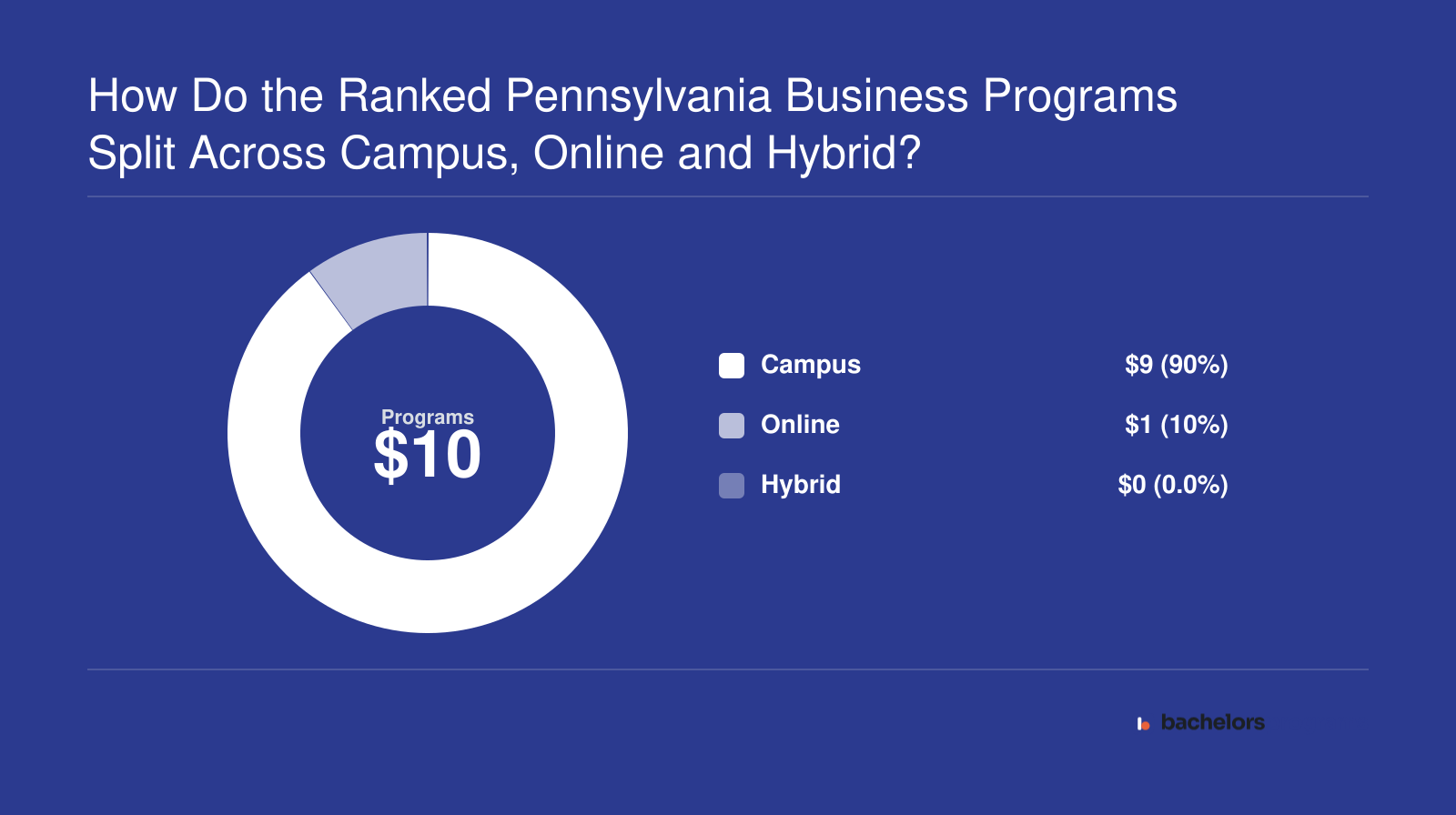
How Do the Ranked Pennsylvania Business Programs Split Across Campus, Online and Hybrid?
Most of the schools ranked here deliver their business bachelor's on campus. Temple University is the online option among them, which matters most for working students who need coursework that fits around a job.
Admissions for Business Bachelor's Programs in Pennsylvania: GPA, Tests and Transfer Credit
Admission difficulty for Pennsylvania business programs depends far more on the school than on the major. The gap between the most and least selective options here is wide, and the published rules on GPA, testing and transfer credit are uneven.
Selectivity and GPA
Admission rates are school-wide, not specific to the business program, but they still signal how competitive entry is. The University of Pennsylvania admits about 5.4% of applicants, and Bucknell University about 28.9%. Saint Vincent College sits near 62%, Holy Family University near 71%, and York College of Pennsylvania near 74%. Temple University, the University of Scranton, Duquesne University, Saint Joseph's University and Robert Morris University all admit roughly 80% to 90%.
Penn requires a high school GPA but publishes no typical or minimum figure. For most of the other schools, we found no published minimum GPA, so confirm the range with admissions before assuming a cutoff.
Test Policies
Penn considers SAT or ACT scores but does not require them. Saint Joseph's lists SAT/ACT scores as optional. Where a school's admissions page does not state a first-year test policy, treat it as unconfirmed and ask.
Transfer Credit and Community-College Pathways
Temple and Saint Joseph's both accept transfer applications, but neither publishes a credit cap in the material we reviewed. Kutztown University of Pennsylvania is more specific: it states no maximum credit limit, offers dual admission with community colleges, and describes aligned pathways that leave no more than 60 additional credits toward a standard 120-credit bachelor's. Its dual admission requires you to enroll before reaching the college's community-college credit threshold, so timing matters.
Agreements like these typically ask you to file an intent form early, often before 30 or so college-level credits, and to finish an associate degree with a minimum GPA, commonly around 2.0. Details vary by partner college and major.
Before You Apply
- Transfer-credit cap: Ask for the maximum credits accepted and whether business core courses count toward the major.
- Test policy: Confirm whether SAT or ACT scores are required, optional or merely considered.
- Priority deadline: Note the date for admission and aid consideration, and any earlier deadline for dual-admission paperwork.
What a Business Bachelor's Costs in Pennsylvania
Among the private colleges here with cost data, annual tuition and fees run from $25,588 at York College of Pennsylvania to $42,396 at Saint Vincent College. Holy Family University ($35,330) and Robert Morris University ($35,970) fall in between. Net price after grants and scholarships is far lower: about $13,143 at Holy Family, $18,556 at York, $23,003 at Robert Morris and $23,510 at Saint Vincent.
A Rough Four-Year Estimate
Multiplying by four gives a rough four-year total. At York, sticker tuition and fees come to roughly $102,000, while net price points to about $74,000. At Holy Family, net price works out to about $52,500. At Saint Vincent, the sticker figure is near $169,600 against about $94,000 net. This is an estimate only. It excludes housing, meals and books, and aid packages change year to year.
In-State Versus Out-of-State
The private schools above charge one rate to everyone. Public universities split. Commonwealth University of Pennsylvania lists $11,046 in-state against $22,870 out-of-state, and Millersville University of Pennsylvania lists $11,128 against $22,952. Indiana University of Pennsylvania runs $11,380 against $16,297. Residency matters most at the public schools.
PHEAA State Grant Basics
The PA State Grant maxes out at $6,000 for a qualifying undergraduate in 2026-27.1 The final amount is set after the state budget, usually in late June, so May award notices are conditional.2 The grant is need-based, and the FAFSA is the gateway: PHEAA will not process a State Grant application without it.2 First-time applicants also complete a PA State Grant Form.1
- Residency: Pennsylvania residents, with students 18 and older generally needing 12 consecutive months in the state before the deadline.2
- Enrollment: At least half-time, in a program of at least two academic years, with satisfactory academic progress.
- Restrictions: No prior bachelor's degree, and no defaulted education loans.
- Deadline: May 1 for first-time and renewal applicants at four-year colleges and universities.3 Aug. 1 applies to community colleges and some other schools. An April 1, 2027 reconsideration deadline exists for the 2026-27 year.4
Students attending out of state receive $600, or $800 for PHEAA-defined veterans.5 Pennsylvania State Work-Study also offers paid jobs through participating colleges, so ask each school's financial aid office whether it takes part.
Related Articles
AACSB vs. ACBSP: How Accreditation Affects Pennsylvania Business Degrees
Neither accreditation is better in every case. AACSB and ACBSP are different standards with different emphases, and neither is required to work in business or to sit for any business licensing exam. The table below compares how they generally differ, and the last rows give a decision rule for Pennsylvania students.
| Factor | AACSB | ACBSP |
|---|---|---|
| Core focus | Mission, scholarship, societal impact, and student learning, with attention to global business preparation | Teaching quality and measured student learning outcomes, with continuous improvement |
| Role of faculty research | Significant. Schools are expected to produce scholarship and apply it in the classroom | Secondary. Classroom teaching and outcomes assessment carry more weight |
| Selectivity | Generally viewed as the more demanding and selective process | Rigorous, but generally viewed as more accessible to a wider range of institutions |
| Typical institutions | Often larger universities and research-oriented or nationally known business schools | Often teaching-focused colleges and universities, including smaller and regional schools |
| Employer and graduate school view | Widely recognized. Many MBA programs and some employers treat it as a quality marker | A legitimate quality signal, though it carries less name recognition with some employers |
| Licensure requirement | None for business degrees | None for business degrees |
| Ranked Pennsylvania schools confirmed | Duquesne University appears in the current AACSB directory. Check the directory for the other schools here before relying on a claim | Check the current ACBSP directory for each school you are considering. Some schools hold neither accreditation |
| Decision rule | Prioritize it if you may pursue an MBA later or want maximum brand recognition | Consider it a strong signal if you want a teaching-focused program and value outcomes assessment |
Pennsylvania CPA Licensure for Accounting Concentrations
A business bachelor's in Pennsylvania is a degree you choose with three filters, not one. Start with the top-ranked list above, then narrow by format and net price, because Holy Family's $35,330 sticker price and the net figures after aid are different numbers. Confirm accreditation and each school's published GPA, testing and transfer rules. Then weigh early earnings against likely debt.
Run those three steps and the shortlist usually settles itself.
Compare Business programs on the data that matters
Explore more Business & Management majors or browse every field of study.
All Business & Management programs Browse every field of study