Best Online Emergency Management Degree Programs
Compare 90+ accredited online Emergency Management programs, with net price after aid, graduation rates, earnings and debt from IPEDS and the U.S. College Scorecard.

Demand for emergency managers keeps climbing as wildfires, hurricanes and public health emergencies strain local response budgets. A bachelor's degree is now the standard entry point for county and state director roles, and most curricula track FEMA's National Preparedness mission areas.
Geography is the harder problem. Emergency management jobs sit in county agencies, hospitals, utilities and federal regional offices scattered across the map, so relocating for a campus program rarely fits a career already in motion. Every program ranked here runs 100% online with no residency and no campus visit, though FEMA's ICS 300 and 400 courses, which several curricula fold in, are still taught in person.
Key Points
- Transfer credits can shrink a 120-credit degree to about two years.
- Out-of-state tuition at the lowest-cost public schools runs triple to quadruple in-state.
- FEMA Independent Study courses build toward IAEM's AEM and CEM credentials.
Top 10 Fully Online Emergency Management Degree Programs
Every program below is delivered 100% online, with no in-person components and no campus visits required, and hybrid formats were excluded from consideration. The order reflects a mixed quality composite that weighs cost after aid and on-time completion alongside program depth and flexibility, so it is not a cost ranking or an outcomes ranking on its own. Tuition, net price, and graduation figures shown for each entry are institution-wide.
Florida International University
#1Miami, FL · ~$9,000/yr (est.)
Best for: Students targeting FEMA credentials
Florida International University delivers its disaster management degree through the Academy for International Disaster Preparedness, and the university is the initial rollout site for Florida's Coalition for Operational Readiness in Education, a statewide partnership with the state's emergency management, commerce, and education agencies. Students learn from faculty who hold senior roles at the United Nations and FEMA, and the university is planning a Disaster Preparedness Center for training, research, and applied exercises with agency partners.
- 120 credit hours, with prior learning credit available
- Faculty include senior UN and FEMA officials
- Core coursework covers disaster preparedness, response, and recovery
- Curriculum aligned with FEMA core competencies
- Prepares students for FEMA ICS 300 and 400 certification
- Associate of Arts transfer students can finish in 60 credits
- Double majors possible within the flexible 120-credit degree
American Public University System
#2Charles Town, WV · $5,000 – $10,000/yr (est.)
Best for: Military members and working adults
American Public University System serves a largely military and working-adult population, and its emergency and disaster management faculty include board-certified emergency managers and agency leaders. In August 2026 the system combined with Rasmussen University and Hondros College of Nursing into a single institution.
- $360 per credit, with a $250 per credit military rate
- 120 credit hours; transfer up to 90 credits
- 12 start dates per year
- Senior capstone includes a disaster simulation
- All-hazards approach spanning mitigation through recovery
- Coursework covers counterterrorism and consequence management
- Many faculty are board-certified emergency managers
- No application fee and no entrance exam required
Indian River State College
#3Fort Pierce, FL · ~$3,800/yr (est.)
Best for: Public-sector career changers
Indian River State College is a public college in Fort Pierce that built its emergency management offering inside a public administration degree, so students study urban and regional planning and organizational behavior alongside disaster coursework. A second concentration in public policy and leadership serves students aiming at management-track roles. The college designs the 120-credit degree for working adults and offers financial aid and scholarships.
- 120 credit hours offered fully online
- Emergency Planning and Management concentration
- Second concentration available in Public Policy and Leadership
- Coursework spans urban planning, organizational behavior, and program management
- Prepares students for government, nonprofit, and emergency services roles
- Financial aid and scholarships available
Arizona State University
#4Tempe, AZ · ~$15,000/yr (est.)
Arizona State University's emergency management and homeland security program is taught by faculty in the Watts College of Public Service and Community Solutions. The university runs 7.5-week classes with multiple start dates and does not require ACT or SAT scores. An Earned Admission pathway lets applicants who fall below the GPA threshold demonstrate readiness before enrolling.
- 120 credit hours across 40 courses
- 7.5-week classes with multiple start dates
- Capstone develops solutions for disaster planning and response
- Coursework spans biological threats, cybersecurity, and risk reduction
- Test optional; no ACT or SAT scores required
- Earned Admission pathway for applicants below the 3.0 GPA minimum
- Faculty teach through the Watts College of Public Service
Thomas Edison State University
#5Trenton, NJ · $5,000 – $10,000/yr (est.)
Thomas Edison State University in Trenton is built around flexible online study for adults returning to finish a degree. Its homeland security and emergency management curriculum maps policy coursework to the five National Preparedness mission areas and adds public safety and business continuity material. Students can join the Order of the Sword & Shield honor society and continue into the university's master's programs in homeland security or management.
- 120 credit hours, fully online
- Policy coursework aligned to the five National Preparedness mission areas
- Covers prevention, protection, mitigation, response, and recovery
- Includes public safety and business continuity coursework
- Order of the Sword & Shield honor society membership
- Pathway into TESU master's degrees in homeland security or management
University at Albany
#6Albany, NY · ~$17,000/yr (est.)
The University at Albany offers the degree through its college of emergency preparedness and homeland security, pairing risk assessment and recovery coursework with applied learning. Students complete 100 hours of approved training and choose from internships, client simulations, or a Washington-based program. An honors track and combined bachelor's and master's pathways are available for students aiming at research or graduate study.
- Emergency Management concentration within the BS
- 100 hours of approved training required
- Experiential options include internships and client simulations
- Washington-based program opportunity
- Combined bachelor's and master's pathways available
- Optional honors thesis track
- About four years to complete
University of New Hampshire
#7Durham, NH · $24,000/yr (est. net price)
The University of New Hampshire offers this option through its College of Professional Studies, which is designed for adults completing a bachelor's online. Because the emergency management option sits inside applied psychology, students study risk perception and decision-making alongside disaster planning, homeland security, and community response. Terms run eight weeks with rolling admissions, and prior learning credit can shorten the path.
- 120 credit hours across 24 courses
- 8-week terms with rolling admissions
- Transfer up to 90 credits and earn credit for prior learning
- Emergency Management Strategy and Planning option
- Emphasizes risk perception and cognitive biases in preparedness
- Integrative capstone project or internship
- Regionally accredited by NECHE
- No application fee and no entrance exam required
Arkansas State University
#8Jonesboro, AR · $8,000 – $15,000/yr (est.)
Arkansas State University's online disaster preparedness and emergency management degree gives unusual attention to the mental health side of disasters, including pandemic planning and hazardous materials response. The program runs on accelerated 7-week courses with pay-by-the-course tuition and several start dates each year. Graduates move into emergency services management, safety, disaster recovery, and public information roles with agencies, hospitals, and nonprofits.
- CAEMHSE-accredited curriculum
- $302 per credit with pay-by-the-course tuition
- 120 credit hours; transfer up to 90 credits
- Accelerated 7-week courses with multiple start dates
- Emphasis on disaster mental health
- Coursework covers pandemic planning, hazardous materials, and business continuity
- Prepares students for FEMA and government roles
Florida State College at Jacksonville
#9Jacksonville, FL · under $5,000/yr (est.)
Florida State College at Jacksonville offers a public safety management degree with an emergency management emphasis, and students choose from four concentration options spanning criminal justice, fire science, and homeland security. The college runs continual admissions with fall, spring, and summer starts. Instruction blends theory and practice and targets leadership and promotional roles inside public safety agencies.
- 120 credit hours, fully online
- Emergency management emphasis within public safety management
- Four concentration options
- Three start dates per year: fall, spring, and summer
- Blends theory and practice in emergency planning
- Prepares students for supervisory roles in fire, EMS, and law enforcement
Aims Community College
#10Greeley, CO · ~$11,000/yr (est.)
Aims Community College in Greeley designed its applied public safety bachelor's for working professionals already in fire, EMS, law enforcement, or emergency management. Most major courses run in eight-week sessions so students can take two to four classes per semester and keep working full time. A research course and capstone let students apply their coursework to a real challenge inside their own agency.
- 120 credit hours, fully online
- Emergency Services Administration concentration
- Most major courses run in 8-week sessions
- Take two to four courses per semester
- Prior learning credits may shorten the program
- Research course and capstone tied to real agency challenges
- Finish in about two years with prior learning credit
Cost & outcomes by school
Federal data for the highest-earning Emergency Management programs, independent of the ranking above. Earnings are this field's bachelor's graduates four years after completing where the Scorecard reports them, else the school's undergraduate median.
| School | Net price / yr | Grad rate | Earnings | Debt | Grads/yr | Format |
|---|---|---|---|---|---|---|
| George Washington University DC | $36,586 | 84% | $90,873 | $20,449 | 7 | Online |
| Grand Canyon University AZ | $22,472 | 44% | $84,553 | $25,616 | 196 | Online |
| National University CA | $22,878 | 43% | $80,134 | $23,437 | 60 | Online |
| Bethel University TN | $12,595 | 35% | $79,079 | $28,709 | 13 | Online |
| Excelsior University NY | — | — | $78,493 | $13,769 | 8 | Online |
| Thomas Jefferson University PA | $28,928 | 69% | $77,449 | $14,744 | — | Online |
| American Public University System WV | $9,597 | 57% | $77,122 | $24,942 | 457 | Online |
| Colorado State University Global CO | $16,510 | — | $76,813 | $25,000 | — | Online |
| Adelphi University NY | $30,783 | 67% | $75,482 | $25,000 | 4 | Online |
| Columbia Southern University AL | $14,580 | 33% | $73,703 | $21,628 | 109 | Online |
| University of Florida FL | $6,541 | 91% | $71,588 | $15,000 | — | Online |
| University of Florida FL | $4,815 | 85% | $71,588 | $15,000 | — | Online |
Sources: U.S. Department of Education. Net price, graduation rate, earnings and debt: College Scorecard (earnings and debt for this field's bachelor's graduates where reported, else school-wide); graduates: IPEDS. A dash means no figure is reported.
Cost, debt & payoff
Median earnings of this field's bachelor's graduates (4 yrs after completing, else the school's undergraduate median) vs. their median federal loan debt · U.S. College Scorecard
Across these programs the median graduate earns about $51,926 and finishes with roughly $22,281 in debt — a ratio that clears a common rule of thumb (keep debt below first-year salary). Net price and debt vary widely school to school, so check the per-school figures in the table above before you shortlist.
How We Ranked These 100% Online Programs
A fully online program is one where every course, from the first class to the capstone, can be finished without traveling to campus. That was the first cut. Any program that requires on-site residencies or hybrid sessions was excluded, so the schools here are ones you can complete from home.
What Went Into the Score
Each program received a composite built from three areas, with no single measure deciding the order on its own:
- Affordability: published tuition and the average net price students pay after aid.
- Completion: school-wide graduation and retention rates, which indicate how many students stay and finish.
- Graduate outcomes: program-level earnings and debt from the College Scorecard, where those figures are published.
Where the Data Comes From
We used College Scorecard program-level and institution-level data from the U.S. Department of Education, along with IPEDS tuition figures. The institution-level snapshot is from 2024. Program-level earnings and debt reflect the 2022 Scorecard outcomes release where a school reports them.
Limits Worth Knowing
These numbers are useful for comparison, but they are not perfect:
- Graduation and retention rates cover the whole institution, not the emergency management major or the online student body specifically.
- Net price reflects average aid from grants and scholarships. Your own cost depends on transfer credits, aid, and enrollment pace.
- Some small programs have too few graduates for the Scorecard to publish earnings or debt, so those schools were scored on the measures that are available.
Treat the ranking as a starting point, then confirm current tuition, start dates, and accreditation with each school before you commit.
Most Affordable Online Emergency Management Degrees
The lowest-cost fully online options here are all public colleges, and out-of-state tuition at each runs roughly three to four times the in-state rate. Average net price is what students paid on average after grants and scholarships, not a quote, so your own cost may be higher or lower. Pricing models also vary across other online programs: Arkansas State charges all U.S. residents one $302 per-credit rate with fees included, while private schools such as American Public University ($360 per credit) and Adelphi ($475 per credit) list standard rates with lower military pricing, so confirm current costs directly with each school.
| School | Location | Program | Average Net Price (per year) | In-State Tuition and Fees (per year) | Out-of-State Tuition and Fees (per year) | Median Graduate Debt (school-wide) |
|---|---|---|---|---|---|---|
| Indian River State College | Fort Pierce, FL | Bachelor's in Public Administration (Emergency Planning and Management) | $3,815 | $2,764 | $10,201 | $8,023 |
| Florida State College at Jacksonville | Jacksonville, FL | Bachelor's in Public Safety Management (Emergency Management) | $4,128 | $2,878 | $9,992 | $13,562 |
| Truckee Meadows Community College | Reno, NV | Bachelor's in Emergency Management | $8,312 | $3,352 | $12,018 | $11,000 |
How Long Does an Online Emergency Management Degree Take?
Can you finish an online emergency management bachelor's degree in two years instead of four?
The short answer: yes, sometimes, but only when you arrive with credits already earned. A bachelor's degree is typically 120 semester credits, which works out to about four years of full-time study at 12 to 15 credits per semester. Students who bring an associate degree, military training, or a stack of prior coursework can often finish in two years or less.
How far transfer credit can take you
The ceiling depends on the school. At Arizona State University, online undergraduates typically transfer up to 64 credits, with regionally accredited college-level courses accepted at a grade of C or better, though the exact total depends on the program and college. American Military University requires 120 credits for its BA in Emergency and Disaster Management1 and accepts up to 90 in transfer, including up to 60 nontraditional credits.2 Thomas Edison State University also accepts up to 90 credits from an accepted institutionally accredited community college4; students arriving from an accepted four-year institution can meet every requirement by transfer except SOS-1100 and the capstone. The gap between a 64-credit and a 90-credit ceiling is more than a semester of tuition, so compare caps before you apply.
Turning training into credit
Prior learning credit sets emergency management programs apart from general business degrees. AMU evaluates Joint Services Transcripts, DSST and CLEP exams, POST training, and ACE-evaluated coursework. FEMA coursework that has not been reviewed by ACE can still count for up to 12 semester hours, converted from CEUs and applied as undergraduate electives.3 TESU generally accepts ACE and NCCRS credit recommendations, though the school makes the final call on how each course applies.
Terms and pacing
AMU runs courses in 8- to 16-week sessions with monthly starts1, so you can add credits without waiting for a semester to turn over. TESU's accelerated pathway lets eligible students apply 12 undergraduate credits toward its master's in homeland security, which shortens a graduate timeline rather than the bachelor's itself. For part-time students, a workable rule of thumb is 6 credits per term: at that pace, 120 credits takes roughly twice as long as a full-time load. Map your transfer credit first, then pick a pace, and you will have a realistic finish date.
Are Online Emergency Management Degrees Accredited?
A familiar name on a diploma says little about whether your federal aid will clear, whether your credits will transfer, or whether a hiring panel will count the degree. Emergency management adds a wrinkle: the field has no dedicated programmatic accreditor, so the real question is whether the institution itself is accredited and whether anyone is claiming more than that.
Institutional Accreditation Is the Baseline
Yes, reputable online emergency management degrees sit inside institutionally accredited colleges and universities.1 That accreditation covers the whole institution and the degree levels it offers, not the emergency management major. The major regional bodies are the Higher Learning Commission (HLC), the Middle States Commission on Higher Education (MSCHE), the Southern Association of Colleges and Schools Commission on Colleges (SACSCOC), the New England Commission of Higher Education (NECHE), the Northwest Commission on Colleges and Universities (NWCCU) and the WASC Senior College and University Commission (WSCUC). Several ED-recognized national accreditors also operate, often at career-focused schools.
Institutional accreditation is what makes you eligible for federal student aid, what most receiving schools look for when you transfer credits, and what federal hiring pathways expect. It also says nothing about whether the online version of the program is covered, so confirm that separately, along with any state authorization you need where you live.1
What Programmatic Claims Actually Mean
No single mandatory programmatic accreditor exists for emergency management.1 Be careful with labels that sound like accreditation but are not:
- FEMA College List: a self-reported directory of programs at associate through doctoral level. Inclusion is a listing function, not accreditation.2
- FESHE Recognition: issued through the National Fire Academy against FESHE standards. It acknowledges collegiate emergency services programs focused on firefighting response, fire prevention, fire administration and EMS management. It is recognition, not accreditation.3
- IHMM board-approved: some schools describe programs this way, for example Columbia Southern University's M.S. in Emergency Services Management, whose institutional accreditor is SACSCOC. Ask the school and IHMM whether the approval covers the exact degree, format and certification pathway you want.
A FEMA newsletter reported that CAEMHSE has been working toward standards and seeking to assess programs.4 That work does not confer federal recognition, and its current status should be confirmed directly.
Two-Step Verification
1. Search DAPIP, the Department of Education's accreditation database, using the institution's exact legal name, then cross-check the CHEA directory. DAPIP shows the accreditor, status, effective dates, campus or location and degree scope, though its data is not audited. 2. Go to the program page and confirm the online format, the degree level and any out-of-state authorization are covered. If the two do not match, ask for it in writing before you enroll.
Related Articles
BA vs. BS vs. BAS in Emergency Management: Which Degree Fits You?
A BA, a BS, and a BAS all lead to the same bachelor's-level credential, but each packages emergency management differently. One leans on policy and people, one on science and data, and one on applied technical work. The right choice depends on what you bring to the program and what you want to do after it.
What Each Degree Emphasizes
A BA typically builds around public policy, social science, communication, and community resilience. Coursework centers on how agencies, nonprofits, and residents respond to disasters. A BS leans technical: hazard science, GIS, data analysis, infrastructure, and planning methods. A BAS is the applied option, blending emergency management with workforce-oriented courses and often granting credit for technical training. In career terms, the BA fits policy, planning, and public health work; the BS fits GIS, hazard analysis, and consulting; the BAS fits field coordination and operations.
Admission and Transfer Fit
BA and BS programs generally admit first-year and transfer students, though a BS may expect more comfort with math or science. BAS programs are usually designed for students who hold an Associate of Applied Science or have military or first-responder experience. Transfer friendliness varies by school, so ask how technical credits, certifications, and service training are evaluated. Requirements differ, and no single template applies.
Careers and Graduate School
The U.S. Bureau of Labor Statistics lists a bachelor's degree as typical for emergency management directors and reports a median annual wage of $93,330, compared with $50,980 across all occupations.1 That figure covers the occupation, not one degree type. Gallup finds 68 percent of U.S. employers prefer candidates with at least a bachelor's degree, again without separating BA, BS, and BAS.2 For graduate study, BA and BS routes tend to align with master's programs in public administration, public health, or emergency management; BAS graduates should check prerequisites.
Compare Course Lists, Not Titles
Programs named "homeland security and emergency management" or "disaster preparedness and emergency management" are naming variants, not reliable signals of a different degree. Compare required courses, GIS and data requirements, internships, and capstone projects. The course list tells you more than the title.
What Emergency Management Directors Earn
A bachelor's in emergency management can lead to director-level roles that coordinate disaster preparedness and response.
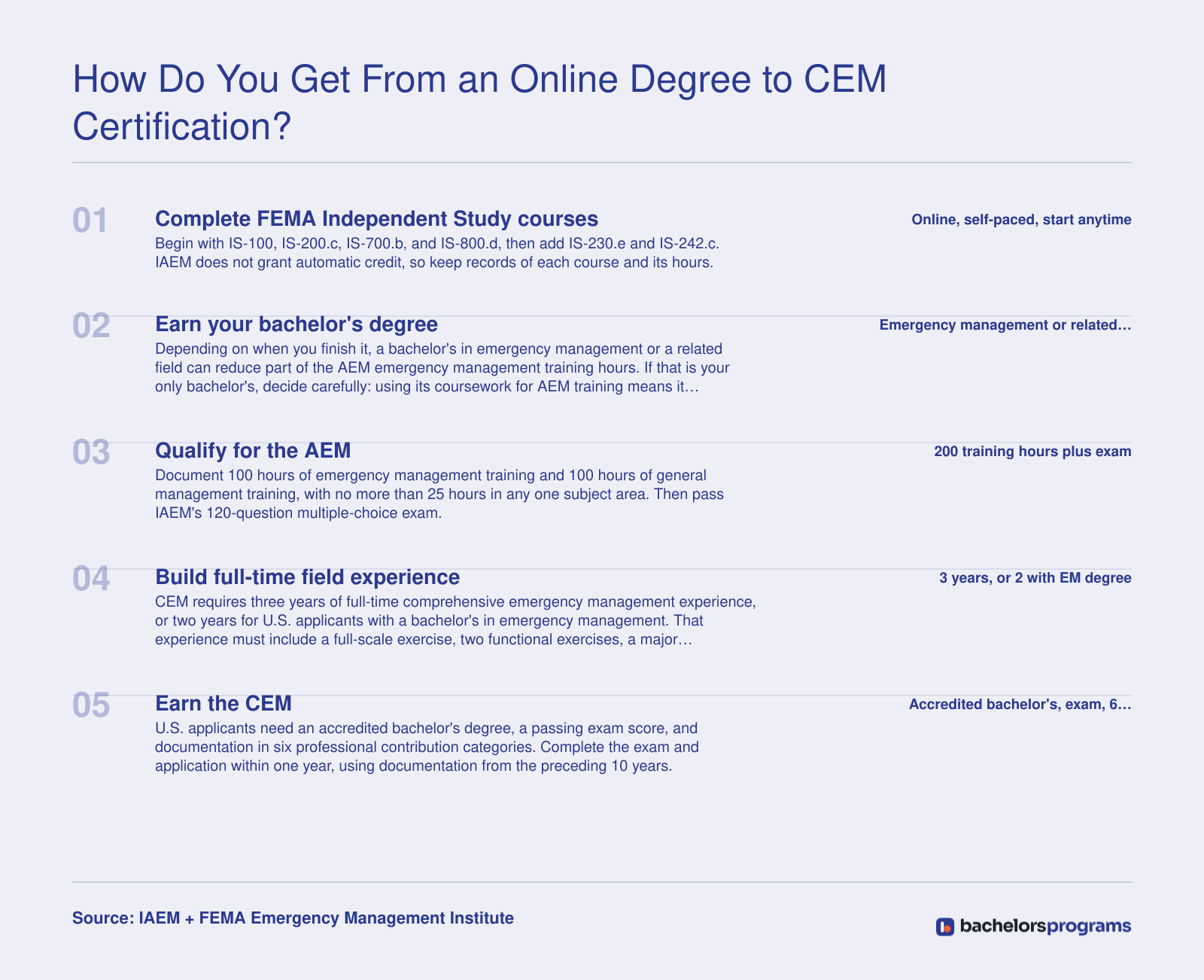
How Do You Get From an Online Degree to CEM Certification?
IAEM's two credentials, the Associate Emergency Manager (AEM) and the Certified Emergency Manager (CEM), build on training, education, and field experience. You can start the first two steps while enrolled in an online program: take FEMA's self-paced Independent Study courses and log training hours. The experience requirement comes after you graduate.
Questions to Ask Yourself
How many of your existing credits, military training, or FEMA courses will this school actually accept toward the 120?
Do you want a policy-heavy BA, a technical BS with GIS and hazard science, or a BAS that builds on your AAS?
Can you complete the internship or capstone where you live while working shifts?
Does the curriculum line up with IAEM's AEM and CEM requirements so the degree pulls double duty?
Emergency Management programs by state
Compare Emergency Management programs on the data that matters
Explore more Business & Management majors or browse every field of study.
All Business & Management programs Browse every field of study