Best Emergency Management Degree Programs
Compare 140+ accredited Emergency Management programs, with net price after aid, graduation rates, earnings and debt from IPEDS and the U.S. College Scorecard.

Emergency management is the discipline of planning for, responding to, and recovering from disasters, and a bachelor's degree covers all four phases (mitigation, preparedness, response, recovery) plus the incident command system that FEMA and state agencies operate.
Demand has grown as hurricanes, wildfires, and public health emergencies strain local budgets, pushing hospitals, utilities, and insurers to hire dedicated preparedness staff.
Cost is the dividing line. Annual tuition at the programs below ranges from a few thousand dollars at public universities to over $60,000 at private ones, and the credential employers recognize, IAEM's Certified Emergency Manager, still requires years on the job first.
Key Points
- Indian River State College lists $2,764 in-state tuition versus $10,201 out-of-state.
- BLS reports a 2025 median wage of $93,330 for emergency management directors.
- IAEM's Associate Emergency Manager credential is the entry point before full CEM.
The 10 Best Emergency Management Degree Programs
Six of the ten ranked programs below can be completed fully online, which matters if you are a working adult, a veteran, or a current responder fitting a degree around shift work. Each card shows delivery format, city and state, degree level, and any concentration so you can compare quickly. Net price and institution-wide graduation rates follow every entry.
Florida International University
#1Miami, FL · ~$9,000/yr (est.)
Best for: South Florida hurricane-zone practitioners
Florida International University is a large public research university in Miami, a setting that puts students close to the hurricane, flood, and international response work that shapes South Florida emergency management. Its disaster management faculty include senior UN and FEMA officials, and the degree is built to flex around double majors and prior learning credit for experienced practitioners.
- 120-credit degree blends public health, crisis leadership, and incident command
- Earn FEMA ICS 300 and 400 certifications plus HSEEP training
- FEMA certifications require in-person course enrollment
- Prior learning credit can accelerate completion by up to 30 credits
- Flexible structure supports double majors
- Faculty include senior UN and FEMA officials
- AA transfer students can finish with 60 credits
- Objectives aligned with FEMA core competencies
University of Central Florida
#2Orlando, FL · ~$10,000/yr (est.)
Best for: Students wanting live EOC internships
The University of Central Florida launched the first emergency management bachelor's degree in Florida and keeps students close to live operations. Seminole County opens its emergency operations center to UCF students multiple times each semester, and the program has produced nearly 200 graduates since fall 2018 while serving 108 students in spring 2026. Classes run face-to-face at UCF Downtown, in mixed-mode, and online.
- First emergency management bachelor's degree in Florida
- Internships inside live emergency operations centers
- Hands-on GIS work plus NIMS and ICS training
- Capstone in community resiliency required
- Requires a minor to complement the major
- Four concentration options available
- Formats include face-to-face, mixed-mode, and online
- Covers hazard mitigation, response, recovery, and preparedness
American Public University System
#3Charles Town, WV · $5,000 – $10,000/yr (est.)
Best for: Military and veteran online learners
American Public University System, home of American Military University, is built for service members and working adults, with monthly starts, no entrance exam, and transfer credit up to 90 hours. Faculty include board-certified emergency managers and leaders from government and security agencies, and tuition is the same in-state and out. A senior capstone simulation puts the all-hazards curriculum into practice.
- All-hazards curriculum covering mitigation through recovery
- Many faculty are board-certified emergency managers
- Senior capstone disaster simulation required
- 12 start dates per year with $0 application fee
- Transfer up to 90 credits toward the 120-hour degree
- No entrance exam required
- Military benefits accepted, with a reduced per-credit military rate
- Online courses run 8 to 16 weeks
George Washington University
#4Washington, DC · ~$37,000/yr (est.)
George Washington University sits in Washington, D.C., next door to the federal agencies that shape national emergency management policy. Its leadership for emergency action and disaster response degree is a 100% online completion program with accelerated 8-week classes starting in fall, spring, and summer, and it evaluates ACE-recognized military coursework for credit.
- 100% online bachelor's degree-completion program
- Accelerated 8-week classes in Session A and Session B
- Starts offered fall, spring, and summer
- 120 credit hours: 60 in the major, 60 in general education and electives
- Major coursework includes hazmat and CBRNE incident management
- Covers financial management across the disaster cycle
- Transfer credit evaluated for prior academic coursework
- ACE-recognized military courses may receive credit
CUNY John Jay College of Criminal Justice
#5New York, NY · ~$3,200/yr (est.)
CUNY John Jay College of Criminal Justice is a public senior college in Manhattan with a long public-safety mission and graduate emergency management coursework dating to 2001. The undergraduate program layers fire and emergency services fundamentals onto management and administration courses, and a capstone pulls all specializations into one integrative research project. CUNY's low in-state tuition makes it one of the most affordable routes on this list.
- Common core in fire and emergency services principles
- Three specializations available within the major
- Capstone integrative research project required
- Builds skills in emergency plan design and situational analysis
- Prepares students for fire services and EMS administration roles
- Sample five-year advising plan available
- Faculty department combines security, fire, and emergency management
University of New Hampshire
#6Durham, NH · $24,000/yr (est. net price)
The University of New Hampshire offers its emergency management option through the College of Professional Studies, pairing disaster planning with applied psychology. Students study risk perception, cognitive biases, and the social influences that explain why communities underprepare, then apply that to homeland security and community response. The program is fully online with 8-week terms and rolling admissions.
- 100% online with 8-week course terms
- Rolling admissions and no entrance exam required
- Transfer up to 90 credits, plus credit for prior learning
- 120 credit hours across 24 courses with a 2.0 GPA minimum
- Concentration emphasizes risk perception and cognitive biases
- Coursework spans homeland security, terrorism, and disaster management
- Integrative capstone project or internship required
- Regionally accredited by NECHE
Arizona State University
#7Tempe, AZ · ~$15,000/yr (est.)
Arizona State University delivers its emergency management and homeland security degree online or in person through the Watts College of Public Service and Community Solutions, a college ranked second nationally for graduate homeland security programs. Classes run 7.5 weeks, ACT and SAT scores are not required, and an Earned Admission pathway lets students demonstrate readiness. A capstone asks students to build real disaster planning solutions.
- Available fully online or in person
- 7.5-week classes across 40 total courses
- 120 credit hours with a capstone in disaster planning
- Covers biological threats, cybersecurity, and disaster risk reduction
- No ACT or SAT required; test optional
- Earned Admission pathway available at a 2.75 GPA
- Faculty from the Watts College of Public Service
- Prepares for roles such as emergency management director and GIS analyst
Utah Valley University
#8Orem, UT · $5,000 – $10,000/yr (est.)
Utah Valley University frames emergency management inside a broader emergency services administration degree, so students learn mitigation, preparedness, response, and recovery alongside management principles, public administration, and the psychology of emergency services. The 120-credit curriculum ends in a capstone, and online course options plus a flexible online graduation plan suit working professionals already in public safety.
- 120 credit hours with a required capstone
- Concentration in emergency management
- Covers homeland security, management, and public administration
- Online course options and a flexible online graduation plan
- Emphasizes ethical decision-making under pressure
- Teaches vulnerability assessment for populations and infrastructure
- Prepares students for public safety and security leadership roles
University at Albany
#9Albany, NY · ~$17,000/yr (est.)
The University at Albany offers emergency management and homeland security on campus or fully online, with an emergency management concentration inside a broader homeland security degree. Students complete 100 hours of approved training and can choose internships, real-world client simulations, or Washington-based programs, and an optional honors track supports independent thesis research. Combined bachelor's and master's pathways are available.
- Emergency Management concentration within a homeland security degree
- 100 hours of approved training required
- Experiential options include internships and client simulations
- Washington-based program opportunity
- Online or on-campus completion, about four years
- Optional honors thesis track
- Combined bachelor's and master's pathway available
- Coursework in risk assessment, mitigation, and crisis communication
Mercer University
#10Macon, GA · ~$24,000/yr (est.)
Mercer University is a private institution in Macon, Georgia, offering homeland security and emergency management entirely online for working adults. Eight-week sessions and five start dates a year let students keep full-time jobs, and online students get the same faculty access as on-campus peers. Service-based learning and a focus on crisis communication round out the degree.
- Available completely online
- Eight-week course sessions with five start dates per year
- Designed for working adults balancing full-time jobs
- Same faculty access as on-campus students
- Service-based learning opportunity built into the program
- Coursework in disaster planning and crisis communication
- Prepares for emergency management, public safety, and disaster response roles
Cost & outcomes by school
Federal data for the highest-earning Emergency Management programs, independent of the ranking above. Earnings are this field's bachelor's graduates four years after completing where the Scorecard reports them, else the school's undergraduate median.
| School | Net price / yr | Grad rate | Earnings | Debt | Grads/yr | Format |
|---|---|---|---|---|---|---|
| George Washington University DC | $36,586 | 84% | $90,873 | $20,449 | 7 | Online |
| Grand Canyon University AZ | $22,472 | 44% | $84,553 | $25,616 | 196 | Online |
| Massachusetts Maritime Academy MA | $21,582 | 74% | $82,392 | $25,000 | — | Campus |
| National University CA | $22,878 | 43% | $80,134 | $23,437 | 60 | Online |
| Bethel University TN | $12,595 | 35% | $79,079 | $28,709 | 13 | Online |
| Excelsior University NY | — | — | $78,493 | $13,769 | 8 | Online |
| Thomas Jefferson University PA | $28,928 | 69% | $77,449 | $14,744 | — | Online |
| American Public University System WV | $9,597 | 57% | $77,122 | $24,942 | 457 | Online |
| Colorado State University Global CO | $16,510 | — | $76,813 | $25,000 | — | Online |
| Immaculata University PA | $24,258 | 71% | $75,701 | $27,000 | 3 | Campus |
| Adelphi University NY | $30,783 | 67% | $75,482 | $25,000 | 4 | Online |
| Columbia Southern University AL | $14,580 | 33% | $73,703 | $21,628 | 109 | Online |
Sources: U.S. Department of Education. Net price, graduation rate, earnings and debt: College Scorecard (earnings and debt for this field's bachelor's graduates where reported, else school-wide); graduates: IPEDS. A dash means no figure is reported.
Cost, debt & payoff
Median earnings of this field's bachelor's graduates (4 yrs after completing, else the school's undergraduate median) vs. their median federal loan debt · U.S. College Scorecard
Across these programs the median graduate earns about $51,926 and finishes with roughly $22,281 in debt — a ratio that clears a common rule of thumb (keep debt below first-year salary). Net price and debt vary widely school to school, so check the per-school figures in the table above before you shortlist.
How We Ranked These Emergency Management Programs
A degree in emergency management should be judged by what it costs and what graduates earn, not by name recognition alone.
The Five Measures
The ranking draws on five plain inputs: average net price after aid, the institution-wide graduation rate, earnings for program completers, median federal student debt, and admissions selectivity. Each answers a different practical question. Net price shows what a student actually pays after grant aid. Graduation rate shows whether students finish. Program earnings show whether the credential pays off in the workforce. Median federal debt shows how much borrowing graduates carry. Selectivity gives a sense of the applicant pool and peer group.
The Data Behind It
Figures come from the U.S. Department of Education's College Scorecard and IPEDS data, using the 2025-26 College Scorecard snapshot. The Scorecard supplies the earnings, debt, net price, and completion figures; IPEDS supplies institutional context.
The Limits
Net price and graduation rate are school-wide averages, so they describe the institution rather than a single major. Earnings are available at the program level where the data exist, but small programs often do not have published figures. Those gaps stay gaps, not zeros.
Why Outcomes Matter More
Emergency management is a career-focused degree, and reputation surveys mostly measure familiarity. Cost, completion, borrowing, and graduate earnings tell a prospective student more about what the program will actually do for them. A familiar name does not lower a tuition bill or improve a graduate's starting salary by itself.
Emergency Management Degree Tuition Comparison: The Most Affordable Options
The most affordable emergency management programs ranked here are all at public universities, and the gap between resident and nonresident pricing is wide. Indian River State College lists $2,764 in in-state tuition against $10,201 out of state for its online public administration degree with an emergency planning concentration, so online delivery alone does not guarantee one residency-neutral rate, and Utah Valley University's out-of-state tuition of $18,489 is nearly triple its in-state figure. Federal IPEDS and College Scorecard figures for 2024 put John Jay College of Criminal Justice at the lowest average net price, $3,203, but net price is an average after grants and scholarships for aided students, not a personal quote, so run each school's net price calculator before comparing offers.
| School | Program | Format | In-State Tuition | Out-of-State Tuition | Average Net Price (After Aid) | Median Graduate Debt |
|---|---|---|---|---|---|---|
| CUNY John Jay College of Criminal Justice (New York, NY) | BS in Emergency Management | On campus | $7,470 | $15,420 | $3,203 | $11,000 |
| Indian River State College (Fort Pierce, FL) | Public Administration (Emergency Planning and Management concentration) | Online | $2,764 | $10,201 | $3,815 | $8,023 |
| Utah Valley University (Orem, UT) | Emergency Services Administration, B.S. | On campus (online course options available) | $6,507 | $18,489 | $6,376 | $14,750 |
Emergency Management Degree Jobs and Salary Outlook
Emergency management directors earned a mean of $45.05 an hour nationally in May 2023, which works out to roughly $93,700 a year for full-time work. BLS lists a 2025 median annual wage of $93,330 for the occupation. A bachelor's degree is the typical entry credential, but the role usually also asks for five or more years of related work experience.
Growth and Where the Jobs Are
BLS projects employment for directors to grow 3.9% from 2025 to 2035, from about 14,000 jobs to about 14,500. That is a small occupation with steady, not explosive, demand. Most openings come from turnover and retirements rather than new positions.
State and local governments are the largest employers of directors. Hospitals and community or emergency-relief services employ fewer, but those jobs tend to pay more. California, Washington, Florida, New York, and Texas appear among the higher-paying states in BLS data. Large, hazard-exposed jurisdictions often pay the most.
One survey of 1,178 emergency management graduates from 2020 to 2025 shows a similar pattern. It put 46% in state and local government, 14% in federal roles such as FEMA, 12% in healthcare preparedness, and 10% in private-sector business continuity. Treat those as survey shares, not federal labor statistics. The same survey reports business continuity salaries commonly landing between $90,000 and $120,000.
Realistic Job Titles
Graduates rarely start as directors. Common first and mid-career titles include:
- Emergency management specialist or coordinator: the standard entry point in city, county, and state offices.
- Business continuity analyst: planning and recovery work for corporations and financial firms.
- Hospital emergency preparedness coordinator: drills, surge plans, and regulatory readiness for health systems.
- FEMA program specialist: grants, mitigation, or recovery programs at the federal level.
- Homeland security analyst: threat assessment and planning at federal, state, or regional agencies.
Is It Worth It?
It can be, with realistic expectations. Director pay is strong, the public-sector employers are stable, and the work is mission-driven. But entry-level roles pay noticeably less than the director figures above, and the path to the top runs through experience. Internships, volunteer response work with groups like CERT or the Red Cross, and part-time roles in a local emergency office all help. A degree gets an application read, but time in the field is what moves you toward a director's role.
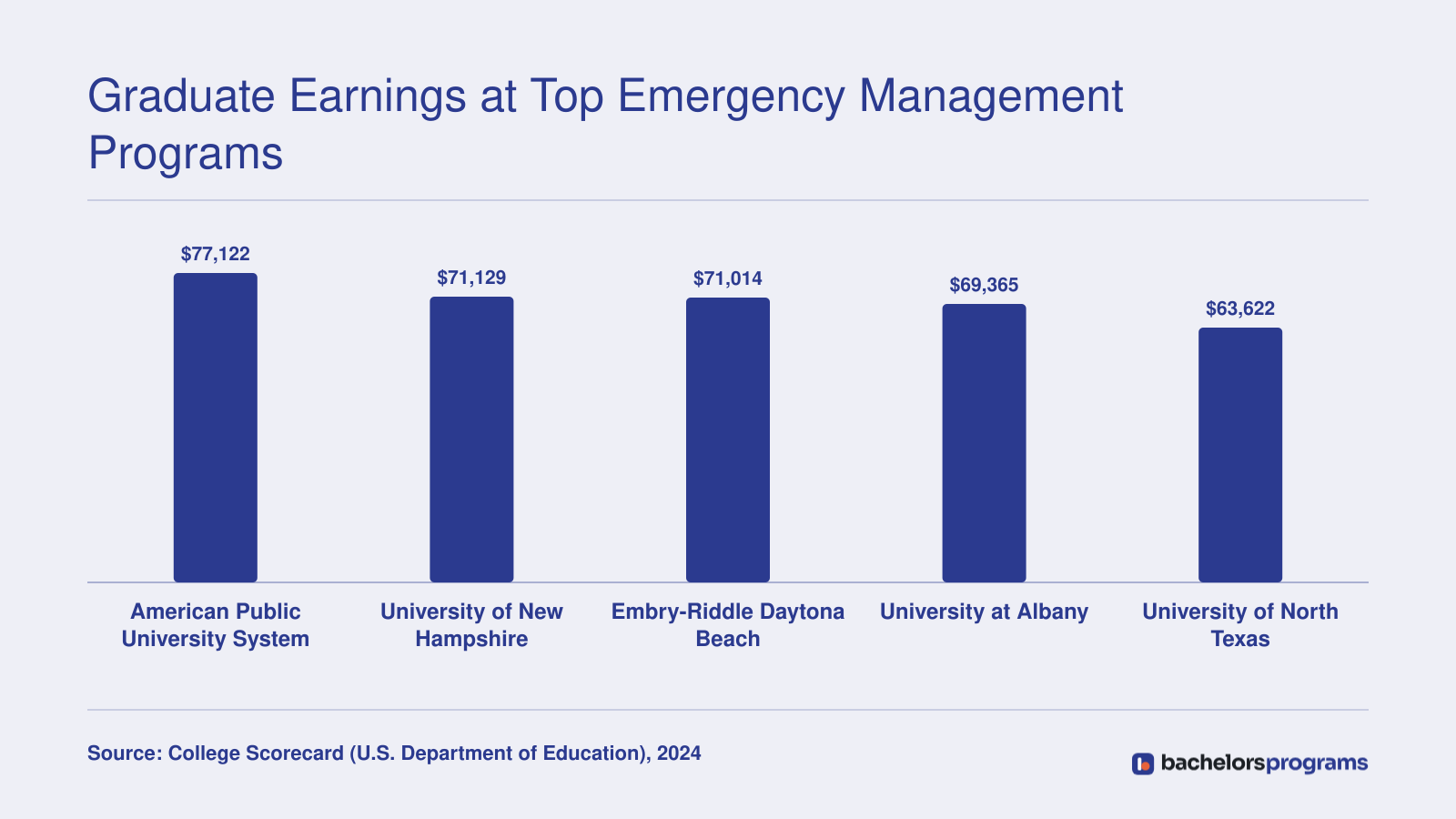
Graduate Earnings at Top Emergency Management Programs
These College Scorecard figures show median earnings for people who completed each specific emergency management bachelor's program, measured four years after completion. They track actual program graduates, so they differ from the BLS occupational wages discussed above, which cover everyone working in the field. American Public University System leads at $77,122 four years after completion, while University of North Texas graduates report $63,622 at the same point.
Related Articles
Questions to Ask Yourself
Will your work or deployment schedule allow live synchronous class sessions, or do you need fully asynchronous coursework?
Can you land an internship with a local emergency management office or hospital on your own if your online program doesn't place you?
Are you using GI Bill benefits, and does the online-only housing rate change your budget?
IAEM CEM and AEM Credential Requirements Checklist
The International Association of Emergency Managers (IAEM) awards two credentials. The Certified Emergency Manager (CEM) is the full designation, and the Associate Emergency Manager (AEM) is the entry point. Use this checklist to see where your degree fits.
- Bachelor's degree (CEM only)The CEM requires a bachelor's degree from an accredited institution. A degree more than 10 years old may still be accepted. The AEM requires no degree.
- Emergency management experience (CEM only)The CEM requires three years of full-time, comprehensive disaster or emergency management work. U.S. applicants with a bachelor's in emergency management need two years. The work must include a full-scale exercise, two functional exercises, a phase of a declared disaster, or a major public event.
- 200 training hoursBoth credentials require 100 hours of emergency management training and 100 hours of general management training, generally from the last 10 years. Each subject is capped at 25 hours, and all hours need third-party verification. An emergency management degree can waive or reduce the emergency management hours but not the general management hours.
- FEMA Independent Study coursesFree FEMA Independent Study courses count toward training hours when you document them with an official FEMA certificate. The 25-hour subject cap applies.
- Contributions, references, essay and examCandidates document professional contributions, and the CEM requires six separate categories. You also need a current-supervisor reference, and two additional references are optional. Both credentials require an essay and a 120-question multiple-choice exam.
- AEM as a stepping stoneThe AEM skips the CEM education and work-history requirements, so it suits students and recent graduates. If you use only your bachelor's coursework for AEM training hours, that same degree cannot later satisfy the CEM education requirement.
Questions to Ask Yourself
Do you see yourself in public-sector disaster response, hospital preparedness, or corporate business continuity?
Will you pursue the CEM within five years of graduating?
Is a lower in-state net price worth giving up an online program's flexibility?
Emergency Management programs by state
Emergency Management Degree FAQs
These answers cover the questions prospective students ask most often about choosing a degree, its value, and how FEMA training and hiring connect to a bachelor's. Confirm specifics with the school or the job announcement you are considering.
What is the best degree for emergency management?
Is an emergency management degree worth it?
Can FEMA Emergency Management Institute courses earn college credit toward a degree?
Do you need a degree to work for FEMA?
Compare Emergency Management programs on the data that matters
Explore more Business & Management majors or browse every field of study.
All Business & Management programs Browse every field of study