Best Finance Schools in Colorado
Compare 13 accredited Finance programs in Colorado, with net price after aid, graduation rates, earnings and debt from IPEDS and the U.S. College Scorecard.

A bachelor's degree in finance is the usual entry point to analyst, lending and advisory jobs in the Denver-Boulder market, home to banks, wealth managers and corporate finance teams. Most programs award a Bachelor of Science (B.S.) in Finance. Others place finance inside a business administration or economics degree.
Ranking matters, but price, online options, admission standards and career outcomes separate these programs just as sharply.
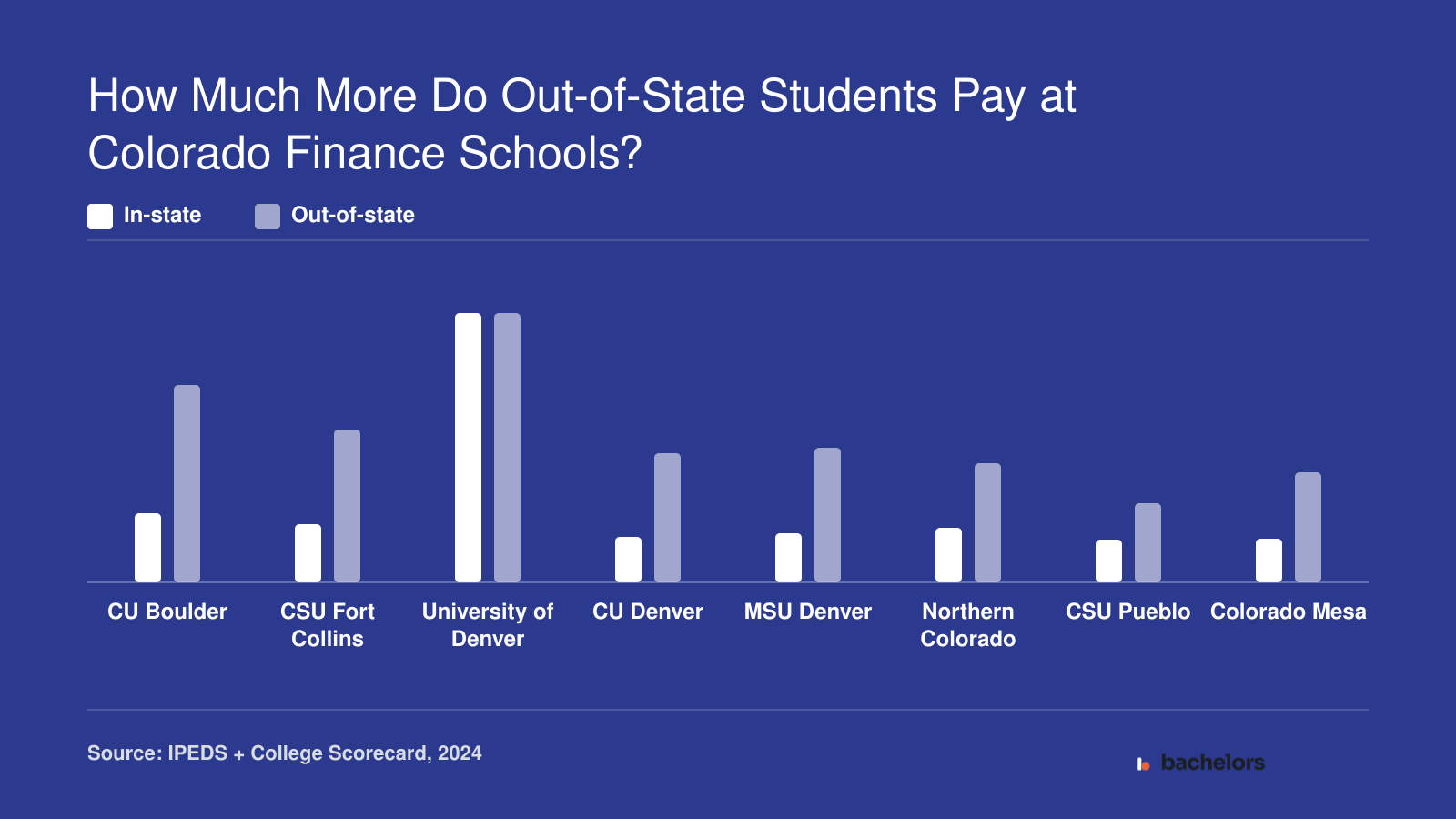
Price creates the sharpest tension. At CU Boulder, residents pay $15,666 in tuition and fees while out-of-state students pay $44,918, a $29,252 yearly gap that can matter more than program prestige.
Key Points
- CU Boulder residents pay $15,666 in tuition versus $44,918 out-of-state.
- Colorado State University Pueblo posts the lowest average net price here.
- Colorado finance graduates work as financial analysts, advisors and loan officers.
Best Bachelor's in Finance Schools in Colorado: Our Ranked List
Colorado's finance bachelor's degrees run from a flagship program with six career-focused tracks to a downtown Denver business school where students manage money in a real endowment portfolio. The ten schools below cover public flagships, urban commuter campuses and private universities, and each entry notes the program structure, concentrations and hands-on opportunities that set it apart. Use these summaries to shortlist programs, then compare cost and admission details before you apply.
University of Colorado Boulder
#1Boulder, CO · $25,000 – $30,000/yr (est.)
Best for: Aspiring investment bankers and portfolio analysts
The state's flagship campus, CU Boulder delivers its finance area of emphasis through the Leeds School of Business, where undergraduates choose a focus such as investment banking, investment management, corporate finance or entrepreneurial finance. The Burridge Center for Finance connects students to capital markets, banking, fintech and regulatory professionals through events, competitions and industry programming. Roughly three in four students finish their degree, and the Boulder campus carries the widest name recognition of any finance program in Colorado.
- Six focus areas including investment banking, investment management and corporate finance
- Options also cover commercial banking, entrepreneurial finance and personal finance
- Burridge Center for Finance hosts networking events and competitions
- Curriculum stresses evaluating new technologies and platforms critically
- Finance professionals projected to grow 7 percent
Colorado State University-Fort Collins
#2Fort Collins, CO · ~$21,000/yr (est.)
Best for: Students wanting a real estate finance track
Colorado State's Fort Collins campus houses finance as a concentration inside the Bachelor of Science in Business Administration, with options in corporate finance, investment analysis and real estate finance. Students take at least 24 credits of finance coursework on top of the university core and business college requirements, and the full degree runs 120 credits. Tuition sits far below the state's private options, and the Fort Collins campus pairs the degree with a broad, traditional college experience.
- At least 24 credits of finance-specific coursework beyond the business core
- Three options: corporate finance, investment analysis or real estate finance
- Core includes Principles of Finance, Financial Markets and Institutions, Principles of Investments
- 120 total credits for the degree
- 2.000 minimum GPA in business and economics courses to graduate
- Course listings reflect the 2026-2027 catalog
University of Denver
#3Denver, CO · ~$36,000/yr (est.)
Best for: Hands-on investors managing real endowment money
The University of Denver's Reiman School of Finance runs a finance bachelor's built around applied investing: students in the Reiman Fund class research sectors, select stocks and manage recommendations that are actually invested in a portfolio tied to the university endowment. The Daniels College of Business sits in Denver, giving students access to the city's banking, private-equity and corporate finance employers. A 4+1 option lets students add a master's degree in a fifth year.
- Reiman Fund class: students pitch stocks that are invested in a real endowment portfolio
- Covers sector analysis, stock selection and portfolio management
- Uses industry datasets and analytical tools in coursework
- 4+1 option adds a master's degree in a fifth year
- Reiman School of Finance housed in the Daniels College of Business
Regis University
#4Denver, CO · ~$18,000/yr (est.)
Regis University is a private Jesuit campus in north Denver that offers a Bachelor of Science in Finance inside a broad business administration core. Courses cover business finance, international finance and fundamentals of investments, and the FastForward option lets students apply up to four graduate courses toward the bachelor's degree. Classes run in 16-week semesters with full-time and part-time enrollment, and applications are reviewed on a rolling basis.
- Up to four graduate courses can count toward the bachelor's degree through FastForward
- Courses include Business Finance, International Finance and Fundamentals of Investments
- 16-week semesters with full-time and part-time enrollment
- Rolling admissions with scholarships and grants available
- Jesuit, whole-person education model
University of Colorado Denver/Anschutz Medical Campus
#5Denver, CO · $10,000 – $15,000/yr (est.)
CU Denver's Business School awards the finance degree as a Bachelor of Science in Business Administration on its downtown Denver campus. The curriculum covers financial management, investments, financial institutions and international finance, with upper-division electives that let students steer the degree toward corporate finance, securities or personal financial planning. As a public urban campus, it draws a mix of working students, transfers and commuters.
- Covers financial management, investments, financial institutions and international finance
- Upper-division finance electives tailor the degree to career goals
- Emphasis on financial policy, control and value-maximizing decisions
- Prepares for business finance, mutual funds, securities and wealth management roles
- Degree awarded by the CU Denver Business School
Colorado Christian University
#6Lakewood, CO · $25,000 – $30,000/yr (est.)
Colorado Christian University in Lakewood offers a Bachelor of Science in Finance through its School of Business and Leadership, taught from a Christian framework by practitioner-professors. The major covers asset valuation, cost of capital, budgeting and forecasting, with electives in derivatives, fintech, new-venture financing and international finance. A dual degree path lets students start MBA coursework in leadership or project management while finishing the bachelor's.
- Dual degree path applies coursework toward an MBA in Leadership or Project Management
- Electives in derivatives, FinTech, new-venture financing and international finance
- Covers asset valuation, raising funds, cost of capital, budgeting and forecasting
- Taught by practitioner-professors within a Christian framework
- Major, minor and dual degree options available
Metropolitan State University of Denver
#7Denver, CO · $15,000/yr (est. net price)
Metropolitan State University of Denver runs its finance major inside an AACSB-accredited business college and is one of only three Colorado programs registered with the CFP Board, so graduates can sit for the CFP certification exam. Small classes and faculty mentorship support a practical curriculum in capital markets, financial modeling and data analysis. Internships with local employers and the CFA Student Research Challenge give students applied experience, and alumni work at firms such as Charles Schwab and Wells Fargo.
- One of three Colorado programs registered with the CFP Board
- Graduates can sit for the CFP certification exam
- AACSB-accredited College of Business
- Small classes with close faculty mentorship
- Internships with local companies and the CFA Student Research Challenge
- Coursework in capital markets, financial modeling and data analysis
University of Northern Colorado
#8Greeley, CO · $18,000/yr (est. net price)
The University of Northern Colorado in Greeley offers finance as one of 11 concentrations inside its 120-credit Business Administration BS. Every major completes a business core in accounting, marketing and operations management plus three professional experience workshops and an internship or approved professional experience. Juniors with a 3.0 GPA can take three MBA-level courses that count toward both degrees, and the Monfort College of Business holds AACSB accreditation.
- Finance is one of 11 concentrations in the 120-credit Business Administration BS
- Business core in accounting, marketing and operations management
- Three professional experience workshops plus an internship or approved experience
- Juniors with a 3.0 GPA can take three MBA-level courses counting toward both degrees
- Monfort College of Business holds AACSB accreditation
- Students often rank in the top 5-10 percent nationally on the ETS Field Test
Colorado State University Pueblo
#9Pueblo, CO · $10,000/yr (est. net price)
CSU Pueblo awards the finance concentration through its Bachelor of Science in Business Administration in Economics, blending economic theory with applied finance coursework. Students take intermediate microeconomics, money and banking, and 12 credits of upper-level finance electives on top of a foundation in accounting, management and business statistics. A senior capstone requires the ETS Major Field Test, and published tuition here is the lowest among the four-year finance programs in this list.
- Finance concentration inside the Economics BSBA
- 12 credits of upper-level finance electives
- Includes intermediate microeconomics and money and banking
- Senior capstone requires the ETS Major Field Test
- 120 total credit hours
- Prepares for banking, financial analysis and financial services roles
Colorado Mesa University
#10Grand Junction, CO · ~$15,000/yr (est.)
Colorado Mesa University in Grand Junction offers a finance concentration within its Bachelor of Business Administration, covering managerial finance, risk management, investments, security analysis and international financial management. A 3+2 option lets students earn both the BBA and an MBA in five years, and the curriculum lines up with CFA exam topics. The Grand Junction campus serves Colorado's Western Slope with tuition below the Front Range public universities.
- Courses in managerial finance, risk management, investments and security analysis
- Also covers portfolio management and international financial management
- 3+2 option earns the BBA and MBA in five years
- 2.0 GPA minimum; capstone required
- Curriculum aligns with CFA exam topics
- 120 total credit hours with room for a second concentration
Cost & outcomes by school
Federal data for the highest-earning Finance programs, independent of the ranking above. Earnings are this field's bachelor's graduates four years after completing where the Scorecard reports them, else the school's undergraduate median.
| School | Net price / yr | Grad rate | Earnings | Debt | Grads/yr | Format |
|---|---|---|---|---|---|---|
| University of Denver CO | $36,131 | 76% | $99,135 | $19,500 | 131 | Campus |
| Regis University CO | $18,397 | 61% | $91,631 | $25,000 | 11 | Campus |
| Metropolitan State University of Denver CO | $15,327 | 32% | $77,596 | $20,437 | 56 | Campus |
| University of Colorado Boulder CO | $25,346 | 74% | $69,738 | $19,500 | — | Campus |
| University of Colorado Denver/Anschutz Medical Campus CO | $11,900 | 46% | $64,270 | $20,500 | — | Hybrid |
| Colorado State University-Fort Collins CO | $21,279 | 67% | $60,543 | $20,000 | — | Campus |
| Colorado State University Pueblo CO | $10,051 | 40% | $55,563 | $21,500 | — | Campus |
| University of Colorado Colorado Springs CO | $15,788 | 47% | $54,659 | $20,000 | — | Online |
| University of Northern Colorado CO | $17,760 | 51% | $52,231 | $20,470 | — | Campus |
| Colorado Christian University CO | $29,500 | 64% | $50,416 | $28,312 | 10 | Campus |
| Western Colorado University CO | $16,425 | 51% | $46,833 | $20,250 | — | Campus |
| Colorado Mesa University CO | $15,103 | 41% | $45,823 | $22,000 | — | Campus |
Sources: U.S. Department of Education. Net price, graduation rate, earnings and debt: College Scorecard (earnings and debt for this field's bachelor's graduates where reported, else school-wide); graduates: IPEDS. A dash means no figure is reported.
Cost, debt & payoff
Median earnings of this field's bachelor's graduates (4 yrs after completing, else the school's undergraduate median) vs. their median federal loan debt · U.S. College Scorecard
Across these programs the median graduate earns about $55,563 and finishes with roughly $20,470 in debt — a ratio that clears a common rule of thumb (keep debt below first-year salary). Net price and debt vary widely school to school, so check the per-school figures in the table above before you shortlist.
Most Affordable Bachelor's in Finance Programs in Colorado
Colorado's public universities keep a bachelor's degree in finance within reach for in-state students, and the options below are sorted by average net price, what families actually pay after grants and scholarships. Colorado State University Pueblo has the lowest average net price, at $10,051, with CU Denver close behind. Figures come from the U.S. Department of Education's IPEDS and College Scorecard data (2024).
| School | City | Finance Program | Format | In-State Tuition & Fees | Out-of-State Tuition & Fees | Average Net Price | Graduation Rate |
|---|---|---|---|---|---|---|---|
| Colorado State University Pueblo | Pueblo | Economics: Finance Concentration | Campus | $9,720 | $17,944 | $10,051 | 39.7% |
| University of Colorado Denver/Anschutz Medical Campus | Denver | Finance, BS in Business Administration | Hybrid | $10,383 | $29,391 | $11,900 | 46.1% |
| Colorado Mesa University | Grand Junction | Finance, Business Administration (BBA) | Campus | $9,927 | $25,124 | $15,103 | 40.6% |
| Metropolitan State University of Denver | Denver | Finance Major, B.S. | Campus | $11,124 | $30,684 | $15,327 | 31.5% |
| University of Colorado Colorado Springs | Colorado Springs | Business, BS - Finance | Campus, online, or hybrid | $10,149 | $24,336 | $15,788 | 46.9% |
What to Expect From a Bachelor's Degree in Finance in Colorado
Finance programs in Colorado differ more in packaging than in subject matter. The coursework is fairly consistent across the state. Most B.S. in Finance programs combine a general business core (accounting, marketing, operations) with finance courses in corporate finance, investments, and financial markets. Exact course lists vary, so check each school's catalog page.
Major, Emphasis, or Concentration?
The terms are used loosely, and Colorado schools package finance in different ways.
- Standalone major: Regis University, Colorado Christian University, and Metropolitan State University of Denver list finance as a standalone bachelor's major.
- Concentration or track inside a business degree: the University of Northern Colorado houses finance in its Business Administration B.S., and Colorado State University Pueblo offers a finance concentration within an economics degree.
- Finance with sub-options: the University of Colorado Boulder describes six concentration options, Colorado State University-Fort Collins lists three, and Colorado Mesa University lists nine. Colorado State's page cites 24 credits of finance-specific courses.
Compare the degree title, the required credits, and the elective menu, not just the word "finance."
Why AACSB Accreditation Matters
AACSB is the leading global accreditor of business schools, and employers and graduate programs often look for it.1 AACSB's directory lists the University of Colorado Boulder, Colorado State University, the University of Denver, the University of Colorado Denver, the University of Colorado Colorado Springs, Metropolitan State University of Denver, the University of Northern Colorado, Colorado Mesa University, and Colorado State University Pueblo. Confirm current status on AACSB's site before you apply.
Planning-Oriented Paths
If you want to become a financial planner, look closely at program pages. Metropolitan State University of Denver describes itself as a CFP Board registered program preparing students for the CFP exam. Colorado Mesa University mentions financial analyst exam preparation. The University of Colorado Denver points to careers in financial planning firms.
Questions to Ask Yourself
Do you want a corporate finance and banking track, or a financial planning track that leads toward CFP coursework?
Would studying in Denver or Boulder put you closer to the employers you want, or is a smaller campus a better fit?
Does a business school's AACSB accreditation matter for the roles or graduate options you want later?
Will you need to work while enrolled, and do the class schedule and internship requirements allow it?
Online and Hybrid Bachelor's in Finance Options at Colorado Schools
An online or hybrid bachelor's degree in finance lets you complete some or all coursework off campus while earning the same B.S. or business degree with a finance focus. Here, "online" means online through a Colorado-based school, so your options come from in-state institutions rather than a national provider.
Where Online and Hybrid Formats Exist
Metropolitan State University of Denver is the clearest case. Its B.S. in Finance was listed as available online, hybrid, and face-to-face for 2024-25, even though the school's general format label reads campus.1 University of Colorado Denver is labeled hybrid, but its program description stresses on-campus delivery, so treat it as a campus-first program with possible flexibility.
Campus-Only Programs
University of Denver and the University of Colorado Colorado Springs are listed as fully face-to-face for 2026, so neither offers an online route.2 University of Colorado Boulder, Colorado State University-Fort Collins, Colorado Christian University, University of Northern Colorado, Colorado State University Pueblo, and Colorado Mesa University carry campus labels. Regis University describes an on-campus course format. We could not confirm online or hybrid finance delivery at any of these schools.
Who Benefits, and How to Verify
Flexible formats tend to suit working adults and transfer students who need to keep a job or finish credits already earned. Regis says its classes are designed for working professionals, which may help part-time students even without an online option.
A format label is only a starting point. Before you apply, open the finance program page and the current schedule at each school. Confirm whether required finance courses are offered online or hybrid every term, and whether any in-person sessions, internships, or capstones are required.
Admission Requirements for Colorado Bachelor's in Finance Programs
What does admission to a Colorado finance program actually require? The answer depends on the campus, and the most selective business schools can add a second gate.
CU Boulder is the clearest example. It publishes no single required first-year GPA. Instead, it weighs GPA alongside core-course performance, rigor relative to your school's offerings, and the rest of your application. The middle 50% of admitted first-years for 2026 had a weighted high school GPA of 3.70 to 4.26; for the College of Arts & Sciences, the range was 3.62 to 4.20. CU Boulder publishes no separate first-year GPA range for Leeds or finance. SAT and ACT scores are not required for the 2027 admission cycle, and self-reported scores are accepted.
Test policy and admit rates
Colorado's public four-year institutions have been allowed to make SAT and ACT optional since 2021, so test-optional review is common across the public campuses here.1 Admit rates still vary. MSU Denver and CSU Pueblo admit nearly all applicants (98.8% and 94.9%), while CU Boulder and the University of Denver admit roughly 78%. The admit rate tells you how many applicants receive an offer, not what the finance program requires once you enroll.
Transfer credit and the Leeds gate
At CU Boulder, recognized college courses with a C- or better may count, and there is no minimum number of transfer credit hours. Applicants with fewer than 24 post-high-school credits are reviewed on both their college and high school records. Leeds is stricter for transfer: a 3.2 GPA plus microeconomics, macroeconomics and statistics, with business statistics strongly preferred and general statistics accepted. CU Denver's finance transfer map caps applicable transfer credit at 90 hours, recommends 30 credits a year, and lists a 2.0 CU/business GPA without making clear whether that figure governs admission, continuation or graduation.2
When no policy is published
For several programs on this list, we found no published finance-specific first-year GPA or test rule. Do not assume a number. Ask undergraduate admissions which general first-year criteria apply and whether the business school has a separate admission or continuation requirement. For community college students, the practical tip is to finish more than 24 college-level credits after high school before transferring.1 Statewide recommended transfer GPAs run from 2.30 to 2.70, but those are guidance, not guarantees.1 Send official transcripts directly and use Transferology to check how courses count before you apply.
Related Articles
Questions to Ask Yourself
Will you qualify for Colorado in-state tuition, and what would out-of-state tuition add to your total?
Does the school's average net price, not its sticker price, fit your budget once aid is counted?
Would starting at a community college and transferring cut the total cost without losing finance credits?
How Much More Do Out-of-State Students Pay at Colorado Finance Schools?
At Colorado's public universities, residency is the biggest factor in your tuition bill. CU Boulder shows the widest gap: out-of-state students pay $44,918 in tuition and fees versus $15,666 for residents, a difference of $29,252 a year. Private schools such as the University of Denver charge everyone the same rate, so if you plan to establish Colorado residency, check each public school's residency rules before you enroll.
Finance Careers and Wages in Colorado
A bachelor's degree in finance prepares graduates for Colorado roles such as financial analyst, personal financial advisor and loan officer. In the Denver metro, May 2025 U.S. Bureau of Labor Statistics data puts the median annual wage at $132,020 for personal financial advisors and $103,790 for loan officers. These figures cover all workers in each occupation, not the early-career graduate earnings shown for schools elsewhere in this article, and statewide and Boulder figures were not reported in the data we reviewed, so check the Colorado Department of Labor and Employment's 2025 wage tables before comparing metros.
| Occupation | Colorado Statewide Median Wage | Denver Metro Median Wage | Boulder Metro Median Wage |
|---|---|---|---|
| Personal financial advisors | N/A | $132,020 | N/A |
| Loan officers | N/A | $103,790 | N/A |
Common Questions About Finance Degrees in Colorado
These answers draw on the school, cost, online and licensing details covered earlier on this page. Figures are estimates and vary by residency, credits and aid.
What is the best finance school in Colorado?
How much does a bachelor's degree in finance cost in Colorado?
Does Colorado have online finance degrees?
Do I need a CFP to work as a financial advisor in Colorado?
Compare Finance programs on the data that matters
Explore more Business & Management majors or browse every field of study.
All Business & Management programs Browse every field of study