Best Cybersecurity Schools in Colorado
Compare 13 accredited Cybersecurity programs in Colorado, with net price after aid, graduation rates, earnings and debt from IPEDS and the U.S. College Scorecard.

What does a bachelor's degree in cybersecurity actually lead to in Colorado? Often it leads to Colorado Springs, where defense contractors and federal installations hire for cleared security roles, or to the Denver tech corridor, where banks, health systems and software firms staff their own security teams.
The usual credential is the Bachelor of Science (B.S.) in Cybersecurity, though several Colorado schools offer a Bachelor of Applied Science or a security concentration inside computer science or information systems. Cost, format and career fit vary widely.
The real tradeoff is between a lower-cost applied path that gets you working sooner and a research-oriented university route with deeper theory and federal recruiting ties.
Key Points
- University of Colorado Denver tops the ranking with a dedicated cybersecurity B.S.
- Pikes Peak State College averages just $6,007 a year after aid.
- Colorado information security analysts averaged $128,340 a year in May 2023.
The 10 Best Bachelor's in Cybersecurity Programs in Colorado, Ranked
Short answer: the University of Colorado Denver offers the strongest overall combination of a dedicated Bachelor of Science in Cybersecurity, a Denver location, and a shared cyber range with UCCS. UCCS is the better fit for students who want security taught inside a business degree, and the Air Force Academy is the one to beat for anyone aiming at military cyber operations. The ten programs below run from research universities to applied bachelor's degrees built on top of an associate degree, so the right pick depends heavily on where you are starting.
University of Colorado Denver/Anschutz Medical Campus
#1Denver, CO · $10,000 – $15,000/yr (est.)
Best for: Denver learners preferring in-person instruction
CU Denver delivers cybersecurity as a full Bachelor of Science rather than a concentration, with the curriculum split into 31 credits of computer science core, 32 credits of cybersecurity core and 15 credits of electives on top of general education. Coursework covers both offensive and defensive technique, and the campus shares a cyber range with UCCS for simulated attack and defense exercises. Around 46 percent of undergraduates finish within six years, and the downtown Denver address puts students close to the state's densest cluster of security employers.
- 120 credits required, including 24 credits of core curriculum
- 31 credits of computer science core
- 32 credits of cybersecurity core plus 15 credits of electives
- 3 credits of engineering design capstone
- Balances offensive and defensive security strategy
- Prepares students for public and private sector security roles
University of Colorado Colorado Springs
#2Colorado Springs, CO · $10,000 – $24,000/yr (est.)
Best for: Business-minded students eyeing management tracks
UCCS teaches cybersecurity inside its business school, awarding a Bachelor of Science in Business with a Cybersecurity Management emphasis rather than a standalone technical degree. The 24-credit emphasis runs through computer networks, security technologies, IT risk management and security auditing, with electives in ethical hacking, cloud computing and advanced networking. The campus coordinates the Mountain West Cybersecurity Consortium and works with the National Cybersecurity Center, and about 47 percent of undergraduates finish within six years.
- 24 semester hours in the cybersecurity management emphasis
- 2.5 GPA required in emphasis courses, with no grade below C-
- Core courses in networks, security technologies and IT risk management
- Security auditing core plus ethical hacking and cloud electives
- 120 total credits
- Internship option available within the emphasis
United States Air Force Academy
#3USAF Academy, CO
Best for: Aiming at military cyber operations careers
The Air Force Academy teaches Cyber Science as a major accredited by ABET, with coursework spanning programming, embedded systems, networks, cryptography, cyber warfare and cyber operations. No prior programming experience is assumed, and graduates commission into roles such as cyber operations officer, intelligence officer or pilot, while civilian paths include network administrator and IT security consultant. It is a service academy with a highly selective admissions process and a military commitment attached, so it suits a very specific applicant. Roughly 88 percent of students graduate.
- ABET accredited under computing and cybersecurity program criteria
- Coursework in cryptography, cyber warfare and cyber operations
- No prior programming experience required or assumed
- Prepares cyber operations officers and intelligence officers
- Civilian paths include network administrator and IT security consultant
- Program objectives measured two to five years after graduation
Colorado State University-Fort Collins
#4Fort Collins, CO · ~$21,000/yr (est.)
Colorado State offers cybersecurity as the Networks and Security concentration inside its Computer Science major, a 120-credit path built on systems security, modern cybersecurity, ethical hacking and cryptography. Students also take operating systems, algorithms and software engineering, and the on-campus Cyber-Security Center supports security projects and research. About 67 percent of undergraduates finish within six years, one of the stronger completion records among the public options here.
- 120 credit hours, with a C minimum in required courses
- Core courses in systems security, modern cybersecurity and computer networks
- Includes ethical hacking and cryptography coursework
- Technical electives plus operating systems, algorithms and software engineering
- Cyber-Security Center resources available to students
- Calculus preparation recommended before entry
Red Rocks Community College
#5Lakewood, CO · $5,000 – $10,000/yr (est.)
Red Rocks Community College awards a Bachelor of Applied Science in Cybersecurity designed as a completion degree for students who already hold an Associate of Applied Science in Cybersecurity or Secure Software Development. The 120-credit program is hands-on and project based, with cybersecurity simulations, network management and secure coding, and an industry advisory board shapes the curriculum. About 32 percent of undergraduates finish within six years, and the applied format is aimed squarely at transfer students rather than first-time freshmen.
- 120 credits, built for AAS in Cybersecurity or Secure Software Development holders
- Project-based coursework with cybersecurity simulations
- Covers network management, secure coding, cloud computing and AI-driven tools
- Industry advisory board input on curriculum
- Emphasizes technical communication and critical thinking
- Applications processed through the department chair
Colorado State University Global
#6Denver, CO · ~$17,000/yr (est.)
CSU Global is the online arm of the Colorado State University system, and its Bachelor of Science in Cybersecurity is built for working adults: 8-week asynchronous courses, 12 start dates a year and up to 90 transfer credits from prior college, military service or career experience. The 120-credit curriculum covers network security, database management, digital forensics and ethical hacking, closing with a capstone. Tuition runs $375 per credit with no fees and no out-of-state rate, which makes it one of the more predictable price points in the state.
- 120 credits at $375 per credit with no fees
- Asynchronous 8-week courses with 12 start dates per year
- Transfer up to 90 credits, including military and career experience
- Prepares students for CISSP, CCSP and SSCP certifications
- Coursework in ethical hacking, digital forensics and network security
- Cybersecurity capstone project to close the degree
University of Denver
#7Denver, CO · ~$36,000/yr (est.)
The University of Denver treats cybersecurity as a concentration inside the Bachelor of Science in Computer Science, taught by the Department of Computer Science, which also runs a companion Artificial Intelligence concentration. Computer Science can be taken as a BA or a BS, and the minor is open to every degree, so students can pair security study with a second field. About 76 percent of undergraduates finish within six years, the strongest completion rate among the four-year options listed here.
- Concentration sits inside the Computer Science BS
- Computer Science also available as a BA
- Second concentration offered in Artificial Intelligence
- Computer Science minor open to all degrees
- Bulletin charts majors, minors and concentrations by degree
Colorado State University Pueblo
#8Pueblo, CO · $10,000/yr (est. net price)
CSU Pueblo teaches cybersecurity as the Cyber Security concentration inside the Bachelor of Science in Computer Information Systems, housed in the Hasan School of Business. The 18-credit concentration runs through network systems administration, cyber security and defense, IT security risk management and computer forensics, plus upper-division CIS electives, and the coursework covers cryptography, wireless security, disaster recovery and cyber law. About 40 percent of undergraduates finish within six years, and the program participates in Colorado's statewide cybersecurity workforce collaboration.
- 18-credit Cyber Security concentration in the Hasan School of Business
- Three concentration options: Cyber Security, Data Analytics, Software Development
- CIS 460 Cyber Security and Defense and CIS 461 IT Security Risk Management
- CIS 462 Computer Forensics plus 6 credits of upper-division CIS electives
- Covers cryptography, wireless security, disaster recovery and cyber law
- Networking Concepts prerequisite for three of the core courses
Pikes Peak State College
#9Colorado Springs, CO · $5,000 – $10,000/yr (est.)
Pikes Peak State College awards a Bachelor of Applied Science in Cybersecurity that stacks onto an associate degree: 60 credits come from the AAS, then 60 upper-division credits cover cyber law, business continuity, forensics, vulnerability assessment, active cyber defense and threat intelligence. Students choose 16 hours of Network Security Operations electives such as zero trust networks, malware threats and analysis, and cyber war. Admission is selective and competitive, and applicants without a related associate degree are directed into a certificate or AAS first. About 21 percent of undergraduates finish within six years.
- 120 credits: 60 from an associate degree, 60 upper division
- Selective, competitive admission; declaring the major does not admit you
- Upper division covers cyber law, forensics, vulnerability assessment and threat intelligence
- 16 hours of Network Security Operations emphasis electives
- Electives include zero trust networks, malware analysis and cyber war
- Applicants without a related associate degree steered to certificate or AAS
Arapahoe Community College
#10Littleton, CO · ~$12,000/yr (est.)
Arapahoe Community College offers a Bachelor of Applied Science in Cybersecurity split into 30 general education credits, 40 lower-division major credits and 44 upper-division credits, with virtual labs and interactive modules throughout. Upper-division work covers cyber law and ethics, cyber operations, investigation and forensics, active cyber defense and threat intelligence, plus four Network Security Operations electives that include an internship and a capstone. Entry requires a completed associate degree or enrollment in a related one, such as the AAS in Cybersecurity, Networking or Secure Software Development. About 29 percent of undergraduates finish within six years.
- 120 credits: 30 general education, 40 lower division, 44 upper division
- Virtual labs and simulations for hands-on practice
- Upper division covers cyber operations, forensics, active cyber defense and threat intelligence
- Four Network Security Operations electives, including internship and capstone
- Requires a completed associate degree or enrollment in a related one
- Coursework in cryptography and ethical hacking
Cost & outcomes by school
Federal data for the highest-earning Cybersecurity programs, independent of the ranking above. Earnings are this field's bachelor's graduates four years after completing where the Scorecard reports them, else the school's undergraduate median.
| School | Net price / yr | Grad rate | Earnings | Debt | Grads/yr | Format |
|---|---|---|---|---|---|---|
| Colorado State University Global CO | $16,510 | — | $76,813 | $25,000 | — | Online |
| University of Denver CO | $36,131 | 76% | $71,155 | $21,844 | — | Campus |
| University of Colorado Denver/Anschutz Medical Campus CO | $11,900 | 46% | $64,270 | $20,500 | — | Campus |
| Colorado State University-Fort Collins CO | $21,279 | 67% | $60,543 | $20,000 | — | Campus |
| Colorado State University Pueblo CO | $10,051 | 40% | $55,563 | $21,500 | — | Campus |
| University of Colorado Colorado Springs CO | $15,788 | 47% | $54,659 | $20,000 | — | On Campu |
| Metropolitan State University of Denver CO | $15,327 | 32% | $52,093 | $21,500 | — | Campus |
| Arapahoe Community College CO | $11,571 | 29% | $48,341 | $11,884 | — | Online |
| Red Rocks Community College CO | $9,044 | 32% | $46,288 | $9,500 | — | Campus |
| Pikes Peak State College CO | $6,007 | 21% | $40,796 | $9,000 | — | Campus |
| Pueblo Community College CO | $12,045 | 31% | $37,434 | $10,000 | — | Campus |
| Colorado Technical University-Colorado Springs CO | $16,745 | 19% | $37,180 | $29,832 | — | Hybrid |
Sources: U.S. Department of Education. Net price, graduation rate, earnings and debt: College Scorecard (earnings and debt for this field's bachelor's graduates where reported, else school-wide); graduates: IPEDS. A dash means no figure is reported.
Cost, debt & payoff
Median earnings of this field's bachelor's graduates (4 yrs after completing, else the school's undergraduate median) vs. their median federal loan debt · U.S. College Scorecard
Across these programs the median graduate earns about $53,376 and finishes with roughly $20,250 in debt — a ratio that clears a common rule of thumb (keep debt below first-year salary). Net price and debt vary widely school to school, so check the per-school figures in the table above before you shortlist.
What Separates a Strong Colorado Cybersecurity Program From a Merely Cheap One
A low sticker price is easy to spot, but it says little about whether a degree will pay off. Five signals help separate a program worth your money from one that is merely inexpensive.
The signals that matter
- Net price after aid: What students actually pay after grants and scholarships come off the sticker price, which is often well below published tuition.
- Graduation rate: The share of students who finish. A school where many students leave without a degree is a riskier bet at any price.
- Earnings and debt: Program-level figures for graduates in the field, so you see what cybersecurity majors earn and borrow rather than a school-wide average.
- Completions: How many students finish the program. Larger programs tend to offer more course variety and employer contacts, while smaller ones may offer closer faculty attention.
- Selectivity: How hard admission is, which shapes both your odds and the cohort you study alongside.
Read the numbers carefully
Both figures are institution-wide averages. They describe the whole school, not the cybersecurity major alone. Every earnings figure names its time window, such as four years after finishing, so compare like with like.
How to use the list
Start with whichever factor matters most to you. If budget drives the decision, start with the cheapest programs in the ranking table. If format matters most, look for campus, online or both. If pay is the priority, go straight to the earnings comparison. Then check the graduation rate before you commit, since a bargain only helps if you finish.
The Five Cheapest Cybersecurity Bachelor's Programs in Colorado
In this table, "cheapest" means the lowest average net price after grants and scholarships, based on 2024 U.S. Department of Education data from IPEDS and the College Scorecard. That is why Arapahoe Community College, which has the lowest in-state tuition here, ranks behind Pikes Peak State College once aid is counted. Every school in this table is public, and net prices run from $6,007 to $11,900; the private schools ranked here do not reach this price tier. Net price is an average across aided students, so your own cost will depend on your family's income and the aid you receive. Arapahoe offers a fully online path and Red Rocks Community College lists hybrid and online formats, while the other three programs are campus-based.
| School | City | Program | In-State Tuition & Fees | Out-of-State Tuition & Fees | Average Net Price After Aid | Format |
|---|---|---|---|---|---|---|
| Pikes Peak State College | Colorado Springs | Cybersecurity, Bachelor of Applied Science (BAS) | $4,510 | $17,110 | $6,007 | Campus |
| Red Rocks Community College | Lakewood | Bachelor of Applied Science (BAS) in Cybersecurity | $4,859 | $17,459 | $9,044 | Campus, with hybrid and online formats listed |
| Colorado State University Pueblo | Pueblo | Computer Information Systems, Cyber Security concentration | $9,720 | $17,944 | $10,051 | Campus |
| Arapahoe Community College | Littleton | Cybersecurity, Bachelor of Applied Science (BAS) | $4,434 | $17,034 | $11,571 | Fully online option available |
| University of Colorado Denver/Anschutz Medical Campus | Denver | Bachelor of Science in Cybersecurity | $10,383 | $29,391 | $11,900 | Campus |
Online and Hybrid Bachelor's Degree in Cybersecurity Options at Colorado Schools
Yes, you can finish a cybersecurity bachelor's degree entirely online at a Colorado-based school, and there is more than one way to do it.
Fully online
Colorado State University Global, a public nonprofit based in Denver, delivers its Bachelor of Science in Cybersecurity 100 percent online: 120 credits, eight-week asynchronous courses, and monthly start dates. Arapahoe Community College's Cybersecurity BAS also publishes a fully online option, built on virtual labs and simulations, with 30 general education credits and 44 upper-division credits. Both are designed for students who are working while they study.
Hybrid and flexible formats
Red Rocks Community College runs its Bachelor of Applied Science in Cybersecurity in classroom, hybrid and online formats, so you can mix campus lab time with remote coursework. Metropolitan State University of Denver's B.S. in Cybersecurity, administered jointly by its criminal justice, computer information systems and computer sciences departments, schedules daytime, evening, online and hybrid classes for full- and part-time students. UCCS lists on-campus, online and hybrid delivery for its Cybersecurity Management B.S. inside the business school; confirm with admissions that the program is still enrolling new students before you plan around it.
Campus-only programs
The Bachelor of Science in Cybersecurity at CU Denver is campus-based, as are Colorado State University's networks and security concentration, the University of Denver's cybersecurity concentration, CSU Pueblo's cyber security concentration and the Cyber Science major at the Air Force Academy. If you need remote study, these are not the places to start.
Practical differences to weigh
Pacing is the big one: eight-week asynchronous terms move fast and reward self-discipline, while semester-length hybrid courses give you scheduled lab access. Tuition behaves differently too. CSU Global charges one rate regardless of residency, so out-of-state students pay what Coloradans pay, while campus programs keep a sharp in-state advantage. Transfer credit favors the online route: CSU Global accepts up to 90 transfer credits plus military and career-experience credit, and the applied-science degrees at Arapahoe, Red Rocks and Pikes Peak are built to absorb a completed associate degree.
Related Articles
Getting in: GPA, Test Policies and Transfer Credit at Colorado Schools
Admissions in Colorado runs on two tracks. The universities screen first-year applicants on GPA and course rigor; the open-access and degree-completion programs mostly ask for a diploma or GED and let transfer credit do the sorting.
Where the Bar Sits
- Metropolitan State University of Denver: guaranteed admission at a 2.0 unweighted high school GPA, or for applicants 20 and older with a diploma or GED, or with 24 transferable college credits.
- United States Air Force Academy: the most selective on this page, admitting roughly 14% of applicants, and its appointment process works differently from every other school here.
- University of Colorado Denver (about 75%) and University of Denver (about 78%): selective, with essays and course history carrying real weight.
- Colorado State University-Fort Collins (about 89%), CSU Pueblo (about 95%), University of Colorado Colorado Springs (about 97%), CSU Global (about 98%): the admit rate is high enough that the program, not the door, is the real filter.
Test Scores, and the Schools That Publish No Policy
MSU Denver is test optional: SAT or ACT scores are not required, and scores from the past five years may still help with advising and course placement. Several other schools here publish no first-year GPA cutoff or testing policy at all, so ask an admissions counselor for the current rule in writing rather than assuming a number.
Transfer Credit and Community College Pathways
CSU Global accepts up to 90 transfer credits, 64 of them from community colleges, and requires 30 credits in residence. MSU Denver takes coursework graded C- or better and also requires 30 credits earned there. Red Rocks Community College, Pikes Peak State College, Arapahoe Community College and Pueblo Community College build their bachelor's completion degrees around an associate (AAS) credential, which makes a two-year start the lowest-risk route into a Colorado cybersecurity bachelor's degree.
If a school admits nearly everyone, the first semester decides your timeline: placement and prerequisite sequence matter more than the application did. Book an advising appointment before orientation.
What a Cybersecurity Bachelor's Degree Costs in Colorado, From Sticker Price to Aid
Net price after aid runs from about $6,007 a year at Pikes Peak State College to $36,131 at the University of Denver, a gap of roughly $30,000 annually. A cybersecurity bachelor's degree in Colorado typically costs between about $24,000 and $145,000 in net price over four years, depending mostly on whether you pick a community college BAS, a public university or a private school.
Sticker Price vs. Net Price
In-state tuition and fees at the public options run from $4,434 at Arapahoe Community College and $4,859 at Red Rocks Community College up to $13,373 at Colorado State University-Fort Collins, with CU Denver at $10,383 and UCCS at $10,149 in between. DU lists $61,398, but its net price is far lower. Net price for the others: Red Rocks $9,044, CSU Pueblo $10,051, Arapahoe $11,571, CU Denver $11,900, UCCS $15,788, CSU Global $16,510, and CSU-Fort Collins $21,279.
Multiplying net price by four gives a rough total: about $24,000 at Pikes Peak, $85,000 at CSU-Fort Collins, and $144,500 at DU. These are averages across each school's students, not quotes. Your own figure depends on income, aid and credits transferred.
Debt and Pell Context
Median debt at completion is $9,000 at Pikes Peak, $9,500 at Red Rocks, and $11,884 at Arapahoe. It sits between $20,000 and $21,844 at CU Denver, UCCS, CSU-Fort Collins, CSU Pueblo and DU, and reaches $25,000 at CSU Global. Pell shares are highest at the community colleges (82% at Pikes Peak, 70% at Red Rocks) and lowest at DU (40%).
Colorado State Aid
- College Opportunity Fund: A stipend applied to tuition for eligible in-state undergraduates at participating public schools.1 The 2026-27 rate is $116 per credit hour2, though one CSU page lists $104, so confirm with your school. You must apply, authorize it, and stay under 145 lifetime credits.3 Online-only enrollment may be excluded at some schools.4
- Private schools: Eligible students must be Pell-eligible Colorado high school graduates, but one Colorado private college reports no state funding allocated to privates for 2026-27.1
- Colorado Opportunity Scholarship and Colorado Student Grant: These need-based awards come through schools after you file the FAFSA or CASFA. Amounts vary by year and campus, so ask each financial aid office for current figures.
What Do Cybersecurity Professionals Earn in Colorado?
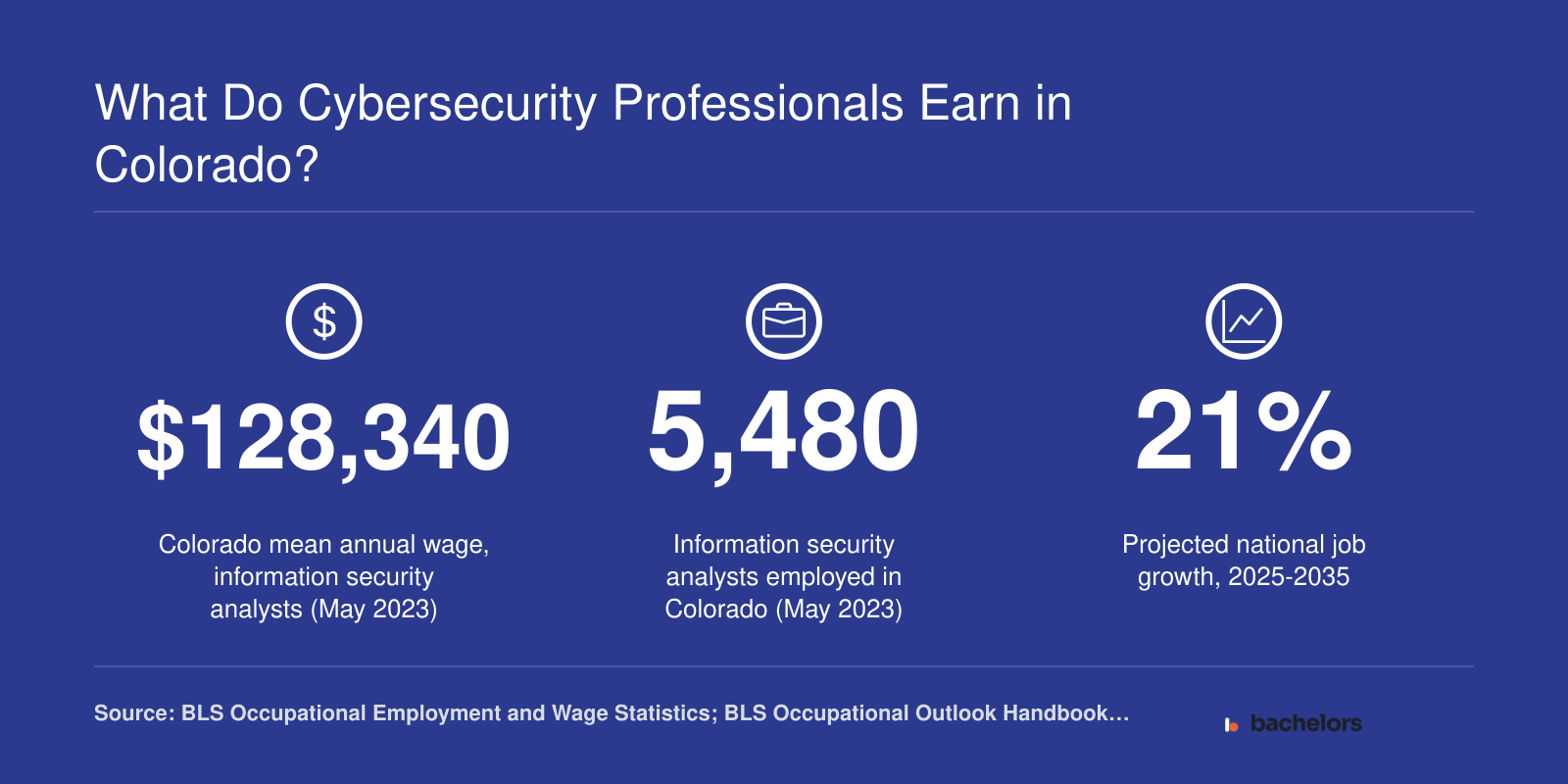
Information security analysts in Colorado earned a mean annual wage of $128,340 in May 2023, with nearly identical averages in the Denver-Aurora-Lakewood metro ($127,320) and the Colorado Springs metro ($127,270), according to the Bureau of Labor Statistics. Colorado Springs stands out for how concentrated these jobs are there, not for higher pay. These are averages across all experience levels, so the early-career earnings reported for individual bachelor's programs earlier in this article will typically run lower.
Compare Cybersecurity programs on the data that matters
Explore more Computers & IT majors or browse every field of study.
All Computers & IT programs Browse every field of study