Best Finance Schools in Georgia
Compare 31 accredited Finance programs in Georgia, with net price after aid, graduation rates, earnings and debt from IPEDS and the U.S. College Scorecard.

How much does your choice of school change a Georgia finance graduate's first paycheck? Among the schools ranked here, median earnings one year after a bachelor's degree in finance run from $43,532 at Valdosta State University to $67,444 at the University of Georgia.
Programs award either a Bachelor of Business Administration or a Bachelor of Science (B.S.) in Finance. Degrees are available in campus, hybrid, and online formats.
Price does not track that pay spread. In-state tuition and fees at the ranked public universities run from $5,285 to $11,450. Mercer University lists $42,312 before aid, and its finance graduates report a first-year median of $47,956, well below the University of Georgia's figure.
Key Points
- Dalton State College lists in-state tuition and fees of just $3,336.
- Brenau University offers a fully online Bachelor of Business Administration in Finance.
- Selling securities in Georgia requires the SIE, Series 7, and Series 63.
Best Finance Schools in Georgia: Our Top 10 Ranked
The top of this list separates on three things: cost after aid, completion outcomes, and how much real money students get to manage before they graduate. The University of Georgia pairs the state's highest completion rate with a finance curriculum built around derivatives, trading strategies, and deal work, while Georgia State puts a $500,000 student-run portfolio and an online completion track within reach of working students in Atlanta. Tuition, net price, and graduation figures on each card below are institution-wide averages for the whole school, not numbers for the finance major alone.
University of Georgia
#1Athens, GA · ~$14,000/yr (est.)
Best for: Investment banking aspirants seeking Wall Street pipelines
The flagship public university in Athens and the largest name on this list, with finance housed in the Terry College of Business as a Bachelor of Business Administration. Coursework runs through financial management, investment analysis, financial institutions and markets, and international finance, with upper-level work in derivatives, mergers and acquisitions, and financial modeling. Students build asset pricing, risk assessment, and capital budgeting skills, and the program reports internship placements at firms such as Goldman Sachs and JPMorgan. A large alumni network and the UGA Career Center support placement into investment banking, financial analysis, credit analysis, and actuarial roles.
- Coursework in derivatives, mergers and acquisitions, trading strategies
- Builds skills in asset pricing, risk assessment and capital budgeting
- Reported internship placements at Goldman Sachs and JPMorgan
- Prepares for investment banking analyst, financial analyst, credit analyst roles
- Case-study approach to practical financial decision-making
- Career Center support and an active finance alumni network
- Financial aid and scholarship options available
Georgia State University
#2Atlanta, GA · $9,000 – $25,000/yr (est.)
Best for: Atlanta transfer students wanting an online finish
An Atlanta public research university whose Robinson College of Business awards the finance degree as a Bachelor of Business Administration, with a four-year, 120-credit structure and fall, spring, and summer entry. Students manage a real $500,000 portfolio, work on Bloomberg terminals, and compete in the CFA Institute Research Challenge and the Atlanta Hedge Fund Challenge. Coursework spans corporate strategy, asset management, fintech, and financial data analytics, and a fully online completion track lets transfer students finish at their own pace. Graduates land at Bank of America, JPMorgan Chase, and Deloitte in financial analyst, credit analyst, and investment officer roles.
- 120 credit hours, about four years, entry fall, spring or summer
- Students manage a real $500,000 stock portfolio
- Bloomberg Essentials certification and terminal access
- CFA Institute Research Challenge and Atlanta Hedge Fund Challenge
- Four-day Wall Street trip and an honors track in finance
- Fully online B.B.A. completion track with advisor support
- Graduates hired at Bank of America, JPMorgan Chase and Deloitte
Georgia College & State University
#3Milledgeville, GA · $9,000 – $30,000/yr (est.)
Best for: Debt-averse students wanting small-campus attention
A public liberal arts university in Milledgeville whose College of Business and Technology is AACSB accredited and awards the finance degree as a Bachelor of Science. The department leans on CFA Institute and CFP Board academic resources, plus the FinTech Academy and The Wall Street Journal, and offers pre-law advising for students aiming at law school. The school reports that more than half of its department graduates finish with no student debt, which makes it a standout for cost-conscious families who still want a small-campus setting.
- AACSB-accredited College of Business and Technology
- CFA Institute and CFP Board academic resources
- FinTech Academy and Wall Street Journal resources
- More than half of department graduates finish with no student debt
- Pre-law opportunities for students considering law school
Mercer University
#4Macon, GA · ~$24,000/yr (est.)
A private university in Macon whose Stetson-Hatcher School of Business awards the finance degree as a Bachelor of Business Administration with three concentration options, including investments, mergers and acquisitions, and derivatives. Students work with a Bloomberg dashboard on live financial data, and faculty are Ph.D. holders, many of them practicing CPAs. Employer outcomes include E*TRADE, Regions Financial, and Blue Bird, and a Special Consideration Program lets graduates move into Mercer's graduate business programs with a waived application fee and no GMAT or GRE.
- Three concentration options, including investments and mergers
- Bloomberg dashboard for working with live financial data
- Ph.D. faculty who are also practicing CPAs
- Employers include E*TRADE, Regions Financial and Blue Bird
- Special Consideration Program waives the graduate application fee
- No GMAT or GRE required to move into graduate business study
- Coursework in corporate finance, fixed income and portfolio management
Kennesaw State University
#5Kennesaw, GA · ~$15,000/yr (est.)
A large public university in Kennesaw whose Coles College of Business awards the finance degree as a Bachelor of Business Administration, with 120 credit hours and three start dates a year. Students learn quantitative financial analysis, statement interpretation, investment risk assessment, and industry regulation, then present findings in team-based projects. Courses run online, face to face, and hybrid, and the Double Owl Pathway lets students earn a bachelor's and an MBA together at lower cost. The school reports that more than 7,100 companies recruit its students.
- 120 credit hours with fall, spring and summer entry terms
- Online, face-to-face and hybrid course formats
- Double Owl Pathway earns a bachelor's and MBA at lower cost
- Team-based projects with findings presented to stakeholders
- More than 7,100 companies recruit KSU students
- Prepares for financial analyst, portfolio manager and financial planner roles
- Prerequisite courses required before upper-division finance work
Georgia Southern University
#6Statesboro, GA · $15,000 – $20,000/yr (est.)
A public university in Statesboro whose Parker College of Business awards the finance degree as a Bachelor of Business Administration, delivered in person over 124 credit hours. The curriculum covers real estate, insurance, banking, investment, financial institutions, and international finance, with an emphasis on time value of money analysis and data-driven recommendations. Internships with organizations such as State Farm and the U.S. Department of Agriculture integrate academics with practice, and graduates move into roles at Fidelity Investments, GEICO, and PricewaterhouseCoopers.
- 124 credit hours taught in person on the Statesboro campus
- Covers real estate, insurance, banking and international finance
- Internships with State Farm and the U.S. Department of Agriculture
- Employers include Fidelity Investments, GEICO and PwC
- Coursework in time value of money, ratio analysis and risk-return evaluation
- Prepares for financial analyst, investment analyst and risk assurance roles
Berry College
#7Mount Berry, GA · $22,000/yr (est. net price)
A private college in Mount Berry that pairs a finance major with a strong liberal arts foundation inside the Campbell School of Business. Students gain hands-on experience through a student-managed investment fund, off-campus internships, and Berry's distinctive Work Program, while 15 student-managed enterprises give any major room to build something. The curriculum folds in data analytics, legal and ethical business practice, and economic history, and alumni have moved into analyst roles at firms such as BlackRock.
- Student-managed investment fund run by undergraduates
- Off-campus internship experiences built into the major
- Part of Berry's Work Program and 15 student-managed enterprises
- Liberal arts foundation alongside the business core
- Curriculum includes data analytics and legal and ethical practice
- Alumni have advanced into analyst roles at BlackRock
University of West Georgia
#8Carrollton, GA · $13,000/yr (est. net price)
A public university in Carrollton whose Richards College of Business awards the finance degree as a Bachelor of Business Administration with a major in finance. The program is built for entry-level roles, with coursework in analyzing financial data, developing strategy, and understanding how organizations make sound financial decisions. Graduates head into financial manager, financial analyst, credit analyst, and commercial banker positions in local, regional, and national organizations, and the degree also prepares students to continue to master's-level study.
- Prepares for entry-level finance positions in local and national firms
- Career paths include financial analyst, credit analyst and commercial banker
- Coursework in financial data analysis and strategic decision-making
- Pathway to continue into master's-level study
University of North Georgia
#9Dahlonega, GA · ~$10,000/yr (est.)
A public university based in Dahlonega that awards the finance degree as a Bachelor of Business Administration, with teaching split across the Dahlonega and Gainesville campuses. Students work through trading simulations and corporate finance case studies, and Investment Club members help manage a real portfolio using Bloomberg Terminal tools. A FinTech minor, study abroad options in London, Italy, Singapore, and Germany, and job-search support such as resume reviews and mock interviews round out the experience.
- Trading simulations in investments and case studies in corporate finance
- Investment Club members help manage a real portfolio
- Bloomberg Terminal access for students
- FinTech minor available alongside the finance major
- Study abroad in London, Italy, Singapore and Germany
- Resume reviews and mock interviews offered through the program
- Coursework in financial markets, risk management and financial policy
Valdosta State University
#10Valdosta, GA · $10,000 – $15,000/yr (est.)
A public university in Valdosta whose Harley Langdale Jr. College of Business Administration awards the finance degree as a Bachelor of Business Administration with a major in finance. The 120-credit on-campus program blends core business fundamentals with corporate finance, financial institutions, markets, and investment instruments, and classes average 25 students with 90 percent of faculty holding doctorates. Students add hands-on work through the Co-op Program and internships, and can join Beta Alpha Psi and Students in Free Enterprise for leadership and networking.
- 120 credit hours with classes averaging 25 students
- 90% of faculty hold doctorates
- Co-op program and internships for applied experience
- Beta Alpha Psi and Students in Free Enterprise chapters
- Coursework in corporate finance, financial institutions, markets and investments
- Prepares for financial analyst, bank manager, risk manager and treasurer roles
Cost & outcomes by school
Federal data for the highest-earning Finance programs, independent of the ranking above. Earnings are this field's bachelor's graduates four years after completing where the Scorecard reports them, else the school's undergraduate median.
| School | Net price / yr | Grad rate | Earnings | Debt | Grads/yr | Format |
|---|---|---|---|---|---|---|
| Georgia Institute of Technology GA | $12,116 | 94% | $102,772 | $21,672 | — | Campus |
| University of Georgia GA | $13,936 | 90% | $97,364 | $17,500 | 600 | Campus |
| Georgia State University GA | $15,931 | 53% | $82,688 | $21,625 | 251 | Online |
| Kennesaw State University GA | $15,048 | 52% | $81,002 | $24,355 | 224 | Hybrid |
| Emory University GA | $22,585 | 91% | $80,137 | $18,250 | — | Campus |
| Georgia Southern University GA | $15,267 | 55% | $79,411 | $22,000 | 144 | Campus |
| University of West Georgia GA | $12,786 | 44% | $72,717 | $23,000 | 43 | Hybrid |
| Valdosta State University GA | $10,945 | 42% | $68,453 | $23,312 | 37 | Campus |
| University of North Georgia GA | $9,823 | 37% | $67,554 | $16,650 | 81 | Campus |
| Mercer University GA | $23,847 | 70% | $66,036 | $19,500 | 27 | Campus |
| Columbus State University GA | $13,115 | 42% | $65,380 | $24,750 | 24 | Campus |
| Georgia College & State University GA | $20,686 | 64% | $58,140 | $22,250 | 28 | Campus |
Sources: U.S. Department of Education. Net price, graduation rate, earnings and debt: College Scorecard (earnings and debt for this field's bachelor's graduates where reported, else school-wide); graduates: IPEDS. A dash means no figure is reported.
Cost, debt & payoff
Median earnings of this field's bachelor's graduates (4 yrs after completing, else the school's undergraduate median) vs. their median federal loan debt · U.S. College Scorecard
Across these programs the median graduate earns about $51,745 and finishes with roughly $23,000 in debt — a ratio that clears a common rule of thumb (keep debt below first-year salary). Net price and debt vary widely school to school, so check the per-school figures in the table above before you shortlist.
Most Affordable Bachelor's in Finance Schools in Georgia
The lowest net prices among Georgia finance programs in our data all belong to public colleges and universities, and sticker price can mislead: Georgia Institute of Technology lists $12,058 in in-state tuition and fees, while Dalton State College lists $3,336 and posts an average net price of $5,012. Net price, drawn from 2024 IPEDS and College Scorecard data, is the average yearly cost after grants and scholarships for aided in-state students at public schools, so treat it as a benchmark rather than an exact quote. Dalton State's average net price is $7,349 lower than Middle Georgia State University's $12,361, roughly 40 percent of the cost, and ranked schools University of North Georgia and Valdosta State University both come in under $11,000.
| School | City | Sector | In-State Tuition and Fees | Average Net Price | Median Debt at Completion |
|---|---|---|---|---|---|
| Dalton State College | Dalton | Public | $3,336 | $5,012 | $12,937 |
| University of North Georgia | Dahlonega | Public | $5,285 | $9,823 | $17,750 |
| Valdosta State University | Valdosta | Public | $6,124 | $10,945 | $24,779 |
| Georgia Institute of Technology | Atlanta | Public | $12,058 | $12,116 | $21,672 |
| Middle Georgia State University | Macon | Public | $5,038 | $12,361 | $19,000 |
Which Georgia Finance Programs Are AACSB Accredited, and CFP and CFA Alignment
AACSB is the main business accreditation. Employers often treat it as a quality signal, and CFA and CFP candidates benefit from a rigorous, well-regarded business curriculum. AACSB accreditation does not by itself confer CFP or CFA status.
AACSB Listings
- Finance programs confirmed: Kennesaw State (BBA in Finance)1, Georgia College & State University (B.S. in Finance)2, University of West Georgia (BBA in Finance)3, and Clark Atlanta University (business administration with a finance concentration; its School of Business programs outside economics are covered).4
- Institution listed, finance major not shown: Georgia State, the University of Georgia (only an MBA in Finance appeared in the listing)5, Georgia Tech, Emory, and University of North Georgia. Check that the finance major sits inside the accredited business school.
- Not confirmed: Mercer University and Georgia Southern University did not appear in the AACSB results we reviewed.
Accreditation generally attaches to the business school, not to individual majors, so confirm your finance degree is housed there.
CFP and CFA Alignment
Online and Hybrid Bachelor's in Finance Options at Georgia Schools
Georgia offers three distinct online-friendly routes to a finance degree, and they are not interchangeable. Check the format on each school's official program page before you apply.
Fully Online
Brenau University offers its Bachelor of Business Administration in Finance on campus or fully online. Its 2025-26 online tuition is $450 per credit, or $16,200 for the year. This suits out-of-state students and anyone who cannot relocate.
Degree-Completion
Georgia State University lists its Finance B.B.A. completion program as 100% online. It requires 60 credits, about 24 months, and an associate degree. An orientation or exam may require a campus visit. It fits transfer students and working adults with credits already earned. No separate online tuition rate is published for it.
Campus Programs With Online Courses
Kennesaw State and the University of West Georgia are listed as hybrid in our data. At West Georgia, courses below the 4000 level can be taken online, but the degree is not entirely online and requires multiple campus visits. Kennesaw State describes flexible online, face-to-face and hybrid courses. The University of North Georgia offers a FinTech minor through eCampus. The University of Georgia, Georgia College, Mercer, Georgia Southern, Berry and Valdosta State are listed as campus programs. Georgia Southern appears on its online-degrees page, but the finance program's own format is not confirmed, so ask the school directly.
Does Online Change Tuition?
Sometimes. West Georgia says students taking only online courses do not pay nonresident tuition, so out-of-state students may save. Georgia residents generally pay about the same either way. A term mixing campus and online courses carries campus fees and higher eTuition. Confirm current rates with each bursar.
Cost of a Finance Degree in Georgia: Tuition, Net Price, and State Aid
Sticker Price vs. Net Price
At the ranked public universities in our data, in-state tuition and fees range from $5,285 at University of North Georgia to $11,450 at University of Georgia. Average net price after aid tells a different story: $9,823 at North Georgia, $10,945 at Valdosta State, $12,786 at West Georgia, $13,936 at UGA, and $15,048 at Kennesaw State. Net price sits above tuition at every one of them because it folds in housing, meals, and other costs. These are institution-wide averages for first-time, full-time students, not finance-specific numbers, so use them as a planning baseline rather than a quote for your major.
HOPE and Zell Miller in 2026
Both are tuition awards administered by the Georgia Student Finance Commission, and neither covers fees, books, or housing.6
- HOPE Scholarship: Entering freshmen need a 3.00 HOPE GPA in core high school courses and must hold a 3.00 at each checkpoint.1 The award covers standard tuition at up to 15 credit hours per term at public colleges and up to 12 hours at private colleges, with a 127 semester-hour cap and a ten-year window.2
- Zell Miller Scholarship: Requires a 3.70 HOPE GPA plus SAT 1200 (math and reading) or ACT 25 in a single national sitting, then a 3.30 to renew.3 It funds standard tuition at up to 15 credit hours per term in the public system.4
- HOPE Grant: This one is tied to certificate and diploma programs and a 2.00 checkpoint GPA, so it is not the route to a bachelor's degree in finance.5
Two Practical Moves
File the FAFSA early so state and school aid land in the same package, then ask each finance department about donor scholarships, which often stack on top of HOPE. If you enroll online from outside Georgia, confirm your in-state or out-of-state billing rate before you commit.
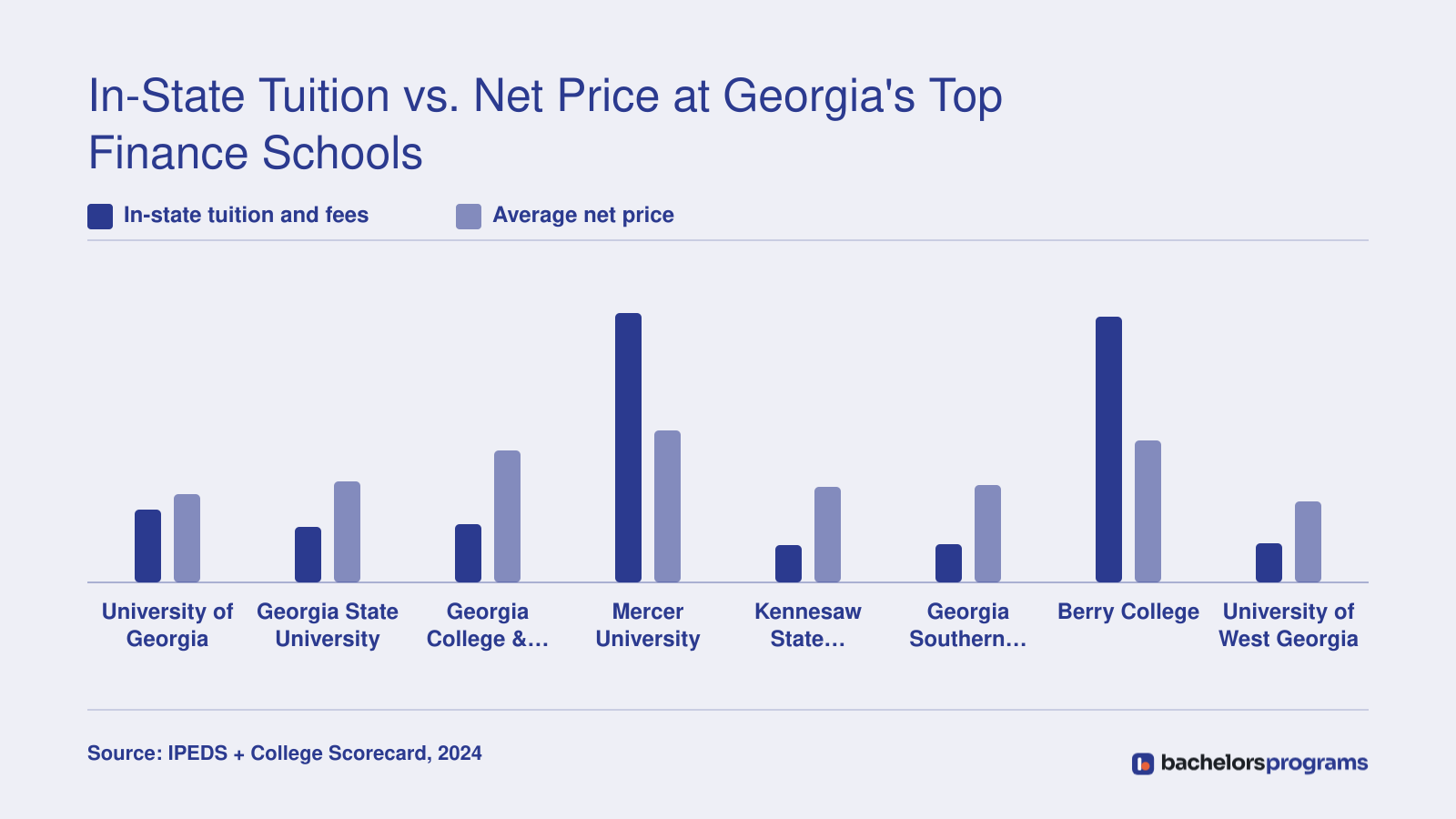
In-State Tuition vs. Net Price at Georgia's Top Finance Schools
Listed tuition and what students actually pay are two different numbers. At Georgia's public universities, the average net price is higher than in-state tuition and fees because it includes housing, books, and other living costs after grants are subtracted. At private Mercer University and Berry College, the pattern reverses: aid brings the average net price well below the published tuition. Net price is an average for the whole institution, not for the finance major alone. It also depends on the type of school. At public schools it covers in-state students who receive aid, and at private schools it covers all students who receive aid. Use it as a starting estimate and confirm your own cost with each school's net price calculator.
Related Articles
Finance Careers in Georgia: Employers, Roles, and Pay
Georgia's finance job market is concentrated in Atlanta, and two of the three occupations below post metro medians well above their national counterparts. The most recent metro-level detail BLS publishes for these three occupations is from May 2022, so read the figures as a benchmark rather than a 2026 snapshot.
Atlanta Metro Wages and Employment
- Financial and investment analysts: 7,360 jobs, median annual wage of $95,360
- Personal financial advisors: 5,710 jobs, median annual wage of $127,780
- Loan officers: 6,140 jobs, median annual wage of $129,580
All three are May 2022 metro estimates for the Atlanta-Sandy Springs-Roswell area.1
National Benchmarks, May 2025
Nationally, financial and investment analysts earned a median of $102,740 across 377,200 jobs.2 Personal financial advisors earned $105,070 across 299,400 jobs3, and loan officers earned $76,690.4 These are national numbers, not Georgia ones, and they come from a later survey year than the metro figures above.
Entry Roles and Internship Pipelines
Most finance graduates start in analyst or trainee seats: credit analyst, financial analyst, loan officer trainee, bank management trainee, or paraplanner at an advisory practice. Banking, payments, insurance, and corporate finance operations in Atlanta absorb a large share of that hiring. Internships are the main on-ramp, and several Georgia programs build a credit-bearing internship into the degree, so ask about placement support when comparing schools.
Two Numbers That Are Not the Same
Program earnings from the federal College Scorecard describe what a school's graduates earn after finishing, averaged across the graduates the data covers. BLS wage figures describe what workers in an occupation earn. A strong program earnings figure does not guarantee an analyst salary, and a modest one does not cap it.
Georgia Licensing for Finance Careers at a Glance
Compare Finance programs on the data that matters
Explore more Business & Management majors or browse every field of study.
All Business & Management programs Browse every field of study