Best Public Health Schools in Georgia
Compare 22 accredited Public Health programs in Georgia, with net price after aid, graduation rates, earnings and debt from IPEDS and the U.S. College Scorecard.

Georgia is one of the few states where a bachelor's degree in public health puts students within commuting distance of the agencies that hire its graduates. The Georgia Department of Public Health, the CDC headquarters, and a dense cluster of hospitals and nonprofits are all in the Atlanta area. Most of these programs award a Bachelor of Science (B.S.) in Public Health.
Cost is the sharper divide. In-state tuition runs from about $6,022 a year at Georgia Southern University to $50,604 at Agnes Scott College. Entry-level employers favor graduates with internship experience, so placement access matters as much as price.
Key Points
- Wesleyan College's $27,650 sticker tuition drops to a $12,724 average net price.
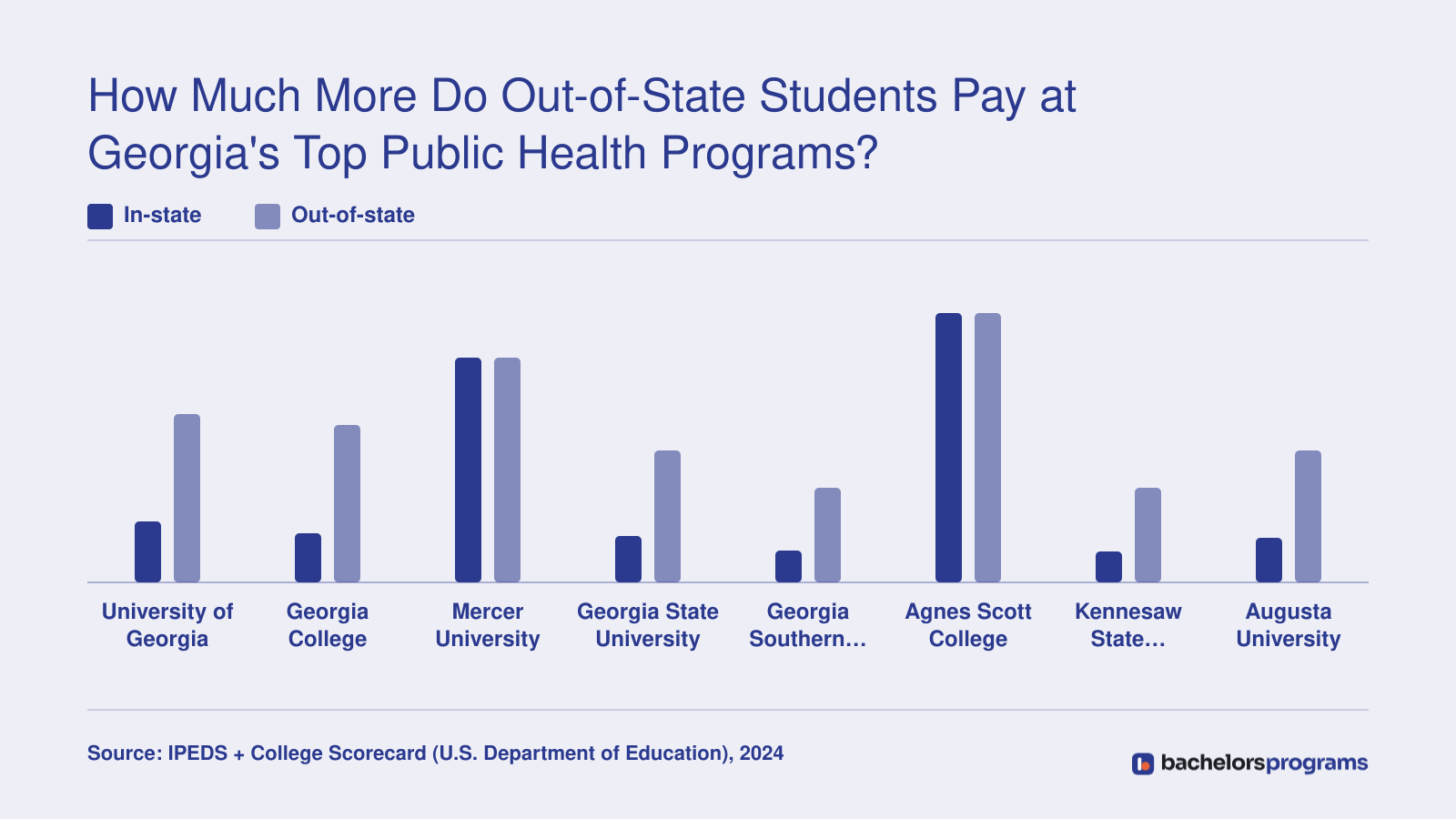
- Mercer and Agnes Scott charge residents and nonresidents the same tuition.
- Common entry roles include health educator and community health worker.
Best Bachelor's Degree in Public Health Schools in Georgia: Our Top 10
These ten bachelor's degree in public health programs in Georgia are ordered by our review of completion, cost and program fit. Each entry shows the credential offered, the concentrations available, the format and the program specifics that set it apart. The net price after aid and graduation rate listed alongside each school are institution-wide approximations, not figures for the public health program alone.
University of Georgia
#1Athens, GA · ~$14,000/yr (est.)
Best for: Future health educators wanting hands-on practicum
Georgia's flagship public university houses public health in a full college rather than a single department, so undergraduates learn epidemiology, health policy and chronic disease prevention from research faculty in Athens. The health promotion degree splits into three emphasis tracks and admits a modest cohort each year. A supervised field placement in a community agency, a capstone e-portfolio and CPR certification give it a professional finish.
- CEPH accredited program inside a full college of public health
- Three tracks: health promotion, health services, behavioral medicine
- 300-hour field experience with a community agency
- 2.7 GPA to enter; 3.5 GPA for the behavioral medicine track
- Fall and spring entry, about 100 students admitted yearly
- Capstone e-portfolio and First Aid/CPR certification required
- Prepares students for graduate public health study or medical school
Georgia College & State University
#2Milledgeville, GA · $9,000 – $30,000/yr (est.)
Best for: Undergraduates wanting mentored public health research
Public health at Georgia College & State University sits inside a health and human performance school on a small public liberal arts campus in Milledgeville. The degree blends health promotion, health sciences and behavioral sciences, and pairs its internship with faculty-mentored research and a campus center focused on health and social issues. Students who want seminar-sized classes and a clear path toward health education certification tend to fit well here.
- 12 course-hour internship with community partners
- Coursework prepares students for the CHES/MCHES exam
- Faculty-mentored undergraduate research opportunities
- Home to the Center for Health and Social Issues
- Active Public Health Student Organization on campus
- Campus-based program in Milledgeville
Mercer University
#3Macon, GA · ~$24,000/yr (est.)
Best for: Graduate-school bound students wanting policy depth
Mercer University is a private institution in Macon whose public health degree is CEPH accredited and taught on a single campus. The curriculum moves from program planning and evaluation into the legal, ethical, economic and regulatory side of health care and public health policy. A capstone portfolio and required community service hours give the degree a professional rather than purely academic finish.
- CEPH accredited
- Taught on the Macon campus only
- Capstone portfolio required for graduation
- 30 hours of community service required
- Covers legal, ethical, economic and regulatory policy
- Research available with faculty partners
- Prepares graduates for health educator and program coordinator roles
Georgia State University
#4Atlanta, GA · $9,000 – $25,000/yr (est.)
Georgia State University runs a CEPH-accredited public health degree in downtown Atlanta, in a metro area that holds the CDC, state health agencies and a dense nonprofit sector. Undergraduates choose between health policy and behavioral sciences or population health sciences, then complete a Signature Experience capstone. Pre-med students get dedicated advising, and the school's research centers on child and family health open applied policy work to students.
- Two concentrations: health policy and behavioral sciences, or population health sciences
- 120 credit hours with a 2.5 GPA minimum
- Signature Experience capstone required
- Pre-med track with tailored advising
- Transfer credits accepted; study abroad options available
- Health equity and informatics coursework built into the curriculum
Georgia Southern University
#5Statesboro, GA · $15,000 – $20,000/yr (est.)
Georgia Southern University offers its CEPH-accredited public health degree on the Statesboro campus and fully online, which makes it one of the few Georgia publics where students can finish the major remotely. The curriculum covers epidemiology, biostatistics, environmental health, emergency preparedness and program planning, with a required internship. Targeted electives can also earn a certificate in areas like environmental health, emergency preparedness or public health informatics.
- 123 credit hours, 39 of them in the major
- Offered in Statesboro or fully online
- 2.0 institutional GPA and 60 completed credit hours to enter
- Internship of 12 credit hours required; 2.5 GPA to enroll
- Optional certificates in seven areas, including emergency preparedness
- Coursework spans epidemiology, biostatistics and environmental health
- Nine hours of specified electives earn a certificate
Agnes Scott College
#6Decatur, GA · ~$25,000/yr (est.)
Agnes Scott College is a small private women's college in Decatur where public health has become one of the largest and fastest-growing majors. The B.A. approaches the field through social justice, teaching data analysis, intervention planning, evaluation and grant writing rather than clinical science. Atlanta internships at the CDC, CARE and the International Rescue Committee, plus cross-enrollment at Emory's Rollins School of Public Health, extend the classroom considerably.
- One of the college's largest and fastest-growing majors
- Social justice lens on health disparities
- Internships at the CDC, CARE and the International Rescue Committee
- Concurrent enrollment option at Emory's Rollins School of Public Health
- Bevier Summer Internship provides a stipend and housing
- Training in data analysis, program evaluation and grant writing
- Graduates often continue to Master of Public Health programs
Kennesaw State University
#7Kennesaw, GA · ~$15,000/yr (est.)
Kennesaw State University is a large public university northwest of Atlanta that runs its public health degree face to face, fully online or in a hybrid mix. The 120-credit program is built on the eight competency areas the national health education commission defines, and internships run either 240 or 360 field hours. A Double Owl pathway lets strong students begin a related master's sooner and at lower cost.
- Face-to-face, fully online or hybrid formats
- 120 credit hours; entry in fall, spring or summer
- Internship of 240 or 360 field-based hours
- Built on eight national health education competency areas
- Double Owl Pathway to an MPA or related master's
- Part-time and full-time enrollment options
- Synchronous and asynchronous online course options
Augusta University
#8Augusta, GA · $8,000 – $25,000/yr (est.)
Augusta University teaches public health through a dedicated School of Public Health on a health sciences campus shared with a medical school and an academic health system. The degree pairs a capstone and internship sequence with 30 elective hours, including an experiential elective in disaster preparedness, community health or research. Faculty involvement in rural maternal health and care coordination pilots gives students a live view of implementation work in eastern Georgia.
- CEPH accredited, housed in a dedicated School of Public Health
- 120 credit hours, including 30 elective hours
- Six-credit internship and capstone sequence
- Experiential elective in disaster preparedness, community health or research
- Electives can be stacked toward health communication and informatics
- Named employers include public health departments and the CDC
Oglethorpe University
#9Atlanta, GA · ~$20,000/yr (est.)
Oglethorpe University is a small private liberal arts college in Atlanta, and its public health offering is a concentration rather than a standalone major. Students in any major can add it, and it can stand in for a minor, with a seminar-style workshop, guest lectures from Atlanta practitioners and fieldwork with a community organization. Placements have included the CDC, NIH and Children's Healthcare of Atlanta, which suits students pairing public health with another field.
- Concentration open to students in any major
- Can count in place of a traditional minor
- Sophomore standing required to apply
- At least 52 field contact hours with a community partner
- Seminar-style workshop and guest lectures from Atlanta practitioners
- Placements have included the CDC, NIH and Children's Healthcare of Atlanta
- Ideal preparation for graduate public health study
Georgia Military College
#10Milledgeville, GA · ~$17,000/yr (est.)
Georgia Military College is a public institution based in Milledgeville that delivers its public health degree entirely online through GMC Online. The applied-science program leans on policy and management, covering biostatistics, epidemiology, health care systems, environmental health and health law, and ends in an integrative project. Multiple quarter start dates and flexible pacing are built for working adults, and the tuition is among the lowest of Georgia's public options.
- 100% online through GMC Online
- Multiple quarter start dates each year
- Integrative capstone project required
- Electives in emergency management response and healthcare management
- Biostatistics, epidemiology, environmental health and health law coursework
- Flexible pacing designed for working adults
- Four concentration options across the degree
Cost & outcomes by school
Federal data for the highest-earning Public Health programs, independent of the ranking above. Earnings are this field's bachelor's graduates four years after completing where the Scorecard reports them, else the school's undergraduate median.
| School | Net price / yr | Grad rate | Earnings | Debt | Grads/yr | Format |
|---|---|---|---|---|---|---|
| University of Georgia GA | $13,936 | 90% | $78,085 | $20,788 | 136 | Campus |
| Agnes Scott College GA | $24,754 | 71% | $63,621 | $26,749 | 14 | Campus |
| Georgia College & State University GA | $20,686 | 64% | $62,386 | $25,649 | 31 | Campus |
| Kennesaw State University GA | $15,048 | 52% | $61,665 | $25,250 | 20 | Hybrid |
| Mercer University GA | $23,847 | 70% | $60,401 | $27,000 | 52 | Campus |
| Spelman College GA | $38,967 | 79% | $59,993 | $25,000 | — | Campus |
| Oglethorpe University GA | $19,509 | 54% | $55,232 | $25,000 | — | Campus |
| LaGrange College GA | $20,875 | 47% | $51,745 | $25,730 | — | Campus |
| Georgia Southern University GA | $15,267 | 55% | $49,881 | $25,250 | 52 | Hybrid |
| Valdosta State University GA | $10,945 | 42% | $49,361 | $24,779 | — | Campus |
| Georgia State University GA | $15,931 | 53% | $48,896 | $23,400 | 82 | Campus |
| Augusta University GA | $13,787 | 49% | $48,472 | $20,500 | 1 | Campus |
Sources: U.S. Department of Education. Net price, graduation rate, earnings and debt: College Scorecard (earnings and debt for this field's bachelor's graduates where reported, else school-wide); graduates: IPEDS. A dash means no figure is reported.
Cost, debt & payoff
Median earnings of this field's bachelor's graduates (4 yrs after completing, else the school's undergraduate median) vs. their median federal loan debt · U.S. College Scorecard
Across these programs the median graduate earns about $48,684 and finishes with roughly $25,000 in debt — a ratio that clears a common rule of thumb (keep debt below first-year salary). Net price and debt vary widely school to school, so check the per-school figures in the table above before you shortlist.
How We Ranked Georgia's Public Health Schools
This comparison of bachelor's programs in public health and closely related fields in Georgia is independent and rests on federal College Scorecard data rather than university marketing. It covers campus programs in the state and online programs at Georgia-based schools. No school paid for placement, and no university produced the list.
What We Weighed
- Outcomes: Earnings for graduates, where the Scorecard reports them for a program.
- Net price: What students pay on average after grants and scholarships, not the sticker price.
- Completion: The share of students who finish their degree at the school.
- Program size: The number of graduates, a signal of how established a program is.
- Format: Whether students can study on campus, online, or both.
Limits Worth Knowing
Graduation rate and net price describe the whole institution, not the public health program alone. A large university's figures blend every major, so they show the school's overall record rather than one degree's.
Program-level earnings are published for only some programs, so a school without an earnings figure was judged on its other measures. Several programs here also sit under related titles such as health promotion, health science, or health services administration, and we note that where it applies.
Use the rankings as a starting point. Confirm current costs, curriculum, and accreditation on each school's own pages before you apply.
Cheapest Bachelor's in Public Health Programs in Georgia
Average net price, the cost after grants and scholarships, is a more realistic comparison than sticker tuition. Wesleyan College, for example, lists $27,650 in tuition and fees but has an average net price of $12,724. Using 2024 IPEDS and College Scorecard data, Georgia Highlands College in Rome is the lowest-cost option at $6,928 a year, and net prices among these schools run up to $12,724, a gap of about $5,800 a year.
| School | City | Program | Format | Sector | In-State Tuition & Fees | Out-of-State Tuition & Fees | Average Net Price |
|---|---|---|---|---|---|---|---|
| Georgia Highlands College | Rome | Bachelor of Science in Health Science (Public Health) | Hybrid | Public | $3,120 | $10,080 | $6,928 |
| Gordon State College | Barnesville | Health Science (Public Health) | Campus | Public | $3,628 | $10,948 | $8,105 |
| Valdosta State University | Valdosta | Bachelor of Science in Health Sciences (Public Health) | Campus | Public | $6,124 | $17,836 | $10,945 |
| Middle Georgia State University | Macon | Health Services Administration (Public Health Management) | Campus | Public | $5,038 | $16,390 | $12,361 |
| Wesleyan College | Macon | Public Health | Campus | Private nonprofit | $27,650 | $27,650 | $12,724 |
Related Articles
Online and Hybrid Public Health Bachelor's Options at Georgia Schools
In public health, flexibility and hands-on experience pull against each other, and Georgia's bachelor's programs make different trade-offs between them. Based on the delivery labels in our ranked data, most programs are campus-based. Georgia Military College is the school labeled fully online, and Kennesaw State lists face-to-face, online and hybrid formats.
Hybrid and Mixed Formats
Georgia State's Public Health B.S. is a good example of why labels need checking. Its concentration listings mention online delivery, but the admissions page says only some classes are online or hybrid, so plan for time on the Atlanta campus.1 Georgia Southern's page describes its Public Health B.S.P.H. as in person at Statesboro or Armstrong (Savannah), and it points fully online seekers to a separate Global Health program.
Out-of-State Enrollment, Curriculum and Advising
The program pages we reviewed do not clearly say whether students outside Georgia can enroll online, and they say little about whether online students get the same curriculum and advising as on-campus peers. Ask admissions directly before applying.
Practicum and Internship Expectations
Online does not mean experience-free. Georgia Military College requires a capstone with experiential activities, a written report and a presentation. Elsewhere, expectations are heavier:
- Augusta University: a required 6-credit internship within its 120-credit curriculum.
- Georgia College & State University: a 12-credit-hour internship.
- Kennesaw State University: 240 or 360 field-based hours.
The pages do not say whether any of these can be completed remotely.
Online Tuition
Georgia State's online rate is $464 per credit plus a $660 per-semester online learning fee at six or more credits, and no on-campus comparison is published for that concentration. Georgia Military College estimates $8,640 per year, covering tuition, fees, textbooks and materials, based on 45 quarter hours.
Admissions: GPA, Test Policy and Transfer Credit for Georgia Public Health Programs
First-year applicants and transfer students face different hurdles at Georgia's public health programs. Freshmen are judged mostly on high school coursework and, at several schools, SAT or ACT scores. Transfers are judged on college GPA and on how much prior coursework the major will accept.
First-Year Admission
At University System of Georgia (USG) schools, the Board of Regents sets baseline first-year requirements.1 Each school then adds its own testing rules.
- University of Georgia: SAT or ACT required. Minimum GPA: no policy published beyond USG requirements.
- Georgia College & State University: SAT or ACT required. Minimum GPA: no policy published beyond USG requirements.
- Georgia State University: SAT or ACT required for Atlanta Campus applicants starting Fall 2026.4 Scores combine with high school curriculum GPA to form a Freshman Index, so there is no single GPA cutoff.
Transfer and Major Requirements
Transfer rules vary more than first-year rules, and the public health major can set a higher bar than the university.
- University of Georgia: Applicants with 30 to 59 transferable hours need a 3.30 transfer GPA.2 Those with 60 or more need 3.00. High school grades and test scores are not considered. The B.S. in Health Promotion then requires a 2.7 overall GPA for external and internal transfers, and Behavioral Medicine requires 3.5.
- Georgia College & State University: The USG minimum transfer GPA of 2.00 applies, calculated only from transferable credits.1 Public health transfer rule: no policy published.
- Georgia State University: No more than 15 credit hours can transfer into the B.S. in Public Health's major areas (Areas F, G and I combined), with a cap of 9 in Area G.3 Public health courses must come from CEPH-accredited schools or standalone bachelor's programs. Graduation requires a 2.0 institutional GPA.
For Mercer University, Georgia Southern University, Kennesaw State University, Augusta University and the other schools on this page, confirm current rules with each admissions office.
Takeaway for Transfer Students
Core curriculum credit earned at a USG college is designed to move within the system, but major credit is not guaranteed. Plan public health electives around the receiving school's caps and accreditation rules before you enroll.
Cost of a Bachelor's Degree in Public Health in Georgia
What you pay for a bachelor's degree in public health in Georgia depends mostly on two things: whether the school is public or private, and whether you count as a Georgia resident. These are approximate annual tuition and fees; your own bill will vary.
In-State, Out-of-State and Net Price
At the public universities here, in-state tuition runs from roughly $5,800 a year at Kennesaw State University to about $11,500 at the University of Georgia. Out-of-state rates are much higher, from around $17,700 at Georgia Southern University and Kennesaw State to nearly $31,700 at the University of Georgia. After grants and scholarships, the typical net price at these public schools lands between about $13,800 and $20,700 a year.
Private options start higher. Sticker prices at Mercer University, Oglethorpe University and Agnes Scott College range from about $31,600 to $50,600, but net prices after aid fall closer to $19,500 to $24,800.
Georgia Military College's online program estimates the same $8,640 a year for residents and nonresidents alike.
HOPE and Zell Miller Scholarships
The HOPE Scholarship is for Georgia residents who keep at least a 3.00 HOPE GPA, calculated on core courses.1 You must meet that bar at set checkpoints, including 30, 60 and 90 attempted semester hours, though you can regain eligibility once if you slip. HOPE pays a set rate per enrolled hour, up to 15 hours a term, so it does not always cover full tuition.2 Eligibility ends after 127 attempted semester hours.2
The Zell Miller Scholarship is the higher tier. High school graduates need a 3.70 HOPE GPA plus a 1200 SAT (math and reading) or a 25 ACT composite.3 Recipients must keep a 3.30 HOPE GPA in college.3 At public institutions it is generally set at the standard undergraduate tuition rate, up to 15 hours a term, and it does not necessarily cover fees, books or housing.
The Georgia Student Finance Commission sets the current award amounts and any other state aid, so confirm figures with it before budgeting.
One Practical Way to Cut Costs
Enrolling in-state at a public university is the biggest single saver. Starting at a lower-cost University System of Georgia school such as Georgia Highlands College or Gordon State College, then transferring, can trim the bill further. Confirm in writing that your credits will count toward the public health major first.
How Much More Do Out-of-State Students Pay at Georgia's Top Public Health Programs?
These are published tuition and fees before financial aid. Georgia's public universities charge residents far less than nonresidents, while private Mercer University and Agnes Scott College charge everyone the same rate. Most students pay less than the sticker price once grants and scholarships apply: the average net price after aid is $23,847 at Mercer and $24,754 at Agnes Scott.
Public Health Careers and Salaries in Georgia With a Bachelor's Degree
Georgia's public health job market rewards bachelor's graduates who start in community-facing roles and add data skills early. The titles that come up most often are health educator, community health worker, public health analyst and program coordinator. Each is reachable with a B.S. in Public Health plus an internship or a year of volunteer or practicum work.
Wage Benchmarks to Plan Around
Community health workers report a median wage of $24.93 per hour as of May 2025, which works out to roughly $51,900 a year at full-time hours, with projected national growth of 13% from 2025 to 2035. Health education specialists show 6% projected growth over the same window, and a bachelor's degree is the typical entry requirement for that role. Epidemiologists, the analyst tier that anchors the top of this pay band at $41.93 per hour and 19% projected growth, sit above where most new graduates start; bachelor's-level analysts and coordinators typically enter below that figure and move up with experience.
These are national occupational wages from the Bureau of Labor Statistics, not Georgia-specific pay, so treat them as a planning benchmark rather than a local quote. They also describe occupations, not programs: earnings that a particular school reports for its own graduates measure something different and should not be read as a salary forecast.
Where Georgia Employers Hire
State government is the largest single source of public health work in Georgia, led by the Georgia Department of Public Health and its statewide network of district health offices, where health educators and community health workers staff county-level programs. The Atlanta metro adds the CDC's headquarters and the nonprofit and contract organizations that cluster around it, along with hospital community-benefit teams and clinics that run outreach and screening programs.
Georgia Public Health Bachelor's Degree: Common Questions
These answers summarize the most common questions about studying for a bachelor's degree in public health in Georgia. Details on each school appear in the sections above.
What are the best public health schools in Georgia for undergraduates?
Which Georgia public health programs are CEPH-accredited?
Can you earn a bachelor's degree in public health online in Georgia?
How much does a bachelor's degree in public health cost in Georgia?
What can you do with a bachelor's degree in public health in Georgia?
Compare Public Health programs on the data that matters
Explore more Healthcare majors or browse every field of study.
All Healthcare programs Browse every field of study