Best Finance Schools in Massachusetts
Compare 52 accredited Finance programs in Massachusetts at 39 colleges, with net price after aid, graduation rates, earnings and debt from IPEDS and the U.S. College Scorecard.

Finance hiring in Massachusetts has long been anchored in Boston, where asset managers, banks and insurers recruit directly from nearby undergraduate programs. A bachelor's degree in finance, most often a Bachelor of Science (B.S.) in Finance, is the standard entry credential for those roles, and the programs here run from large public universities to small private colleges, on campus and online at Massachusetts-based schools.
The tension is practical: the schools with the strongest employer pipelines also carry the highest sticker prices, while public campuses cost far less but recruit with less concentrated Boston-area reach.
That tradeoff, more than prestige, should drive most decisions in this field.
Key Points
- UMass Amherst's Isenberg finance program leads at public-university prices.
- The most affordable public picks average $13,381 to $17,163 net per year.
- Boston College's $70,702 sticker price falls to a $41,704 average net price.
Best Schools for a Bachelor's Degree in Finance in Massachusetts
The best finance school in Massachusetts for undergraduates depends on whether you weigh price, placement, or financial firepower. The University of Massachusetts Amherst leads this ranking on the strength of a large, well-connected Isenberg finance program at a public-university net price. Boston College and Bentley University post the highest early-career median earnings in the group, and each school below earns its place for a different kind of student.
University of Massachusetts-Amherst
#1Amherst, MA · $20,000 – $25,000/yr (est.)
Best for: In-state students seeking low net cost
The flagship campus pairs a public-university price with an Isenberg finance program that behaves like a private business school: a dozen Bloomberg terminals, a student-run family of funds, and CFA Institute affiliation. The online Bachelor of Business Administration in Finance serves working adults through a corporate finance concentration, while the on-campus degree offers corporate finance, financial analyst, and alternative investments tracks. Isenberg reports a 96% job placement rate for finance graduates, and the state's expanded MASSGrant Plus program makes the in-state price hard to beat.
- AACSB-accredited online BBA with a corporate finance concentration
- Built for working adults; at least 27 transferable credits required
- Coursework in financial modeling, investments, and bank management
- Upper-level electives from accounting, marketing, and operations
- Career support through Isenberg's Office of Career Success
- Tracks in corporate finance, financial analyst, and alternative investments
- Twelve Bloomberg terminals available to undergraduates
- Student-run Minuteman family of funds
- CFA Institute affiliation and CAIA academic partnership
- Internships at major financial firms; 96% placement reported
Boston College
#2Chestnut Hill, MA · ~$42,000/yr (est.)
Best for: High-achievers aiming for investment banking
The Carroll School of Management's finance concentration is the most selective route into the field in Massachusetts, built on five prescribed courses with electives in investment banking, fixed income analysis, behavioral finance, and fintech. The department is cited among the top 15 in the country by U.S. News & World Report and runs a weekly finance seminar series alongside an alumni advisement system. Median earnings for finance graduates sit near $82,500 one year after graduation, the highest in this group.
- Five prescribed finance courses plus a short-list elective
- Electives include investment banking, fixed income, and fintech
- Department cited among top 15 nationally by U.S. News
- Weekly finance department seminar series
- Alumni advisement system supplements faculty advising
- Core finance courses must be taken within the Carroll School
Bentley University
#3Waltham, MA · ~$38,000/yr (est.)
Best for: Hands-on learners wanting real-money fund work
Bentley is a business-only university, and finance is its flagship: four concentrations, a student-run investment group that manages a slice of the endowment, and an accelerated path to a master's degree in four years. Bentley reports an average starting salary of $74,000 and that 89% of students complete at least one internship. Its advertised 100% post-graduate outcome rate is the kind of number career-focused families notice.
- Four concentrations: capital markets, corporate finance, financial planning, sustainable investing
- Bentley Investment Group manages part of the university endowment
- 89% of students complete at least one internship
- Accelerated bachelor's and master's pathway in four years
- Reported average starting salary of $74,000
Northeastern University
#4Boston, MA · ~$31,000/yr (est.)
D'Amore-McKim's finance concentration sits inside one of the country's most established co-op programs, with paid full-time placements across more than 3,100 employers. Students choose among corporate finance, investments and portfolio analysis, financial risk management, and real estate, and can study in Boston or Oakland. A student-run fund of roughly $290,000 gives undergraduates real portfolio experience before they graduate.
- Four tracks: corporate finance, investments, risk management, real estate
- 16 credit hours of finance concentration coursework
- Paid full-time co-ops with more than 3,100 employers
- Student-run investment fund of about $290,000
- Alumni at Goldman Sachs and JPMorgan
- Study in Boston or Oakland
College of Our Lady of the Elms
#5Chicopee, MA · ~$18,000/yr (est.)
A small Catholic college in Chicopee, Elms offers a Bachelor of Arts in Finance built on a 42-credit business core and a required three-credit internship. It is the most affordable private option in this ranking after aid, which makes it a practical choice for students who want a finance major without a heavy debt load. Classes are small, and electives reach into fintech, real estate investments, and data analytics.
- 42-credit business core includes a three-credit internship
- 12 credits of finance foundations plus six credits of electives
- Electives include fintech, real estate investments, and data analytics
- Small class sizes emphasized
- Internships with local and nationwide companies
University of Massachusetts-Lowell
#6Lowell, MA · ~$17,000/yr (est.)
The Manning School's finance concentration is a 122-credit, four-year degree with a required Career Connected Experience and a capstone. Coursework covers financial statement analysis, derivatives, portfolio analysis, and international finance, and finance courses run in evening and online formats as well as on campus. It is one of the lowest-net-price public routes to a finance degree in the state.
- 122 credits, four-year plan, capstone required
- Required Career Connected Experience before graduation
- Coursework in derivatives, portfolio analysis, and international finance
- Finance courses offered in evening and online formats
- Concentration sits inside the BSBA at the Manning School
University of Massachusetts-Boston
#7Boston, MA · $18,000/yr (est. net price)
UMass Boston's finance degree leans on its Boston location and a Bloomberg Lab inside the College of Management. The student-run Capital Markets Group manages real capital, giving undergraduates portfolio decisions to put on a resume before they interview. Graduates move into financial analyst, investment analyst, credit analyst, and business analyst roles across the city's finance sector.
- Bloomberg Lab in the College of Management
- Student-run Capital Markets Group manages real capital
- Prepares for financial analyst, investment analyst, and credit analyst roles
- Early action deadline of November 1
Assumption University
#8Worcester, MA · ~$29,000/yr (est.)
Assumption's Grenon School of Business runs a Bachelor of Arts in Finance with investment and corporate finance tracks and a values-based emphasis on ethics and corporate responsibility. The Lagarce Trading Room's Bloomberg terminals and the Greyhounds Investment Club give students hands-on practice, and the curriculum is flexible enough for double or triple majors. A Rome campus adds a study-abroad option.
- Tracks in investment and corporate finance
- Lagarce Trading Room with Bloomberg terminals
- Greyhounds Investment Club manages a portfolio
- Double or triple majors possible with economics or accounting
- Study abroad at Assumption's Rome campus
- Values-based emphasis on ethics and corporate responsibility
Stonehill College
#9Easton, MA · ~$33,000/yr (est.)
Stonehill's Meehan School of Business pairs a liberal arts foundation with a CFA Institute-affiliated finance major and three paths: investment, corporate, and public finance. Students manage real money through the Mary Herlihy Opportunity Fund and can earn Bloomberg Certification before graduating. The college reports a 98% placement rate and runs a LAUNCH initiative for women in finance.
- Tracks in investment, corporate, and public finance
- CFA Institute University Affiliation Program
- Students manage the real-money Mary Herlihy Opportunity Fund
- Bloomberg Certification training available
- AACSB accredited; college reports 98% placement rate
- LAUNCH initiative supports women in finance
Gordon College
#10Wenham, MA · ~$25,000/yr (est.)
Gordon offers a faith-integrated Bachelor of Arts in Finance on Boston's North Shore, with internships at firms such as KPMG, PwC, and JLL. Students can sit for the Level 1 CFA exam before graduating, and faculty mentors are active finance professionals rather than full-time academics alone. The curriculum weaves stewardship and integrity into standard corporate finance and investment coursework.
- Option to sit for the Level 1 CFA exam before graduating
- Internships at KPMG, PwC, and JLL
- North of Boston, near the region's asset management firms
- Faculty mentors are active finance professionals
- Faith-integrated curriculum emphasizing stewardship
- Business Club and Investment Club
Cost & outcomes by school
Federal data for the highest-earning Finance programs, independent of the ranking above. Earnings are this field's bachelor's graduates four years after completing where the Scorecard reports them, else the school's undergraduate median.
| School | Net price / yr | Grad rate | Earnings | Debt | Grads/yr | Format |
|---|---|---|---|---|---|---|
| Boston College MA | $41,704 | 91% | $147,746 | $18,000 | 456 | Campus |
| Massachusetts Institute of Technology MA | $20,111 | 96% | $143,372 | $14,768 | — | Campus |
| Babson College MA | $40,514 | 93% | $123,938 | $20,000 | — | Campus |
| Bentley University MA | $37,930 | 87% | $113,795 | $25,000 | 307 | Campus |
| Endicott College MA | $40,654 | 76% | $98,139 | $27,000 | 34 | Campus |
| University of Massachusetts-Amherst MA | $22,383 | 83% | $96,995 | $20,500 | 383 | Online |
| Stonehill College MA | $33,016 | 76% | $93,693 | $26,000 | 54 | Campus |
| Suffolk University MA | $29,618 | 61% | $90,090 | $27,000 | 74 | Campus |
| Gordon College MA | $24,883 | 69% | $83,184 | $26,250 | 19 | Campus |
| Northeastern University MA | $30,915 | 91% | $83,023 | $24,375 | — | Campus |
| Northeastern University MA | — | — | $83,023 | $24,375 | 45 | Campus |
| Nichols College MA | $33,036 | 63% | $81,485 | $25,522 | 22 | Campus |
Sources: U.S. Department of Education. Net price, graduation rate, earnings and debt: College Scorecard (earnings and debt for this field's bachelor's graduates where reported, else school-wide); graduates: IPEDS. A dash means no figure is reported.
Cost, debt & payoff
Median earnings of this field's bachelor's graduates (4 yrs after completing, else the school's undergraduate median) vs. their median federal loan debt · U.S. College Scorecard
Across these programs the median graduate earns about $75,584 and finishes with roughly $25,000 in debt — a ratio that clears a common rule of thumb (keep debt below first-year salary). Net price and debt vary widely school to school, so check the per-school figures in the table above before you shortlist.
Most Affordable Schools for a Bachelor's Degree in Finance in Massachusetts
Every school below is a public university, and all offer on-campus finance study at a yearly average net price between $13,381 and $17,163 after grants and scholarships, according to U.S. Department of Education IPEDS and College Scorecard data. Worcester State University has the lowest net price in the group, while the University of Massachusetts-Lowell, one of the schools ranked on this page, pairs a $17,163 net price with a full Bachelor of Science in Business Administration in finance.
| School | City | Finance Program | Format | In-State Tuition and Fees | Average Net Price |
|---|---|---|---|---|---|
| Worcester State University | Worcester | Business Administration Major, Concentration in Finance | Campus | $11,786 | $13,381 |
| Massachusetts College of Liberal Arts | North Adams | Business Administration, Finance Concentration | Campus | $12,436 | $16,068 |
| Framingham State University | Framingham | Finance | Campus | $11,920 | $16,114 |
| Westfield State University | Westfield | B.S. in Finance | Campus | $12,179 | $16,721 |
| University of Massachusetts-Lowell | Lowell | Bachelor of Science in Business Administration (Finance) | Campus | $16,966 | $17,163 |
How We Ranked Massachusetts Bachelor's in Finance Schools
This ranking compares bachelor's degree programs in finance on public federal data and each school's own program details, not on reputation surveys. Three inputs drive the ranking: College Scorecard figures for programs and institutions, tuition from IPEDS (the federal postsecondary data system), and each program's delivery format, whether on campus, online, or both.
Program-Level vs. School-Wide Figures
The distinction matters when you read the numbers. Some figures describe the finance program itself: graduate earnings, debt at graduation, and the number of students who complete the degree. Others describe the whole school: graduation rate and net price, which is what students pay after grant aid. A school's graduation rate reflects every major on campus, not only finance, so treat it as context about the institution rather than a finance-specific result.
Scope and Limits
Only bachelor's programs at Massachusetts-based schools are included, both campus-based and online. Programs go by different names, such as a Finance major, a B.S. in Finance, or a finance concentration inside a business administration degree, and we include those that appear in our verified program data.
We did not invent a weighting formula beyond what the data supports. When a figure is unavailable for a school, we leave it out rather than estimate it. Before you apply, check any school that interests you against its own admissions and program pages.
AACSB-Accredited Finance Programs in Massachusetts: How the Top Schools Compare
A famous name and a documented credential are not always the same thing, and for finance majors the gap matters. Accreditation, CFA affiliation and hands-on features are documented unevenly from school to school, so treat the comparison below as a starting point and confirm specifics with each school.
Schools With Clearly Documented Features
- UMass Amherst: The Isenberg School of Management is AACSB-accredited and has a CFA affiliation. Finance students get 12 Bloomberg terminals donated by Babson Capital and access to three student-run Minutemen funds.1
- Babson College: Its B.S. in Finance carries a CFA affiliation, with at least 70% of the CFA Candidate Body of Knowledge and an emphasis on ethics. Students can use 25 Bloomberg terminals and the Cutler Center.
- UMass Dartmouth: Its Charlton College of Business holds AACSB accreditation, which fewer than 6% of business schools worldwide earn. The school documents career and credential preparation in its B.S. in Finance, though it does not highlight a Bloomberg lab, student-managed fund, or co-op.
Where Details Are Less Certain
UMass Boston's AACSB accreditation is confirmed, and the school lists a student-managed fund and Bloomberg certification. The evidence for CFA affiliation, however, points to its graduate offering, so ask whether these resources are part of the bachelor's curriculum.
Boston College and Bentley University rank at the top of this list (scores of 96.5 and 93.4)2; Boston College's business school holds AACSB accreditation, but the sources reviewed did not confirm a CFA affiliation or finance-specific features for either school. The same is true of Northeastern University and UMass Lowell. Northeastern is known for its co-op model, but confirm how it applies to the finance major. Check each school's business-school page before you apply.
Related Articles
Online and Hybrid Bachelor's in Finance Options at Massachusetts Schools
An online bachelor's degree in finance covers the same material as a campus program, but lectures, problem sets and exams run through a learning platform, usually on your own schedule rather than at set class times. A hybrid program mixes remote classes with occasional in-person sessions. In Massachusetts, the most developed online route is at UMass Dartmouth, and most other finance programs in the state are built around a campus.
UMass Dartmouth's Online B.S. in Finance
The program is delivered online and mostly asynchronous, taught by UMass Dartmouth faculty, and designed for working adults and part-time learners. It requires 120 credits, and the university's program information does not state a required on-campus residency or in-person attendance rule.
For 2026-2027, online undergraduate tuition is $370 per credit, plus a $50 per credit online technology fee, a $6 per credit library access fee, and a college fee of $21 to $78.67 per credit. Listed totals run $402 to $504.67 per credit, or roughly $1,206 to $1,514 for a three-credit course. The lower total does not appear to include the technology fee, and the published tuition table treats online and on-campus undergraduates as one rate, so no separate Massachusetts-resident online rate is published.
Transfer Credits and Pace
Transfer students may bring in up to 90 credits from a regionally accredited institution, though the 120-credit graduation requirement still applies. UMass Amherst also lists an online pathway into its finance major, which requires 27 transferable credits before entry.
Where the Published Details Stop
Finance programs at Boston College, Bentley, Northeastern, UMass Lowell, UMass Boston, Assumption, Stonehill and Gordon are listed as campus programs. None of those pages publishes a hybrid finance format, and a secondary description of a hybrid UMass Dartmouth business degree in finance is not confirmed by the university's own program pages.
Admissions for Finance Majors: GPA, Test Policy, and Transfer Credit
Two kinds of applicant matter here: a first-year student applying from high school, and a transfer student who already holds college credit. Massachusetts finance programs treat those paths almost as separate processes, and the transfer side carries most of the fine print.
Test Policy and Published GPA Expectations
UMass Amherst is test-optional for first-year applicants in 20261, and without scores the admissions office weighs grades more heavily. It does not publish an average admitted GPA, and its general transfer guidance cites a typical 2.7 applied holistically2, so meeting the number does not guarantee a seat. Boston College makes tests optional for transfer applicants and superscores them,3 and it also publishes no average admitted GPA. Bentley and Northeastern publish no GPA target, testing rule, or transfer-credit policy specific to finance applicants.
Direct Admit or Apply to the Business School Later
At some schools the finance major arrives with your admission to the business school. At UMass Amherst, finance is one of several majors with special transfer requirements layered on top of general admission: a 3.2 GPA, a B- or better in college math and in microeconomics, macroeconomics, or financial accounting, plus two more predictor courses for sophomore-standing transfers and three for junior standing4. Mapped associate-degree transfers need a 3.0 and at least three predictor courses at B-.
Transfer Credit and the Community-College Route
UMass Amherst's MassTransfer pathway guarantees admission with a 2.5 or higher final community-college GPA5 into a linked program, subject to that program's conditions. UMass Lowell evaluates work course by course and caps transfer credit at 90, with no more than 75 from a community college. Boston College accepts C- or better work up to 60 credits and requires four semesters in residence3; Carroll transfers also complete a 3-credit Management Ethics course after enrolling. UMass Dartmouth reviews elective credit against its Transfer Dictionary.
A practical tip for community-college transfers: finish microeconomics, macroeconomics, financial accounting, and college math before you apply, and clear the B- bar in each rather than leaning on your overall GPA alone.
Cost of a Finance Degree in Massachusetts: Tuition, Net Price, and State Aid
The cost of a bachelor's degree in finance in Massachusetts comes down to two numbers: the published in-state tuition and the net price, which is what families pay on average after grants and scholarships. The gap between them is large, especially at private schools.
Tuition vs. Net Price
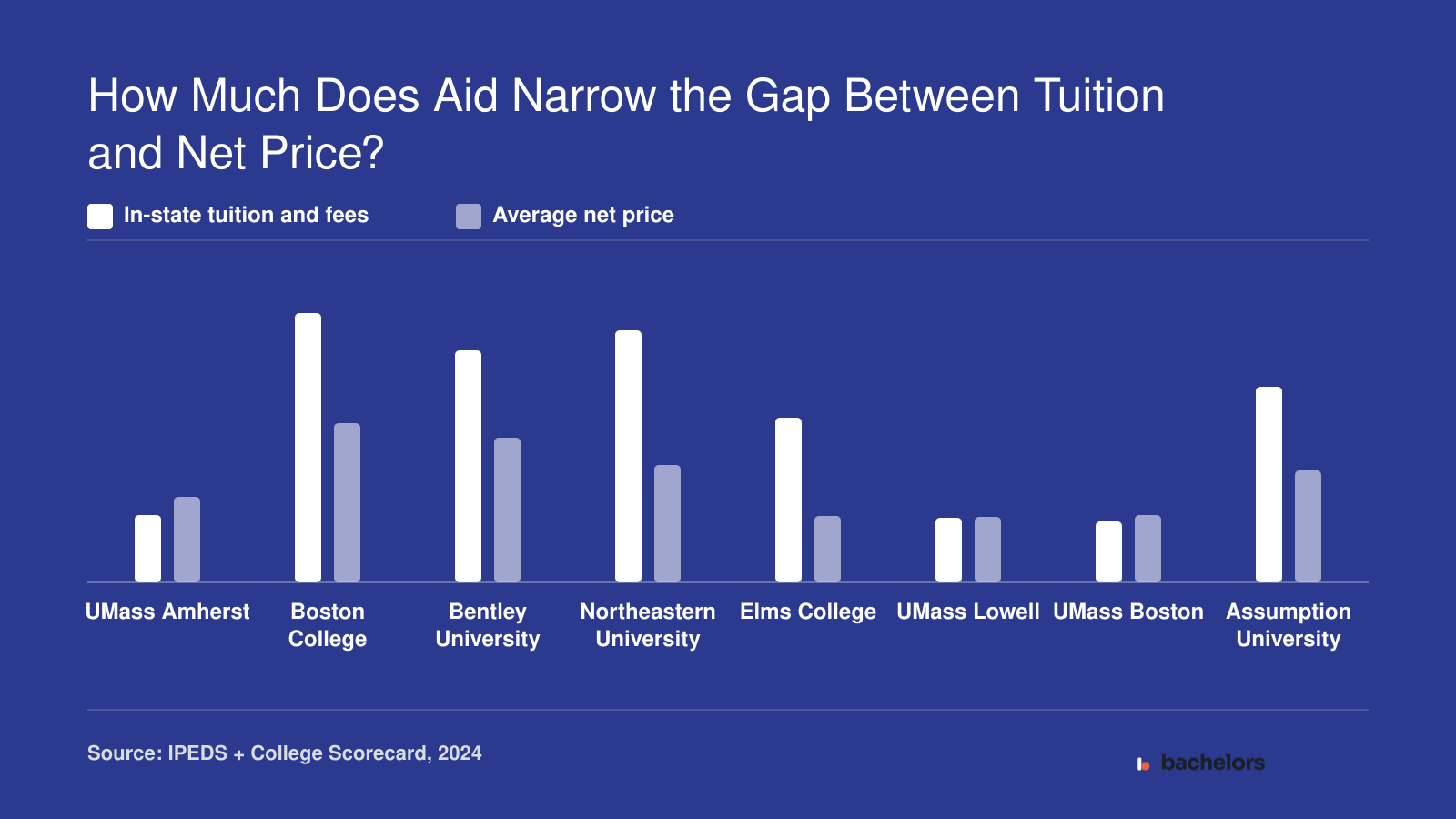
The public campuses carry the lowest sticker prices. In-state tuition and fees run about $15,908 at UMass Boston, $16,966 at UMass Lowell and $17,772 at UMass Amherst. Private tuition is far higher: $43,325 at College of Our Lady of the Elms, $61,000 at Bentley and $70,702 at Boston College.
Aid narrows that difference. Average net price is roughly $17,545 at Elms, $30,915 at Northeastern and $41,704 at Boston College. The public campuses sit between $17,163 and $22,383. These are approximate sector averages, not a quote for your household, so run each school's net price calculator before comparing.
Massachusetts State Aid
- MASSGrant: Need-based aid for residents who have lived in Massachusetts at least one year and plan to stay.1 For 2026-2027 you must be Pell-eligible (or have a Student Aid Index of 14,790 or less if you file the state MASFA), enroll full-time at 12 credits or more, make satisfactory academic progress, and hold no prior bachelor's degree.2 Award amounts vary, so confirm yours with the school.
- MassTransfer: Students starting at a community college can use an A2B Mapped or Linked pathway,3 which comes with a 10% tuition and fee rebate at the community college and a 10% campus-fee rebate at the four-year school.4
- Commonwealth Commitment: Eligible students earn a 10% tuition and fee rebate each semester.5 The state's earlier cost example for Fall 2022 through Spring 2026 showed $38,004 in locked tuition and fees falling to $32,054 after transfer credits and rebates. Treat that as an illustration, not a current price.6
- Tuition waivers: The 2026-2027 waiver program requires the recipient to be a public school teacher, so it rarely applies to first-time finance majors.7
One Takeaway
Sticker price can mislead. Elms lists far above UMass Amherst yet averages a lower net price, and state aid can shift the order again for a Pell-eligible resident. Compare each school's own aid offer, with MASSGrant and any rebates included, before naming the cheapest option.
How Much Does Aid Narrow the Gap Between Tuition and Net Price?
At Boston College, published tuition and fees of $70,702 drop to an average net price of $41,704 once grants are applied, and Bentley and Northeastern show similar gaps. At the UMass campuses, net price can sit above tuition because it covers housing, books, and other costs, not just tuition. Each net price figure is an average based on the school's public or private sector reporting, not an exact quote, so use each school's net price calculator for your own estimate.
Finance Careers in Massachusetts: Employers, Wages, and Credentials
What is the starting salary for finance majors in Massachusetts? The BLS wages below are averages across all experience levels, so they run higher than entry-level pay. For a new-graduate benchmark, use the program-level earnings figures in the ranking above, which reflect what each school's graduates earn after finishing.
Boston-Area Employers and Entry Roles
Greater Boston has a deep finance job market. Asset managers, banks, insurers, wealth management firms, and corporate finance departments all hire bachelor's graduates. Common entry roles include financial analyst, personal financial advisor (often after a trainee period), and credit or portfolio support positions.
BLS May 2025 data for the Boston-Cambridge-Newton metro show:
- Financial and investment analysts: mean annual wage of $131,310 ($63.13 per hour), with 13,010 jobs and a location quotient of 2.07, meaning the area employs about twice the national share1.
- Personal financial advisors: mean annual wage of $176,780 ($84.99 per hour)1. The national median for this role was $105,070 in May 2025, so Boston pays well above that benchmark.2
Advisor pay often includes commissions or fees tied to client assets, which is one reason the average sits so high.
Licensure and Credentials
Finance has no state license like nursing. A bachelor's degree in finance does not itself authorize you to sell securities. Registration depends on your job duties and employer, not on holding the degree. Credentials that matter:
- SIE: the FINRA Securities Industry Essentials exam. Anyone 18 or older can take it, with no job offer or sponsor needed. Passing does not authorize securities business, and results stay valid for four years.
- Series 7: the General Securities Representative exam, which requires sponsorship by a FINRA member firm. You must also pass the SIE to register as a representative.
- Massachusetts securities registration: may apply to representatives and advisers depending on the role. Your employer typically handles the filings, so confirm the current requirements with the state securities regulator.
- CFA: three exams for investment analysis and portfolio roles. Eligibility requires a bachelor's degree, being within 23 months of graduating, or 4,000 hours of qualifying work and education.3
- CFP: the planning credential for personal financial advisors. It requires a bachelor's degree for certification (not to sit for the exam), plus 4,000 to 6,000 hours of experience depending on the pathway.4
Massachusetts Finance Degree FAQs
These answers cover the questions students ask most often about a bachelor's degree in finance in Massachusetts. They draw on the school and accreditation details given earlier on this page.
What is the best finance school in Massachusetts for undergraduates?
Which Massachusetts colleges have AACSB-accredited finance programs?
Are there online bachelor's degrees in finance from Massachusetts schools?
Do I need a CFA or other credential to start a finance career in Massachusetts?
Compare Finance programs on the data that matters
Explore more Business & Management majors or browse every field of study.
All Business & Management programs Browse every field of study