Best Computer Science Schools in Massachusetts
Compare 54 accredited Computer Science programs in Massachusetts at 42 colleges, with net price after aid, graduation rates, earnings and debt from IPEDS and the U.S. College Scorecard.
Admission rates for undergraduate computer science in Massachusetts run from 4.55 percent at MIT to 83.04 percent at UMass Lowell. Either way, the credential is a Bachelor of Science (B.S.) or Bachelor of Arts (B.A.) in Computer Science.
The state pairs elite private research universities with a public system priced far lower: in-state tuition is $17,772 at UMass Amherst and $16,966 at UMass Lowell. Most national computer science rankings lean on graduate research output. The focus here is undergraduate programs, where cost, co-op access and online options matter more.
Selectivity and payoff pull against each other. MIT's school-wide median earnings reach $143,372 ten years after entry, and it is also the hardest school here to get into.
Key Points
- MIT leads: $143,372 median earnings 10 years after entry, $14,768 debt.
- Co-op programs add paid, full-time work but can extend graduation.
- University of Massachusetts-Dartmouth offers AI and software engineering concentrations.
Best Bachelor's Degree in Computer Science Schools in Massachusetts, Ranked
This ranked list covers bachelor's degree programs in computer science at Massachusetts schools, both campus and online. The page is about undergraduate study only; schools award the credential as a Bachelor of Science (B.S.) or a Bachelor of Arts (B.A.) in Computer Science, and graduate programs sit outside its scope. Net price figures are average net price after aid for each school's sector, so they are a benchmark rather than an exact quote for every student. The methodology note at the end explains how the order was set.
Massachusetts Institute of Technology
#1Cambridge, MA · ~$20,000/yr (est.)
Best for: Hands-on builders wanting undergraduate research access
MIT awards a Bachelor of Science in Computer Science and Engineering (Course 6-3) through its Department of Electrical Engineering and Computer Science, and the program is built around theory and making things work. Average net price after aid is about $20,111 and the school's graduation rate is 96%. Graduates of the program report median earnings of $154,492 one year after graduation and $225,141 four years out.
- Course 6-3 combines 17 General Institute Requirements with 177 major units
- Tracks: computer science, AI and decision making, electrical engineering
- Two communication-intensive subjects required within the major
- Undergraduate research through MIT's UROP program
- Housed in the Department of Electrical Engineering and Computer Science
- Part of the MIT Schwarzman College of Computing
- Swimming requirement plus four physical education courses
Harvard University
#2Cambridge, MA · $15,000 – $20,000/yr (est.)
Best for: Students pairing computing with another field
Harvard grants a Bachelor of Arts (A.B.) in Computer Science through the John A. Paulson School of Engineering and Applied Sciences, with the concentration declared in sophomore spring. Average net price after aid is about $19,066 and the school's graduation rate is 98%. Median earnings for program graduates are $152,251 one year after graduation and $203,169 four years out.
- Concentration declared in sophomore spring
- Eleven to fourteen 4-credit courses in the concentration
- Math covers linear algebra, single-variable calculus, probability and statistics
- Mind, Brain, and Behavior honors track available
- Thesis required to complete the concentration
- Concurrent A.B./S.M. option leads to a master's degree
- Research opportunities in SEAS labs with faculty
- Computer science secondary field available in four courses
Williams College
#3Williamstown, MA · ~$18,000/yr (est.)
Best for: Small-college students seeking close faculty contact
Williams offers a Bachelor of Arts in Computer Science at a small liberal arts college in the Berkshires, where majors complete at least eight computer science courses and attend departmental colloquia. Average net price after aid is about $17,716, the lowest among the private schools here, and the school's graduation rate is 94%. Median earnings run $110,814 one year after graduation and $209,574 four years out.
- At least eight computer science courses required
- Core courses CSCI 237 and 256 plus 300- or 400-level electives
- Discrete mathematics proficiency and one 200-level math course
- Declare by sophomore year after completing two CS courses
- Twenty computer science colloquia required for the major
- Honors thesis and faculty research opportunities available
- Study away options with colloquium credit
University of Massachusetts-Amherst
#4Amherst, MA · $20,000 – $25,000/yr (est.)
UMass Amherst awards a BS in Computer Science through the Manning College of Information and Computer Sciences, one of the largest computing schools in the state. Average net price after aid is about $22,383 and the school's graduation rate is 83%. Undergraduates can apply generative AI to public-sector problems through the paid, 16-week AI for the Commonwealth program, and graduates report median earnings of $88,554 one year after graduation and $123,519 four years out.
- Degree requirements updated in 2023
- C average required across major courses
- Electives at the 300 level or above
- Independent study and capstone options available
- No pass/fail grading for major courses
- Housed in the Manning College of Information and Computer Sciences
- Advising center plus progress tracking forms
Tufts University
#5Medford, MA · ~$40,000/yr (est.)
Tufts awards a Bachelor of Science in Computer Science from its School of Engineering, a 120-semester-hour degree that finishes with a senior capstone. Average net price after aid is about $39,998 and the school's graduation rate is 94%. Median earnings are $105,659 one year after graduation and $156,343 four years out, and internship credit and research experience are both available.
- 120 semester hours including 14 computer science courses
- Senior capstone project required
- C- or better required in each computer science course
- Ethics and social context coursework included
- Internship credit and independent study allowed
- Concentration electives plus research experience options
Smith College
#6Northampton, MA · $25,000 – $30,000/yr (est.)
Smith College, a women's college in Northampton, offers computer science as an undergraduate major that pairs a 12-course core with honors work and study abroad. Average net price after aid is about $27,579 and the school's graduation rate is 89%. Median earnings one year after graduation are $66,981.
- 12 full-semester courses required
- Introductory CSC 110 and 120, core CSC 210, 231 and 250
- One 300-level course required
- Honors program available with a 3.3 GPA
- Minors in digital arts and music
- Facilities in Ford Hall with 3-D printers and labs
- Study abroad opportunities built into the major
Boston College
#7Chestnut Hill, MA · ~$42,000/yr (est.)
Boston College lets undergraduates choose between a Bachelor of Arts and a Bachelor of Science in Computer Science, so students can weight the degree toward computing or toward advanced mathematics and lab science. Average net price after aid is about $41,704 and the school's graduation rate is 91%. Median earnings are $86,749 one year after graduation and $143,204 four years out.
- Both B.A. and B.S. paths available
- B.A. requires Calculus II; B.S. adds a two-semester lab science sequence
- Core courses must be taken in order
- 1.67 GPA minimum in computer science courses
- Bioinformatics concentration offered with Biology and Mathematics
- B.S. includes 12 additional math credits
Worcester Polytechnic Institute
#8Worcester, MA · $40,000 – $45,000/yr (est.)
WPI awards a Bachelor of Science in Computer Science on a project-based calendar of seven-week terms, with concentrations available in cybersecurity and artificial intelligence. Average net price after aid is about $43,071 and the school's graduation rate is 90%. Median earnings are $93,888 one year after graduation and $134,208 four years out.
- Tracks: cybersecurity, artificial intelligence
- Project-based learning on seven-week terms
- BS/MS accelerated five-year option
- Global project centers for hands-on industry work
- STEM-designated degree
- 13:1 student-to-faculty ratio and more than 235 student clubs
Mount Holyoke College
#9South Hadley, MA · $25,000 – $30,000/yr (est.)
Mount Holyoke College offers a Bachelor of Arts in Computer Science that runs from core systems and algorithms coursework into artificial intelligence, robotics and computer vision. Average net price after aid is about $26,441 and the school's graduation rate is 84%. Median earnings are $71,672 one year after graduation and $120,021 four years out.
- Minimum of 40 credits in the major
- Core covers problem solving, data structures, systems and software design
- Discrete Mathematics plus 12 credits of computer science electives
- Placement test can start experienced students at COMSC-205
- Coursework in AI, robotics, networking and computer vision
- Fimbel Maker and Innovation lab for robotics projects
- Embedded peer mentoring in introductory courses
University of Massachusetts-Lowell
#10Lowell, MA · ~$17,000/yr (est.)
UMass Lowell awards a Bachelor of Science in Computer Science with a bottom-up curriculum that starts with machine fundamentals before moving into programming and system design. Average net price after aid is about $17,163, the lowest on this list, and the school's graduation rate is 65%. Median earnings are $86,167 one year after graduation and $111,612 four years out, and co-op and internship placements are built into the program.
- Tracks: cybersecurity, data science, bio-cheminformatics, general
- Bottom-up curriculum starts with machine fundamentals
- Part-time or full-time enrollment available
- Co-op and internship opportunities
- Robotics teaching lab and NERVE Center facilities
- Ethics course required for the major
- Robotics minor available
Cost & outcomes by school
Federal data for the highest-earning Computer Science programs, independent of the ranking above. Earnings are this field's bachelor's graduates four years after completing where the Scorecard reports them, else the school's undergraduate median.
| School | Net price / yr | Grad rate | Earnings | Debt | Grads/yr | Format |
|---|---|---|---|---|---|---|
| Massachusetts Institute of Technology MA | $20,111 | 96% | $225,141 | $11,077 | 362 | Campus |
| Williams College MA | $17,716 | 94% | $209,574 | $12,208 | 68 | Campus |
| Harvard University MA | $19,066 | 98% | $203,169 | $14,000 | 264 | Campus |
| Tufts University MA | $39,998 | 94% | $156,343 | $15,500 | 248 | Campus |
| Boston College MA | $41,704 | 91% | $143,204 | $18,000 | 160 | Campus |
| Amherst College MA | $23,367 | 94% | $142,680 | $16,750 | 65 | Campus |
| Boston University MA | $24,402 | 89% | $136,667 | $23,125 | 445 | Campus |
| Worcester Polytechnic Institute MA | $43,071 | 90% | $134,208 | $27,000 | 270 | Campus |
| University of Massachusetts-Amherst MA | $22,383 | 83% | $123,519 | $22,679 | 471 | Campus |
| Brandeis University MA | $35,736 | 86% | $123,460 | $26,142 | 97 | Campus |
| Wentworth Institute of Technology MA | $34,170 | 68% | $121,671 | $25,000 | 120 | Campus |
| Mount Holyoke College MA | $26,441 | 84% | $120,021 | $20,750 | 47 | Campus |
Sources: U.S. Department of Education. Net price, graduation rate, earnings and debt: College Scorecard (earnings and debt for this field's bachelor's graduates where reported, else school-wide); graduates: IPEDS. A dash means no figure is reported.
Cost, debt & payoff
Median earnings of this field's bachelor's graduates (4 yrs after completing, else the school's undergraduate median) vs. their median federal loan debt · U.S. College Scorecard
Across these programs the median graduate earns about $87,099 and finishes with roughly $25,000 in debt — a ratio that clears a common rule of thumb (keep debt below first-year salary). Net price and debt vary widely school to school, so check the per-school figures in the table above before you shortlist.
MIT or Northeastern: Which Is Better for Computer Science?
The choice comes down to two ways to earn a bachelor's degree in computer science: a highly selective research university, or a program that builds paid co-op work terms into the degree. Neither model is better for every student. The right pick depends on your admissions odds, your budget, and how early you want real job experience.
The Selectivity and Research Path
MIT admits about 4.6% of applicants and graduates 96% of its students. Its average net price after aid is $20,111. Its computer science graduates report median earnings of $154,492 one year after finishing, rising to $225,141 four years out, with median program debt of $11,077.
The Co-op Path
Co-op programs trade some of that selectivity for structured work experience before graduation. UMass Lowell, whose B.S. in Computer Science includes a co-op program, admits 83% of applicants and has a $17,163 average net price. Its computer science graduates report median earnings of $86,167 one year out and $111,612 at four years, with $25,000 in median debt. Its graduation rate is 65%. The co-op section below explains how these work terms fit into the degree.
Which Should You Choose?
Choose MIT if you are a competitive applicant aiming for research, graduate study, or the highest earnings ceiling in the state. Choose a co-op program if you want paid industry experience on your résumé before graduation and a more reachable admissions bar.
Most Affordable Computer Science Schools in Massachusetts
Net price is the average a full-time undergraduate pays per year after grants and scholarships, so it can sit far below the sticker price. In federal IPEDS and College Scorecard data, private College of Our Lady of the Elms lists $43,325 in tuition and fees but averages $17,545 after aid, while the public universities in the table land between $13,381 and $17,163, and Pell Grant recipients make up 47% to 58% of undergraduates at these schools, a sign of broad access for lower-income students. A lower net price is not automatically a better deal, so weigh it against graduation rates, typical debt and graduate earnings before you decide.
| School | City | Sector | Average Net Price (After Aid) | In-State Tuition and Fees | Undergraduates Receiving Pell Grants |
|---|---|---|---|---|---|
| Worcester State University | Worcester | Public | $13,381 | $11,786 | 50.5% |
| Bridgewater State University | Bridgewater | Public | $16,383 | $11,808 | 50.0% |
| Westfield State University | Westfield | Public | $16,721 | $12,179 | 47.1% |
| University of Massachusetts-Lowell | Lowell | Public | $17,163 | $16,966 | 47.7% |
| College of Our Lady of the Elms | Chicopee | Private nonprofit | $17,545 | $43,325 | 57.8% |
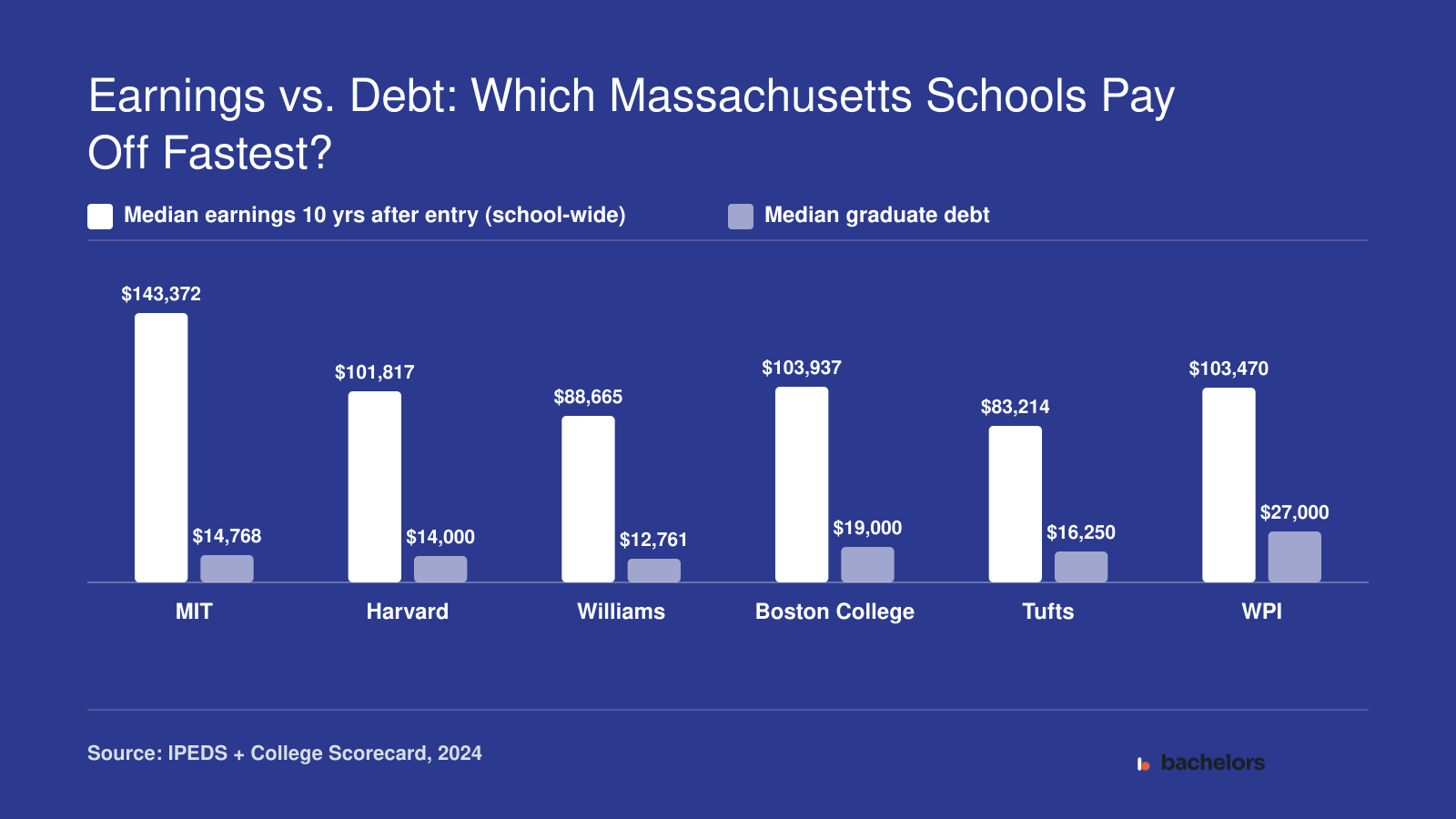
Earnings vs. Debt: Which Massachusetts Schools Pay Off Fastest?
These figures cover all graduates at each school, not computer science majors alone, so treat them as a school-wide proxy for payoff. MIT leads with $143,372 in median earnings 10 years after entry against $14,768 in median debt. Net price also changes the payoff: Williams graduates earn less than those from Boston College or WPI, but a $17,716 net price and $12,761 median debt give them a faster path to paying off what they borrowed than peers carrying $19,000-$27,000.
Co-Op, Internships, and Specializations at Massachusetts Computer Science Schools
A co-op can give you a year of paid, full-time work before graduation, but it can also stretch the path to a bachelor's degree in computer science. An internship keeps you on the standard schedule and costs less time, though it usually gives you less. Knowing which model a school uses helps you pick the right fit.
Co-op vs. Internship
A co-op is a paid, full-time, for-credit rotation with an employer, usually lasting a semester or longer and often alternating with classes.1 An internship is typically a shorter placement, most often a summer, and may or may not carry credit.2 Co-ops build deeper experience and a longer résumé line. Internships are easier to fit around coursework, research and study away.
Schools With Co-op or Credit-Bearing Work
University of Massachusetts-Lowell lists a co-op program and internship opportunities alongside its B.S. in Computer Science, which can be taken part time or full time. Tufts University offers internship credit and research experience options within its B.S. Worcester Polytechnic Institute builds experience through project-based learning, seven-week terms and global project centers rather than a standard co-op model. Before you commit, check each department's own pages for co-op length, whether it is required, and how employers are recruited.
Schools Built Around Research and Career Fairs
Massachusetts Institute of Technology and Harvard University emphasize undergraduate research with faculty. Harvard also requires a thesis. Williams College offers research opportunities, honors thesis options and teaching assistant positions. Smith College and Mount Holyoke College pair faculty research with maker-lab access and peer mentoring. At these schools, job experience usually comes through summer internships, campus recruiting and your own search.
Specializations to Look For
- Cybersecurity: Worcester Polytechnic Institute offers a Cyber Security concentration, and University of Massachusetts-Lowell lists a cybersecurity option.
- Data science: University of Massachusetts-Lowell offers a data science option, along with bio-cheminformatics.
- Artificial intelligence: University of Massachusetts-Dartmouth offers a B.S. in Computer Science with an Artificial Intelligence concentration. Mount Holyoke College lists coursework in AI, robotics, networking and algorithms.
- Software engineering: University of Massachusetts-Dartmouth also offers a Software Engineering concentration.
A Question to Ask on Your Campus Visit
Ask the career office: "What share of last year's computer science majors completed a paid co-op or internship, and how many of those placements came through the school rather than the student's own search?" A specific number, with names of recent employers, tells you more than a general claim about industry connections.
Related Articles
Admissions for a Bachelor's in Computer Science in Massachusetts: GPA, Test Policy, and Transfer Credit
Use this checklist to confirm each requirement on the school's own admissions page before you apply. Published policies vary, and some details below come from program pages rather than admissions offices.
- GPA expectations at MITMIT reviews applicants holistically and sets no minimum or typical high school GPA. Strong grades in rigorous courses still matter.
- SAT/ACT scores at MITMIT's 2024-25 Common Data Set shows enrolled students scoring 1520-1570 on the SAT (median 1550) and 34-36 on the ACT (median 35). These figures do not say whether testing is required, so check MIT's current policy for your entry year.
- Testing and GPA at other ranked schoolsLook up each school's current SAT/ACT policy and any GPA guidance yourself. Smith and WPI admit computer science students through the standard college application, and WPI accepts the Common Application.
- Direct admit vs. declaring laterMIT does not admit students directly into computer science. Harvard students declare the concentration in the spring of sophomore year. Williams asks students to complete two CS courses and declare by a sophomore-year deadline. At UMass Amherst, changing into the major requires an application.
- Math preparationTake calculus in high school if you can, or at least precalculus. Harvard's major covers calculus, linear algebra and probability. Boston College's B.A. requires Calculus II, and Tufts lists mathematics prerequisites.
- Transfer credit at MITApplicants need at least one year of strong grades at an accredited college or community college. Those with more than two and a half years of study are ineligible. The academic department awards credit after admission, and only for courses substantially equivalent to MIT's. Most transfers enter as sophomores and lose at least one semester.
- Community college pathwayStarting at a Massachusetts community college can lower your total cost before you transfer to a public university. See the cost section for how MassTransfer works.
Massachusetts Computer Science Degree FAQs
These answers cover the questions students ask most when comparing a bachelor's degree in computer science in Massachusetts. Each one points back to the section of this page with more detail.
What is the best college for computer science in Massachusetts?
Should I choose a B.S. or a B.A. in Computer Science?
Can I start at a community college and transfer into a Massachusetts CS bachelor's program?
Do I need a license to work as a software developer in Massachusetts?
Compare Computer Science programs on the data that matters
Explore more Computers & IT majors or browse every field of study.
All Computers & IT programs Browse every field of study