Best Psychology Schools in Massachusetts
Compare 51 accredited General Psychology programs in Massachusetts at 47 colleges, with net price after aid, graduation rates, earnings and debt from IPEDS and the U.S. College Scorecard.

Massachusetts schools award the psychology bachelor's as either a Bachelor of Science (B.S.) or a Bachelor of Arts (B.A.). Published tuition and fees behind it range from $11,786 at Worcester State University to $70,702 at Boston College.
The programs here suit students who want to study in Massachusetts, or online through a Massachusetts-based school. It pairs a ranked list with the cheapest and highest-earning options, online formats, admissions, cost, and careers.
Selectivity is just as uneven. Harvard University admits 3.65 percent of applicants, while Worcester State admits about 88 percent.
Key Points
- Boston University and Boston College award both a B.A. and B.S.
- Most online psychology routes here suit students who already hold college credit.
- Acceptance rates run from under 5 percent to nearly 90 percent.
Best Schools for a Bachelor's Degree in Psychology in Massachusetts
The strongest psychology bachelor's programs in Massachusetts split into two camps: small colleges that put undergraduates into faculty labs, and large universities with the scale to offer six concentrations or a fully online route. What separates them for a prospective student is usually price after aid and how many of their students actually finish.
Harvard University
#1Cambridge, MA · $15,000 – $20,000/yr (est.)
Best for: Self-directed students designing their own curriculum
Harvard's psychology concentration is built for breadth: students choose two foundational courses from six subfields and can skip the thesis entirely, with statistics and research methods as the only fixed science requirements. A sophomore tutorial and optional lab work give anyone heading toward research a running start. It is the hardest admit on this list by a wide margin, and the university-wide graduation rate near 98% reflects a student body that arrives prepared. Net price after aid averages roughly $19,100.
- No thesis or capstone required
- Choose two foundational courses from six subfields
- Statistics (PSY 1900) and research methods (PSY 1901) required
- Sophomore tutorial on contemporary issues
- Optional thesis for research-focused students
- Optional lab work across several research areas
- Prepares for paths in business, law, medicine, and academia
University of Massachusetts-Amherst
#2Amherst, MA · $20,000 – $25,000/yr (est.)
Best for: Massachusetts residents wanting big public research options
UMass Amherst is the largest psychology producer in the state, awarding more than 540 bachelor's degrees in the most recent federal count, with a general track and a neuroscience track. Statistics and research methods are required of everyone, and students can join faculty labs or take clinical and counseling internships at hospitals, law enforcement agencies, and schools. Program graduates report median earnings of about $51,300 four years after finishing, and net price after aid lands near $22,400.
- General psychology and psychology neuroscience tracks
- Statistics and research methodology required of all tracks
- Electives include forensic psychology and the science of sleep
- Research placements alongside faculty
- Internships at hospitals, law enforcement agencies, and schools
- Structured as preparation for graduate study
Boston University
#3Boston, MA · $20,000 – $25,000/yr (est.)
Best for: Boston-based students pursuing honors research
Boston University runs both a B.A. and a B.S. in psychology, and the split matters: the B.A. is an 11-course, 44-credit liberal arts route, while the B.S. version runs 128 credits across 32 courses with an experimental psychology series and research experience built in. Research methods and APA-style writing are threaded through the coursework, and honors students can design an independent thesis. Program graduates earn a median of roughly $63,800 four years out, among the stronger outcomes here, against a net price after aid near $23,300.
- 44 credit hours across 11 courses
- Research methods with APA-style writing
- Group A and Group B content course selections
- Honors in the major with independent research
- Transfer courses limited to three
- Statistics fulfilled by MA 116, MA 214, PS 211, or PS 212
- C or higher required in principal courses
- 128 total credit hours, 32 courses
- Experimental psychology series available
- Research experience opportunities
- General Psychology and statistics required
- 11 courses (44 units) inside the major
- Flexible elective choices
Boston College
#4Chestnut Hill, MA · ~$42,000/yr (est.)
Boston College offers psychology as both a B.A. and a B.S., and the two diverge sharply: the B.A. needs 33 credits and leaves room for a clinical concentration, study abroad, or a fifth-year master's, while the B.S. runs 54 credits with science and computation corequisites for students aiming at Ph.D. or M.D. paths. A senior thesis is optional in both. Median earnings for program graduates reach about $70,000 four years out, with a net price after aid near $41,700 and an admit rate around 16%.
- 33 total credit hours
- Clinical concentration available
- Optional senior thesis
- Study abroad permitted with approval
- Fifth-year master's option
- Faculty advisement required
- 54 total credit hours
- Computational corequisite required
- Science corequisites required
- Senior thesis option
- Strongly recommended research
- Prepares for research-focused graduate work
Bentley University
#5Waltham, MA · ~$38,000/yr (est.)
Bentley is the outlier here: psychology taught inside a business university, with a Business Administration minor baked into the 120-credit degree. Students take courses across sociocultural, mind and development, and health and wellbeing areas, then finish with a research capstone, and an internship in psychology is available for those who want workplace experience first. It suits students aiming at marketing, human resources, healthcare, or technology rather than a clinical path. Net price after aid runs about $37,900, roughly 87% of students graduate, and about 45% of applicants are admitted.
- 120 total credit hours
- Business Administration minor included
- Research capstone required
- Internship in Psychology available
- Course areas: sociocultural, mind and development, health and wellbeing
- Communication Intensive course required
- 42 unrestricted elective credits
Worcester State University
#6Worcester, MA · ~$13,000/yr (est.)
Worcester State is the affordability play on this list, with a net price after aid averaging about $13,400. The B.S. requires 14 psychology courses (43 credits) including statistics, research methods, and applied research, plus a capstone seminar, and students can add a Mental Health Services concentration or an interdisciplinary women's studies concentration. Undergraduates take internships and faculty-led research projects, and the honors program is aimed at students planning graduate school. Program graduates report median earnings near $57,200 four years out.
- 14 psychology courses totaling 43 credits
- Concentrations in Mental Health Services and Women's Studies
- Psychological Statistics, Research Methods, and Applied Research Methods
- Capstone seminar required
- Internships and faculty-led undergraduate research
- Psi Chi psychology honor society chapter
- Honors program with a faculty-sponsored project
University of Massachusetts-Lowell
#7Lowell, MA · ~$17,000/yr (est.)
UMass Lowell's B.A. in psychology carries six concentration options, from behavior analysis and clinical psychology to community social psychology and developmental disabilities and health psychology, and the 120-credit degree can be completed part time. It is also one of the few psychology bachelor's degrees in Massachusetts with a fully online route. Major requirements run 36 to 54 psychology credits with at least 18 at the 3000 level, graduates report median earnings of about $57,500 four years out, and net price after aid is roughly $17,200.
- Six concentration options including behavior analysis and clinical psychology
- 120 total credits, 36 to 54 in psychology
- At least 18 psychology credits at the 3000 level
- Fully online option available
- Full-time and part-time enrollment
- 2.2 GPA minimum in psychology courses
- Bachelor's-to-master's path in five years
- Psi Chi international honor society
College of the Holy Cross
#8Worcester, MA · $39,000/yr (est. net price)
Holy Cross treats psychology as a liberal arts discipline that leans hard on lab work: 10 courses including statistics and research methods, with undergraduates joining faculty labs studying neurobiology, language development, and visual perception. Internships around Worcester add applied experience, and Psi Chi membership is open to high achievers. The payoff shows in outcomes, with program graduates reporting the highest median earnings on this list at about $74,100 four years out, though net price after aid is also high at roughly $38,800 and the admit rate sits near 18%.
- 10 courses in the major
- Introduction to Psychology, Statistics, and Research Methods required
- Advanced work in biological, cognitive, and social processes
- Research in faculty labs on neurobiology and visual perception
- Internships in the Worcester area
- Psi Chi National Honor Society
Simmons University
#9Boston, MA · $25,000 – $30,000/yr (est.)
Simmons, a Boston university whose undergraduate college enrolls primarily women, builds its B.A. in psychology around a capstone that integrates upper-level theory with research, plus fieldwork placements around the city. Coursework spans biological, cognitive, developmental, and social psychology with required statistics and research methods. Graduates move directly into roles as behavioral technicians, research assistants, and human resources specialists, and the program feeds graduate study in clinical psychology, social work, and behavior analysis. Net price after aid is about $25,300 and median earnings four years out are around $51,500.
- Capstone integrating upper-level theory and research
- Fieldwork and research placements in Boston
- Required statistics and research methods
- Coursework in basic processes, social and developmental, clinical and personality
- Thesis and fieldwork options for independent learning
- Prepares for Ph.D., MSW, and LMHC pathways
Assumption University
#10Worcester, MA · ~$29,000/yr (est.)
Assumption's B.A. in psychology is a 12-course major with a research sequence and a capstone seminar, and enough flexibility to focus on child development, mental health, neuroscience, or applied behavior analysis. Students can earn course credit for internships and join faculty research in dedicated labs, with summer fellowships available. The Worcester campus keeps classes small and the Psychology Club and Psi Chi chapter active. Median earnings four years out are about $61,600 against a net price after aid near $29,500.
- 12 courses in the major
- Capstone seminar and research sequence
- Focus areas include child development, mental health, neuroscience, and ABA
- Internships for course credit
- Faculty-student research in dedicated labs
- Summer research fellowships available
- Psychology Club and Psi Chi chapter
Cost & outcomes by school
Federal data for the highest-earning General Psychology programs, independent of the ranking above. Earnings are this field's bachelor's graduates four years after completing where the Scorecard reports them, else the school's undergraduate median.
| School | Net price / yr | Grad rate | Earnings | Debt | Grads/yr | Format |
|---|---|---|---|---|---|---|
| Bentley University MA | $37,930 | 87% | $120,959 | $25,023 | 1 | Campus |
| Worcester Polytechnic Institute MA | $43,071 | 90% | $103,470 | $27,000 | 5 | Campus |
| Harvard University MA | $19,066 | 98% | $101,817 | $14,000 | — | Campus |
| Northeastern University MA | $30,915 | 91% | $92,538 | $24,250 | — | Campus |
| Northeastern University MA | — | — | $92,538 | $24,250 | — | Online |
| Wellesley College MA | $25,496 | 92% | $84,803 | $10,000 | — | Campus |
| Tufts University MA | $39,998 | 94% | $83,214 | $16,250 | — | Campus |
| Brandeis University MA | $35,736 | 86% | $77,231 | $25,648 | — | Campus |
| College of the Holy Cross MA | $38,782 | 87% | $74,095 | $26,990 | 102 | Campus |
| Boston College MA | $41,704 | 91% | $70,033 | $18,000 | 199 | Campus |
| Emmanuel College MA | $26,706 | 68% | $68,245 | $27,000 | — | Campus |
| Stonehill College MA | $33,016 | 76% | $63,957 | $25,000 | 74 | Campus |
Sources: U.S. Department of Education. Net price, graduation rate, earnings and debt: College Scorecard (earnings and debt for this field's bachelor's graduates where reported, else school-wide); graduates: IPEDS. A dash means no figure is reported.
Cost, debt & payoff
Median earnings of this field's bachelor's graduates (4 yrs after completing, else the school's undergraduate median) vs. their median federal loan debt · U.S. College Scorecard
Across these programs the median graduate earns about $54,702 and finishes with roughly $25,000 in debt — a ratio that clears a common rule of thumb (keep debt below first-year salary). Net price and debt vary widely school to school, so check the per-school figures in the table above before you shortlist.
Most Affordable Psychology Bachelor's Programs in Massachusetts
These Massachusetts schools post the lowest average net price for a bachelor's degree in psychology, based on 2024 U.S. Department of Education data from IPEDS and the College Scorecard. Net price is an average of what aided students pay after grants and scholarships, calculated under the federal public-sector formula, so treat it as a benchmark rather than a quote for your own bill. Every school here is a public state university, which shows that the public sector is where Massachusetts residents find the lowest psychology costs.
| School | City | Sector | Average Net Price | In-State Tuition and Fees | Pell Grant Share | Median Debt at Graduation |
|---|---|---|---|---|---|---|
| Worcester State University | Worcester | Public | $13,381 | $11,786 | 50% | $19,500 |
| Fitchburg State University | Fitchburg | Public | $14,262 | $11,346 | 53% | $24,239 |
| Massachusetts College of Liberal Arts | North Adams | Public | $16,068 | $12,436 | 61% | $23,750 |
| Framingham State University | Framingham | Public | $16,114 | $11,920 | 51% | $25,000 |
| Westfield State University | Westfield | Public | $16,721 | $12,179 | 47% | $22,457 |
Online and Hybrid Bachelor's Degree in Psychology Options at Massachusetts Schools
Can you earn a psychology bachelor's online from a Massachusetts school? Yes, but most online routes here are built for students who already hold college credit, not for first-year students starting from scratch.
Campus-Based Programs
Harvard, Boston University, Boston College, Bentley, Worcester State, Holy Cross, Simmons, and Assumption deliver their psychology majors on campus. These programs suit students who want hands-on research and local internships. Holy Cross offers research in faculty labs, and Assumption highlights its research laboratories and summer research fellowships.
Online and Hybrid Routes
- UMass Amherst: Applied Psychology through University Without Walls is fully online, with mostly asynchronous courses and an optional blended path. It is a degree-completion program that requires prior credits. It is separate from the campus B.S. in General Psychology.
- UMass Lowell: The B.A. in Psychology runs both on campus and online, including a fully online option. The degree totals 120 credits, transfer students can apply up to 90, and the school lists a 2.2 GPA minimum. Confirm whether every requirement can be finished remotely.
- Fitchburg State University: Its psychology program is reported as fully online. Ask whether it runs as a standard four-year track or as completion only.
- Massachusetts College of Liberal Arts: MCLA offers a hybrid completion cohort for adults. Courses run in 7-week sessions that meet one evening a week, online and in Pittsfield. Applicants need an associate degree or 45 to 75 transfer credits, plus a 2.0 GPA.
Which Format Fits You
Working adults with existing credits gain the most flexibility from UMass Amherst's asynchronous courses, which let you study around a job. Commuters who want some structure may prefer MCLA's single weekly evening meeting or UMass Lowell's mix of online and campus courses. Students entering college for the first time, or anyone planning on lab research and graduate study, are better served by the campus programs.
Limits to Check
Completion tracks set credit minimums before you can enroll, so new high school graduates generally will not qualify. MCLA's cohort includes in-person time in Pittsfield, which matters if you live far from western Massachusetts. Before applying, ask each school about residency rules, in-person requirements, and how your transfer credits will count.
Admissions: GPA, Test Policy, and Transfer Credit
Two applicants can hold identical transcripts and get different answers: a college admitting under 5 percent of applicants reads the same file against a far deeper pool than one admitting close to 90 percent. The Massachusetts psychology programs compared here differ on testing, GPA, and transfer credit, and in a few places the published record goes quiet.
Test policy and selectivity
UMass Amherst states that SAT and ACT scores are optional for first-year applicants, and with an acceptance rate near 60 percent, a strong transcript carries most of the weight. Harvard is the outlier among these schools: after several test-optional cycles it has returned to requiring SAT or ACT scores, and with an acceptance rate under 4 percent, testing is only one filter in a very narrow review. Boston University (about 11 percent), Boston College (about 16 percent), and College of the Holy Cross (about 18 percent) form the most selective group, and their testing rules have shifted from cycle to cycle. Confirm the policy for the year you apply rather than trusting a page you read last spring. Worcester State (about 88 percent), UMass Lowell (about 83 percent), and Assumption (about 83 percent) admit broadly, which tends to mean more predictable outcomes for solid applicants; Bentley (about 45 percent) and Simmons (about 70 percent) sit in between.
What the schools say about GPA
- UMass Lowell: publishes a 2.2 GPA minimum for the psychology major.
- UMass Amherst: states plainly that no GPA or test score alone guarantees admission; reviewers weigh grades, overall GPA, course rigor, and relevance to the major.
- Elsewhere: several of the private colleges here do not publish a hard GPA floor for psychology, and where a number exists it functions as a review threshold, not a promise.
Transfer credit and community college pathways
- UMass Lowell: the online BA in psychology runs 120 credits and accepts up to 90 transfer credits, 75 percent of the degree.
- UMass Amherst: the traditional psychology bachelor's requires at least 18 psychology credits taken in residence. A separate applied-psychology completion route is reported to accept up to 105 transfer credits, but it is its own program with its own rules.
- Boston University: limits transfer coursework applied to the major to three courses.
- MassTransfer: the state's transfer compact is worth checking if you start at a Massachusetts community college, particularly for UMass Amherst, UMass Lowell, and Worcester State.
For Harvard, Boston College, Holy Cross, Bentley, Simmons, and Assumption, we did not find a published cap on transfer credits for the psychology bachelor's, so ask admissions in writing before you apply.
The skim version
Harvard, Boston University, Boston College, and Holy Cross demand the strongest academic profile. Worcester State, Assumption, and UMass Lowell are the most accessible entry points, and UMass Lowell's generous transfer cap makes it the friendliest landing spot for students arriving with prior college credit.
Related Articles
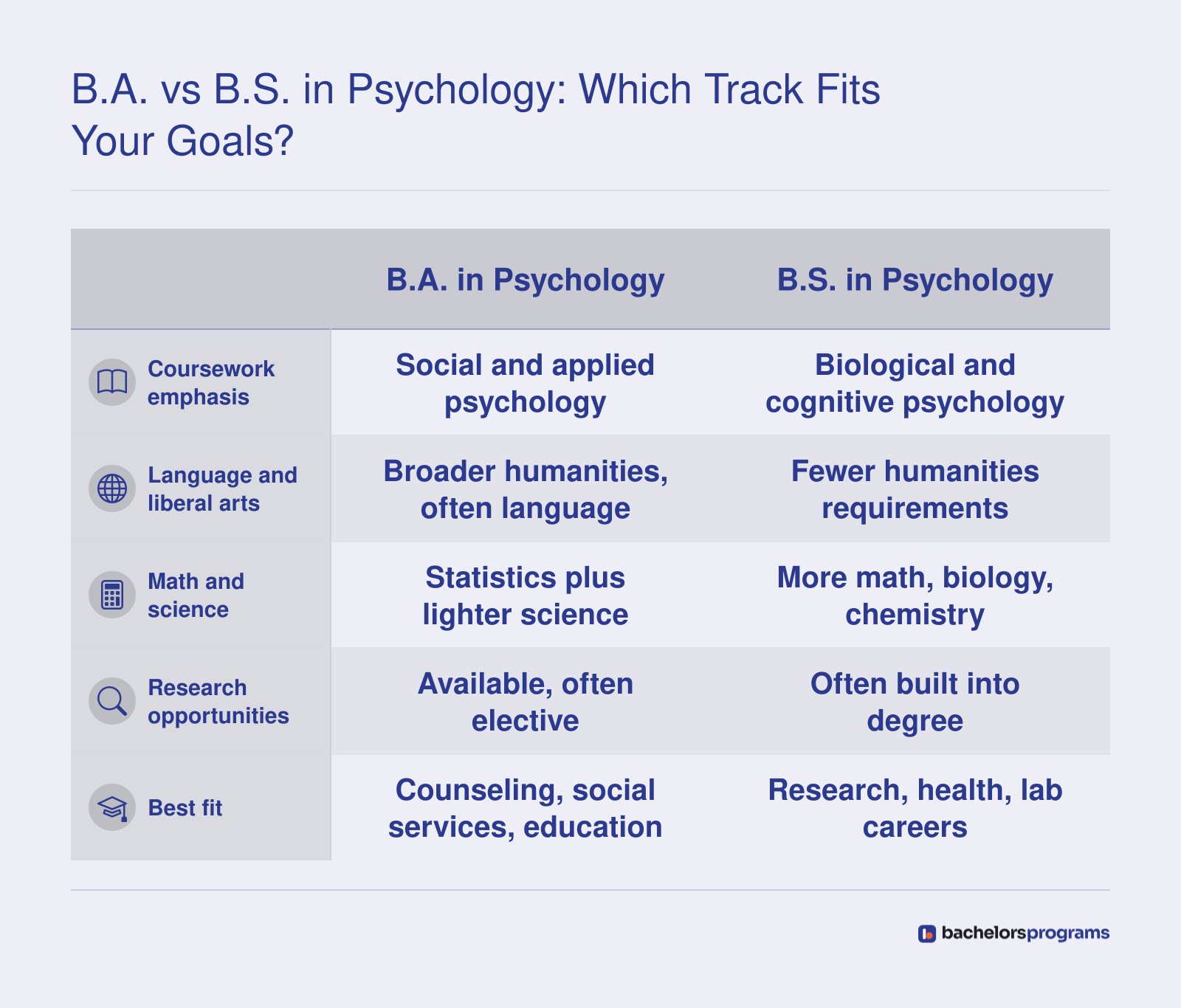
B.A. vs B.S. in Psychology: Which Track Fits Your Goals?
A bachelor's degree in psychology is awarded as either a Bachelor of Arts (B.A.) or a Bachelor of Science (B.S.), and both cover the same core psychology courses. The differences usually show up in the courses around the major. Boston University, Boston College and Fitchburg State University offer both tracks, so you can compare them side by side at a single school. Requirements vary by school, so check each catalog before you choose.
Questions to Ask Yourself
Do you want a B.A. with room for electives, or a B.S. with more research methods and science?
Would a Massachusetts public school's lower net price outweigh a private school's smaller classes?
Do you need a fully online or degree-completion format, or can you commute to campus?
Are you planning further study for licensure, and does your target school offer research or internship experience to prepare you?
Common Questions About Psychology Bachelor's Programs in Massachusetts
These answers summarize the main points from the rankings and program details above. Program requirements and formats change, so confirm specifics with each school before you apply.
What is the best school for psychology in Massachusetts?
Can you get a bachelor's degree in psychology online from a Massachusetts school?
What is the difference between a B.A. and a B.S. in psychology?
What can you do with a bachelor's degree in psychology in Massachusetts?
Compare General Psychology programs on the data that matters
Explore more Psychology majors or browse every field of study.
All Psychology programs Browse every field of study