Best Finance Schools in Missouri
Compare 41 accredited Finance programs in Missouri at 28 colleges, with net price after aid, graduation rates, earnings and debt from IPEDS and the U.S. College Scorecard.

A bachelor's degree in finance in Missouri prepares students for banking, investments, insurance and corporate finance, the work that anchors the St. Louis and Kansas City job markets. The common credential is the Bachelor of Science (B.S.) in Finance.
Cost drives the decision. Annual tuition runs from $9,502 in-state at Missouri State University to $65,790 at Washington University in St Louis, though aid narrows that gap sharply. At Washington University the average net price is $21,786, so sticker price alone is a poor guide.
Key Points
- At Washington University in St Louis, $65,790 tuition averages $21,786 after aid.
- Missouri State requires a 2.50 GPA to enter its finance major.
- Personal financial advisors posted top medians, reaching $149,900 (BLS May 2023).
Best Bachelor's Degree in Finance Schools in Missouri: Top 10 Ranked
Every school below awards a bachelor's degree in finance, on campus or fully online, from a Missouri institution. Cards are ordered by how each school performs on on-time completion and net price after aid, with program earnings, typical debt and delivery format shown alongside. Each entry names the school's graduation rate and any concentration the finance major carries.
Washington University in St Louis
#1St. Louis, MO · ~$22,000/yr (est.)
Best for: High-achievers weighing a selective private campus
Washington University in St. Louis is the most selective campus in this ranking, admitting roughly 12% of applicants, and the school's graduation rate is 94%. Finance is one of the majors inside the BSBA at Olin Business School, so students complete a full business core before specializing, and a second major in Financial Engineering is available to BSBA students who meet the GPA rules. Finance graduates report median earnings of $102,814 one year after graduation and $185,551 four years after graduation.
- Finance is one of the majors inside the Olin BSBA
- Open to non-BSBA students as a second major
- Financial Engineering second major open to BSBA students meeting GPA rules
- Located at Olin Business School in St. Louis
University of Missouri
#2Columbia, MO · ~$20,000/yr (est.)
Best for: In-state students wanting a flagship research campus
The University of Missouri pairs a 120-credit Finance and Banking major with the resources of the state's flagship public research university, and the school's graduation rate is 75%. The major is campus-based in Columbia and centers on how financial markets work, how to analyze financial information and how to build forecasts of business and economic conditions. Selected students also manage roughly $2.3 million of university endowment money through the Investment Fund Management Program.
- 120 total credit hours
- Major in Finance and Banking inside the BSBA
- Prepares for commercial banking, corporate finance and investment banking
- Selected students manage about $2.3 million of endowment funds
College of the Ozarks
#3Point Lookout, MO · $5,000 – $10,000/yr (est.)
Best for: Families prioritizing a low net price
College of the Ozarks runs a small campus in Point Lookout and posts the lowest net price after aid in this ranking, $6,100, with a school graduation rate of 64%. Finance sits inside the Robert W. Plaster School of Business and requires 18 credit hours of major coursework on top of a broad business core spanning accounting, economics, marketing and management. Business ethics and free-market principles are taught through a Christian worldview.
- 18 credit hours of required major coursework
- Built on a business core across six disciplines
- Corporate finance decision-making and time-value-of-money analysis
- Risk and return management at every level of business
- Ethics and business taught through a Christian worldview
- Reeve Chair of Free Enterprise and Walton Chair of Retailing sit in the school
Saint Louis University
#4Saint Louis, MO · $24,000/yr (est. net price)
Saint Louis University is a private campus in midtown St. Louis with a graduation rate of 80% and a finance program that is AACSB accredited and affiliated with the CFA Institute. Majors get Bloomberg terminal time in the Edward Jones Data Analytics Lab and can help manage more than $3 million of endowment money through Applied Portfolio Management, with paid internships and a six-month co-op option. Finance graduates report median earnings of $60,055 one year after graduation and $93,647 four years after graduation.
- AACSB accredited and CFA Institute affiliated
- 120 credit hours with a 2.5 GPA minimum
- Tracks: financial analysis, real estate finance, financial planning
- Bloomberg terminals in the Edward Jones Data Analytics Lab
- Students help manage more than $3 million of endowment funds
- Six-month paid co-op option and paid internships
- 95% employed or in graduate school within six months
Maryville University
#5Saint Louis, MO · ~$22,000/yr (est.)
Maryville University, in west St. Louis County, offers the finance bachelor's on campus or fully online, and the school's graduation rate is 66%. Classes average 14 students and several are taught by practitioners working in the St. Louis financial community, and a senior-year internship or project is required before graduation. Finance graduates report median earnings of $67,159 five years after graduation.
- Fully online option available
- Average class size of 14
- No application fee
- Several courses taught by St. Louis finance practitioners
- Senior-year internship or project required
- Two start dates per year, spring and fall
Missouri State University
#6Springfield, MO · $18,000/yr (est. net price)
Missouri State University in Springfield delivers its AACSB-accredited finance bachelor's entirely online, with tracks in corporate and investments and in financial planning, and the school's graduation rate is 58%. The program is built around CFA Level 1 preparation and lets students shape electives toward the corner of the industry they want. Finance graduates report median earnings of $50,486 one year after graduation, $72,227 four years after and $75,211 five years after.
- 100% online delivery
- AACSB accredited and CFA Institute affiliated
- Prepares students for the CFA Level 1 exam
- Electives let students specialize within finance
- Fast Track Grant may be available to eligible students
- Career Center support for the job search
- Four-year course plan
- Career paths in accounting, banking, insurance and real estate
- Prepares for graduate study in business
- On-campus interview opportunities
- 120 total credit hours
- 40 upper-division hours required
- 2.5 GPA required in business courses
- International and domestic study away
- Finance internship opportunity
Southeast Missouri State University
#7Cape Girardeau, MO · $16,000/yr (est. net price)
Southeast Missouri State University in Cape Girardeau keeps tuition low and classes small, and the school's graduation rate is 58%. The 120-credit finance major has students manage a real-money investment portfolio, travel to organizations such as the Federal Reserve and the Board of Trade, and choose from more than 30 study-abroad programs. Finance graduates report median earnings of $46,736 one year after graduation and $92,092 five years after graduation.
- 120 total credit hours
- Students manage a real-money investment portfolio
- Trips to the Federal Reserve and Board of Trade
- More than 30 study-abroad programs
- Small classes with award-winning faculty
- Fast Track Grant eligible
Evangel University
#8Springfield, MO · ~$19,000/yr (est.)
Evangel University is a private campus in Springfield with a graduation rate of 65% and a finance major built deliberately small, with tight class sizes and instructors who cover investment strategy, risk management and business communication. Students learn to read a financial situation and explain it to business professionals, which suits corporate, nonprofit and entrepreneurial settings. Finance is also offered as a minor for students majoring elsewhere.
- Small class sizes and built-in peer support
- Focus on investment strategies and risk management
- Real-world training and practical instruction
- Also offered as a minor in finance
Drury University
#9Springfield, MO · ~$21,000/yr (est.)
Drury University blends a liberal arts foundation with business coursework on its Springfield campus, and the school's graduation rate is 62%. The finance degree leans into risk and reward evaluation, business ethics and long-range financial planning, and it stands out for covering blockchain and cryptocurrency alongside traditional markets. Finance graduates report median earnings of $62,319 five years after graduation.
- Liberal arts foundation paired with business skills
- Coursework covers blockchain and cryptocurrency
- Risk and reward evaluation and financial analysis
- Networking opportunities with investors
- Business ethics woven through the major
University of Central Missouri
#10Warrensburg, MO · ~$14,000/yr (est.)
The University of Central Missouri in Warrensburg is AACSB accredited and runs a Student Managed Investment Fund where students invest real money using Bloomberg workstations; the school's graduation rate is 54%. Finance is a BSBA major with room for electives in international finance and insurance, and internships connect students with employers around Kansas City. Finance graduates report median earnings of $49,785 one year after graduation and $66,897 four years after graduation.
- AACSB accredited
- Student Managed Investment Fund uses real money
- Bloomberg workstations available to students
- Internships near Kansas City, including the Federal Reserve Bank
- Electives in international finance and insurance
- Integrative Business Experience runs a business for a local nonprofit
Cost & outcomes by school
Federal data for the highest-earning Finance programs, independent of the ranking above. Earnings are this field's bachelor's graduates four years after completing where the Scorecard reports them, else the school's undergraduate median.
| School | Net price / yr | Grad rate | Earnings | Debt | Grads/yr | Format |
|---|---|---|---|---|---|---|
| Washington University in St Louis MO | $21,786 | 94% | $185,551 | $19,500 | 154 | Campus |
| Saint Louis University MO | $24,398 | 80% | $93,647 | $20,500 | 76 | Campus |
| Park University MO | $21,032 | 38% | $82,973 | $21,685 | 16 | Campus |
| Southeast Missouri State University MO | $15,882 | 58% | $78,407 | $21,497 | 21 | Campus |
| Missouri State University MO | $17,613 | 58% | $72,227 | $22,500 | 110 | Online |
| Rockhurst University MO | $25,884 | 75% | $67,102 | $18,250 | — | Campus |
| University of Central Missouri MO | $14,462 | 54% | $66,897 | $20,500 | 27 | Campus |
| Northwest Missouri State University MO | $16,244 | 54% | $65,692 | $21,500 | 28 | Online |
| Columbia College MO | $22,715 | 42% | $64,555 | $18,750 | 37 | Online |
| University of Missouri MO | $20,268 | 75% | $63,403 | $20,500 | 36 | Campus |
| Lindenwood University MO | $19,638 | 49% | $63,077 | $23,250 | 31 | Hybrid |
| Maryville University MO | $22,066 | 66% | $62,105 | $22,000 | 24 | Campus |
Sources: U.S. Department of Education. Net price, graduation rate, earnings and debt: College Scorecard (earnings and debt for this field's bachelor's graduates where reported, else school-wide); graduates: IPEDS. A dash means no figure is reported.
Cost, debt & payoff
Median earnings of this field's bachelor's graduates (4 yrs after completing, else the school's undergraduate median) vs. their median federal loan debt · U.S. College Scorecard
Across these programs the median graduate earns about $59,637 and finishes with roughly $21,499 in debt — a ratio that clears a common rule of thumb (keep debt below first-year salary). Net price and debt vary widely school to school, so check the per-school figures in the table above before you shortlist.
Most Affordable Missouri Bachelor's in Finance Programs
Sorted by average annual net price in 2024 IPEDS and College Scorecard data from the U.S. Department of Education, these are the lowest-cost bachelor's in finance options among the Missouri schools covered here, led by ranked College of the Ozarks at $6,100 a year despite a $22,320 published tuition, with Drury's College of Continuing Professional Studies (a division outside this page's ranked list) also appearing. Net price is the average a first-time, full-time student paid after grants and scholarships, reported under the public or private formula for each school's sector, so treat it as a benchmark rather than a quote for every student; because it also covers housing, books and other costs, it can run higher than tuition. Public universities such as Missouri Southern, Truman and UMKC roughly double or more their tuition for out-of-state students, while the private schools in this group charge everyone the same published rate.
| School | City | Sector | In-State Tuition and Fees | Out-of-State Tuition and Fees | Average Annual Net Price |
|---|---|---|---|---|---|
| College of the Ozarks | Point Lookout | Private nonprofit | $22,320 | $22,320 | $6,100 |
| Drury University-College of Continuing Professional Studies | Springfield | Private nonprofit | $8,054 | $8,054 | $10,566 |
| Missouri Southern State University | Joplin | Public | $8,960 | $17,080 | $12,007 |
| Truman State University | Kirksville | Public | $9,838 | $18,566 | $12,780 |
| University of Missouri-Kansas City | Kansas City | Public | $12,587 | $30,227 | $13,310 |
Online and Hybrid Bachelor's in Finance Options at Missouri Schools
Online delivery is now a standard option at Missouri business schools, and several programs run the same finance curriculum in three formats at once. Yes, you can earn a bachelor's degree in finance online from a Missouri school, and you have more than one choice.
Fully online, flexible and campus-only
Missouri State University offers its Bachelor of Science in Finance, with Corporate and Investments and Financial Planning tracks, 100% online, on campus, or hybrid. Northwest Missouri State University offers two fully online finance tracks, Financial Management and Corporate Finance, each requiring 120 credits. The University of Missouri's online Business Administration BS BA uses a finance curriculum and is delivered fully online.1 The University of Missouri-St. Louis runs its Finance Emphasis in person, online, or hybrid.3 Maryville University advertises a fully online option for its finance bachelor's.
Others are campus-based. Washington University in St Louis, Saint Louis University, College of the Ozarks, Evangel University, Drury University and Southeast Missouri State University deliver finance on campus. The University of Central Missouri's 120-credit Finance BSBA page does not state a delivery mode, so ask admissions directly.
What online credits cost
Northwest Missouri State publishes $368 per credit for its online finance tracks, the same rate for residents and non-residents, plus a $39 per-course fee.2 Mizzou's online rate for 2026-2027 is load-dependent: $707.50 per credit for part-time enrollment, a flat $8,484.80 per semester at 12 to 18 credits, and $458.60 per credit in summer.1 Most other schools do not publish a separate online per-credit figure.
Ask whether online students pay the same student fees as on-campus students. Course fees, technology charges and proctoring costs are often quoted separately from tuition and can shift the real total.
Admission Requirements for Missouri Bachelor's in Finance Programs
Missouri State University requires a 2.50 GPA for admission to its College of Business and the finance major, counting both Missouri State and transfer grades. That is a separate step from getting into the university, and it is tied to reaching 60 total semester hours, transfer credit included. The two-stage pattern (university first, business college or major second) shows up elsewhere too, so read each finance page and not just the general admissions page.
GPA and Test Policies
- Missouri State University: The 2.50 GPA applies to business college admission. Its finance admission page publishes no SAT/ACT policy.
- University of Missouri: Admission material cites a 2.3 university minimum and ACT 24 or SAT 1090 (1160 on the redesigned SAT) benchmarks, with test scores framed as required.1 It does not make clear whether that minimum or an added Trulaske rule governs direct finance-major entry, and it does not settle 2026 test status, so confirm both before applying.
- University of Missouri-St Louis: The figures come from the general undergraduate bulletin, not a finance page.2 It lists a 2.3 GPA with the same ACT and SAT benchmarks, plus 2.0 minimums for the degree and the major. Its finance page publishes no GPA, test or transfer rule.
- Missouri Valley College: The 2.0 GPA for graduation and for the major is a completion rule, not an admission one. No finance-specific admission GPA or SAT/ACT policy is published.
- Saint Louis University: Its finance page lists a 2.5 GPA minimum.
Two schools here, Missouri State and Missouri Valley, publish no test policy in the pages reviewed. That means no policy was found, not proof that none exists, so ask admissions directly.
Transfer Credit
The University of Missouri expects a 2.0 transfer GPA once you have 24 or more semester hours, and a 2.5 if you have fewer.1 Trulaske caps certain upper-level business transfer coursework at 9 hours, and individual programs may be stricter. Missouri Valley College requires 30 hours in residence, 12 of them in the major, but does not state a transfer-credit maximum.
One sourced tip for community college students comes from Missouri State's transfer guide: finance admission is separate from university admission, so meet an adviser before choosing courses. Confirm each school's requirements on its own admissions page.
How Much a Bachelor's Degree in Finance Costs in Missouri
Sticker price versus what students actually pay
Published tuition and the amount families write checks for are rarely the same number. Southeast Missouri State lists in-state tuition near $9,900 a year, while the average net price after grants and scholarships lands closer to $15,900 once housing, fees and living costs enter the picture. At the University of Central Missouri, in-state tuition runs about $10,050 and the average net price sits near $14,500. Private schools show the gap running the other direction: Avila University publishes tuition around $42,000, but the average net price after institutional aid drops to roughly $16,000. College of the Ozarks sits at the low end, with an average net price near $6,100.
So the range for a bachelor's degree in finance in Missouri is roughly $6,000 to $16,000 per year in actual cost after aid at these schools. Across four years, that works out to about $24,000 to $64,000. Out-of-state students at public campuses pay considerably more on tuition alone: the University of Missouri-St. Louis lists out-of-state tuition above $35,000.
Missouri state aid programs
- Access Missouri: Awards run from $500 to $1,700 for 2026-2027.1 You must be a Missouri resident and U.S. citizen enrolled full time, with a Student Aid Index of $12,000 or less. Renewal requires a 2.5 GPA. File the FAFSA by February 1, and no later than April 1.1
- Bright Flight: $3,000 for 2026-2027, reserved for students scoring in the top 5 percent of Missouri ACT or SAT test takers.2 Renewal also requires a 2.5 GPA. Final amounts depend on legislative funding.
- A+ Scholarship: Covers unpaid tuition and fees up to $240 per credit hour (or $8 per clock hour) for graduates of A+ designated high schools who attended two years, held a 2.5 GPA, and enroll full time at a participating two-year public or vocational school.3 It is tied to community college attendance, not four-year enrollment, so finance students typically use it for their first two years before transferring.
Award amounts shift year to year. Confirm current figures and eligibility with the Missouri Department of Higher Education and Workforce Development before you budget around them.
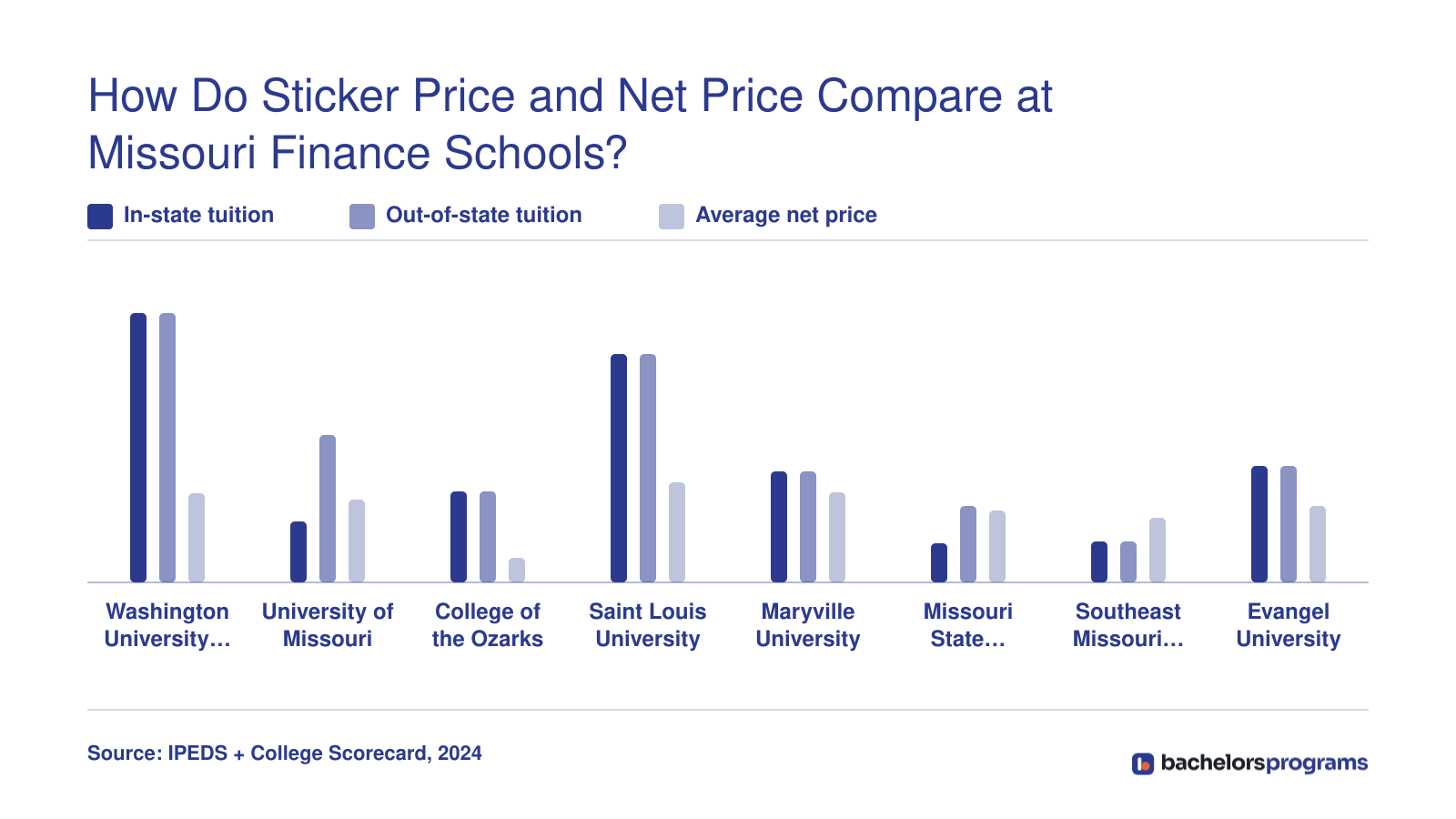
How Do Sticker Price and Net Price Compare at Missouri Finance Schools?
Published tuition rarely matches what families pay. At Washington University in St Louis, $65,790 in tuition drops to an average net price of $21,786, a gap of more than $44,000 and the widest shown here. Net price is an average for first-time, full-time students who receive federal aid, and it includes housing and other costs. That is why it can exceed in-state tuition at public schools like the University of Missouri and Missouri State University.
Related Articles
Finance Salaries in Missouri: Statewide, St. Louis and Kansas City
The table below uses the U.S. Bureau of Labor Statistics May 2023 occupational wage estimates for Missouri, the St. Louis metro (MO-IL) and the Kansas City metro (MO-KS). Personal financial advisors posted the highest medians, topping out at $149,900 in Kansas City, while financial and investment analysts earned the most in St. Louis at $91,200. These are medians across all experience levels rather than starting salaries, and BLS did not report a statewide wage or employment figure for loan officers, so those two cells are marked N/A.
| Occupation | Missouri Median Wage | St. Louis Metro Median Wage | Kansas City Metro Median Wage | Missouri Employment |
|---|---|---|---|---|
| Financial and Investment Analysts | $86,310 | $91,200 | $87,360 | 5,650 |
| Personal Financial Advisors | $136,690 | $137,560 | $149,900 | 5,150 |
| Loan Officers | N/A | $82,150 | $85,210 | N/A |
Finance Careers in Missouri: Employers, Entry Roles and Optional Credentials
Where Missouri Finance Graduates Work
St. Louis and Kansas City anchor most of the state's finance hiring. Both metros are home to regional and national banks, wealth management and brokerage firms, insurance carriers, and corporate finance teams at large employers. Springfield, Columbia and Cape Girardeau add community banks, credit unions and insurance agencies. Hiring shifts from year to year, so current job postings are a better guide than any fixed employer list.
Common Entry Roles
- Financial analyst: These roles typically require a bachelor's degree in finance, accounting, business or a related field.
- Credit analyst or loan officer: Frequent starting points at banks and credit unions.
- Financial advisor trainee or client service associate: Support roles at wealth management firms, often on a licensing track.
- Personal banker: Branch roles that can lead to lending or advisory work.
Licenses and Optional Credentials
Missouri has no single state license for finance as a field. Specific roles carry their own requirements instead:
- FINRA Series 7 and 63: Required for registered representatives who sell securities. FINRA sets no degree requirement, though large firms usually expect a bachelor's or equivalent experience.
- CFP: CFP Board requires a bachelor's in any discipline, registered planning coursework with a capstone, and 6,000 hours of experience (4,000 through an apprenticeship pathway). The degree can be completed up to five years after passing the exam.
- CFA: Geared to investment analysis. Candidates can enroll with a bachelor's, within 23 months of graduating, or with 4,000 hours of qualifying work or education across three sequential years.
Common Questions About Finance Degrees in Missouri
These answers draw on the program details, costs and scholarship rules covered above. Always confirm current figures with each school and the state before you apply.
Can you earn a bachelor's degree in finance online from a Missouri school?
How much does a bachelor's degree in finance cost in Missouri?
Do you need a license to work in finance in Missouri?
Does Bright Flight or Access Missouri apply to finance majors?
Compare Finance programs on the data that matters
Explore more Business & Management majors or browse every field of study.
All Business & Management programs Browse every field of study