Best Finance Schools in Oregon
Compare 13 accredited Finance programs in Oregon at 9 colleges, with net price after aid, graduation rates, earnings and debt from IPEDS and the U.S. College Scorecard.

A public university in Corvallis and a private one in Portland can both lead to the same analyst desk, but the price of getting there differs sharply. A bachelor's degree in finance in Oregon can lead to jobs in Portland's banking, corporate finance and wealth management sectors, and the Bachelor of Science (B.S.) in Finance is the most common credential.
Sticker tuition runs from about $11,700 at Portland State University to $58,100 at the University of Portland, yet net price after aid narrows that gap considerably.
Most of the schools here also publish a career path, which matters more than a school's name once recruiters start screening.
Key Points
- Oregon State University ranks first, with AACSB accreditation and online study.
- Portland State University has the lowest net price here: $9,552 a year.
- In 2024, University of Oregon charged nonresidents $28,461 more than residents.
Best Bachelor's in Finance Schools in Oregon: Our Ranked List
Oregon State University takes the top spot for a bachelor's degree in finance in Oregon, pairing AACSB accreditation and a 70% graduation rate with the choice of the Corvallis campus or fully online study through Ecampus. The nine schools below cover the range of Oregon options, from large public research universities to small private colleges and one fully online program, with net prices after aid spanning roughly $9,600 to $35,300.
Oregon State University
#1Corvallis, OR · $15,000 – $20,000/yr (est.)
Best for: Financial-planning hopefuls seeking CFP preparation
Yes, Oregon State stands out for finance in Oregon: schools offering this program report a graduation rate of 70%, and the degree is AACSB accredited and taught on campus in Corvallis or fully online through Ecampus. Net price after aid runs about $19,600, low for a research university. More than 450 companies recruit on campus each year, and students can add a financial planning or international business option.
- AACSB accredited; offered on the Corvallis campus and fully online via Ecampus
- About 450 companies recruit students each year
- 84% of classes enroll fewer than 50 students
- Deloitte Scholarship available to finance students
- Study-abroad options in Australia, Austria and Chile
- Finance Club and active corporate recruiting on campus
- CFP Board registered program that fulfills CFP education requirements
- CFA Institute University Affiliation Program member
- Students help manage a multi-million-dollar portfolio
- 180 total credit hours with a four-year completion plan
- Thesis or capstone option
- Coursework in fixed income and commercial banking
- International finance coursework built into the option
- Experiential learning requirement
- Available in Corvallis and through Ecampus
- Coursework in investments and risk management
University of Portland
#2Portland, OR · $28,000/yr (est. net price)
Best for: Portland-area students wanting small classes
The University of Portland is a campus-based private option with a graduation rate near 80% for this group. The finance BBA centers on four required courses, including International Finance, then adds electives in economics, accounting and marketing. Net price after aid is roughly $28,200, and classes stay small enough for close faculty feedback on valuation, portfolio theory and security law.
- Four required courses, including International Finance
- Electives in economics, accounting and marketing
- Covers stock and bond valuation, risk and return, portfolio theory
- Financial statement analysis, leverage and security legislation
- Prepares students for roles like investment analyst or portfolio manager
Portland State University
#3Portland, OR · ~$10,000/yr (est.)
Best for: Budget-minded adults balancing work and school
Portland State offers the lowest net price in this list, about $9,600 after aid, from an AACSB-accredited business school in downtown Portland. The graduation rate for this group is 53%. Students can enroll online, hybrid or in person, manage a real-dollar stock fund, and add an AI in Business Microcredential alongside the finance degree.
- AACSB-accredited School of Business
- 180 total credit hours; online, hybrid or in-person formats
- Students manage a real-dollar stock fund
- AI in Business Microcredential included
- Annual finance research competition
- Downtown Portland ties with Nike, Intel and Fisher Investments
Linfield University
#4McMinnville, OR · $25,000 – $30,000/yr (est.)
Linfield University runs a campus-based finance major with BA and BS routes and a graduation rate around 70% for this group. The major takes 38 to 41 credits, with at least 15 completed at Linfield, plus electives in financial institutions, international finance and corporate finance seminars. Net price after aid is roughly $26,500, and small classes keep faculty mentoring close.
- BA or BS degree options
- 38 to 41 credits in the major
- At least 15 credits must be taken at Linfield
- Electives in financial institutions, international finance, corporate seminars
- Ethics, legal and global business perspectives woven through coursework
- Small classes with personalized faculty mentorship
George Fox University
#5Newberg, OR · $30,000 – $35,000/yr (est.)
George Fox delivers finance as a concentration inside its business administration degree, accredited by ACBSP, with a graduation rate near 72% for this group. A 15-credit finance core sits inside a 42-credit business foundation covering capital structure, security valuation and portfolio optimization. Net price after aid is about $31,700, and students can compete in the CFA Research Challenge or be matched with an industry mentor.
- ACBSP accredited
- 15-credit finance core inside a 42-credit business foundation
- Courses include Intermediate Financial Management and Investment Planning
- Students can compete in the CFA Research Challenge
- Ignite program matches students with industry mentors
- Graduates hired by Goldman Sachs, Nike, Wells Fargo and Microsoft
- Investment club with industry speakers
University of Oregon
#6Eugene, OR · ~$22,000/yr (est.)
The University of Oregon's campus-based finance concentration carries a graduation rate of 72% for this group and a net price after aid of about $22,200. Students pick electives in derivatives and international finance, join the UO Investment Group, and hear industry guest speakers at the Cameron Center. Internships are encouraged, and the course sequence is timed to recruiting season.
- Tracks: Investments, Commercial Banking
- 3+1 Finance Scholars option for high-achieving freshmen
- UO Investment Group and Financial Management Association chapter
- Cameron Center brings finance industry guest speakers
- Electives in derivatives and international finance
- Internships encouraged; course sequence timed to recruiting season
- Prepares students for CFA, CFP and FRM designations
Bushnell University
#7Eugene, OR · ~$21,000/yr (est.)
Bushnell University offers its finance bachelor's fully online, with a graduation rate of 56% for this group and a net price after aid of roughly $20,800. Courses cost $495 per credit across 45 credits, and students can finish in 12 to 18 months with six start dates a year. A Strategic Financial Analysis capstone closes the degree.
- IACBE accredited through the School of Business, Leadership, & Technology
- $495 per credit; 45 total credits
- Complete in 12 to 18 months with six start dates a year
- Fully online with a Strategic Financial Analysis capstone
- Upper-division courses delivered through Rize Education
- Prior learning assessment and transfer credit support
- Military benefits accepted
Western Oregon University
#8Monmouth, OR · ~$17,000/yr (est.)
Western Oregon University keeps costs low, with net price after aid around $17,200 and a graduation rate of 47% for this group. Finance sits inside the Business B.S. and covers financial analysis, corporate finance, investment banking and risk management. The campus is in Monmouth, a published four-year plan keeps students on sequence, and graduates move into banks, insurers and government agencies.
- Finance concentration inside the Business B.S.
- Coursework in financial analysis, corporate finance and risk management
- Sample four-year plan published for students
- Prepares students for professional certifications
- Employers include JPMorgan Chase
- Career paths in banking, insurance, government and nonprofits
Pacific University
#9Forest Grove, OR · ~$35,000/yr (est.)
Pacific University teaches finance as a concentration inside the business administration major at its Forest Grove campus, ACBSP accredited, with a graduation rate of 67% for this group. Net price after aid is about $35,300. Small classes, internships and a Business Club with professional workshops round out the degree, and students can pair finance with accounting, marketing or management.
- ACBSP accredited
- Five concentration options within business administration
- Internships build applied finance skills
- Small classes taught by faculty with industry insight
- Business Club runs networking and professional workshops
- Related concentrations in accounting, marketing and management
Cost & outcomes by school
Federal data for the highest-earning Finance programs, independent of the ranking above. Earnings are this field's bachelor's graduates four years after completing where the Scorecard reports them, else the school's undergraduate median.
| School | Net price / yr | Grad rate | Earnings | Debt | Grads/yr | Format |
|---|---|---|---|---|---|---|
| University of Portland OR | $28,210 | 80% | $82,804 | $21,370 | 37 | Campus |
| Portland State University OR | $9,552 | 53% | $79,727 | $16,444 | 98 | Campus |
| Oregon State University OR | $19,604 | 70% | $78,427 | $21,000 | 136 | Online |
| Linfield University OR | $26,536 | 71% | $67,946 | $27,000 | 19 | Campus |
| University of Oregon OR | $22,182 | 72% | $61,324 | $20,139 | — | Campus |
| Pacific University OR | $35,273 | 67% | $60,583 | $23,223 | — | Campus |
| George Fox University OR | $31,679 | 72% | $59,761 | $24,250 | 21 | Campus |
| Bushnell University OR | $20,789 | 56% | $53,623 | $23,500 | — | Online |
| Western Oregon University OR | $17,237 | 47% | $51,815 | $20,609 | — | Campus |
Sources: U.S. Department of Education. Net price, graduation rate, earnings and debt: College Scorecard (earnings and debt for this field's bachelor's graduates where reported, else school-wide); graduates: IPEDS. A dash means no figure is reported.
Cost, debt & payoff
Median earnings of this field's bachelor's graduates (4 yrs after completing, else the school's undergraduate median) vs. their median federal loan debt · U.S. College Scorecard
Across these programs the median graduate earns about $61,324 and finishes with roughly $21,000 in debt — a ratio that clears a common rule of thumb (keep debt below first-year salary). Net price and debt vary widely school to school, so check the per-school figures in the table above before you shortlist.
Most Affordable Bachelor's in Finance Programs in Oregon
For affordable finance degree programs in Oregon, net price after aid is a better guide than sticker tuition. Portland State University has the lowest net price of the schools below at $9,552 a year. Bushnell University shows how far aid can lower a private school's published tuition, and median debt is listed only where federal data reports it for the finance program itself. Figures come from IPEDS and College Scorecard data from the U.S. Department of Education.
| School | Program | Location | Format | In-State Tuition and Fees | Average Net Price After Aid | Median Debt (Finance Program) |
|---|---|---|---|---|---|---|
| Portland State University | Finance | Portland | Campus | $11,679 | $9,552 | $16,444 |
| Western Oregon University | Finance (Business B.S.) | Monmouth | Campus | $11,879 | $17,237 | N/A |
| Oregon State University | Finance | Corvallis | Campus or online | $14,400 | $19,604 | $21,000 |
| Bushnell University | Finance | Eugene | Online | $35,800 | $20,789 | N/A |
| University of Oregon | Finance Concentration | Eugene | Campus | $16,137 | $22,182 | N/A |
How We Ranked Oregon Finance Schools
A fair ranking weighs what a degree costs, whether students finish it, and what graduates earn, not just a school's name.
The Factors
- Net price: the average amount families pay after grants and scholarships, a better guide than sticker tuition.
- Graduation rate: the share of students who complete a degree.
- Program earnings: what graduates in the field earn after leaving school.
- Selectivity: how competitive admission is.
- Delivery format: campus, online or hybrid.
Limits to Keep in Mind
Graduation rate and net price describe the whole institution, not the finance major alone. Net price is also an average, so your own cost depends on your aid, residency and family income. Use these figures to compare schools, then confirm details with each financial aid office.
Why AACSB Accreditation Matters
AACSB International is the best-known accreditor for business schools. It signals that a school meets standards for faculty, curriculum and student outcomes, which can matter to employers and to anyone planning further study.
AACSB's directory lists Oregon State University1, Portland State University2, the University of Oregon and the University of Portland as accredited. Oregon State and Portland State both appear with a finance program. The directory entries for the University of Oregon3 and the University of Portland4 show other business programs, so check each school's own finance offering. For the other schools here, we did not confirm AACSB status, so verify it before you apply.
Related Articles
Online and Hybrid Bachelor's in Finance Options at Oregon Schools
Oregon State University's Ecampus delivers its Finance B.A. or B.S. fully online on a quarter calendar, with four start dates a year: March 30, June 15 and Sept. 23 in 2026, and Jan. 4, 2027.
Which Oregon schools offer online or hybrid delivery
- Oregon State University: the Ecampus finance degree is fully online and requires 180 quarter credits (about 120 semester credits). OSU designs its online bachelor's degrees for roughly four years. Standard quarters run 11 weeks, and summer sessions can run anywhere from one to 11 weeks.
- Bushnell University: lists a fully online option for its finance program, with six start dates a year, $495 per credit, and a listed completion window of 12 to 18 months.
- Portland State University: the finance major is campus-based, but the school lists flexible online, hybrid and in-person course formats.
- On campus only: University of Portland, Linfield University, George Fox University, University of Oregon, Western Oregon University and Pacific University each list their finance programs as campus programs.
Transferring in
OSU reviews transfer credit course by course, and you must complete 45 of your last 75 credits at OSU, online or in Corvallis, to satisfy the residency rule. Transfers can begin in any of the four terms, and OSU offers Transfer Credit Central, transcript evaluations and planning tools to see how prior coursework applies. Bushnell also advertises transfer credit support and prior learning assessment.
Whichever route you choose, an online finance bachelor's still comes from the same Oregon institution, with the same accreditation and the same diploma.
Admission Requirements for a Bachelor's Degree in Finance in Oregon
At the University of Oregon, finance admission runs through two gates: the university first, the business school later. Finance is a concentration inside business administration, not a separate bachelor's degree, and the published rules are specific enough to plan around.
First-Year GPA and Test Policy
First-year applicants need 15 core academic units with a C- or better in each.1 The admissions page does not publish a minimum or typical high school GPA; standard admission weighs rigor and grades. UO accepts SAT or ACT scores when they appear on official transcripts or arrive from the testing service, but its published pages do not state whether scores are required, optional or recommended for 2026 first-year admission.1 High school seniors who list business for direct admission are reviewed on test scores, GPA and other factors, with no minimum direct-admission GPA published. Where a school does not publish a hard cutoff, ask admissions to confirm the current policy rather than assume one.
Transfer Credits and the Business Gate
Oregon residents need at least a 2.25 transfer GPA, nonresidents 2.50, and holders of specified Oregon transfer degrees or modules from Oregon public institutions 2.00.1 UO counts all attempted A-F credits, including repeats. Up to 135 transfer credits apply toward a 180-credit degree, including 60 upper-division credits, and only letter-prefixed courses above 100 are accepted. Students generally enter as pre-business and later apply to the business school with 75 credits, a 3.0 cumulative GPA and a 3.0 lower-division business-core GPA; required courses must be letter-graded at C- or better. Meeting both 3.0 thresholds gives guaranteed admission pending the application, which includes essays, a cover letter, a resume and transcripts. Applicants below the thresholds may receive holistic review, but no minimum or typical admitted GPA is published.
Selectivity and a Transfer Tip
Admission rates at the schools here run from 67% at Bushnell to 98% at Western Oregon; UO admits 88%. That first number measures the university gate, not the business-school gate. For community college transfers, the practical move is to finish an Oregon transfer degree or module before applying: it can lower UO's transfer GPA floor to 2.00 and satisfy core requirements, but confirm with an advisor that the module maps to business prerequisites, not just general education.
What a Bachelor's Degree in Finance Costs in Oregon
Oregon now ties its Oregon Promise grant for new applicants to a Student Aid Index cap, so eligibility matters more than the sticker price.1 The gap between sticker and net price is wide, so look at both.
Sticker Price vs. Net Price
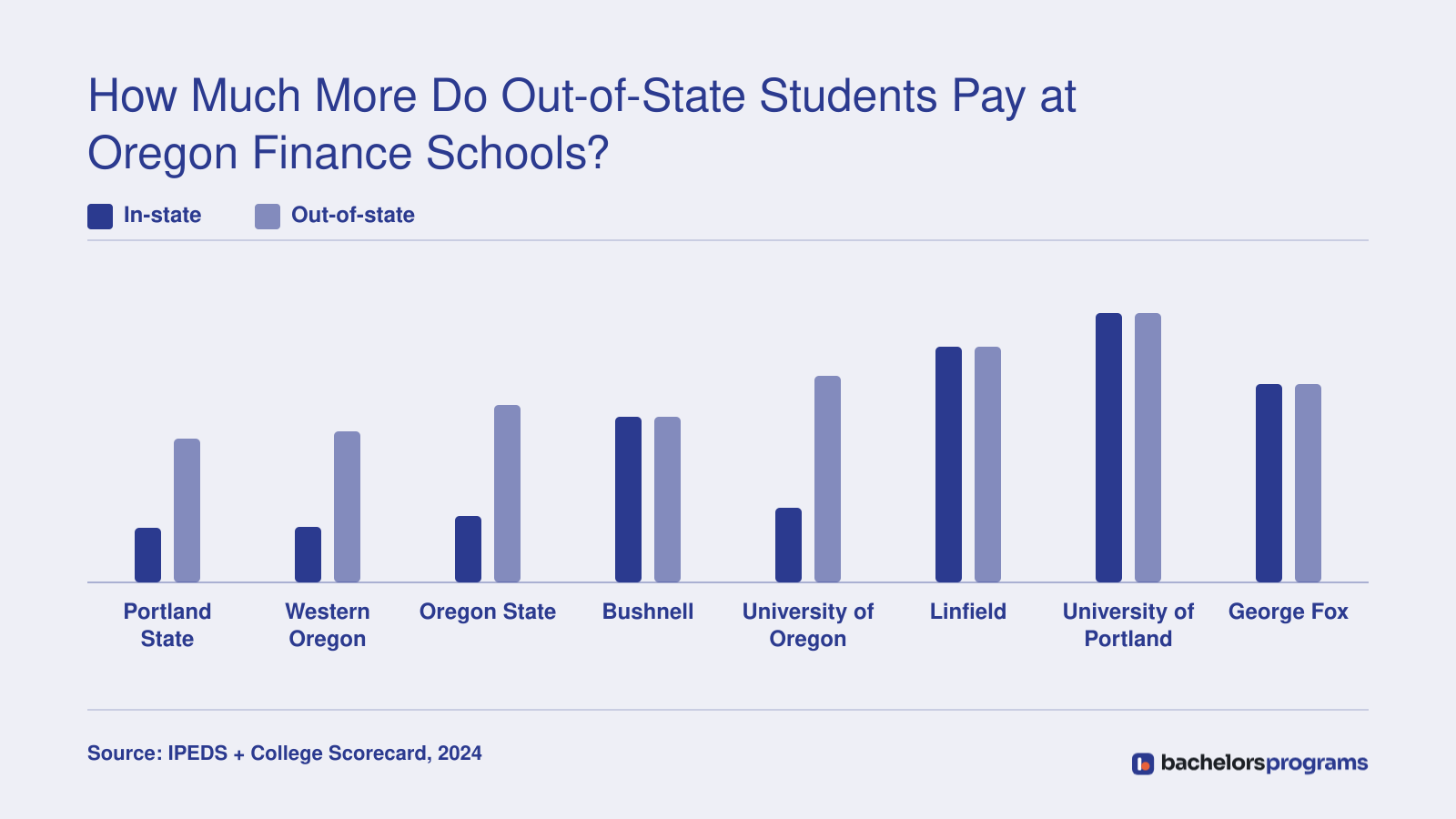
Among the public schools, Portland State charges $11,679 in-state and $31,074 out-of-state. Western Oregon is $11,879 and $32,534. Oregon State runs $14,400 and $38,190, and the University of Oregon $16,137 and $44,598. Western Oregon bases its published tuition and fees on 15 credit hours per term.5
Private schools charge one rate for everyone: Bushnell $35,800, George Fox $42,750, Linfield $50,850, Pacific $56,374 and University of Portland $58,100.
Average net price after aid shifts the order. Portland State is lowest at $9,552, then Western Oregon at $17,237, Oregon State at $19,604, Bushnell at $20,789 and the University of Oregon at $22,182. Linfield ($26,536), University of Portland ($28,210), George Fox ($31,679) and Pacific ($35,273) follow.
On online costs, Bushnell lists $495 per credit for its online finance program. Confirm per-credit rates for other online options on each school's tuition page.
Oregon Aid Programs
- Oregon Opportunity Grant: Oregon's need-based grant works at public and participating private schools. Applicants must be Oregon residents for 12 months before enrolling and have no bachelor's degree.2 For 2026-27 the Student Aid Index limit is $8,000, with a tentative May 15, 2026 deadline.3 Award amounts vary, so check HECC Oregon Student Aid for current figures.
- Oregon Promise: This grant covers tuition at Oregon community colleges, not four-year universities.4 New Class of 2026 applicants needed a Student Aid Index below 27,000 and a June 1 deadline (July 10 for GED recipients).1 It suits students who start at a community college and transfer.
Apply through the FAFSA, or ApplyORSAA if you are not eligible for federal aid. One application feeds both state programs.
A Realistic Out-of-Pocket Total
Median debt for finance completers is $16,444 at Portland State, $21,000 at Oregon State and $27,000 at Linfield. Four years at the public schools' average net prices comes to roughly $38,000 to $89,000. Private options run higher unless institutional aid closes the gap. Compare net price, not sticker price.
How Much More Do Out-of-State Students Pay at Oregon Finance Schools?
Published 2024 tuition and fees show that residency matters a lot at Oregon's public universities and not at all at its private ones. University of Oregon carries the biggest out-of-state premium ($44,598 against $16,137 in-state, a $28,461 gap), Portland State has the smallest gap among public schools at $19,395, and Bushnell, Linfield, George Fox and University of Portland charge every student the same rate. These are sticker prices before grants and scholarships, so what most students actually pay after aid is lower.
Finance Salaries in Oregon: What Graduates Earn in Common Roles
What does a finance job in Oregon actually pay in the first few years, before commissions and bonuses?
Three roles, three separate pay scales
The Bureau of Labor Statistics tracks financial and investment analysts, personal financial advisors, and loan officers as distinct occupations, and its May 2025 estimates, released in 2026, report each one separately for Oregon and for the Portland-Vancouver-Hillsboro metro area. Each entry lists wages at the 10th, 25th, 50th, 75th and 90th percentiles alongside an employment count.1 One caveat for Portland: the metro area crosses into Washington, so its figures pool workers on both sides of the Columbia River rather than covering Oregon alone.2
How to read entry-level pay from that spread
The 10th and 25th percentiles are the closest stand-in for starting salaries, since they describe the bottom of the distribution where new graduates land. The median describes the midpoint of everyone already working in the role, including people with a decade or more of experience. All of these are straight-time gross wages, which exclude overtime and incentive pay, so advisors and loan officers working on commission can earn more than the reported figure suggests.
Occupation pay is not the same as graduate earnings
The earnings reported alongside the rankings above describe what graduates of a particular finance program earned after finishing, not what the occupation pays statewide. Use those program figures to compare schools against each other, then check the OEWS percentile band you would realistically enter against the salary a school advertises.
What You Can Do With a Finance Degree in Oregon
A finance degree leads to two broad kinds of work: analytical work inside a company's finance function, or client-facing work in banking, lending and planning. Both rest on the same finance coursework, and both hire across Oregon.
Four Common Career Paths
- Corporate finance: budgeting, forecasting and analysis inside finance teams at manufacturers, health systems, insurers and the state's outdoor and technology employers.
- Banking and lending: credit analysis, commercial lending and treasury work at national banks, community banks and credit unions.
- Financial planning: client-facing work at wealth management practices and registered advisory firms, often starting as a client associate or paraplanner.
- Investments: research support, trading operations and fund administration at asset managers and institutional investment offices.
The Portland metro holds the largest share of these roles, especially in commercial banking, wealth management and corporate headquarters. State government in Salem and the universities in Eugene and Corvallis also employ finance and accounting staff, which spreads opportunity beyond the metro.
Credentials and Licensing
The Chartered Financial Analyst (CFA) designation requires three sequential exams plus qualifying professional experience, and it carries weight in investment research and portfolio management. The Certified Financial Planner (CFP) mark requires coursework, a comprehensive exam and experience hours, and it is the standard credential in planning practices.
Licensing depends on the role. Mortgage loan originators register through the NMLS. Selling securities or advising clients generally calls for FINRA exams such as the Series 7 or Series 65, and the Oregon Division of Financial Regulation oversees state-registered advisers and consumer finance lenders.
Choosing Between a B.S., B.A. and BBA in Finance
A finance credential is not one degree with three labels. Each emphasizes different skills, and the right pick depends on what you want to do with the numbers.
What Separates Them
- B.S. in Finance: The most quantitative route, with heavier statistics, econometrics, and financial modeling, and less room for outside subjects.
- BBA in Finance: A business core first (accounting, marketing, management), then the finance specialization. Broader, slightly less math-heavy.
- B.A. in Finance: Built for pairing. More liberal arts and language credits, fewer required quantitative courses, which suits double majors and future law students.
What Oregon Programs Award
University of Portland awards the BBA in Finance, and Western Oregon University awards the B.S. Linfield University lets students choose either a B.A. or a B.S. pathway. Oregon State, Portland State, the University of Oregon, and Bushnell name finance as the bachelor's major or concentration, while George Fox and Pacific University house it as a concentration inside business administration.
A Simple Rule
Lean toward the B.S. or BBA if you are aiming at investment banking, corporate analyst roles, or a CFA track. Choose the B.A. when finance is one half of a deliberate pairing with another field.
Employers rarely parse the letters during screening. Business school accreditation and a completed internship carry more weight than whether the diploma reads B.S., B.A., or BBA.
Compare Finance programs on the data that matters
Explore more Business & Management majors or browse every field of study.
All Business & Management programs Browse every field of study