Best Finance Schools in Rhode Island
Compare 12 accredited Finance programs in Rhode Island at 8 colleges, with net price after aid, graduation rates, earnings and debt from IPEDS and the U.S. College Scorecard.

What does a finance degree in Rhode Island actually cost, and what does it pay back? Average net price after aid runs from $12,805 a year at Rhode Island College to $34,391 at Bryant University.
The credential is almost always the Bachelor of Science (B.S.) in Finance, taught across a compact field of private and public campuses. Classes are small, and the hiring is local: banks, insurers and wealth managers in the Providence corridor recruit through internships long before they post openings.
In a market this small, the school that gets you into an internship matters more than the name on the diploma.
Key Points
- Rhode Island College has the lowest average net price: $9,478 per year.
- At $100,232 five years out, Providence College graduates earn the most.
- Online learners can choose Johnson & Wales' asynchronous 7- or 15-week courses.
Best Bachelor's Degree in Finance Programs in Rhode Island, Ranked
Seven Rhode Island colleges award a bachelor's degree in finance, and they sit at very different points on price, size and access to real markets. The cards below run from the state's public research university to its largest online provider, with the format, concentrations and outcomes listed for each.
University of Rhode Island
#1Kingston, RI · ~$21,000/yr (est.)
Best for: Rhode Island residents wanting research university scale
Rhode Island's public research university in Kingston, URI pairs a broad business administration core with a finance major and is one of only a handful of undergraduate CFA Institute partner programs in the country, so the coursework lines up with Level 1 CFA material. Graduates move into banking, corporate finance and investment analysis, and students get the scale and course catalog of a full research university. The university graduates 74% of its students overall.
- B.S. in Business Administration with a major in Finance
- One of a handful of undergraduate CFA Institute partner programs
- Prepares students to sit for the Level 1 CFA exam
- Median earnings of $87,196 four years after completion
- Median debt of $23,620 for program graduates
- Career paths in banking, corporate finance and investment analysis
Bryant University
#2Smithfield, RI · ~$41,000/yr (est.)
Best for: Hands-on investors wanting live portfolio experience
A private business-focused university in Smithfield, Bryant builds its undergraduate finance degree around applied practice: students run the Archway Investment Fund, a live portfolio above $3 million, and work with Bloomberg, FactSet, MSCI and Morningstar data in the Financial Markets Center. Concentrations cover investment management, financial planning and investment advising, corporate finance, and banking, and a separate Financial Services track lines up with CFP coursework. The university graduates 80% of its students overall.
- Five concentration options, including corporate finance and banking
- Students manage the Archway Investment Fund, a portfolio above $3 million
- Bloomberg, FactSet, MSCI and Morningstar data in the Financial Markets Center
- Students earn the Bloomberg Market Concepts Certificate
- Median earnings of $90,499 four years after completion
- Median debt of $26,953 for program graduates
- Financial Services concentration with two options
- Financial Planning Track prepares students for the CFP designation
- 120 credit hours including the business core
- Requires a liberal arts minor, one 400-level elective and a financial planning internship
Providence College
#3Providence, RI · ~$49,000/yr (est.)
Best for: Aspiring analysts wanting a liberal arts foundation
A private Catholic college in Providence, PC awards a Bachelor of Science in Finance through an AACSB-accredited school of business, with a liberal arts core and a values-based approach to the field. Finance majors manage a real-money Student Managed Investment Fund, work on Bloomberg terminals in the finance lab, and can add the quantitative track for Python and statistical software. The college graduates 86% of its students overall and reports that 96% of recent finance graduates are employed or in graduate school.
- Tracks: Finance Quant Track (FINq)
- Real-money Student Managed Investment Fund run by finance majors
- Bloomberg terminals in the finance lab
- Student-Led Asset Management club and Wall Street Interview Boot Camp
- AACSB accredited school of business
- Median earnings of $103,021 four years after completion
- Median debt of $27,000 for program graduates
Rhode Island College
#4Providence, RI · $9,000/yr (est. net price)
Rhode Island College is the state's public comprehensive college, in Providence, and its finance BS leans on access and practical tooling: a Finance Lab with Bloomberg terminals, coursework across corporate finance, investments and risk management, and a CFA Institute affiliate designation. The business school is accredited by the International Accreditation Council for Business Education rather than AACSB, and eligible Rhode Island students can attend tuition-free in their junior and senior years through the Hope Scholarship. The college graduates 48% of its students overall.
- Finance Lab with Bloomberg terminals and real-time market data
- CFA Institute Affiliate
- Accredited by the International Accreditation Council for Business Education
- Coursework in corporate finance, investments, risk management and accounting
- Hope Scholarship covers tuition for eligible juniors and seniors
- Median earnings of $70,470 four years after completion
- Median debt of $23,750 for program graduates
Salve Regina University
#5Newport, RI · ~$37,000/yr (est.)
A private university in Newport with a mercy mission and small classes, Salve Regina requires a finance internship before graduation and builds the CFA body of knowledge into the curriculum. Students choose between corporate finance and wealth management concentrations, finish with a team capstone that feeds the Seahawk Tank pitch competition, and can spend a summer studying in Oxford. The university graduates 77% of its students overall.
- Tracks: Corporate Finance and Wealth Management
- Required internship worth three credits before graduation
- Team capstone feeds the annual Seahawk Tank competition
- CFA body of knowledge built into the curriculum
- Small classes with faculty who have industry experience
- Median earnings of $89,657 four years after completion
- Median debt of $27,000 for program graduates
Roger Williams University
#6Bristol, RI · ~$38,000/yr (est.)
Roger Williams University, in Bristol, runs its finance degree through the AACSB-accredited Mario J. Gabelli School of Business, with a trading room where students manage real money and train for Bloomberg certification. Internships with firms such as Morgan Stanley, Fidelity and Goldman Sachs often convert to full-time offers, and the curriculum covers corporate finance, investments, risk management and analytics. The university graduates 69% of its students overall.
- Manage real-money portfolios in the CAFE trading room
- Bloomberg certification training available
- Internships with Morgan Stanley, Fidelity and Goldman Sachs
- AACSB accreditation through the Mario J. Gabelli School of Business
- Accelerated 3+1 and 4+1 pathways available
- Median earnings of $94,919 four years after completion
- Median debt of $26,500 for program graduates
Johnson & Wales University
#7Providence, RI · ~$20,000/yr (est.)
Johnson & Wales University, based in Providence, delivers its Bachelor of Science in Finance fully online and asynchronously, which makes it the most flexible option on this list for working students. Courses run in 7 or 15 week terms at $495 per credit hour for 2026-27, and the program covers corporate finance, investments, financial markets and institutions, and financial modeling and valuation. The university reports a 97.7% career outcomes rate for undergraduate degree recipients.
- Fully online, asynchronous coursework
- $495 per credit hour for 2026-27, or $1,485 per three-credit course
- Courses run in 7 or 15 week terms
- Career Catalyst Scholarship gives eligible students 20% tuition savings from Fall 2026
- Transfer credit evaluations returned in 48 hours
- Median earnings of $73,152 four years after completion
- Median debt of $27,000 for program graduates
Cost & outcomes by school
Federal data for the highest-earning Finance programs, independent of the ranking above. Earnings are this field's bachelor's graduates four years after completing where the Scorecard reports them, else the school's undergraduate median.
| School | Net price / yr | Grad rate | Earnings | Debt | Grads/yr | Format |
|---|---|---|---|---|---|---|
| Providence College RI | $48,523 | 86% | $103,021 | $27,000 | 181 | Campus |
| Roger Williams University RI | $37,999 | 69% | $94,919 | $24,500 | 54 | Campus |
| Bryant University RI | $41,219 | 80% | $90,499 | $26,714 | 192 | Campus |
| Salve Regina University RI | $36,967 | 77% | $89,657 | $27,000 | 31 | Campus |
| University of Rhode Island RI | $21,440 | 73% | $87,196 | $21,875 | 126 | Campus |
| Johnson & Wales University RI | $31,027 | 55% | $73,152 | $27,000 | 7 | Campus |
| Johnson & Wales University RI | $20,252 | — | $73,152 | $27,000 | 15 | Online |
| Rhode Island College RI | $9,478 | 48% | $70,470 | $19,041 | 23 | Campus |
Sources: U.S. Department of Education. Net price, graduation rate, earnings and debt: College Scorecard (earnings and debt for this field's bachelor's graduates where reported, else school-wide); graduates: IPEDS. A dash means no figure is reported.
Cost, debt & payoff
Median earnings of this field's bachelor's graduates (4 yrs after completing, else the school's undergraduate median) vs. their median federal loan debt · U.S. College Scorecard
Across these programs the median graduate earns about $89,657 and finishes with roughly $27,000 in debt — a ratio that clears a common rule of thumb (keep debt below first-year salary). Net price and debt vary widely school to school, so check the per-school figures in the table above before you shortlist.
How We Ranked Rhode Island Finance Schools (And Which Is Best)
No single Rhode Island school wins on every measure, so the best answer depends on what you weigh most.
What the Rankings Weigh
Four measures set the order: net price, program-level earnings and debt, completions, and institution-wide graduation rate. Two caveats apply. College Scorecard figures are medians, so half of graduates did better and half did worse. Net price is an approximate sector average, not a quote for your own family. Your aid package will differ.
So, Which School Is Best?
It depends on the criterion:
- Lowest cost: The state's public options, University of Rhode Island and Rhode Island College, are the natural starting points for in-state students. Check the cost table for current figures.
- Best for earnings: The earnings comparison shows which program's graduates earn the highest median pay. Read it next to debt, since a higher salary can come with a larger loan balance.
- Best overall value: Look for the school where net price, earnings and debt line up well together, not just one strong number.
Limits Worth Knowing
Only schools with a bachelor's in finance in the data are ranked. Graduation rates describe the whole institution, not the finance major, so treat them as context and not as a program outcome. Small programs can also produce volatile earnings medians.
Weigh Fit Alongside the Numbers
Numbers will not tell you whether a campus suits you. Compare setting, class size, and how easy it is to get an internship or co-op during your studies. For finance, that early experience can shape your first job offer as much as the school's name.
Cheapest Finance Bachelor's Programs in Rhode Island
Rhode Island College has the lowest average net price for a bachelor's degree in finance among the schools here, at $9,478 per year after grants and scholarships, according to 2024 IPEDS and College Scorecard data from the U.S. Department of Education. Rows are ordered by average net price, which is what students actually pay after aid. Private schools such as Salve Regina University and Roger Williams University post high sticker prices but much lower net prices, so compare both figures before ruling a school out.
| School | City | Format | Average Net Price (After Aid) | In-State Tuition & Fees | Out-of-State Tuition & Fees | Median Debt (Finance Grads) | Graduation Rate |
|---|---|---|---|---|---|---|---|
| Rhode Island College | Providence | Campus | $9,478 | $11,300 | $27,299 | $19,041 | 48% |
| Johnson & Wales University | Providence | Online | $20,252 | $13,365 | $13,365 | $27,000 | N/A |
| University of Rhode Island | Kingston | Campus | $21,440 | $16,942 | $37,146 | $21,875 | 73% |
| Salve Regina University | Newport | Campus | $36,967 | $50,100 | $50,100 | $27,000 | 77% |
| Roger Williams University | Bristol | Campus | $37,999 | $44,418 | $44,418 | $24,500 | 69% |
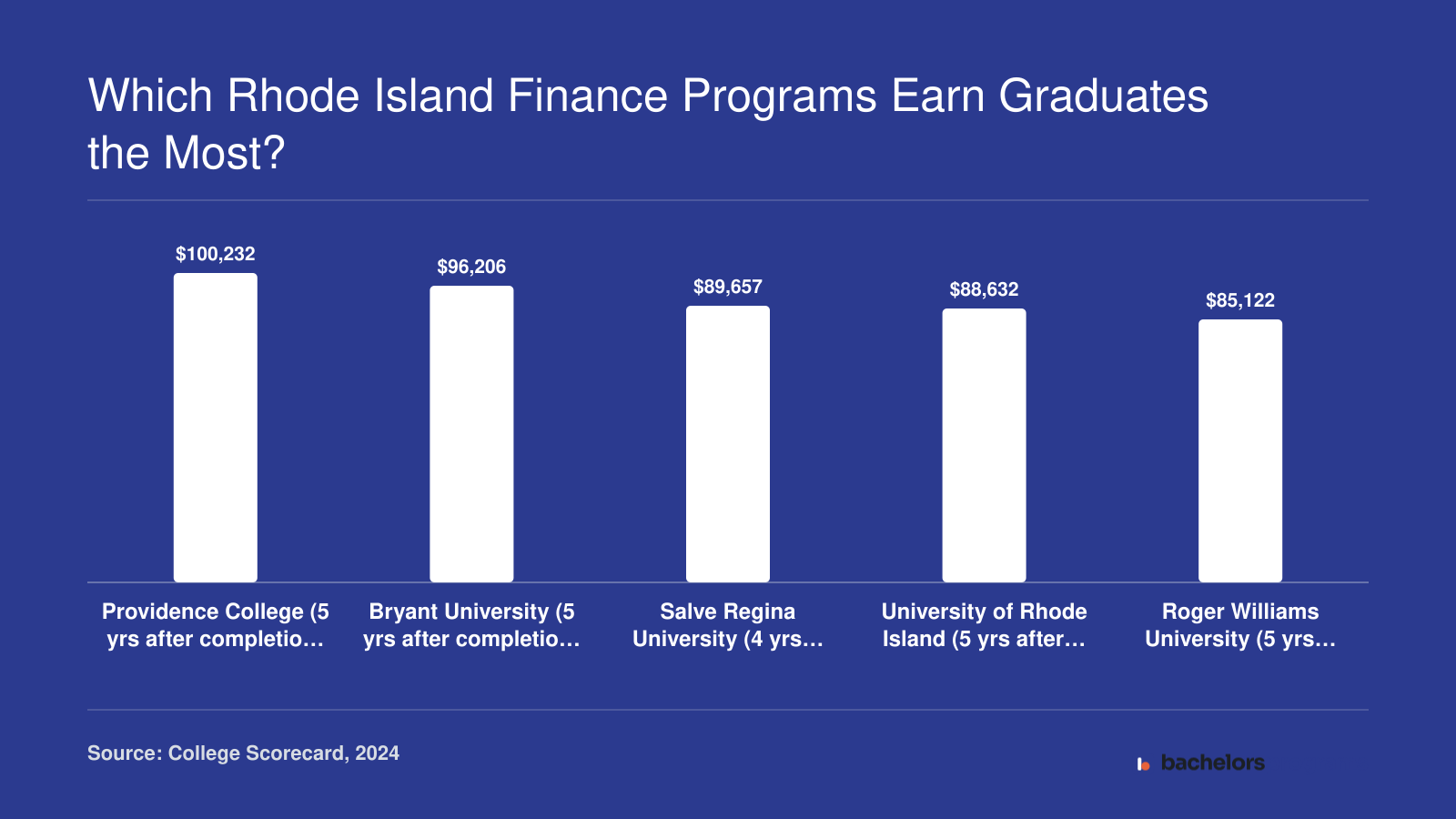
Which Rhode Island Finance Programs Earn Graduates the Most?
Providence College finance graduates post the highest median earnings here, at $100,232 five years after completion, with Bryant University close behind at $96,206. These are College Scorecard program medians, and Salve Regina's figure is measured four years out, so it is not directly comparable to the five-year rows. Against median program debt of $21,875 at URI to $27,000 at Providence College and Salve Regina, each program shown pays graduates more than three times what they typically borrow.
AACSB Accreditation, CFA Alignment and Finance Curriculum Differences
What separates these finance departments is hands-on investing practice as much as the course list. Accreditation and program structure are the two quickest ways to tell schools apart.
AACSB Accreditation
The AACSB accredited-schools directory lists four of the schools here: the University of Rhode Island1, Bryant University (accredited since 1994)2, Providence College3 and Roger Williams University. Johnson & Wales University and Salve Regina University did not appear in the directory results, and Rhode Island College was not confirmed there either. Treat that as a gap to verify with each school, since AACSB status can change. AACSB is the most widely recognized business accreditation, and some employers and graduate programs look for it.
Standalone Major or Concentration
URI and Providence College both offer finance as a standalone major. Providence's is a Bachelor of Science (B.S.) in Finance that includes a banking option, and finance sits beside accountancy, management and marketing as its own undergraduate program. Roger Williams also lists a B.S. in Finance including banking.4 For Bryant, Salve Regina, Johnson & Wales and Rhode Island College, check the catalog to see whether finance is a full major or a concentration inside a business administration degree. Concentrations usually carry fewer finance electives.
CFA Alignment
Some schools join the CFA program's university affiliation network, which signals that part of the curriculum maps to the CFA body of knowledge. Affiliation in 2026 was not confirmed for any school on this page, so ask each finance department directly rather than assuming it.
How the Curricula Differ
- Student-managed investing: Roger Williams runs the Center for Advanced Financial Education, where student fund managers invest a real-dollar stock portfolio and compete internationally on performance.
- Banking: Providence College and Roger Williams build banking into the finance degree, which suits students aiming at commercial or retail banking.
- Everything else: For URI and the remaining schools, program pages list finance courses, but a student-managed fund or specific emphasis was not confirmed. Compare course catalogs for investments, corporate finance and financial planning offerings before you decide.
Related Articles
Online and Hybrid Bachelor's in Finance Options at Rhode Island Schools
Johnson & Wales University offers its bachelor's in finance as a fully online option, with asynchronous coursework delivered in 7- or 15-week courses. For Rhode Island students who need to study around a job or family schedule, it is the clearest fully online path from a school based in the state.
Fully Online at Johnson & Wales
The JWU online degree is a finance program offered through the College of Hospitality & Business, not a general business degree with a finance track. Asynchronous delivery means no set login times, and the 7-week format lets you move through courses faster when your schedule allows. The school also advertises transfer credit evaluations within 48 hours, which helps if you are bringing in community college credits.
Campus Programs With Flexible Scheduling
The finance bachelor's programs at the University of Rhode Island, Bryant University, Providence College, Rhode Island College, Salve Regina University and Roger Williams University are listed in our data as campus programs. Formats change, so confirm current delivery options with each admissions office.
If scheduling flexibility matters most, look closely at Bryant. Its 2026-2027 catalog places finance inside a B.S. in Business Administration, which requires at least 120 credits, with at least 18 in the finance concentration.1 Bryant also lets part-time bachelor's students take day and/or evening classes, up to three courses and 11 credits per semester.2 That policy covers part-time study at Bryant generally rather than the finance concentration specifically, so ask how many finance courses actually run in the evening. Bryant also offers finance as a concentration within its B.S. in International Business.
What You Trade Away Online
Online delivery saves commuting time, but finance hiring leans heavily on internships and personal networks. Several campus programs build that in: Salve Regina requires an internship before graduation, Providence College reports that nearly all finance graduates complete one, and Bryant, Providence College and Rhode Island College give students hands-on access to Bloomberg tools on campus. Being physically near Providence also makes it easier to attend recruiting events and meet local employers in person. If you choose online, start your internship search early and ask what career services and internship support the school provides to online students.
Questions to Ask Yourself
Do you want a standalone finance major or a business degree with a finance concentration?
Is AACSB accreditation or CFA curriculum alignment a must-have for the career you want?
Would a Providence-area internship pipeline matter more to you than the lowest net price?
Can you realistically commute, or do you need an online or hybrid schedule?
Admissions for Rhode Island Bachelor's in Finance Programs: GPA, Test Policy and Transfer Credit
The university, not the finance department, sets admission, so the standards you need to clear are the ones in each school's first-year or transfer policy. The University of Rhode Island publishes the fullest picture.
GPA and Test Policy
URI's 2026 admitted-student profile puts the middle 50% at a 3.7 to 4.1 GPA, recalculated on a 4.0 scale from core academic courses in grades 9 through 11, with extra weight for honors and AP work. Applicants need a minimum 2.5 recalculated GPA by the end of junior year and at least 13 core college-preparatory units. That 2.5 is a general first-year floor, not a finance-specific one. URI is test-optional: SAT or ACT scores may be submitted but are not required.
Bryant University, Providence College, Rhode Island College, Salve Regina University, Roger Williams University and Johnson & Wales University did not state a first-year GPA minimum or a test policy on the admissions pages reviewed here. Confirm the current standard with each office before applying.
Transfer Credit Rules
URI sets transfer thresholds by credit load: 2.8 GPA for applicants with fewer than 24 transferable credits, who must also meet first-year requirements; 2.5 for 24 or more; and 2.4 for holders of an associate's or bachelor's degree from a regionally accredited institution. Credit generally requires a C or better. Remedial, vocational, culinary arts and applied technical science courses do not transfer, and the academic college decides the URI equivalent after you are admitted.
Selectivity at a Glance
Admission rates from federal data: Providence College 51%, Bryant 65%, Salve Regina 68%, URI 72%, Roger Williams 88%, Johnson & Wales 91%, Rhode Island College 92%.
A Tip for Transfer Students
Cross the 24-credit line before you apply. At URI that single threshold lowers the GPA you need from 2.8 to 2.5 and frees you from first-year requirements. Keep syllabi for every course you want counted, and get written confirmation of how each one transfers before you enroll.
Finance Careers in Rhode Island After Your Bachelor's Degree
Rhode Island finance careers are built in Providence and the surrounding corridor, and internships are how most graduates get through the door. Corporate finance, insurance, energy, construction and wealth management all hire here, so a finance degree does not have to point toward a bank.
Employers and Internship Routes
Recent postings show the range.1 Bally's has offered a Finance Internship at $20 an hour, and Teknor Apex has listed a Spring 2027 Finance Intern role in Pawtucket. Textron runs a year-round Accounting & Financial Reporting Internship in Providence, with an anticipated April 2027 start.2 Gilbane Building Company's two-year Accounting & Finance Development Program has been listed through the University of Rhode Island career center. Rhode Island Energy has posted summer finance planning internships3, and Northwestern Mutual has run a College Financial Representative Internship Program tied to Providence College.4 Year Up United's Providence Financial Operations program places participants with corporate partners.5
Postings change each cycle, so treat these as examples of the pipeline, not a permanent list.
What the Pay Looks Like
The Bureau of Labor Statistics put the national median for personal financial advisors at $105,070 a year ($50.51 an hour) in 2025. Rhode Island-specific medians for advisors and financial analysts are not broken out here, so use the national figure as an upper reference, not a starting salary. Advisor pay often rises with a client book. New graduates earn less, and the earnings figures in the ranking show what recent alumni of each school earn.
Licensing and Credentials
Finance is generally not a state-licensed field in Rhode Island. You can work as an analyst or in corporate finance with a bachelor's degree alone. Roles that sell securities or give investment advice require FINRA-administered exams such as the Series 7, 66 or 65, which employers typically sponsor.
Two optional credentials add value later:
Common Questions About Finance Degrees in Rhode Island
These answers draw on the school, cost and licensing details covered above. Figures vary by source, so confirm current numbers with each school before you apply.
Are there AACSB-accredited finance programs in Rhode Island?
Can you get a bachelor's degree in finance online from a Rhode Island school?
How much does a finance degree cost in Rhode Island?
Do you need a license to work in finance in Rhode Island?
Compare Finance programs on the data that matters
Explore more Business & Management majors or browse every field of study.
All Business & Management programs Browse every field of study