Best Finance Schools in Vermont
Compare 3 accredited Finance programs in Vermont, with net price after aid, graduation rates, earnings and debt from IPEDS and the U.S. College Scorecard.

Vermont's finance field is small and mostly private, so a bachelor's degree in finance here comes down to a few distinct models: a fully online program, a flagship business school, or a small liberal arts college. Each choice matters more than it would in a state with dozens of options.
All three award a Bachelor of Science (B.S.), and all three build it around corporate finance, investments, and financial modeling. Champlain College, the University of Vermont, and Saint Michael's College each take a different route to it, with different price tags and class sizes.
Vermont's employer base is modest, so many graduates look to Boston, New York, or remote roles.
Key Points
- Champlain College offers its B.S. in Finance fully online.
- Only the University of Vermont charges a lower in-state tuition rate.
- Saint Michael's admits about 85 percent of applicants; Champlain, 83 percent.
Best Bachelor's in Finance Schools in Vermont, Ranked
Vermont is a small state with a short list of finance programs, so the choice usually comes down to format and fit: an online degree you can finish from anywhere, the flagship business school in Burlington, or a small private college where finance majors must also complete a minor. Each of the three schools below awards a recognized bachelor's credential in the field, and each takes a noticeably different approach to the major.
Champlain College
#1Burlington, VT · ~$36,000/yr (est.)
Best for: Working adults wanting online finance coursework
Champlain College is a private, career-focused institution in Burlington whose majors are built around applied, industry-aligned coursework rather than theory alone. Its finance program is available online, so students can complete the degree without relocating, and the upper-level work leans on financial modeling, regression analysis and a two-course senior capstone. Finance majors may also spend a semester abroad, and Vermont residents entering in fall 2027 are expected to see first-year tuition and fees capped at the University of Vermont's in-state rate after grants and scholarships.
- Online delivery for the finance major
- Two-course senior capstone in finance
- Coursework in financial modeling and applied regression analysis
- Investments, international finance and advanced investment topics
- Optional junior-year study abroad
University of Vermont
#2Burlington, VT · $19,000 – $46,000/yr (est.)
Best for: Vermont residents seeking the public flagship
The University of Vermont is the state's flagship public research university, and its Grossman School of Business awards the finance credential as a concentration inside the Bachelor of Science in Business Administration. Students build a broad business core, pick one of three interdisciplinary themes, and finish with a senior capstone, so finance coursework sits alongside strategy, sustainability or entrepreneurship rather than in isolation. The school is AACSB accredited, and the UVM Promise covers tuition and the comprehensive fee for qualifying Vermont families.
- 120-credit degree at the Grossman School of Business
- AACSB International accreditation
- Finance is one of four concentrations, with accounting, marketing and business analytics
- Five concentration courses for students entering fall 2016 or later
- Theme options: Global Business, Sustainable Business or Entrepreneurship
- Senior capstone course required
- 42-credit Catamount Core plus 40 credits outside the business school
Saint Michael's College
#3Colchester, VT · $25,000 – $30,000/yr (est.)
Best for: Students preferring a small residential campus
Saint Michael's College is a private residential liberal arts college in Colchester, and its School of Business & Analytics awards a Bachelor of Science in Finance. The major pairs six required finance courses with four electives and a required experiential component, and every finance major must also complete a minor, which a second major can satisfy. Vermont access programs introduced for fall 2026 entrants, including full tuition coverage for households below an income threshold and reduced pricing for nearby commuters, make it one of the more affordable private routes in the state.
- Awarded through the School of Business & Analytics
- Six required finance courses
- Four finance electives, including one approved alternate option
- Required experiential component of at least one course
- Minor required for all finance majors
- A second major satisfies the minor requirement
- Sample degree map published in the catalog
Cost & outcomes by school
Federal data for the highest-earning Finance programs, independent of the ranking above. Earnings are this field's bachelor's graduates four years after completing where the Scorecard reports them, else the school's undergraduate median.
| School | Net price / yr | Grad rate | Earnings | Debt | Grads/yr | Format |
|---|---|---|---|---|---|---|
| University of Vermont VT | $19,343 | 79% | $62,472 | $20,951 | — | Campus |
| Saint Michael's College VT | $25,239 | 73% | $61,317 | $26,922 | — | Campus |
| Champlain College VT | $35,860 | 65% | $58,386 | $26,814 | 8 | Online |
Sources: U.S. Department of Education. Net price, graduation rate, earnings and debt: College Scorecard (earnings and debt for this field's bachelor's graduates where reported, else school-wide); graduates: IPEDS. A dash means no figure is reported.
Cost, debt & payoff
Median earnings of this field's bachelor's graduates (4 yrs after completing, else the school's undergraduate median) vs. their median federal loan debt · U.S. College Scorecard
Across these programs the median graduate earns about $61,317 and finishes with roughly $26,814 in debt — a ratio that clears a common rule of thumb (keep debt below first-year salary). Net price and debt vary widely school to school, so check the per-school figures in the table above before you shortlist.
How We Ranked Vermont Bachelor's in Finance Programs
Federal outcomes data is now public, and it says more about these programs than most brochures do. The rankings here draw on College Scorecard figures: net price, graduation rate, program earnings and debt, and the number of students completing each finance degree.
What the Numbers Do and Don't Show
Two of those measures need a caveat. Graduation rate and net price describe the whole institution rather than the finance major. Champlain College's net price of $35,860, for example, reflects all undergraduates. Program-level earnings and debt are narrower and are not reported for every school, so we lean on them only where they exist.
Context for Choosing a School
We also track three factors that shape fit more than rank:
- Selectivity: Admit rates run from about 65% at the University of Vermont to roughly 84% at Saint Michael's College.
- Pell share: The portion of students receiving Pell Grants hints at how much low-income aid support a campus offers. It ranges from 25% at Saint Michael's to about 42% at Champlain.
- Public vs. private: UVM is public. Champlain and Saint Michael's are private, which usually means a higher sticker price but different aid packages.
A Smaller Pool Than Usual
Vermont has a small set of bachelor's finance programs, so the list is shorter than a typical top 10. We would rather show a few well-documented options than pad it with weak matches.
Are There Accredited Finance Schools in Vermont?
Yes. What matters most is the difference between institutional and program accreditation.
Institutional vs. Program Accreditation
Institutional (regional) accreditation covers the whole college. It is the baseline: without it, a school cannot disburse federal student aid, and credits rarely transfer cleanly to another institution. Each Vermont finance school ranked here holds institutional accreditation from the New England Commission of Higher Education (NECHE).
Business-program accreditation is separate, voluntary, and awarded to the business school rather than the college. AACSB International is the most selective of the three recognized business accreditors, followed by ACBSP and IACBE. Holding one signals that the school has been reviewed against standards for curriculum, faculty qualifications, and student outcomes, a detail some employers and graduate programs notice.
Which Vermont Schools Hold What
- University of Vermont: the Grossman School of Business holds AACSB International accreditation, covering the Bachelor of Science in Business Administration and its finance concentration.1
- Champlain College: institutionally accredited by NECHE2; its business programs do not appear in the 2026 AACSB or IACBE directories reviewed for this page.
- Saint Michael's College: institutionally accredited by NECHE; likewise not listed in those business accreditation directories.3
So a finance degree from Champlain or Saint Michael's rests on institutional accreditation alone, while UVM's carries both layers. Confirm any absence directly with the school, since accreditors update their listings on their own schedule.
Verify It Yourself
Start with the school's own accreditation page, then confirm it at the source: AACSB publishes a searchable list of accredited institutions3, IACBE maintains a member directory4, and NECHE lists its member colleges. The U.S. Department of Education's accreditation database is the tiebreaker.
Is a Bachelor's Degree in Finance or a Finance Minor Right for You?
A bachelor's degree in finance, usually a Bachelor of Science, trains you to read money decisions the way an analyst would. Expect coursework along these lines:
- Corporate finance: how companies fund projects, weigh risk and return, and decide on capital.
- Investments: valuing stocks, bonds and portfolios.
- Markets and institutions: how banks, exchanges and regulators shape pricing and credit.
- Financial modeling: building spreadsheet forecasts and valuation models.
Major, Minor or Concentration?
A standalone major gives you the deepest sequence and the clearest signal to employers. A finance minor adds core skills to another field, such as economics, data analytics or accounting. A business major with a finance concentration sits in between: you take the broad business core, then a cluster of finance electives.
Vermont schools package the subject differently, so look closely at how each one labels it.
- Champlain College: lists a Finance, B.S. program.
- University of Vermont: offers finance as a concentration within its business administration degree, which carries AACSB accreditation and requires four courses in the chosen concentration.
- Saint Michael's College: lists a Bachelor of Science in Finance through its School of Business & Analytics, with six required finance courses and four finance electives. Every major there also needs a minor, though a second major satisfies that rule.
Confirm Before You Apply
Program names on school pages can blur the line between a major and a concentration. Open each school's catalog and check whether finance is a standalone major, a concentration or a minor, since that label affects your course load, your transcript and how you describe the degree to employers.
Questions to Ask Yourself
Do you want a standalone finance major, or is a business degree with a finance concentration enough?
Do you need an online or hybrid schedule, or can you attend on a Vermont campus?
Would you rather pay in-state public tuition or accept a higher sticker price at a private school with larger aid packages?
Online and Hybrid Finance Bachelor's Options at Vermont Schools
Champlain College is the one school among these Vermont options that offers its bachelor's in finance fully online. The other two are campus-based, so format alone will settle the choice for anyone who cannot relocate or needs a flexible schedule.
Which Programs Are Campus, Online, or Both
- Champlain College: The Bachelor of Science in Finance is delivered online through Champlain College Online.
- University of Vermont: The finance concentration within its business administration degree is an on-campus program in Burlington.
- Saint Michael's College: The Bachelor of Science in Finance is taught on its Colchester campus.
No hybrid finance option is confirmed for UVM or Saint Michael's. If you want a finance degree you can finish remotely while staying tied to a Vermont school, Champlain is the realistic choice here. If you prefer in-person classes, UVM and Saint Michael's fit better, but you should confirm any flexibility directly with their admissions offices.
How the Champlain Online Format Works
The degree requires 120 credits and runs in 7-week terms.1 Students can take one course per term or two to three. At two courses per term, Champlain estimates about 3 years and 4 months to finish.1 Your actual timeline depends on your course load and how many credits transfer in, and the college accepts up to 90 transfer credits. That makes the program especially practical for students who already have college coursework.
How Online Students Are Charged
Champlain prices the online degree per credit, not as a flat annual rate: $342 per credit for Fall 2026 through Summer 2027.1 Over a full 120 credits with no transfer credit, that works out to roughly $41,000 in tuition. Every accepted transfer credit lowers that figure, so ask for a transfer evaluation before you compare costs. UVM and Saint Michael's publish campus tuition and fees, covered in the cost section of this page.
When comparing, ask each school whether its finance courses can be taken partly online and whether the format you choose changes your cost.
Related Articles
Admissions Requirements for Vermont Finance Bachelor's Programs
How selective each school is
Admission odds at the Vermont schools here are generally favorable. Saint Michael's College admits roughly 85 percent of applicants and Champlain College about 83 percent, so a solid college-preparatory transcript puts most applicants in contention. The University of Vermont is the more selective at around 65 percent, so stronger grades in math-heavy coursework (algebra, pre-calculus, statistics) carry more weight in an application to its business administration program with a finance concentration.
What Champlain publishes
Champlain's first-year admissions materials describe a review that weighs the transcript, course rigor, and class rank rather than a published minimum GPA, so there is no single number to aim at. Testing is optional: you may submit SAT or ACT scores if you think they help, and skipping them does not disadvantage your file.1
Transfer rules are spelled out more precisely. On-campus bachelor's programs accept up to 75 credits from another accredited college, provided the courses match program requirements and you earned a C or better.2 At least 45 credits must be completed at Champlain, including 15 credits of 300-level or higher coursework in the major. Transferred grades do not factor into your Champlain GPA, and every credit decision is made at the college's discretion. The online B.S. in Finance follows different terms: it recommends a minimum 2.5 GPA with case-by-case exceptions and allows up to 90 credits to transfer in.3
Verify the rest directly
For the University of Vermont and Saint Michael's College, we were not able to confirm current GPA expectations, testing policy, or transfer credit caps from the admissions pages reviewed, so treat any figure you see elsewhere as unverified and request the current policy from each admissions office before you apply.
One practical move for transfer students: ask for a preliminary credit evaluation in writing before you deposit. Residency rules like Champlain's 45-credit minimum can quietly reduce how much of an associate degree actually counts toward your finance major, and that changes both your timeline and your total cost.
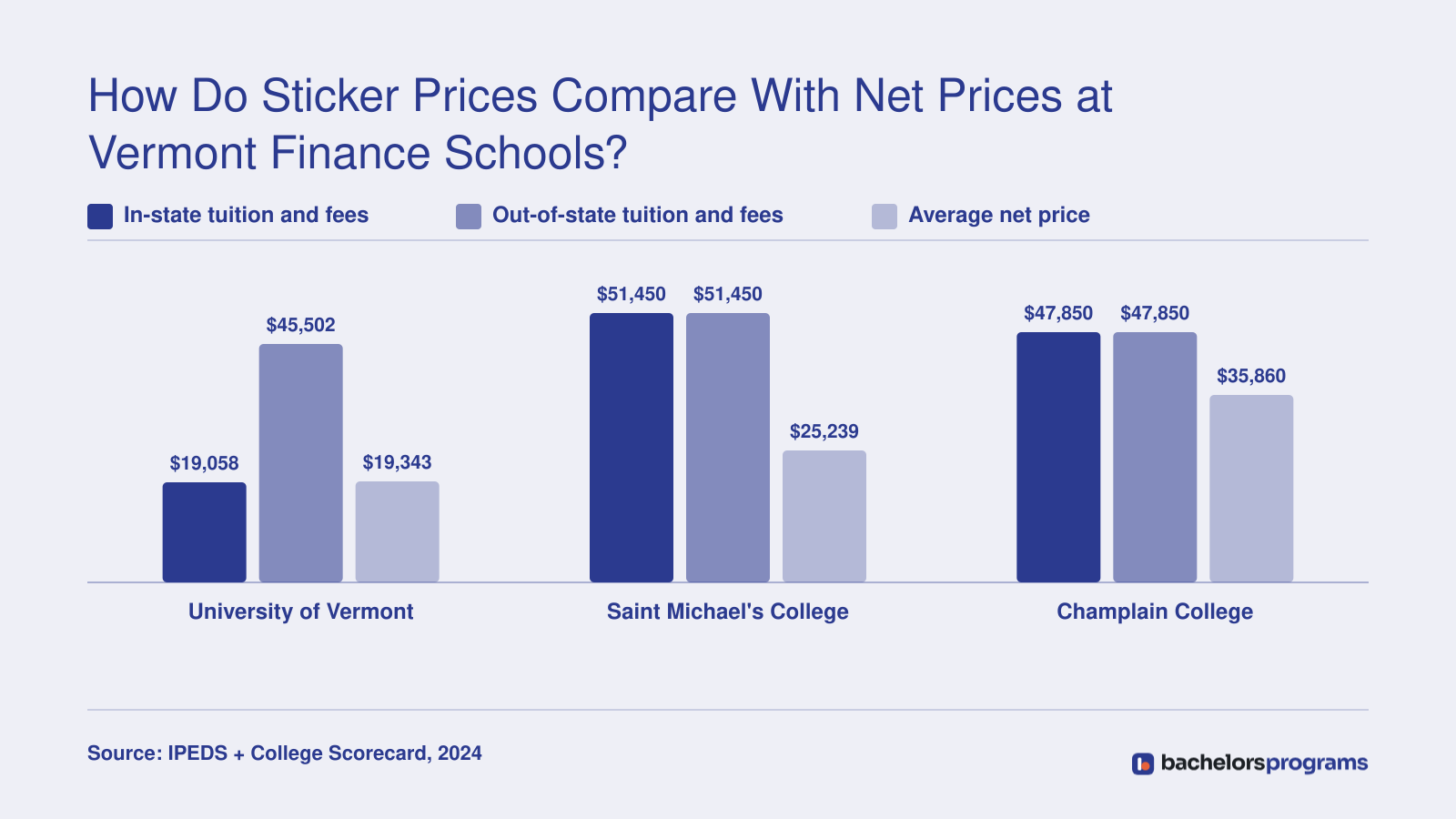
How Do Sticker Prices Compare With Net Prices at Vermont Finance Schools?
The University of Vermont is the only school here that charges a lower in-state rate. Saint Michael's College and Champlain College bill the same tuition to every student. The largest gap between sticker price and net price is at Saint Michael's College, where average net price ($25,239) is $26,211 below annual tuition and fees ($51,450). Average net price reflects what students actually paid after grants and scholarships, and it covers the full cost of attendance, so it can sit slightly above in-state tuition, as it does at UVM.
Vermont Securities Licensing and Finance Certifications
Frequently Asked Questions About Finance Schools in Vermont
These answers draw on the rankings, cost, and career details covered earlier on this page. Figures reflect the most recent published information for 2026.
What is the best college in Vermont for finance?
How much does a finance degree cost in Vermont?
Are there accredited finance schools in Vermont?
Can you earn a finance degree online from a Vermont school?
Do you need a finance degree to start a career in finance?
Compare Finance programs on the data that matters
Explore more Business & Management majors or browse every field of study.
All Business & Management programs Browse every field of study