Best Healthcare Administration Schools in Connecticut
Compare 5 accredited Healthcare Administration programs in Connecticut, with net price after aid, graduation rates, earnings and debt from IPEDS and the U.S. College Scorecard.

A bachelor's degree in healthcare administration can lead to a management role, but the strongest Connecticut programs differ sharply in price, format, and how much of the degree you can finish online. The usual credential is the Bachelor of Science (B.S.) in Healthcare Administration, and it prepares graduates to manage departments, billing, staffing, and compliance in the state's hospitals, nursing homes, and clinics.
The ranking below rests on College Scorecard data; admissions, cost, careers, and licensure follow it.
Most entry-level administrative jobs need no state license. Nursing home administrator is the notable exception in Connecticut.
Key Points
- Charter Oak State College's online bachelor's offers six start dates yearly.
- Charter Oak charges $8,506 a year; Albertus Magnus lists $41,908.
- Connecticut's Roberta B. Willis Scholarship pays up to $5,250 per year.
Best Bachelor's in Healthcare Administration Schools in Connecticut
These five Connecticut colleges award a bachelor's degree in healthcare administration or a close variant, and they differ sharply in format: some run fully online, some on campus, and one mixes the two. Each entry notes what the program is actually called, because several Connecticut schools house the field inside a business or health science degree. Graduation rates below are institution-wide, while earnings figures are for program graduates and always carry their time window.
University of Connecticut
#1Storrs, CT · ~$25,000/yr (est.)
Best for: Students targeting insurance and payer roles
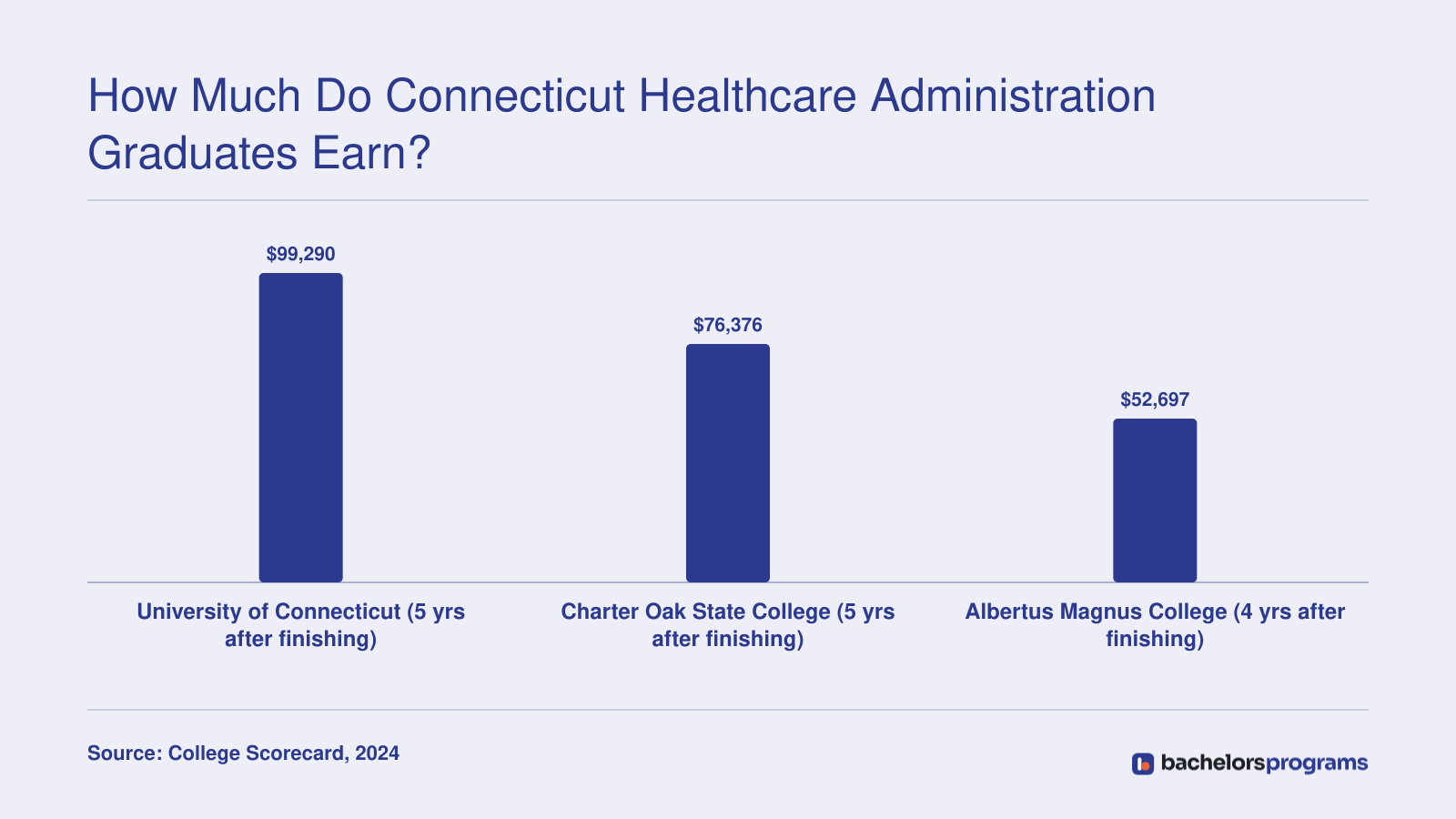
The University of Connecticut is the state's flagship public research university, and its health care management major sits inside a full business curriculum rather than a standalone health department. Students take accounting, finance, and marketing alongside health law, insurance, and risk management, and most internships with insurers and hospitals are paid. The program is deliberately small, with a student-run society and an advisory board of industry leaders. The school's institution-wide graduation rate is 83 percent, and program graduates reported median earnings of $99,290 five years after finishing.
- Leads to a B.S. in Business Administration
- Business core plus health law, insurance and risk management
- Internships with major insurers and hospitals, most paid
- Regional tuition savings for Maine, Massachusetts and Rhode Island residents
- Scholarships available after junior year
- Student-run organization connects students with industry leaders
- Advisory board of health care executives
- Interdisciplinary electives and study abroad options
Charter Oak State College
#2New Britain, CT · $15,000 – $20,000/yr (est.)
Best for: Adults converting credentials into college credit
Charter Oak State College is Connecticut's public online college, and its healthcare administration bachelor's is built for adults who need flexibility. Enrollment is 100 percent online with six start dates a year and one flat tuition rate regardless of residency, and students can turn professional credentials into college credit. A Fast Track option lets strong students bank graduate-level credit toward a master's. The school's institution-wide graduation rate is 67 percent; program graduates reported median earnings of $72,446 four years after finishing and median debt of $28,688.
- 100% online, part-time or full-time enrollment
- Six start dates each year
- One flat tuition rate for all students
- Credit available for professional credentials
- Capstone required to finish the degree
- Fast Track option earns graduate credit toward the M.S.
- ACHE Higher Education Network member
- AUPHA associate member
Goodwin University
#3East Hartford, CT · ~$29,000/yr (est.)
Best for: Shift workers needing fully asynchronous classes
Goodwin University in East Hartford is a career-focused private institution where most students are working adults balancing jobs with school. The health science degree carries a healthcare administration concentration and runs asynchronously online, so coursework fits around shift work rather than a fixed class hour. Transcripts are reviewed within one business day, military benefits are accepted, and financial aid and scholarships are available. The school's institution-wide graduation rate is 58 percent.
- Asynchronous online classes
- Three concentration options within the health science degree
- Transcripts reviewed within one business day
- Military benefits accepted
- Financial aid and scholarships available
- Work-study opportunities available
Albertus Magnus College
#4New Haven, CT · ~$34,000/yr (est.)
Albertus Magnus College is a small private college in New Haven with an accelerated healthcare management degree designed for working adults and career changers. Most students finish in about 18 months by taking one or two classes every eight weeks, choosing online, blended, or FLEX formats, and every student completes a field-based internship. Classes are small, faculty bring industry experience, and there is an option to attend class one night a week. The school's institution-wide graduation rate is 51 percent; program graduates reported median earnings of $52,697 four years after finishing.
- Accelerated 18-month completion for most students
- One or two classes every eight weeks
- Online, blended or FLEX formats
- Internship required of every student
- Small class sizes
- Faculty with real-world experience
- One night per week class option
University of Bridgeport
#5Bridgeport, CT · $28,000/yr (est. net price)
The University of Bridgeport delivers healthcare administration as an 18-credit concentration inside a Bachelor of Science in Business Administration, offered online. Coursework covers health care finance, law and ethics, policy, and information systems, so graduates can manage operations inside hospitals, clinics, and insurers. Connecticut community college graduates with an associate degree and at least a 2.0 GPA may qualify for the university's CT Guarantee, and this program is included in that transfer pathway. The school's institution-wide graduation rate is 41 percent.
- Online business administration degree
- 18-credit healthcare administration concentration
- Covers regulatory, technological and financial forces in health care
- Coursework in health care finance, law, ethics and policy
- Applies statistical and economic tools to health policy
- CT Guarantee admission for eligible community college transfers
Cost & outcomes by school
Federal data for the highest-earning Healthcare Administration programs, independent of the ranking above. Earnings are this field's bachelor's graduates four years after completing where the Scorecard reports them, else the school's undergraduate median.
| School | Net price / yr | Grad rate | Earnings | Debt | Grads/yr | Format |
|---|---|---|---|---|---|---|
| University of Connecticut CT | $25,097 | 83% | $73,997 | $21,500 | 14 | Campus |
| Charter Oak State College CT | $15,815 | 67% | $72,446 | $21,958 | 56 | Online |
| Albertus Magnus College CT | $34,028 | 52% | $52,697 | $31,902 | 7 | Campus |
| University of Bridgeport CT | $27,807 | 41% | $50,323 | $25,750 | — | Online |
| Goodwin University CT | $29,249 | 58% | $43,596 | $33,500 | — | Hybrid |
Sources: U.S. Department of Education. Net price, graduation rate, earnings and debt: College Scorecard (earnings and debt for this field's bachelor's graduates where reported, else school-wide); graduates: IPEDS. A dash means no figure is reported.
Cost, debt & payoff
Median earnings of this field's bachelor's graduates (4 yrs after completing, else the school's undergraduate median) vs. their median federal loan debt · U.S. College Scorecard
Across these programs the median graduate earns about $52,697 and finishes with roughly $25,750 in debt — a ratio that clears a common rule of thumb (keep debt below first-year salary). Net price and debt vary widely school to school, so check the per-school figures in the table above before you shortlist.
How We Ranked Connecticut Healthcare Administration Schools
What Drove the Order
The ranking draws on four federal College Scorecard measures: student outcomes after graduation, net price, graduation rate, and the number of students who complete the program. Outcomes show what graduates go on to earn. Net price shows what students typically pay after grants and scholarships. Graduation rate shows how many students finish. Completions show how established a program is.
The list covers only bachelor's programs at Connecticut schools, on campus and online. It reflects the most recent Scorecard data available as of the 2026 update.
Caveats Worth Knowing
The numbers are useful for comparison, but they are not a quote for your own bill.
- Net price: This is a sector-average estimate for each school, not a figure for your household. Your aid depends on income, residency, and enrollment status.
- Graduation rate: It is measured across the whole institution, not just the healthcare program. A school's rate may differ from what students in one major experience.
- Program labels: Programs go by different names. UConn offers Health Care Management, Charter Oak State College and Albertus Magnus College offer Healthcare Administration and Healthcare Management, Goodwin University offers Health Science, and the University of Bridgeport offers a B.S. in Business Administration.
Tips for Reading the Numbers
- Compare net price, not sticker price. Published tuition is the starting point, and aid can narrow the gap between schools considerably.
- Treat graduation rate as one signal. A school with a strong rate but a poor fit for your schedule may still be the wrong choice.
- Confirm details with the school's admissions or financial aid office before you apply, because curriculum, format, and costs change from year to year.
Online and Hybrid Bachelor's Options at Connecticut Schools
Charter Oak State College runs its Bachelor of Science in Health Care Administration entirely online, with six start dates a year and both full-time and part-time pacing. So yes: you can earn a bachelor's degree in healthcare administration at a Connecticut-based school without setting foot on a campus.
Fully Online
Charter Oak is the clearest fully online route, and its structure is built for adults already working: rolling entry across six annual starts, credit awarded for industry credentials, and a capstone to close the degree. The University of Bridgeport also delivers online, though the credential there is a Bachelor of Science in Business Administration with an 18-credit healthcare administration concentration covering regulation, technology, finance, ethics, and law.
Hybrid and Evening Formats
Goodwin University's Health Science degree, with its healthcare administration concentration, is offered in both formats and uses asynchronous online classes. Albertus Magnus College schedules its Healthcare Management bachelor's across roughly 18 months, with students taking one or two classes every eight weeks and attending class one night a week; the college's own materials describe online, blended, or FLEX options, and an internship is required of all students. The University of Connecticut's Healthcare Administration concentration sits inside the B.S. in Allied Health Sciences at Storrs, a campus program with a traditional daytime rhythm.1
Internships and Accreditation
Albertus Magnus requires an internship. Charter Oak requires a capstone. Beyond that, none of these programs publishes a program-level business accreditation such as ACBSP or AACSB, and CAHME accredits graduate healthcare management programs rather than bachelor's degrees. Charter Oak notes associate membership in AUPHA and participation in the ACHE Higher Education Network; those are professional memberships, not accreditation.
Which Format Fits You
- Fully online: working adults with shifting schedules who need multiple entry points.
- Hybrid or evening: Connecticut residents who want occasional face time without a daytime commitment.
- Campus: students seeking a residential experience who can meet UConn's 3.0 GPA and science and economics prerequisites.1
Admission Requirements for a Bachelor's Degree in Healthcare Administration
Test-optional admission has become a settled feature of Connecticut undergraduate admissions, and the state's flagship says it will stay that way for the foreseeable future. Beyond that, the published rules for a bachelor's degree in healthcare administration vary widely by school. Where a school does not state a policy, the listing says so.
School-by-School Admissions Snapshot
- University of Connecticut: General undergraduate admission is holistic, with no published minimum GPA for first-year or transfer applicants. The Healthcare Administration concentration (within the B.S. in Allied Health Sciences) asks for a 3.0 GPA plus prerequisites: chemistry with lab, BIOL 1107, either ARE 1150 or ECON 1201/1202, and either MATH 1070Q or MATH 1131Q. Test policy: test-optional. Transfer credit limit: no published maximum. UConn counts a transfer applicant as someone with 12 or more postsecondary credits after high school.
- Charter Oak State College: GPA expectations: no published policy. Test policy: no published policy. Transfer credit limit: no published policy.
- Goodwin University: GPA expectations: no published policy. Test policy: no published policy. Transfer credit limit: no published policy.
- Albertus Magnus College: GPA expectations: no published policy. Test policy: no published policy. Transfer credit limit: no published policy.
- University of Bridgeport: General GPA expectations: no published policy. The 2.0 GPA figure belongs to the CT Guarantee, which requires an associate degree from a Connecticut community college and an eligible major, including Business Administration: Healthcare Administration (B.S.). Test policy: no published policy. Transfer credit limit: no published policy.
Transfer Credit and Community-College Pathways
Transfer is where these schools differ most in practice. UConn defines who counts as a transfer applicant but sets no published cap on credits accepted, so the evaluation of your prior coursework happens case by case. The UConn prerequisites matter here: a student at a community college can often complete the math, biology, chemistry and economics requirements before transferring, which makes the 3.0 GPA for the concentration the number to protect.
The clearest community-college route among these schools is the University of Bridgeport's CT Guarantee. A student who finishes an associate degree at a Connecticut community college and keeps a 2.0 GPA can use it to enter the healthcare administration B.S. Other articulation agreements between Connecticut community colleges and public or private four-year schools may exist, but none are established here, so confirm them in writing before you enroll.
Before you apply, ask each admissions office three things: the maximum credits it will accept toward your degree, whether your associate coursework satisfies the program's prerequisites, and whether a transfer-specific GPA threshold applies. Where a school publishes no policy, an advisor's written answer is worth more than an assumption.
Cost of a Healthcare Administration Bachelor's in Connecticut: Tuition and Net Price Compared
Charter Oak State College charges $8,506 in annual tuition and fees to every student, while Albertus Magnus College lists $41,908, a gap of $33,402 a year before aid; after grants, the spread in average net price narrows to $18,213 ($15,815 at Charter Oak versus $34,028 at Albertus Magnus). Net price is a federal average for aided students, calculated separately for public and private schools, so read it as a benchmark for each sector rather than a quote for your family. Also note that UConn's out-of-state rate of $43,712 is more than double its $21,044 in-state charge. All figures come from 2024 IPEDS and College Scorecard data, and median debt covers all undergraduate borrowers at each school, not only healthcare administration majors.
| School | Sector | In-State Tuition and Fees | Out-of-State Tuition and Fees | Average Net Price After Aid | Median Debt at Graduation |
|---|---|---|---|---|---|
| Charter Oak State College | Public | $8,506 | $8,506 | $15,815 | $18,683 |
| University of Connecticut | Public | $21,044 | $43,712 | $25,097 | $21,500 |
| University of Bridgeport | Private nonprofit | $35,760 | $35,760 | $27,807 | $25,750 |
| Goodwin University | Private nonprofit | $21,198 | $21,198 | $29,249 | $33,500 |
| Albertus Magnus College | Private nonprofit | $41,908 | $41,908 | $34,028 | $30,964 |
Connecticut Grants, Scholarships, and Tuition Aid for Bachelor's Students
The Roberta B. Willis Need/Merit Scholarship pays up to $5,250 per year to full-time students at four-year Connecticut public or nonprofit private colleges, based on Connecticut Office of Higher Education (OHE) figures for the 2025-2026 award year1. It rewards Connecticut residents who show both strong academics and financial need.
Willis Need/Merit Scholarship
- Academic bar: top 20 percent of your high school junior class, or, for current undergraduates, top 20 percent of your senior class and/or an SAT of 1200+ or ACT of 25+2.
- Need test: a federal Student Aid Index (SAI) at or below 10,999 for 2025-20262.
- How to apply: a high school counselor submits the application through CT Scholars. Students cannot apply directly.
- Deadline: the counselor application and your FAFSA are due February 15 of the year before the award year, with an eligible Connecticut college listed on the FAFSA1.
Treat the 2025-2026 amount and SAI cutoff as the latest OHE reference until updated figures appear.
Willis Need-Based Scholarship
OHE lists awards of up to $4,500 per year for full-time study at four-year Connecticut public or nonprofit private colleges2. Eligibility depends on your SAI, and there is no separate application: the FAFSA is the application. Because colleges set their own FAFSA priority dates, OHE advises confirming deadlines with each school's financial aid office.
School Aid at Charter Oak and Other Colleges
Charter Oak State College, the University of Connecticut, Goodwin University, Albertus Magnus College, and the University of Bridgeport each run their own scholarship and grant processes. Ask each office which awards fit healthcare administration students and whether part-time enrollment qualifies. That matters at Charter Oak, where many adult learners study part-time, since the Willis Need/Merit award requires full-time enrollment.
Stacking Tip
File the FAFSA early, before February 15. That one form is what qualifies you for a federal Pell Grant, Willis awards, and most school aid3. Then ask your financial aid office how a state award combines with institutional scholarships, since total aid generally cannot exceed the school's cost of attendance.
Related Articles
Healthcare Administration Careers and Salaries in Connecticut
A first job inside a large hospital system and one inside a small physician practice lead to the same career by different routes. The system offers structured administrative tracks, internal job postings, and often tuition support; the practice hands a new graduate wider responsibility sooner, frequently across billing, scheduling, and compliance at once. Either way, the bachelor's degree in healthcare administration is the entry credential, and the title grows with experience.
Where Connecticut Graduates Start
Common first titles include patient access coordinator, medical office coordinator, practice manager, billing and reimbursement specialist, scheduling supervisor, and assistant department manager. Hiring spreads across the state's hospital systems, skilled nursing and rehabilitation facilities, physician groups, community health centers, and home health agencies. Because Connecticut packs a substantial hospital and long-term care footprint into a small state, administrative openings appear in both city centers and suburban towns, and many sit within commuting distance of the Hartford, New Haven, and Bridgeport metros.
What the Occupation Pays in Connecticut
State wage data for medical and health services managers put the median annual wage at $130,790 as of May 20251, comfortably above the national median of $114,1302 for the same occupation. The spread is wide: $82,890 at the 10th percentile, $103,490 at the 25th, $167,620 at the 75th, and $219,010 at the 90th.1
Read those figures as the occupation's range, not as a starting salary tied to any one program. Many first jobs after a bachelor's are classified as coordinator or administrative roles rather than manager roles, so early pay can fall below the occupation's lowest reported percentile. Pay usually moves toward the median once your title carries a department, site, or service line.
Outlook Through 2035
The Bureau of Labor Statistics projects 24 percent growth for medical and health services managers nationally between 2025 and 20353, far faster than the average across occupations. An aging population and the administrative weight of insurance, quality reporting, and regulation drive that demand, and Connecticut's hospital and long-term care employment base puts graduates close to it. Roles that lead to running a skilled nursing facility bring the state administrator license into the picture, which the licensure section covers.
How Much Do Connecticut Healthcare Administration Graduates Earn?
These bars compare median earnings for each school's own healthcare administration bachelor's graduates, measured four or five years after finishing as labeled on each bar. Unlike the occupation-wide wages above, which cover every worker in a job title regardless of school or experience, these figures track only one program's graduates over a set window. Program-level earnings are not reported for Goodwin University or the University of Bridgeport, so they are not charted.
Connecticut Nursing Home Administrator Licensure at a Glance
Choosing the Right Connecticut Healthcare Administration School
Which Connecticut school fits your situation best? The answer depends less on rankings than on where you are starting from and how you plan to attend.
Match the School to Your Situation
- Transfer students: Check credit limits before anything else. Charter Oak State College is built around students bringing in prior credits, while UConn, Goodwin University, Albertus Magnus College, and the University of Bridgeport each set their own caps and rules. A school that accepts fewer of your credits can cost you a semester or more.
- Working adults: Compare online and hybrid formats, class schedules, and how often you would need to be on campus. Charter Oak and Goodwin are worth a close look for flexibility, and you should confirm each format on the program page.
- Traditional students: Weigh campus life, internships near Hartford, New Haven, and Bridgeport hospitals, and above all net price. UConn in Storrs offers the large-university experience, while Albertus Magnus in New Haven and the University of Bridgeport offer smaller settings.
The University of Bridgeport's option is a Bachelor of Science in Business Administration, and Goodwin's is a Health Science degree. Read the curriculum to confirm it covers health systems, finance, and management as you expect.
Run a Quick Accreditation Check
Start by confirming that the school holds institutional accreditation from the New England Commission of Higher Education (NECHE). Then look on the program's own page for any program-level accreditation or specialized recognition. If a school does not mention it, ask admissions directly rather than assuming.
Keep Graduate Study in View
A bachelor's degree in healthcare administration can lead to entry-level management work right away, and it also leaves graduate study open later if your career goals shift. You do not need to decide that now, but it helps to choose a school whose credits and reputation will carry forward.
Your Next Three Steps
- Shortlist: Pick two or three schools from this list that match your student type and preferred format.
- Run the net price calculator: Use each school's calculator to see what you would actually pay after aid, not just the sticker price.
- Contact admissions about transfer credits: Ask for a written evaluation of your prior coursework before you apply, and compare the results side by side.
Compare Healthcare Administration programs on the data that matters
Explore more Business & Management majors or browse every field of study.
All Business & Management programs Browse every field of study