Best Information Technology Schools in Connecticut
Compare 3 accredited Information Technology programs in Connecticut, with net price after aid, graduation rates, earnings and debt from IPEDS and the U.S. College Scorecard.

Central Connecticut State University networking graduates reported a median salary of $69,334 one year after finishing and $104,520 five years out, a gap that argues for treating a bachelor's degree in information technology as a long game, not a first-job ticket. Degree titles vary, a Bachelor of Science in Information Technology, a networking major, a computer information systems major, but they teach overlapping skills and land graduates in different entry roles.
Format matters less than what the degree is built around. A hybrid schedule with evening labs suits a working technician; a full-time sequence with a required internship suits a student entering from high school. Connecticut employers read transcripts for infrastructure coursework, not the word "technology" on the diploma.
Key Points
- Central Connecticut State networking graduates reach $104,520 median pay five years out.
- Public Central Connecticut State lists far lower tuition than private campuses.
- Confirm online delivery for the IT major itself, not just the school.
Best Bachelor's Degree in Information Technology Programs in Connecticut
Three Connecticut institutions rose to the top for different reasons, and the same qualities separated them from the rest of the field: recognized program accreditation, a required internship or co-op, and labs and employer partnerships that put students on real hardware and real networks before they graduate. The public option leads on price for Connecticut residents, the private university leads on accreditation pedigree and corporate internship connections, and the online-friendly option leads on scheduling flexibility for working adults. Each card below gives you the format, city, published in-state tuition and fees, average net price after aid, and the share of students the school graduates overall.
Central Connecticut State University
#1New Britain, CT · ~$17,000/yr (est.)
Best for: Connecticut residents seeking affordable public options
A public university in New Britain and part of the Connecticut State Colleges and Universities system, CCSU keeps tuition low for Connecticut residents and pairs it with hands-on technology training. Its Bachelor of Science in Networking Information Technology lives in the Computer Electronics & Graphics Technology department, where students work in networking and cybersecurity labs and hold Cisco Networking Academy, VMware IT Academy, and CompTIA affiliations. An internship or co-op is required, students can enroll full- or part-time, and the program reports that graduates often land jobs before commencement with hospitals, banks, school systems, and state agencies.
- ATMAE-accredited BS in Networking Information Technology
- Coursework covers networking, server administration, and IT security
- Cisco Networking Academy and VMware IT Academy affiliations
- Prepares students for A+, Network+, CCNA, and Security+ credentials
- Internship or co-op required before graduation
- Full-time and part-time enrollment available
- Hands-on networking and cybersecurity labs
- Free on-campus child care for student parents
Sacred Heart University
#2Fairfield, CT · ~$46,000/yr (est.)
Best for: Accreditation-focused students wanting corporate internships
A private university in Fairfield, Sacred Heart delivers its Bachelor of Science in Information Technology on campus with hybrid coursework through the School of Computing & Engineering. The university states that this is Connecticut's first four-year IT bachelor's to earn accreditation from the Computing Accreditation Commission of ABET, a distinction worth checking carefully against other programs. Students complete internships with employers including IBM, Lockheed Martin Sikorsky, NBCUniversal, Dell Technologies, and UBS, and coursework runs from database design and systems analysis to web design and human-computer interaction.
- ABET-accredited BS in Information Technology
- University says it is Connecticut's first accredited four-year IT BS
- On-campus and hybrid delivery through School of Computing & Engineering
- Internships with IBM, Lockheed Martin Sikorsky, NBCUniversal, and UBS
- Coursework in database design, systems analysis, and programming
- Human-computer interaction and multimedia system design included
Post University
#3Waterbury, CT · ~$22,000/yr (est.)
Best for: Working adults needing fully online flexibility
A private university in Waterbury, Post offers a Bachelor of Science in Computer Information Systems that can be completed on campus or entirely online, which makes it the most schedule-friendly of the three for working adults. The 120-credit degree splits into a 21-credit essential skills core, 21 credits of general education, 63 credits of major and concentration work, and 15 open electives, with four concentrations: general computer information systems, computer networking, cybersecurity, and software development. There is no application fee, transfer credits and work experience are evaluated for credit, and the degree carries STEM designation on the Department of Homeland Security list.
- 120-credit degree designed to finish in four years
- Four concentrations including cybersecurity and software development
- Attend on the Waterbury campus or fully online
- STEM-designated on the Department of Homeland Security list
- No application fee to apply
- Transfer credits and work experience evaluated for credit
- Tuition reductions for military, public safety, and alumni
- One-on-one student success advisor assigned
Cost & outcomes by school
Federal data for the highest-earning Information Technology programs, independent of the ranking above. Earnings are this field's bachelor's graduates four years after completing where the Scorecard reports them, else the school's undergraduate median.
| School | Net price / yr | Grad rate | Earnings | Debt | Grads/yr | Format |
|---|---|---|---|---|---|---|
| Sacred Heart University CT | $46,174 | 74% | $93,209 | $26,191 | 21 | Hybrid |
| Central Connecticut State University CT | $16,857 | 48% | $86,238 | $18,625 | 98 | Campus |
| Post University CT | $21,634 | 25% | $38,696 | $30,157 | 55 | Online or campus |
Sources: U.S. Department of Education. Net price, graduation rate, earnings and debt: College Scorecard (earnings and debt for this field's bachelor's graduates where reported, else school-wide); graduates: IPEDS. A dash means no figure is reported.
Cost, debt & payoff
Median earnings of this field's bachelor's graduates (4 yrs after completing, else the school's undergraduate median) vs. their median federal loan debt · U.S. College Scorecard
Across these programs the median graduate earns about $86,238 and finishes with roughly $26,191 in debt — a ratio that clears a common rule of thumb (keep debt below first-year salary). Net price and debt vary widely school to school, so check the per-school figures in the table above before you shortlist.
How We Ranked Connecticut Bachelor's Programs (And IT vs. Computer Science)
Two Connecticut bachelor's programs can promise the same technology career and still prepare you for very different first jobs, so the wording on the degree often matters more than a school's spot on a list.
What Shaped the Order
Programs were weighed on published cost, graduate outcomes, graduation rates and delivery format, whether the schedule works for a campus student, a hybrid student or someone studying fully online. Only bachelor's-level programs at Connecticut schools, or online bachelor's programs from Connecticut-based schools, were in scope. Sticker price alone rarely decides it: a cheap program you never finish costs more than a costly one you do.
IT Is Not Computer Science
Information technology is the applied side of the field: networks, systems administration, security operations, cloud infrastructure and end-user support. Computer science is the theoretical side: algorithms, computation, programming languages and software engineering. Information systems sits between the two, tilted toward business processes and the software that runs them. All three share introductory coursework and then diverge sharply by junior year.
At the three schools ranked here, the names tell you which side you are on. Central Connecticut State's Networking Information Technology leans toward infrastructure, Sacred Heart's B.S. in Information Technology covers the applied core, and Post University's Computer Information Systems is the bridge option with the business angle.
If You Lean Toward Computer Science
Look for a degree titled computer science or software engineering, one with calculus, discrete math and data structures early in the sequence. An IT degree can still lead to development work, but plan to add that math and theory yourself.
Online and Hybrid Bachelor's in IT Options at Connecticut Schools
You can earn a bachelor's degree in information technology from a Connecticut-based school without going to campus full time, but delivery details are uneven, and you need to confirm the format for the IT major itself rather than for a related program.
Sort the options by format
Start with four buckets: campus-first, hybrid, fully online and degree completion. Campus-first programs assume most classes meet in person. Hybrid programs mix online coursework with scheduled labs or seminars. Degree-completion programs are built for students who already hold an associate degree and want to finish the bachelor's.
Campus and hybrid options
Sacred Heart University in Fairfield lists a B.S. in Information Technology. Post University in Waterbury lists a bachelor's in Computer Information Systems, an IT-adjacent computing degree. Neither program page reviewed states whether the major is campus-only, hybrid or fully online, so ask admissions for the modality in writing before you apply. Central Connecticut State University in New Britain lists Networking Information Technology; the state's academic program directory also labels CCSU's computer science bachelor's as on-ground, hybrid and online.1 That mixed label is a useful signal, not proof that every IT course can be completed remotely.
Fully online and transfer routes
The Connecticut program pages reviewed do not publish a fully online IT bachelor's as a standing option. If distance study is essential, ask each school whether the IT major can be completed entirely online, including labs and upper-level networking courses. Transfer students from a Connecticut community college should request a written articulation for the IT major and confirm how many credits count toward the bachelor's, not just toward general education.
Requirements and cost to verify
Ask about proctored exams, any on-campus residency or lab weekend, and internship or capstone attendance. Also confirm whether online students pay the same per-credit tuition as campus students, and whether technology or distance-learning fees apply. Where a school does not publish modality details, treat that as a question for admissions, not as evidence that an online path exists.
Admission Requirements for Connecticut Bachelor's IT Programs
Admission rules differ by school, and our review could not confirm every current GPA floor or test policy. Use this checklist as a starting point and verify each detail with the admissions office before you apply.
- Central Connecticut State UniversityGraduates of Connecticut's public community college with an associate degree receive guaranteed general admission to Central if they are in good academic, financial and disciplinary standing. Transfer Ticket programs add guaranteed admission and junior status. Neither guarantee promises a seat in the Networking Information Technology major. Our review did not confirm a minimum GPA or SAT/ACT policy for first-year applicants, so confirm both with the university.
- Sacred Heart UniversityUnder its transfer agreement with the state's public community college, Sacred Heart accepts up to 66 credits. It reviews credits beyond 66 one by one, and they count only if they apply to your program. You must still complete every Sacred Heart requirement for the Information Technology B.S. No minimum GPA or test policy was confirmed in our review.
- Post UniversityContact admissions directly about the Computer Information Systems bachelor's. Our review found no published minimum GPA, test policy or transfer-credit rule, so get any credit estimate in writing.
- Community college transfer pathwaysThe public community college's Computer Science Studies transfer associate degree runs about 61 to 63 credits. Finishing it with at least a 2.0 GPA guarantees admission to a Connecticut state university, but not necessarily to an IT major. Course transfer varies by school, so meet with a pathway advisor early.
- General application materialsExpect to submit official transcripts from every college you attended. Credit evaluation often happens only after acceptance. First-year applicants should also plan for high school transcripts and, at many schools, a personal essay.
Bachelor's in IT Accreditation: What to Check in Connecticut
Accreditation is an outside review that confirms a school or program meets a set of academic standards. For a bachelor's degree in information technology, you are checking two separate things: the institution and the program.
Institutional Accreditation: NECHE
NECHE, the New England Commission of Higher Education, accredits whole colleges and universities in Connecticut. That status matters for federal financial aid, because eligible students can only use aid at an accredited institution, and for credit transfer, since another college is more likely to accept courses from a regionally accredited school. Central Connecticut State University is NECHE-accredited, with its initial accreditation dating to 1947. Sacred Heart University and Post University should be checked directly in the NECHE directory before you apply.
Programmatic Accreditation: ABET
ABET's Computing Accreditation Commission reviews computing and IT programs at the associate, bachelor's, and master's levels. Programmatic accreditation is optional, but it is a useful quality signal because it means an outside team examined the curriculum, faculty, and facilities. At CCSU, the B.S. in Computer Science holds ABET accreditation. For Sacred Heart's Information Technology BS and Post's Computer Information Systems program, check the ABET accredited program search to see whether the specific degree is listed.
The Two-Minute Check
- Go to the NECHE directory and search the college name. Confirm it is a current member.
- Go to ABET's accredited program search, choose Computing, and search by school and state.
- Match the exact degree title, not just the department.
- If a program is not listed, ask the admissions office whether it is seeking accreditation or has a different review cycle.
Related Articles
Cost of a Bachelor's in Information Technology in Connecticut
The central tradeoff is sticker price against what you actually pay. A public school's listed cost is far lower, but aid can narrow the gap with private campuses.
Tuition and Net Price
Central Connecticut State University, the public option here, lists in-state tuition and fees of $13,050 and an average net price after aid of $16,857. Net price covers more than tuition, including housing and other costs, so it can run higher than the sticker figure. Post University charges $16,327 in tuition and fees, with an average net price of $21,634. Sacred Heart University lists $50,404 in tuition and fees and an average net price of $46,174, so aid cuts its cost the most in dollar terms, though it stays the priciest by a wide margin.
Median graduate debt is institution-wide, not specific to IT majors: $22,300 at Central Connecticut State, $30,157 at Post and $25,000 at Sacred Heart. Treat it as context only.
Connecticut State Aid
The Connecticut Office of Higher Education publishes the main state programs, all under the Roberta B. Willis name:
- Need-merit scholarship: Up to $5,250 a year for full-time four-year study in 2025-2026, renewable for up to six years.1 Applicants must be Connecticut residents attending a Connecticut public or nonprofit private college, file the FAFSA, and have their counselor submit by February 15.2
- Need-merit eligibility: Students must have ranked in the top 20% of their class or scored at least 1200 on the SAT or 25 on the ACT.1 The 2025-2026 cap on the student aid index is 10,999.2
- Need-based grant: A separate component, with need now measured by the student aid index.3 Each college administers its own awards, and no uniform amount is set, so ask the financial aid office what you would receive.
- Two-year awards: Full-time two-year students can receive up to $4,650 a year1, which matters if you start at a community college.
Amounts are published as "up to," so don't assume the maximum.
One Way to Lower the Bill
Start at a Connecticut community college, finish your general education credits there, then transfer into a bachelor's in IT program. Confirm in writing how the credits will be accepted before you enroll.
What Do Connecticut IT Graduates Earn After Finishing?
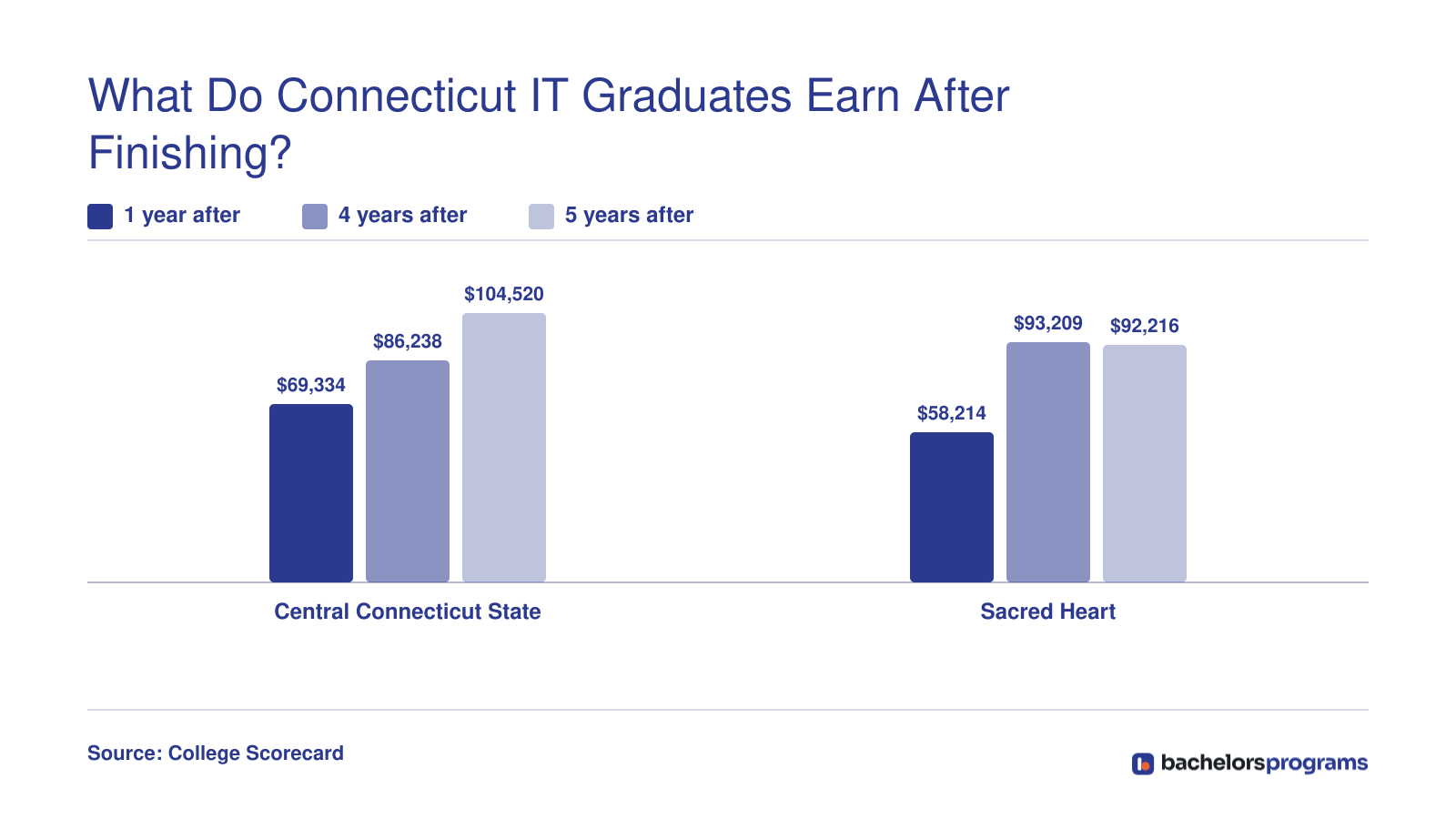
Graduates of Central Connecticut State University's networking information technology bachelor's program earned a median of $69,334 one year after completion, rising to $104,520 five years out. Sacred Heart University's information technology graduates reported $58,214 at one year and $93,209 at four years. These are program-level medians from federal College Scorecard data, not schoolwide figures.
Information Technology Careers and Salaries in Connecticut
In Connecticut, IT hiring has drifted away from generalist help-desk work and toward specialized roles, and the pay gap between those two tracks is now wide.
What the State Wage Data Shows
The Bureau of Labor Statistics' Occupational Employment and Wage Statistics for May 2023 give the clearest Connecticut picture available:
- Computer user support specialists: 8,370 jobs statewide, median annual wage of $68,640. This is the entry point most bachelor's graduates use to get a foot in the door.
- Network and computer systems administrators: 1,840 jobs, median annual wage of $105,810.
- Software developers: 18,380 jobs, median annual wage of $128,450.1
Software developers are both the largest and the best paid of the three, one reason so many information technology majors add programming coursework. Information security analysts are a fourth core role in the state, though pay for that title is not broken out in the same statewide table, so compare offers against the three benchmarks above.
New Haven and the Metro Picture
New Haven is the one metro area with a current published figure: computer and mathematical occupations there held 5,410 jobs at a median annual wage of $104,660 in May 2023.2 Older releases put support specialists at 1,270 jobs with a median of $66,120 and software developers at 1,370 jobs with a median of $118,080 in May 2022.3 Those 2022 numbers are not directly comparable to the 2023 release, so use them as background rather than as a trend line.
Where the Jobs Are
Connecticut's IT employment clusters in its largest labor markets: Hartford, with its insurance and financial services base; Stamford, tied closely to the New York metro economy; and New Haven, anchored by health care and higher education. For a new graduate, the practical read is that a support or administrator role in any of these markets is a realistic first job, while the higher medians sit with employers large enough to run their own systems and security teams.
Figures come from BLS state and metro wage estimates for May 2023, with the May 2022 release noted separately.
Questions to Ask Yourself
Do you need an online or hybrid schedule, or can you attend class on campus in person?
Will you be bringing credits from a Connecticut community college or another school?
Do you want hands-on IT, networking and security work, or theory-heavy computer science?
Does the program hold program-level accreditation, and does your target employer care?
Connecticut IT Degree Questions Answered
These answers cover the questions Connecticut students ask most often about a bachelor's degree in information technology. Program details and transfer rules can change, so confirm specifics with each school's admissions or advising office.
Which Connecticut colleges offer a bachelor's degree in information technology?
Can you get an online information technology degree in Connecticut?
Is information technology the same as computer science?
Can I transfer from a CT State community college into a bachelor's in IT?
How long does a degree-completion path take?
Is ABET accreditation required for IT jobs?
Compare Information Technology programs on the data that matters
Explore more Computers & IT majors or browse every field of study.
All Computers & IT programs Browse every field of study