Best Healthcare Administration Schools in Idaho
Compare 3 accredited Healthcare Administration programs in Idaho, with net price after aid, graduation rates, earnings and debt from IPEDS and the U.S. College Scorecard.

Tuition and fees for a bachelor's degree in healthcare administration in Idaho run from about $4,800 a year at Brigham Young University-Idaho to about $9,048 at Boise State University. The common credential is the Bachelor of Science (B.S.) in Healthcare Administration, though some Idaho schools use another label, such as a BBA.
Idaho has few dedicated programs, so the ranking covers every program the data supports rather than padding the list. Admissions, cost, online options, careers and nursing-home administrator licensure follow.
Licensure and manager-level pay both reward experience as much as the diploma, so format and cost matter more than prestige here.
Key Points
- Brigham Young University-Idaho posts the lowest tuition here, about $4,800.
- Boise State and Idaho State University both offer online bachelor's routes.
- Nursing home administrator licensure in Idaho requires supervised training plus exams.
Best Healthcare Administration Schools in Idaho: Our Ranked Bachelor's Programs
Idaho has a short but genuinely varied list of bachelor's programs in healthcare administration, and the three below differ in format, degree title, and setting. One is a private campus program in Rexburg, one is an online degree built for adults who already hold a technical credential, and one is a business school degree in Pocatello. Read each entry for the credential awarded and the kind of student it fits.
Brigham Young University-Idaho
#1Rexburg, ID · ~$8,000/yr (est.)
Best for: Traditional campus students in eastern Idaho
BYU-Idaho is a private university in Rexburg where the bachelor's degree in healthcare administration blends clinical, business, and ethics coursework into a single four-year major. Students work through healthcare law, financial management, operations, and strategy with hands-on projects and case-based challenges, and the curriculum builds in training on evaluating AI tools for accuracy and bias. Gospel-centered ethics run through the leadership coursework, and graduates leave prepared for hospital systems, insurers, medical device firms, or an MHA or MBA later. Rolling admissions and a test-optional application keep the entry process simple.
- Four-year campus program in Rexburg combining health and business coursework
- Core topics include healthcare law and ethics, financial management, and operations
- AI tools integrated throughout the curriculum, including accuracy and bias review
- Gospel-centered ethics woven into leadership and decision-making courses
- Hands-on projects and real-world challenges alongside clinical care teams
- Prepares students to continue into an MHA or MBA program
Boise State University
#2Boise, ID · $20,000 – $25,000/yr (est.)
Best for: Working adults holding a technical credential
Boise State University offers its healthcare administration bachelor's through an online Bachelor of Applied Science with a health administration emphasis, designed for adults who already hold a technical certificate or associate degree. The 120-credit program covers healthcare delivery systems, determinants of health, legal and ethical patient care issues, and research methods, with 15 credits of focused health administration study and room for transfer credit. Tuition is charged per credit for the 2026-27 year, and eligible military benefits are accepted through an approved pathway. Applicants who already hold a bachelor's degree are not eligible.
- Online, 120-credit degree for adults who already hold a technical credential
- Requires an accredited technical certificate or associate degree to apply
- 15 credits of focused health administration coursework
- Covers healthcare delivery systems, determinants of health, and research methods
- Ethical and legal issues in patient care built into the core
- Military benefits accepted through an approved pathway
- Estimated book costs of about $1,500 for the program
- Applicants who already hold a bachelor's degree are not eligible
Idaho State University
#3Pocatello, ID · ~$12,000/yr (est.)
Best for: Business-minded students wanting a management track
Idaho State University in Pocatello awards a Bachelor of Business Administration in Healthcare Administration, so the degree sits inside the business school rather than a standalone health college. Coursework pairs administrative know-how with technical, problem-solving, and human relations skills, aimed at entry to mid-level management in hospitals, group practices, long-term care facilities, managed care organizations, and state health agencies. Students get practical experience and mentoring from alumni at regional healthcare organizations, and no additional program admission requirements stand between admitted students and the major.
- Business administration degree with a healthcare administration focus
- No additional program admission requirements beyond university admission
- Prepares graduates for entry to mid-level management roles
- Career paths in hospitals, group practices, long-term care, and state agencies
- Practical experience and mentoring with regional healthcare alumni
- Solid foundation for a graduate degree in healthcare administration
- Housed at the main campus in Pocatello
Cost & outcomes by school
Federal data for the highest-earning Healthcare Administration programs, independent of the ranking above. Earnings are this field's bachelor's graduates four years after completing where the Scorecard reports them, else the school's undergraduate median.
| School | Net price / yr | Grad rate | Earnings | Debt | Grads/yr | Format |
|---|---|---|---|---|---|---|
| Brigham Young University-Idaho ID | $8,221 | 56% | $60,571 | $13,148 | 86 | Campus |
| Boise State University ID | $21,610 | 60% | $51,658 | $20,500 | — | Online |
| Idaho State University ID | $12,193 | 39% | $45,608 | $20,039 | 7 | Campus |
Sources: U.S. Department of Education. Net price, graduation rate, earnings and debt: College Scorecard (earnings and debt for this field's bachelor's graduates where reported, else school-wide); graduates: IPEDS. A dash means no figure is reported.
Cost, debt & payoff
Median earnings of this field's bachelor's graduates (4 yrs after completing, else the school's undergraduate median) vs. their median federal loan debt · U.S. College Scorecard
Across these programs the median graduate earns about $51,658 and finishes with roughly $20,039 in debt — a ratio that clears a common rule of thumb (keep debt below first-year salary). Net price and debt vary widely school to school, so check the per-school figures in the table above before you shortlist.
How We Ranked Idaho Bachelor's Programs in Healthcare Administration
This ranking compares Idaho bachelor's programs in healthcare administration using public federal data. The goal is to show which programs offer students the strongest mix of value, completion, and career payoff.
What the Data Measures
- Net price: The average amount students pay after grants and scholarships, which is usually far below the sticker price.
- Program completions: How many students finish this specific program, a sign that it is active and well established.
- Earnings and debt: Where the Scorecard reports them, typical graduate earnings and federal loan debt for this program rather than the school as a whole.
Graduation rate and net price are institution-wide averages, so treat them as approximations. When this page says a school offering this program has a certain graduation rate, that figure reflects students in every major, not healthcare administration alone.
Quality Signals and Independence
The Association of University Programs in Health Administration (AUPHA) certifies undergraduate programs that meet its curriculum and faculty standards. We treat that certification as a meaningful quality signal. bachelorsprograms.com is independent of the schools ranked here, and no school shaped its own placement.
A Small Field
Idaho has only a handful of bachelor's options in this field, so the list is short and the ranks sit close together. Brigham Young University-Idaho, Boise State University, and Idaho State University each bring different strengths. A gap of one spot matters less than format, cost, and fit with your goals.
Which Idaho Schools Offer a Bachelor's Degree in Healthcare Administration?
Idaho State University and Brigham Young University-Idaho both offer a bachelor's degree with healthcare administration as the named major, while Boise State University offers a related applied science degree with a health administration emphasis. That difference matters when you compare programs, so each credential is named explicitly.
Healthcare Administration Majors
- Idaho State University (Pocatello): The credential is a Bachelor of Business Administration (B.B.A.) in Healthcare Administration. The university is institutionally accredited by the Northwest Commission on Colleges and Universities (NWCCU).1 The degree requirements list HCA 3393 Healthcare Administration Internship, so hands-on experience is built in. Online options are available through the College of Business, but the sources do not establish that the whole major can be completed online, so confirm that with an advisor.
- Brigham Young University-Idaho (Rexburg): The credential is a Bachelor of Science (B.S.) in Healthcare Administration. The program page identifies the degree but does not state a delivery format, so ask the department whether courses are offered on campus, online, or both.
Related Degree, Not an Equivalent
- Boise State University (Boise): The credential is a Bachelor of Applied Science with a Health Administration Emphasis. It is a related applied science degree with a health focus, not a major titled healthcare administration. If you want that exact major name on your diploma, Idaho State and BYU-Idaho are the closer matches. Boise State may suit you better if the applied science format fits your background or career plans.
Accreditation and AUPHA Status
Idaho State is the one school here with a confirmed accreditor in the research: NWCCU, which is institutional accreditation covering the whole university. That is different from programmatic accreditation, which reviews a specific degree. The AUPHA (Association of University Programs in Health Administration) is the main professional body for undergraduate health administration education, and its membership and certification status is worth checking in its public directory. I could not verify AUPHA status for any program on this page, so treat it as a question to ask each school directly.
Internship and Capstone Requirements
Idaho State's required internship (HCA 3393) is not the only one: BYU-Idaho requires HCA 498R as well. Boise State's program listing does not specify one, so ask that department directly. Before applying, ask each department whether a practicum, internship, or capstone is required and how placements are arranged, since that experience often shapes your first job search.
Online and Hybrid Bachelor's Options at Idaho Schools
Can you earn a bachelor's degree in healthcare administration online in Idaho? Yes. Boise State University and Idaho State University both offer a route that does not require you to live near campus.
How Delivery Compares
- Boise State University: The Bachelor of Applied Science with a Health Administration emphasis is listed as an online program. It is built for degree completion, so applicants need a prior technical certificate or degree.
- Idaho State University: Our program listing codes the B.B.A. in Healthcare Administration as campus-based in Pocatello. ISU also delivers the same degree online through eISU, and its online programs do not require campus travel.
- Brigham Young University-Idaho: The B.S. in Healthcare Administration is listed as a campus program in Rexburg. Some coursework, such as HS 285, runs online. The sources reviewed do not show the whole degree being offered remotely, so treat it as campus-based unless the school confirms otherwise.
None of the schools here describes a hybrid format.
Synchronous or Asynchronous?
ISU is the only school that spells this out. Its online courses vary: some are asynchronous with no set time or place, and others are synchronous with scheduled meeting times. Check each course before you register. BYU-Idaho's HS 285 is a 3-credit online course that runs about 9 hours a week through assignments and discussions. Boise State's pages do not say whether its courses meet live, so ask an advisor.
What Working Adults Should Know
Boise State's online format, a published per-credit price of $395, and acceptance of military benefits suit people already working. The materials we reviewed do not state part-time pacing or evening course schedules for any of the three, so confirm those with admissions.
Internships are the part to plan around. ISU requires HCA 3393, a 3-credit internship of 180 hours at an approved healthcare organization. BYU-Idaho requires a 2-credit internship (HCA 498R) after a 2-credit capstone (HCA 490). Online courses at ISU may still require clinical activities at your location, which suggests you can arrange a placement near home. Ask each program how placements are approved. We found no published internship details for Boise State.
Admissions Requirements: GPA, Test Policy, and Transfer Credit
The easier a program is to enter, the more its transfer rules decide how long the degree actually takes. Idaho's healthcare administration bachelor's programs lean accessible on the front end, with modest GPA expectations and no test requirement, but the credit-transfer details are where community college students gain or lose a semester.
GPA and Test Policy
- Idaho State University: first-year applicants should have about a 2.25 GPA, and SAT or ACT scores are not required for admission.
- BYU-Idaho: a cumulative GPA of 2.0 is expected. Test scores are not required to be admitted, but they are required for scholarship consideration, so a solid score is worth submitting for funding rather than for entry.
Is There a Second Admission Step?
Idaho State states plainly that its healthcare administration bachelor's has no program-specific admission requirements, so general university admission is the whole gate. BYU-Idaho publishes no separate major application, portfolio, or interview, which means university admission is the only step unless an advisor tells you otherwise.
Transfer Credit and Its Limits
- Idaho State: transfer applicants need a 2.0 cumulative GPA, good standing at the last institution, and official transcripts from every college attended. With fewer than 14 semester credits, a high school transcript and diploma are required too.
- BYU-Idaho: credit must come from an accredited institution and be earned at C- or higher, and transfer grades are not folded into your BYU-Idaho GPA. Coursework older than 10 years generally counts only as elective credit. A transfer associate degree from a regionally accredited school covers most Foundation requirements, but applied associate degrees do not, which matters if you earned an AAS at a community college.
Idaho State also requires a 2.0 ISU cumulative GPA to hold degree-level standing, so a rough semester after you arrive still has consequences.
Cost of a Healthcare Administration Bachelor's Degree in Idaho
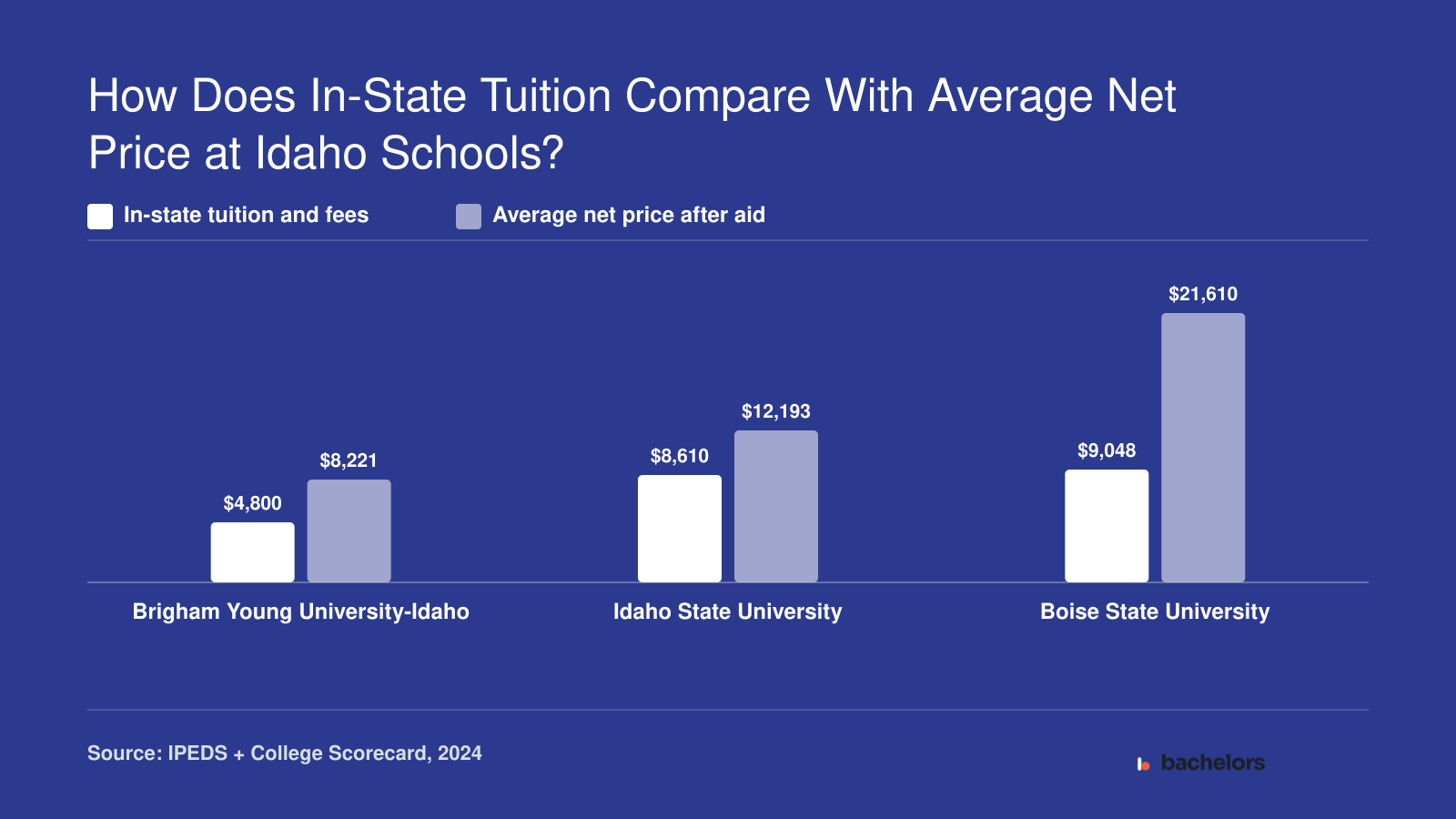
Sticker price and the price you actually pay are two different numbers, and in Idaho the gap between them varies by school. In-state tuition and fees for the schools here run from about $4,800 at Brigham Young University-Idaho to about $9,048 at Boise State University, with Idaho State University at $8,610. Average net price after aid is an institution-wide, approximate figure, not specific to this major. It runs about $8,221 at BYU-Idaho, $12,193 at Idaho State, and $21,610 at Boise State. Those net prices include living costs, which is why they can exceed tuition.
Program-Level Debt
Only BYU-Idaho has a program-level median debt figure for its healthcare administration graduates: about $13,148. The other two schools have no comparable program figure, so a head-to-head debt comparison isn't possible yet. Boise State's online option lists $395 per credit and estimates $1,500 for books, which helps if you plan to pay by the course.
Idaho Aid to Know
- Idaho LAUNCH: Covers 80% of tuition and fees up to $8,000 total, generally $4,000 in the first year. You must be a current Idaho high school graduate and resident, start in the fall, and file a Career Pathway Plan. The program must lead to an in-demand career, so confirm that healthcare administration is on the LAUNCH Portal before counting on it. ISU says there is no GPA or financial-need requirement.
- Idaho Opportunity Scholarship: Up to $3,500 a year, renewable for up to four years (a $14,000 maximum). ISU asks for an unweighted GPA of at least 2.7 and a FAFSA filed by March 1. BYU-Idaho caps it at $1,750 per semester. It is for a first bachelor's degree, and schools may award less depending on need and other aid.
- One or the other: Applicants can take the Opportunity Scholarship or LAUNCH, not both, so compare the two against your own tuition bill.
- Major eligibility: The Opportunity Scholarship isn't tied to a specific major. LAUNCH depends on whether your major counts as in-demand, so check with each school's financial aid office.
One Practical Way to Cut Costs
Choose the lowest-cost route that still ends at your target school. BYU-Idaho has the lowest sticker price and net price of the three schools. If you would rather start at an Idaho community college, finish general education there and transfer in, you pay lower tuition for the first two years.
How Does In-State Tuition Compare With Average Net Price at Idaho Schools?
Tuition is only part of the bill. Net price is what students pay on average after grants and scholarships, and it also counts housing, books, and other living costs, so it can run higher than tuition alone. Net price is an institution-wide average across all undergraduates, so your own cost will vary with your aid package, residency, and living situation.
Related Articles
Healthcare Administration Careers and Salaries in Idaho
Demand for healthcare administration graduates in Idaho is real, but the high manager salaries come after several years of experience, not on day one.
Entry and Early-Career Roles
Most graduates start below the manager title and work upward. Realistic first jobs include:
- Practice manager: runs scheduling, billing and staffing for a physician group.
- Clinic administrator: oversees daily operations at a clinic or outpatient site.
- Patient services coordinator: manages intake, referrals and patient communication.
- Long-term care administrator: leads a nursing or assisted-living facility, which requires a state license.
Idaho and National Pay and Outlook
The Idaho Department of Labor's JobScape tool lists medical and health services managers at $67,140 for entry-level, $124,660 for typical and $175,570 for experienced workers, with 321 annual openings.1 The most recent statewide figures from the Bureau of Labor Statistics (May 2021) show a median of $46.96 per hour and a mean of $105,990 a year.2 Regional data from May 2024 puts the median at $56.99 per hour in North Central Idaho3 and $54.34 in South Central Idaho4. State projections that start from a 2021 base add about 416 positions, roughly 17.5 percent growth.5 Nationally, BLS reports a May 2025 median of $123,8606 and projects 24 percent growth from 2025 to 2035, with about 62,300 openings a year.7
What Drives Idaho Demand
Three forces stand out. Rural hospitals and clinics need administrators who can handle budgets, compliance and staffing with small teams. An aging population keeps long-term care facilities hiring. In the Boise area, large health systems such as St. Luke's and Saint Alphonsus run complex operations that need coordinators, supervisors and managers. Neither employer publishes manager wage schedules or hiring totals, so treat them as places to look, not guarantees.
Program-Level Earnings
Scorecard data reports earnings for graduates of specific programs. Five years after finishing, Brigham Young University-Idaho healthcare administration graduates had median earnings of $69,921, and Idaho State University graduates had $62,627. The Idaho State figure rests on a small group of completers, so read it cautiously. Boise State University's Bachelor of Applied Science with a Health Administration Emphasis has no program-level earnings figure reported. These numbers describe program graduates, not whole universities, and they sit well below the typical manager wage because they include early-career roles.
Idaho Nursing Home Administrator License: Does a Bachelor's Degree Qualify?
A bachelor's degree is where Idaho nursing home administrator licensure starts, but the degree alone does not confer the license. The Idaho Board of Long-Term Care Administrators issues it, and you must also complete supervised training and pass exams.
The Steps in Order
- Meet the basics: You must be at least 18 and hold a bachelor's degree or an equivalent credential. The rules allow 2 years of satisfactory nursing-home management experience in place of each year of required education.
- Take the specialized course: The Board requires a specialized course in addition to your degree.
- Complete the internship: Register with the Board as an administrator-in-training, secure a registered preceptor, and finish 1,000 hours in an Idaho-licensed nursing home.
- Pass the exams: Idaho requires the NAB Core and NAB Nursing Home Administrators Line of Service exams, plus a state laws and rules exam with a 75% passing score. Plan on the state exam being separate unless the Board tells you otherwise.
How the Internship Works
Training is full time, meaning at least 32 hours a week, with an additional 32 hours a month directly with your preceptor unless you hold a full-time designated trainee role. Reports are due after each 500-hour increment, and the internship generally may not run past 2 years without Board approval. You may begin it before you finish your bachelor's degree, and the training hours must be complete before you sit for the exams.
A master's in health care administration related to long-term care exempts you from the 1,000 hours. Idaho State University's healthcare administration coursework may be worth asking about if you want classroom credit to count toward training. Confirm with the Board before you plan around it, including which courses qualify and how many hours they could cover.
Most Other Roles Need No License
Most other healthcare administration jobs in Idaho, such as practice management, health information, and department supervision, do not require a state license. The administrator license matters mainly if you want to run a nursing facility.
Choosing the Right Idaho Program for Your Goals
Boise State University builds its health administration emphasis into a Bachelor of Applied Science, while Brigham Young University-Idaho and Idaho State University offer a Healthcare Administration degree. That difference in credential and location should shape your choice more than any single ranking position.
Working Adults
If you are balancing a job, look for the schools with the most flexible course formats, and Boise State's applied science structure is worth a close look if you already hold technical or associate-level coursework. Before you commit, ask an advisor at each school how much of your existing transfer credit applies.
Traditional On-Campus Students
Brigham Young University-Idaho in Rexburg and Idaho State University in Pocatello both offer a residential experience built around a full-time course load. Ask each program how internships are arranged and where recent students have been placed.
Licensure Seekers
If you want to run a long-term care facility, your degree is only one piece of the process, since Idaho licensing has its own requirements beyond coursework. Confirm with the program which classes and practicum hours support licensure, then check current rules with the state licensing board.
Rural-Health Focus
Much of Idaho is rural, and Idaho State and Brigham Young University-Idaho sit outside the Boise metro area, close to smaller regional health systems. Next step: request program information and ask whether internships or projects involve critical-access hospitals or rural clinics. Also ask about aid eligibility so you know what funding applies to your situation.
Before You Apply
Admissions standards, tuition, and aid details change from year to year. Verify GPA expectations, test policy, transfer rules, and current costs directly with the school before you submit an application.
Compare Healthcare Administration programs on the data that matters
Explore more Business & Management majors or browse every field of study.
All Business & Management programs Browse every field of study