Best Healthcare Administration Schools in Maryland
Compare 5 accredited Healthcare Administration programs in Maryland at 4 colleges, with net price after aid, graduation rates, earnings and debt from IPEDS and the U.S. College Scorecard.

Hospital systems are consolidating and adding administrative layers, and that is pushing employers toward managers who hold a degree in the field rather than a clinical credential alone. In Maryland, large hospital networks and health systems around Baltimore, the Washington suburbs and the Eastern Shore keep that demand steady.
You can earn the degree on campus at Towson University, Stevenson University and Washington Adventist University, or online through University of Maryland Global Campus; most of these programs award a Bachelor of Science (B.S.) in Healthcare Administration.
The real tension is cost against format. Tuition, aid, admission rules and the pace of study differ sharply between these schools, and the cheapest route is not always the one that fits a working adult.
Key Points
- Maryland medical and health services managers averaged $150,590 in May 2023.
- Working adults can study fully online through University of Maryland Global Campus.
- Towson and UMGC graduates earn near $66,000 against $24,000 median debt.
Best Bachelor's Degree in Healthcare Administration Programs in Maryland
Maryland's bachelor's degree in healthcare administration options split three ways: public universities with campus programs, private colleges that fold the field into a business curriculum, and a fully online public option that serves working adults statewide. The cards below show school-wide graduation rates and net prices after aid, alongside program-level earnings for graduates of the healthcare administration program itself, measured four years after finishing. Where a school reports no program earnings figure, the card simply omits it.
Towson University
#1Towson, MD · ~$17,000/yr (est.)
Best for: Baltimore-area students seeking campus internships
Towson University is a public university in Towson, just north of Baltimore, and its campus-based Bachelor of Science in Health Care Management leans on the business side of the field. Students pair coursework in health administration, population health, finance and quality improvement with a required business minor, and seniors spend 15 weeks in a full-time internship at a health care organization. Graduates of the program reported median earnings of $68,077 four years after finishing, according to College Scorecard data.
- 120 credit hours, capstone, and a required 24-unit business minor
- 15-week full-time internship at a health care organization
- Tracks: Long-Term Care Administration for nursing home and assisted living careers
- Coursework adheres to the ACHE Code of Ethics
- Student groups include the Health Care Leadership Academy and IHI Open School chapter
- Upsilon Phi Delta honor society recognizes academic excellence
Stevenson University
#2Owings Mills, MD · ~$27,000/yr (est.)
Stevenson University is a private university in Owings Mills, northwest of Baltimore, and it teaches healthcare management as a business discipline. The B.S. in Healthcare Management is IACBE accredited and combines accounting, finance, economics and healthcare marketing with policy, law and ethics, plus an internship. A B.S. to M.S. option lets students continue into graduate study, and graduates pursue roles such as hospital administrator, healthcare operations manager and compliance specialist.
- IACBE-accredited business and healthcare curriculum
- Core includes accounting, finance, economics, and healthcare marketing
- Internship places students in real healthcare settings
- B.S. to M.S. option for continuing to graduate study
- Coursework covers HIPAA compliance and healthcare law and ethics
- Prepares students for hospital administrator and operations manager roles
University of Maryland Global Campus
#3Adelphi, MD · $22,000/yr (est. net price)
Best for: Working adults needing fully online coursework
University of Maryland Global Campus is the state's fully online public option, based in Adelphi, and its Bachelor of Science in Health Services Management is built for students who want to lead in healthcare without a clinical background. The 120-credit program accepts up to 90 transfer credits, requires no prior healthcare experience, and offers an embedded certificate in health information management and data analytics as well as preparation for CHDA and CDH-P certification exams. Graduates of the program reported median earnings of $70,119 four years after finishing, according to College Scorecard data.
- Fully online, 120 credits, $337 per credit
- Up to 90 transfer credits accepted
- No prior healthcare experience required
- Capstone required, with an accelerated pathway available
- Embedded certificate option in health information management and data analytics
- Prepares students for CHDA and CDH-P certification exams
- Interest-free monthly payment plan and no-cost digital materials
- Military benefits accepted
Washington Adventist University
#4Takoma Park, MD · $15,000 – $20,000/yr (est.)
Washington Adventist University is a private university in Takoma Park, inside the Washington, D.C. area healthcare job market, and its Bachelor of Science in Health Care Administration is designed for working adults who already have some healthcare experience. Classes meet one night a week in eight-week sessions, online, in person or hybrid, and the curriculum covers finance, personnel, information systems, managerial economics, legal issues and public policy. A guided independent research project caps the degree, and graduates leave with supervisory skills for clinics, hospitals and other care settings.
- $465 per credit, with a 2.5 GPA minimum
- Classes meet one night a week in eight-week sessions
- Online, face-to-face, or hybrid formats available
- Prerequisite courses and a capstone research project required
- Coursework spans finance, personnel, information systems, and public policy
- Built for adult learners already working in healthcare
Cost & outcomes by school
Federal data for the highest-earning Healthcare Administration programs, independent of the ranking above. Earnings are this field's bachelor's graduates four years after completing where the Scorecard reports them, else the school's undergraduate median.
| School | Net price / yr | Grad rate | Earnings | Debt | Grads/yr | Format |
|---|---|---|---|---|---|---|
| University of Maryland Global Campus MD | $22,063 | 33% | $70,119 | $24,000 | 261 | Online |
| Towson University MD | $17,413 | 70% | $68,077 | $23,500 | 68 | Campus |
| Washington Adventist University MD | $18,526 | 29% | $64,249 | $30,500 | 8 | Campus |
| Stevenson University MD | $26,505 | 69% | $62,079 | $26,000 | 6 | Campus |
Sources: U.S. Department of Education. Net price, graduation rate, earnings and debt: College Scorecard (earnings and debt for this field's bachelor's graduates where reported, else school-wide); graduates: IPEDS. A dash means no figure is reported.
Cost, debt & payoff
Median earnings of this field's bachelor's graduates (4 yrs after completing, else the school's undergraduate median) vs. their median federal loan debt · U.S. College Scorecard
Across these programs the median graduate earns about $68,077 and finishes with roughly $24,000 in debt — a ratio that clears a common rule of thumb (keep debt below first-year salary). Net price and debt vary widely school to school, so check the per-school figures in the table above before you shortlist.
How We Ranked Maryland Healthcare Administration Schools
Some figures describe an entire university, while others describe a single degree program. This ranking draws on both, and the distinction matters when you compare schools.
What We Weighed
- Net price after aid: what students actually pay once grants and scholarships are counted, not the sticker price.
- Graduation and retention: how many students finish, and how many come back after the first year.
- Program-level earnings and debt: what graduates of the specific program earn and borrow, where those figures are published.
- Completions: how many students finish the program each year, a sign of an established track.
- Delivery format: campus, online or hybrid.
- Active program status: only programs currently open to new students are included.
What the Numbers Do and Don't Tell You
Graduation rate and net price are institution-wide averages. They reflect every undergraduate at Towson University, Stevenson University, University of Maryland Global Campus or Washington Adventist University, not only healthcare administration majors. A school with a strong overall record can still have a weaker program, and the reverse is possible too, so confirm program-specific costs with the school.
Scope and Sources
The ranking covers only Maryland bachelor's programs, both campus and online. Online programs count when the school is based in Maryland. Figures come from the College Scorecard and IPEDS, the federal education databases, and they reflect the latest published snapshot rather than live numbers.
Online and Hybrid Bachelor's Options at Maryland Schools
An online or hybrid bachelor's degree in healthcare administration puts some or all coursework off campus, so you can keep working while you study. Each of the four Maryland programs handles the split differently.
Fully Online
University of Maryland Global Campus (UMGC) is the one fully online option here. Its Bachelor of Science in Health Services Management is a 120-credit program delivered online, with select hybrid courses. Classes run in 8-week sessions year-round with multiple start dates, and a capstone is required. UMGC uses rolling admissions and was accepting students for 2026. Its program page does not state an internship requirement.
Hybrid and Campus-Based
Washington Adventist University is classified as campus-based, yet its Bachelor of Science in Health Care Administration lists online, face-to-face and hybrid formats. It meets one night per week and is designed for adults already working in healthcare. A capstone is required.
Towson University (Health Care Management) and Stevenson University (Healthcare Management) are campus programs. Towson's program includes an internship at a health care organization plus a capstone, so expect real in-person time in a clinical or administrative setting. For Stevenson, check with admissions on course scheduling and any field experience before you apply.
Enrollment Status
UMGC is the only program here with 2026 enrollment confirmed in the sources we reviewed. None of the four programs shows signs of being archived or in teach-out, but confirm current start terms with Towson, Stevenson, and Washington Adventist directly.
A Practical Takeaway for Working Adults
Match the format to your schedule, not the other way around. If your hours change week to week, UMGC's short terms and frequent starts give you the most room to pause or speed up. If you do better with set meeting times and classmates in the room, a weekly evening cohort like Washington Adventist's may keep you on track. Whichever you choose, ask early how any internship or practicum fits around your work hours, since that is the piece online coursework cannot replace.
Admission Requirements: GPA, Test Policy and Transfer Credit
Start with each school's official .edu site and check four pages in order: the undergraduate admissions requirements page, the healthcare administration program page, the transfer credit policy, and the prior learning credit page. Search each site for "GPA requirement," "test optional," and "transfer credit maximum." If Towson University, Stevenson University, University of Maryland Global Campus or Washington Adventist University publishes no policy on a point, ask the admissions office or transfer coordinator for the minimum GPA, SAT/ACT policy and credit cap in writing. Policies change by school and by year, so treat third-party sites as possibly outdated, use BLS.gov only for occupation and education context (not admission rules), and turn to ACHE or AUPHA for accreditation and career guidance. The table below shows the Maryland Higher Education Commission's statewide transfer standards for public four-year schools. Community college students should also run their courses through ARTSYS.
| School | Minimum GPA / Admit Standard | Test Policy | Transfer Credit Policy | Notes |
|---|---|---|---|---|
| Towson University (Health Care Management) | 2.0 cumulative GPA for Maryland community college transfers with an associate degree or 56 semester hours, under the state's direct transfer standard | Verify on the undergraduate admissions page (search "test optional") | Credit from a community college is generally limited to about one-half of the bachelor's requirement, not to exceed 70 credits | Public four-year school. Direct transfer is subject to capacity. Check course transferability in ARTSYS and get written confirmation of which credits count toward the major. |
| University of Maryland Global Campus (Health Services Management) | 2.0 cumulative GPA for Maryland community college transfers with an associate degree or 56 semester hours, under the state's direct transfer standard | Verify on the undergraduate admissions page (search "test optional") | Credit from a community college is generally limited to about one-half of the bachelor's requirement, not to exceed 70 credits | Public four-year school. Direct transfer is subject to capacity. Check courses in ARTSYS and ask the transfer office about prior learning credit and any separate limits on it. |
Related Articles
Questions to Ask Yourself
Do you need an online or evening format, or can you attend classes on campus near Baltimore or Towson?
Will your Maryland community college credits transfer into the major?
Is a license-track path such as nursing home administration part of your plan?
What will you actually pay after aid, not just the published tuition?
Healthcare Administration Salaries and Jobs in Maryland
The U.S. Bureau of Labor Statistics May 2023 wage estimates put the mean annual wage for medical and health services managers in Maryland at $150,590 across 14,770 jobs, with the Baltimore-Columbia-Towson metro at $130,520 and the state's nonmetropolitan area at $133,960 (median wages are not reported in the figures used here). A bachelor's degree in healthcare administration typically leads to entry roles such as health services coordinator, medical office manager or patient access supervisor, while senior manager and director positions usually go to candidates with several years of experience, and demand for these managers is expected to keep growing as hospitals, clinics and long-term care providers expand. These are occupation-wide wages that include seasoned executives, so they run well above what recent graduates of the programs ranked here earn in their first years after finishing a bachelor's degree.
| Area | Median Annual Wage | Mean Annual Wage | Employment |
|---|---|---|---|
| Maryland (statewide) | N/A | $150,590 | 14,770 |
| Baltimore-Columbia-Towson, MD | N/A | $130,520 | 210 |
Maryland Nursing Home Administrator Licensure at a Glance
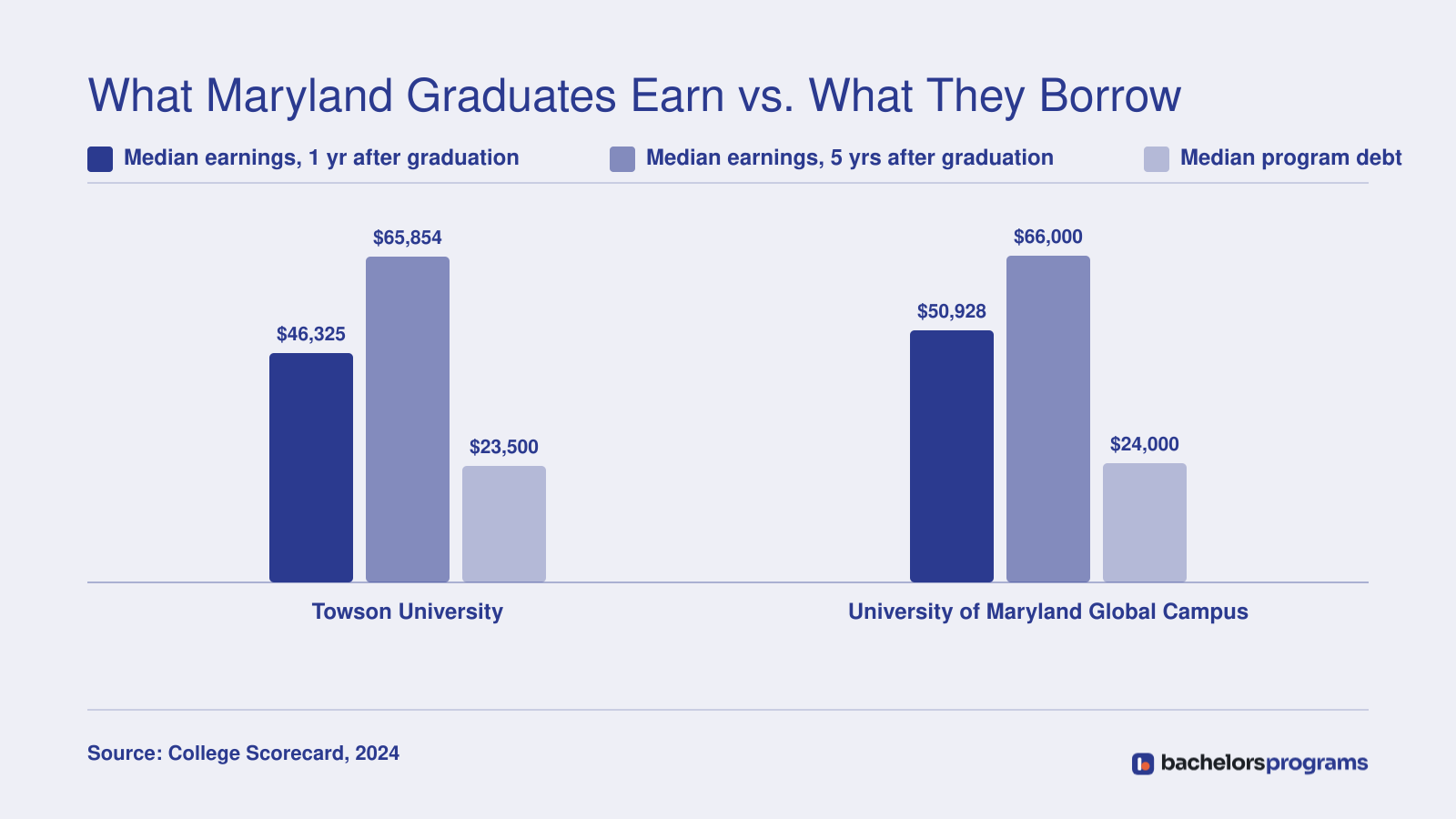
What Maryland Graduates Earn vs. What They Borrow
Bachelor's graduates in healthcare administration from Towson University and University of Maryland Global Campus report median earnings near $66,000 five years after graduation, against median debt of about $24,000. Towson shows the strongest earnings relative to debt, with five-year earnings of roughly 2.8 times median borrowing, though UMGC graduates earn more in the first year ($50,928 vs. $46,325). Stevenson University and Washington Adventist University have no program-level earnings or debt figures reported, so the chart leaves them out.
Common Questions About Healthcare Administration Degrees in Maryland
Can you get a bachelor's in healthcare administration online from a Maryland school?
Do you need a license to work in healthcare administration in Maryland?
What jobs can you get with a bachelor's degree in healthcare administration in Maryland?
Is a healthcare administration degree worth it compared with a nursing or business degree?
Compare Healthcare Administration programs on the data that matters
Explore more Business & Management majors or browse every field of study.
All Business & Management programs Browse every field of study