Best Information Technology Schools in Maryland
Compare 8 accredited Information Technology programs in Maryland at 6 colleges, with net price after aid, graduation rates, earnings and debt from IPEDS and the U.S. College Scorecard.

What does a bachelor's degree in information technology in Maryland cost to finish, and what does it pay afterward? The first number varies sharply by sector. Towson University lists $11,728 in annual in-state tuition; Strayer University-Maryland prices its Bachelor of Science (B.S.) in Information Technology by the course at $1,555, with transfer credit for up to 28 classes.
The second number depends on where you work. Federal agencies, defense contractors and the cyber commands clustered around Fort Meade and Aberdeen Proving Ground hire year-round, and Capitol Technology University sits close to that Baltimore-Washington corridor.
The credential is standard. The price of it is not.
Key Points
- Strayer University-Maryland IT graduates earned a median $82,304 four years out.
- Towson pairs $75,785 median earnings with only $19,500 in debt.
- Capitol Technology admits about 74% of applicants; Frostburg State admits about 89%.
Best Bachelor's in Information Technology Schools in Maryland, Ranked
Maryland's information technology bachelor's options range from large public universities with dedicated computing labs to a small private college offering a five-year combined degree and a provider built around online study for working adults. Each entry below covers the tracks a student can actually enroll in, how the degree is delivered, and the details that separate one program from the next.
Towson University
#1Towson, MD · ~$17,000/yr (est.)
Best for: In-state transfers using 2+2 agreements
Towson University runs its information technology major through a computer and information sciences department with more than 40 full-time faculty and over 20 computing labs. Students add a Network Security or Data Management and Analytics track, and a 2+2 agreement with Harford Community College gives A.A.S. graduates a defined route into the major. It is the largest and most established IT program in this ranking, with full- and part-time enrollment and a second bachelor's option for career changers.
- Tracks: Network Security and Data Management and Analytics
- 2+2 agreement with Harford Community College for A.A.S. Computer Information Systems graduates
- More than 40 full-time faculty and over 20 computing labs
- Prepares students for CompTIA Network+ and Security+ exams
- Evening courses available, though not every required course each term
- Prerequisite sequencing normally takes a minimum of five terms
- Second bachelor's candidates complete at least 30 units in the major at Towson
- James W. Smith Scholarship and a student chapter of the ACM
Hood College
#2Frederick, MD · ~$21,000/yr (est.)
Best for: Students wanting a five-year bachelor's and master's
Hood College approaches information technology through its 4PLUS program, a five-year track that pairs a bachelor's degree with a master's in information technology and is open to students from any major. Undergraduates take up to three graduate courses during junior and senior years, then finish the master's in about a year with two summer sessions. The small Frederick campus and 10-to-1 student-faculty ratio suit students who want a combined degree rather than a standalone B.S.
- Five-year track pairing a bachelor's degree with an M.S. in Information Technology
- Open to students from any major
- 30 graduate credits: 18 core and 12 elective
- Up to three graduate courses taken during junior and senior years
- Master's finishes in one year after the bachelor's, including two summers
- Careful elective choices add a 15-credit cybersecurity certificate
- Foundation courses IT 510 and IT 512 required, with C- or better in prerequisites
Frostburg State University
#3Frostburg, MD · $10,000 – $26,000/yr (est.)
Best for: Business-minded students weighing several IT tracks
Frostburg State University's Bachelor of Science in Information Technology blends business coursework with computer information systems, and students specialize through five tracks spanning computer security, business IT, accounting, graphic arts, and mass communication. The program points graduates toward roles such as network architect, security analyst, database administrator, and web developer, and students collect projects into an employer-ready portfolio. It is a lower-cost public option with a 13-to-1 student-faculty ratio and active computing student organizations.
- Tracks in accounting, business IT, computer security, graphic arts, mass communication
- Combines business coursework with computer information systems
- Student chapter of the Association for Computing Machinery
- Upsilon Pi Epsilon honor society and a student-run Computer Club
- Students build a project portfolio for employers
- Prepares graduates for roles like network architect and security analyst
Capitol Technology University
#4Laurel, MD · ~$22,000/yr (est.)
Capitol Technology University offers a Bachelor of Science in Information Technology built around 121 credits and a required capstone, with tuition that does not rise more than 1 percent a year for four years for full-time students who keep their account current. Its Laurel location puts students next to the Baltimore-Washington technology corridor, and the university maintains partnerships with technology firms and government agencies. Military benefits are accepted, and the curriculum pairs technical coursework with business, mathematics, and communication requirements.
- 121 credits, including a required capstone project
- Tuition rises no more than 1% a year for four years for full-time students
- Located near the Baltimore-Washington technology corridor
- Military benefits accepted
- Coursework spans computer and web, business, math, science, English and social science
- Partners include technology firms and government agencies
Strayer University-Maryland
#5Baltimore, MD · ~$14,000/yr (est.)
Strayer University's Bachelor of Science in Information Technology is built for working adults: 40 courses of 11 weeks each, delivered fully online or at select Maryland campuses, with up to 28 classes accepted in transfer. Students choose from eight concentrations, including cybersecurity, data analytics, cloud computing, and artificial intelligence, the last two offered online only. The program is accredited by the Middle States Commission on Higher Education, and employer tuition reimbursement is supported.
- 40 courses of 11 weeks each
- Eight concentrations, including artificial intelligence, cybersecurity and cloud computing
- AI and cloud computing concentrations offered online only
- Fully online or in person at select campuses
- Transfer up to 28 classes
- $1,555 per course plus a $65 technology fee each term
- No-cost general education courses through Sophia Learning
University of Baltimore
#6Baltimore, MD · $10,000 – $24,000/yr (est.)
The University of Baltimore's Bachelor of Science in Applied Information Technology is a STEM-designated, 120-credit degree taught in the evening on the downtown Baltimore campus, aimed at students who work during the day. Students take a general track or a 24-credit concentration in Application Development or Cyber Security, and an accelerated bachelor's to master's option lets strong students continue at UBalt. The program also lets students complete a major IT certification as part of the degree.
- 120 credits; evening classes on the downtown Baltimore campus
- General track of 18 credits or 24-credit concentrations in Application Development and Cyber Security
- STEM-designated program
- Accelerated bachelor's to master's option
- Students can complete a major IT certification as part of the degree
- Coursework covers virtualization, cloud computing and relational databases
- Alumni Advisory Board advises faculty on tools and technologies
Cost & outcomes by school
Federal data for the highest-earning Information Technology programs, independent of the ranking above. Earnings are this field's bachelor's graduates four years after completing where the Scorecard reports them, else the school's undergraduate median.
| School | Net price / yr | Grad rate | Earnings | Debt | Grads/yr | Format |
|---|---|---|---|---|---|---|
| Capitol Technology University MD | $22,102 | 43% | $85,035 | $20,264 | 10 | Campus |
| Strayer University-Maryland MD | — | 38% | $82,304 | $37,500 | 33 | Online or campus |
| Towson University MD | $17,413 | 70% | $75,785 | $19,500 | 265 | Campus |
| Frostburg State University MD | $16,715 | 50% | $70,144 | $29,750 | 13 | Campus |
| University of Baltimore MD | $13,868 | 38% | $61,335 | $23,250 | — | Campus |
| Hood College MD | $20,873 | 57% | $57,089 | $25,000 | — | Campus |
Sources: U.S. Department of Education. Net price, graduation rate, earnings and debt: College Scorecard (earnings and debt for this field's bachelor's graduates where reported, else school-wide); graduates: IPEDS. A dash means no figure is reported.
Cost, debt & payoff
Median earnings of this field's bachelor's graduates (4 yrs after completing, else the school's undergraduate median) vs. their median federal loan debt · U.S. College Scorecard
Across these programs the median graduate earns about $75,785 and finishes with roughly $21,757 in debt — a ratio that clears a common rule of thumb (keep debt below first-year salary). Net price and debt vary widely school to school, so check the per-school figures in the table above before you shortlist.
How We Ranked Maryland's IT Schools
We rank these schools on four things: what graduates of each program earn and owe, what attending costs, how many students finish, and whether the school holds regional accreditation.
Outcomes and Cost
Program-level earnings and debt come from the U.S. Department of Education's College Scorecard. These figures describe graduates of one specific program, not the whole university. Every earnings figure names its measurement window, how many years after finishing it was measured, so you can compare like with like.
The other two measures work differently. Both are institution-wide figures, so they reflect the entire school rather than its information technology majors alone. Net price is an average of what students pay after grants and scholarships. It is not a quote for any one student, and your own cost will depend on your aid package and your household finances.
Who Is Included
Only bachelor's programs based in Maryland appear here. That covers campus, hybrid, and online formats, so a Maryland-based school that delivers its degree mostly online qualifies alongside a traditional campus program.
Accreditation matters because it affects financial aid eligibility and whether credits transfer. Use the order as a starting point, then check each school's own program page for current details.
What a Bachelor's Degree in Information Technology Covers (And How It Differs From CS, IS, and Cybersecurity)
A bachelor's degree in information technology is an applied degree. Where a computer science major studies the mathematics behind computation, an IT major studies the systems an organization actually runs on: local and cloud networks, servers and systems administration, databases, endpoint and network security, and the user support that holds a workplace together. Capitol Technology University requires a capstone, and Towson University's program gives students access to more than 20 computing labs.
IT Versus Its Neighbors
- Computer science: theory, algorithms, and software engineering. More math, more abstraction, more building of software from first principles.
- Information systems: the bridge between business and technology, focused on processes, data, and managing systems rather than operating them.
- Cybersecurity: either a specialization inside IT or a degree of its own. Hood College, for instance, offers a cybersecurity certificate option alongside its information technology program.
Specializations You Can Choose
The schools on this page let you steer the degree toward a target job. Towson University lists two concentration options, the University of Baltimore lists three for its Applied Information Technology program, Frostburg State University lists five, and Strayer University-Maryland lists eight. Typical tracks include cybersecurity, software and application development, networking, and data analytics.
Which Path Fits You
If you searched for computer science but you picture yourself administering systems, securing a network, or running cloud infrastructure for an employer, IT is the closer match. Choose computer science if you want to design algorithms or write production software, and information systems if you want to sit between technologists and business leaders.
Are Maryland's IT Programs Accredited? MSCHE, ABET, and Capitol Technology University
Institutional accreditation is the credential that matters most for a bachelor's degree in information technology, and ABET is a useful extra, not a requirement. The two work at different levels.
Two Kinds of Accreditation
The Middle States Commission on Higher Education (MSCHE) is the regional accreditor for Maryland.4 It reviews a whole institution, and its status affects federal financial aid eligibility, credit transfer, and how employers view the diploma. ABET is programmatic. It reviews a single program, such as computing or IT, against technical curriculum standards.
Where the Ranked Schools Stand
Three schools have MSCHE status verified in the directory, each listed as Accredited with accreditation reaffirmed:
- Capitol Technology University: accredited since 1976, last reaffirmed November 17, 2022, with its next self-study evaluation in 2028-2029.1
- Hood College: accredited since 1922, reaffirmed June 25, 2026.2
- University of Baltimore: accredited since 1971, reaffirmed June 25, 2026.3
For Towson University, Frostburg State University, and Strayer University-Maryland, confirm current status in the directory yourself. We could not establish ABET accreditation for the IT bachelor's at any school here, so do not assume it. Treat any claim of programmatic accreditation as something to verify.
Is Capitol Technology University Accredited?
Yes. MSCHE accredits Capitol, and its scope includes bachelor's-level degrees, including the B.S. in Information Technology. That regional status generally means other accredited colleges will consider its credits, though each receiving school makes its own transfer decision. Employers and graduate programs commonly treat it as a recognized institution.
How to Check Any School
Search the school's name in the MSCHE institution directory and look for an "Accredited" status. Then search ABET's accredited program listings by school name and confirm the exact program and degree level.
Online and Hybrid Bachelor's Options at Maryland Schools
Delivery format divides Maryland's IT bachelor's programs: campus options emphasize labs and local employer ties, while online options compete on schedule flexibility. State distance-education rules draw a useful line: fully online means 100% electronic delivery, hybrid mixes scheduled face-to-face work with online coursework, and correspondence is self-paced with limited instructor interaction.1 Those labels describe formats; they do not guarantee that every program publishes which one it uses.
Who Offers What
Strayer University-Maryland lists both campus and fully online delivery for its Bachelor of Science in Information Technology, and the school is accredited by the Middle States Commission on Higher Education. That makes it the clearest starting point for an accredited online information technology degree from a Maryland-based school. Towson University, Frostburg State University, Capitol Technology University, Hood College and the University of Baltimore list campus-based programs. Towson publishes full-time and part-time options, and the University of Baltimore schedules evening classes plus an accelerated bachelor's pathway.
A Quick Format Rule
- Fully online: Pick this if you work full time or live far from campus and can manage self-directed coursework.
- Hybrid or evening: Pick this if you want some in-person lab or advising time but cannot attend daytime classes.
- Campus: Pick this if you want regular faculty contact, computing labs and local internships, and your schedule allows daytime study.
For any online program, confirm the regional accreditor first, then ask whether the IT program carries additional programmatic review.
Related Articles
Admissions: GPA, Test Policy, and Transfer Credit
Towson University reports an admission rate of about 82%, Frostburg State University about 89%, and Capitol Technology University about 74%, a spread wide enough that fit matters more than a single selectivity number. Those rates describe the university, not the information technology major, so check whether the major has separate capacity limits.
Reading the Admission Rates
Hood College (about 78%), University of Baltimore (about 79%), and Towson sit in a similar band. Capitol Technology University is the most selective of the ranked schools that report a rate. Strayer University-Maryland reports no first-year admission rate, so evaluate its stated admission requirements directly rather than using a selectivity figure. A higher admit rate does not mean the IT program is weaker; it usually means the university admits a broader first-year class.
GPA and Test Policy
For first-year applicants, the relevant standard is the university's campus-wide GPA and test policy, not a separate IT-major cutoff. The program pages for the ranked schools describe the IT curriculum rather than a first-year GPA cutoff, so use the campus admissions page. Confirm the current test-optional or test-required stance for your start term, because these policies change. If a university does not publish a first-year GPA or test requirement on its admissions page, ask the admissions office to confirm the policy in writing before you apply.
Transfer Credit and 2+2 Agreements
Maryland public four-year institutions must accept at least 60 credits from Maryland community colleges, with 70 as the usual maximum. An associate degree holder, or a student with 56 semester hours and at least a 2.0 GPA, is protected from denial when capacity allows, but that protection is not a guarantee for a capacity-limited major or a specific campus. University of Baltimore accepts up to 70 applicable credits and maintains articulation agreements with Maryland community colleges. Towson University publishes a 2+2 transfer plan. Ask whether the IT major has a transfer-completion track; when it does, an associate degree can be the entry point rather than a detour. A program-to-program agreement is more reliable than a general education agreement, especially for an A.A.S. in a technical field. Use ARTSYS to check course transferability, then confirm in writing that the credits apply to the IT major; ARTSYS does not establish major admission or guarantee that a course meets a major requirement.
Your Next Step
- First-time student: Request the first-year checklist for your intended start term and confirm whether SAT or ACT scores are required.
- Transfer student: Run your completed courses through ARTSYS, then ask the IT department which credits count toward the major before you register.
Is It Worth the Cost? Program Earnings Versus Debt
Four years after finishing, Strayer University-Maryland's IT graduates earned a median $82,304 against $37,500 in median debt. Towson University's earned $75,785 against $19,500, and Frostburg State University's earned $70,144 against $29,750, so each charted program's four-year earnings are at least double its median debt. Capitol Technology University's IT graduates earned a median $63,334 one year after finishing, but the program's debt figure is not reported, so it is left off the chart.
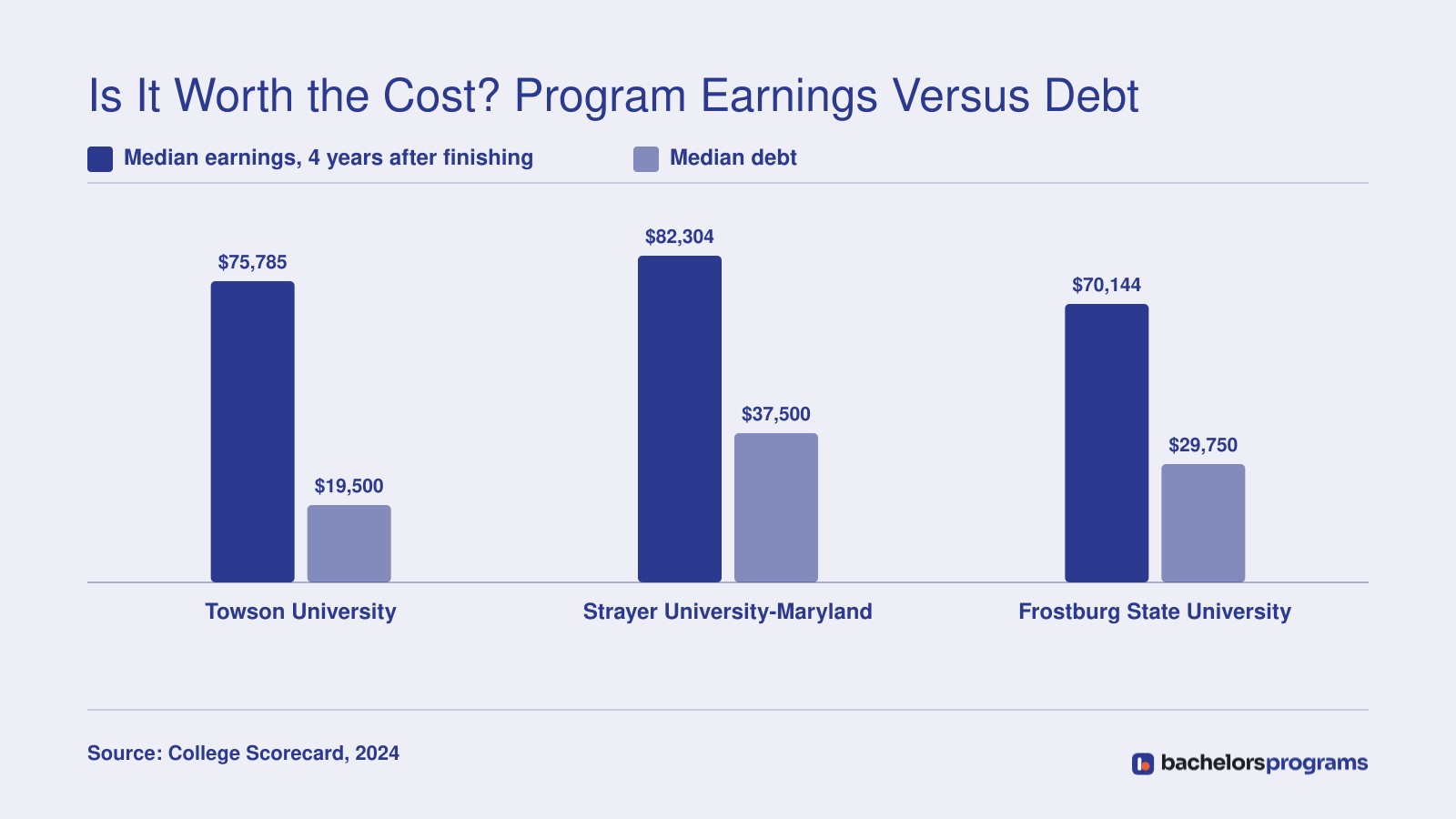
Highest Program-Level Earnings Among Ranked Maryland IT Programs
Towson University's IT graduates post the strongest earnings among the ranked programs.
Common Questions About Information Technology Degrees in Maryland
These answers cover the questions readers ask most about choosing a bachelor's degree in information technology in Maryland. Check each school's current program pages before you apply, since offerings and policies change.
What is the best college in Maryland for information technology?
Is Capitol Technology University accredited?
Are there accredited online IT degree programs in Maryland?
What is the difference between information technology and computer science degrees?
Compare Information Technology programs on the data that matters
Explore more Computers & IT majors or browse every field of study.
All Computers & IT programs Browse every field of study