Best Healthcare Administration Schools in Ohio
Compare 31 accredited Healthcare Administration programs in Ohio, with net price after aid, graduation rates, earnings and debt from IPEDS and the U.S. College Scorecard.

A bachelor's degree in healthcare administration is the typical entry-level credential for medical and health services managers, according to the Bureau of Labor Statistics. Ohio's hospital systems and long-term-care sector create steady demand for these managers. Ohio schools most often award the Bachelor of Science (B.S.) in Healthcare Administration, though titles such as healthcare management and health services administration also appear.
The ranking weighs net price, graduation rate, earnings and debt for campus and online programs alike. Residency drives cost more than anything else: University of Cincinnati charges about $13,363 a year in state versus $28,697 for nonresidents.
Hospital and clinic management roles carry no state license, but Ohio does license nursing home administrators.
Key Points
- University of Cincinnati tuition: about $13,363 in-state, $28,697 out of state.
- Ohio University's regional campuses post some of the lowest net prices.
- BLS names a bachelor's as typical entry-level education for health services managers.
Best Bachelor's Degree in Healthcare Administration Programs in Ohio: Our Top 10
Ohio's bachelor's programs in healthcare administration run from a three-year degree at a private health sciences college to online completion programs built for working allied health professionals. Every option below leads to a bachelor's credential employers recognize, whether the school awards a Bachelor of Science in Healthcare Administration or a closely named variant. The ten programs are listed in ranking order, with the details that matter most for comparing them.
University of Cincinnati
#1Cincinnati, OH · ~$26,000/yr (est.)
Best for: Allied health professionals with an associate degree
The University of Cincinnati is a large public research university whose healthcare leadership bachelor's is built as an online completion degree for people who already hold an associate degree in an allied health field. Students enter as juniors and finish 60 credits over five semesters, with starts available in any term. Program graduates reported median earnings of $77,549 four years after finishing, with median debt of $25,000. It is the strongest fit in this list for credentialed practitioners who want a manager-track credential without pausing their careers.
- Online completion program; students enroll as juniors
- 60 credit hours at UC after an associate degree
- Five semesters full time; part-time study available
- Starts in any semester on a rolling carousel
- Requires an allied health associate degree plus certification or licensure
- 2.0 GPA minimum to graduate
- Assigned program advisor and retention specialist
- Prepares for supervisory and managerial roles
Ohio University
#2Athens, OH · ~$22,000/yr (est.)
Best for: Campus learners aiming at hospital management
Ohio University is a public university in Athens whose health services administration bachelor's is taught on campus, with coursework shared alongside nursing and pre-physical therapy students. Internships at sites such as Cleveland Clinic and OhioHealth give students management experience before graduation, and the degree feeds into MHA, MBA and MPH pathways. In 2026 the university launched Health Workforce OHIO, connecting its health programs with more than 80 Ohio healthcare organizations, with an emphasis on rural and underserved counties. Program graduates reported median earnings of $61,538 four years after finishing, with median debt of $24,750.
- 16:1 student-to-faculty ratio
- Internships at sites such as Cleveland Clinic and OhioHealth
- Classes shared with nursing and pre-physical therapy students
- Pathway to an MHA, MBA or MPH
- Available at multiple Ohio campuses
- Student organization: Ohio University Society for Health Administration
- Prepares for managerial, non-clinical roles in healthcare
Kettering College
#3Kettering, OH · ~$22,000/yr (est.)
Best for: Students preparing for occupational therapy school
Kettering College is a small private nonprofit college in the Dayton area whose healthcare management bachelor's compresses 120 credits into three years of full-time study. Courses blend online and campus delivery, and the final year includes an internship at a healthcare organization. Students can add a pre-occupational therapy emphasis or use the degree as a bridge into a master's in healthcare administration. It suits students who want a fast, tightly sequenced path into a supervisory role.
- Three-year bachelor's; 120 credits taken full time
- Blended online and campus courses
- Final-year internship at a healthcare organization
- Pre-occupational therapy emphasis available
- Bridge to a master's in healthcare administration
- Financial aid available
Mercy College of Ohio
#4Toledo, OH · $18,000/yr (est. net price)
Mercy College of Ohio is a small Toledo college with a fully online bachelor's in healthcare administration that can be finished in as little as five semesters. The curriculum is entirely healthcare focused, covering leadership, policy and ethics, finance and operations, and students can apply prior professional experience toward the degree. Up to six graduate credits can count toward the college's Master of Health Administration, and a Healthcare Management Certificate is bundled at no extra cost. Program graduates reported median earnings of $66,015 four years after finishing.
- Five-semester bachelor's with three start dates a year
- Credit for prior professional experience
- Up to six graduate credits can count toward the MHA
- Healthcare Management Certificate at no extra cost
- Curriculum is entirely healthcare focused
- Small class sizes and faculty support
Sinclair Community College
#5Dayton, OH · $3,700 – $9,000/yr (est.)
Sinclair Community College in Dayton awards a Bachelor of Applied Science in Health Sciences, one of the few bachelor's degrees available at an Ohio community college. It is designed for people who already hold an associate degree in a healthcare field and offers three concentrations: leadership and management, education, and community and global health. Its net price after aid is the lowest in this ranking, and program graduates reported median debt of $12,000.
- 121 credit hours including a capstone or senior project
- Concentrations in leadership, education, and community health
- Requires an associate degree from a healthcare program
- Grade of C or better required in every course
- Plans to seek CAHIIM accreditation
- Designed as a pathway for associate degree holders
University of Toledo
#6Toledo, OH · $13,000 – $22,000/yr (est.)
The University of Toledo runs a four-year healthcare administration bachelor's that can be completed entirely online or face to face, and every student graduates with a minor in business. Roughly 90% of majors complete an internship at a hospital, insurer or other healthcare facility, and faculty bring industry experience to upper-level courses. Program graduates reported median earnings of $54,335 four years after finishing, with median debt of about $24,800.
- Graduate with a minor in business
- About 90% of majors complete an internship
- Can be completed fully online or in person
- Coursework in quality improvement, finance and leadership
- Faculty with healthcare industry experience
- Healthcare Administration Student Association on campus
Bowling Green State University
#7Bowling Green, OH · ~$24,000/yr (est.)
Bowling Green State University offers a health care administration bachelor's with an unusual depth of hands-on requirements: an internship, a capstone, and an optional long-term care specialization that includes a 1,000-hour administrator residency toward state licensure. Upper-level courses are taught by working professionals, and graduates are recruited by systems such as Cleveland Clinic and ProMedica. A combined bachelor's-to-master's option is available for students who want to continue. Program graduates reported median earnings of $61,483 four years after finishing.
- Long-term care specialization with a 1,000-hour residency
- Residency counts toward nursing home administrator licensure
- Internship plus a capstone project required
- Combined bachelor's-to-master's option
- Coursework in health policy, finance and quality assessment
- Upper-level courses taught by industry professionals
- Qualifies students for ACHE network membership
Baldwin Wallace University
#8Berea, OH · ~$28,000/yr (est.)
Baldwin Wallace University delivers its healthcare management bachelor's through the A2BW pathway with Cuyahoga Community College, a structure built for transfer students and working adults. The 124-credit degree accepts up to 62 transfer credits, guarantees junior status to Tri-C transfers, and requires two internships plus a minor or second major. Part-time study is available, and an assigned advisor maps out a graduation plan. Median earnings for program graduates reached $52,080 five years after finishing.
- Delivered through the A2BW pathway with Cuyahoga Community College
- 124 semester credits; full-time or part-time study
- Two internships in healthcare settings
- Up to 62 credits accepted in transfer
- Guaranteed junior status for Tri-C transfer students
- Requires a minor or a second major
- Assigned advisor helps map a graduation plan
Youngstown State University
#9Youngstown, OH · ~$13,000/yr (est.)
Youngstown State University houses its healthcare administration bachelor's in the Department of Social Work, Public Health and Administration, and the degree is aimed squarely at managing services rather than delivering them. Coursework spans healthcare management, marketing, human resources, finance, and medical law and ethics, with graduates moving into hospitals, clinics, nursing homes and physician offices. The same department also offers an associate degree in healthcare administration for students who want a shorter entry point.
- Coursework in healthcare management, marketing and finance
- Covers human resources, medical law and ethics
- Prepares for roles in hospitals, clinics and nursing homes
- Administrators oversee facilities, departments or practices
- Housed in the Department of Social Work, Public Health and Administration
Cleveland State University
#10Cleveland, OH · $15,000/yr (est. net price)
Cleveland State University's healthcare management bachelor's pairs a 27-credit business core with a 31-credit healthcare management core, so graduates leave with both management training and healthcare-specific knowledge. Students add a healthcare concentration, such as informatics, or a minor from any discipline in the university. Transfer students complete as little as half of the major at Cleveland State, which makes the degree practical for people arriving with credit already in hand.
- 27-credit business core plus a 31-credit healthcare management core
- Students add a healthcare concentration such as informatics
- Minimum of 120 credit hours
- Transfer students complete 50% of the major at CSU
- Minor available from any CSU discipline
- Covers finance, marketing, law and information systems
- Prepares for hospital administration or health consulting
Cost & outcomes by school
Federal data for the highest-earning Healthcare Administration programs, independent of the ranking above. Earnings are this field's bachelor's graduates four years after completing where the Scorecard reports them, else the school's undergraduate median.
| School | Net price / yr | Grad rate | Earnings | Debt | Grads/yr | Format |
|---|---|---|---|---|---|---|
| University of Cincinnati OH | $25,648 | 75% | $77,549 | $25,000 | 31 | Online |
| The Christ College of Nursing and Health Sciences OH | $18,378 | 56% | $68,303 | $24,250 | 12 | Online |
| Kettering College OH | $21,650 | 65% | $67,492 | $23,500 | 3 | Campus |
| Mercy College of Ohio OH | $17,989 | 56% | $66,015 | $25,000 | 21 | Online |
| Xavier University OH | $32,997 | 69% | $64,873 | $23,250 | 12 | Campus |
| Ohio University OH | $21,637 | 66% | $61,538 | $24,750 | 39 | Campus |
| Ohio University-Eastern Campus OH | $3,925 | 21% | $61,538 | $24,750 | — | Campus |
| Ohio University-Zanesville OH | $5,746 | 22% | $61,538 | $24,750 | — | Campus |
| Ohio University-Southern Campus OH | $5,993 | 21% | $61,538 | $24,750 | — | Campus |
| Ohio University-Chillicothe Campus OH | $5,755 | 14% | $61,538 | $24,750 | — | Campus |
| Ohio University-Lancaster Campus OH | $5,650 | 14% | $61,538 | $24,750 | 1 | Campus |
| Bowling Green State University OH | $24,022 | 64% | $61,483 | $25,498 | 19 | Campus |
Sources: U.S. Department of Education. Net price, graduation rate, earnings and debt: College Scorecard (earnings and debt for this field's bachelor's graduates where reported, else school-wide); graduates: IPEDS. A dash means no figure is reported.
Cost, debt & payoff
Median earnings of this field's bachelor's graduates (4 yrs after completing, else the school's undergraduate median) vs. their median federal loan debt · U.S. College Scorecard
Across these programs the median graduate earns about $56,350 and finishes with roughly $24,750 in debt — a ratio that clears a common rule of thumb (keep debt below first-year salary). Net price and debt vary widely school to school, so check the per-school figures in the table above before you shortlist.
Most Affordable Bachelor's Degrees in Healthcare Administration in Ohio
Average net price, what students pay after grants and scholarships, is the clearest cost measure, and the figures below come from 2024 IPEDS and College Scorecard data from the U.S. Department of Education. Ohio University's regional campuses in Saint Clairsville, Lancaster, Zanesville and Chillicothe all charge $6,362 in in-state tuition and fees for the Health Services Administration bachelor's, while net price ranges from $3,925 to $5,755 depending on the campus. Sinclair Community College in Dayton has the lowest in-state tuition and fees at $3,675, and its Health Sciences BAS is designed for students who already hold a healthcare associate degree.
| School | City | Program | In-State Tuition and Fees | Out-of-State Tuition and Fees | Average Net Price | Median Debt at Graduation |
|---|---|---|---|---|---|---|
| Ohio University-Eastern Campus | Saint Clairsville | Health Services Administration | $6,362 | $9,444 | $3,925 | $21,056 |
| Ohio University-Lancaster Campus | Lancaster | Health Services Administration | $6,362 | $9,444 | $5,650 | $21,056 |
| Ohio University-Zanesville | Zanesville | Health Services Administration | $6,362 | $9,444 | $5,746 | $21,056 |
| Ohio University-Chillicothe Campus | Chillicothe | Health Services Administration | $6,362 | $9,444 | $5,755 | $21,056 |
| Sinclair Community College | Dayton | Health Sciences, BAS (Leadership/Management) | $3,675 | $8,556 | $5,992 | $12,000 |
Online and Hybrid Bachelor's Options at Ohio Schools
Can you earn a bachelor's degree in healthcare administration in Ohio without ever going to campus? Yes. Ohio schools deliver the degree in three formats: fully online, hybrid, and campus-only, and a few build in a completion path for students who already hold an associate degree.
Fully Online
University of Cincinnati teaches its Bachelor of Technical and Applied Studies in Healthcare Leadership online, with rolling starts in any semester. Mercy College of Ohio offers a fully online option for its Bachelor of Science in Healthcare Administration and takes three start dates a year. University of Toledo lists its Healthcare Administration degree as available both ways and notes it can be completed 100% online.
Hybrid and Campus Formats
Kettering College blends online and campus courses in its BSHS in Healthcare Management, which can be finished in three years of full-time study. Ohio University, Bowling Green State University, Baldwin Wallace University, Youngstown State University, Cleveland State University and Sinclair Community College run campus-based programs, and Ohio University also teaches Health Services Administration at several of its regional campuses.
Degree-Completion and Transfer Paths
Cincinnati's program suits working adults who already hold an associate degree in an allied health field plus a current certification or license; students enroll as juniors. Sinclair's Bachelor of Applied Science requires an associate degree in healthcare for admission. Baldwin Wallace accepts up to 62 transfer credits and guarantees junior standing.
Confirm the Hands-On Requirement
Bowling Green's long-term care track includes a 1,000-hour administrator residency, and Toledo reports that about 90% of its students complete an internship. Ask admissions who finds the placement site and whether any of those hours must be in person. A few programs, including Franklin University's BS in Healthcare Administration, do not state a delivery format on the program page, so confirm online status before you apply.
Admission Requirements: GPA, Test Policy, and Transfer Credit
First-year and transfer applicants follow different admission paths at Ohio's healthcare administration programs, and the requirements on each path are not the same.
GPA and Test Policy
Program-specific minimum GPAs are uncommon. Ohio University publishes no healthcare-administration GPA floor for the bachelor's degree; its stated 2.0 cumulative standard applies to academic coursework from a regionally accredited institution.1 Ohio University also says transfer applicants who finished high school more than a year earlier do not need ACT or SAT scores unless Undergraduate Admissions requests them, and scores may be sent for math placement.1 It does not publish a first-year testing policy tied to this major, so confirm with undergraduate admissions before applying.
Several schools ranked here publish no program-level GPA or testing policy, which generally means the standard undergraduate rule governs.
Admission rates offer a rough read on selectivity. Baldwin Wallace (about 76 percent) and Kettering College (about 77 percent) admit the smallest shares of applicants, while Mercy College of Ohio, the University of Toledo, and Cleveland State University each admit roughly nine in ten.
Transfer Credit Rules
Ohio University accepts college-level courses graded D- or better from institutions meeting its accreditation requirements and publishes no maximum credit cap; applicants with fewer than 20 semester or 30 quarter transferable hours must also satisfy freshman admission requirements. Baldwin Wallace accepts up to 62 transfer credits. Cleveland State requires transfer students to complete half the major there. Sinclair Community College's Health Sciences bachelor's expects an associate degree in a healthcare field, with a C or better in required coursework.
The University of Northwestern Ohio, which appears in our wider directory, publishes no minimum GPA, testing, or transfer credit limit for Healthcare Administration; ask an admissions counselor directly.
Arriving With Credits Already
Ohio high schoolers can bank college credit through College Credit Plus before they ever apply. Our cost section explains how those credits affect tuition.
Related Articles
Cost of a Bachelor's Degree in Healthcare Administration in Ohio
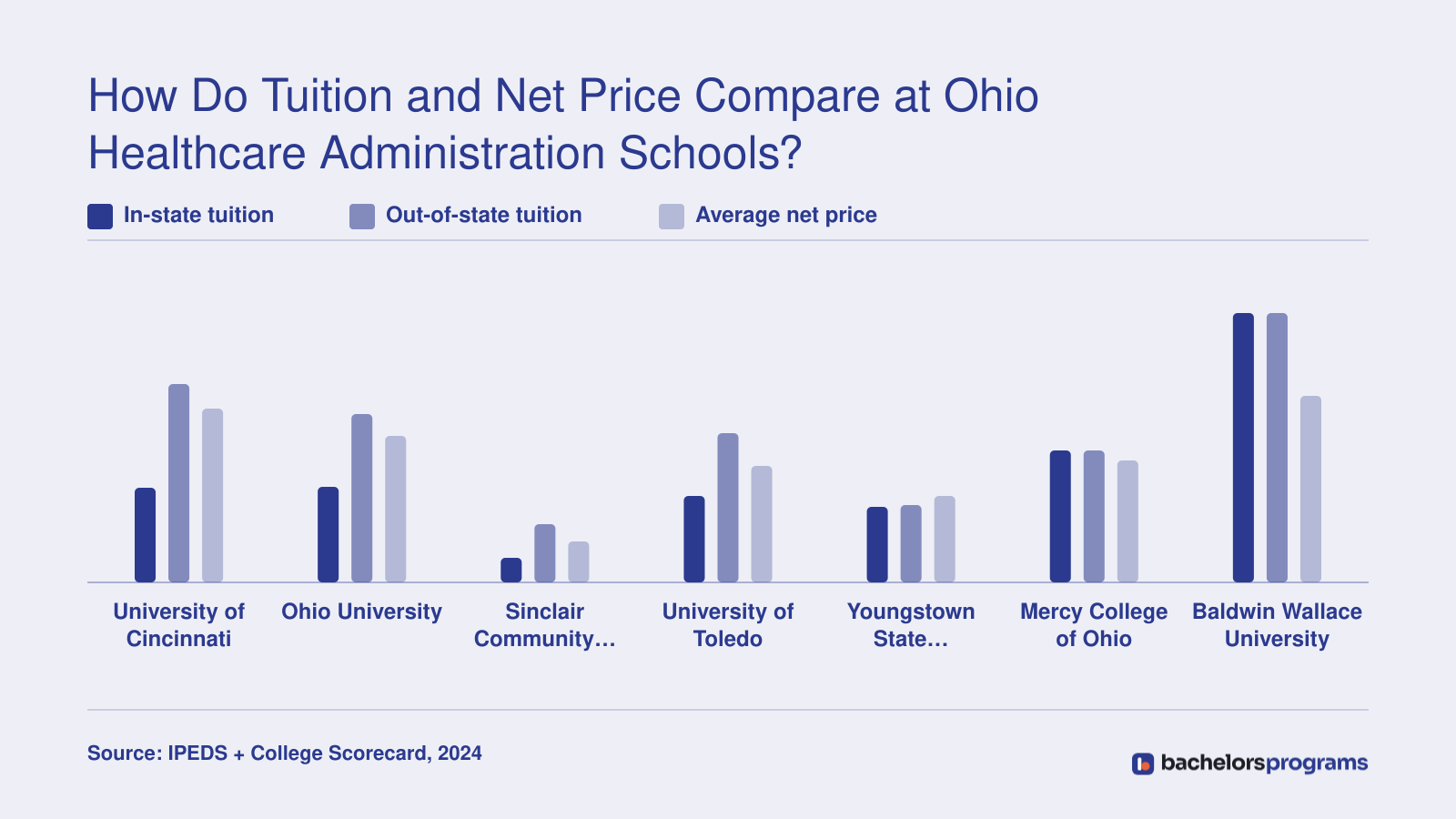
How much does a bachelor's degree in healthcare administration actually cost in Ohio? It depends on residency and sector. In-state tuition at the University of Cincinnati runs about $13,363 a year; out-of-state students pay about $28,697. Ohio University lists about $14,158 in-state and $24,838 out of state. Youngstown State University sits much lower, near $9,926 in-state and $10,286 out of state. Private schools often charge one rate to everyone: Mercy College of Ohio is about $19,345 and Kettering College about $16,320.
Net Price Is an Estimate
Net price is what families pay after grants and scholarships. The figures are approximate institution-wide averages, not a quote for this major or for you. Youngstown State's average is near $12,767, while University of Cincinnati's is closer to $25,648. Your own aid offer is the only number that counts.
Ohio Aid Programs
- Ohio College Opportunity Grant: Need-based aid applied to tuition and general fees at participating Ohio schools. Awards are capped by enrollment status per term, and a portion is refunded if you withdraw and receive a tuition refund. Check the state's calculator for current thresholds.1
- College Credit Plus: Dual enrollment for Ohio-resident students in grades 7 to 12, up to 120 credit hours.2 Eligible males must register with Selective Service within 30 days of turning 18.
- Ohio National Guard Scholarship Program: For service members. Recipients are excluded from the Second Chance Grant.4 Confirm current eligibility and amounts with the Guard and the Ohio Department of Higher Education.
- Tuition guarantees: Ohio law lets public universities lock in rates for an entering class.3 University of Cincinnati, Bowling Green State University, Youngstown State University, and Cleveland State University have approved guarantee directives. Ask each school how its guarantee works.
One Practical Tip
File the FAFSA early, since state grants can run out, and compare net price rather than sticker price.
How Do Tuition and Net Price Compare at Ohio Healthcare Administration Schools?
Sticker tuition tells only part of the story. At Ohio's public universities, out-of-state students pay far more than residents. Average net price can run higher than in-state tuition because it counts housing, books, and other costs after grants. At private schools such as Mercy College of Ohio and Baldwin Wallace University, residents and nonresidents pay the same rate, and aid brings the net price below the listed tuition. Net price is a sector-conditional average: public figures reflect in-state students who receive aid, and private figures reflect all aided students.
Healthcare Administration Careers in Ohio: Jobs, Employers, and Outlook
Healthcare administration is the business side of medicine: the staff who manage budgets, schedules, billing, records, and teams so clinicians can focus on patients. The Bureau of Labor Statistics lists a bachelor's degree as the typical entry-level education for medical and health services managers.1
Entry and Early-Career Roles
- Practice manager: Runs daily operations at a physician group or specialty office.
- Clinic administrator: Oversees staffing, scheduling, and budgets at an outpatient site.
- Patient services manager: Leads registration, patient access, and patient experience teams.
- Health information roles: Coordinates medical records, coding workflows, and data privacy.
- Long-term-care roles: Supports operations in nursing and residential care facilities.
Job Outlook
BLS projects employment of medical and health services managers to grow 24% from 2025 to 2035, much faster than average, rising from about 640,400 to 795,500 jobs nationally.1 That works out to roughly 62,300 openings a year.1 For regional detail, the Ohio Department of Job and Family Services publishes occupational projections, annual openings, and wages through its Ohio Job Outlook materials.
Where Graduates Work
Nationally, hospitals employ 28% of these managers, followed by physicians' offices (13%), nursing and residential care facilities (9%), outpatient care centers (7%), and government (7%).1 In Ohio, the places to look are health systems, community hospitals, physician groups, and long-term-care operators.
Plan for Experience
Many director and department-head jobs expect several years of work history on top of a bachelor's degree. Internships and coordinator-level roles during or right after school build the track record those promotions require.
What Ohio Healthcare Managers Earn
A bachelor's degree in healthcare administration is a common starting point for management roles in hospitals, clinics and other healthcare organizations.
Questions to Ask Yourself
Do you want to run a nursing home someday, or manage in hospitals and clinics?
Do you need an online or evening format, or can you attend campus daily?
Will you pay in-state tuition, and does the net price still fit after aid?
Are you transferring credits, and does the school accept them?
Compare Healthcare Administration programs on the data that matters
Explore more Business & Management majors or browse every field of study.
All Business & Management programs Browse every field of study