Best Information Technology Schools in Ohio
Compare 20 accredited Information Technology programs in Ohio, with net price after aid, graduation rates, earnings and debt from IPEDS and the U.S. College Scorecard.

Annual in-state tuition for an Ohio IT bachelor's runs from $7,491 at Miami University's regional campuses to $66,608 at Case Western Reserve, and the cheaper route does not automatically pay less. Median earnings two years after graduation run from roughly $55,600 to nearly $101,000 across the schools on this list. Most award the Bachelor of Science in Information Technology, a systems, networking, and security credential rather than a computer science theory degree.
Kent State and the Miami regional campuses deliver the degree fully online for working technicians. Hiring managers in Cincinnati, Columbus, and Dayton still weight paid co-op experience and security certifications heavily.
Key Points
- University of Cincinnati ranks first, with a 20-month paid co-op.
- Kent State, Franklin and Miami University-Hamilton offer fully online IT bachelor's routes.
- In-state tuition and fees start at $7,491 at Miami University-Middletown.
Best Information Technology Schools in Ohio: Our Top 10
The University of Cincinnati tops this list: its ABET-accredited Bachelor of Science in Information Technology combines four concentration options with a 20-month paid co-op that consistently places students with Fortune 500 companies and startups. Every school below awards a bachelor's degree in information technology, and the range runs from a large research university with a national co-op program to regional campuses that teach the same coursework fully online.
University of Cincinnati
#1Cincinnati, OH · ~$26,000/yr (est.)
Best for: Co-op seekers wanting paid tech experience
The University of Cincinnati runs one of the largest cooperative education programs in the country, and its information technology degree is built around it, with a 20-month paid co-op at Fortune 500 companies and startups. The B.S. in Information Technology is ABET accredited and offers four concentrations, and students choose between the Cincinnati campus and a fully online track. An accelerated option awards a bachelor's and a master's in five years, and the university reports 98% job placement. Institution-wide, about 75% of students graduate.
- ABET-accredited B.S. in Information Technology
- Four concentrations, including game development and data technologies
- Students choose the Cincinnati campus or a fully online track
- 20-month paid co-op, about $45,000 across co-op semesters
- Accelerated bachelor's and master's in five years
- University reports 98% job placement
- Early IT pathway gives high school students automatic admission to eligible IT majors
Kent State University
#2Kent, OH · ~$21,000/yr (est.)
Best for: Working adults who need a fully online option
Kent State delivers its 120-credit Bachelor of Science in Information Technology entirely online through the university's regional campuses, which makes it one of the most flexible four-year IT degrees in the state for working students. Eight 24-credit concentrations let students specialize in areas such as cybersecurity and forensics, cloud and virtualization, or health information technology. A capstone is required, and first-year admission at the regional campuses is open to anyone with a high school diploma or its equivalent. About 64% of students graduate institution-wide.
- 120-credit B.S.I.T. delivered fully online via regional campuses
- Eight 24-credit concentrations to choose from
- Options include cybersecurity and forensics, cloud and virtualization, health IT
- Capstone course required for graduation
- 2.000 major and overall GPA required
- Coursework covers relational databases, networking and generative AI ethics
Case Western Reserve University
#3Cleveland, OH · ~$41,000/yr (est.)
Best for: Business-minded students pairing IT with management
Case Western Reserve houses its business information technology major inside the Weatherhead School of Management, so the degree pairs programming, systems analysis and database management with economics, accounting, statistics and leadership courses. It suits students who want to work between IT and management rather than specialize in infrastructure alone. Admission is competitive. The university's overall graduation rate is about 87%.
- Business information technology major at Weatherhead School of Management
- Coursework in programming for business applications, systems analysis and design
- Required economics, accounting, statistics and leadership courses
- Operations research and supply chain management coursework
- Prepares for IT, programming, systems analytics and database roles
Bowling Green State University
#4Bowling Green, OH · ~$24,000/yr (est.)
Bowling Green State University offers its information technology coursework through the Bachelor of Technical and Applied Studies at the Firelands campus, a completion degree aimed at students who already hold an associate degree. The Information Technology Support concentration runs 100% online, though some BTAS professional courses must be taken in person. Coursework covers programming, operating systems, virtualization, databases, networking, security and forensics, and graduates move into roles such as IT manager, network administrator and IT project manager. The university's overall graduation rate is about 64%.
- Information Technology Support concentration in the B.T.A.S.
- Associate degree required for entrance
- Concentration offered 100% online; some BTAS courses meet in person
- Coursework in programming, operating systems, databases, networking, security
- Full-time and part-time enrollment
- Prepares for IT manager and network administrator roles
University of Toledo
#5Toledo, OH · $13,000 – $22,000/yr (est.)
The University of Toledo awards its Bachelor of Science in Information Technology jointly through the College of Engineering and the College of Business and Innovation, so technical courses sit alongside management coursework. Five pillars (programming, networking, human computer interaction, databases and web systems) are rounded out with information assurance and security. Technical and professional electives give students room to shape their own focus toward operations, infrastructure or business systems. About 57% of students graduate institution-wide.
- Joint degree from the Engineering and Business colleges
- Five pillars: programming, networking, HCI, databases, web systems
- Includes information assurance and security coursework
- Technical and professional electives shape the focus
- Emphasizes user advocacy and system administration
Youngstown State University
#6Youngstown, OH · ~$13,000/yr (est.)
Youngstown State awards a Bachelor of Science in Applied Science in Information Technology of 120 to 126 semester hours, with a required minor and five concentration choices including database engineering, networking and security. Core courses include Cisco Networking Academy sequences and information assurance, and students complete at least nine hours of upper-division IT or CSIS electives. The degree also lays groundwork for graduate study in computing. The university's overall graduation rate is about 50%.
- 120 to 126 semester hours, including a 12-hour minor
- Concentrations: database engineering, networking, security, multimedia/web, software development
- Cisco Networking Academy sequences in the core
- At least 9 hours of upper-division IT or CSIS electives
- Foundation for graduate study in computing
Wright State University
#7Dayton, OH · ~$15,000/yr (est.)
Wright State offers a Bachelor of Science in Information Technology and Cybersecurity through its engineering and computer science college, and the university's partnership with the Ohio Supercomputer Center gives students access to large-scale computing resources. The degree sits alongside computer science, computer engineering and engineering technology programs, so students can combine interests across departments. About 42% of students graduate institution-wide.
- B.S. in Information Technology and Cybersecurity
- Offered by the College of Engineering and Computer Science
- Access to the Ohio Supercomputer Center for large-scale computing
Bluffton University
#8Bluffton, OH · $20,000/yr (est. net price)
Bluffton University's information technology major is a compact 47-credit program covering programming, database systems, network technologies and information security, with two required technology practicum courses. Students can earn up to 12 credits through an internship or practicum, and many pair the major with a graphic design or business administration minor. It is a small private-campus option for students who want tight faculty contact and a liberal arts base. About 53% of students graduate institution-wide.
- 47-credit information technology major
- Two technology practicum courses required
- Up to 12 credits for an internship or practicum
- Coursework in network technologies, information security and database systems
- Often paired with a graphic design or business minor
- Includes a course on technology, ethics and society
Miami University-Middletown
#9Middletown, OH · $11,000/yr (est. net price)
Miami University's Middletown regional campus offers the Bachelor of Science in Information Technology online or in person, with focus areas in Agile and software development. Two Agile courses carry ICAgile certification and the cybersecurity course prepares students for CompTIA Security+, so graduates leave with industry credentials as well as a degree. Eligible students can join the NSF S-STEM Scholars program, which awards up to $5,000 a year. About 32% of students at this campus graduate.
- B.S. in Information Technology, online or at regional campuses
- Focus areas in Agile or software development
- CIT 205 and CIT 225 carry ICAgile certification
- CIT 258 prepares students for CompTIA Security+
- NSF S-STEM scholarships up to $5,000 per year
- Coursework in Dev/Ops, global cybersecurity and information management
Miami University-Hamilton
#10Hamilton, OH · $7,000 – $19,000/yr (est.)
The Hamilton campus of Miami University Regionals teaches the Bachelor of Science in Information Technology both online and in person, with Agile and software development focus areas. Coursework includes Agile Launchpad I, Fundamentals of Dev/Ops and Introduction to Global Cybersecurity, tied to ICAgile certification and CompTIA Security+ preparation. NSF S-STEM scholarships of up to $5,000 a year are available to eligible students. About 25% of students at this campus graduate.
- Online or in person at the Hamilton regional campus
- Agile Launchpad I and Fundamentals of Dev/Ops focus area
- Agile courses map to ICAgile certification
- Introduction to Global Cybersecurity prepares for CompTIA Security+
- Required courses in information management and retrieval
- NSF S-STEM Scholars awards up to $5,000 a year
Cost & outcomes by school
Federal data for the highest-earning Information Technology programs, independent of the ranking above. Earnings are this field's bachelor's graduates four years after completing where the Scorecard reports them, else the school's undergraduate median.
| School | Net price / yr | Grad rate | Earnings | Debt | Grads/yr | Format |
|---|---|---|---|---|---|---|
| University of Cincinnati OH | $25,648 | 75% | $100,975 | $22,400 | 278 | Online or campus |
| Miami University OH | $28,384 | 80% | $94,001 | $25,000 | — | Online or campus |
| Miami University-Middletown OH | $10,809 | 32% | $94,001 | $25,000 | 2 | Online or campus |
| Miami University-Hamilton OH | $11,286 | 25% | $94,001 | $25,000 | 29 | Online or campus |
| Wright State University OH | $15,415 | 42% | $92,006 | $25,000 | 71 | Campus |
| Case Western Reserve University OH | $41,190 | 87% | $87,989 | $24,000 | 14 | Campus |
| University of Toledo OH | $17,249 | 57% | $80,501 | $29,909 | 29 | Campus |
| Franklin University OH | $25,243 | 11% | $77,175 | $28,927 | 71 | Online |
| Kent State University OH | $20,787 | 64% | $76,515 | $25,000 | 1 | Online |
| Bowling Green State University OH | $24,022 | 64% | $70,493 | $31,000 | 13 | Hybrid |
| Walsh University OH | $20,493 | 59% | $59,764 | $27,000 | — | Online or campus |
| Youngstown State University OH | $12,767 | 51% | $55,648 | $28,500 | 28 | Campus |
Sources: U.S. Department of Education. Net price, graduation rate, earnings and debt: College Scorecard (earnings and debt for this field's bachelor's graduates where reported, else school-wide); graduates: IPEDS. A dash means no figure is reported.
Cost, debt & payoff
Median earnings of this field's bachelor's graduates (4 yrs after completing, else the school's undergraduate median) vs. their median federal loan debt · U.S. College Scorecard
Across these programs the median graduate earns about $65,129 and finishes with roughly $25,000 in debt — a ratio that clears a common rule of thumb (keep debt below first-year salary). Net price and debt vary widely school to school, so check the per-school figures in the table above before you shortlist.
How We Ranked Ohio Bachelor's Degree in Information Technology Programs
Every program in this ranking is a bachelor's degree in information technology or a closely named equivalent, offered on campus, online or both at an Ohio school.
What We Compared
Four signals shaped the order: what graduates earn after finishing, what the degree costs after aid, how many students complete, and whether the school holds institutional accreditation. Cost reflects net price after federal, state and institutional aid, the figure most families actually pay. Delivery format decided how we grouped schools rather than how we scored them, so a strong online option can sit beside a campus program.
Where the Numbers Stop
Two caveats apply to every school on this list. Graduation rates and net price describe the whole institution, not the IT department alone, so a school with a modest overall rate may still run a demanding technology program. Earnings are measured over a fixed window after graduation rather than across a career, so they describe one cohort's experience instead of a promise about yours. Read the rankings as a starting point for your own comparison, not a verdict.
Figures come from the College Scorecard, in the release current for 2026, and from IPEDS.
Cheapest Bachelor's in IT Programs in Ohio
These Ohio bachelor's programs in information technology are sorted by average annual net price, based on 2024 IPEDS and College Scorecard data from the U.S. Department of Education. Wilberforce University, an HBCU in our directory, has the lowest net price at $5,567 a year, and Miami University-Middletown is the most affordable of the ranked schools at $10,809. Net price counts tuition, housing, books and other costs minus grants and scholarships, so it can run higher than a school's published tuition and fees.
| School | City | Format | Avg. Annual Net Price | In-State Tuition and Fees | Out-of-State Tuition and Fees | Median Graduate Debt |
|---|---|---|---|---|---|---|
| Wilberforce University | Wilberforce | Online | $5,567 | $16,448 | $16,448 | $26,468 |
| Miami University-Middletown | Middletown | Campus and online | $10,809 | $7,491 | $19,407 | $23,000 |
| Kent State University at Stark | North Canton | Online | $10,897 | $7,492 | $17,342 | $24,500 |
| Miami University-Hamilton | Hamilton | Campus and online | $11,286 | $7,491 | $19,407 | $23,000 |
| Youngstown State University | Youngstown | Campus | $12,767 | $11,113 | $11,473 | $24,000 |
Related Articles
Online and Hybrid Bachelor's in IT Options at Ohio Schools
Yes, you can earn a bachelor's degree in information technology online from an Ohio school. Kent State University, Franklin University, the University of Cincinnati and Miami University-Hamilton all offer a fully online route.
How the Schools Sort by Format
- Fully online: Kent State's B.S.I.T. is delivered completely online through its regional campuses, and Franklin University offers its IT bachelor's 100% online.
- Online and on-campus: The University of Cincinnati, Miami University-Hamilton and Miami University-Middletown list both formats. Cincinnati and Miami-Hamilton each advertise a fully online option.
- Blended: Bowling Green State University's IT Support program runs in a blended format, with one concentration offered 100% online. It requires an associate degree for entrance.
- Campus-only: Case Western Reserve University, the University of Toledo, Youngstown State University, Wright State University and Bluffton University are listed as campus programs.
These labels come from program pages, so confirm the delivery details with each school's admissions office before you apply.
Cost, Credits and Requirements
Online per-credit rates are not available for every school here, so ask each one for its current figure. Compare it against the in-state campus rate, because the two often differ. For reference, annual in-state tuition and fees run about $13,976 at Cincinnati, $13,232 at Kent State and $7,491 at the two Miami regional campuses.
Kent State's online program lists a 2.0 GPA minimum, and regional campus admission requires a high school diploma. For transfer credit, BGSU's associate degree requirement shows how much the rules vary. Ask every school how many credits it accepts and whether online courses require proctored exams or campus visits, since those policies are set school by school.
Questions to Ask Yourself
Do you need to be near Columbus, Cleveland or Cincinnati for internships?
Will your community college or College Credit Plus credits transfer?
Is the online per-credit rate lower than the in-state campus rate?
How much of the coursework requires scheduled, live attendance?
Admissions Requirements for an Ohio Bachelor's Degree in Information Technology
Admission standards at Ohio IT programs range from near-open enrollment at regional campuses to a selective private university. Always confirm current terms on each school's undergraduate admissions page before you apply.
GPA and Test Policy
Kent State University is the clearest case. Its B.S.I.T. lists a 2.0 GPA minimum, and its regional campus admission, which serves the fully online option, asks for a high school diploma. For the other schools here, we found no published minimum GPA or firm SAT/ACT policy, and we have not guessed at one. Check those pages directly, and ask admissions whether a test-optional route exists.
The federal College Scorecard admission rate gives a rough sense of selectivity, not a cutoff:
- Most accessible: Wright State University (about 96%), University of Toledo (about 92%), Kent State University (about 86%), University of Cincinnati (about 85%), and Youngstown State University (about 84%).
- Moderately selective: Bowling Green State University (about 81%) and Bluffton University (about 67%).
- Most selective: Case Western Reserve University (about 37%), whose Business Information Technology major sits inside the business school.
Miami University-Middletown and Miami University-Hamilton report no admission rate in the Scorecard data.
Transfer Students
Bowling Green State University's Information Technology Support degree, offered at its Firelands campus, requires an associate degree for entrance. That makes it a natural fit for transfer students who already hold a two-year credential. Specific transfer-credit caps and minimum course grades were not published for the schools here. Request an unofficial credit evaluation before you commit, and send official transcripts from every college you attended.
Takeaways
- Kent State is the only school here with a published 2.0 GPA floor in our data.
- Wright State and Toledo have the highest admission rates, so they are the lower-risk applications.
- Case Western is the competitive outlier, so apply with a stronger academic record.
- Associate degree holders should look first at Bowling Green's Firelands program.
- Where no GPA or test policy is published, email admissions before applying.
Cost of an IT Bachelor's Degree in Ohio
For an Ohio IT degree, the cost that matters is the gap between the sticker price and what you pay after grants. Published in-state tuition and fees at these schools run from $7,491 at Miami University-Middletown and Miami University-Hamilton to $37,362 at Bluffton University. Average net price after aid spans $5,567 at Wilberforce University to $20,079 at Ohio Dominican University.
Tuition vs. Net Price
Private colleges discount heavily. Bluffton's net price drops to $19,943, and Ohio Dominican's lands near half its $35,720 list price. Public universities start cheaper but discount less. Youngstown State University lists $11,113 in tuition and fees, and the University of Toledo's net price is $17,249.
Net price also counts housing, books and living costs, so it can exceed tuition. It is an average for students who receive aid. Public schools calculate it for in-state students and private schools for all students, so your own bill may differ.
Borrowing
Median graduate debt, measured across each whole institution rather than for IT alone, ranges from $21,500 at Herzing University-Akron to $27,000 at Bluffton.
Ohio Aid Programs
- Ohio College Opportunity Grant (OCOG): For 2026-27, Ohio residents pursuing a first bachelor's degree at an eligible school can qualify with a Student Aid Index of $3,750 or less and household income up to $96,0001. The Ohio Department of Higher Education's award table sets maximums of $4,000 at public universities, $5,000 at private nonprofits, $2,000 at private for-profits and $492 at regional campuses. Awards can come in below these caps. Part-time students generally receive 75, 50 or 25 percent of the full amount, depending on course load1. Eligibility ends after 10 semesters or 15 quarters, and you must maintain satisfactory academic progress.
- College Credit Plus: Ohio high school students can earn high school and college credit at the same time. Courses at public colleges are free2. Families at private schools or homeschooling must apply for funding between February 1 and April 1 at 5 p.m.
File the FAFSA early. OCOG eligibility depends on your Student Aid Index, and most college aid offers start from the same form.
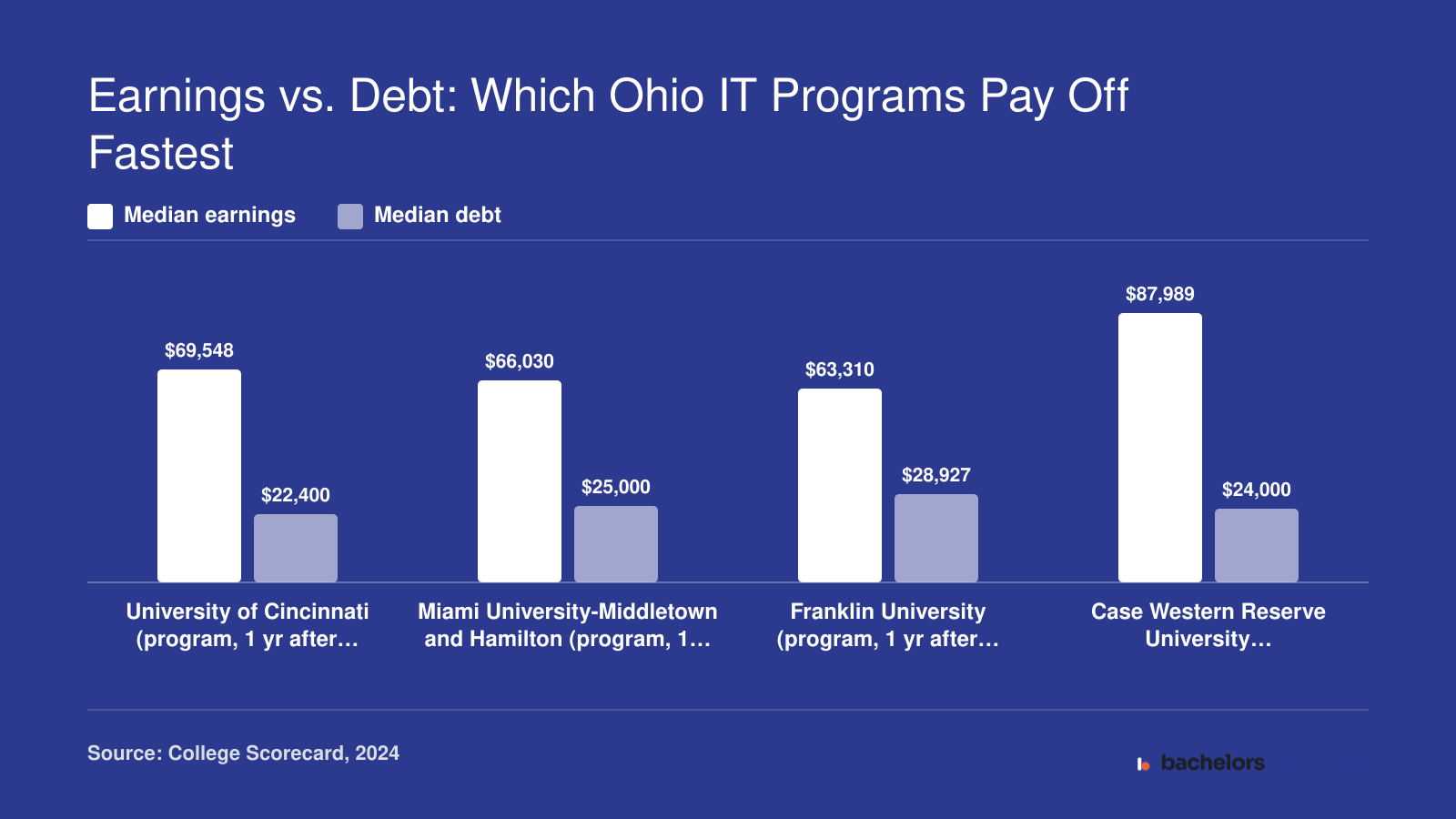
Earnings vs. Debt: Which Ohio IT Programs Pay Off Fastest
The chart puts each school's median graduate earnings beside its median debt. Each label shows the earnings time window and whether the figure covers the IT bachelor's program alone or the whole institution. The main takeaway: University of Cincinnati IT graduates earn about $69,548 in their first year after graduating, roughly three times their $22,400 median debt, which makes it the fastest payoff among the ranked programs with program-level data. Miami's Middletown and Hamilton campuses share one set of program figures. Franklin University, in our directory, posts lower first-year pay against higher debt.
IT Careers and Salaries in Ohio for Bachelor's Graduates
A national median tells you what IT pays somewhere; Ohio metro data tells you what it pays where you plan to live. The two are rarely identical. Start with the national benchmarks, then replace them with local figures before you commit to a program or a city.
Start With the National Benchmarks
As of May 2025, the median annual wage for computer and IT occupations was $109,470, about double the $50,980 median across all occupations.1 The Bureau of Labor Statistics projects faster-than-average growth for the field from 2025 to 2035, with roughly 280,000 openings a year from growth and replacement combined.1 Role by role, the national medians look like this:
- Information security analysts: $129,180, with a bachelor's degree typical for entry.1
- Software developers: $135,980, with 10% projected growth.4
- Computer network architects: $134,050.1
- Computer systems analysts: $105,850, with 8% projected growth.3
- Network and computer systems administrators: $99,130, though this occupation is projected to shrink 4%.2
- Computer programmers: $100,390, projected to shrink 7%.5
- Computer support specialists: $62,890.6
Then Pull the Ohio Numbers Yourself
These figures move every year, so verify them directly rather than trusting any summary, including this one. On BLS.gov, open the OEWS metro tables for Columbus, Cleveland, and Cincinnati to see what employers in those metros actually pay. Use O*NET for day-to-day tasks and trend notes on each occupation.
Cincinnati offers a useful directional signal: in May 2025 the computer and mathematical group averaged $57.73 per hour there, against $50.67 nationally, and made up 3.4% of local employment versus 2.9% nationally.7 That group is broader than any single job title and the figure is a mean, so treat it as evidence of concentrated demand, not a salary forecast. For hiring volume, check OhioMeansJobs, Ohio Department of Job and Family Services labor market information, and current postings from employers with large Ohio operations such as Nationwide, Cardinal Health, and JPMorgan Chase.
Ask the Programs and Associations
Program pages at schools such as the University of Cincinnati, Kent State University, and Franklin University should spell out internship pipelines, employer partners, and where recent graduates landed. Ask which certifications the curriculum prepares you for, and whether CompTIA, Cisco, or AWS exam vouchers are included or discounted. Certifications complement a bachelor's degree rather than replace it, and the right one depends on your target role. CompTIA, Cisco, AWS, and ISACA publish salary surveys and certification requirements, while Ohio technology councils run the networking events where hiring managers show up.
Common Questions About IT Degrees in Ohio
What is the best school for information technology in Ohio?
How much does a bachelor's degree in information technology cost in Ohio?
Can I earn an information technology degree online from an Ohio school?
Are there accredited information technology colleges in Ohio?
Do I need a license to work in IT in Ohio?
Compare Information Technology programs on the data that matters
Explore more Computers & IT majors or browse every field of study.
All Computers & IT programs Browse every field of study