Best Marketing Schools in Minnesota
Compare 43 accredited Marketing programs in Minnesota at 31 colleges, with net price after aid, graduation rates, earnings and debt from IPEDS and the U.S. College Scorecard.

Marketing graduates of the University of Minnesota-Twin Cities earn a median $59,609 one year after finishing. Saint Mary's University of Minnesota lists $45,080 in tuition and fees but averages $11,704 after aid. Those two numbers frame the decision: in Minnesota, the Bachelor of Science (B.S.) in Marketing is the common credential.
Programs run from campuses in Minneapolis, Duluth and Winona to fully online study at Rasmussen University-Minnesota, all at the bachelor's level. Admissions rules, net price and career outcomes vary by school.
Accreditation separates them too. Winona State University and Minnesota State University-Mankato hold AACSB accreditation, the most widely recognized business-school credential.
Key Points
- Saint Mary's University of Minnesota averages $11,704 net price despite $45,080 sticker.
- University of Minnesota-Twin Cities charges $17,214 in-state versus $38,362 out-of-state.
- Transfer GPA thresholds are usually published; freshman cutoffs rarely are.
Top 10 Best Bachelor's in Marketing Programs in Minnesota
Minnesota's marketing programs range from a Big Ten business school in Minneapolis to small private campuses in Winona and Duluth, plus fully online options you can complete from anywhere in the state. The ten schools below all award a bachelor's degree in marketing or a business degree with a marketing major, and each entry notes what the school does well and who it tends to suit.
University of Minnesota-Twin Cities
#1Minneapolis, MN · ~$17,000/yr (est.)
Best for: Metro students seeking big-university resources
The state's flagship campus houses marketing inside the Carlson School of Business, where the B.S.B. marketing major sits alongside research and advertising coursework. Big-university resources meet seminar-sized marketing classes, and the Minneapolis location puts students in a dense market of agencies and corporate headquarters. Students can add a marketing minor or pair the major with a second business field.
- Marketing major and minor both available within the B.S.B.
- Coursework covers marketing research, advertising, and channel distribution
- Prepares students for marketing research, advertising, and sales roles
- Taught at the Carlson School on the Minneapolis campus
Saint Mary's University of Minnesota
#2Winona, MN · $12,000/yr (est. net price)
Best for: Private-college seekers wanting small classes
A Lasallian Catholic university in Winona, Saint Mary's keeps marketing classes small and deliberately blends behavioral and quantitative coursework. The 60-credit major builds on accounting, economics, finance, business law, and management before moving into marketing specialties. It suits students who want a private residential campus and steady faculty contact.
- 60-credit major blending behavioral and quantitative marketing
- Core in accounting, economics, finance, business law, and management
- Upper-level courses in consumer behavior, professional selling, and sales management
- Also covers advertising and promotions, marketing research, and social media analytics
- Math options include calculus or finite mathematics
- Strategic management course ties the major together
University of St Thomas
#3Saint Paul, MN · ~$29,000/yr (est.)
Best for: Project-based learners drawn to local clients
St. Thomas runs one of the larger marketing programs in the Twin Cities, awarding a Bachelor of Science in Business Administration with a marketing management major. Students work on campaigns for local companies, can spend a January term in Argentina, and join the Tommie Marketing Club. Small classes and an assigned faculty advisor are part of the appeal.
- Awarded as a Bachelor of Science in Business Administration
- Capstone teams solve real problems for Small Business Institute clients
- Courses pair students with local companies on campaigns and sports marketing
- January term study abroad in Argentina
- Tommie Marketing Club for networking
- GHR Fellows receive full tuition
University of Minnesota-Duluth
#4Duluth, MN · $15,000 – $20,000/yr (est.)
At UMD's Labovitz School of Business and Economics, marketing is the largest major, and much of the coursework runs on live projects for real companies. Paid internships are common before graduation, and the program reports strong placement for recent classes. Duluth adds lake access and a residential campus to a business school that advertises premier, globally recognized accreditation.
- Largest major at the Labovitz School of Business and Economics
- Live projects for real companies built into coursework
- Paid internships are common before graduation
- Coursework includes digital marketing, international marketing, green and sports marketing
- Student marketing clubs and professional networking events
- Reports 99% placement in its 2024-25 graduate follow-up
Rasmussen University-Minnesota
#5St. Cloud, MN · ~$18,000/yr (est.)
Rasmussen's Minnesota-based marketing bachelor's runs fully online, which makes it the most flexible option on this list. Students pick a digital marketing or sales management concentration and can move through 90 credits in as few as 18 months. Transfer estimates come back in one business day, and military and employer tuition benefits are accepted.
- Fully online bachelor's with a digital marketing concentration
- Coursework covers SEO, social media, digital advertising, and creative content
- 90 total credit hours across 23 courses
- Finish in as few as 18 months
- $149 self-directed assessments let you skip material you already know
- Prepares students for AMA PCM certification and CAPM or PMP exams
- Accelerated MBA pathway at no extra tuition
- Second concentration option, in sales management
- Full-time and part-time enrollment available
- Courses cover market research, public relations, and product management
- Military benefits and employer tuition reimbursement accepted
- Transfer credit estimate returned in one business day
The College of Saint Scholastica
#6Duluth, MN · $28,000/yr (est. net price)
On its Duluth campus, St. Scholastica offers marketing as a concentration inside the Business Management BA rather than a stand-alone major. That structure gives students a broad business base with focused marketing courses, taught in small classes. Transfer students get counselor help mapping a personal path to a four-year degree, and scholarships are awarded every year.
- Marketing concentration inside the Business Management BA
- One of five concentration options in the major
- Small classes with attentive faculty
- Scholarships awarded every year
- Transfer credits accepted with counselor help
- Duluth main campus with historic buildings and modern facilities
Winona State University
#7Winona, MN · ~$18,000/yr (est.)
Winona State's marketing major sits in an AACSB-accredited college of business and requires a 120-hour internship before graduation. Students take on real client projects and can compete on a national sales team through the Strauss Center for Sales Excellence. Three start dates a year make the program easy to enter, and the school reports 94 percent of marketing students finding work in their field.
- AACSB-accredited College of Business
- 120 total credit hours
- Required 120-hour internship before graduation
- Real client projects, including work for Allstate and the U.S. Army
- Strauss Center for Sales Excellence and a nationally competing sales team
- Three start dates: fall, spring, and summer
- Study abroad earns degree credit
University of Northwestern-St Paul
#8Saint Paul, MN · ~$28,000/yr (est.)
A Christian liberal arts university in St. Paul, Northwestern pairs a B.S. in Marketing with an internship requirement that applies across the business school. Students add a concentration in analytics, communication, graphic design, or media production, and guest speakers tie coursework to the Twin Cities business scene. Small classes and an American Marketing Association student chapter round out the experience.
- 126 total credit hours on campus
- Concentrations in analytics, communication, graphic design, or media production
- Internship required of all business students
- Guest speakers from local corporations
- American Marketing Association student chapter
- Housed in the Stoltz School of Business
University of Minnesota-Crookston
#9Crookston, MN · ~$12,000/yr (est.)
Crookston offers the Minnesota marketing bachelor's in two formats: on campus in northwestern Minnesota and fully online with asynchronous classes. The ACBSP-accredited program leans on applied projects, analytics software, and an optional internship. On-campus students are issued laptops, and the DECA chapter has been named top 10 internationally.
- Offered on campus and fully online with asynchronous classes
- ACBSP-accredited program
- Coursework in advertising, personal selling, consumer behavior, and marketing research
- Also covers digital and social media, international marketing, and strategic planning
- Internship option for hands-on work experience
- Statistical software and business analytics used in class
- DECA chapter named top 10 internationally
Minnesota State University-Mankato
#10Mankato, MN · $10,000 – $19,000/yr (est.)
Minnesota State Mankato places marketing inside an AACSB-accredited college of business, with a B.S. that stresses consumer behavior, professional selling, and research. The Marketing Club is open to all majors, and the college's internship team helps students land placements while they study. In-state tuition here is among the lowest of the public universities ranked above.
- AACSB-accredited College of Business
- Coursework in consumer behavior, professional selling, marketing research, and strategy
- Marketing Club open to all majors
- Company tours and guest speaker events
- Internship team helps students land placements
- Graduates move into retail management, sales, advertising sales, and market analysis
Cost & outcomes by school
Federal data for the highest-earning Marketing programs, independent of the ranking above. Earnings are this field's bachelor's graduates four years after completing where the Scorecard reports them, else the school's undergraduate median.
| School | Net price / yr | Grad rate | Earnings | Debt | Grads/yr | Format |
|---|---|---|---|---|---|---|
| University of Minnesota-Twin Cities MN | $16,778 | 85% | $86,246 | $22,136 | 205 | Campus |
| Capella University MN | $17,956 | 20% | $80,588 | $37,999 | 11 | Online |
| University of St Thomas MN | $29,155 | 76% | $77,870 | $26,481 | 127 | Campus |
| Saint Johns University MN | $25,672 | 75% | $76,786 | $27,000 | — | Campus |
| Saint Mary's University of Minnesota MN | $11,704 | 66% | $76,285 | $15,332 | 10 | Campus |
| Concordia University-Saint Paul MN | $18,462 | 46% | $76,183 | $17,694 | 19 | Online |
| Saint Cloud State University MN | $13,529 | 40% | $74,847 | $20,000 | 36 | Campus |
| University of Minnesota-Duluth MN | $18,743 | 65% | $74,079 | $24,250 | 99 | Campus |
| Winona State University MN | $17,503 | 57% | $70,203 | $24,269 | 21 | Campus |
| Minnesota State University-Mankato MN | $19,139 | 54% | $68,772 | $21,500 | 130 | Campus |
| Augsburg University MN | $23,873 | 52% | $68,757 | $25,000 | 38 | Campus |
| Metropolitan State University MN | $16,863 | 44% | $67,031 | $16,625 | 37 | Online |
Sources: U.S. Department of Education. Net price, graduation rate, earnings and debt: College Scorecard (earnings and debt for this field's bachelor's graduates where reported, else school-wide); graduates: IPEDS. A dash means no figure is reported.
Cost, debt & payoff
Median earnings of this field's bachelor's graduates (4 yrs after completing, else the school's undergraduate median) vs. their median federal loan debt · U.S. College Scorecard
Across these programs the median graduate earns about $63,260 and finishes with roughly $21,500 in debt — a ratio that clears a common rule of thumb (keep debt below first-year salary). Net price and debt vary widely school to school, so check the per-school figures in the table above before you shortlist.
Most Affordable Bachelor's in Marketing Programs in Minnesota
Saint Mary's University of Minnesota in Winona has the lowest average net price among the marketing programs below. A typical student there pays $11,704 a year after grants and scholarships, even though listed tuition and fees are $45,080. Net price is an institution-wide average from 2024 U.S. Department of Education data (IPEDS and College Scorecard), so your own cost will depend on family income, aid eligibility and living arrangements. Private schools like Saint Mary's tend to pair high sticker prices with large aid packages, while public universities such as University of Minnesota-Crookston, Saint Cloud State University and Southwest Minnesota State University start from much lower tuition.
| School | City | Sector | Program | Listed Tuition and Fees | Average Net Price After Aid | Graduation Rate | Median Earnings 1 Year After Graduation (Marketing) |
|---|---|---|---|---|---|---|---|
| Saint Mary's University of Minnesota | Winona | Private nonprofit | Marketing Major, B.A. | $45,080 | $11,704 | 66% | $55,158 |
| University of Minnesota-Crookston | Crookston | Public | Marketing - Major | $13,288 | $12,212 | 50% | $44,555 |
| Saint Cloud State University | Saint Cloud | Public | Marketing Bachelor of Science | $10,245 | $13,529 | 40% | $47,453 |
| Southwest Minnesota State University | Marshall | Public | Marketing, BS | $10,361 | $15,291 | 45% | $48,939 |
Online and Hybrid Bachelor's in Marketing Options at Minnesota Schools
Flexibility and campus experience pull in different directions, and few Minnesota marketing programs let you choose the flexible side. Yes, you can earn a bachelor's degree in marketing online from a Minnesota school. The clearest options are the University of Minnesota-Crookston and Rasmussen University-Minnesota.
Fully Online
- University of Minnesota-Crookston: The Bachelor of Science in Marketing is offered fully online.1 It is asynchronous, with no required campus attendance, and the degree runs 120 credits.2
- Rasmussen University-Minnesota: Its Marketing bachelor's, with a Digital Marketing concentration, has a fully online option and full-time and part-time pacing. It is a 90-credit program built to finish in about 18 months.
Campus-Based
The University of Minnesota-Twin Cities, Saint Mary's University of Minnesota, University of St Thomas, The College of Saint Scholastica, Winona State University, University of Northwestern-St Paul and Minnesota State University-Mankato list campus programs. University of Minnesota-Duluth confirms a bachelor's-level marketing program, but its delivery format isn't established here, so check with the school before assuming a hybrid or online route.3
What to Compare Before You Enroll
Crookston's online rate is $483.70 per credit, quoted before fees. A $250 campus fee applies each semester at 0.5 or more credits. For 2026-2027, tuition and fees run $13,096 at full time (12 or more credits) and $7,290 at half time (6 to 8 credits).2 I could not confirm a separate campus marketing rate there, so ask whether online students pay a different amount.
Also ask each school about start dates, which vary by program, and whether the online diploma and curriculum match the on-campus version. Rasmussen's pacing and credit count differ from Crookston's, so compare transfer credit and total time to degree, not just price.
Questions to Ask Yourself
Can you commit to Twin Cities internships and in-person networking, or do you need to keep working while you study?
Does the online version of your program charge the same tuition as its campus version?
Do you want a campus recruiting pipeline to Minnesota employers, or is portfolio-building on your own enough?
Admission Requirements for a Bachelor's Degree in Marketing at Minnesota Schools
First-year and transfer admission work differently at Minnesota schools, and the published rules are far clearer for transfers. Freshman GPA cutoffs are rarely stated, while transfer thresholds usually are.
GPA and Test Policies
University of St. Thomas lists no freshman GPA cutoff.1 It weighs your GPA, class rank where one exists, and college-prep coursework, and it is test-optional, so SAT or ACT scores are your choice to submit.1 St. Cloud State does not require SAT or ACT scores.2 For the University of Minnesota-Twin Cities, I found no freshman GPA expectation or test policy published for the Carlson marketing major. Minnesota State University Moorhead publishes no GPA or test policy for its marketing emphasis either. Minnesota State University-Mankato describes marketing admission as competitive, and it publishes no test policy for the major.
Transfer Credit Rules
- St. Thomas: Only grades of C- or higher from regionally accredited institutions are recognized. You need a 2.00 at St. Thomas and must complete 32 of your last 36 credits there.3
- Mankato: A 2.5 cumulative GPA, including transfer work, plus a C or better in CIS 101, MATH 130, ACCT 200, BUS 295 and ECON 201. You must finish at least half the major coursework and 30 upper-division business credits on campus.
- St. Cloud State: Transfers with 12 or more credits need a 2.0. Up to 90 of the 122 required credits can transfer.2
- Metropolitan State: The business marketing pathway accepts a 60-credit associate degree with grades of C- or higher, and you finish the last 60 credits there.4
Transfer-Friendly Routes
If you are starting at a community college, the Minnesota Transfer Curriculum (MnTC) helps, but it is not a blanket guarantee. St. Thomas guarantees admission to applicants who hold an associate degree with the MnTC, a 3.0 cumulative college GPA and at least a 1.7 in every course.5 St. Cloud State's Marketing Transfer Pathway for Minnesota State college students is stronger: it guarantees junior status and counts all 60 pathway credits toward the bachelor's degree, after which you complete 60 credits on campus.6
Business School Entry
Some schools add a second gate. St. Cloud State's upper-division business program asks for a 2.5 GPA and 40 earned credits.6 Mankato's prerequisite list works as a similar checkpoint. Check each school's business-college page before you count on a marketing seat.
Related Articles
Cost of a Bachelor's Degree in Marketing in Minnesota
What does a bachelor's degree in marketing in Minnesota actually cost once financial aid is applied?
Sticker Price vs. Net Price
Published in-state tuition is only a starting number. Average net price subtracts grant and scholarship aid from tuition, fees, housing, food and books, so the two figures measure different things. At Winona State University, in-state tuition is about $10,576, while average net price for students receiving aid is roughly $17,503, because living costs are folded in. Saint Mary's University of Minnesota runs the other direction: published tuition of $45,080, average net price of about $11,704, since institutional aid is substantial there. Compare net prices, not stickers, when you build a shortlist.
Minnesota Grant and Scholarship Programs
The Minnesota State Grant is need-based and open to Minnesota residents enrolled in eligible Minnesota programs. It counts tuition and fees plus a living allowance set at 106% of the federal poverty guideline when calculating need, so file the FAFSA or the Minnesota alternative application.
North Star Promise covers tuition and mandatory fees at Minnesota public colleges and universities for residents whose family adjusted gross income is below $80,000. It is last-dollar, applied after other gift aid, and it does not pay housing, food, books or transportation.1 The 2026-27 application deadline is June 1, 2026, and you need at least one credit per term.2 Pell-eligible students may also receive North Star Promise Plus, worth 15% of the calculated Pell award.3
Tuition Reciprocity for Neighboring States
Residents of Wisconsin and North Dakota can attend participating Minnesota public institutions at reduced reciprocity tuition instead of full nonresident rates.4 There is no reciprocity agreement with South Dakota.
One Way to Lower the Bill
Run each school's net price calculator before you apply, and ask how credits earned at a Minnesota community college would transfer. A lower-cost start can trim the total.
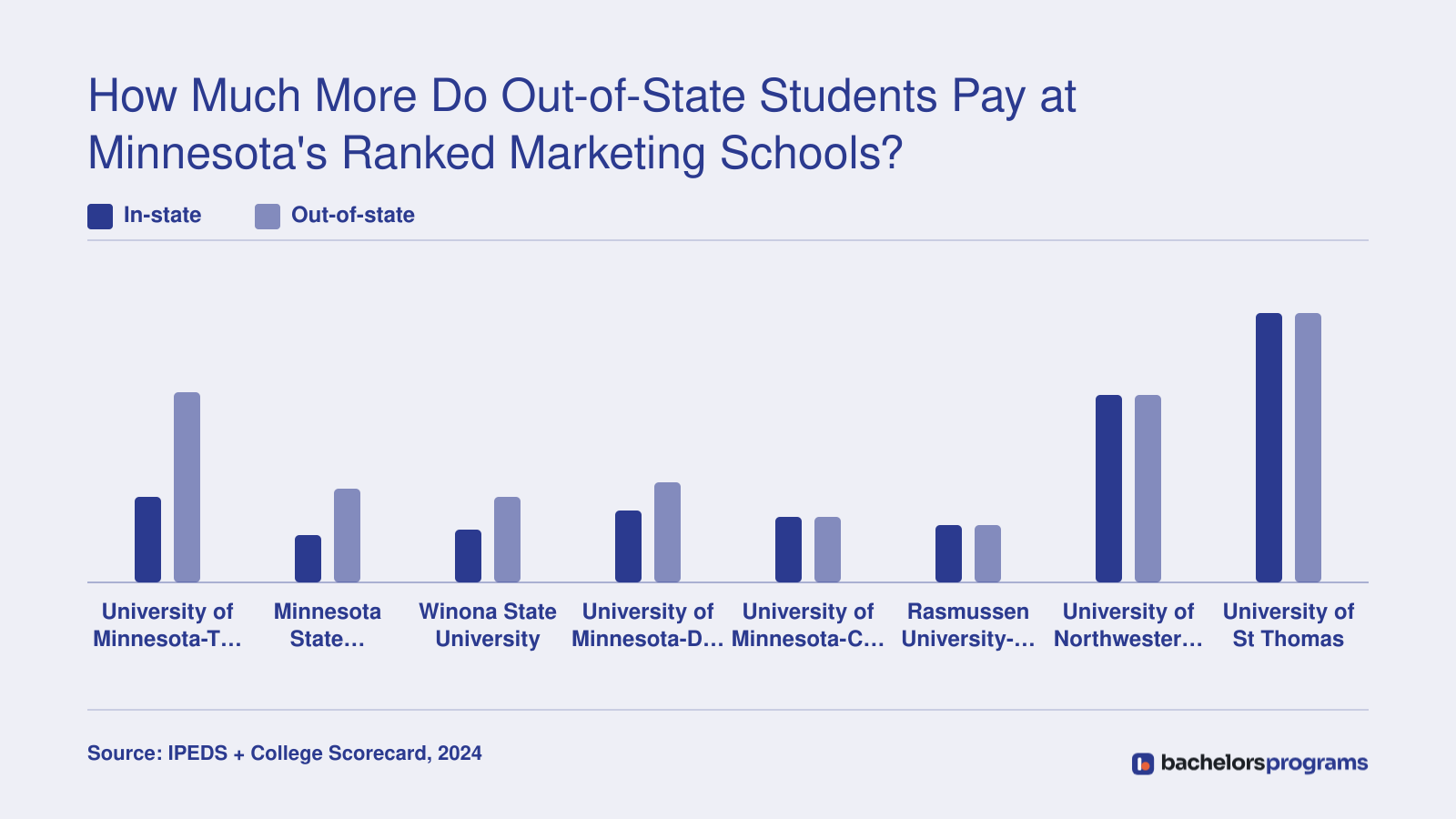
How Much More Do Out-of-State Students Pay at Minnesota's Ranked Marketing Schools?
Residency matters most at Minnesota's public universities. The University of Minnesota-Twin Cities has the widest gap, charging $17,214 in-state against $38,362 out-of-state, while Minnesota State University-Mankato posts the lowest in-state figure at $9,572 and nearly doubles it for nonresidents. The University of Minnesota-Duluth has the smallest gap among publics that charge two rates, $5,520. The University of Minnesota-Crookston and private schools such as the University of St Thomas and Rasmussen University-Minnesota charge one published rate regardless of where you live.
Questions to Ask Yourself
Are you planning an MBA or other graduate study later?
Do the Minnesota employers you are targeting recruit from specific business schools?
Would a lower-cost ACBSP- or IACBE-accredited program meet your needs just as well?
Common Questions About Marketing Schools in Minnesota
These answers draw on the figures and school details covered earlier on this page. Tuition and earnings numbers are published program figures, not guarantees of what any one student will pay or earn.
What is the best college for marketing in Minnesota?
What is the cheapest marketing degree in Minnesota?
Can you get a bachelor's degree in marketing online in Minnesota?
How much do marketing graduates earn in Minnesota?
Is the University of Minnesota good for marketing?
Compare Marketing programs on the data that matters
Explore more Business & Management majors or browse every field of study.
All Business & Management programs Browse every field of study