Best Marketing Schools in Oregon
Compare 34 accredited Marketing programs in Oregon at 15 colleges, with net price after aid, graduation rates, earnings and debt from IPEDS and the U.S. College Scorecard.

The first decision a marketing student in Oregon makes is whether to study on campus or online. A bachelor's degree in marketing can be earned in person in Portland, Eugene, Corvallis, McMinnville and other towns, or online from an Oregon-based school such as Oregon State University through Ecampus.
The common credential is the Bachelor of Science (B.S.) in Marketing, though some schools award a BBA or a B.A. instead, and others fold marketing into a business administration major as a concentration. Digital marketing is also a standalone degree at Bushnell University and Warner Pacific University.
That variety makes the program label matter less than the curriculum, the accreditation and the local employer connections behind it. In a state where Portland's brand, apparel and tech employers hire most of the graduates, internships often count as much as the diploma.
Key Points
- Portland State University's average net price after aid is $9,552 per year.
- Marketing graduates here earned medians of $63,267 to $69,182 five years out.
- Oregon State and Eastern Oregon offer fully online marketing bachelor's degrees.
Best Bachelor's in Marketing Programs in Oregon: Our Top 10 Ranked
Oregon's marketing schools range from large public business colleges with national recruiting pipelines to small private campuses built around live client projects. Every entry below is a bachelor's degree in marketing or the school's equivalent bachelor's credential, and the list covers bachelor's programs only. The rankings are our own and independent, and each card notes the delivery format, the approximate net price after aid, and the institution-wide graduation rate.
Oregon State University
#1Corvallis, OR · $15,000 – $20,000/yr (est.)
Best for: Students wanting sales-track marketing coursework
Oregon State University runs its B.S. in Marketing from Corvallis and through Ecampus, so students can finish the degree without relocating. The major requires 34 credits, and students shape it with tracks such as consumer insights, professional sales, or sports marketing. The College of Business puts student consultants on live client research through its Center for Marketing and Consumer Insights, and more than 450 companies recruit students each year. Average net price after aid is about $19,600, and the institution-wide graduation rate is near 70 percent.
- 34 credits in the major
- Tracks in consumer insights, fashion and retail marketing, professional sales, sports marketing
- Available in Corvallis and fully online through Ecampus
- AACSB-accredited business college
- 84% of classes enroll fewer than 50 students
- Student consultants work on client research, campaigns, and brand projects
- FoodGuys Values Scholarship and Marketing Department Scholarship
- Study abroad option in Sydney, Australia
University of Oregon
#2Eugene, OR · ~$22,000/yr (est.)
Best for: Sports and entertainment marketing hopefuls
The University of Oregon houses marketing as a concentration inside the business administration major at the Lundquist College of Business, and students can earn either a BS or a BA. Upper-division work runs through eleven core courses plus seven electives, with marketing coursework in consumer insight, brand building, strategy, and digital tactics. The Oregon Accelerator, a student-run sports marketing and communications agency, gives students live campaign work with Oregon athletes and brands. Average net price after aid is roughly $22,200, and the institution-wide graduation rate is about 72 percent.
- BS or BA with a marketing concentration
- Eleven upper-division core courses plus seven electives
- Tracks: Marketing Analytics, Consumer Behavior
- Capstone required
- One elective must come from outside the marketing department
- Digital marketing and international marketing electives
- Clubs include the American Marketing Association and the Warsaw Sports Business Club
- Oregon Accelerator student agency works on live sports marketing
University of Portland
#3Portland, OR · $28,000/yr (est. net price)
Best for: Portland campus students wanting internship coaching
The University of Portland awards a BBA in Marketing through an AACSB-accredited business school, pairing core accounting and economics with consumer behavior, marketing research, digital marketing, and international marketing. A Professional Preparation Program adds one-on-one coaching and a professional internship component, and electives can tilt toward sports marketing, sustainability, entrepreneurship, or design. Alumni work at Nike, Intel, and Billboard, which reflects the Portland network students plug into. Average net price after aid is about $28,200, and the institution-wide graduation rate is close to 80 percent.
- AACSB-accredited business school
- Five concentration options
- Professional Preparation Program with one-on-one coaching
- Professional internship component built into the degree
- Electives in sports marketing, sustainability, entrepreneurship, and design
- Global Acumen Initiative and ethics-centered Holy Cross tradition
- Alumni employers include Nike, Intel, and Billboard
Portland State University
#4Portland, OR · ~$10,000/yr (est.)
Portland State University offers a BA or BS in Marketing inside a business school with dual AACSB accreditation and working ties to Portland employers such as Nike, Adidas, and Intel. The 180-credit degree covers consumer behavior, marketing research, retailing, digital and social media, sales, advertising management, and strategy, plus an embedded AI in Business microcredential. Students can work at FIR Northwest, the student-run ad agency, and the school posts more than 800 internships and jobs each year. Average net price after aid is about $9,600, the lowest on this list, and the institution-wide graduation rate is roughly 53 percent.
- BA or BS in Marketing, 180 total credits
- Dual AACSB accreditation
- AI in Business Microcredential embedded in the degree
- Student-run ad agency FIR Northwest
- Center for Retail Leadership ventures
- 800+ internships and jobs posted each year
- Industry partners include Nike, Adidas, and Intel
- Some online course options when available
Linfield University
#5McMinnville, OR · $25,000 – $30,000/yr (est.)
Linfield University delivers its marketing bachelor's through Online and Continuing Education, which suits working adults who need to keep a job while finishing the degree. The curriculum covers market research, promotions management, sales strategy, and international marketing, and students can add tracks in international marketing, sales and sales management, or promotions management. Small classes and automatic scholarship consideration round out the offer. Average net price after aid is about $26,500, and the institution-wide graduation rate is around 70 percent.
- Fully online through Online and Continuing Education
- Tracks: International Marketing, Sales and Sales Management, Promotions Management
- Coursework in market research, promotions management, and sales strategy
- Internships, field trips, and study abroad
- Small classes with faculty mentorship
- Automatic scholarship consideration
Oregon Institute of Technology
#6Klamath Falls, OR · $15,000 – $20,000/yr (est.)
Oregon Tech builds its B.S. in Marketing on a technical foundation, with core coursework in accounting, finance, economics, business law, and globalization layered under marketing strategy. Students choose a Market Research, Marketing Design, or customized concentration, take on projects with local businesses, and finish a year-long capstone presented at the Oregon Tech Project Symposium. The business program holds IACBE accreditation. Average net price after aid is about $15,700, and the institution-wide graduation rate is roughly 54 percent.
- IACBE-accredited business program
- Tracks: Market Research, Marketing Design, Customized Program
- Year-long senior capstone presented at the Oregon Tech Project Symposium
- Junior-year internship encouraged
- Hands-on projects with local business partners
- Core in accounting, finance, economics, business law, and ethics
- Employers include Google, Intel, Boeing, and IBM
Warner Pacific University
#7Portland, OR · $25,000 – $30,000/yr (est.)
Warner Pacific University's B.S. in Digital Marketing runs 42 major credits inside a 120-credit degree on the Portland campus, with coursework in SEO, email and social campaigns, customer relationship management, and analytics. An internship places students alongside working digital marketers, and industry partners such as Anvil Media and Gravitate support networking. It is a small, Christ-centered program with rolling admissions. Average net price after aid is about $25,600, and the institution-wide graduation rate is around 49 percent.
- 42 major credits inside a 120-credit degree
- Coursework in SEO, social campaigns, CRM, and analytics
- Internship with working digital marketing professionals
- Industry partners include Anvil Media and Gravitate
- Rolling admissions
- Christ-centered, purpose-driven business program
- Sample four-year and two-year degree plans
Bushnell University
#8Eugene, OR · ~$21,000/yr (est.)
Bushnell University's digital marketing degree is built around client work: students complete three to five real campaigns before graduating and finish with a capstone managing a nonprofit's marketing from strategy through analysis. Internship and project partners have included Holt International, Harvest House Publishers, Circle Media, Columbia Bank, and the Boys & Girls Club. The business school holds IACBE accreditation, and an accelerated pathway lets students pair the bachelor's with a master's in five years. Average net price after aid is about $20,800, and the institution-wide graduation rate is roughly 56 percent.
- IACBE-accredited business school
- Three to five real client campaigns before graduation
- Capstone manages a nonprofit's campaigns start to finish
- Instructors who work in digital marketing, some with Google and YouTube backgrounds
- Internship partners include Holt International and Harvest House Publishers
- Accelerated pathway to a paired master's in five years
- Graduate with a portfolio of measurable campaign results
Eastern Oregon University
#9La Grande, OR · $15,000 – $20,000/yr (est.)
Eastern Oregon University offers its marketing bachelor's fully online, with four start dates a year and the same professors who teach on campus. The 180-credit program, offered as a BA or BS, covers digital marketing, social media strategy, personal selling, data analytics, and integrated communications, and students build an ePortfolio for employers. Up to 135 transfer credits can be applied, which makes it a practical finish line for transfer students. Average net price after aid is about $17,100, and the institution-wide graduation rate is around 43 percent.
- Fully online, no campus visits required
- 180 total credits, about four years
- Four start dates per year
- Up to 135 transfer credits accepted
- Build an ePortfolio for employers
- Employer tuition reimbursement supported
- Same professors as on-campus students
- Additional $14.50 per credit business fee
Western Oregon University
#10Monmouth, OR · ~$17,000/yr (est.)
Western Oregon University's B.S. in Marketing blends creative work with analytics: social media strategy, data analysis, consumer behavior, brand management, market research, advertising, and sales. Students can add tracks in personal selling, marketing research, or advertising and promotion, and the division publishes a sample four-year plan so the path stays clear. Recruiters include Wieden-Kennedy and CMD Agency, and employers of graduates include Adidas, Intel, and Microsoft. Average net price after aid is about $17,200, and the institution-wide graduation rate is roughly 47 percent.
- Business B.S. with a marketing concentration
- Tracks: Personal Selling, Marketing Research, Advertising & Promotion
- Skills in social media strategy, data analytics, and consumer behavior
- Sample four-year degree plan published
- Recruiters include Wieden-Kennedy and CMD Agency
- Employers of graduates include Adidas, Intel, Microsoft, and Starbucks
Cost & outcomes by school
Federal data for the highest-earning Marketing programs, independent of the ranking above. Earnings are this field's bachelor's graduates four years after completing where the Scorecard reports them, else the school's undergraduate median.
| School | Net price / yr | Grad rate | Earnings | Debt | Grads/yr | Format |
|---|---|---|---|---|---|---|
| Oregon State University OR | $19,604 | 70% | $73,205 | $19,250 | 125 | Hybrid |
| University of Portland OR | $28,210 | 80% | $72,891 | $22,696 | 46 | Campus |
| Oregon Institute of Technology OR | $15,706 | 54% | $72,273 | $22,500 | 2 | Campus |
| George Fox University OR | $31,679 | 72% | $67,364 | $21,000 | — | Campus |
| Linfield University OR | $26,536 | 71% | $66,731 | $27,000 | 11 | Online |
| Portland State University OR | $9,552 | 53% | $61,499 | $18,000 | 155 | Hybrid |
| University of Oregon OR | $22,182 | 72% | $61,324 | $20,139 | — | Campus |
| Pacific University OR | $35,273 | 67% | $60,583 | $23,223 | — | Campus |
| Warner Pacific University Professional and Graduate Studies OR | — | — | $55,204 | $25,000 | — | Campus |
| Warner Pacific University OR | $25,629 | 49% | $55,204 | $25,000 | 1 | Campus |
| Bushnell University OR | $20,789 | 56% | $53,623 | $23,500 | 6 | Campus |
| Western Oregon University OR | $17,237 | 47% | $51,815 | $20,609 | — | Campus |
Sources: U.S. Department of Education. Net price, graduation rate, earnings and debt: College Scorecard (earnings and debt for this field's bachelor's graduates where reported, else school-wide); graduates: IPEDS. A dash means no figure is reported.
Cost, debt & payoff
Median earnings of this field's bachelor's graduates (4 yrs after completing, else the school's undergraduate median) vs. their median federal loan debt · U.S. College Scorecard
Across these programs the median graduate earns about $57,894 and finishes with roughly $22,500 in debt — a ratio that clears a common rule of thumb (keep debt below first-year salary). Net price and debt vary widely school to school, so check the per-school figures in the table above before you shortlist.
Most Affordable Marketing Bachelor's Programs in Oregon
For Oregon residents, Portland State University offers the lowest-cost marketing bachelor's degree in this table, with an average net price after aid of $9,552 per year against in-state tuition and fees of $11,679. Eastern Oregon University has the lowest in-state tuition at $11,076, but its average net price after aid is higher, so compare both figures when budgeting. Net price is an institution-wide average for all undergraduates (IPEDS and College Scorecard, 2024 data), not a quote for any one student, so your cost will depend on your aid package, housing and enrollment status.
| School | City | Program | Format | In-State Tuition and Fees (per year) | Average Net Price After Aid (per year) |
|---|---|---|---|---|---|
| Portland State University | Portland | Marketing | Hybrid | $11,679 | $9,552 |
| Oregon Institute of Technology | Klamath Falls | Marketing | Campus | $13,260 | $15,706 |
| Southern Oregon University | Ashland | Business Administration, BA/BS (Marketing Concentration) | Campus | $12,762 | $16,732 |
| Eastern Oregon University | La Grande | Marketing | Online | $11,076 | $17,148 |
| Western Oregon University | Monmouth | Marketing (Business B.S.) | Campus | $11,879 | $17,237 |
Highest-Earning Marketing Bachelor's Programs in Oregon
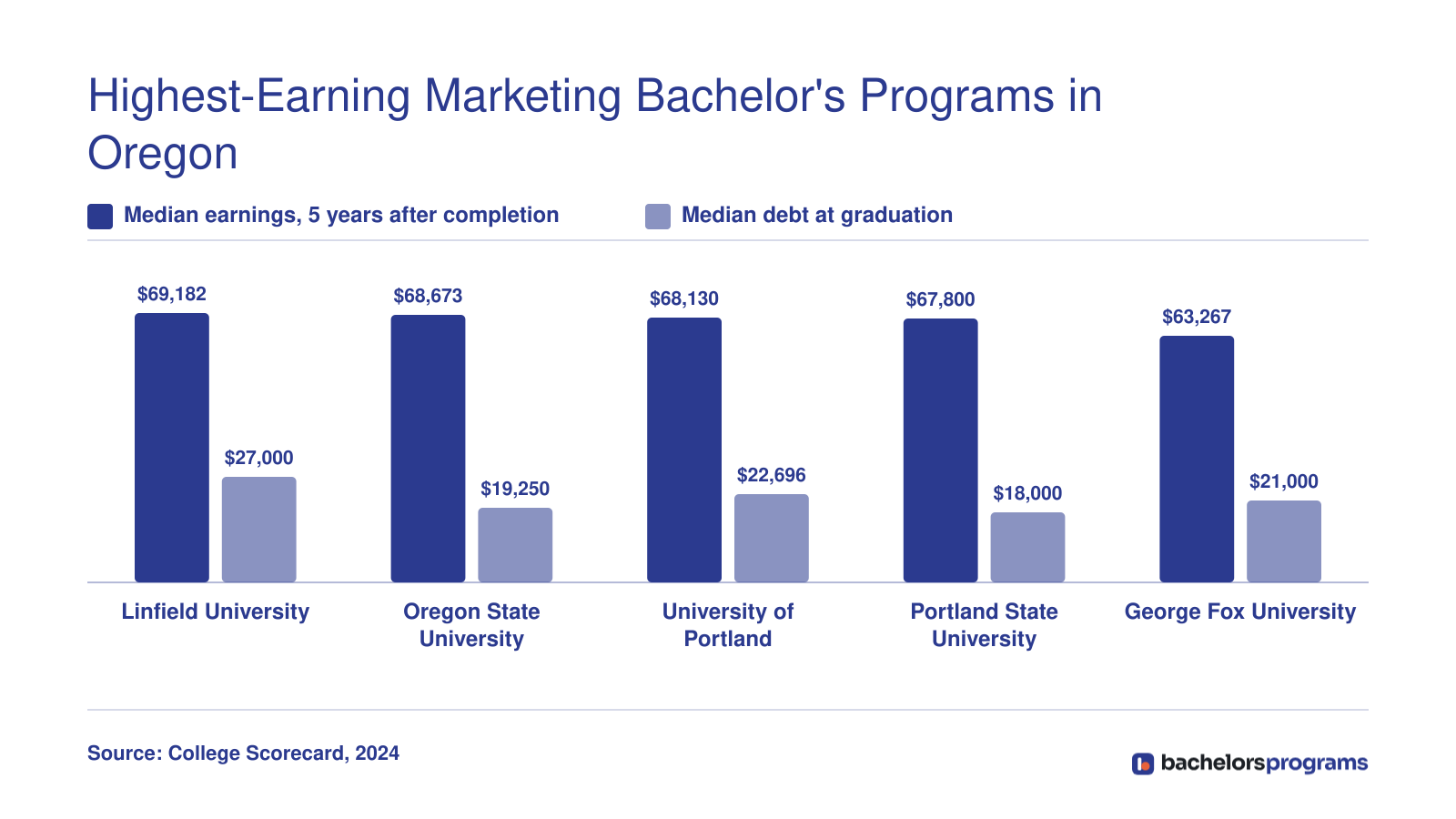
Marketing graduates of these Oregon bachelor's programs earned a median of $63,267 to $69,182 five years after completion, against median debt at graduation of $18,000 to $27,000. These figures belong to each marketing program, not the school as a whole. Linfield University leads on earnings at $69,182, while Portland State University pairs $67,800 with the lowest median debt shown, $18,000. When earnings run this close, the larger gap between pay and debt is the better tiebreaker.
Online and Hybrid Bachelor's in Marketing Options at Oregon Schools
You can finish a marketing degree fully online at several schools based in Oregon. Oregon State University delivers its marketing major through Ecampus as a 100% online B.A. or B.S., and Eastern Oregon University offers its marketing degree entirely online with four start dates a year. Linfield University also publishes a fully online option. Portland State blends classroom and online coursework in a hybrid format, while University of Oregon, University of Portland, Oregon Institute of Technology, Warner Pacific, Bushnell and Western Oregon are built around campus study.
Quarters, Credits and Transfer
Both of the state's major online marketing degrees run on the quarter system rather than semesters, so expect four shorter terms per year instead of two long ones. Each requires 180 quarter credits to graduate, roughly equal to 120 semester credits. Oregon State sets a minimum of 60 upper-division credits toward the total. At Eastern Oregon, the marketing core alone is 21 courses worth 85 credits, and the university accepts up to 135 transfer credits, though at least 20 credits must be earned at EOU. If you are bringing in an associate degree or a stack of community college credit, that transfer ceiling matters more than any other figure: it is what turns a four-year plan into something considerably shorter.
What Online Study Costs
Oregon State's Ecampus rate for 2026-27 is $438 per credit, a figure that already folds in the $15 per credit distance education fee and carries no nonresident surcharge. That last detail matters: out-of-state students pay the same as Oregonians. Eastern Oregon's online rate for 2025-26 is $338 per credit, or about $60,840 for the full 180 credits before fees, with an additional $14.50 per credit on marketing courses and a one-time $250 matriculation fee. Neither school publishes a directly comparable per-credit on-campus rate for marketing, so compare total published cost rather than assuming online is automatically cheaper.
Picking a Format
Fully online suits working adults who need evening flexibility, transfer students banking prior credit, and anyone living outside Oregon who wants an Oregon degree without relocating. Hybrid study at Portland State works well if you want Portland's agency and brand internships within driving distance. Campus programs still offer the densest access to clubs, capstone teams and recruiter events.
Admissions: GPA, Test Policy and Transfer Credit for Oregon Marketing Programs
The University of Oregon sets a 2.25 minimum GPA for Oregon resident transfer applicants, 2.50 for nonresidents and 2.00 for applicants who hold an AAOT or ASOT in Business from an accredited Oregon community college.1 Among the Oregon schools that offer a marketing bachelor's degree, that is the clearest published transfer threshold.
Side-by-Side Admissions Policies
| School | Minimum GPA | SAT/ACT policy | Transfer credit |
|---|---|---|---|
| University of Oregon | 2.25 Oregon residents; 2.50 nonresidents; 2.00 with AAOT/ASOT in Business | Scores accepted from official high school transcripts or testing service; 2026 requirement not stated | Up to 124 community college credits; 90 from an international junior college; no maximum from four-year colleges; community college credit applies as lower-division only |
| Oregon State University | No published policy | No published policy | Up to 135 credits (2026-27); 180 total and 60 upper-division credits for graduation; Degree Partnership Program with Oregon community colleges |
| University of Portland | No published policy | No published policy | No published policy |
| Portland State University | No published policy | No published policy | No published policy |
| Linfield University | No published policy | No published policy | No published policy |
| Oregon Institute of Technology | No published policy | No published policy | No published policy |
| Warner Pacific University | No published policy | No published policy | No published policy |
| Bushnell University | No published policy | No published policy | No published policy |
| Eastern Oregon University | No published policy | No published policy | No published policy |
| Western Oregon University | No published policy | No published policy | No published policy |
| Southern Oregon University | No published policy | No published policy | No published policy |
| George Fox University | No published policy | No published policy | No published policy |
A "No published policy" entry means the school's reviewed admissions page did not state a 2026 rule; it does not mean no rule exists.
What This Means for Applicants
- Transfer-friendly route: Oregon's AAOT or ASOT in Business pathway admits at 2.00 and satisfies writing and area-of-inquiry requirements. Oregon State's Degree Partnership Program lets students take classes at both OSU and an Oregon community college, but it does not guarantee admission or a marketing seat.
- Test policy: Oregon accepts SAT or ACT scores from an official high school transcript or a testing service, but the 2026 requirement is not stated. No reviewed school publishes a blanket test-optional rule for marketing applicants, so check each page before you pay for score reports.
- Verify before applying: Minimum GPAs are thresholds, not typical admitted profiles. Confirm current marketing major requirements, test policy, transfer caps and community college agreements on the school's admissions page, since these rules change by term.
Related Articles
Cost of a Bachelor's Degree in Marketing in Oregon
Oregon's state aid rules shifted in 2025 when lawmakers opened the Oregon Opportunity Grant to students enrolled less than half time2, a change that makes part-time marketing study easier to finance. At Oregon's public universities, published in-state tuition for a marketing bachelor's degree runs roughly $11,000 to $16,000, though average net price after aid can land well below or above that.
Sticker Price vs. Net Price
Published tuition and fees are what a school lists before any grant or scholarship. Average net price is what first-time, full-time students actually pay after federal, state and institutional grant aid, and it usually includes living costs. At Portland State University, average net price is $9,552, below published in-state tuition of $11,679. At Oregon State University, net price is $19,604 against tuition of $14,400, because the figure includes room and board. Linfield University lists tuition of $50,850 but an average net price of $26,536.
Oregon Opportunity Grant
The Oregon Opportunity Grant is the state's largest need-based program.1 Eligibility rests on financial need and other state requirements. File the FAFSA or, if you cannot complete the federal form, the ORSAA; HECC lists a tentative May 15, 2026 cutoff for 2026-272. The grant works at eligible Oregon public colleges and participating private institutions.1 Awards are prorated from 1 to 12 credits, with 12 credits counting as full time2, and the 2025 expansion now lets less-than-half-time students receive a prorated award. Award amounts vary with need, enrollment load and available funding rather than following one flat figure.
Oregon Promise and Other State Aid
Oregon Promise is not a general four-year grant. It serves recent Oregon high school and GED graduates attending an Oregon community college5, so it does not fund direct enrollment in a bachelor's program. For the class of 2026, students needed a Student Aid Index below $27,000, and the application deadline was June 1, 2026, with a separate FAFSA/ORSAA deadline of July 10, 2026.3 The award requires at least 6 credits and caps eligibility at 90 credits4; renewal requires a new FAFSA or ORSAA by June 14. Other state scholarships through OSAC are individually administered and carry their own eligibility rules and deadlines.6
File Early
Treat the FAFSA or ORSAA as the first task, not the last. The Opportunity Grant and Promise deadlines fall in the spring and early summer, and late filers can lose a full year of eligibility. Check the OSAC Student Access Portal for each program's current deadline before you submit.
Accreditation and Specializations: AACSB, ACBSP and IACBE Compared
Which Oregon marketing programs are AACSB accredited? Oregon State University, Portland State University, the University of Oregon and the University of Portland all hold AACSB accreditation for their business schools1. Oregon Institute of Technology is an IACBE member with accredited programs2, and the IACBE directory lists its business unit as the Department of Management. Current directory results do not show any Oregon business school offering a bachelor's in marketing under ACBSP accreditation.
How the Three Accreditors Differ
AACSB is generally considered the most selective of the three. It puts heavy weight on faculty research, strategic management and global reach, so employers and graduate admissions offices often recognize it. ACBSP emphasizes teaching quality and measurable student learning. IACBE focuses on outcomes assessment and on how well a program serves its own stated mission. None of this makes one label "better" for every student. It tells you what the school is being measured on.
Accreditation Status at a Glance
- Oregon State University: AACSB accredited. Offered as a B.A. or B.S. in marketing.
- Portland State University: AACSB accredited in business and accounting. The AACSB directory lists both BA-Marketing and BS-Marketing.3
- University of Oregon: AACSB accredited. Marketing is a concentration within the Business Administration major.5
- University of Portland: AACSB accredited. The AACSB directory lists a Bachelor of Business Administration in Marketing.4
- Oregon Institute of Technology: IACBE accredited-program member. The directory result does not identify a marketing track.
Directory results did not establish accreditation status for the remaining schools, so check each one directly.
Tracks and Specializations
Oregon State University offers the widest menu for online learners: consumer insights, marketing and digital communications, marketing management, professional sales and personal selling, and sports marketing. The University of Oregon lists marketing alongside separate concentrations in business analytics and sports business. Portland State and the University of Portland each offer a general marketing path. Warner Pacific University and Bushnell University offer degrees built specifically around digital marketing, and Southern Oregon University offers a marketing concentration within its business administration degree.
Confirm Status Before You Apply
Accreditation can change, and a school's website may be out of date. Search the AACSB, ACBSP and IACBE directories by institution name, and confirm that your specific marketing degree falls under the accredited business unit.
Marketing Careers and Salaries in Oregon: What Bachelor's Graduates Can Expect
A bachelor's graduate in Oregon is paid by Oregon employers, so national salary figures are only a starting point. Treat them as a benchmark and confirm the local picture yourself.
National Benchmarks to Start From
For 2025, the Bureau of Labor Statistics reports a median annual wage of $78,760 for market research analysts and marketing specialists.1 Its May 2025 wage table shows a mean annual wage of $89,490 for the same group, or $37.87 an hour.2 The combined category of advertising, promotions, and marketing managers has a national median of $165,780.3 Managers usually need several years of experience, so entry-level pay will sit well below that figure. None of these are Oregon or Portland numbers.
Pull Oregon and Portland Data From BLS
Go to the BLS Occupational Employment and Wage Statistics (OEWS) pages and search by occupation and by location. Look up market research analysts and marketing specialists, marketing managers, and advertising and promotions managers. Then run each search twice: once for Oregon and once for the Portland-Vancouver-Hillsboro metro area. Each result gives median annual wages and employment counts. The metro area includes Vancouver, Washington, so it is not identical to Portland city or to Oregon as a whole.
Add Local Context
The Oregon Employment Department publishes regional labor market information, including hiring trends and wage ranges by area. Use it to see whether pay and demand differ between the Portland region and places like Eugene, Corvallis, or Klamath Falls. Then ask the career-services office at any school you are considering for salary ranges, recent employer lists, and internship placements. Those lists show who actually hires graduates from that campus.
Professional associations are another source:
- American Marketing Association: Check for salary resources, job boards, and local chapter events.
- American Advertising Federation: Look for student chapters and networking contacts.
- Portland Ad Fed: The local advertising community is a good place to meet Portland-area professionals and see who is hiring.
A Practical Checklist Before You Apply
- Compare the Oregon and Portland metro wage figures for each occupation, and note the gap.
- Check current postings on employer career pages and LinkedIn to see what titles and pay ranges employers advertise today.
- Match the job titles in those postings to the OEWS occupation names so you are comparing the same roles.
- Ask school career services and association contacts whether the salaries you found are realistic for new bachelor's graduates.
- Recheck the data each year. OEWS updates annually, and postings change faster than that.
If the local figures come in lower than the national ones, weigh that against the cost of living and the in-state tuition and net price before choosing a program.
Compare Marketing programs on the data that matters
Explore more Business & Management majors or browse every field of study.
All Business & Management programs Browse every field of study