Best Computer Science Schools in Minnesota
Compare 34 accredited Computer Science programs in Minnesota at 27 colleges, with net price after aid, graduation rates, earnings and debt from IPEDS and the U.S. College Scorecard.
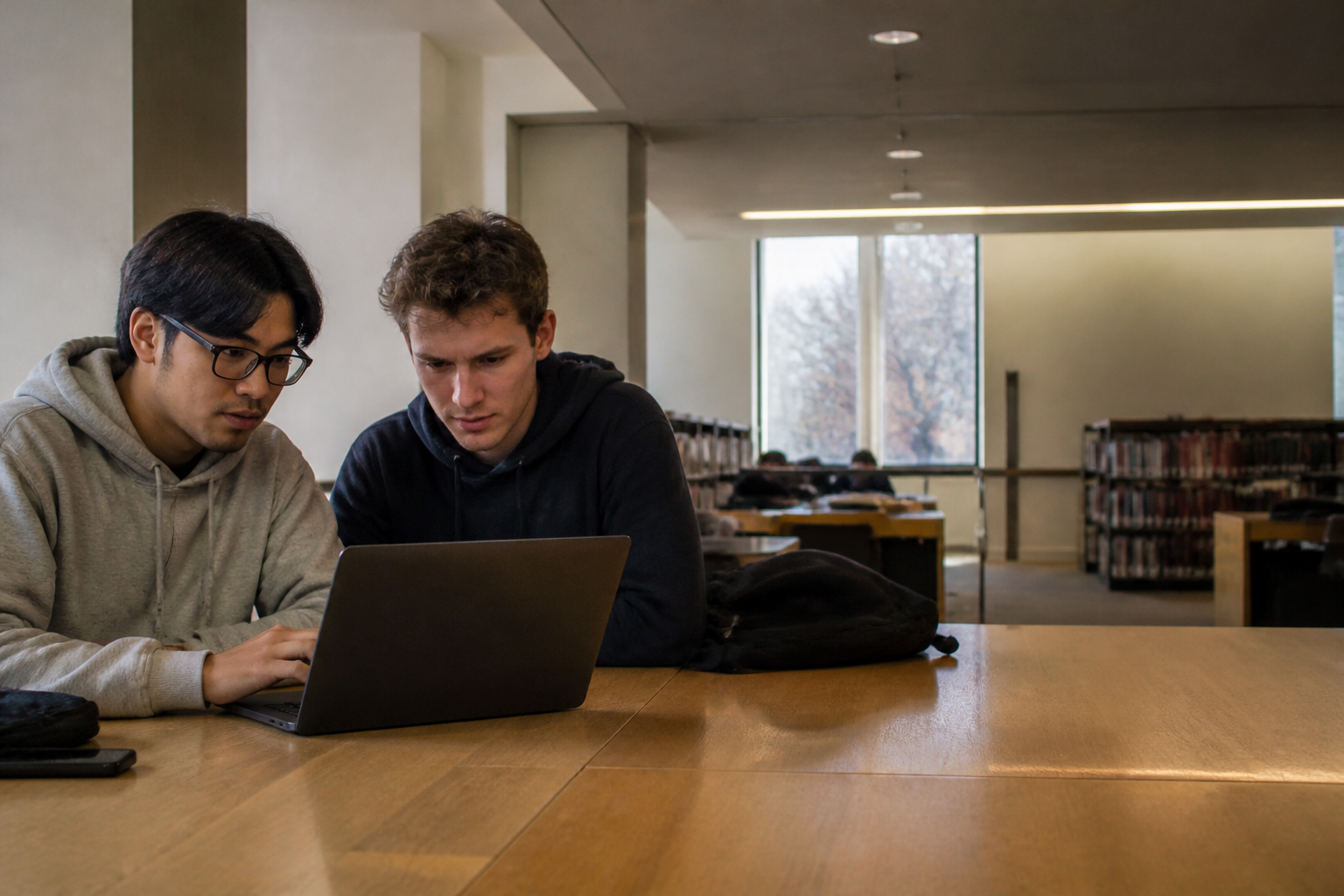
Minnesota colleges offer computer science as either a Bachelor of Science (B.S.) or a Bachelor of Arts (B.A.). Graduates enter a Twin Cities job market anchored by employers such as Target and Thomson Reuters.
The tension is price. Published tuition and fees run from $11,490 at Rasmussen University-Minnesota to $68,892 at Carleton College, though University of Minnesota-Morris has the lowest average net price after aid, at $8,837. Median earnings a year after graduation span $53,832 to $88,132.
The University of Minnesota-Twin Cities charges in-state students $17,214 in tuition and fees, and its computer science graduates earn a median $82,861 in their first year. Among private colleges charging more than three times as much, only Carleton tops that.
Key Points
- University of Minnesota-Twin Cities ranks first for computer science bachelor's degrees.
- University of Minnesota-Morris has the lowest net price: $8,837 a year.
- Rasmussen University-Minnesota and Concordia University-Saint Paul offer online computer science bachelor's.
Best Computer Science Schools in Minnesota: Top 10 Ranked
The University of Minnesota Twin Cities is the strongest overall choice for a bachelor's degree in computer science in Minnesota, combining the course range of a major research university with the state's deepest technology recruiting pipeline. The ten schools below cover public flagships, private liberal arts colleges, and an online completion option, so the right fit depends on how you want to learn and what you can pay. Net prices shown with each entry are sector averages from federal data, not a personalized financial aid quote.
University of Minnesota-Twin Cities
#1Minneapolis, MN · ~$17,000/yr (est.)
Best for: Research-minded students at a large public university
The flagship public university and the state's largest computer science department, offering both a Bachelor of Science and a Bachelor of Arts in Computer Science so students can lean technical or interdisciplinary. Institution-wide, about 85% of students graduate and about 80% of applicants are admitted. AI-focused courses arrived in fall 2026, and a new interdisciplinary computing major is in development with the College of Liberal Arts and College of Design.
- B.S. adds two lab science courses and a math-oriented requirement
- Upper-division electives let students go deeper in one area
- All computer science courses must be passed with a C- or better
- Combined B.S. to M.S. five-year plan available
- Undergraduate research opportunities with faculty
- 3.2 GPA minimum to declare the major
- Second language proficiency required
- Internship and work opportunities
- Flexibility to pursue multiple interests
- Student group: Women in Computer Science
Carleton College
#2Northfield, MN · $25,000 – $30,000/yr (est.)
Best for: Liberal arts students wanting a capstone year
A small Northfield liberal arts college where the computer science major ends in a required senior capstone and students are encouraged to take electives outside the department. About 20% of applicants are admitted and roughly 90% of students graduate. Classes are small, with an 8:1 student-to-faculty ratio, and off-campus study fits easily into the plan.
- Senior capstone (comps) required
- Electives outside the CS department encouraged
- Off-campus study available
- Course sequence planned with faculty advisors
St Olaf College
#3Northfield, MN · ~$24,000/yr (est.)
Best for: Team-oriented learners drawn to parallel computing
St. Olaf pairs a liberal arts core with a computer science major known for parallel and distributed computing, and undergraduates join research projects early. About 48% of applicants are admitted and roughly 84% of students graduate. Interdisciplinary work with music, physics, and environmental studies is common, and a study-abroad capstone in Ghana is one option.
- Known for parallel and distributed computing
- Undergraduate research built into coursework
- Study-abroad capstone in Ghana
- Interdisciplinary projects with music, physics, environmental studies
- Ethics and communication emphasized alongside technical work
University of Minnesota-Morris
#4Morris, MN · ~$9,000/yr (est.)
A public liberal arts campus where the computer science B.A. is taught with heavy faculty contact and room for electives in game development, systems, or data analysis. About 75% of applicants are admitted and roughly 63% of students graduate. Student-run labs and funded undergraduate research give it a practical, community-minded feel, and alumni work at IBM, Mayo Clinic, and Hewlett-Packard.
- Electives in game development, systems, data analysis, or web development
- Funded undergraduate research through UROP and the Morris Academic Partnership
- Team-based software projects built for real clients
- CenterPoint Energy Scholarship available to CS majors
- Graduates hired at IBM, Mayo Clinic, Hewlett-Packard, and US Bank
- About one-third of graduates go on to graduate school
Saint Mary's University of Minnesota
#5Winona, MN · $12,000/yr (est. net price)
A private Catholic university in Winona whose computer science major includes a software engineering track built around Java, Python, C++, and JavaScript along with Agile and Scrum practice. About 93% of applicants are admitted and roughly 66% of students graduate. The program holds a STEM designation that qualifies international graduates for Optional Practical Training.
- Covers Java, Python, C++, and JavaScript
- Agile and Scrum methodologies taught
- STEM designated, so international students qualify for OPT
- Customize the degree with one of 20 minors
- Study abroad in Rome available
University of Minnesota-Duluth
#6Duluth, MN · $15,000 – $20,000/yr (est.)
UMD awards both a B.A. and an ABET-accredited B.S. in computer science, and its B.S. is one of only two accredited computer science programs in Minnesota. About 89% of applicants are admitted and roughly 65% of students graduate. ACM, Women in Computing, and a robotics club give the department an active lab culture, and Swenson College offers scholarships.
- Interdisciplinary: coursework in a complementary discipline
- Clubs include ACM, robotics, and the Software Development Club
- Scholarships through Swenson College
- Undergraduate research with modern instrumentation
- ABET accredited, one of two accredited programs in Minnesota
- Includes class and lab experience
- Industry Advisory Board involvement
- Reported high employment rate for graduates
- Women in Computing and ACM student clubs
Gustavus Adolphus College
#7Saint Peter, MN · $20,000 – $25,000/yr (est.)
A liberal arts college in Saint Peter where computer science sits within the mathematics, computer science, and statistics department and every course is taught by a faculty member. About 61% of applicants are admitted and roughly 77% of students graduate. Coursework runs from data structures to AI and human-computer interaction, and the college reports an 11:1 student-to-faculty ratio.
- 48 credit hours for the major, 24 for the minor
- Coursework in AI, machine learning, and database systems
- Functional, object-oriented, and parallel programming paradigms
- 11:1 student-to-faculty ratio; all courses taught by faculty
- Recent graduates at CIGNA and Thomson Reuters
- Four-year course plan published
Rasmussen University-Minnesota
#8St. Cloud, MN · ~$18,000/yr (est.)
A fully online bachelor's completion program for students who already hold an associate degree or about 60 quarter credits, built around 23 courses and 90 credits that can be finished in as few as 18 months. The curriculum was designed with input from engineers at Intel and Lockheed Martin. About 53% of students graduate, and live sessions, virtual labs, and self-paced courses make up the format.
- Bachelor's completion program for students with about 60 quarter credits
- 90 credits across 23 courses; finishable in as few as 18 months
- Fully online with live sessions, virtual labs, and self-paced courses
- Curriculum reviewed with experts from Intel and Lockheed Martin
- Prepares for Java Foundations and Database Foundations exams
- Transfer credit estimate returned within one business day
University of St Thomas
#9Saint Paul, MN · ~$29,000/yr (est.)
St. Thomas runs small, lab-based computer science classes, with introductory sections capped at 24 students and majors learning four or more programming languages. About 85% of applicants are admitted and roughly 76% of students graduate. A required senior capstone ties the four years together, and alumni work at organizations including the FBI, Meta, and Target.
- Intro classes capped at 24 students
- Majors learn four or more programming languages
- Required senior capstone
- Research assistant roles in machine learning, VR, and cybersecurity
- Study abroad in Barcelona, Ireland, and Scotland
- Computer Science Club with 147 members
Saint Johns University
#10Collegeville, MN · ~$26,000/yr (est.)
Saint John's runs its computer science program jointly with the College of Saint Benedict, and students apply to the major before junior year with a 2.5 GPA and no more than one grade below C. About 91% of applicants are admitted and roughly 75% of students graduate. The department is small, with nine faculty members, and conditional admission is available for students still finishing prerequisites.
- Apply to the major before junior year
- 2.5 GPA required, with no more than one grade below C
- Conditional admission for students still completing prerequisites
- Requires CSCI 150 or 130, CSCI 160, and CSCI 200 or 230
- Nine faculty members in the department
- Non-competitive admission process
Cost & outcomes by school
Federal data for the highest-earning Computer Science programs, independent of the ranking above. Earnings are this field's bachelor's graduates four years after completing where the Scorecard reports them, else the school's undergraduate median.
| School | Net price / yr | Grad rate | Earnings | Debt | Grads/yr | Format |
|---|---|---|---|---|---|---|
| St Olaf College MN | $23,874 | 84% | $122,912 | $23,125 | 39 | Campus |
| University of Minnesota-Twin Cities MN | $16,778 | 85% | $111,661 | $18,577 | 627 | Campus |
| University of St Thomas MN | $29,155 | 76% | $107,938 | $22,454 | 43 | Campus |
| Concordia University-Saint Paul MN | $18,462 | 46% | $105,577 | $27,754 | 28 | Online |
| Saint Cloud State University MN | $13,529 | 40% | $103,765 | $25,463 | 45 | Campus |
| Saint Johns University MN | $25,672 | 75% | $101,188 | $24,384 | 22 | Campus |
| Augsburg University MN | $23,873 | 52% | $95,637 | $23,766 | 33 | Campus |
| University of Minnesota-Morris MN | $8,837 | 63% | $92,449 | $18,786 | 11 | Campus |
| Metropolitan State University MN | $16,863 | 44% | $92,342 | $19,287 | 94 | Hybrid |
| University of Minnesota-Duluth MN | $18,743 | 65% | $91,911 | $21,500 | 109 | Campus |
| Winona State University MN | $17,503 | 57% | $88,164 | $19,874 | 40 | Campus |
| Rasmussen University-Minnesota MN | $17,962 | 54% | $84,899 | $28,113 | 31 | Online |
Sources: U.S. Department of Education. Net price, graduation rate, earnings and debt: College Scorecard (earnings and debt for this field's bachelor's graduates where reported, else school-wide); graduates: IPEDS. A dash means no figure is reported.
Cost, debt & payoff
Median earnings of this field's bachelor's graduates (4 yrs after completing, else the school's undergraduate median) vs. their median federal loan debt · U.S. College Scorecard
Across these programs the median graduate earns about $88,164 and finishes with roughly $21,500 in debt — a ratio that clears a common rule of thumb (keep debt below first-year salary). Net price and debt vary widely school to school, so check the per-school figures in the table above before you shortlist.
Cheapest Bachelor's in Computer Science Programs in Minnesota
University of Minnesota-Morris has the lowest average net price in this data at $8,837 a year after grants and scholarships, based on 2024 IPEDS and College Scorecard figures from the U.S. Department of Education. Sticker price can mislead, though: Saint Mary's University of Minnesota, a private school, lists $45,080 in tuition and fees but averages $11,704 after aid, less than public Saint Cloud State, Bemidji State and Southwest Minnesota State, where tuition runs about $10,200 to $10,400 but net price lands between $13,529 and $15,291. Net price is an average across aided students, so your own cost will depend on family income and the aid package each school offers you.
| School | City | Control | In-State Tuition and Fees | Average Net Price After Aid |
|---|---|---|---|---|
| University of Minnesota-Morris | Morris | Public | $14,526 | $8,837 |
| Saint Mary's University of Minnesota | Winona | Private nonprofit | $45,080 | $11,704 |
| Saint Cloud State University | Saint Cloud | Public | $10,245 | $13,529 |
| Bemidji State University | Bemidji | Public | $10,237 | $15,261 |
| Southwest Minnesota State University | Marshall | Public | $10,361 | $15,291 |
Related Articles
Online and Hybrid Bachelor's in Computer Science at Minnesota Schools
You can earn a bachelor's degree in computer science online from a Minnesota-based school, but the online path is narrower than the campus path. Rasmussen University-Minnesota lists its computer science bachelor's as an online program, and Concordia University-Saint Paul lists an online-only Bachelor of Science in Computer Science. Those are the clearest fully online options among the Minnesota schools in this ranking.
Online and Campus Formats
The other programs on this page are built around campus attendance. The University of Minnesota Twin Cities, Carleton College, St Olaf College, University of Minnesota Morris, Saint Mary's University of Minnesota, Gustavus Adolphus College, University of St Thomas, and Saint Johns University all list campus-based formats. The University of Minnesota Duluth is explicit: its B.A. and B.S. in computer science are campus-only. No hybrid programs appear in this ranking, so the practical choice is between a fully online program and a campus program. That pattern holds at public and private schools alike, so format usually follows the school rather than the individual program. If you need a remote option, verify the format on the program page before you apply.
What to Check Before You Enroll
A fully online program can fit work and family commitments, but it usually offers fewer in-person labs, clubs, and career fairs. Campus programs put those opportunities in front of you. Either way, check these points before you commit.
- Tuition rate: Public universities may charge in-state and out-of-state rates even for online courses, while private schools usually post one rate. Compare the total cost per credit, not just the sticker price.
- Campus requirements: Ask whether the program requires labs, proctored exams, internships, or short residencies on campus. A program marketed as online can still have an in-person component.
- Accreditation: Confirm the school is regionally accredited and ask whether the computer science program holds program-level accreditation, which some employers and graduate schools look for.
Admissions for a Bachelor's Degree in Computer Science in Minnesota
Getting into a computer science program in Minnesota often takes two steps: you are admitted to the school, then you qualify for the major itself. That second step is where GPA rules, prerequisite courses and transfer credit matter most.
University of Minnesota Twin Cities: The 3.2 Technical GPA
The UMN CS program admits students to the B.A. major using a technical GPA built from math, science, engineering and computer science courses. A technical GPA of at least 3.2 guarantees admission in fall semesters.1 Students between 2.00 and 3.2 are considered as space allows. Repeated courses count every attempt, so a retake does not erase the first grade.2
You need five prerequisites before applying: Calculus I, Calculus II, CS I, CS II and Discrete Structures.1 An AP Computer Science A score of 3, 4 or 5 earns 4 credits toward an introductory computing course.4
Transferring Into the UMN Major
UMN accepts transferred courses with grades as low as a D3, but courses taken elsewhere are left out of the technical GPA even when they meet degree requirements. The College of Science and Engineering sets a 3.2 minimum GPA for transfer applicants.2 Transfer students with all five prerequisites who meet the previous cycle's cutoff may qualify for direct admission.1 Students missing a prerequisite enter the College of Liberal Arts as pre-computer-science and apply once eligible; those below the cutoff must apply in their first semester of technical coursework at UMN.
How Selective Are These Schools?
Overall admission rates vary widely:
- Carleton College: about 20 percent, the most selective here
- St Olaf College: about 48 percent
- Gustavus Adolphus College: about 61 percent
- University of Minnesota-Morris: about 75 percent
- University of Minnesota-Twin Cities: about 80 percent
- University of St Thomas: about 85 percent
- University of Minnesota-Duluth: about 89 percent
- Saint Johns University: about 91 percent
- Saint Mary's University of Minnesota: about 93 percent, the least selective here
What to Confirm Before Applying
Saint John's uses a non-competitive process for its computer science major: students apply before junior year, need a 2.5 GPA and may earn no more than one C in required courses, with conditional admission available.
We could not verify current test-optional rules for any school here, including UMN, or published GPA and transfer policies at Minnesota State University-Mankato, Saint Cloud State University, Metropolitan State University and Winona State University. Check each admissions page or call a counselor before planning around a specific number.
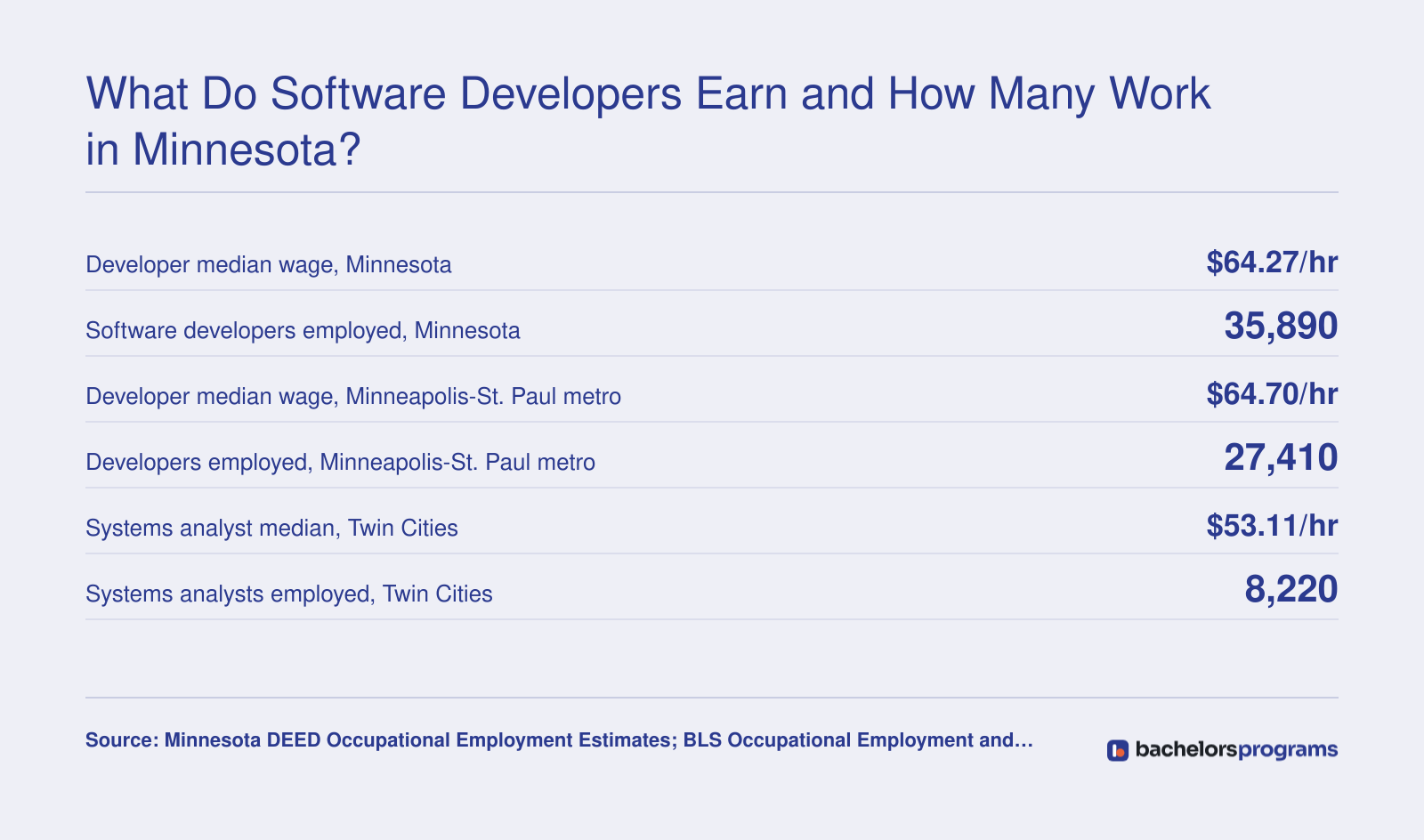
What Do Software Developers Earn and How Many Work in Minnesota?
These figures are occupational wages for all workers in each job, not the earnings of recent computer science graduates shown earlier on this page. Software developer figures come from the Minnesota Department of Employment and Economic Development (DEED) for the first quarter of 2026. Systems analyst figures come from a separate DEED estimate for the seven-county Twin Cities region, which is not the same area as the full Minneapolis-St. Paul metro. For context, the Bureau of Labor Statistics put the national median annual wage for software developers at $135,980 in May 2025. Treat all of these as snapshots, since local estimates shift from quarter to quarter.
Common Questions About Computer Science Bachelor's Programs in Minnesota
What is the best college for computer science in Minnesota?
What is the difference between a B.A. and a B.S. in computer science?
Can I transfer from a Minnesota community college into a bachelor's in computer science?
Do Wisconsin or North Dakota residents pay in-state rates at Minnesota schools?
Compare Computer Science programs on the data that matters
Explore more Computers & IT majors or browse every field of study.
All Computers & IT programs Browse every field of study