Best Finance Schools in Minnesota
Compare 35 accredited Finance programs in Minnesota at 25 colleges, with net price after aid, graduation rates, earnings and debt from IPEDS and the U.S. College Scorecard.

Sticker tuition for a bachelor's degree in finance in Minnesota runs from $10,576 at Winona State University to $55,816 at Saint Johns University, a gap of more than $45,000. The common credential is the Bachelor of Science (B.S.) in Finance, but the schools behind it differ sharply in price, size, accreditation and format.
The data here covers campus programs in Minnesota and online programs at Minnesota-based schools. That includes Winona State, which carries AACSB accreditation, so cost, earnings and admissions can be compared on one footing.
Sticker price overstates the divide. Private schools discount heavily, and net price after aid at Saint Johns lands near $25,700, far closer to Winona State's $17,500 than tuition suggests.
Key Points
- University of St Thomas posts the strongest finance earnings figure here.
- Compare net price after grants, not sticker tuition, to find savings.
- Capella and Walden offer online finance bachelor's paths from Minneapolis.
Best Bachelor's Degree in Finance Schools in Minnesota, Ranked
The ten schools below are ordered by how well they serve undergraduates pursuing a bachelor's degree in finance in Minnesota, weighing program breadth and hands-on investing opportunities against completion and cost. Graduation rates and net prices shown on each card are institution-wide, approximate figures rather than finance-major-only numbers.
North Central University
#1Minneapolis, MN · ~$26,000/yr (est.)
Best for: Minneapolis students eyeing CPA careers
A private Christian university in downtown Minneapolis, North Central keeps its finance offering practical by combining accounting and finance into a single Bachelor of Science. The 124-credit program requires an internship before graduation and builds in preparation for the CPA exam, with extra undergraduate coursework available to reach the 150 credits licensure requires. Classes run on campus, and every business major takes a project management course with an optional certification exam.
- 124 total credit hours
- Internship required before graduation
- Coursework prepares students for the CPA exam
- Extra undergraduate classes reach the 150 credits for CPA licensure
- Real-money investing simulations
- Project Management Certification option by proficiency exam
- 98.8% of 2020 and 2021 graduates employed within six months
University of St Thomas
#2Saint Paul, MN · ~$29,000/yr (est.)
Best for: Aspiring analysts seeking Wall Street exposure
The University of St. Thomas is a private Catholic university in Saint Paul whose Opus College of Business houses the Financial Management major, taught on campus with small classes. Students work in the student-managed Aristotle Fund, take a Wall Street immersion course and can add a study-abroad elective in China. The university reports that 98% of graduates are employed within six months and that the median starting salary is $69,000, and a full-tuition O'Neill Scholars program supports selected finance students.
- Student-managed Aristotle Fund
- Wall Street immersion course
- Study-abroad elective in China
- 90% of graduates complete an internship
- Full-tuition O'Neill Scholars program with mentorship
- Reported median starting salary of $69,000
- 98% employed within six months of graduation
- Small class sizes
University of Minnesota-Duluth
#3Duluth, MN · $15,000 – $20,000/yr (est.)
Best for: Northland students wanting hands-on trading labs
The University of Minnesota Duluth is a public campus on Lake Superior with three finance pathways inside its Bachelor of Business Administration. Undergraduates get heavy internship support, with more than 200 placements arranged each year at employers such as 3M and Google, and the Wells Fargo Financial Markets Lab gives students real-time market displays to work from. The school also runs an Investment Club, a Student Professional Engagement Program and more than 150 scholarships a year.
- Placements at 3M, Google and Target
- Investment Club with stock market simulations
- Student Professional Engagement Program
- Networking at LSBE Company Days
- Wells Fargo Financial Markets Lab with real-time index displays
- Manage a live $5M student investment portfolio
- Student teams manage an S&P 500 portfolio
- Four rebalance opportunities each year
- Director with 20+ years of industry experience
- Prepares for securities trading careers
- Reviewed by practicing finance professionals
- 200+ internships arranged annually
- Internships at 3M and Google
- Business clubs open to all students
- More than 150 scholarships each year
Saint Mary's University of Minnesota
#4Winona, MN · $12,000/yr (est. net price)
Saint Mary's University of Minnesota is a private Lasallian institution in Winona offering a Bachelor of Arts in Finance that leans on investments, international finance and risk management. The degree is IACBE-accredited, allows a double major in accounting, analytics or management, and comes with 20 minors to choose from. Students can also manage money through a student-run investment fund, and the residential campus suits those who want a smaller college setting.
- IACBE-accredited business program
- Coursework in investments, international finance, risk management and insurance
- Student-managed investment fund
- Double major option in accounting, analytics or management
- 20 minors available
- Lasallian general education core
College of Saint Benedict
#5Saint Joseph, MN · $27,000/yr (est. net price)
The College of Saint Benedict is a women's liberal arts college in St. Joseph that runs its finance major jointly with Saint John's University, so students share courses, faculty and one business network across two campuses. Finance majors choose among business finance, financial economics and mathematical finance, and the coursework deliberately pulls in accounting, economics, mathematics and statistics. The program stresses ethical reasoning and communication and prepares students for banking and corporate finance roles as well as graduate study.
- Tracks: Business Finance, Financial Economics, Mathematical Finance
- Interdisciplinary coursework in accounting, economics, mathematics and statistics
- Liberal arts foundation with ethical reasoning emphasis
- Prepares for careers and postgraduate study
- Shared curriculum and faculty with Saint John's University
Saint Johns University
#6Collegeville, MN · ~$26,000/yr (est.)
Saint John's University is a men's liberal arts college in Collegeville that shares its finance curriculum with the College of Saint Benedict, pairing a small residential campus with a combined business alumni network. Finance majors choose among business finance, financial economics and mathematical finance concentrations, with coursework spanning accounting, economics, mathematics and statistics. The liberal arts core emphasizes ethics and critical thinking, and graduates move into corporate finance, banking, investment management and financial analysis.
- Tracks: Business Finance, Financial Economics, Mathematical Finance
- Coursework integrates accounting, economics, mathematics and statistics
- Prepares for corporate finance, banking and investment management roles
- Also suitable preparation for graduate study
- Coordinate program shared with the College of Saint Benedict
Rasmussen University-Minnesota
#7St. Cloud, MN · ~$18,000/yr (est.)
Rasmussen University's Minnesota campus in St. Cloud delivers its finance bachelor's degree fully online, aimed at working adults who want to finish quickly without pausing their jobs. The accelerated design runs about 18 months across 90 credit hours and 23 courses, with tuition charged per credit and self-directed assessments available to lower the cost. Students prepare for the CFA Level I exam, can take one MBA course while still an undergraduate, and get a transfer credit estimate within a day.
- Fully online coursework
- About 18 months to finish
- 90 credit hours across 23 courses
- $332 per credit, about $29,880 total tuition
- $149 self-directed assessments to reduce cost
- Prepares for the CFA Level I exam
- One MBA course can be taken during the bachelor's
- Transfer credit estimate within one day
The College of Saint Scholastica
#8Duluth, MN · $28,000/yr (est. net price)
The College of Saint Scholastica is a private Benedictine campus in Duluth where finance is taught in small, discussion-driven classes. Undergraduates can take the major or the minor, use an internship to satisfy an elective, and pair finance with a language such as Spanish, German or American Sign Language to stand out in global markets. Graduates move into roles such as actuary, financial analyst, fund manager, financial planner and loan officer.
- Small, discussion-driven classes
- Internship can fulfill an elective
- Offered as a major or a minor
- Pair the major with Spanish, German or American Sign Language
- Benedictine values and ethical decision-making built into the curriculum
- Career paths include actuary, financial analyst, fund manager and loan officer
University of Northwestern-St Paul
#9Saint Paul, MN · ~$28,000/yr (est.)
University of Northwestern-St. Paul is a private Christian university in the Twin Cities metro whose finance bachelor's degree pairs financial modeling and data analytics with a faith-based leadership emphasis. Internships and a capstone are required, and juniors and seniors can manage real money through the Student Investment Practicum. Concentrations in analytics, corporate finance and wealth management let students aim at data roles, corporate strategy or financial planning, and an accelerated bachelor's-to-master's option is available.
- 128 total credit hours
- Tracks: Analytics, Corporate Finance, Wealth Management
- Wealth Management track is a CFP Board Registered Program
- Internship required before graduation
- Capstone required
- Student Investment Practicum for juniors and seniors
- Internships with employers such as Wells Fargo and United Airlines
- Accelerated bachelor's-to-master's option
Winona State University
#10Winona, MN · ~$18,000/yr (est.)
Winona State University is a public campus in southeastern Minnesota whose finance degree sits inside an AACSB-accredited business school. Students manage a $400,000 stock portfolio, work in a dedicated Financial Markets Lab, train for the CFA exam and compete in the CFA Research Challenge. Internships at firms such as Edward Jones and IBM, plus industry tours to Minneapolis and Chicago, extend the network well beyond Winona.
- AACSB accredited business program
- 120 total credit hours
- Manage a $400,000 student stock portfolio
- Financial Markets Lab on campus
- CFA exam preparation and CFA Research Challenge participation
- Internships at Edward Jones and IBM
- Industry tours to Minneapolis and Chicago
- Three start dates each year (fall, spring, summer)
Cost & outcomes by school
Federal data for the highest-earning Finance programs, independent of the ranking above. Earnings are this field's bachelor's graduates four years after completing where the Scorecard reports them, else the school's undergraduate median.
| School | Net price / yr | Grad rate | Earnings | Debt | Grads/yr | Format |
|---|---|---|---|---|---|---|
| University of St Thomas MN | $29,155 | 76% | $93,720 | $25,485 | 141 | Campus |
| Augsburg University MN | $23,873 | 52% | $79,809 | $27,000 | 38 | Campus |
| Capella University MN | $17,956 | 20% | $78,941 | $14,968 | 16 | Online |
| Saint Johns University MN | $25,672 | 75% | $76,786 | $27,000 | 11 | Campus |
| Winona State University MN | $17,503 | 57% | $75,807 | $20,410 | 20 | Campus |
| Minnesota State University-Mankato MN | $19,139 | 54% | $74,852 | $21,492 | 101 | Campus |
| Saint Mary's University of Minnesota MN | $11,704 | 66% | $74,642 | $27,000 | 21 | Campus |
| Metropolitan State University MN | $16,863 | 44% | $74,237 | $18,750 | 32 | Hybrid |
| University of Minnesota-Duluth MN | $18,743 | 65% | $73,979 | $21,800 | 115 | Campus |
| Rasmussen University-Minnesota MN | $17,962 | 54% | $70,838 | $24,433 | 9 | Online |
| Saint Cloud State University MN | $13,529 | 40% | $70,259 | $22,250 | 35 | Campus |
| University of Minnesota-Crookston MN | $12,212 | 50% | $69,866 | $12,750 | 30 | Campus |
Sources: U.S. Department of Education. Net price, graduation rate, earnings and debt: College Scorecard (earnings and debt for this field's bachelor's graduates where reported, else school-wide); graduates: IPEDS. A dash means no figure is reported.
Cost, debt & payoff
Median earnings of this field's bachelor's graduates (4 yrs after completing, else the school's undergraduate median) vs. their median federal loan debt · U.S. College Scorecard
Across these programs the median graduate earns about $66,210 and finishes with roughly $21,500 in debt — a ratio that clears a common rule of thumb (keep debt below first-year salary). Net price and debt vary widely school to school, so check the per-school figures in the table above before you shortlist.
Most Affordable Finance Bachelor's Programs in Minnesota
If you want the cheapest finance degree in Minnesota, compare average net price after grants and scholarships rather than sticker tuition. The schools below post the lowest net prices among the Minnesota finance bachelor's programs in our directory, according to 2024 U.S. Department of Education data from IPEDS and the College Scorecard. Sector explains most of the gap between the two columns: private Saint Mary's University of Minnesota lists the highest tuition here, yet aid brings its average net price to $11,704, the lowest in the table, while the public universities start with tuition near $10,000 to $13,000 and post net prices slightly above it because net price also counts housing, books and other living costs.
| School | City | Sector | Finance Program | Average Net Price After Aid | In-State Tuition and Fees |
|---|---|---|---|---|---|
| Saint Mary's University of Minnesota | Winona | Private nonprofit | Finance Major | $11,704 | $45,080 |
| University of Minnesota-Crookston | Crookston | Public | Finance | $12,212 | $13,288 |
| Saint Cloud State University | Saint Cloud | Public | Finance | $13,529 | $10,245 |
| Bemidji State University | Bemidji | Public | Business Administration (Finance) | $15,261 | $10,237 |
| Southwest Minnesota State University | Marshall | Public | Finance | $15,291 | $10,361 |
What Top Finance Graduates Earn After Finishing
University of St Thomas posts the strongest finance earnings figure among the schools ranked here.
Online and Hybrid Finance Bachelor's Options at Minnesota Schools
An online finance bachelor's covers the same B.S. in Finance coursework remotely, usually asynchronously; a hybrid program mixes online classes with occasional campus sessions. In Minnesota, fully online options are few, and most finance majors still meet in person.
Fully Online B.S. in Finance
- Southwest Minnesota State University: 100% online at $406.25 per credit, about $48,750 for the 120-credit degree before books and fees, with a Corporate Finance concentration.2
- St. Cloud State University: 100% online at an estimated $385.67 per credit (roughly $1,157 per three-credit course), 120 credits, and up to 90 transfer credits accepted.3
- University of Minnesota Crookston: asynchronous and 100% online at $483.70 per credit before fees, with 65 of the 120 credits inside the major.1
- Rasmussen University-Minnesota: an online finance bachelor's at $332 per credit, $29,880 total, 90 credits over about 18 months.
What Stays on Campus
Minnesota State Mankato's finance B.S. is fully face-to-face, and Minnesota State Moorhead lists finance as on campus only. So do the Duluth B.B.A. at the Labovitz School4 and the programs at St. Thomas, Saint Benedict and Saint John's, Saint Scholastica, Northwestern-St Paul, Winona State, Saint Mary's and North Central.
The Trade-Offs
Online study is the cheapest and most flexible route, but internships, campus recruiting and Twin Cities networking happen in person, so online students have to build those connections themselves. A few schools also fold finance into a broader business degree rather than a standalone major, including Bethel's business major with a finance emphasis, Capella's B.S. in Business with a finance focus, and North Central's Accounting and Finance program.
Related Articles
Admission Requirements: GPA, Test Policy and Transfer Credit
The admissions bar for a Minnesota finance bachelor's is less about getting in than about when the gate closes: some schools set a GPA to enter the major, others admit widely and let required courses sort students out. Knowing which model a school uses tells you more than the headline acceptance rate.
GPA and test policy
Minnesota State University-Mankato sets the clearest gate. Finance majors need a 2.50 cumulative GPA, including transfer work, at least a 2.0 in major-required courses, and a 2.25 overall to graduate; admission usually comes at the start of sophomore year. Minnesota State University Moorhead publishes a 2.0 minimum and requires a high school diploma or equivalent. Not every school here posts a finance-specific minimum GPA; where none is published, the general university admission standard governs. Test-optional policies shift by year and by campus1, and extended waivers are common, so confirm the rule for your entry term on the admissions page.
Selectivity, from open-access to competitive
Published admission rates among the schools ranked here run from about 75% at Winona State University to the high 90s at North Central University, with the University of St Thomas and the University of Minnesota-Duluth in between; most sit above 85%. The spread matters less than it looks, because a high acceptance rate can still come with a GPA gate for the major.
Transfer credit and the Minnesota Transfer Curriculum
Minnesota's public colleges share the Minnesota Transfer Curriculum, a 40-credit general-education framework that transfers as a block when a school participates. Mankato layers program rules on top: transfer students need 30 resident upper-division College of Business credits and must complete at least 50% of major and minor coursework at Mankato. Where a finance-specific transfer policy is not published, ask for a written credit evaluation before you enroll.
International applicants
Expect to document English proficiency and proof of funds. Moorhead asks international transfer applicants for at least 12 transferable credits and a high school diploma or equivalent.
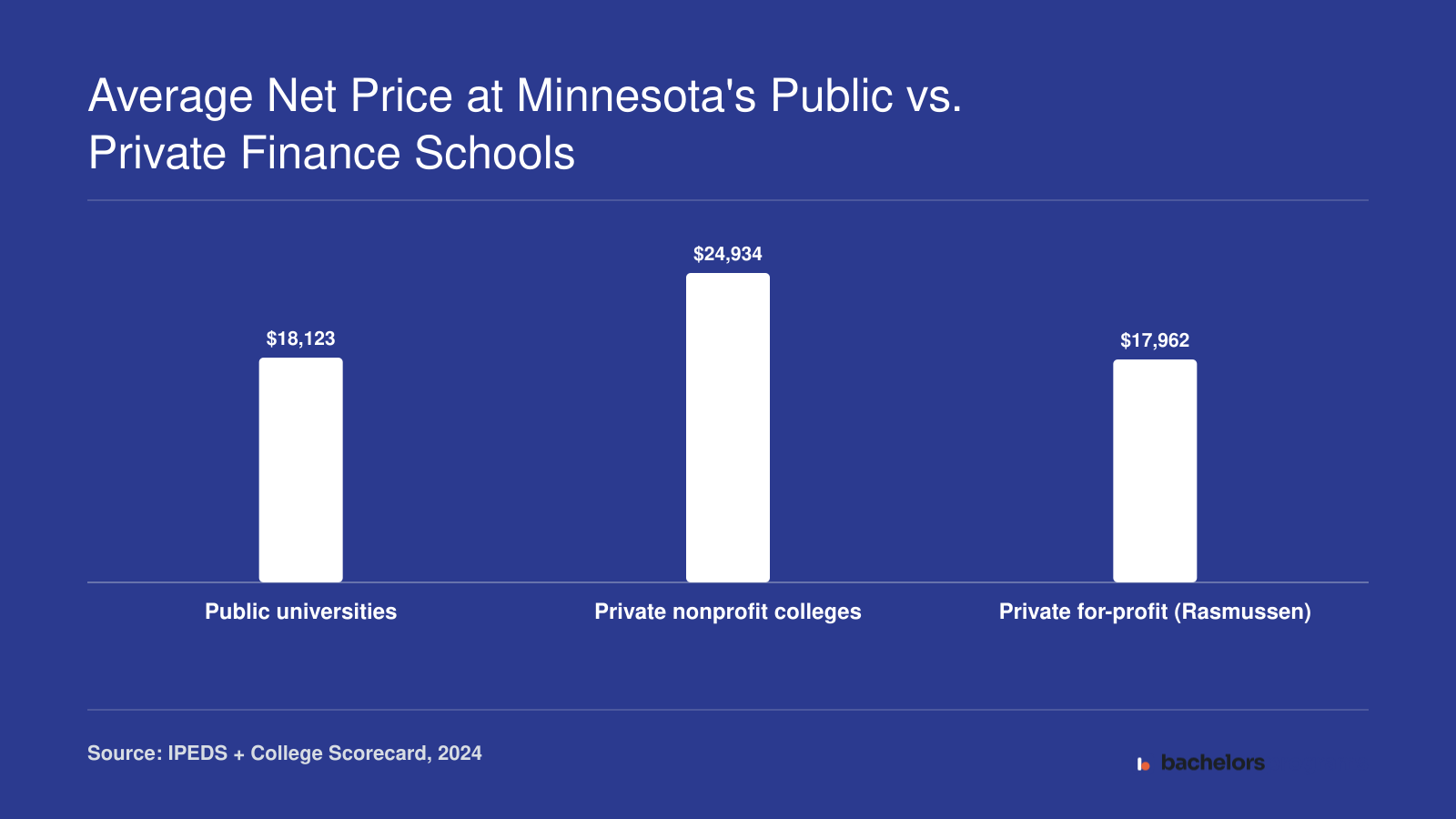
Average Net Price at Minnesota's Public vs. Private Finance Schools
Net price is what families actually pay in a year after grants and scholarships, and it covers more than tuition, so it is the fairer way to compare schools. Among the schools ranked here, the public universities (University of Minnesota-Duluth and Winona State University) average $18,123 after aid. The private nonprofit colleges average $24,934, even though their published tuition and fees average $46,138 against $12,593 at the publics. The sticker gap is more than $33,000; the net price gap is about $6,800. Saint Mary's University of Minnesota, a private school, has the lowest net price in the group at $11,704. Rasmussen University-Minnesota, a private for-profit school, sits at $17,962.
Finance Schools in Minnesota: Common Questions
These answers draw on the program details and costs covered earlier on this page. Tuition varies by residency, delivery format, fees and transfer credit, so confirm current figures with each school.
What is the best school for finance in Minnesota?
Is the University of Minnesota good for finance?
What is the cheapest finance degree in Minnesota?
Can you get a bachelor's degree in finance online in Minnesota?
Which Minnesota finance programs are AACSB accredited?
Compare Finance programs on the data that matters
Explore more Business & Management majors or browse every field of study.
All Business & Management programs Browse every field of study