Best Nonprofit Management Degree Programs
Compare 130+ accredited Nonprofit Management programs, with net price after aid, graduation rates, earnings and debt from IPEDS and the U.S. College Scorecard.

Median earnings a decade after entry at the schools ranked here run from about $58,000 to $74,000, while average net price spans roughly $10,400 to $24,300. Nonprofit salaries start modest and climb with management experience, so the gap between the cheapest and priciest program keeps mattering long after graduation.
Format matters less than it once did: online, campus, and hybrid bachelor's degrees award the same credential, and institutional accreditation decides whether federal aid and transfer credits follow you.
Cost and outcomes, not name recognition, determine whether the degree pays off.
Key Points
- Nonprofits employed 12.8 million U.S. workers in 2022, per BLS.
- Our rankings weigh average net price after aid, not sticker tuition.
- Without recognized institutional accreditation, federal financial aid is generally off the table.
The 10 Best Nonprofit Management Degree Programs
This list covers every delivery format, from fully online degrees to campus programs built around required field placements. Each entry blends cost, graduate outcomes, and access, so a modest price tag or a schedule that fits a working life can count for more than a famous name.
University of Central Florida
#1Orlando, FL · ~$10,000/yr (est.)
Best for: Working adults needing flexible class formats
UCF was the first university in Florida to award a bachelor's degree in nonprofit management, and it still runs the state's most flexible version. The College of Community Innovation and Education builds the program on public and private partnerships, so internships, practicums, and policy work sit alongside coursework. Students can stack extra nonprofit certificates and a minor around the major, and graduates report median earnings of about $45,400 one year after completion.
- First nonprofit management bachelor's degree in Florida
- Concentrations include emergency management and urban planning
- Required internship plus a capstone leadership seminar
- 120 total credit hours; 2.5 GPA minimum
- Classes fully online, mixed-mode, or at UCF Downtown
- Annual nonprofit leadership conference access
- Path to national nonprofit leadership and fundraising credentials
University of Wisconsin-Madison
#2Madison, WI · ~$17,000/yr (est.)
Best for: Community organizers moving into nonprofit leadership
Wisconsin's flagship campus houses this major in the School of Human Ecology, where community and organizational development sits beside consumer science and design programs. The Center for Community and Nonprofit Studies anchors conferences, workshops, and a Chicago networking trip with nonprofit leaders, and every student completes an internship. Graduates report median earnings of about $67,700 one year after completion, the highest early-career figure on this list.
- Concentration in Organizational Development & Nonprofit Management
- Required internships and projects with community partners
- Coursework in grant writing, program evaluation, and philanthropy
- Home to the Center for Community and Nonprofit Studies
- Chicago networking trip with nonprofit leaders
- Social entrepreneurship and innovation coursework
California State Polytechnic University-Pomona
#3Pomona, CA · $10,000 – $15,000/yr (est.)
Best for: Business-minded students entering nonprofit management
Cal Poly Pomona is a polytechnic campus at the eastern edge of Los Angeles County, and its College of Business Administration holds AACSB accreditation. The nonprofit path sits inside a business administration degree, so students complete a full core in accounting, finance, marketing, and strategy before specializing in mission-driven organizations. The university reported roughly 1,400 micro-internship placements in 2025-26 and community projects with the City of Pomona.
- Nonprofit emphasis built on a full business core
- AACSB-accredited college of business
- Internship or senior project option
- Two years before choosing a specialty
- Five concentration options
- 2.0 GPA minimum for the option
Texas A&M University-College Station
#4College Station, TX · ~$21,000/yr (est.)
Texas A&M's College Station campus wraps a public service and administration degree inside a large research university, with 120 credit hours and intermediate foreign language study required. The Public and Nonprofit Management cluster covers fundraising and philanthropy, program assessment, cross-sector collaboration, and stakeholder communication. Listed example employers for graduates include the Red Cross and Texas Health and Human Services, and program graduates report median earnings of about $59,300 one year after completion.
- Public and nonprofit management course cluster
- 120 semester credit hours
- Grade of C or better required in major courses
- 14 hours of foreign language through the intermediate level
- Coursework in fundraising, philanthropy, and program evaluation
- Alternative clusters in policy analysis and emergency management
The University of Texas at Dallas
#5Richardson, TX · $18,000/yr (est. net price)
UT Dallas runs its public and nonprofit management degree through the School of Economic, Political and Policy Sciences, with a curriculum weighted toward public finance, human resources, and leadership ethics. Students complete a capstone in public affairs and 18 upper-level credit hours in public administration courses. A nonprofit management minor and certificate are also available for students in other majors.
- 120 semester credit hours
- 24-credit major core including Public Finance and Economics
- Capstone in public affairs required
- 18 upper-level PA credit hours required
- 45 upper-division credit hours required
- Nonprofit management minor and certificate available
Auburn University
#6Auburn, AL · $13,000 – $35,000/yr (est.)
Auburn treats fundraising, grantmaking, and nonprofit law as core coursework rather than electives, which gives the philanthropy and nonprofit studies major an unusually practical spine. A required internship and portfolio capstone give students documented work to show hiring managers, and a study abroad travel course adds an international view of giving. Graduates report median earnings of about $56,900 one year after completion.
- Required internship in the nonprofit sector
- Portfolio capstone requirement
- Coursework in grantmaking, fundraising, and nonprofit law
- 120 total credit hours
- Study abroad travel course in international philanthropy
- Pairs with minors such as Hunger Studies or Consumer Financial Planning
University of Houston
#7Houston, TX · $10,000 – $23,000/yr (est.)
The University of Houston's nonprofit offering is a certificate open to undergraduates in any degree program, run through the David M. Underwood Chapter under the Graduate College of Social Work. Students build competencies in fundraising, governance, advocacy, and volunteer management, then can sit for the national Certified Nonprofit Professional designation. The chapter has served as a Houston workforce pipeline since 1993 and added MSW students in 2022.
- Open to undergraduates in any degree program
- Path to the Certified Nonprofit Professional credential
- Competencies in fundraising, governance, and advocacy
- Legal and ethical decision making coursework
- David M. Underwood Chapter serving Houston since 1993
- Expanded to include MSW students in 2022
Indiana University-Bloomington
#8Bloomington, IN · $12,000 – $42,000/yr (est.)
Indiana University Bloomington delivers nonprofit management and leadership through the O'Neill School of Public and Environmental Affairs, a top-ranked public affairs school. The BS in Public Affairs pairs core public affairs training with fund development, cost-benefit analysis, and financial management. Students learn to run organizations, coordinate programs, and manage people and communication, which feeds directly into director, program manager, and development officer roles.
- Offered by the O'Neill School of Public and Environmental Affairs
- Coursework in cost-benefit analysis and fund development
- Focus on managing people, projects, and communication
- Prepares students to run organizations and programs
- Emphasis on healthy organizational leadership
California State University-Monterey Bay
#9Seaside, CA · ~$14,000/yr (est.)
Cal State Monterey Bay structures its collaborative health and human services degree around supervised field practice: a junior practicum seminar, a senior practicum paired with a capstone, and a community engaged research course. The public administration and nonprofit management concentration adds 12 upper-division units that cannot double count toward other minors or concentrations. Required coursework includes professional ethics, policy analysis, and quantitative analysis of survey data.
- Concentration in public administration and nonprofit management
- Junior and senior field practicum seminars
- Senior capstone paired with the field practicum
- Community engaged research course
- Professional ethics and policy analysis coursework
- 12 upper-division concentration units that cannot double count
Arizona State University
#10Tempe, AZ · ~$15,000/yr (est.)
Arizona State University's nonprofit leadership and management degree is accredited by the Nonprofit Academic Centers Council and includes an internship in organizational strategy. Students can earn the Certified Nonprofit Professional credential, intern abroad with nonprofits in South America or Asia, or use an accelerated route to finish a bachelor's and master's in five years. Graduates report median earnings of about $61,100 one year after completion.
- Accredited by the Nonprofit Academic Centers Council
- Certified Nonprofit Professional credential offered
- Accelerated bachelor's plus master's option in five years
- Internship in organizational strategy
- Intern abroad with nonprofits in South America or Asia
- No second language requirement
Cost & outcomes by school
Federal data for the highest-earning Nonprofit Management programs, independent of the ranking above. Earnings are this field's bachelor's graduates four years after completing where the Scorecard reports them, else the school's undergraduate median.
| School | Net price / yr | Grad rate | Earnings | Debt | Grads/yr | Format |
|---|---|---|---|---|---|---|
| University of Wisconsin-Madison WI | $17,354 | 90% | $100,005 | $20,000 | 226 | Campus |
| University of Pittsburgh-Pittsburgh PA | $30,434 | 86% | $95,917 | $20,500 | 106 | Campus |
| George Mason University VA | $17,915 | 68% | $85,224 | $19,440 | 2 | Campus |
| Colorado State University Global CO | $16,510 | — | $83,415 | $24,495 | 495 | Online |
| Arizona State University AZ | $14,967 | 68% | $82,535 | $20,490 | 284 | Hybrid |
| Texas A&M University-College Station TX | $21,315 | 84% | $82,213 | $17,974 | 486 | Campus |
| Washington State University WA | $14,971 | 61% | $81,321 | $19,443 | 183 | Campus |
| Auburn University AL | $24,323 | 82% | $80,323 | $20,750 | 598 | Campus |
| Grand Valley State University MI | $16,317 | 67% | $79,324 | $25,000 | 109 | Campus |
| College of Saint Benedict MN | $26,640 | 77% | $78,901 | $27,000 | 32 | Campus |
| Wheaton College (Massachusetts) MA | $29,822 | 73% | $78,769 | $27,000 | 65 | Campus |
| Linfield University OR | $26,536 | 71% | $77,983 | $27,000 | 16 | Online |
Sources: U.S. Department of Education. Net price, graduation rate, earnings and debt: College Scorecard (earnings and debt for this field's bachelor's graduates where reported, else school-wide); graduates: IPEDS. A dash means no figure is reported.
Cost, debt & payoff
Median earnings of this field's bachelor's graduates (4 yrs after completing, else the school's undergraduate median) vs. their median federal loan debt · U.S. College Scorecard
Across these programs the median graduate earns about $60,176 and finishes with roughly $22,778 in debt — a ratio that clears a common rule of thumb (keep debt below first-year salary). Net price and debt vary widely school to school, so check the per-school figures in the table above before you shortlist.
How We Ranked These Nonprofit Management Programs
A strong nonprofit management program is not necessarily the expensive one.
The Factors That Carry Weight
Affordability leads, measured by average net price after grants and scholarships rather than published tuition. Next come the institution's graduation and retention rates, then program-level earnings and typical debt reported through the federal College Scorecard. A larger Pell-eligible share signals a school that genuinely enrolls lower-income students, and format flexibility counts for working students who need evening or online classes. These factors are read together, because a low-cost program that few students finish is no bargain.
Why Net Price Beats Sticker Price
Nonprofit careers often begin with modest salaries, so borrowing less matters more than a recognizable name. A lower net cost leaves room to accept the entry-level role that builds real experience, and it shortens the years spent repaying loans before you can afford to stay in the field you trained for.
What the Numbers Cannot Tell You
Graduation rates describe the whole institution, not the nonprofit management major, and net price describes the average student rather than your own bill. Figures come from federal College Scorecard and IPEDS data, not from school self-reporting or reputation surveys.
Nonprofit Management Degree Cost: The Most Affordable Options
These are the lowest-cost picks among the ranked programs, based on 2024 U.S. Department of Education data from IPEDS and the College Scorecard, with median federal debt at completion and the typical 10-year monthly payment showing what graduates actually owe. Eastern Florida State College is the most affordable option here at $6,440 a year after aid, though its bachelor of applied science requires a prior associate degree. Before you commit, run each school's net price calculator and compare your personalized estimate against these averages, since your aid package can land well above or below the typical student's.
| School | Location | Program | Format | Average Net Price After Aid | Median Federal Debt at Completion | 10-Year Monthly Payment |
|---|---|---|---|---|---|---|
| Eastern Florida State College | Melbourne, FL | Organizational Management (BAS), Nonprofit Management Specialization | Hybrid | $6,440 | $18,751 | $199 |
| Murray State University | Murray, KY | Nonprofit Leadership Studies | Campus | $9,096 | $21,061 | $223 |
| University of Illinois Springfield | Springfield, IL | Public and Nonprofit Administration | Online | $9,833 | $21,799 | $231 |
Nonprofit Management Degree Salary and Career Outcomes
A nonprofit management degree salary is a trajectory, not a single posted number. Graduates usually enter the sector in coordinator, associate, or program assistant roles, then move into management as they build experience. The latest federal program-level data shows what that path can look like: at the University of Pittsburgh, graduates of the nonprofit management track reported median earnings of $102,112 five years after finishing. The University of Wisconsin-Madison's community and organizational development program reported $92,203 at the same five-year mark. Grand Valley State's public and nonprofit administration graduates reported $83,452 five years out, and Auburn's philanthropy and nonprofit studies graduates reported $76,513. These are program-level medians, not institution-wide 10-year earnings. At the top end, they already sit above the median for social and community service managers, which is one reason specific program outcomes and broad occupation averages should be read side by side.1
What the Occupation Medians Show
The Bureau of Labor Statistics' May 2025 median annual wages provide a broader benchmark. Social and community service managers earned $80,390, with projected growth of 7% from 2025 to 2035, about 16,600 additional jobs.1 Fundraisers earned $72,550, with 6% growth and 7,800 jobs.2 Human resources managers, a common destination for nonprofit operations staff, earned $149,280, with 6% growth and 12,500 jobs.3 Administrative services and facilities managers are reported as a combined category with a median of $110,500 and 5% growth, about 22,000 jobs; within that group, administrative services managers earned $114,130 and facilities managers $106,660.4
From Coordinator to Executive Director
The practical answer to "what jobs can you get" starts with program manager, development or fundraising officer, volunteer coordinator, and grants manager. Experienced graduates move into operations director, development director, and eventually executive director roles. That progression explains the gap between early program earnings and occupation medians: many alumni are still in coordinator or associate positions five years out, while the BLS medians reflect a more seasoned workforce. The degree qualifies you for the first role; sustained responsibility and results move you up the salary scale.
What Social and Community Service Managers Earn
Many nonprofit management graduates move into program director and executive roles, which federal labor data groups under social and community service managers.
Related Articles
Online vs. Campus Nonprofit Management Degrees
Fully online bachelor's degrees in nonprofit management and nonprofit leadership do exist, and several of the programs ranked here are offered online or in both formats. The right choice depends on how much flexibility you need, how many credits you can bring in, and whether you want in-person internships. Policies change, so confirm current transfer limits and prior-learning rules with each admissions office.
| Factor | Online | On Campus |
|---|---|---|
| Flexibility | Mostly asynchronous coursework that fits around a job or family. Arizona State University and City Vision University both offer fully online bachelor's options. | Fixed class times and a set location. Less schedule control, but more structure and face-to-face access to faculty. |
| Typical student profile | Working adults, career changers, and nonprofit staff finishing a degree they started earlier. | Traditional-age students who can study full time and want a conventional college experience. |
| Transfer credit | Caps are often generous. City Vision University accepts up to 75 percent of bachelor's degree credits, and the University of South Carolina Upstate lists 90 credit hours for its online organizational leadership degree with a nonprofit leadership concentration. | Varies by school and is set by the registrar. Ask for a written credit evaluation before you enroll. |
| Prior-learning credit | City Vision University has students complete a Prior Learning Assessment Portfolio Development course using the CAEL process. Faculty review each portfolio against course learning outcomes. | DePaul University's Bachelor of Arts in Nonprofit Management lets students pursue credit for prior learning from experience. |
| Internship access | Often arranged locally or through your current employer. Arizona State University offers a six-credit internship as one option for the culminating experience. | Easier to tap campus career offices, local nonprofit partners, and nearby agencies for placements during the term. |
| Networking | Built through discussion boards, virtual cohorts, and your own community. It takes more deliberate effort. | Built through classmates, faculty, student groups, and in-person events with local nonprofit leaders. |
| Best suited for | Working adults and career changers who need flexibility and want their experience and earlier credits to count. | Traditional-age students who want campus internships, face-to-face mentoring, and a local professional network. |
Accreditation and Quality Signals: Regional Accreditation and NACC Alignment
The U.S. Department of Education recognizes the accrediting agencies that matter most, and institutional accreditation from one of them is the baseline for any nonprofit management degree. Without it, federal financial aid is generally off the table and credits may not transfer to another school or a graduate program. Treat it as non-negotiable.
What NACC Adds
The Nonprofit Academic Centers Council (NACC) is a network of university centers that publishes curricular guidelines for nonprofit education. At the undergraduate level, those guidelines typically address themes such as the nonprofit sector and philanthropy, governance, leadership, fundraising, financial management, and ethics. NACC offers peer review and curricular alignment, not programmatic accreditation. A program that follows NACC guidance is signaling curricular quality, but that is not the same as holding an accreditor's approval. Current guidelines and review procedures change, so confirm details with NACC directly.
How to Verify
- Institutional status: Search the school in the Department of Education's DAPIP database or on the Council for Higher Education Accreditation (CHEA) site.
- NACC connection: Check NACC's published list of member or peer-reviewed programs, and ask the program office what its alignment means in practice.
The CNP Credential
Some schools embed the Nonprofit Leadership Alliance's Certified Nonprofit Professional (CNP) credential into their degrees. It rests on five areas: volunteer service, professional experience, nonprofit knowledge and skills, leadership development, and education.2 Fees depend on the pathway. NLA lists $150 for campus partner students and $325 for independent students3, while ASU Lodestar lists a separate $450 credentialing fee4, so ask any school exactly what you would pay. NLA does not require renewal.5 Think of the CNP as an add-on signal, never a replacement for accreditation.
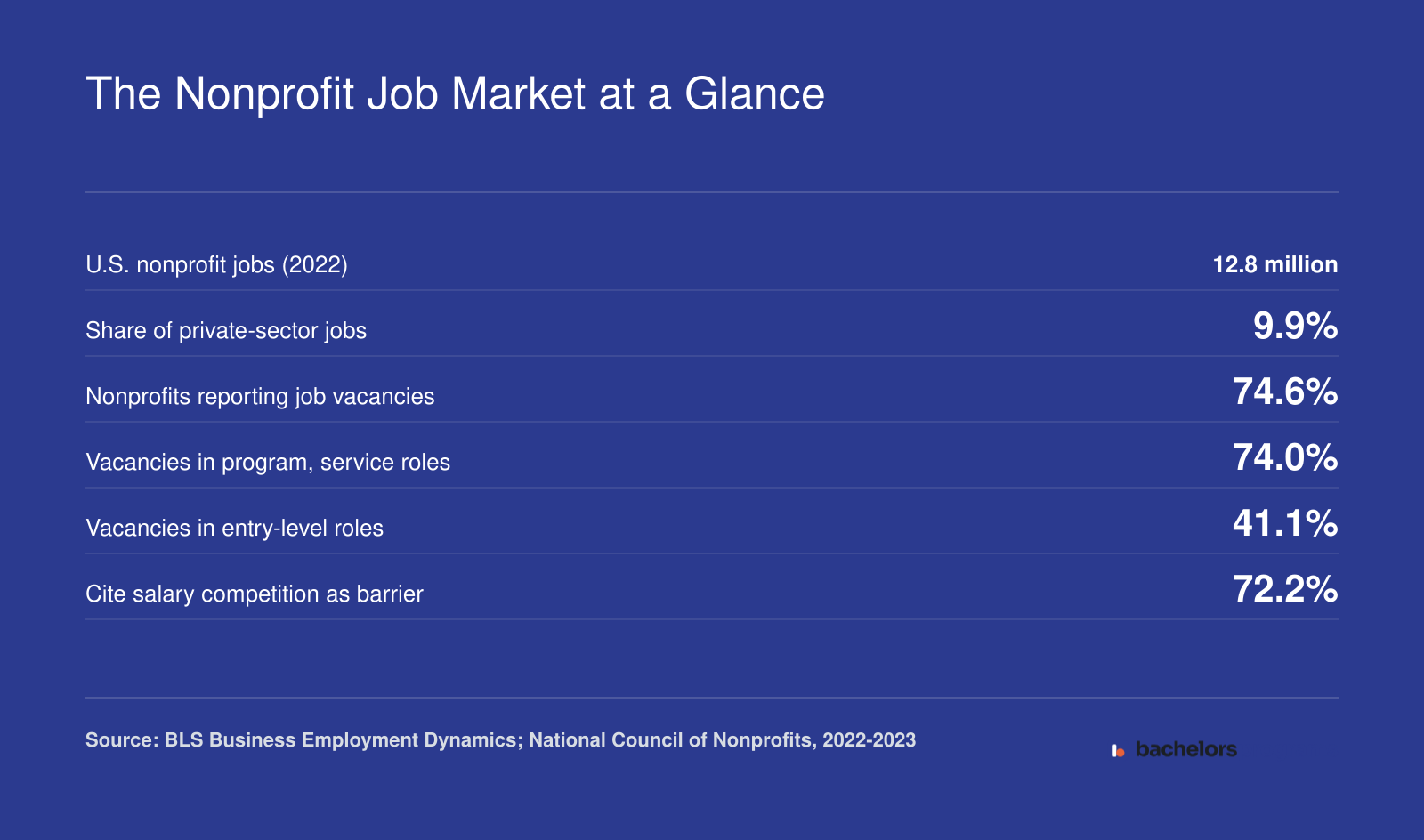
The Nonprofit Job Market at a Glance
Nonprofits employed 12.8 million people in 2022, according to the Bureau of Labor Statistics (a count that excludes some small nonprofits), or nearly one in ten private-sector workers. In the National Council of Nonprofits' 2023 workforce survey, about three in four responding organizations reported open positions, most often in program delivery and entry-level roles. Those openings favor graduates who pair nonprofit management coursework with internships or service experience, and because salary competition was the top hiring barrier, compare pay carefully when weighing offers.
Nonprofit Management programs by state
Nonprofit Management Degree FAQs
These answers draw on the program, cost, and earnings details covered above. Requirements and outcomes vary by employer and school, so confirm specifics directly with any program you are considering.
Is a nonprofit management degree worth it?
Are there fully online bachelor's degrees in nonprofit management?
Do you need a master's degree to become a nonprofit executive director?
Can you work in nonprofits with a general business degree instead?
Compare Nonprofit Management programs on the data that matters
Explore more Business & Management majors or browse every field of study.
All Business & Management programs Browse every field of study