Best Risk Management Degree Programs
Compare 90+ accredited Risk Management programs, with net price after aid, graduation rates, earnings and debt from IPEDS and the U.S. College Scorecard.

Risk management has moved well beyond the insurance claims desk, and employers now want graduates who can price exposure as well as prevent loss. A bachelor's degree in risk management, usually awarded as a Bachelor of Business Administration (B.B.A.) or a Bachelor of Science (B.S.), leads directly into underwriting, brokerage, and corporate risk roles at insurers, banks, hospitals, and corporations.
Every program covered here is undergraduate; graduate study is a separate decision. Program titles vary (BBA, B.S.B.A., B.S.), but recruiting often runs through a few university-industry partnerships, so the school you choose shapes which insurers and brokers hire you.
Key Points
- Public net prices run from $9,812 (USF) to $19,398 (Illinois State).
- Every ranked program is campus-based, so online students must look elsewhere.
- The University of Iowa holds Society of Actuaries University Earned Credit status.
Best Risk Management Degree Programs for 2027
These ten programs are listed with cost, graduation rates, selectivity and program-level earnings side by side, so you can compare schools on the measures that matter most when choosing a bachelor's degree in risk management. All ten are campus-based, and most sit inside business schools that insurers, brokerages and corporate risk teams recruit from directly. Where a program publishes earnings or debt figures for its own graduates, those numbers appear in the write-up.
University of Georgia
#1Athens, GA · ~$14,000/yr (est.)
Best for: Insurance majors eyeing corporate recruiter pipelines
UGA sits in Athens, Georgia, and its Terry College of Business runs one of the country's larger risk management and insurance majors, with corporate sponsorship from Chubb, Liberty Mutual, Lockton and Marsh McLennan feeding internships and recruiting. Average net price after aid is about $13,936 and the school's graduation rate is 90 percent. Program graduates report median first-year earnings of $64,131 and median debt of $22,394.
- 120 credit hours plus one physical education hour
- 30 credit hours of major coursework in the Terry College
- Admission needs 2.6 GPA, MATH 1113, ACCT 2101, ACT or SAT
- Choose from actuarial math, life insurance, or international risk
- Optional 12-credit Business Analytics area of emphasis
- Internships earn up to 6 credits
- Insurance Society and Gamma Iota Sigma award scholarships
Florida State University
#2Tallahassee, FL · ~$11,000/yr (est.)
Best for: Florida students wanting built-in placement events
Florida State's Tallahassee campus admits risk management and insurance students through a specialized admission program in the College of Business, with certification typically in the junior year. The department runs Insurance Days, a two-day placement event for RMI majors, and hosts a Gamma Iota Sigma chapter. Average net price after aid is about $11,297 and the school's graduation rate is 86 percent, with program graduates reporting median first-year earnings of $61,071.
- Specialized admission program; students certify junior year
- Covers property-casualty, life and health, financial planning, benefits
- Two-day Insurance Days placement event for RMI majors
- Combined bachelor's/master's pathway; double count up to nine credits
- Gamma Iota Sigma chapter on campus
- Eight-semester map outlines the four-year degree
University of Wisconsin-Madison
#3Madison, WI · ~$17,000/yr (est.)
Best for: Analytics-minded students drawn to catastrophe risk
At UW-Madison, the BBA in risk management and insurance is quantitative: students take risk analytics and behavioral science, catastrophe risk and reinsurance, and risk financing techniques within a 120-credit degree. Admission is fall-only with a 3.0 GPA threshold. Average net price after aid is about $17,354, the school's graduation rate is 90 percent, and program graduates report the highest median first-year earnings on this list at $78,796.
- 15 major credits inside a 120-credit degree
- R M I 300 is prerequisite for all other R M I courses
- Choose from catastrophe risk and reinsurance, risk analytics, and more
- 3.0 UW-Madison GPA and calculus required for admission
- Fall-only admission; 24 credits for first-year, 12 for transfers
- Coursework prepares students for CPCU and ARM designations
University of South Florida
#4Tampa, FL · ~$10,000/yr (est.)
USF's Tampa campus houses the Baldwin Group School of Risk Management and Insurance inside the Muma College of Business, with separate tracks in property-casualty and life-health insurance. A $1 million commitment from the Florida Surplus Lines Service Office created a directorship in excess and surplus lines, a niche few undergraduate programs cover, and the major is also offered at USF St. Petersburg. Average net price after aid is about $9,812, the lowest here, and the school's graduation rate is 77 percent.
- Two tracks: property-casualty insurance and life/health insurance
- Housed in the Baldwin Group School of Risk Management and Insurance
- Prepares for risk analyst, underwriter, broker and claims roles
- Major also offered at the USF St. Petersburg location
- Florida Surplus Lines Insurance Directorship focuses on excess and surplus lines
University of Minnesota-Twin Cities
#5Minneapolis, MN · ~$17,000/yr (est.)
The Carlson School of Management folds finance and risk management insurance into one Bachelor of Science in Business major, and every student completes an international experience. Coursework runs from employee benefits and corporate risk management to options and derivatives, and the major cannot be combined with a finance minor. Average net price after aid is about $16,778 and the school's graduation rate is 85 percent.
- 120 credits, combining finance and risk management insurance
- Includes Employee Benefits, Corporate Risk Management, Options & Derivatives
- Required international experience, short-term or semester length
- Cannot be paired with a Finance minor
- Separate Risk Management and Insurance minor available
- Graduates hired by Travelers, Allianz, State Farm and major banks
University of South Carolina
#6Columbia, SC · ~$23,000/yr (est.)
The Darla Moore School of Business holds a Global Center for Insurance Excellence designation from the International Insurance Society and a Gamma Iota Sigma chapter. Its 122-credit B.S.B.A. mixes risk management and insurance courses in life insurance, property and liability, and corporate risk with the business core. Average net price after aid is about $22,811, the school's graduation rate is 79 percent, and program graduates report median first-year earnings of $63,417.
- 122 credit hours through the Darla Moore School of Business
- Global Center for Insurance Excellence designation
- Coursework in life insurance, property and liability, corporate risk
- Optional business analytics concentration
- Lambda chapter of Gamma Iota Sigma
- Risk and Uncertainty Management Center on campus
University of Iowa
#7Iowa City, IA · $11,000 – $33,000/yr (est.)
Iowa's Vaughan Institute supplies scholarships, networking events and a recruiting book for risk management majors, and the Tippie College holds a Global Center of Insurance Excellence designation. Classes are project-based, including a captive insurer business plan, and a risk management certificate is open to every Iowa major. Average net price after aid is about $22,531 and the school's graduation rate is 75 percent; the program reports full placement within six months and a $68,000 starting salary for its Class of 2025.
- Vaughan Institute offers scholarships, networking and a recruiting book
- One of 25 Global Centers of Insurance Excellence
- Risk Management Certificate open to all Iowa majors
- Students build a captive insurer business plan in class projects
- Gamma Iota Sigma chapter at the Tippie College
- Program reports 100% placement and a $68,000 Class of 2025 salary
University of Mississippi
#8University, MS · $10,000 – $15,000/yr (est.)
Ole Miss runs a 120-credit B.B.A. in risk management and insurance on its Oxford campus, with required courses in commercial insurance, insurer operations and enterprise risk management. Strong grades in two required courses earn credit toward CPCU and CIC designations, and the program is one of 34 Global Centers of Insurance Excellence. Average net price after aid is about $13,314, the school's graduation rate is 72 percent, and program graduates report median first-year earnings of $55,154.
- 120 credit hours over four years in Oxford
- Courses in commercial insurance, enterprise risk and insurer operations
- Up to 6 credits for a graded RMI internship
- B or better in FINA 4410 and FINA 4420 earns CPCU credit
- One of 34 Global Centers of Insurance Excellence
- Thirteen named RMI scholarships; biannual career fairs
- Paid internships for most RMI students
Appalachian State University
#9Boone, NC · $8,000 – $25,000/yr (est.)
Appalachian State's Walker College of Business supports its risk management and insurance BSBA through the Brantley Risk and Insurance Center, which handles career coaching, networking and study abroad. Majors must add a minor, usually marketing, management, or finance and banking, and the program reports a 96 percent placement rate and a No. 2 national ranking from AM Best. Average net price after aid is about $16,836, the school's graduation rate is 75 percent, and program graduates report median first-year earnings of $55,611 with median debt of $18,625.
- Required minor, typically marketing, management, or finance and banking
- Brantley Risk and Insurance Center handles career development
- Program reports 96% job placement
- AM Best ranks the program No. 2 in the country
- Global Center of Insurance Excellence designation
- Accelerated bachelor's to master's option available
University of Cincinnati
#10Cincinnati, OH · ~$26,000/yr (est.)
Cincinnati's Lindner College of Business requires two co-op rotations of every new first-year student, so insurance and risk management majors graduate with work experience already completed. The BBA covers property-casualty and life-health insurance plus corporate risk management, with study abroad options running from one week to a full semester. Average net price after aid is about $25,648, the highest here, and the school's graduation rate is 75 percent.
- Two required co-op rotations for all new first-year students
- Curriculum guide effective Fall 2026 for the BBA
- 2.0 GPA minimum; 50% of business courses in residence
- AACSB International accredited since 1919
- Study abroad from one week to a full semester
- Careers in property-casualty, life and health, corporate risk
Cost & outcomes by school
Federal data for the highest-earning Risk Management programs, independent of the ranking above. Earnings are this field's bachelor's graduates four years after completing where the Scorecard reports them, else the school's undergraduate median.
| School | Net price / yr | Grad rate | Earnings | Debt | Grads/yr | Format |
|---|---|---|---|---|---|---|
| University of Wisconsin-Madison WI | $17,354 | 90% | $105,992 | $20,500 | 96 | Campus |
| St. John's University-New York NY | $29,999 | 66% | $105,688 | $24,072 | 25 | Campus |
| Saint Joseph's University - Philadelphia PA | $29,689 | 79% | $101,930 | $21,500 | 58 | Campus |
| Georgia State University GA | $15,931 | 53% | $101,040 | $21,000 | 34 | Campus |
| University of Houston-Downtown TX | $10,542 | 33% | $98,510 | $18,750 | 24 | Online or campus |
| University of South Carolina SC | $22,811 | 79% | $96,539 | $25,173 | 90 | Campus |
| University of Georgia GA | $13,936 | 90% | $94,729 | $17,642 | 274 | Campus |
| Illinois State University IL | $19,398 | 65% | $94,124 | $19,000 | 26 | Campus |
| Temple University PA | $28,198 | 75% | $92,555 | $24,750 | 150 | Campus |
| University of Southern California CA | $32,740 | 92% | $92,498 | $18,000 | — | Campus |
| Florida State University FL | $11,297 | 86% | $92,064 | $21,875 | 93 | Campus |
| Butler University IN | $36,041 | 80% | $89,343 | $26,000 | 38 | Campus |
Sources: U.S. Department of Education. Net price, graduation rate, earnings and debt: College Scorecard (earnings and debt for this field's bachelor's graduates where reported, else school-wide); graduates: IPEDS. A dash means no figure is reported.
Cost, debt & payoff
Median earnings of this field's bachelor's graduates (4 yrs after completing, else the school's undergraduate median) vs. their median federal loan debt · U.S. College Scorecard
Across these programs the median graduate earns about $59,612 and finishes with roughly $22,142 in debt — a ratio that clears a common rule of thumb (keep debt below first-year salary). Net price and debt vary widely school to school, so check the per-school figures in the table above before you shortlist.
How We Ranked These Bachelor's Programs
Prestige-based rankings reward reputation, while outcome-based rankings reward what actually happens to students after they enroll. Our ranking of risk management bachelor's programs uses the second approach.
What We Measured
Each school was evaluated on a consistent set of public measures:
- Affordability: average net price once grants and scholarships are applied
- Student success: institution-wide graduation and first-year retention rates
- Access: admission rate
- Program outcomes: median earnings and median debt for graduates of the school's risk management or risk management and insurance program
Cost, admissions, and completion figures come from the 2024 College Scorecard release and federal IPEDS data. Program-level earnings and debt are drawn from College Scorecard's field-of-study records, which track recent graduates of a specific major rather than the whole campus.
Limits to Keep in Mind
Graduation rates and net price describe the entire university, not the risk management major alone. A business college may graduate students faster or slower than its campus average. Some smaller programs also have no published program-level earnings, because federal data withholds results for small graduating classes. The University of South Florida and the University of Minnesota-Twin Cities fall into this group, so their placement rests on the other measures.
Why Outcomes Outweigh Prestige
Entry-level roles such as underwriter, claims adjuster, and risk analyst tend to hire on skills, internships, and progress toward industry designations rather than school name alone. A program that keeps debt manageable and produces strong early earnings delivers more value than a famous brand with a higher price tag.
What a Bachelor's Degree in Risk Management Covers
A risk management bachelor's degree is a business degree: it teaches you to identify, measure, and finance the threats organizations and households face, with insurance as the main tool. Most programs sit inside a business school, so the risk courses share the schedule with a business core.
Credits and structure
Credit totals are set by each school, not nationally. Eastern Kentucky, St. John's, and Virginia Commonwealth each list 120 credits, while Temple lists 124 for students entering in 2026-2027. Those credits generally divide among general education, a business core (accounting, finance, statistics, management, marketing, business law), the risk major, and electives. At Temple, the major itself is 18 credits. At Colorado Denver, it is 24.3
Courses you will likely take
Exact requirements differ, but these topics recur across catalogs:
- Foundations: Principles of Risk and Insurance, the usual entry point.1
- Property and liability: Personal insurance and commercial property risk management.
- Life and health: Fundamentals of Life and Health Insurance.
- Enterprise focus: Risk Management and Commercial Risk Management courses.
- Quantitative skills: Statistics, risk analytics, or a quantitative track such as St. John's Quantitative Risk and Insurance concentration.
Search under both names
Many schools title the major Risk Management and Insurance (RMI), and some, like Virginia Commonwealth, offer it as a concentration within a general business degree.2 Search both names so you don't miss options.
Hands-on requirements
Colorado Denver builds 3 credits of experiential learning in the RMI industry into the major.3 Temple asks students to choose a concentration: Healthcare Risk Management, Managing Corporate Risk, or Managing Human Capital Risk. Check each program's catalog for capstones, case competitions, or internship requirements.
Insurance, Enterprise Risk, Financial Risk, or Actuarial: Which Track Fits?
Most bachelor's programs in risk management share a business core, then split into tracks with different quantitative demands and career paths. The actuarial track carries the heaviest math load and is built around professional exams, while the other three lean more on business, finance, and analytics. To see which tracks each school offers, check the concentration field in the ranking above.
| Factor | Insurance and Risk Management | Enterprise Risk Management | Financial Risk Management | Actuarial Science |
|---|---|---|---|---|
| Primary focus | Identifying risk exposures, estimating their impact, and putting protections such as insurance contracts in place | Managing risk across the whole organization | Financial-risk topics represented in the Financial Risk Manager (FRM) exam | Quantitative actuarial qualification built on math, statistics, finance, and insurance |
| Signature coursework | Commercial property and liability insurance, employee benefits, insurer operations, life insurance, corporate risk management | Principles of Risk Management and Insurance, Introductory Financial Management, Enterprise Risk Management | Financial risk management courses that expose students to the first part of the FRM syllabus | At least 24 semester hours across actuarial science, math, statistics, business, finance, economics, insurance, or computer science |
| Entry-level roles | Underwriter, claims adjuster, broker or agent, risk analyst | Risk analyst, risk consultant, risk manager | Financial or credit analyst, corporate risk, risk consulting | Actuary |
| Related credential | No single required credential identified | No specific designation identified | FRM exam, sponsored by the Global Association of Risk Professionals (GARP) | Federal actuarial-series qualification recognizes the degree with specified coursework; professional actuarial exams follow |
| Math intensity | Moderate: data analytics and financial risk courses on a business foundation | Moderate: business and analytics focus | Moderate to high: finance-heavy quantitative topics tied to FRM material | Highest: at least 12 semester hours of math including differential and integral calculus, with an exam-driven path |
Can You Earn a Risk Management Degree Online?
Is a risk management degree available fully online?
Yes, though none of the schools in this ranking is fully online. Every program listed is campus-based, so readers who need an online format have to look beyond this ranking.
Where the Online Options Are
Several schools outside the ranking run fully online risk management and insurance degrees. Old Dominion University's online RMI major requires 120 credits1, SUNY Oswego offers its RMI B.S. online to first-year and transfer students2, and Faulkner University's Bachelor of Risk Management and Insurance is fully online3 and aimed partly at mid-career students. Eastern Kentucky University's BBA in Risk Management & Insurance allows up to 90 transfer credits.4 Availability can vary by concentration within a single department, so confirm your intended track is offered online before applying.
Transfer Credits and Residency
Degree-completion students should plan on a 90/30 split: up to 90 transfer credits toward a 120-credit degree, with at least 30 earned at the awarding institution. Residency commonly runs 25% to 30% of the degree.
- Southern New Hampshire University: up to 90 credits, at least 12 in the major, C- minimum on transferable coursework
- Old Dominion University: 90 transfer credits, 30 completed at ODU
- Eastern Kentucky University: 90 transfer credits, 30 completed at EKU
- Arizona State University Online: 64 credits published, a planning figure for community college work since limits vary by college
Community college business and economics courses usually apply toward lower-division and general business requirements rather than the major, and transcripts are typically reviewed for articulation after admission.
Campus vs. Online Trade-offs
Online suits working adults already in insurance roles who need schedule flexibility around a job. Campus programs put recruiting events, risk management clubs such as Gamma Iota Sigma, and case competitions within easier reach.
Related Articles
Risk Management Degree Cost, Debt, and Return on Investment by School
Public universities dominate the value end of this list: average net prices after aid at the public schools run from $9,812 at the University of South Florida to $19,398 at Illinois State University, while the private schools (Northwood, Saint Joseph's, and Butler) range from $27,232 to $36,041. The ROI ratio is a proxy that divides a school's institution-wide median earnings 10 years after entry by its institution-wide median federal debt, so it describes the whole university rather than the risk management program's own graduates. The monthly payment column reflects program graduates where U.S. Department of Education College Scorecard data reports it. Net price is an average after grants and scholarships, so your cost may be higher or lower; run each school's net price calculator for an estimate based on your family's finances.
| School | Sector | Average Net Price After Aid | Median Federal Debt at Completion (Institution-Wide) | Median 10-Year Monthly Payment (Program Graduates) | ROI Ratio (Institution-Wide Proxy) |
|---|---|---|---|---|---|
| University of Georgia | Public | $13,936 | $18,500 | $187 | 3.71 |
| University of Wisconsin-Madison | Public | $17,354 | $20,484 | $217 | 3.60 |
| University of Minnesota-Twin Cities | Public | $16,778 | $19,500 | N/A | 3.54 |
| Florida State University | Public | $11,297 | $18,000 | $232 | 3.43 |
| Saint Joseph's University | Private nonprofit | $29,689 | $25,500 | $228 | 3.41 |
| University of South Florida | Public | $9,812 | $17,988 | N/A | 3.21 |
| Central Washington University | Public | $18,476 | $19,500 | N/A | 3.16 |
| Illinois State University | Public | $19,398 | $20,482 | $201 | 3.03 |
| Northwood University | Private nonprofit | $27,232 | $20,842 | N/A | 3.03 |
| Butler University | Private nonprofit | $36,041 | $26,000 | N/A | 2.97 |
Top First-Year Earnings Among Ranked Programs
Among the schools ranked here, one program stands out for early-career pay.
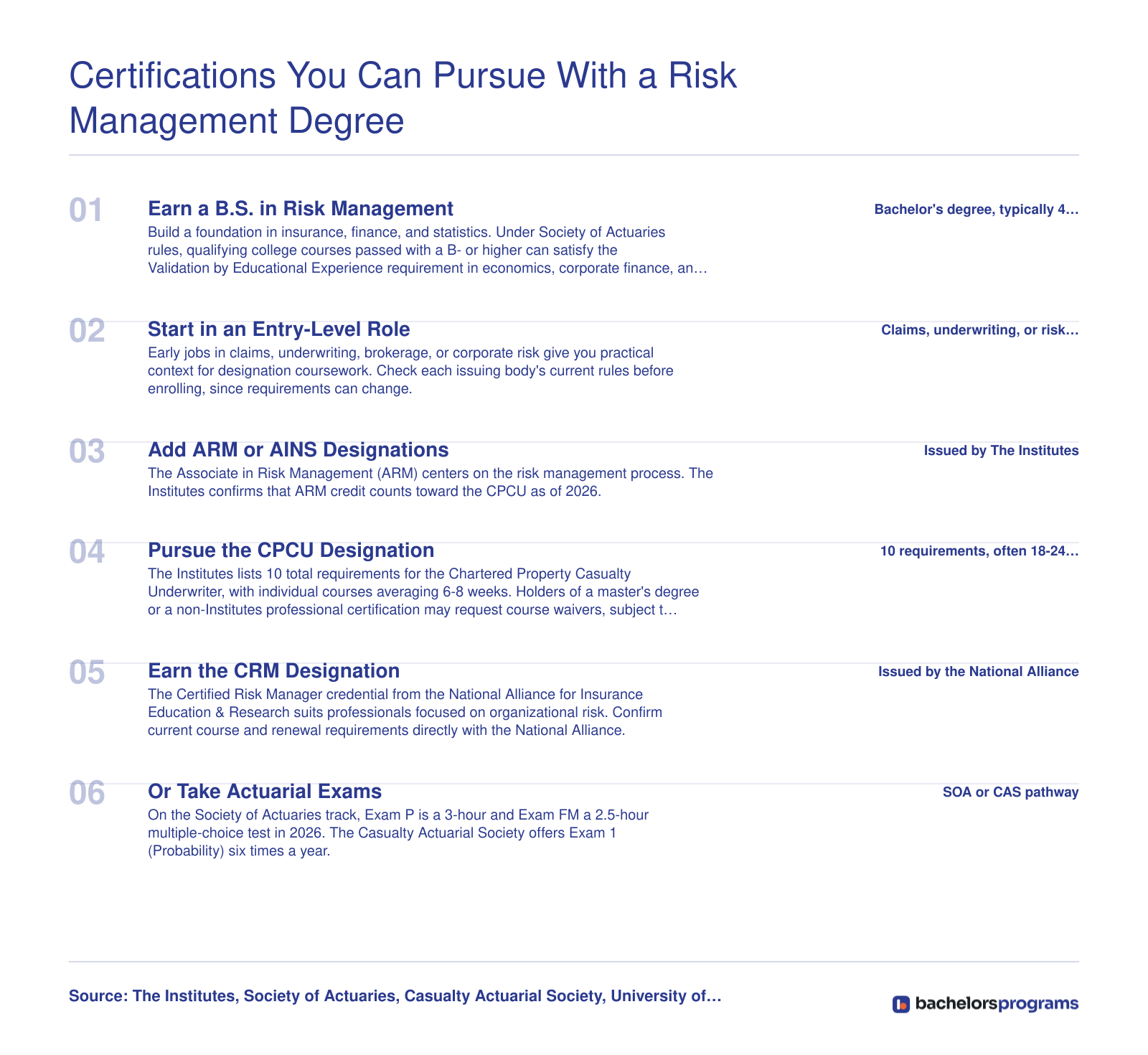
Certifications You Can Pursue With a Risk Management Degree
Most risk management careers advance through professional designations earned after graduation, building on the degree rather than replacing it. Some programs give coursework a direct role: the University of Iowa holds Society of Actuaries University Earned Credit status for Exams FM, FAM, ALTAM, and SRM, which requires a score of at least 85% in the matching courses. In most cases, though, college coursework prepares you for designation and actuarial exams rather than waiving them automatically.
Risk Management programs by state
Risk Management Degree FAQs
These answers draw on federal Scorecard data, BLS wage estimates, and program descriptions from universities that teach risk management and actuarial science.
How much does a risk management degree cost?
How much do risk management graduates earn?
Is a risk management and insurance major the same as an actuarial science degree?
Can I work in risk management with a finance or business degree instead?
Compare Risk Management programs on the data that matters
Explore more Business & Management majors or browse every field of study.
All Business & Management programs Browse every field of study