Best Information Technology Degree Programs
Compare 510+ accredited Information Technology programs at 480+ colleges, with net price after aid, graduation rates, earnings and debt from IPEDS and the U.S. College Scorecard.

A bachelor's degree in information technology trains students for the work that keeps networks, cloud tenants, and support desks running: configuring systems, tightening access controls, and diagnosing failures under time pressure. The common credential is the Bachelor of Science (B.S.) in Information Technology, though some institutions title the major informatics or applied computing.
The real tension is cost and format. Average net price after aid at the schools ranked here runs from about $1,300 to more than $24,000 a year, and several strong programs are fully online, letting a working technician keep earning while finishing.
Employers hiring for these roles still screen on certifications and hands-on evidence alongside the diploma.
Key Points
- NC State, Florida State and Rutgers earn top IT rankings on outcomes.
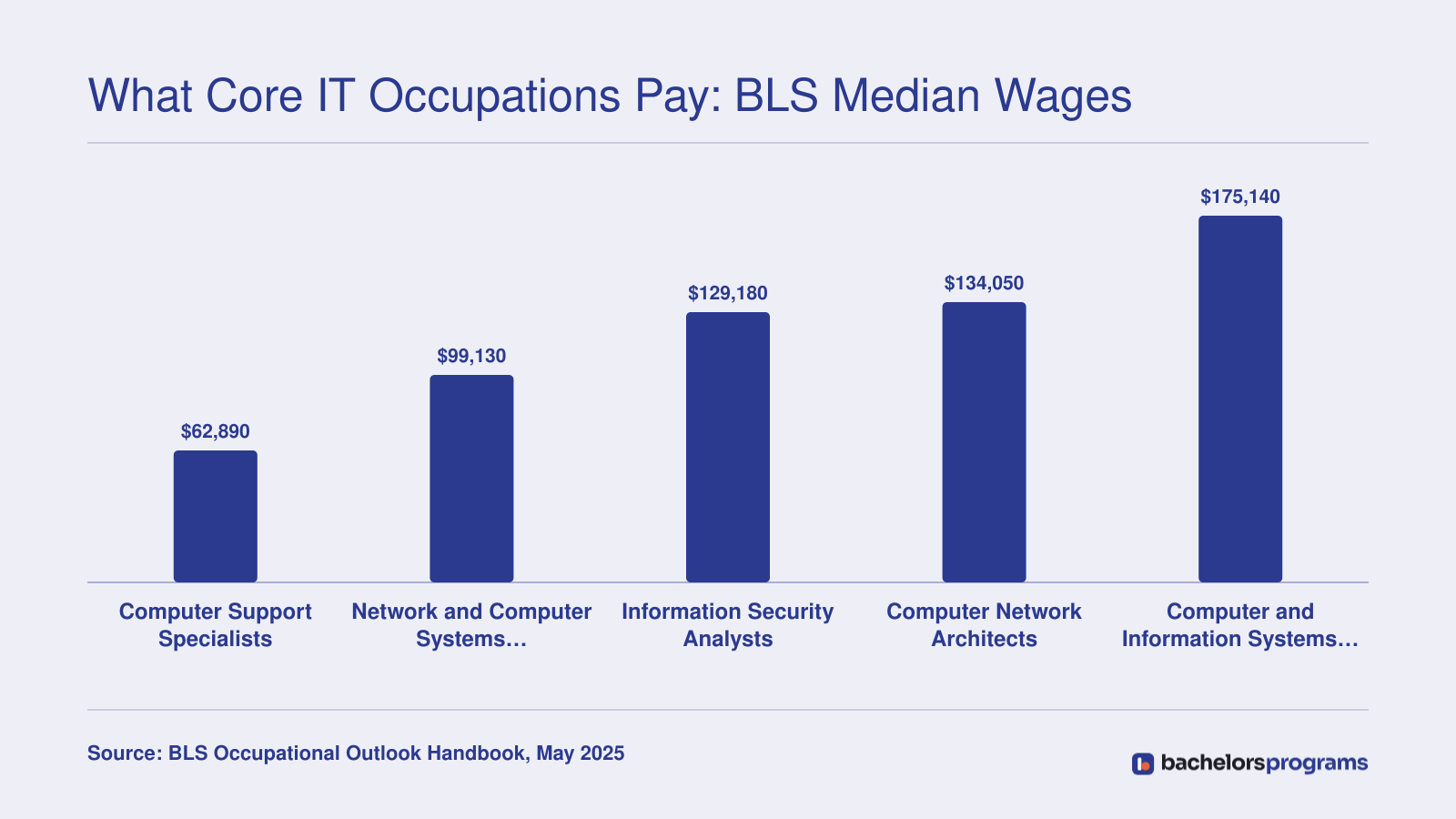
- BLS May 2025 medians rise steeply from help-desk support to security roles.
- Choose IT for infrastructure and support; computer science suits software engineering.
Best Schools for a Bachelor's Degree in Information Technology: Top 10 Ranked
This top 10 spans every delivery format we track: fully online, fully on-campus, and hybrid programs that let students mix the two. Each entry earns its place on outcomes rather than name recognition, so the cards below pair strong completion numbers with net prices that leave graduates in reasonable financial shape. You will see the credential offered, the format, an average net price after aid, the school's overall graduation rate, and the concentrations that set each program apart.
North Carolina State University at Raleigh
#1Raleigh, NC · $9,000 – $33,000/yr (est.)
Best for: Business-minded students pairing IT with management
North Carolina State University is a large public research university in Raleigh, and its information technology coursework sits inside the Poole College of Management rather than a standalone computing school. Students build technical skills in databases, cybersecurity and software development alongside a full business core, which suits anyone aiming at analyst or IT management work. The school's graduation rate is 85%.
- 120 total credit hours
- IT concentration accounts for 46 of those credits
- 34 core business credits plus 6 IT requirement credits
- IT electives include web development and systems analysis
- Capstone business strategy course required
- Hands-on, project-oriented courses and labs
- Internships across industries; IT and consulting clubs
Florida State University
#2Tallahassee, FL · ~$11,000/yr (est.)
Best for: Florida residents who want campus-based instruction
Florida State University is a public research university in Tallahassee where information technology is taught as a dedicated major inside the College of Communication and Information. The degree is built for full-time campus study, with a structured sequence of prerequisites before students enter the upper division. The school's graduation rate is 86%.
- 120 total credit hours: 24 prerequisite, 42 major, 30 elective
- 2.00 GPA and 52 credit hours needed for upper division
- Capstone courses account for 6 credit hours
- Face-to-face on the Tallahassee campus; not offered online
- Minor strongly recommended; students supply their own laptop
- Prepares database administrators, IT managers and security analysts
University of Virginia
#3Charlottesville, VA · $22,000/yr (est. net price)
Best for: Working adults finishing a bachelor's online
The University of Virginia is a selective public research university in Charlottesville with a strong liberal arts core. Its information technology offering sits inside an online bachelor's completion degree run by the School of Continuing and Professional Studies, designed for adults who already hold some college credit. The school's graduation rate is 96%.
- Bachelor's completion degree with an 18-credit IT concentration
- Five required IT courses and one elective
- Covers database management, business intelligence and web development
- Two-semester capstone required for graduation
- About two courses per term; finish in three to four years
- At least 60 of the 120 credits must be completed at UVA
Rutgers University
#4New Brunswick, NJ · $24,000/yr (est. net price)
Rutgers University is New Jersey's flagship public research university, with its main campus in New Brunswick. Information technology is taught through the School of Communication and Information, which emphasizes managing technology and information rather than writing code all day. The school's graduation rate is 84%.
- 120 degree credits; about 15 per semester advised
- Major declaration requires an application to the school
- Prerequisites must be passed with a C or better and a 2.0 GPA
- Pairs humanities and social science theory with computing skills
- Optional senior thesis capstone, IT practicum or internship
- Careers include IT manager and web analyst
Texas A&M University-Central Texas
#5Killeen, TX · under $5,000/yr (est.)
Texas A&M University-Central Texas is a public university in Killeen built around upper-division and transfer students, and it is designated as a Hispanic-serving institution. Most students arrive with an associate degree, industry certification or military training and finish the bachelor's around a full-time job.
- Designed for students arriving with an AAS or technical training
- Up to 36 credits for technical, vocational or military training
- Four concentrations, including Data Analytics and Cybersecurity
- Other tracks: Management and Networking; Software and Database Design
- ACE-evaluated military credit accepted
- Zero-credit Computer Information Systems capstone assessment
- Minimum 12 credits of occupational specialization for admission
University of California-Santa Cruz
#6Santa Cruz, CA · $15,000 – $20,000/yr (est.)
UC Santa Cruz is a public research university on the California coast, and its technology and information management major sits in the Baskin School of Engineering. The program leans on projects and commercialization rather than pure theory, which fits students who want to build and pitch systems for real organizations. The school's graduation rate is 75%.
- Offered through the Baskin School of Engineering
- Foundation in computer science, mathematics and economics
- Project-centric courses design systems for real business problems
- Weekly seminar brings tech CIOs and product managers to class
- Focus areas include systems analysis, data mining and optimization
- Roles include data analyst, systems analyst and product manager
Brigham Young University
#7Provo, UT · $15,000 – $20,000/yr (est.)
Brigham Young University is a private university in Provo, Utah, owned by The Church of Jesus Christ of Latter-day Saints. Its information technology program is housed in the Department of Electrical and Computer Engineering and requires an unusual amount of verified work experience before graduation. The school's graduation rate is 81%.
- 77 credit hours total, both a minimum and a maximum
- 13 IT&C courses cover networks, databases and cybersecurity
- Two-course senior project and capstone required
- 200 hours of pre-approved IT-related work required
- C or higher in IT&C 210B and 252 before 300-level courses
- Department packet and exit interview required to graduate
University of Oklahoma
#8Norman, OK · $15,000 – $20,000/yr (est.)
The University of Oklahoma is a public research university in Norman, and its information science and technology degree is awarded through the School of Library and Information Studies. That home gives the program a strong information architecture and data angle rather than a hardware focus. The school's graduation rate is 75%.
- Internship required for all BSIST students
- Coursework in web technologies, databases and data analytics
- Hands-on with PHP, MySQL, HTML5, JavaScript, Python and R
- Covers AI, data science, machine learning and cybersecurity
- Norman campus track mixes in-person and online classes
- Fully online track for transfer students and working professionals
- Students meet an advisor each semester before enrolling
University of Central Florida
#9Orlando, FL · ~$10,000/yr (est.)
The University of Central Florida is a large public research university in Orlando with one of the biggest enrollments in the country. Its IT degree sits in the College of Engineering and Computer Science, and the surrounding aerospace and defense industry hires many of its graduates. The school's graduation rate is 78%.
- 120 credits in the College of Engineering and Computer Science
- 42 major credits plus 49 advanced core credits
- No capstone required
- Coursework in computer networks, security and system administration
- 12 restricted electives and 6 technical electives
- Hack@UCF has won three national cyber defense championships
Florida International University
#10Miami, FL · ~$9,000/yr (est.)
Florida International University is a large public research university in Miami with a substantial commuter and online population. Its IT degree offers DevOps and Software tracks plus an accelerated route into a master's in engineering management. The school's graduation rate is 74%.
- 120 credits with DevOps and Software tracks
- Both tracks share programming, human-computer interaction and cloud computing
- Junior and senior capstones; senior teams of up to five
- Accelerated pathway to the M.S. in Engineering Management
- Available fully online through FIU Online
- DevOps track covers continuous integration, configuration management and monitoring
Cost & outcomes by school
Federal data for the highest-earning Information Technology programs, independent of the ranking above. Earnings are this field's bachelor's graduates four years after completing where the Scorecard reports them, else the school's undergraduate median.
| School | Net price / yr | Grad rate | Earnings | Debt | Grads/yr | Format |
|---|---|---|---|---|---|---|
| Northeastern University MA | $30,915 | 91% | $163,708 | $22,583 | 748 | Online or campus |
| Northeastern University MA | — | — | $163,708 | $22,583 | 46 | Campus |
| Virginia Polytechnic Institute and State University VA | $24,953 | 86% | $144,103 | $20,500 | 527 | Campus |
| New York University NY | $37,050 | 88% | $142,495 | $19,500 | 698 | Online |
| University of Virginia VA | $21,565 | 96% | $142,041 | $16,547 | 656 | Online |
| Villanova University PA | $43,756 | 92% | $130,585 | $26,000 | 27 | Online or campus |
| Rutgers University NJ | $24,406 | 84% | $125,303 | $20,904 | 924 | Campus |
| Pennsylvania State University PA | $32,875 | 86% | $120,729 | $25,000 | 537 | Campus |
| Ramapo College of New Jersey NJ | $18,173 | 70% | $115,174 | $21,500 | 42 | Campus |
| University of Washington-Tacoma Campus WA | $10,163 | 63% | $114,798 | $15,127 | 276 | Campus |
| Brigham Young University UT | $15,564 | 81% | $113,338 | $13,500 | 69 | Campus |
| Texas Tech University TX | $19,070 | 69% | $113,062 | $19,500 | 297 | Campus |
Sources: U.S. Department of Education. Net price, graduation rate, earnings and debt: College Scorecard (earnings and debt for this field's bachelor's graduates where reported, else school-wide); graduates: IPEDS. A dash means no figure is reported.
Cost, debt & payoff
Median earnings of this field's bachelor's graduates (4 yrs after completing, else the school's undergraduate median) vs. their median federal loan debt · U.S. College Scorecard
Across these programs the median graduate earns about $64,343 and finishes with roughly $23,750 in debt — a ratio that clears a common rule of thumb (keep debt below first-year salary). Net price and debt vary widely school to school, so check the per-school figures in the table above before you shortlist.
How We Ranked These IT Schools
A ranking is only as useful as the criteria behind it, and most IT lists ask you to take the order on faith. This one is built on outcomes you can check for yourself.
What We Measure
Every school on this list is scored on things that show up in a graduate's life, not in a brochure. We look at average net price after aid, the school's graduation and retention rates, median earnings for the program after completion, median federal debt at graduation, and whether the program can be completed online. Cost, completion and paycheck carry the most weight, because those are the numbers a prospective student actually has to plan around.
Where the Numbers Come From
Figures come from the federal College Scorecard and IPEDS, using the most recent year available.
Where This Falls Short
School-wide averages are not program-specific. Both measures cover the whole institution, so a strong IT department can sit inside a school with a middling overall rate. Program-level earnings are also not published for every program, and when a figure is missing we say so rather than substitute a guess.
Plenty of competitor lists rank on name recognition alone or publish no criteria at all. Naming the measures and the gaps is what makes the order usable.
IT School Comparison: Cost, Debt and Earnings at the Lowest-Cost Programs
This value lens compares the lowest-cost information technology programs in our ranking on average annual net price after aid, median program debt at completion, the typical monthly payment on a 10-year loan, and median earnings for graduates of each school's IT program, using U.S. Department of Education data from IPEDS and the College Scorecard. Texas A&M University-Central Texas awards a Bachelor of Applied Arts and Sciences in Information Technology and graduates a much smaller group each year, so its outcome figures can swing more from year to year. The takeaway: at all of these schools, a monthly loan payment of roughly $200 to $240 sits against first-year earnings of about $45,000 to $63,000, which points to strong return on investment, though medians describe typical graduates rather than guaranteeing any one outcome.
| School | Location | Format | Average Net Price After Aid (per year) | Median Debt at Completion (IT program) | Median Monthly Payment (10-year plan) | Median Earnings, 1 Year After Completion | Median Earnings, 4 Years After Completion |
|---|---|---|---|---|---|---|---|
| Texas A&M University-Central Texas | Killeen, TX | Online | $1,300 | $18,940 | $201 | $45,536 | $63,281 |
| Florida International University | Miami, FL | Online and on campus | $9,288 | $18,896 | $200 | $62,562 | $90,397 |
| University of South Florida | Tampa, FL | Online and on campus | $9,812 | $22,500 | $239 | $61,046 | $90,953 |
Online vs. On-Campus IT Degrees: Pacing, Flexibility and Transfer Credit
An on-campus IT degree and an online one lead to the same credential, but they rarely demand the same schedule. The schools ranked here span all three delivery models: NC State, Florida State, Rutgers, UC Santa Cruz, BYU and UCF list their IT bachelor's as campus-based, UVA and Texas A&M-Central Texas run fully online, and Oklahoma and FIU offer both.
Fully Online, Hybrid and Accelerated Formats
Fully online study means coursework, discussion and exams happen remotely, often asynchronously, which suits students who work full time or live far from a campus. A hybrid program keeps some in-person labs, exams or advising on campus while moving the rest online. Accelerated programs compress the calendar into 7- or 8-week terms, so you carry fewer courses at once and finish each faster. Competency-based models go further still: you advance by passing assessments of what you already know instead of logging seat time.
How Long Does an IT Bachelor's Take?
The standard pace is about 120 credits over roughly four years of full-time study. Transfer credit is what shortens it. Several schools cap transfer at 90 credits toward a 120-credit degree, including Columbia Southern, Champlain, William Paterson, CSU Global and Texas State, though CSU Global limits community-college work to 64 credits and William Paterson still requires 30 credits in residence. Northeastern caps transfer at 60 credits2, and Illinois Tech requires at least 61 transferable credits for admission. At Champlain, students bring an average of 40 transfer credits and finish in 24 or more months on 7-week terms.1 LSU Online's accelerated IT bachelor's is a 90-credit program, so its timeline is not directly comparable to a 120-credit degree.3
Can You Earn an Accredited IT Degree Online?
Yes. Regionally accredited universities award the same Bachelor of Science in Information Technology online as on campus. Verify the accreditor's recognition before you enroll.
Questions to Ask Yourself
Can you build a home lab for networking and virtualization practice?
Do you already hold an associate degree or CompTIA and Cisco credentials?
Would self-paced competency-based courses keep you moving, or do you need fixed deadlines?
IT Specializations and Salary Outlook: Cybersecurity, Cloud, Data and More
What jobs can you get with a bachelor's in IT? Most graduates land in one of six paths, and pay differs more by specialization than by degree title. These figures come from different sources and reporting periods, so treat them as rough guides rather than a single scale.
Security, Cloud and Networking
- Cybersecurity: Start as a security analyst or SOC analyst and move toward security engineer. The Bureau of Labor Statistics reports a May 2025 median of $129,180 for information security analysts. Robert Half lists $117,320 to $169,680 for cybersecurity analysts in Miami, a local market, not a national range.
- Cloud computing: Cloud support associate leads to cloud engineer. Robert Half groups cloud and network engineers at $110,000 to $155,000 for 2026 (midpoint $132,000).1
- Networking: Network technician leads to network engineer, and eventually architect. BLS puts the May 2025 median for computer network architects at $134,0502, though that is a more senior occupation.
Data, Development and Management
- Data and analytics: Junior data analyst leads to senior analyst or business intelligence developer. No clean 2026 range exists for data analysts specifically. The closest BLS match, computer systems analysts, had a May 2025 median of $105,850.3
- Software development and DevOps: Junior developer leads to DevOps engineer. Robert Half's 2026 ranges run $118,000 to $173,750 for DevOps engineers and $109,250 to $175,500 for software developers.1 BLS reports a $135,980 median for software developers.4
- IT management: IT support lead leads to IT project manager or IT manager. Robert Half lists $103,500 to $147,000 for project managers.1 BLS reports a May 2025 median of $175,140 for computer and information systems managers, a role that usually requires years of experience.
What This Means for You
Security and cloud roles tend to pay a premium, while help desk and general support positions start lower. They are still a common first rung, and many graduates move into a specialty after a year or two.
Concentration availability varies by school. Some programs offer formal tracks in cybersecurity or cloud, while others give you only electives. Check each program's listed concentrations before you apply.
What Core IT Occupations Pay: BLS Median Wages
These are occupation-wide medians from the Bureau of Labor Statistics Occupational Outlook Handbook for May 2025, covering all workers in each role, not the program-level graduate earnings in the comparison table above. Pay climbs steeply from help-desk support to security, architecture and management roles. Computer support specialists are also projected to decline by 3% (about 24,300 jobs) from 2025 to 2035.
Related Articles
IT vs. Computer Science: Which Bachelor's Degree Fits You?
What is the best degree for IT work? It depends on the job. A bachelor's degree in information technology suits hands-on infrastructure, support, and administration roles, while computer science suits software engineering and theory-heavy work. Information systems and cybersecurity sit between the two, so compare the four before you commit.
| Factor | Information Technology | Computer Science | Information Systems | Cybersecurity |
|---|---|---|---|---|
| Focus | Applied systems: networking, systems administration, cloud computing, databases, IT project leadership | Theory and software: hardware physics, mathematical principles, building software solutions | Enterprise systems, databases, data analytics, project management | Security on a computing and math base: network security, system administration, compliance |
| Typical math | Calculus I and II in the cited curriculum (requirements vary by school) | Calculus I and II, linear algebra, discrete mathematics | Varies by school; confirm in the course catalog | Introductory Statistics in the cited curriculum |
| Programming depth | Moderate: scripting, program design, C# | Deepest: software creation is the core of the degree | Varies by school; confirm in the course catalog | A programming sequence within the first two years |
| Typical first jobs | Network administrator, systems analyst, database administrator, cloud infrastructure specialist, IT support specialist | Software developer, software engineer, computer programmer, network architect | Systems analyst, database, and project roles that overlap with IT | Information security analyst, penetration tester, risk assessment analyst, forensics analyst |
| ABET commission | Computing Accreditation Commission (CAC), where a program is accredited | Computing Accreditation Commission (CAC), where a program is accredited | Computing Accreditation Commission (CAC), where a program is accredited | Computing Accreditation Commission (CAC), where a program is accredited |
| Best-fit student | Likes configuring, running, and fixing systems more than writing them | Enjoys abstract math and wants to build software | Wants to connect business needs with technology | Wants a security career and is comfortable with both math and networking |
Questions to Ask Yourself
Are you comfortable taking two or more semesters of calculus, or would statistics and discrete math suit you better?
Do you want to build software from scratch, or configure, secure and run the systems others build?
Would you rather earn certifications like Security+ or AWS alongside your degree than focus on algorithms and theory?
Information Technology programs by state
Compare Information Technology programs on the data that matters
Explore more Computers & IT majors or browse every field of study.
All Computers & IT programs Browse every field of study