Best Online Risk Management Degree Programs
Compare 20 accredited online Risk Management programs, with net price after aid, graduation rates, earnings and debt from IPEDS and the U.S. College Scorecard.

Insurers, banks and corporate risk departments keep hiring graduates who can measure, price and transfer risk, and online study now supplies much of that talent. A bachelor's degree in risk management, most often a Bachelor of Science (B.S.) in Risk Management, is offered online by public universities such as Eastern Kentucky University and Ferris State University, often with internships at carriers and brokers built in.
Every program listed is undergraduate and delivered 100% online. Hybrid formats are excluded.
Degree titles, price and employer recognition vary more than the shared name suggests, and those differences shape the first job.
Key Points
- Lowest-priced options average $8,624 to $10,873 per year after aid.
- Confirm institutional accreditation and state authorization before enrolling in any online program.
- ARM, CPCU and CRM certifications build on a risk management bachelor's degree.
Best Fully Online Schools for a Bachelor's Degree in Risk Management
This list covers online routes to a bachelor's degree in risk management, ordered to reflect cost, completion and outcomes together rather than any single number. Each entry explains what the degree covers, how the school delivers it online where that is documented, and what graduates earn where the federal data reports it. Where a campus option also exists, the entry says so.
Eastern Kentucky University
#1Richmond, KY · $11,000/yr (est. net price)
Best for: Accelerated online terms for working adults
Eastern Kentucky University awards a Bachelor of Business Administration in Risk Management and Insurance on an online track that requires no campus visits, with accelerated seven-week terms and six start dates a year. The 120-credit degree accepts up to 90 approved transfer credits, internships count toward the hours, and coursework applies toward the CPCU designation. Median earnings for program graduates were about $44,800 one year out and about $67,900 five years after finishing.
- AACSB International accredited College of Business
- 120 total credit hours; up to 90 approved transfer credits
- Accelerated 7-week online terms with six start dates a year
- Online students need no campus visits; $472 per credit hour
- Coursework applies toward the CPCU designation
- Internships count toward credit hours; $0 application fee
University of Louisiana at Monroe
#2Monroe, LA · ~$13,000/yr (est.)
Best for: Surplus lines and reinsurance specialization
ULM built its risk management and insurance major around surplus lines and reinsurance, the high-risk corner of the market that covers energy, coastal property and medical liability. Most majors complete a paid industry internship, and the school has placed students with the Wholesale Specialty Insurance Association for 25 years. The department runs its own insurer career fair and hosts a Gamma Iota Sigma chapter. Graduates report median earnings of about $67,700 four years after finishing.
- Four-year bachelor's degree in risk management and insurance
- Coursework in surplus lines, reinsurance, insurance law and ratemaking
- Paid industry internship before graduation; WSIA partner for 25 years
- 10 ULM Foundation scholarships plus an $8,000 Cavanaugh Scholarship
- Gamma Iota Sigma chapter and RMI-only career fairs with insurers
- Prepares graduates for brokerage, underwriting, claims and actuarial roles
Central Washington University
#3Ellensburg, WA · ~$18,000/yr (est.)
Best for: Applied-degree holders moving into safety roles
Central Washington University offers both a Bachelor of Science and a Bachelor of Applied Science in Risk, Insurance, and Safety Management, delivered 100% online. The applied version builds on a two-year technical degree and industry experience, making it one of the few real degree-completion routes here. A capstone pairs each student with an employer and a faculty advisor to build a working risk plan, and the next intake is listed for January 2027.
- 100% online Bachelor of Science and Bachelor of Applied Science
- Applied version builds on an associate degree plus industry experience
- Capstone risk plan built with an employer and faculty advisor
- Coursework spans occupational safety, risk, insurance and statistics
- Next intake listed for January 2027
Indiana State University
#4Terre Haute, IN · $11,000/yr (est. net price)
Indiana State's Scott College of Business awards a Bachelor of Science in Insurance and Risk Management, and its business programs carry AACSB International accreditation. The 120-credit curriculum runs from risk analysis and claims management to risk modeling and employee benefits, closing with a strategic management capstone. Majors take paid internships, join Gamma Iota Sigma, and can take a surplus lines course that includes a trip to London. Median earnings were about $67,000 four years after finishing.
- AACSB International accredited Scott College of Business
- 120 credits ending in a strategic management capstone
- Coursework in risk analysis, claims management, risk modeling and benefits
- Paid internships with major carriers and brokerages
- Surplus lines course includes a trip to London
- Gamma Iota Sigma chapter; Insurance Public Policy Summit in Washington, D.C.
University of Houston-Downtown
#5Houston, TX · $8,000 – $18,000/yr (est.)
Houston-Downtown's Marilyn Davies College of Business awards a Bachelor of Business Administration in Risk Management and Insurance with a published degree plan and a course schedule that includes online sections. Students join a Gamma Iota Sigma chapter, attend the RMI Speaker Series, and can apply for scholarships reserved for majors. Federal data show median earnings near $98,500 four years after finishing, the highest program figure reported in this group.
- Bachelor of Business Administration with a published degree plan
- Online course sections listed in the RMI course mode schedule
- Gamma Iota Sigma chapter, RMI Speaker Series, major-only scholarships
- Prepares for underwriting, claims adjusting, loss control and brokerage
- Advising guides cover current and prior catalog years
Ferris State University
#6Big Rapids, MI · ~$9,000/yr (est.)
Ferris State assembles its risk management and insurance degree from an 81-credit sequence: a 30-credit business core, 27 credits in the major and an 18-credit emphasis. Every student completes an internship, with recent placements at Auto-Owners, EMC and Farmers, and coursework covers insurance law, property and casualty, benefits and insurer operations. Classes run in person, online or mixed, so the program fits students who want to combine formats; freshmen need a 2.50 GPA and test scores meeting two of three benchmarks.
- 81 credits: 30-credit business core, 27 in the major, 18-credit emphasis
- Classes offered in person, online or mixed delivery
- Internship required; placements include Auto-Owners, EMC and Farmers
- Freshmen need a 2.50 GPA plus SAT or ACT scores meeting two of three criteria
- Transfer students need a 2.35 college GPA after 12 credits
- Covers insurance law, property and casualty, employee benefits and insurer operations
College of Charleston
#7Charleston, SC · $13,000 – $38,000/yr (est.)
The College of Charleston teaches risk management through its Bachelor of Professional Studies, a completion program for students who hold an associate degree or are at least 21 with prerequisites done. The quality and risk management concentration adds 18 credits to a 20 to 22 hour core inside a 122-credit total, covering project risk, project quality, process management and organizational behavior. It is an operational and project risk track rather than an insurance-focused one.
- 122 total credits, including a 20 to 22 hour core
- 18 credit hours in the quality and risk management concentration
- Requires an associate degree, or age 21 with prerequisites complete
- Courses include Managing Risk, Managing Project Quality and Process Management
- More than 19 elective courses to choose from
Northwood University
#8Midland, MI · $27,000/yr (est. net price)
Northwood's insurance risk management major runs through its Gaylord program center, and some or all of the major coursework is available only online. The university positions the degree around the business side of insurance rather than actuarial science or safety, and online sessions run in eight-week blocks. A current employer pathway gives eligible staff of a partner company up to $5,250 a year in tuition benefits.
- Business major in insurance risk management at the Gaylord program center
- Some or all major coursework available fully online
- Online sessions run in eight-week blocks
- Employer pathway offers up to $5,250 a year in tuition benefits for eligible staff
Emporia State University
#9Emporia, KS · ~$16,000/yr (est.)
Emporia State offers insurance as a concentration inside its Bachelor of Science in Business, Business Administration track, so graduates earn a business degree with a focused insurance sequence rather than a standalone risk management major. The concentration covers core insurance concepts and how the industry is changing, and it targets students heading into insurance employment. Median earnings were about $47,600 one year after finishing.
- Insurance concentration inside the B.S. in Business, Business Administration track
- Covers core insurance concepts and how the industry is changing
- Housed in the School of Business and Technology
- Prepares graduates for insurance industry employment
Kent State University
#10Kent, OH · ~$21,000/yr (est.)
Kent State lists an Insurance Studies program delivered online through its College of Applied and Technical Studies, an unusual home for an insurance degree. Published program details are thin, so applicants should confirm credit requirements, transfer limits and term structure directly with the school. The university's graduation rate of roughly 64% is among the stronger institutional figures on this list.
- Online Insurance Studies program
- Housed in the College of Applied and Technical Studies
Cost & outcomes by school
Federal data for the highest-earning Risk Management programs, independent of the ranking above. Earnings are this field's bachelor's graduates four years after completing where the Scorecard reports them, else the school's undergraduate median.
| School | Net price / yr | Grad rate | Earnings | Debt | Grads/yr | Format |
|---|---|---|---|---|---|---|
| University of Houston-Downtown TX | $10,542 | 33% | $98,510 | $18,750 | 24 | Online or campus |
| University of Louisiana at Monroe LA | $13,466 | 54% | $67,704 | $20,500 | 30 | Online or campus |
Sources: U.S. Department of Education. Net price, graduation rate, earnings and debt: College Scorecard (earnings and debt for this field's bachelor's graduates where reported, else school-wide); graduates: IPEDS. A dash means no figure is reported.
Cost, debt & payoff
Median earnings of this field's bachelor's graduates (4 yrs after completing, else the school's undergraduate median) vs. their median federal loan debt · U.S. College Scorecard
Across these programs the median graduate earns about $59,612 and finishes with roughly $22,142 in debt — a ratio that clears a common rule of thumb (keep debt below first-year salary). Net price and debt vary widely school to school, so check the per-school figures in the table above before you shortlist.
Online Risk Management Degree Cost: The Lowest-Priced Programs Compared
An online risk management degree costs about $8,624 to $10,873 per year in average net price after aid at the lowest-priced schools ranked here, and all of them are public universities, so residents of Michigan, Texas or Indiana typically pay less sticker tuition than out-of-state students. Typical median debt at graduation for these schools runs from $18,750 to $24,000 (institution-wide, not program-specific). To estimate full-degree tuition, multiply the online per-credit rate by the credits required (bachelor's programs commonly require about 120), and confirm the rate with each school, since online tuition can differ from the in-state and out-of-state figures below.
| School | Location | Average Net Price After Aid (per year) | In-State Tuition and Fees | Out-of-State Tuition and Fees | Median Debt at Graduation (institution-wide) | Online Per-Credit Tuition |
|---|---|---|---|---|---|---|
| Ferris State University | Big Rapids, MI | $8,624 | $14,778 | $14,778 | $21,000 | N/A |
| University of Houston-Downtown | Houston, TX | $10,542 | $7,708 | $17,548 | $18,750 | N/A |
| Indiana State University | Terre Haute, IN | $10,873 | $10,258 | $22,322 | $24,000 | $351 to $456 (varies by student category) |
Related Articles
Accreditation, Transfer Credit and State Authorization: What to Check Before You Apply
Flexibility counts for nothing if the credential is not recognized or the school cannot legally enroll you where you live. Confirm both before you apply.
Accreditation: The Baseline
Institutional (regional) accreditation is the floor. Business-school accreditation is the differentiator. AACSB and ACBSP are the two recognized business accreditors, and AACSB reviews the business school rather than the online format, expecting equivalent outcomes across modalities.1 Among the schools ranked here, Eastern Kentucky and Indiana State both hold AACSB accreditation for their business programs. Verify status in the Department of Education's DAPIP database or with CHEA, then cross-check the AACSB or ACBSP member directories.
Transfer Credit and Timing
Eastern Kentucky lists 120 total credit hours, in line with the roughly 120 credits a full-time bachelor's degree takes over about four years. Transfer students and associate-degree holders can often finish faster because prior coursework counts toward that total.
State Authorization
NC-SARA membership lets participating schools serve students in other member states, but exceptions exist.2 Eastern Kentucky, a member since 2017, lists Massachusetts as exempt for fully online programs only.3 Confirm your state on the school's authorization or NC-SARA page before you apply.4
Risk Management vs. Risk Management and Insurance: Choosing a Focus
Is a risk management degree the same as a risk management and insurance degree?
Not quite. Programs appear under three names: a B.S. in Risk Management, a B.S. in Risk Management and Insurance (RMI), and a general business degree with a risk management concentration. The RMI version leans toward the insurance industry, with coursework built around carriers, brokers, underwriting and claims. A plain bachelor's degree in risk management usually sits closer to corporate finance and enterprise exposure.
Matching a concentration to your goal
- Insurance: underwriting, claims and brokerage roles; the RMI track fits best.
- Enterprise risk: operational and strategic exposure across a whole company.
- Financial risk: banking, credit and market exposure.
- Risk analytics: modeling, data and quantitative work.
- Compliance: regulatory and governance roles.
Several schools here offer concentrations in insurance, enterprise risk or analytics.
The decision rule
Target carriers and brokers, choose RMI. Target corporate risk departments or banks, choose enterprise or financial risk.
Top Program Earnings Among Ranked Online Risk Management Schools
Among the schools ranked here, one program reports the highest median earnings for its risk management graduates.
Risk Management Degree Jobs and Salary: Is It Worth It?
A claims adjuster role and a corporate risk manager job can both start from the same bachelor's degree in risk management, but they sit at very different points on the pay scale.
What Jobs Can You Get With a Risk Management Degree?
Bureau of Labor Statistics figures from May 2025, with projections for 2025 to 2035, show the spread:
- Insurance underwriter: median $81,370; employment projected to decline 4%, though about 6,800 openings a year are expected.
- Claims adjuster, examiner, or investigator: median $78,020; projected to fall 6%, with roughly 21,600 openings a year.
- Financial risk specialist: median $117,330; projected to grow 7%, from about 66,000 jobs to 70,800.
- Compliance officer: median $80,730; projected to grow 4%, adding about 16,700 jobs.
- Risk manager (mid-career): financial managers, the closest fit, report a median of $166,570 and 10% projected growth.
Is the Degree Worth It?
Compare the lowest of those medians, about $78,000 for claims work, against the net prices in the cost table above. One year at a typical in-state public rate can be recouped quickly at that salary.
Occupational wages and the graduate earnings shown elsewhere on this page measure different things: one covers all workers in a job category, the other graduates of specific programs.
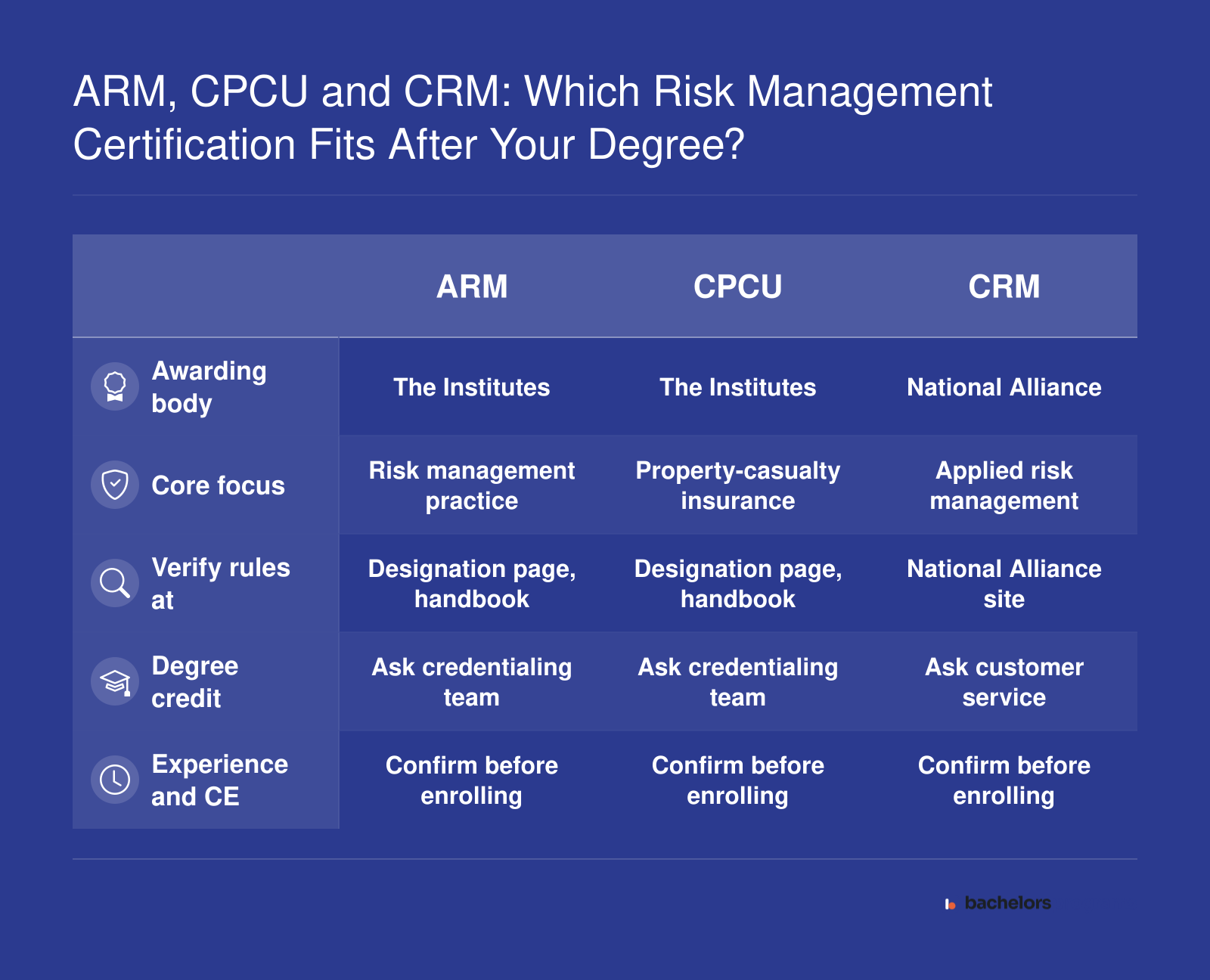
ARM, CPCU and CRM: Which Risk Management Certification Fits After Your Degree?
Before paying for any course or exam, check requirements on the official credentialing sites and ask in writing whether your bachelor's coursework earns credit or waivers. Have transcripts, syllabi and accreditation details ready, and ask your program's risk management and insurance faculty and career services about any articulation agreements. For career context, consult RIMS, the CPCU Society, local insurance associations and BLS.gov.
Risk Management programs by state
Compare Risk Management programs on the data that matters
Explore more Business & Management majors or browse every field of study.
All Business & Management programs Browse every field of study