Best Occupational Safety & Health Degree Programs
Compare 22 accredited Occupational Safety & Health programs at 21 colleges, with net price after aid, graduation rates, earnings and debt from IPEDS and the U.S. College Scorecard.

Safety professionals in construction, manufacturing, energy and healthcare make hazard assessments that can decide whether a worker goes home safe, and the bachelor's degree in occupational safety and health is the standard entry point to the field. The usual credential is the Bachelor of Science (B.S.) in Occupational Safety & Health, a four-year degree that pairs industrial hygiene and ergonomics coursework with regulatory training.
Every program ranked here is undergraduate; none is a graduate program.
Tuition is not the only thing that separates programs: programmatic accreditation and BCSP Qualified Academic Program status determine whether a graduate can claim the Graduate Safety Practitioner designation and waive the ASP exam, which can shape the first five years of a career.
Key Points
- Graduates of a BCSP Qualified Academic Program can apply for the GSP designation.
- Institutional accreditation alone doesn't confirm a safety curriculum meets BCSP standards.
- Online or campus? The occupation treats both degree formats the same.
Best Bachelor's Degree in Occupational Safety and Health: Our Top 10 Schools
The ten schools below all award a bachelor's degree in occupational safety and health, but they take different routes to it. Some run dedicated safety labs and paid co-ops on campus, while others let working adults finish entirely online. A few hold qualified academic program status with the Board of Certified Safety Professionals, which shortens the path to the Graduate Safety Practitioner designation.
Murray State University
#1Murray, KY · $10,000 – $20,000/yr (est.)
Best for: Hands-on learners wanting campus safety labs
Murray State built a full safety department rather than a single major, with its own classrooms, labs and equipment in western Kentucky. Undergraduates choose between the occupational safety and health track and an environmental health and safety track, both inside the same ABET-accredited B.S. The department also runs a standalone certificate in occupational safety for people who already hold a degree.
- ABET-accredited B.S. in Occupational Safety and Health
- Two tracks: Occupational Safety and Health, Environmental Health and Safety
- Formal admission before OSH 353: 30 applicable credits and 2.50 GPA
- Deadlines: February 1 for summer or fall, September 1 for spring
- C or better in every OSH course; a course can be taken twice at most
- Safety classrooms, labs and equipment plus internships and co-ops
- Median earnings of $66,418 one year after finishing
- Four-year academic plans published for 2026-2027
Grand Valley State University
#2Allendale, MI · $15,000 – $20,000/yr (est.)
Best for: Career changers with prior safety training
Grand Valley treats safety as an engineering discipline: the 120-credit OSHM degree pulls in psychology, health sciences and design thinking alongside traditional safety courses. Admission is secondary, so students work with an advisor for two years before applying to the Department of Integrated Engineering. Paid internships and a placement rate the program puts near 100 percent make it a practical choice for manufacturing and construction careers.
- ABET-accredited B.S. in Occupational Safety and Health Management
- 120 credits combining psychology, health sciences and engineering
- Secondary admission through the Department of Integrated Engineering
- Paid internships and a reported near-100% job placement rate
- Prepares students for the Graduate Safety Practitioner credential
- MIOSHA Level 2 certificate holders can earn college credit
- Median earnings of $58,781 one year after finishing
- Two OSHM scholarships, including the FTCH Pathways award
Eastern Kentucky University
#3Richmond, KY · $11,000/yr (est. net price)
Best for: Working adults needing accelerated online terms
Eastern Kentucky's School of Safety, Security and Emergency Management is a high-volume producer of safety graduates, with about 120 bachelor's completions in the safety program in the most recent data. Students take the degree on campus or fully online in accelerated seven-week terms, and a 3+2 path folds graduate coursework into the senior year. Transfer students can bring in up to 90 credits.
- B.S. in Occupational Safety, 120 credits, campus or fully online
- Accelerated 7-week online terms with six start dates a year
- Online courses cost $472 per credit hour
- Transfer up to 90 credits, with 30 completed at the university
- 3+2 option applies nine graduate hours toward the master's
- Coursework in OSHA rules, hazardous materials, ergonomics and leadership
- Median earnings of $71,240 one year after finishing
- No application fee; military benefits accepted
University of Wisconsin-Whitewater
#4Whitewater, WI · $10,000 – $15,000/yr (est.)
UW-Whitewater runs one ABET-accredited safety curriculum and lets students choose the setting, on campus in southeastern Wisconsin or fully online. A final-semester internship matched by the program's own coordinator is the capstone experience, backed by an on-campus safety career fair. Students can add a construction safety management certificate or an industrial hygiene minor.
- ABET-accredited B.S. in Occupational Safety
- Same curriculum on campus or fully online
- Final-semester internship matched by the program coordinator
- Coursework in construction safety, fire protection and ergonomics
- Construction Safety Management certificate and industrial hygiene minor
- Median earnings of $70,016 one year after finishing
- Graduates reported 100% career placement in a 2023-24 survey
Marshall University
#5Huntington, WV · $5,000 – $10,000/yr (est.)
Marshall's safety program leans on a paid, full-time co-op rather than a short internship, so graduates leave with a semester of industry work behind them. Coursework covers accident prevention, construction safety, ergonomics and emergency preparedness, and the department points to regional labs and equipment. The program reports near-perfect job placement over the past five years.
- Paid full-time co-op rather than a short summer internship
- Coursework in accident prevention, construction safety and ergonomics
- Regional labs and equipment for hands-on safety practice
- Prepares students for safety supervisor and safety analyst roles
- Program reports near-100% job placement over the past five years
- Median earnings of $67,923 one year after finishing
Central Washington University
#6Ellensburg, WA · ~$18,000/yr (est.)
Central Washington offers one of the few four-year safety degrees on the West Coast, and it is built to the Board of Certified Safety Professionals' qualified academic program standard. The degree meets the coursework requirements for the Graduate Safety Practitioner designation, so graduates skip an extra exam on the way to certification. An internship and a capstone finish the technical sequence.
- ABET-accredited B.S. in Occupational Safety and Health Management
- Meets BCSP Qualified Academic Program requirements
- Graduates can apply for the Graduate Safety Practitioner designation
- Internship and capstone built into the technical sequence
- Coursework in industrial hygiene, ergonomics and hazardous materials
- One of the few four-year safety programs on the West Coast
- Median earnings of $77,500 one year after finishing
Slippery Rock University of Pennsylvania
#7Slippery Rock, PA · ~$20,000/yr (est.)
Slippery Rock's Safety Management degree is lab-heavy: five dedicated facilities cover general industry, construction, emergency response and fire detection, hazardous materials, and industrial hygiene. A 12-week summer internship is standard, with 99 percent of interns paid. The program holds qualified academic program status with the Board of Certified Safety Professionals and approval from the Institute of Hazardous Materials Management.
- B.S. in Safety Management with BCSP qualified academic program status
- Approved degree program of the Institute of Hazardous Materials Management
- 12-week paid summer internship; 99% of interns are compensated
- Five labs: general industry, construction, emergency response, hazmat
- Median earnings of $67,072 one year after finishing
- Median earnings of $84,783 four years after finishing
University of Central Missouri
#8Warrensburg, MO · ~$14,000/yr (est.)
Central Missouri is the only ABET-accredited safety program in the state, and every full-time faculty member holds the Certified Safety Professional credential. Students can choose the occupational health management option among the program's concentrations, and paid internships carry course credit. Newly renovated safety labs support the hands-on side of the 120-credit degree.
- ABET-accredited B.S. in Occupational Safety
- Occupational Health Management option among three concentrations
- Only ABET-accredited safety program in Missouri
- Graduates qualify for the Graduate Safety Practitioner designation
- Paid internships for course credit
- All full-time faculty hold the Certified Safety Professional credential
- 120 credits; 2.2 GPA, C or better in key courses, final assessment exam
- Median earnings of $67,263 one year after finishing
Keene State College
#9Keene, NH · $18,000/yr (est. net price)
Keene State teaches safety where it happens, with coursework taken on site at workplaces rather than confined to a lecture hall. The department runs an OSHA-authorized Education Center and a free consultation service for New Hampshire employers, which keeps students close to working professionals. A network of partner companies recruits interns directly from the program.
- Hands-on coursework taken on site at workplaces
- Department runs an OSHA-authorized Education Center
- Internships through a network of partner companies
- Covers hazard identification, regulatory compliance and program management
- Fall and spring safety career fairs on campus
- Median earnings of $63,479 one year after finishing
Columbia Southern University
#10Orange Beach, AL · $15,000/yr (est. net price)
Columbia Southern is an online-first institution in Orange Beach, Alabama, designed around adults who are already working in the field. The safety and health bachelor's accepts up to 90 transfer credits and offers 11 start dates a year. Its qualified academic program status lets graduates apply for the Graduate Safety Practitioner designation and waive the Associate Safety Professional exam.
- BCSP Qualified Academic Program; GSP designation waives the ASP exam
- Board-approved through the Institute of Hazardous Materials Management
- $278 per credit hour with textbooks included
- Up to 90 transfer credits accepted; 120 total credits
- 11 start dates a year with courses available around the clock
- $250 per credit hour for active-duty military using tuition assistance
- Median earnings of $78,532 one year after finishing
Cost & outcomes by school
Federal data for the highest-earning Occupational Safety & Health programs, independent of the ranking above. Earnings are this field's bachelor's graduates four years after completing where the Scorecard reports them, else the school's undergraduate median.
| School | Net price / yr | Grad rate | Earnings | Debt | Grads/yr | Format |
|---|---|---|---|---|---|---|
| Central Washington University WA | $18,476 | 54% | $97,869 | $25,333 | 11 | Campus |
| Columbia Southern University AL | $14,580 | 33% | $94,480 | $23,425 | 964 | Online |
| Eastern Kentucky University KY | $11,040 | 50% | $92,289 | $30,849 | 81 | Online or campus |
| Millersville University of Pennsylvania PA | $20,787 | 58% | $91,742 | $25,000 | 20 | Campus |
| Jacksonville State University AL | $14,279 | 55% | $90,850 | $20,500 | 22 | Campus |
| Indiana University of Pennsylvania PA | $16,804 | 56% | $90,257 | $26,000 | 56 | Campus |
| Keene State College NH | $17,887 | 60% | $87,710 | $25,000 | 50 | Campus |
| Slippery Rock University of Pennsylvania PA | $19,608 | 66% | $84,783 | $24,000 | 128 | Campus |
| University of Central Missouri MO | $14,462 | 54% | $84,738 | $27,000 | 29 | Campus |
| Murray State University KY | $9,096 | 61% | $84,705 | $24,561 | 40 | Campus |
| Waldorf University IA | $19,693 | 21% | $83,151 | $18,699 | 110 | Online |
| Southeastern Louisiana University LA | $13,154 | 45% | $83,039 | $21,500 | 12 | Campus |
Sources: U.S. Department of Education. Net price, graduation rate, earnings and debt: College Scorecard (earnings and debt for this field's bachelor's graduates where reported, else school-wide); graduates: IPEDS. A dash means no figure is reported.
Cost, debt & payoff
Median earnings of this field's bachelor's graduates (4 yrs after completing, else the school's undergraduate median) vs. their median federal loan debt · U.S. College Scorecard
Across these programs the median graduate earns about $83,151 and finishes with roughly $24,281 in debt — a ratio that clears a common rule of thumb (keep debt below first-year salary). Net price and debt vary widely school to school, so check the per-school figures in the table above before you shortlist.
How We Ranked These Occupational Safety & Health Schools
This ranking is a shortlist of bachelor's-level occupational safety and health programs, ordered by how they perform on federal data about cost, completion, and earnings. It is a starting point for your research, not a final verdict on any school.
What We Looked At
- Earnings and debt: College Scorecard figures for graduates of each specific program.
- Graduation and retention: Institution-wide rates for completing a degree and returning for a second year.
- Net price: What students actually pay once grants and scholarships are counted.
- Delivery format: Whether the program is offered online, on campus, or in a hybrid model.
Only bachelor's-level programs were ranked. We used the latest available Scorecard snapshot, so figures reflect past graduating classes and may not match what you see today.
Where the Data Falls Short
Graduation and retention rates describe the whole school, not the safety program itself. A university with a strong overall rate may still run a small program with different results. That figure averages the school's sector; it is not a quote for you. Your own aid package could land well above or below it.
Some programs have no published program-level earnings, usually because too few graduates were counted. Those schools are judged on the remaining measures, and a missing earnings figure says nothing bad about program quality.
How to Use the Ranking
Treat the list as a way to narrow your options. Once you have a few schools in mind, confirm with each one whether the program is a BCSP Qualified Academic Program, and ask how transfer credits are handled if you hold an associate degree or earlier coursework. Those two answers can change the value of a degree more than a few spots on a list.
Accreditation and BCSP Qualified Academic Programs: What Counts
A university can be fully accredited and still leave you short of the credential employers look for. The difference is the layer of approval: institutional accreditation covers the whole school, while programmatic and BCSP recognition cover the safety curriculum itself. For a bachelor's degree in occupational safety and health, you want both.
Institutional accreditation: the baseline
Institutional accreditation, often still called regional accreditation, comes from an agency recognized by the U.S. Department of Education or the Council for Higher Education Accreditation. It is the non-negotiable baseline for accredited occupational safety and health degree programs: without it, you generally cannot receive federal financial aid, and credits are much less likely to transfer or count toward a later degree. Every legitimate online or campus option should clear this bar before you compare anything else.
ABET ANSAC: the programmatic seal
ABET's Applied and Natural Science Accreditation Commission (ANSAC, formerly ASAC) accredits associate, bachelor's and master's programs in safety and related fields. It reviews curriculum, faculty and facilities against a discipline-specific standard, and employers read it as evidence that the safety content is rigorous rather than a generic degree with a safety label. Programs ranked on this page that list ABET ANSAC accreditation include Central Washington University, Murray State University, Grand Valley State University, the University of Wisconsin-Whitewater and the University of Central Missouri.
BCSP QAP and the GSP shortcut
The Board of Certified Safety Professionals designates a Qualified Academic Program when a school's required EHS curriculum substantially matches the current ASP exam blueprint.1 QAP graduates can apply for the Graduate Safety Practitioner designation, which BCSP accepts in place of the ASP exam on the path to the Certified Safety Professional credential.1 Within this ranking, Central Washington University and the University of Central Missouri hold both ABET ANSAC accreditation and QAP status. Columbia Southern University is a QAP through its SACSCOC-accredited institution but is not listed as ABET ANSAC accredited. A school can hold one recognition without the other, so verify both.
Check the source, not the brochure
Accreditation and QAP status are not permanent. Confirm the exact program, option or concentration on BCSP's QAP directory and ABET's accredited-program search before you apply. Ask admissions for the program's current status in writing, and keep that confirmation with your application records.
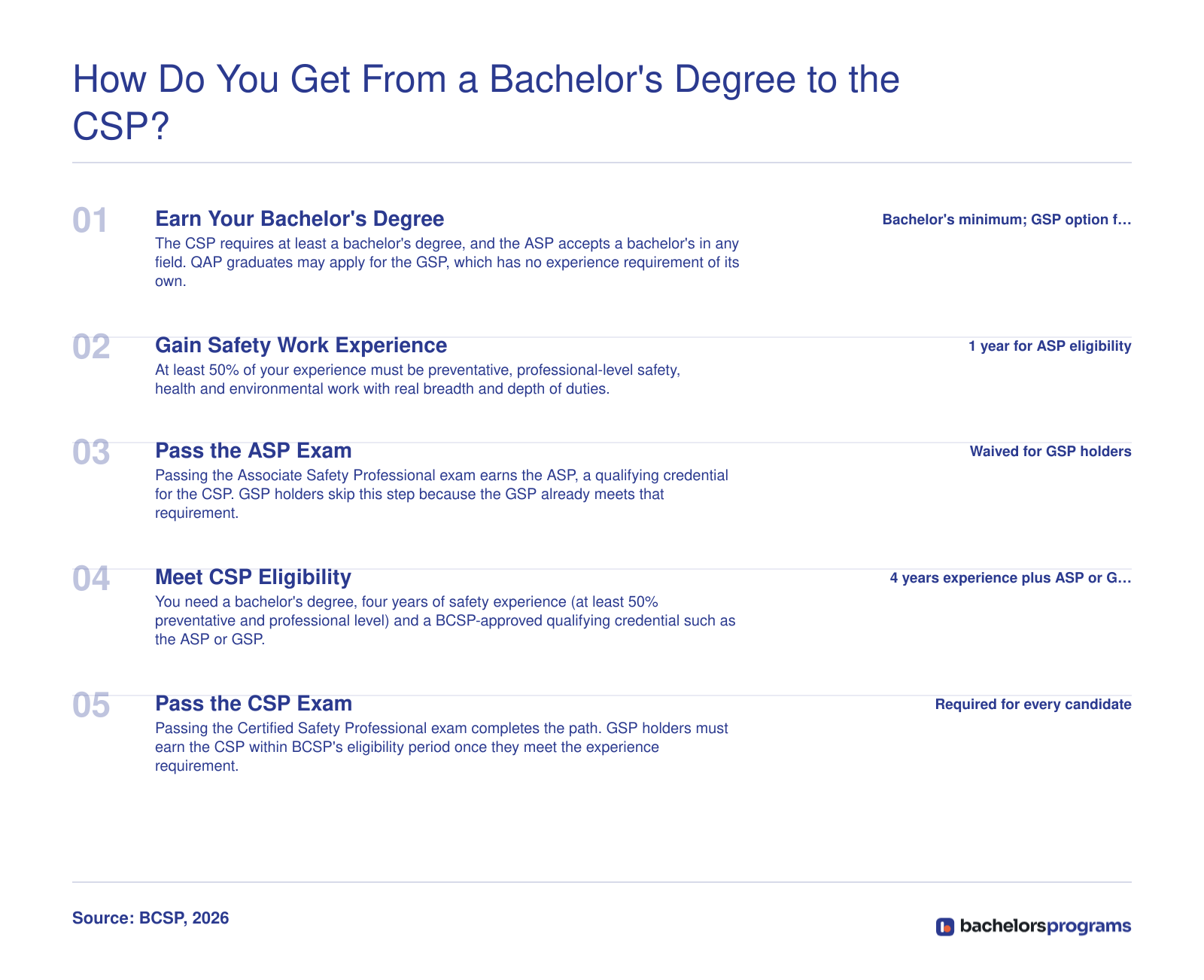
How Do You Get From a Bachelor's Degree to the CSP?
The Certified Safety Professional (CSP) is the Board of Certified Safety Professionals' (BCSP) flagship credential, and most candidates reach it in stages. Graduates of a BCSP Qualified Academic Program (QAP) can apply for the Graduate Safety Practitioner (GSP) designation, which waives the ASP exam and shortens the route. The four-year experience requirement and the CSP exam still apply. BCSP updates its QAP listings quarterly, so confirm a program's status before you enroll.
Related Articles
Online vs. Campus Occupational Safety and Health Degrees
Many of the programs on this page are offered online, on campus, or in both formats. The occupation does not treat the two differently. Employers paid the same starting salary to online and in-person graduates in May 2025, and the Bureau of Labor Statistics lists the same bachelor's degree requirement for specialists either way.
| Factor | Online | Campus |
|---|---|---|
| Schedule flexibility | Often asynchronous or evening coursework that fits around shift work | Fixed class times, better suited to full-time students |
| Hands-on lab and industrial hygiene equipment | Typically virtual labs, simulations, or short on-site sessions; confirm what each program requires | Direct access to campus labs and sampling or monitoring equipment under faculty supervision |
| Internship or co-op support | Students often arrange placements through their current employer; career services vary by school | Placements are often arranged through local employer ties and on-campus recruiting |
| Networking with employers and ASSP chapters | Virtual cohorts; you join a local ASSP chapter yourself | Regular contact with faculty, classmates, and regional employers; some schools have student chapters |
| Cost considerations | No relocation or commute; tuition varies by school, so compare net price | Housing, transportation, and campus fees can add to the total |
| Suitability for working safety technicians | Strong fit for keeping a job while moving toward the specialist role (technician median $61,560, specialist median $90,150, May 2025) | Harder to combine with full-time work |
| Employer perception | 92% of employers viewed online degrees from brick-and-mortar schools favorably, and 61% of HR leaders rated online learning equal or better in quality (2026) | In a 2026 employer experiment, in-person candidates were selected 51.6% of the time versus 48.4% for online candidates |
| Best fit | Working adults, technicians, and career changers who need flexibility | Full-time students who want lab access and structured employer connections |
Cost, Debt and Earnings: Which Programs Pay Off?
The table shows the programs here with the strongest return on investment, using U.S. Department of Education College Scorecard and IPEDS data, with earnings measured for occupational safety and health graduates specifically at one year and four years after completion. To read debt against earnings, compare the estimated monthly payment with first-year pay: at each of these schools, the median graduate's 10-year loan payment is under 5 percent of median monthly earnings in the first year, and earnings rise further by year four. Schoolwide earnings figures, such as the $61,580 reported for all Central Washington University students 10 years after entry, describe every student at the institution and serve only as context, so judge each program by the program-level columns.
| School | Format | Average Net Price (per year) | Median Program Debt | Est. Monthly Payment (10-year plan) | Median Earnings, 1 Year After Graduation | Median Earnings, 4 Years After Graduation |
|---|---|---|---|---|---|---|
| Central Washington University (Ellensburg, WA) | Campus | $18,476 | $25,333 | $269 | $77,500 | $97,869 |
| Columbia Southern University (Orange Beach, AL) | Online | $14,580 | $23,425 | $248 | $78,532 | $94,480 |
| Waldorf University (Forest City, IA) | Online | $19,693 | $18,699 | $198 | $65,908 | $83,151 |
What Occupational Health and Safety Specialists Earn Nationally
This is a national wage for the occupation as a whole, not the earnings of any program's graduates.
How to Choose the Right Program and Apply
Use this checklist to narrow your shortlist and avoid surprises after you enroll.
- Verify accreditation statusConfirm the school holds institutional accreditation. Then check whether the bachelor's program appears on the BCSP Qualified Academic Program list and whether it carries ABET accreditation.
- Map your associate creditsFormal articulation agreements spell out exactly how an associate degree applies. Murray State's agreement, effective October 23, 2026, maps a KCTCS occupational safety and health associate degree into its 120-semester-hour B.S., which requires 42 upper-level hours and a 2.00 GPA. Blackhawk Technical College graduates can apply up to 60 credits toward UW-Whitewater's B.S. in Occupational Safety and receive a general-education block waiver. Without an agreement, credits are reviewed course by course. Columbia Southern, for example, converts quarter hours to semester hours and requires a C or higher in math and English.
- Ask about prior learningAsk whether military training, OSHA 30 or the CHST earns credit. Oakland University can award 12 competency credits for a MOSHATI Level 2 Safety and Health Management Systems certificate.
- Line up fundingFile the FAFSA. Confirm GI Bill approval or your employer's tuition reimbursement rules before you enroll.
- Check practical requirementsFind out whether an internship or capstone is required. Online students should ask whether any in-person attendance is expected.
- Compare outcomesBefore you apply, weigh net price against program-level earnings from our ranking.
Occupational Safety & Health programs by state
Occupational Safety and Health Degree FAQs
These answers cover the questions prospective students ask most about a bachelor's degree in occupational safety and health. Program details change, so confirm current curriculum, accreditation and credential status with each school and with BCSP before you apply.
What is the best degree for occupational safety and health?
Can you get a bachelor's degree in occupational safety and health online?
Which occupational safety and health programs are BCSP Qualified Academic Programs?
Can you work in safety with a degree in a different field, and what does the safety degree add?
Compare Occupational Safety & Health programs on the data that matters
Explore more Science & Engineering majors or browse every field of study.
All Science & Engineering programs Browse every field of study