Best Computer Science Schools in Pennsylvania
Compare 98 accredited Computer Science programs in Pennsylvania at 68 colleges, with net price after aid, graduation rates, earnings and debt from IPEDS and the U.S. College Scorecard.

Pennsylvania schools award the computer science bachelor's as either a Bachelor of Science (B.S.) or a Bachelor of Arts (B.A.). The B.S. usually carries heavier math and systems requirements, while the B.A. leaves more room for a second major or minor.
Pittsburgh's robotics and software employers and Philadelphia's health care, finance and startup sectors give graduates local places to work, and that is much of the draw. The tension is fit. Programs range from large research universities to small liberal arts colleges, and they differ in ABET accreditation, co-op access, and admission to the major versus to the university alone.
Employers in both metros still hire heavily from the state's own campuses, so where you study often shapes where you start.
Key Points
- Penn ranks first; top graduates earn medians of $104,624 to $171,166.
- Drexel University reports more than 1,500 co-op employer partners.
- For the lowest net price after aid, look at publics like PennWest.
Best Bachelor's in Computer Science Programs in Pennsylvania
The University of Pennsylvania is the strongest overall choice for a bachelor's degree in computer science in Pennsylvania, pairing single-digit admission with the highest program-level earnings on this list. Penn State is the leading public option for in-state students, and Grove City College is the value pick among smaller schools. All ten programs below are based in Pennsylvania, and each currently lists an on-campus format.
University of Pennsylvania
#1Philadelphia, PA · $29,000/yr (est. net price)
Best for: Engineers aiming at AI research careers
Penn awards the Bachelor of Science in Engineering in Computer Science through its Department of Computer and Information Science, and students can shape the degree with tracks in computer vision, systems, or artificial intelligence. Admission is the most selective on this list at roughly 5 percent, and the institution-wide graduation rate is about 97 percent. Program graduates report a median salary of about $124,700 one year after completing the degree and about $171,200 five years out. Average net price after aid, measured across the institution, is roughly $28,700, which is low for a private university at this level of selectivity.
- Bachelor of Science in Engineering, taught on campus in Philadelphia
- Tracks: Computer Vision, Systems, Artificial Intelligence
- Customizable degree with electives across the department
- Traditional engineering curriculum with a computer science core
Grove City College
#2Grove City, PA · ~$22,000/yr (est.)
Best for: Cost-focused students wanting a Christian college
Grove City College offers a Bachelor of Science in Computer Science that is ABET-accredited, with tracks in artificial intelligence and machine learning and in cybersecurity, plus electives in game design, big data, and robotics. The four-year program is taught entirely on campus and includes faculty-mentored research, internships, a senior capstone design project, and a career fair that draws more than 150 recruiters. Tuition is the lowest of the private colleges ranked here, at about $21,700 a year with no separate fees, and the college reports that 96 percent of recent graduates were employed or in graduate school. Roughly 72 percent of applicants are admitted and the institution-wide graduation rate is about 83 percent.
- ABET-accredited four-year program
- Tracks: Artificial Intelligence and Machine Learning, Cybersecurity
- Electives in game design, big data, web and mobile development, robotics
- Senior capstone design project
- Minors in AI, machine learning, data science, cybersecurity, game design
- Internships plus a career fair with 150+ recruiters
- Faculty-mentored research opportunities
- Christian liberal arts setting with an ethics focus
Haverford College
#3Haverford, PA · ~$25,000/yr (est.)
Best for: Aspiring researchers who want a senior thesis
Haverford's computer science department sits inside a small liberal arts college, and the major requires a senior thesis while offering concentrations in theory, systems, and applications. Coursework reaches into artificial intelligence, machine learning, and computational biology, and an engineering partnership with the University of Pennsylvania lets students extend into engineering. About 12 percent of applicants are admitted, the institution-wide graduation rate is near 90 percent, and average net price after aid is roughly $25,300, the lowest among the private colleges on this list.
- Concentrations in theory, systems, and applications
- Senior thesis required for the major
- Emphasis on the ethical impact of computing
- Interdisciplinary roots in mathematics and physics
- Engineering partnership with Penn and Caltech
- Individual projects and collaborative group work
Pennsylvania State University
#4University Park, PA · ~$33,000/yr (est.)
Penn State's B.S. in Computer Science, taught on campus at University Park through the School of Electrical Engineering and Computer Science, uses a two-phase curriculum that starts with programming and data structures and builds toward systems, ethics, and teamwork. It is the largest public option here and the most accessible of the top five, admitting about 61 percent of applicants, with an institution-wide graduation rate around 86 percent. Program graduates earn a median of about $72,900 one year after completion, $101,900 four years out, and $114,900 after five years.
- Two-phase curriculum in the School of EECS at University Park
- Strong mathematics aptitude expected of applicants
- Focus on programming, data structures, and computer systems
- Prepares for industry, government, or graduate study
- Cannot be combined with a concurrent major in computer engineering
- Coursework emphasizes ethics, teamwork, and communication
Franklin and Marshall College
#5Lancaster, PA · ~$36,000/yr (est.)
Franklin & Marshall awards a bachelor's degree in computer science as a major or a minor, and strong students can pursue an honors thesis through independent study. Coursework runs from computer organization and data structures into mobile development, artificial intelligence, machine learning, and bioinformatics, and students have interned at Amazon and MongoDB. The college reports that 92 percent of its Class of 2025 was employed or in further study within six months. About 28 percent of applicants are admitted, the institution-wide graduation rate is roughly 84 percent, and average net price after aid is around $36,400.
- Offered as a major and as a minor
- Sequence runs from computer organization to AI and machine learning
- Honors thesis available through independent study
- Electives include mobile app development and bioinformatics
- Internships at Amazon and MongoDB
- Study abroad in England, Australia, and New Zealand
- Research areas include AI ethics and data privacy
Muhlenberg College
#6Allentown, PA · ~$29,000/yr (est.)
Muhlenberg describes its computer science bachelor's as a blend of technical depth and broad thinking: core programming, data structures, and theory come first, then electives in machine learning, cybersecurity, and data analytics. Classes are small, with an institution-wide student-faculty ratio of 9 to 1, and students can build an honors project, join a competitive programming team, or take on community-based tech projects. The college reports that 93 percent of its graduates are employed or in further study. Admission is relatively open at about 72 percent, the institution-wide graduation rate is about 82 percent, and average net price after aid is roughly $28,900.
- Core programming, data structures, and theory
- Advanced electives in machine learning, cybersecurity, data analytics
- 9 to 1 student-faculty ratio with small classes
- Honors project and independent study options
- Competitive programming team and computer science club
- Internships and community-engaged tech projects
- Modern software development labs
Drexel University
#7Philadelphia, PA · $39,000/yr (est. net price)
Drexel's Bachelor of Science in Computer Science runs on a quarter calendar and is built around a full-year team capstone, with four upper-level concentration areas: artificial intelligence and machine learning, security, graphics and vision, and game programming and development. Co-op is the signature feature, offered as a five-year plan with three placements or a four-year plan with one. Program graduates report a median salary of about $86,900 one year after completion, $113,600 four years out, and $116,900 after five years. About 79 percent of applicants are admitted and the institution-wide graduation rate is roughly 78 percent, and the average net price after aid of about $38,500 is the highest on this list.
- Quarter calendar with a full-year team capstone
- Concentrations in AI and machine learning, security, graphics and vision, game programming
- Co-op plans: five years with three placements, or four years with one
- Three writing-intensive courses required after freshman year
- Linux compute cluster and open lab in the college
- Prepares for roles such as software engineer, systems analyst, web designer
- Electives can cover a minor
Bryn Mawr College
#8Bryn Mawr, PA · ~$32,000/yr (est.)
Bryn Mawr is a women's liberal arts college, and its computer science department combines a rigorous major with a liberal arts frame, from algorithms and systems programming to computer animation. Students can major or minor, take a combined degree through the Quaker Consortium, and join paid summer research funded by stipends the department has offered since 1989; interns have gone to Microsoft, Duolingo, and Amazon. About 29 percent of applicants are admitted and the institution-wide graduation rate is roughly 82 percent, with an average net price after aid of about $31,800.
- Major and minor available
- Combined degree option through the Quaker Consortium
- Ten-week summer research stipends offered since 1989
- Coursework from algorithms and systems to computer animation
- Internships at Microsoft, Duolingo, and Amazon
- Small department with close faculty mentorship
Gettysburg College
#9Gettysburg, PA · ~$31,000/yr (est.)
Gettysburg awards both a Bachelor of Arts and a Bachelor of Science in Computer Science, so students can choose a ten-course liberal arts path or a more quantitative B.S. that adds four science courses. The program requires a mathematics foundation, core work in programming, data structures, computer organization and the mathematics of computation, and a senior Advanced Systems Design course. Program graduates earn a median of about $74,600 one year after completion and about $114,400 four years out. Roughly 39 percent of applicants are admitted and the institution-wide graduation rate is about 83 percent.
- B.A. requires ten computer science courses
- B.S. adds four formal or natural science courses
- Minor requires six courses
- Senior Advanced Systems Design course
- Prerequisites must be passed with a C- or better
- Mathematics foundation required
- Optional minor pairs computing with another field
Dickinson College
#10Carlisle, PA · ~$38,000/yr (est.)
Dickinson awards a bachelor's degree in computer science with tracks in artificial intelligence and cybersecurity, and the curriculum is deliberately hands-on: students build software in several languages and work in teams on real projects. Seniors complete a capstone, and study abroad, an honors program, a competitive programming team, and a colloquium series round out the department. Graduates have landed at Google, Amazon, and Lockheed Martin. About 42 percent of applicants are admitted, the institution-wide graduation rate is roughly 80 percent, and average net price after aid is around $37,600.
- Tracks: Artificial Intelligence, Cybersecurity
- Students build software in multiple programming languages
- Senior capstone with real-world team projects
- Writing in the discipline and ethical computing focus
- Study abroad and honors program available
- Competitive programming team and Math and Computer Science Society
- Colloquium series and free and open source projects
Cost & outcomes by school
Federal data for the highest-earning Computer Science programs, independent of the ranking above. Earnings are this field's bachelor's graduates four years after completing where the Scorecard reports them, else the school's undergraduate median.
| School | Net price / yr | Grad rate | Earnings | Debt | Grads/yr | Format |
|---|---|---|---|---|---|---|
| Carnegie Mellon University PA | $31,944 | 94% | $268,121 | $21,442 | 315 | Campus |
| Lehigh University PA | $36,931 | 88% | $141,691 | $23,854 | 163 | Campus |
| Gettysburg College PA | $31,490 | 83% | $114,433 | $27,000 | 21 | Campus |
| Drexel University PA | $38,509 | 78% | $113,610 | $28,993 | 163 | Campus |
| University of Pennsylvania PA | $28,699 | 97% | $111,371 | $15,715 | 89 | Campus |
| Saint Joseph's University - Philadelphia PA | $29,689 | 79% | $110,178 | $27,000 | 23 | Campus |
| University of Pittsburgh-Pittsburgh PA | $30,434 | 86% | $108,680 | $25,750 | 259 | Campus |
| University of Pittsburgh-Johnstown PA | $18,202 | 56% | $108,680 | $25,750 | 27 | Campus |
| Pennsylvania State University PA | $32,875 | 86% | $101,854 | $27,000 | — | Campus |
| Villanova University PA | $43,756 | 92% | $100,423 | $25,874 | 53 | Campus |
| York College of Pennsylvania PA | $18,556 | 64% | $100,044 | $27,000 | 11 | Campus |
| University of Scranton PA | $32,568 | 80% | $98,369 | $25,500 | 11 | Campus |
Sources: U.S. Department of Education. Net price, graduation rate, earnings and debt: College Scorecard (earnings and debt for this field's bachelor's graduates where reported, else school-wide); graduates: IPEDS. A dash means no figure is reported.
Cost, debt & payoff
Median earnings of this field's bachelor's graduates (4 yrs after completing, else the school's undergraduate median) vs. their median federal loan debt · U.S. College Scorecard
Across these programs the median graduate earns about $63,445 and finishes with roughly $25,937 in debt — a ratio that clears a common rule of thumb (keep debt below first-year salary). Net price and debt vary widely school to school, so check the per-school figures in the table above before you shortlist.
Most Affordable Computer Science Bachelor's Programs in Pennsylvania
These Pennsylvania computer science programs post the lowest average net prices in federal IPEDS and College Scorecard data, the average amount students pay after grants and scholarships are subtracted from the full cost of attendance. Public universities such as PennWest, Pitt-Johnstown and Penn State Hazleton charge lower in-state tuition, while private colleges like Waynesburg and Westminster list higher sticker prices but offset much of the gap with institutional aid, so their net prices land close to the public schools'. Your own net price depends on family income and the aid package you receive, so treat these figures as a starting point and run each school's net price calculator.
| School | City | Sector | In-State Tuition and Fees | Average Net Price | Median Debt (All Graduates) |
|---|---|---|---|---|---|
| Pennsylvania State University-Penn State Hazleton | Hazleton | Public | $15,208 | $17,597 | $25,000 |
| University of Pittsburgh-Johnstown | Johnstown | Public | $14,906 | $18,202 | $24,250 |
| Waynesburg University | Waynesburg | Private nonprofit | $30,480 | $18,235 | $27,000 |
| Pennsylvania Western University | California | Public | $11,436 | $18,256 | $23,725 |
| Westminster College | New Wilmington | Private nonprofit | $40,290 | $19,859 | $26,060 |
Pennsylvania Computer Science Graduates With the Highest Earnings
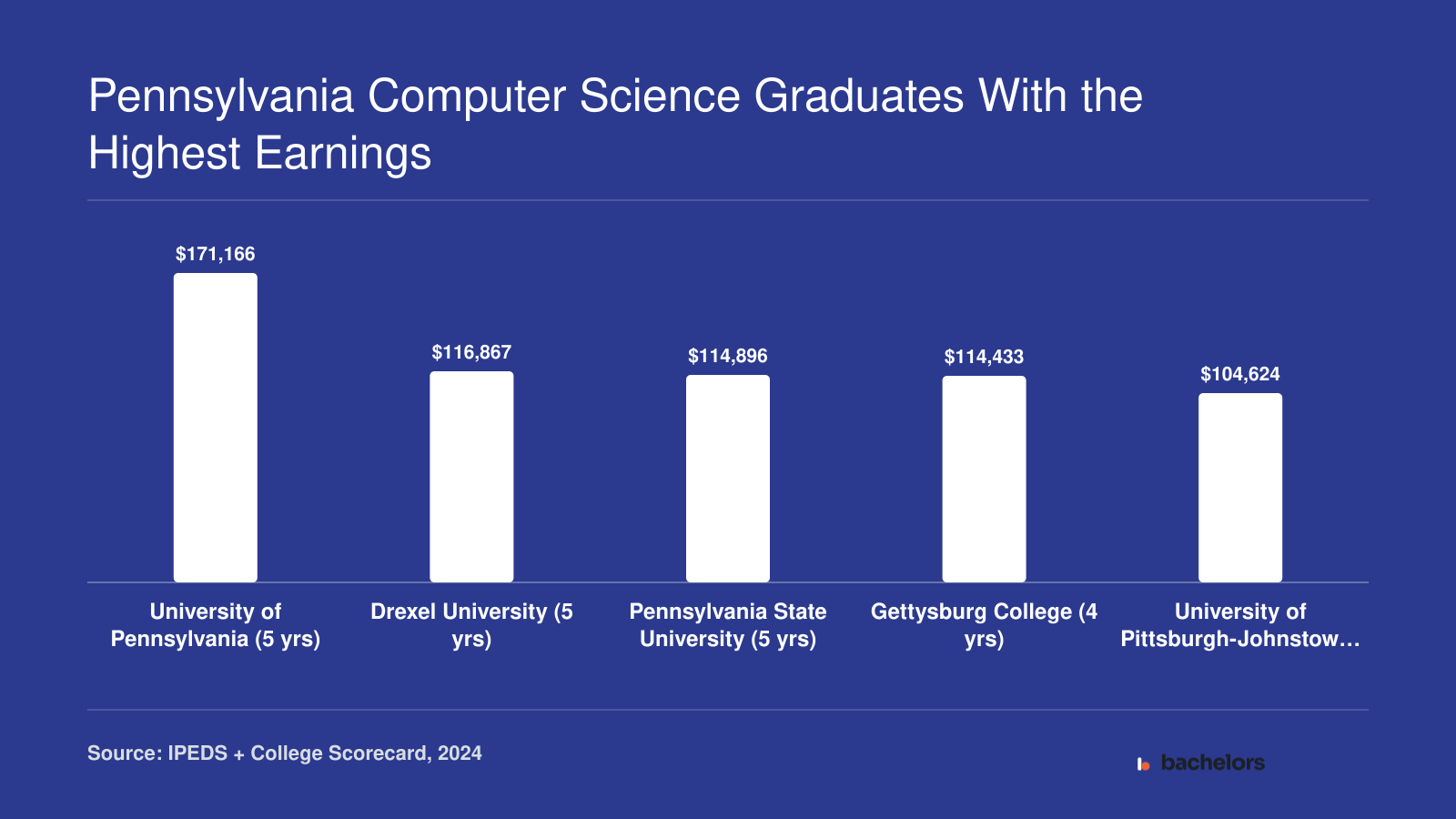
How much do computer science graduates earn in Pennsylvania? At the highest-earning programs, median earnings for bachelor's degree in computer science graduates range from $104,624 to $171,166. Most of these figures are measured five years after completion. Gettysburg College's $114,433 is the exception, measured four years out because its five-year figure is not reported. These are program-level results for computer science graduates, not campus-wide averages. University of Pennsylvania leads at $171,166, followed by Drexel University at $116,867, Pennsylvania State University at $114,896 and University of Pittsburgh-Johnstown at $104,624. Debt is modest next to these earnings: median borrowing for these programs runs from $13,500 at Penn to $28,993 at Drexel, well below a single year's median pay at any of these schools.
How to Choose a Bachelor's Degree in Computer Science: B.S. vs. B.A., Specializations and Co-Ops
Drexel University reports more than 1,500 co-op employer partners2, one measure of how much program structure can matter beyond the degree title. Before comparing schools, settle three questions: which degree type fits you, which specialization you want, and how you plan to get work experience.
B.S. vs. B.A. in Computer Science
A Bachelor of Science typically carries the heavier load of math, theory and technical electives. A Bachelor of Arts usually leaves more room for electives, a minor or a double major. Muhlenberg College lists its program as a B.A., Duquesne University offers both a B.S. and a B.A., and Penn State, the University of Scranton and Seton Hill University list B.S. degrees. If you want to pair computing with music, business or biology, a B.A. can be easier to fit in. If you are aiming at systems, AI research or similar technical work, the B.S. is the more natural route.
Specializations to Look For
Drexel's catalog lists upper-level tracks in artificial intelligence and machine learning, security, graphics and vision, and game programming and development.4 Smaller colleges often have fewer formal tracks, so read the course catalog and count the electives actually offered in your area of interest. A mention of cybersecurity or game design on a school's website does not guarantee coursework in either.
Co-ops and Internships
Drexel is the clearest example of a formal model. Co-op is built into the degree: a four-year path with one co-op or a five-year path with three.1 Each co-op generally lasts six months, alternating with study. Employers have included Amazon Robotics, Comcast, Lockheed Martin, Microsoft, Google and Oracle.2 Students apply, and employers interview over about six weeks.3 Philadelphia-area employers are a natural fit for Drexel and Penn students.
At most other Pennsylvania schools here, work experience comes through optional internships. Pittsburgh-area students at Duquesne and La Roche can look to the city's tech employers, but confirm each school's internship support and credit policy with its career office rather than assuming a formal pipeline.
Penn or Drexel: A Fit-Based Call
Penn offers a Bachelor of Science in Engineering in Computer Science at an Ivy League research university, which suits students who want a theory-heavy curriculum and a broad academic community. Drexel suits students who want paid, full-time work experience built into the degree and are comfortable with a longer path if they choose the five-year option. Neither is better in the abstract. Choose Penn for academic depth and flexibility, and Drexel if you want to graduate with substantial professional experience.
Related Articles
Admissions for a Computer Science Bachelor's: GPA, Test Policy and Transfer Credit
At many universities, computer science admission happens in two stages: first to the university, then to the major. The schools ranked here show how wide that first gate opens. The University of Pennsylvania admits about 5 percent of applicants and Haverford about 12 percent, while Bryn Mawr, Franklin and Marshall, Dickinson and Gettysburg land between roughly 28 and 42 percent. Penn State sits near 61 percent, and Drexel and Grove City near 72 to 79 percent. Pell shares, where reported, run from about 25 percent at Gettysburg to 51 percent at Haverford, a reminder that a low admit rate says nothing about who actually enrolls.
Where the published bar sits
Penn State states plainly that it sets no minimum GPA and no minimum test score for first-year applicants. The private colleges here publish less: most evaluate your transcript in context rather than posting a cutoff, and where a number does appear it usually reads as a recommendation rather than a floor. Treat any figure you find as this year's policy and confirm it on the department's own page before you plan around it.
Tests, prerequisites and declaring the major
Penn State stays test-optional for first-year applicants in every major, computer science included. Policy elsewhere varies by school and sometimes by program, so confirm before you register for a test.2 Prerequisites matter more than the test: expect a year of calculus, some discrete mathematics and prior programming experience. Some schools admit directly to computer science; others admit to the college and let you declare after a set of courses. Internal transfer into a full major can be competitive and space-dependent.3
Transfer credit
Most schools accept eligible courses from accredited institutions when grades are C or better, record units rather than grades, and let the academic department, not the registrar, decide what applies toward the major.1 Keep every syllabus.
Three moves before you apply
- Math sequence: Reach precalculus by junior year, then take calculus and a statistics course if your school offers them. A strong math record carries more weight than a coding club.
- Deadlines: Priority and early action dates typically fall in November and December, with financial aid paperwork close behind. Build your calendar backward from the earliest one.
- Community college route: Ask for the articulation agreement in writing, confirm which courses count toward the computer science major specifically, and keep the syllabus for each course you finish.
Cost of a Computer Science Bachelor's Degree in Pennsylvania
Public campuses in Pennsylvania win on sticker price, but after aid the gap with private colleges narrows. Compare both numbers before you rule any school out.
Sticker Price Versus Net Price
In-state annual tuition and fees run about $11,314 at Kutztown University of Pennsylvania, $11,436 at Pennsylvania Western University, $14,906 at University of Pittsburgh-Johnstown and $15,208 at Penn State Hazleton. Private sticker prices start much higher: $30,480 at Waynesburg University, $40,290 at Westminster College and $42,944 at Seton Hill University.
Net price after aid tells a different story. Waynesburg comes in around $18,235 and Westminster around $19,859, close to Pitt-Johnstown at $18,202 and PennWest at $18,256. Penn State Hazleton is lowest of these at $17,597. Kutztown's net price is $21,331, so a low sticker price does not guarantee the lowest bill. Penn State publishes no single in-state figure for University Park computer science, so check the campus you plan to attend.
The PHEAA PA State Grant
The PHEAA State Grant offers up to $6,000 for 2026-27, though your actual award depends on your finances and school type. You generally need:
- Residency: 12 consecutive months in Pennsylvania before the deadline.2
- Enrollment: a high school diploma, an approved school, and at least half-time status.
- Standing: satisfactory progress, no prior bachelor's degree and no loan default.
The deadline is May 1 for fall and spring.1 Awards are not final until the state budget passes, usually in late June. Supplements of $600 (portable or reciprocal) and $800 (veterans) may apply.2
Scholarship Routes and Timing
Penn State offers an Academic Award to first-time first-year Pennsylvania residents at University Park and a Commonwealth Award at other campuses, with no fixed amounts. One Penn State campus gives $2,000 to $4,000 a year, renewable at a 2.5 GPA, and about 70% of its incoming students receive it. The College of IST reviews full-time students with a 3.0 GPA or higher against a February 15 scholarship deadline, with separate applications for some awards. La Roche University lists the Robert B. Anticole Memorial Scholarship, which needs a 3.65 GPA, an essay and letters. File the FAFSA early and apply to the PHEAA grant by May 1.
A Debt Sanity Check
Median debt at graduation, measured school-wide, is about $25,000 at Penn State Hazleton, $24,250 at Pitt-Johnstown and $23,725 at PennWest. Waynesburg is slightly higher at $27,000. If a quote points well above these figures, ask why.
Compare Computer Science programs on the data that matters
Explore more Computers & IT majors or browse every field of study.
All Computers & IT programs Browse every field of study