Best Psychology Schools in Pennsylvania
Compare 100 accredited General Psychology programs in Pennsylvania at 92 colleges, with net price after aid, graduation rates, earnings and debt from IPEDS and the U.S. College Scorecard.
Pennsylvania's psychology graduates step into human services, research and human resources roles, but the licensed psychologist title sits behind a doctoral degree and two years of supervised practice. Schools award the entry credential as a Bachelor of Science (B.S.) or a Bachelor of Arts (B.A.) in Psychology, and the split matters: B.A. tracks lean toward social science breadth, B.S. tracks toward statistics and research methods.
Cost is the sharper divide. Net price after aid at a private Pennsylvania college can run several times the in-state rate at a public university, while bachelor's-level psychology wages stay roughly flat across both. The rankings and cost comparisons weigh that tradeoff; online programs from Pennsylvania-based schools carry the same credential.
Key Points
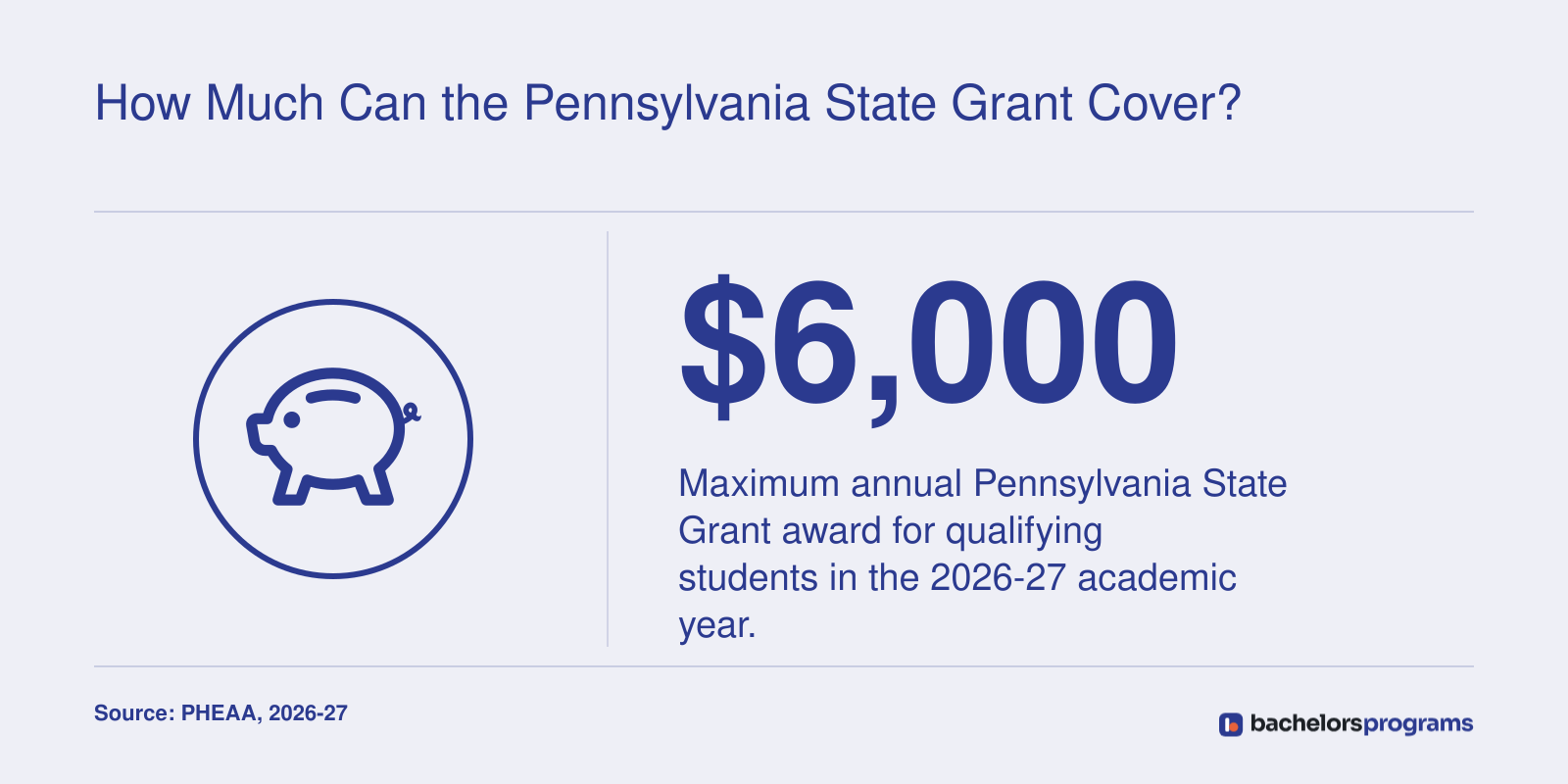
- PHEAA State Grant pays Pennsylvania residents up to $6,000 in 2026-27.
- Carnegie Mellon and Villanova let psychology majors choose a B.A. or B.S.
- Becoming a licensed Pennsylvania psychologist requires a doctorate beyond the bachelor's.
Best Schools for a Bachelor's Degree in Psychology in Pennsylvania
Every school below awards a bachelor's degree in psychology, as a Bachelor of Arts, a Bachelor of Science or both. Campus programs fill most of the list, and the figures shown for net price, graduation rate and selectivity describe the whole institution, not the psychology department alone. Graduation rates at schools offering this program run from roughly 70% to 97%, and average net price after aid ranges from about $23,000 to $44,000.
University of Pennsylvania
#1Philadelphia, PA · $29,000/yr (est. net price)
Best for: High-achieving students targeting research careers
The University of Pennsylvania is a private Ivy League university in Philadelphia, and its psychology major sits in the School of Arts and Sciences. Admission is among the most selective in the country at about 5% of applicants, and the institution-wide graduation rate is 96.5%. Every major completes a mentored research project or a structured research course, and students build breadth across biological, cognitive and social psychology. Net price after aid averages about $28,700.
- 13 total course units, including a capstone
- 2.0 GPA minimum in the major
- Three content areas: biological, cognitive, social
- Cognate electives drawn from other departments
- Statistics requirement plus research experience courses
- Independent study through mentored research
- Small seminars for in-depth discussion
- Honors program available
Carnegie Mellon University
#2Pittsburgh, PA · ~$32,000/yr (est.)
Best for: Future cognitive neuroscientists wanting imaging labs
Carnegie Mellon University is a private university in Pittsburgh with a psychology department inside the Dietrich College of Humanities and Social Sciences. About 12% of applicants are admitted and the institution-wide graduation rate is 94.1%. The department requires a concentration and pairs psychology with computer science coursework, and students have access to an fMRI brain imaging center and a child development lab. Coursework is quantitative, and about half of graduates go on to graduate or professional school.
- Separate B.A. and B.S. tracks with different science requirements
- Six required concentrations, including cognitive neuroscience
- 9-unit statistics sequence and 12 units of advanced research methods
- 10 units of computer science required
- Funding for research projects and conference travel
- fMRI brain imaging center and child development lab on site
- About half of graduates go on to graduate or professional school
Pennsylvania State University
#3University Park, PA · ~$33,000/yr (est.)
Best for: In-state students wanting a large psychology program
Pennsylvania State University's University Park campus is the state's largest public research university and runs the biggest psychology undergraduate department among the schools listed here. Admission is comparatively open at roughly 61% of applicants, and the institution-wide graduation rate is 86.1%. In-state tuition and fees run about $20,600 and net price after aid averages about $32,900. Students pick one of four options, from life sciences to business to quantitative skills.
- 123 total credit hours, 2.00 GPA minimum
- Four options: Life Sciences, Business, Neuroscience, Quantitative Skills
- Practicum in applied settings
- Research with faculty
- Integrated B.S./M.S. in Human Resources and Employment Relations
- Third-semester standing and 2.00 GPA to enter the major
Lehigh University
#4Bethlehem, PA · ~$37,000/yr (est.)
Lehigh University is a private university in Bethlehem, north of Philadelphia, with a psychology department that awards both a B.A. and a B.S. Roughly 26% of applicants are admitted and the institution-wide graduation rate is 87.9%. The B.S. adds substantial math, computer science and natural science coursework on top of the major, and both degrees require a research methods sequence and a written portfolio. Net price after aid averages about $36,900.
- B.A. requires 13 courses, about 49 credit hours
- B.S. adds 9 collateral courses in math, science and computing
- Three-course research methods and data analysis sequence
- Four concentrations, required for B.S. and optional for B.A.
- Portfolio of written work required of all majors
- Honors track asks for 3.5 GPA, thesis and oral presentation
- Study abroad credits may count toward the major
Villanova University
#5Villanova, PA · $40,000 – $45,000/yr (est.)
Villanova University is a private Catholic university outside Philadelphia, and its psychology department offers both a B.A. and a science-intensive B.S. About 27% of applicants are admitted, and the institution-wide graduation rate is 91.9%. Research and internship opportunities are built into the major, and students choose widely from electives. Net price after aid averages about $43,800, the highest among the private schools listed here.
- Separate B.A. and B.S. degrees in psychology
- B.S. is science-intensive and aimed at graduate study
- Research and internship opportunities for majors
- Wide range of elective courses
Temple University
#6Philadelphia, PA · $23,000 – $39,000/yr (est.)
Temple University is Philadelphia's large public research university, and its psychology department enrolls one of the biggest undergraduate cohorts in the state. Admission is accessible at about 80% of applicants, and the institution-wide graduation rate is 75.1%. The major requires a senior capstone and encourages research assistant roles, for-credit internships and practicum work. In-state tuition and fees are about $23,000 and net price after aid averages about $28,200.
- 123 total credit hours with a senior capstone
- Research assistant positions in faculty labs
- Internships and practicum available for credit
- Accelerated +1 B.A./M.S. option
- Honors track with senior thesis
- Psi Chi honor society chapter and psychology student organizations
West Chester University of Pennsylvania
#7West Chester, PA · $20,000 – $25,000/yr (est.)
West Chester University of Pennsylvania is a public university in Chester County, west of Philadelphia, and is the lowest-cost option on this list by a wide margin. In-state tuition and fees run about $10,800 and net price after aid averages about $23,300, against an institution-wide graduation rate of 70.5%. The B.S. blends core psychology with statistics, research methods and communication training, and majors take clinical or research placements. An accelerated B.S./M.S. pathway is available.
- Clinical and research placements built into the B.S.
- Computer training for statistics coursework
- Senior seminar with student presentations
- Accelerated B.S./M.S. pathway
- Small class sizes and faculty mentorship
Muhlenberg College
#8Allentown, PA · ~$29,000/yr (est.)
Muhlenberg College is a private liberal arts college in Allentown with a psychology department that keeps the major to a compact 10-course sequence. Roughly 72% of applicants are admitted, and the institution-wide graduation rate is 82.2%. Every major takes statistics, research methods and an advanced research course, and seniors complete a culminating integrative experience. Internships and independent research are open to students who show capacity for independent work, and net price after aid averages about $28,900.
- Minimum of 10 courses in the department
- Statistics, research methods and advanced research required
- Courses span four content areas; two must be 300 or 400 level
- Senior culminating integrative experience
- Internships and independent research for qualified majors
- Cognate course in statistical analysis or calculus I
Bryn Mawr College
#9Bryn Mawr, PA · ~$32,000/yr (est.)
Bryn Mawr College is a private women's liberal arts college on Philadelphia's Main Line, and its psychology department draws on biological, clinical, cognitive, cultural, developmental, health and social psychology. About 29% of applicants are admitted and the institution-wide graduation rate is 81.8%. Junior and senior coursework shifts into advanced labs and seminars, with supervised research available, and a five-year A.B./M.S.W. option runs with the college's graduate school of social work. Net price after aid averages about $31,800.
- Coursework in biological, clinical, cognitive, cultural, developmental and social psychology
- Advanced laboratory and seminar classes
- Supervised research opportunities
- Five-year A.B./M.S.W. with the Graduate School of Social Work
- Psychology minor available
- Related work in neuroscience, child and family studies, health studies
Bucknell University
#10Lewisburg, PA · ~$41,000/yr (est.)
Bucknell University is a private liberal arts university in Lewisburg, central Pennsylvania, where psychology majors research with faculty across specialties including child development and animal behavior. About 29% of applicants are admitted and the institution-wide graduation rate is 86.3%. The department offers minors in neuropsychology and cognitive and perceptual sciences and awards $1,000 summer research fellowships to emerging behavioral scientists. Net price after aid averages about $40,800.
- Minors in neuropsychology and cognitive and perceptual sciences
- $1,000 summer research fellowships for emerging behavioral scientists
- Research at the Animal Behavior Laboratory and on-site child care center
- Community placements such as Danville State Psychiatric Hospital
- Related majors in neuroscience and animal behavior
- Graduates have taken jobs at the Child Mind Institute and Amazon
Cost & outcomes by school
Federal data for the highest-earning General Psychology programs, independent of the ranking above. Earnings are this field's bachelor's graduates four years after completing where the Scorecard reports them, else the school's undergraduate median.
| School | Net price / yr | Grad rate | Earnings | Debt | Grads/yr | Format |
|---|---|---|---|---|---|---|
| Carnegie Mellon University PA | $31,944 | 94% | $82,433 | $21,750 | 33 | Campus |
| Immaculata University PA | $24,258 | 71% | $75,701 | $27,000 | 24 | Campus |
| Bryn Mawr College PA | $31,759 | 82% | $75,217 | $25,000 | 45 | Campus |
| Lehigh University PA | $36,931 | 88% | $74,939 | $21,160 | 98 | Campus |
| Villanova University PA | $43,756 | 92% | $73,684 | $21,500 | 126 | Campus |
| University of Pennsylvania PA | $28,699 | 97% | $73,012 | $15,715 | — | Campus |
| Misericordia University PA | $37,485 | 72% | $72,572 | $24,250 | 38 | Campus |
| Bucknell University PA | $40,766 | 86% | $66,206 | $27,000 | 88 | Campus |
| Saint Francis University PA | $23,526 | 74% | $66,010 | $27,000 | 25 | Campus |
| Drexel University PA | $38,509 | 78% | $63,287 | $27,000 | — | Campus |
| Haverford College PA | $25,314 | 90% | $63,040 | $13,621 | — | Campus |
| West Chester University of Pennsylvania PA | $23,331 | 71% | $61,258 | $23,500 | 263 | Campus |
Sources: U.S. Department of Education. Net price, graduation rate, earnings and debt: College Scorecard (earnings and debt for this field's bachelor's graduates where reported, else school-wide); graduates: IPEDS. A dash means no figure is reported.
Cost, debt & payoff
Median earnings of this field's bachelor's graduates (4 yrs after completing, else the school's undergraduate median) vs. their median federal loan debt · U.S. College Scorecard
Across these programs the median graduate earns about $49,543 and finishes with roughly $26,000 in debt — a ratio that clears a common rule of thumb (keep debt below first-year salary). Net price and debt vary widely school to school, so check the per-school figures in the table above before you shortlist.
Most Affordable Psychology Bachelor's Programs in Pennsylvania
These Pennsylvania psychology programs are ordered by average net price, the amount families typically pay after grants and scholarships, based on 2024 IPEDS and College Scorecard data from the U.S. Department of Education. Sticker tuition can mislead. Westminster College lists the highest tuition here but lands within about $1,700 of the lowest net price, while public options like Slippery Rock and Millersville pair low in-state tuition with net prices near $20,000. Earnings reflect psychology graduates of each school four years after finishing.
| School | City | Sector | Program | In-State Tuition & Fees | Average Net Price | Graduation Rate | Median Earnings, 4 Years After Graduation |
|---|---|---|---|---|---|---|---|
| University of Pittsburgh-Johnstown | Johnstown | Public | Psychology | $14,906 | $18,202 | 56% | $54,379 |
| York College of Pennsylvania | York | Private nonprofit | Psychology | $25,588 | $18,556 | 64% | $53,927 |
| Slippery Rock University of Pennsylvania | Slippery Rock | Public | B.S. in Psychology | $10,568 | $19,608 | 66% | $47,654 |
| Westminster College | New Wilmington | Private nonprofit | Psychology | $40,290 | $19,859 | 65% | $52,339 |
| Millersville University of Pennsylvania | Millersville | Public | B.A. in Psychology | $11,128 | $20,787 | 58% | $49,374 |
Online and Hybrid Psychology Bachelor's Options at Pennsylvania Schools
An online psychology bachelor's degree and a campus-based one can carry the same credential, but they rarely deliver the same experience. Every online option here comes from a Pennsylvania-based school, so the degree is awarded by a Pennsylvania institution whether you study from Philadelphia or from another state.
What the formats look like here
All the psychology programs ranked on this page are campus-based. Penn State also delivers both psychology degrees fully online, through Penn State World Campus. Both the B.A. and the B.S. are 100% online and require 123 credits1; the B.S. adds a Life Sciences concentration drawing on anthropology, biology and biobehavioral health.2 Hybrid study is arranged at the department level rather than offered as a separately labeled degree, so ask a campus directly if you want a mix of online and in-person coursework.
Residency and course access rules
World Campus degrees carry no separate in-person residency, but the B.A. requires 19 psychology credits, at least 9 of them at the 300 or 400 level, completed through the Psychology Department at World Campus or University Park.3 World Campus psychology courses are reserved for World Campus degree candidates.4 Resident-campus students generally cannot take them in fall or spring without an exception, and a student cannot add a concurrent psychology major through World Campus. Scheduling convenience, late planning and course cost do not qualify as grounds for an exception.
Parity, advising and research access
Penn State describes the online degrees as identical to the University Park versions, with the same requirements; course selection is narrower online. Advising, lab research and local internship placements are where the campus version usually wins, so ask how research supervision and internship credit are handled before you enroll.
Campus changes worth checking
Penn State trustees voted to close seven Commonwealth campuses, including Wilkes-Barre, and 14 campuses under University College, among them Scranton, Hazleton, Schuylkill, Lehigh Valley and Brandywine, were identified as potentially affected.5 In 2026 a curriculum review recommended closing 47 degree programs and placing 71 more under a one-year probationary review. Confirm with the campus where you intend to finish before you commit.
Related Articles
Admissions: GPA, Test Policy and Transfer Credit
Selectivity varies sharply: the most competitive Pennsylvania psychology programs expect a near-perfect record, while the more accessible ones leave room for applicants with uneven grades or a nontraditional path. Admission rate is the clearest way to see where each school sits.
Selectivity at the top-ranked schools
The University of Pennsylvania admits about 5% of applicants and Carnegie Mellon University about 12%. Lehigh University (26%), Villanova University (27%), Bucknell University (29%) and Bryn Mawr College (29%) sit in a middle tier. The more accessible options are Temple University (80%), West Chester University of Pennsylvania (78%), Muhlenberg College (72%) and Pennsylvania State University (61%).
GPA and test policy
No minimum admissions GPA or standardized-test policy is confirmed for these schools, so check each admissions office for current rules before you apply. Some program pages do list GPA floors for the major itself. Penn, Penn State and Muhlenberg each cite a 2.0 GPA minimum, and Lehigh's honors track asks for a 3.5. Those are standards for students already in the major, not admission cutoffs.
Transfer and adult-learner pathways
Penn State World Campus gives the clearest published route. Applicants need a high school diploma or GED, and SAT or ACT scores are not required for adult learners or transfer students. You submit college and military transcripts, plus proof of English proficiency if it applies.
Students already enrolled in liberal arts can move into psychology with:
- Credits: At least 27.5 earned credits.
- Coursework: PSYCH 100, STAT 200 or PSYCH 200, and a 3-credit general quantitative course other than STAT 200.
- Grades: A C or better in those courses.
Transfer students who meet these requirements are admitted directly to the major. No maximum number of transferable credits is stated.
For the other schools, ask about credit caps and whether psychology prerequisites such as introductory psychology and statistics transfer cleanly. Students who begin at a community college should ask each school's transfer office whether a formal transfer agreement exists and how many credits it applies toward the major. Transfer-friendly schools with higher admission rates are usually the safest place to begin that conversation.
How Much Can the Pennsylvania State Grant Cover?
For 2026-27, Pennsylvania residents in a bachelor's degree program can receive up to $6,000 a year through the PHEAA State Grant, which you do not repay. To be considered, file your FAFSA and State Grant application by May 1, 2026, if you are a first-time applicant at a four-year college or a renewal applicant. Summer-term applicants have until September 1, 2026, and PHEAA says late applications for other terms may still qualify if funding permits.
A Typical Pennsylvania Wage for a Bachelor's-Level Psychology Career
Human resources is one of several bachelor's-level fields where psychology graduates often apply their training in behavior, motivation and communication.
Pennsylvania Psychologist Licensure at a Glance
Compare General Psychology programs on the data that matters
Explore more Psychology majors or browse every field of study.
All Psychology programs Browse every field of study