Best Communications Degree Programs in Arkansas
Compare 12 accredited Communications programs in Arkansas at 9 colleges, with net price after aid, graduation rates, earnings and debt from IPEDS and the U.S. College Scorecard.

A communications degree from an Arkansas school starts graduates near $40,000 a year, and the price of earning it varies far more than that paycheck does. The Bachelor of Arts (B.A.) in Communications is the standard degree here. Arkansas State and the University of Arkansas graduates earned about $40,000 one year out, per federal College Scorecard data.
Published in-state tuition and fees run from $7,334 at University of Arkansas-Fort Smith to $26,262 at Harding University. Coverage here is limited to bachelor's programs, on Arkansas campuses or online from Arkansas-based schools.
With early earnings clustered so tightly, cost and format separate these programs more than starting pay does.
Key Points
- Arkansas State communication graduates earned a $40,192 median one year out.
- Published tuition spans $7,334 (University of Arkansas-Fort Smith) to $26,262 (Harding University).
- Fully online options: University of Arkansas, Arkansas State, University of Arkansas Grantham.
Best Bachelor's Degree in Communications Schools in Arkansas: Our Ranking
The strongest communications programs in Arkansas split into three clear groups. The University of Arkansas flagship pairs a nationally recognized online B.A. in Communication with the state's largest research university footprint, regional publics like Arkansas State and Central Arkansas keep tuition low and offer flexible online or on-campus tracks, and private schools such as Harding and Ouachita build smaller cohorts around required internships and media-team experience. Net prices below are approximate sector averages for each institution, and graduation rates are school-wide, not program-specific.
University of Arkansas
#1Fayetteville, AR · ~$18,000/yr (est.)
Best for: Students wanting a flagship name online
The state's flagship university, in Fayetteville, runs its Bachelor of Arts in Communication through the Fulbright College of Arts and Sciences with a fully online option. Coursework spans interpersonal, organizational, and mass communication, with attention to persuasion, media effects, and First Amendment issues. It carries the largest communications enrollment and alumni network in Arkansas, which matters for internships and referrals.
- Fully online delivery through Fulbright College
- Covers interpersonal, group, corporate, and social communication
- Coursework includes media effects, persuasion, and gender stereotypes
- Prepares for public relations, media consulting, and corporate training
- Explores First Amendment issues in professional settings
- Skills transfer to fundraising, project management, and municipal roles
Arkansas State University
#2Jonesboro, AR · $8,000 – $15,000/yr (est.)
Best for: Transfer students stacking prior credits
Arkansas State, in Jonesboro, is the most flexible option in the state for communications study. It offers an online B.A. in Communication Studies plus a B.S. in Strategic Communication with separate public relations and advertising and social media management tracks, all at a flat per-credit rate. Students can transfer up to 90 credits and start four times a year in seven-week terms.
- 120 credits at $292 per credit
- Up to 90 transfer credits accepted
- Seven-week terms with four start dates yearly
- Capstone research project required
- Covers argumentation, persuasion, conflict resolution, and PR
- Accelerated pathway into a master's in strategic communication
- PR and advertising concentration
- HubSpot certification included
- Crisis communication and digital media strategy coursework
- Integrated marketing and advertising sales emphasis
- Internship opportunity offered
- 2.0 GPA admission requirement
- Social media management concentration
- Google Analytics and Hootsuite certifications included
- Content management and social media measurement training
- Case studies and live campaign work
- Internship opportunities available
- No on-campus requirements
- Communications emphasis inside a multidisciplinary degree
- Two subject-area emphases required
- Fully online with no campus visits
- Built for working adults and family caregivers
- Covers communication theory, conflict resolution, and promotional writing
Harding University
#3Searcy, AR · ~$22,000/yr (est.)
Best for: Students wanting a faith-based campus program
Harding, a private Christian university in Searcy, structures its communication studies major as a 53-hour program built on a 24-hour core plus 29 hours of upper-level study, with a required internship and an 18-hour minor. Bible coursework is part of the liberal arts requirements. It is the most prescribed, cohort-style communications path in the state, best suited to students who want a structured, faith-based campus experience.
- 121 total credit hours; 53 in the major
- 24-hour communication core plus 29 hours of studies coursework
- Required internship of at least one hour
- 18-hour minor and 44 hours of liberal arts
- Core includes communication law, ethics, and research methods
- Practicum hours from film, radio, TV, debate, or newspaper
- ENG 1100 or 1110 required before 2300-level COMM courses
Ouachita Baptist University
#4Arkadelphia, AR · $20,000 – $25,000/yr (est.)
Ouachita Baptist, in Arkadelphia, offers a B.A. in Communications and Media with six emphases ranging from sports media to visual media and film. Majors must work on at least two student media teams in their junior and senior years, and the film track includes a January class at the Sundance Film Festival. Students train on Adobe Creative Suite in the Turner Studio and two Mac-only design labs.
- Six emphases: strategic communications, visual media and film, multimedia journalism, sports media, communications studies, integrated communications
- Two media team experiences required in junior and senior years
- Visual media and film emphasis attends Sundance Film Festival
- Training on Adobe Creative Suite in Turner Studio
- Two Mac-only Speer Design Labs available
- Corporate client campaign project
- Internships encouraged but not required
University of Central Arkansas
#5Conway, AR · $15,000 – $20,000/yr (est.)
Central Arkansas, in Conway, grants both a B.A. and a B.S. in Communication through its School of Communication, with core work in organizational and interpersonal communication and advanced public speaking. A television production studio and a writing and communication center support hands-on practice, and strong students can join the Honors in the Major program. The 120-credit degree runs on campus with internship elective options.
- 120 total credit hours with a capstone
- Core includes organizational communication, interpersonal communication, and advanced public speaking
- Electives in health, family, and political communication
- Communication internship available for credit
- Television production studio on site
- Honors in the Major program for high achievers
- Quantitative Literacy Mathematics Pathway
Arkansas Tech University
#6Russellville, AR · $10,000 – $15,000/yr (est.)
Arkansas Tech, in Russellville, takes a production-first approach: its B.A. in Communication with a Theatre and Film Production Option blends stagecraft and directing with narrative film production for digital screens. Students complete a capstone and can add secondary education certification to teach drama in Arkansas high schools. The theatre program has earned Kennedy Center American College Theater Festival awards.
- 120 total credit hours, at least 40 upper-level
- Acting, directing, stagecraft, and narrative film production coursework
- Maximum seven theatre practicum hours count toward the major
- Secondary education certificate option to teach drama in Arkansas
- Communication capstone required
- Produces short films for visual storytelling
University of Arkansas-Fort Smith
#7Fort Smith, AR · ~$11,000/yr (est.)
UA Fort Smith's B.A. in Media Communication is a campus program in the College of Arts and Sciences built around cross-platform skills: video, audio, writing, content creation, and media design. It targets the regional demand for graduates who can produce clear work across print, broadcast, and digital formats. Class sizes sit at an 18-to-1 student-faculty ratio.
- On-campus program in Fort Smith
- Video, audio, and writing skills across platforms
- Content creation and media design coursework
- Digital media and production focus
- Housed in the College of Arts and Sciences
University of Arkansas Grantham
#8LIttle Rock, AR · $5,000 – $10,000/yr (est.)
UA Grantham, based in Little Rock, is a fully online institution offering a B.A. in Strategic Communications that covers public relations, digital and social media, advertising, media law and ethics, and visual communication. Courses start monthly, 12 times a year, and students can transfer up to 75 percent of credits. New degree-seeking students receive a laptop at no cost.
- 120 credits at $305 per credit; no application fee
- 38-month standard completion
- 12 start dates per year with monthly course starts
- Transfer up to 75% of credits
- Public relations, digital and social media, and advertising coursework
- Media law and ethics plus visual communication
- Free laptop for new and returning degree-seeking students
University of Arkansas at Pine Bluff
#9Pine Bluff, AR · $13,000/yr (est. net price)
UAPB, in Pine Bluff, awards a B.A. in Mass Communication through its Department of Multimedia Communication with four options: multimedia news, broadcast news, broadcast production, and public relations. Students work in a campus television studio, on KUAP 89.7 radio, and at the student newspaper, The Arkansawyer. It is the only historically Black university in the state offering the degree, and the department also offers a mass communication minor.
- Four options: multimedia news, broadcast news, broadcast production, public relations
- Hands-on work at UAPB TV, KUAP 89.7 radio, and The Arkansawyer
- Broadcast production covers equipment operation, editing, and on-air staging
- Public relations track focuses on campaigns and reputation building
- Minor in mass communication available
- Prepares students for newspapers, TV, radio, and graduate study
Cost & outcomes by school
Federal data for the highest-earning Communications programs, independent of the ranking above. Earnings are this field's bachelor's graduates four years after completing where the Scorecard reports them, else the school's undergraduate median.
| School | Net price / yr | Grad rate | Earnings | Debt | Grads/yr | Format |
|---|---|---|---|---|---|---|
| University of Arkansas Grantham AR | $8,370 | 43% | $63,496 | $21,956 | 2 | Online |
| University of Arkansas AR | $18,209 | 71% | $56,969 | $19,500 | 228 | Online |
| Harding University AR | $22,130 | 69% | $52,876 | $26,500 | 3 | Campus |
| Ouachita Baptist University AR | $22,409 | 61% | $50,369 | $22,750 | 38 | Campus |
| Arkansas Tech University AR | $12,970 | 49% | $45,385 | $23,500 | 17 | Campus |
| Arkansas State University AR | $12,366 | 55% | $44,327 | $21,250 | 22 | Online |
| University of Central Arkansas AR | $16,511 | 54% | $36,336 | $23,691 | 16 | Campus |
| University of Arkansas-Fort Smith AR | $10,574 | 38% | $35,760 | $19,500 | 6 | Campus |
| University of Arkansas at Pine Bluff AR | $12,653 | 40% | $35,550 | $24,202 | — | Campus |
Sources: U.S. Department of Education. Net price, graduation rate, earnings and debt: College Scorecard (earnings and debt for this field's bachelor's graduates where reported, else school-wide); graduates: IPEDS. A dash means no figure is reported.
Cost, debt & payoff
Median earnings of this field's bachelor's graduates (4 yrs after completing, else the school's undergraduate median) vs. their median federal loan debt · U.S. College Scorecard
Across these programs the median graduate earns about $44,327 and finishes with roughly $21,603 in debt — a ratio that clears a common rule of thumb (keep debt below first-year salary). Net price and debt vary widely school to school, so check the per-school figures in the table above before you shortlist.
Cheapest Bachelor's in Communications Programs in Arkansas
Every program in this table is at a public Arkansas university, and in-state tuition stays between $7,334 and $9,375 a year. Net price after grants and scholarships, as reported by the U.S. Department of Education through IPEDS and the College Scorecard (2024), runs from $8,370 at University of Arkansas Grantham to $12,970 at Arkansas Tech University. Private schools such as Harding University and Ouachita Baptist University do not appear among the lowest-cost options, so students focused on keeping costs down will usually get the best value from these public schools at in-state rates.
| School | Program | Format | In-State Tuition (per year) | Net Price After Aid (per year) | Median Debt (program graduates) |
|---|---|---|---|---|---|
| University of Arkansas Grantham | Strategic Communications (B.A.) | Online | $8,520 | $8,370 | N/A |
| University of Arkansas-Fort Smith | Media Communication (B.A.) | Campus | $7,334 | $10,574 | $19,500 |
| Arkansas State University | Bachelor of Arts in Communication Studies | Online | $8,090 | $12,366 | $21,250 |
| University of Arkansas at Pine Bluff | Mass Communication | Campus | $9,375 | $12,653 | N/A |
| Arkansas Tech University | Communication: Theatre and Film Production Option (B.A.) | Campus | $8,674 | $12,970 | $23,500 |
Communications Concentrations at Arkansas Schools: Which Track Fits You
A future city hall reporter and a future hospital communications director can start from the same communications degree and land in different classrooms. The concentration separates them.
Five Tracks and Who They Suit
- Journalism: For reporters, producers, and fact-checkers. University of Arkansas at Pine Bluff lists multimedia news and broadcast news concentrations within its mass communication degree.
- Public relations: For relationship-builders who like writing, crisis response, and campaign planning. UAPB lists a public relations concentration; University of Arkansas builds its major around public relations careers; University of Arkansas Grantham covers public relations principles and media law.
- Strategic communication: For students drawn to persuasion, digital campaigns, and audience data. Arkansas State University offers a B.S. in Strategic Communication, and Grantham offers a B.A. in Strategic Communications with social media campaign coursework.
- Media production: For editors, videographers, and filmmakers. Arkansas Tech University's theatre and film production option, University of Arkansas-Fort Smith's media communication degree, UAPB's broadcast production tracks, and University of Central Arkansas's TV studio all fit.
- Organizational and health communication: For future managers, trainers, and hospital or public health communicators. University of Arkansas lists corporate training and project management outcomes; Harding wraps communication studies in a broad liberal arts base; UCA emphasizes verbal and nonverbal communication. Health communication is usually assembled rather than declared, by pairing organizational courses with health-related electives and an internship.
B.A. or B.S.?
A B.A. in Communication Studies usually leans liberal arts: theory, rhetoric, writing, and a minor. A B.S. in Strategic Communication tilts applied and sometimes quantitative: campaigns, media planning, analytics. Schools vary. Arkansas State offers both; Grantham's strategic communications degree is a B.A. Read the course list, not the letters.
Match the Track to the Work
Pick the job you want at 30, then trace back to the concentration, courses, and internship that get you there. The right track makes the next step, whether an internship or a first job, easy to name.
Online and Hybrid Communications Bachelor's Options at Arkansas Schools
Can you earn a communications bachelor's online from an Arkansas school? Yes. Three schools here offer fully online programs: the University of Arkansas, Arkansas State University and University of Arkansas Grantham. The other six schools, Harding, Ouachita Baptist, the University of Central Arkansas, Arkansas Tech, UA Fort Smith and UA Pine Bluff, list their communications programs as on-campus.
Online Program Details
- University of Arkansas: The online Bachelor of Arts in Communication requires 120 credits at $277.84 per credit for Fall 2026. Start terms and transfer limits are not clearly published on the program page.
- Arkansas State University: The online Bachelor of Arts in Communication Studies also requires 120 credits, with a capstone. Courses run in 7-week terms, with several start dates a year, including August 19, 2026. Up to 90 transfer credits are accepted. The per-credit rate sits near $300, and the school's pages show slightly different figures, so confirm the current rate before budgeting.
- University of Arkansas Grantham: The online Strategic Communications degree is 120 credits at $305 per credit. Courses start monthly, and students can transfer up to 75 percent of credits. The school is accredited by DEAC.
Fully Online, Hybrid or Campus
Fully online programs let you log in on your own schedule, and the short terms at Arkansas State and Grantham suit working adults who want to finish quickly. Campus programs offer studios, student media and in-person internships that matter in broadcast and production tracks. Hybrid study mixes the two, but none of the schools here publishes a distinct hybrid communications format, so ask admissions directly if you want a blend.
Check Residency Pricing
In-state and out-of-state online pricing can differ. Some schools charge one flat online rate, while others bill by residency or add fees. Confirm which rate applies to you before comparing programs, since a few dollars per credit add up across 120 credits.
Questions to Ask Yourself
Do you want a creative, hands-on track or a strategy-and-writing track?
Do you need an online or part-time format, or can you attend on campus?
Are you transferring community college credits, and does the school cap what it accepts?
Admission Requirements: GPA, Test Policy and Transfer Credit
First-time freshmen and transfer students face two different rulebooks at the same Arkansas school. One applicant is judged on a high school transcript and often a test score; the other on college coursework already finished. Knowing which set of rules applies to you is the fastest way to plan an application.
University of Arkansas: 3.0 for freshmen, 2.0 for transfers
The University of Arkansas asks for a 3.0 high school GPA on a 4.0 scale for regular freshman admission and at least a 2.0 on prior undergraduate work.1 On the transfer side, a 2.0 cumulative college GPA qualifies for automatic admission. Test scores are optional at a 3.2 high school GPA or higher, and transfer freshmen at 3.20 or above may be reviewed without one.2 Even so, ACT, SAT, Next Generation Accuplacer, or Classic Learning Test results are still used for placement and enrollment once you are admitted. Transfer applicants must submit transcripts for all prior college coursework, whether or not credit was earned.1 No transfer-credit cap is published.
International applicants need a TOEFL of 550 paper-based or 79 internet-based, or an IELTS writing score of 6.5, taken within the previous two years.3 Waivers exist for students who finished grades 10 through 12 at a U.S.-accredited high school, or who transfer from an accredited U.S. institution with at least 24 transferable hours and English Composition I and II at a C or better.
University of Central Arkansas: 2.50 GPA, test-optional for now
UCA admits first-time freshmen at a minimum 2.50 cumulative high school GPA and publishes no admission index. Test-optional rules run through the 2026-2027 cycle and require a 3.0 GPA. Transfers need a 2.0 cumulative GPA across all prior colleges; anyone with fewer than 24 earned hours must also meet freshman requirements. International students need a TOEFL of 500 paper-based or 61 internet-based, or an IELTS of 6.
Where the remaining schools stand
Arkansas State's online program page notes that up to 90 transfer credits are accepted, and University of Arkansas Grantham states that students can transfer up to 75% of their credits. For the other schools ranked here, no GPA minimum, test-optional policy, or transfer-credit cap appears in the admissions material reviewed, so ask an admissions counselor directly.
The takeaway for transfers
Arkansas and UCA are the most accessible on paper, since both admit transfers at a 2.0 college GPA, and Arkansas State and Grantham publish the most generous credit-transfer allowances.
What a Bachelor's in Communications Costs in Arkansas
What you actually pay for a communications degree in Arkansas is the published tuition rate minus whatever grants and scholarships you receive, and that gap varies widely by school. Net price is an approximate average of what students pay after aid, so your own bill will differ.
Public vs. Private Prices
Among the public schools here, in-state tuition and fees run from about $7,334 at the University of Arkansas-Fort Smith to $10,523 at the University of Central Arkansas. Average net price runs from $8,370 at University of Arkansas Grantham to $18,209 at the University of Arkansas. Harding University and Ouachita Baptist University are private, with published tuition of $26,262 and $34,500. Their net prices land much closer together, at roughly $22,130 and $22,409, because institutional aid does much of the work.
Arkansas Aid Programs
The Arkansas Academic Challenge Scholarship is the main state award for four-year students. For 2025-2026, the listed amounts are $2,000 in year one, $4,000 in years two and three, and $5,000 in year four.1 The Arkansas Division of Higher Education says lottery-funded changes begin phasing in with Fall 2026, so confirm current amounts with your school.
- Who qualifies: U.S. citizens or lawful permanent residents who have lived in Arkansas for 12 months. Academic routes include a Diploma of Merit, a GPA below 3.00 with a qualifying score (ACT 19, SAT 990 or Accuplacer average 246), or a GPA of 3.00 or higher with any test score on record.
- Keeping it: Traditional students start with 12 credit hours, then take 15 or more each semester. They must earn 27 credits in year one and 30 in later years, and keep a 2.5 cumulative GPA.1
- Deadline: The state application page lists July 1, while an administrative rule cites June 1.2 Treat June 1 as your target.
The Arkansas Future Grant is aimed at certificate and associate programs, up to 75 credit hours.3 It pays $3,800 at four-year institutions, and part-time students can qualify. Most bachelor's students will lean on the Academic Challenge award instead.
How In-State Tuition Works
The scholarship's residency rule is 12 months in Arkansas before enrollment.4 If you are under 21, a parent or guardian must meet the same standard.5 Ask each school's registrar how it classifies tuition residency.
A Practical Tip
File the FAFSA as early as possible, then check each school's own scholarship page. Institutional awards often have separate deadlines.
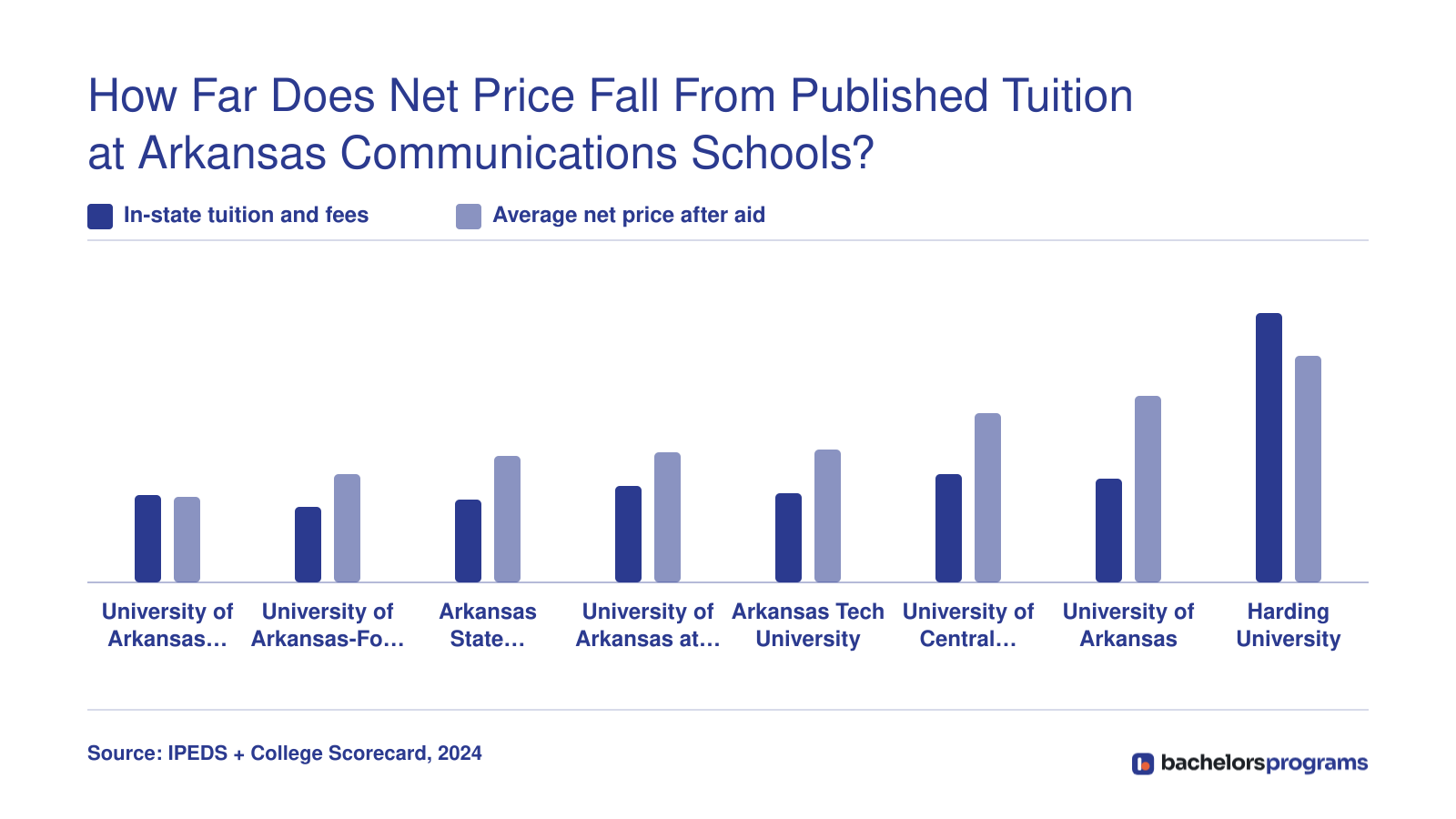
How Far Does Net Price Fall From Published Tuition at Arkansas Communications Schools?
Published in-state tuition and fees at these schools run from $7,334 at University of Arkansas-Fort Smith to $26,262 at Harding University. Average net price is a school-wide figure for aided, full-time undergraduates. It covers tuition, fees, housing, books and other costs, minus grants, which is why it lands above tuition alone at most of the public universities. At Harding, a private school, aid pulls net price about $4,100 below the sticker price, and at University of Arkansas Grantham the two figures sit close together. Treat net price as a campus-level benchmark, not a quote for communications majors specifically.
Related Articles
Communications Careers and Salaries in Arkansas
One year out from a bachelor's, Arkansas State University communication graduates earned a median of $40,192, and University of Arkansas graduates were close behind at $40,095, according to federal College Scorecard data. Those early numbers climb noticeably by year four at several schools.
What Recent Graduates Earn
The College Scorecard follows federally aided students who completed a bachelor's in the broad communication field at each school. The figures below show median earnings at two points: one year and four years after completion.
- University of Arkansas: $40,095 at one year; $56,969 at four years
- Arkansas State University: $40,192 at one year; $44,327 at four years
- Ouachita Baptist University: $34,574 at one year; $50,369 at four years
- Arkansas Tech University: $30,927 at one year; $45,385 at four years
- University of Central Arkansas: $28,490 at one year; $36,336 at four years
- University of Arkansas-Fort Smith: $28,951 at one year; $35,760 at four years
The four-year gap is worth weighing. Ouachita Baptist starts lower than either public university but grows to $50,369, while the University of Arkansas reaches $56,969. Employment is consistently strong: between 89% and 100% of graduates in each school's cohort were working one year after completing the degree.
Occupation Wages From BLS
The Bureau of Labor Statistics' most recent Occupational Employment and Wage Statistics release is from May 2025. It publishes Arkansas state and metro-area estimates for the jobs communication majors most often enter: public relations specialists, news analysts, reporters and journalists, market research analysts and marketing specialists, and public relations and fundraising managers.1 State-level medians for those occupations are not listed here, so check the BLS state estimates page for the role you are targeting.
Keep the two sources separate when you compare. BLS figures describe everyone working in an occupation, from new hires to 20-year veterans. Scorecard figures describe recent graduates of one specific program, measured at a fixed point after completion.
Licensing and Optional Credentials
No state license is required to work in communications, public relations, journalism or marketing in Arkansas. Employers hire on portfolio, writing samples and internship experience, which is why programs like Ouachita Baptist's (two required media team experiences) and the University of Central Arkansas's (a communication internship and TV production studio) stress hands-on work.
PR professionals who want a formal credential later in their careers can pursue Accreditation in Public Relations (APR), a voluntary certification for experienced practitioners. It is a mid-career step, not an entry requirement, so focus on building a strong portfolio while you earn your communications degree.
How We Ranked Arkansas Communications Schools
What the Ranking Weighs
Only bachelor's-level communications programs were eligible.
The cost and completion figures are school-wide. They describe all undergraduates at the university, not communications majors alone. Earnings and debt are program-level, tied to each school's communications field of study.
Accreditation
- University of Arkansas: Its 2026-27 catalog states it has been accredited by the Higher Learning Commission (HLC) continuously since 1924. The School of Journalism and Strategic Media holds ACEJMC accreditation for its B.A. in Journalism and B.A. in Advertising/Public Relations, reaccredited in 2023.2
- Arkansas State University: HLC's 2026 Resource Guide places it on the Standard Pathway.3 ACEJMC accredits its B.S. in Multimedia Journalism, reaccredited in 2022.4
- University of Arkansas Grantham: Its program page cites DEAC accreditation.
- All other schools here: None holds an ACEJMC-accredited program in the council's current list.5 Confirm each school's institutional status in the HLC Directory of Institutions, which shows schools as accredited or candidates and discloses any sanctions separately.
ACEJMC covers journalism and advertising/public relations degrees. The general communication degrees ranked at the University of Arkansas and Arkansas State are separate programs and do not carry that accreditation themselves.
Data Limits
Institution-wide figures come from the 2024 Scorecard release, while program earnings and debt reflect 2022 outcomes data, so they trail current tuition and job markets. Earnings are not reported for Harding University, University of Arkansas Grantham or University of Arkansas at Pine Bluff, usually because too few graduates were tracked. Treat those schools' positions as resting more heavily on cost and completion.
Compare Communications programs on the data that matters
Explore more Communications & Media majors or browse every field of study.
All Communications & Media programs Browse every field of study