Best Communications Degree Programs in Colorado
Compare 19 accredited Communications programs in Colorado at 12 colleges, with net price after aid, graduation rates, earnings and debt from IPEDS and the U.S. College Scorecard.

At the University of Denver, tuition and fees run $61,398 a year, but aid brings the average bill down to $36,131. That spread shapes how students compare communications programs in Colorado, where public flagships, regional campuses and private schools price the same major very differently.
Titles range from Communication Studies to Mass Communication, but the degree itself is usually a Bachelor of Arts (B.A.) in Communications. A ranked top 10, the cheapest and highest-earning picks, and a CU Boulder vs. Colorado State matchup sit alongside online, admissions, cost and career details.
The program name matters less than it seems. Employers in public relations and media tend to weigh internships and a portfolio over the title on the diploma.
Key Points
- CU Denver has the lowest average net price among public options here.
- Grant aid cuts Regis University's $46,340 tuition to an $18,397 net price.
- Colorado State, Regis and Northern Colorado list online communications bachelor's formats.
Best Bachelor's Degree in Communications Programs in Colorado at a Glance
Ten Colorado schools award a bachelor's degree in communications, and they divide fairly cleanly into three groups: large public research universities, regional public campuses with flexible or fully online delivery, and private schools with smaller cohorts. The list below runs from the flagship in Boulder to the hands-on programs in Gunnison and Grand Junction, with the details that actually separate them.
University of Colorado Boulder
#1Boulder, CO · $25,000 – $30,000/yr (est.)
Best for: Interdisciplinary learners pairing communication with a second field
The flagship campus in Boulder runs its communication major through the College of Media, Communication and Information, treating communication as a liberal art built on theory, analysis and practice. Students pair the major with a required secondary area of study outside communication, so the degree carries a built-in interdisciplinary component. Coursework trains speaking, writing, listening, research and media use, and the department frames those skills around how communication shapes organizations, identities and public life. It is the most recognizable communications name in the state and the natural first stop for students who want a large research university.
- Communication treated as a liberal art blending theory, analysis and practice
- Requires a secondary area of study outside the communication major
- Builds speaking, writing, reading, listening and media skills
- Examines how symbols and interaction shape organizations and identities
- Housed in the College of Media, Communication and Information
Colorado State University-Fort Collins
#2Fort Collins, CO · ~$21,000/yr (est.)
Best for: Transfer students planning accelerated completion
Colorado State's communication studies department sits in the College of Liberal Arts in Fort Collins and centers on how people connect through oral, written, visual and digital media. The curriculum covers interpersonal, organizational and public communication, with an accelerated path that lets motivated students finish in three to three and a half years by adding summer terms. Faculty are described as award-winning, and the program leans on teamwork, persuasion and critical thinking rather than narrow production skills. CSU also delivers the degree online, which makes it one of the few Colorado options available in both formats.
- Accelerated track finishes in three to three and a half years with summer terms
- Covers interpersonal, organizational and public communication
- Studies oral, written, visual and digital media
- Emphasizes critical thinking, teamwork and persuasion
- At least 30 upper-division credits must be completed through CSU
- Offered online as well as on campus
University of Denver
#3Denver, CO · ~$36,000/yr (est.)
Best for: Working adults finishing a degree online
The University of Denver offers communication on two paths: a traditional campus major in communication studies and a degree-completion program in communication arts run through University College for adults returning to school. Both emphasize ethical, intercultural and organizational communication, with a capstone tying the coursework together. The University College version is built around 10-week terms, hybrid or online delivery and generous transfer credit, which suits students who arrive with prior college work. DU's private-university setting and Denver location give it a different feel from the public options on this list.
- Degree-completion format designed for adults returning to college
- Hybrid or fully online delivery with 10-week terms
- Accepts transfer credit for up to three years of prior study
- Capstone project integrates the major coursework
- Core courses in writing, leadership and ethical decision making
- Major courses cover media, visual communication and intercultural topics
- Career coaching, resume review and mock interviews included
- Campus-based traditional BA requiring 40 credits in the major
- Capstone sequence and internship opportunities
- Coursework in intercultural, health and organizational communication
- Focus on ethical communication and public deliberation
- Research methods and conflict management courses
- Study abroad and community engagement options
- Admissions reviewed on GPA
University of Colorado Denver/Anschutz Medical Campus
#4Denver, CO · $10,000 – $15,000/yr (est.)
CU Denver's communication department is the most flexible public option in the state, with six concentration pathways and start dates in fall, spring and summer. The 120-credit BA mixes theory with practice through internships, study abroad in Spain, the Dominican Republic and China, and an on-campus Media Learning Lab. Courses run in 8- or 16-week formats, and students can add certificates in strategic or health communication or stack a bachelor's and master's in one extra year. Its Denver location and part-time-friendly schedule make it a strong fit for commuters and working students.
- Six concentration options, including strategic communication and media and cultural studies
- 120 credit hours; full-time or part-time study
- Start terms in fall, spring and summer
- 8-week or 16-week course formats
- Internships tailored to interests; alumni work at Disney and Amazon
- Study abroad in Spain, the Dominican Republic and China
- Certificates in strategic communication and health communication
- BA plus MA pathway completed in one extra year
Regis University
#5Denver, CO · ~$18,000/yr (est.)
Regis University is a Jesuit institution in Denver, and its online Bachelor of Arts in Communication is designed for adult learners who want to finish a degree without coming to campus. The curriculum builds core skills in media, public relations, marketing and corporate communication, with admissions counseling from application through graduation. Transfer credit is accepted generously, and financial aid and scholarships are available against the published per-credit rate. Student-to-faculty ratio is among the lowest on this list, and the Jesuit framing adds an ethics and service dimension that secular programs often leave implicit.
- Fully online format built for adult learners
- Accepts transfer credit equivalents toward the degree
- Published rate of $599 per credit hour before aid
- Financial aid and scholarships available
- Personal admissions counseling from application to graduation
- Curriculum spans media, public relations, marketing and corporate communication
University of Northern Colorado
#6Greeley, CO · $18,000/yr (est. net price)
The University of Northern Colorado in Greeley runs a 120-credit communication studies BA that can be completed in person or online. The program emphasizes public speaking, persuasion, relationship building and emerging media technologies, and lets students shape electives around their own interests. Four-year academic plans and advisor guidance keep students on track, which matters at a school where many students commute or work. It is one of the more affordable public options in the state and a practical choice for students who want a straightforward communication degree without a specialized track.
- 120 credit hours, completed in four years
- Offered in person or online
- Coursework in public speaking, persuasion and relationship cultivation
- Covers emerging media and technologies
- Communication-based electives let students tailor the degree
- Four-year academic plans and advisor guidance provided
University of Colorado Colorado Springs
#7Colorado Springs, CO · $10,000 – $24,000/yr (est.)
UCCS offers a Bachelor of Arts in Communication with six tracks: digital filmmaking and media arts, general communication, media studies, professional communication, sports communication and a fully online option. The major requires at least 39 credit hours of communication coursework, including 18 upper-division hours, and students must earn a C or better in 30 of those hours while holding a 2.0 in the major. Departmental honors is available for students who reach a 3.75 communication GPA and a 3.5 overall. The Colorado Springs location and the sports communication track give it a distinct identity among Colorado programs.
- Six tracks including digital filmmaking and media arts, sports communication and an online option
- At least 39 communication credit hours, 18 of them upper division
- C or better required in 30 communication hours; 2.0 major GPA
- No more than 60 communication credits apply to the degree
- Departmental honors requires 3.75 communication and 3.5 overall GPA
- Learning outcomes cover public speaking, writing, theory and research methods
Colorado Christian University
#8Lakewood, CO · $25,000 – $30,000/yr (est.)
Colorado Christian University in Lakewood offers a campus-based Bachelor of Arts in Communication with a concentration in organizational communication. The curriculum focuses on professional communication strategy and ethical practice, aimed at students preparing for business, nonprofit or ministry-adjacent roles. Admissions requirements are described as flexible, and the school positions tuition as cost-effective relative to other private options in Colorado. It is the clearest choice on this list for students who want a faith-based setting and a small-campus experience.
- Concentration in organizational communication
- Campus-based program in Lakewood
- Focus on professional communication strategy and ethical practice
- Prepares students for business, nonprofit and organizational roles
- Admissions requirements described as flexible
- Tuition positioned as cost-effective among Colorado private options
Western Colorado University
#9Gunnison, CO · $16,000/yr (est. net price)
Western Colorado University in Gunnison takes a hands-on approach, blending writing, film, theater and public relations into a communication arts degree. Students work in student-run outlets such as KWSB radio and the Western Theater Company, and some produce a real-world magazine as part of their coursework. A strategic communication emphasis adds public relations, advertising, brand management and digital marketing for students aimed at agency or corporate work. The mountain-town setting and small classes make it a different proposition from the Front Range universities.
- Blends writing, film, theater and public relations
- Student-run outlets include KWSB radio and the Western Theater Company
- Students can produce a real-world magazine as part of coursework
- Courses include Media Writing and Public Relations Communications
- Department scholarships available
- Strategic communication emphasis within the communication arts degree
- Covers public relations, advertising, brand management and digital marketing
- Includes media relations training and multimedia production
- Builds writing, presentation and analytical skills
- Hands-on media experience using campus facilities
Colorado Mesa University
#10Grand Junction, CO · ~$15,000/yr (est.)
Colorado Mesa's mass communication degree in Grand Junction concentrates on media strategies and applications, with coursework in journalism, broadcasting, public relations and new media. Students work in Mac labs and a multi-camera television studio, and a partnership with Rocky Mountain PBS opens access to professional equipment. Student-run outlets include Horizon Magazine, The Criterion newspaper, KMSA radio and CMU-TV, and small classes put students in close contact with faculty who have industry experience. It is a strong pick for students who want production experience without leaving western Colorado.
- Concentration in media strategies and applications
- Coursework in journalism, broadcasting, public relations and new media
- Mac lab classrooms and a multi-camera TV studio
- Partnership with Rocky Mountain PBS provides professional equipment access
- Student-run Horizon Magazine, The Criterion, KMSA radio and CMU-TV
- Small classes taught by faculty with industry experience
Cost & outcomes by school
Federal data for the highest-earning Communications programs, independent of the ranking above. Earnings are this field's bachelor's graduates four years after completing where the Scorecard reports them, else the school's undergraduate median.
| School | Net price / yr | Grad rate | Earnings | Debt | Grads/yr | Format |
|---|---|---|---|---|---|---|
| University of Colorado Boulder CO | $25,346 | 74% | $66,623 | $16,500 | 244 | Campus |
| University of Denver CO | $36,131 | 76% | $63,374 | $20,666 | 66 | Hybrid |
| University of Colorado Denver/Anschutz Medical Campus CO | $11,900 | 46% | $62,882 | $21,896 | 129 | Campus |
| Colorado State University-Fort Collins CO | $21,279 | 67% | $61,434 | $20,500 | 127 | Online |
| University of Northern Colorado CO | $17,760 | 51% | $56,520 | $19,848 | 49 | Online |
| Colorado Mesa University CO | $15,103 | 41% | $54,717 | $21,061 | 19 | Campus |
| Metropolitan State University of Denver CO | $15,327 | 32% | $52,093 | $21,500 | — | Campus |
| University of Colorado Colorado Springs CO | $15,788 | 47% | $50,692 | $17,535 | 125 | Hybrid |
| Western Colorado University CO | $16,425 | 51% | $47,426 | $20,750 | 9 | Campus |
| Regis University CO | $18,397 | 61% | $46,341 | $25,000 | 11 | Online |
| Adams State University CO | $12,980 | 39% | $44,372 | $19,500 | 6 | Campus |
| Colorado Christian University CO | $29,500 | 64% | $44,245 | $23,250 | 11 | Campus |
Sources: U.S. Department of Education. Net price, graduation rate, earnings and debt: College Scorecard (earnings and debt for this field's bachelor's graduates where reported, else school-wide); graduates: IPEDS. A dash means no figure is reported.
Cost, debt & payoff
Median earnings of this field's bachelor's graduates (4 yrs after completing, else the school's undergraduate median) vs. their median federal loan debt · U.S. College Scorecard
Across these programs the median graduate earns about $52,093 and finishes with roughly $20,666 in debt — a ratio that clears a common rule of thumb (keep debt below first-year salary). Net price and debt vary widely school to school, so check the per-school figures in the table above before you shortlist.
How We Ranked Colorado Communications Programs
Choosing between a prestigious name and a manageable price is hard without comparable numbers, so the rankings here rest on federal College Scorecard data rather than reputation. Four measures do most of the work: earnings of graduates from the communications program itself, median debt, the number of students completing the program, and net price.
What the Numbers Mean
Program earnings and debt describe graduates of the communications bachelor's degree specifically. Completions show how many students finish the major, a rough sign of how established it is.
Net price is the average a student pays after grants and scholarships are subtracted from the full cost of attendance. It is an approximate average, not a quote. Your own figure depends on family income, aid eligibility and residency.
What Is Institution-Wide
Graduation rates and net price describe the whole school, not the communications department. A university with a high graduation rate overall may still run a communications program that looks different from that average. Treat those two figures as context for the school, and use the program figures to compare majors.
Scope and Timing
Only bachelor's programs at Colorado schools are included, both on campus and online. Figures come from the most recent College Scorecard release available when this page was prepared, and they shift as new data is published. Check each school's own site for current tuition and aid before you apply.
Cheapest Communications Bachelor's Programs in Colorado
These Colorado public universities offer the lowest average net price for a communications bachelor's degree, sorted from least to most expensive, based on 2024 IPEDS and College Scorecard data from the U.S. Department of Education. CU Denver leads on net price at $11,900 a year. Adams State University, which appears in our directory, has the lowest in-state sticker price at $9,824. Net price is what students pay after grants and scholarships, so it often differs from published tuition.
| School | City | Program | Format | In-State Tuition and Fees | Average Net Price | Graduation Rate |
|---|---|---|---|---|---|---|
| University of Colorado Denver/Anschutz Medical Campus | Denver | Bachelor of Arts in Communication | Campus | $10,383 | $11,900 | 46% |
| Adams State University | Alamosa | Bachelor of Arts in Communication & Media Studies | Campus | $9,824 | $12,980 | 39% |
| Colorado Mesa University | Grand Junction | Mass Communication (Media Strategies and Applications) | Campus | $9,927 | $15,103 | 41% |
| Metropolitan State University of Denver | Denver | Communication Studies | Campus | $11,124 | $15,327 | 32% |
| University of Colorado Colorado Springs | Colorado Springs | Communication, BA | Hybrid | $10,149 | $15,788 | 47% |
Related Articles
CU Boulder vs. Colorado State: Communications Bachelor's Compared
CU Boulder and Colorado State University-Fort Collins are the two large public research universities students most often weigh for a bachelor's degree in communications in Colorado. Both offer the major: CU Boulder awards a B.A. in Communication, and CSU offers Communication Studies. The CU Boulder column draws on the university's own degree overview and catalog. Its program is a broad liberal-arts major built around 36 credit hours, two named required courses, and a mandatory secondary area of study outside the major. CSU's program structure, required courses, and delivery options should be confirmed in CSU's current catalog and with its communication studies department before you apply. Use this table as a checklist of the questions to ask both schools, not as a final verdict.
| Feature | University of Colorado Boulder | Colorado State University-Fort Collins |
|---|---|---|
| Program | B.A. in Communication | Communication Studies (bachelor's) |
| Campus | Boulder | Fort Collins |
| Academic home | Communication department, College of Media, Communication and Information | Confirm in CSU's current catalog |
| Program style | Broad liberal-arts approach to communication | Confirm with CSU's communication studies department |
| Credit hours in the major | 36 credit hours | Confirm in CSU's current catalog |
| Required courses named in the catalog | COMM 1210 and COMM 1300 | Confirm in CSU's current catalog |
| Concentrations or emphases | No formal concentrations listed in the catalog | Confirm with CSU's communication studies department |
| Secondary area of study | Required: a minor, a second major in the college, a double degree, or a certificate of at least 12 credit hours | Confirm in CSU's current catalog |
| Online availability | Not listed among CU Boulder's online undergraduate degrees; plan for on-campus study | Confirm with CSU's admissions or online office |
Online and Hybrid Communications Bachelor's Options at Colorado Schools
Several Colorado schools let you earn a communications bachelor's degree without living on campus. Colorado State University-Fort Collins, Regis University and the University of Northern Colorado list online formats. The University of Denver and the University of Colorado Colorado Springs list hybrid formats, and UCCS also mentions a fully online option. CU Boulder, CU Denver, Colorado Christian University, Western Colorado University and Colorado Mesa University deliver their programs on campus.
CSU Online Requirements
CSU Online offers a Communication Studies B.A. and a Journalism and Media Communication B.A. Both are described as online. The program pages do not say whether coursework is asynchronous or hybrid. Each degree requires 120 credits, including 42 upper-division credits at the 300/400 level. At least 30 of those upper-division credits must be completed through CSU. The journalism degree also requires 40 JTC credits and at least 72 credits outside JTC.
Transfer Limits
Students who finished an undergraduate degree elsewhere and never attended CSU as degree-seeking undergraduates may receive up to 90 general transfer credits once admitted. CSU warns that transferring more than 90 can create excess electives and may push you past 120 credits. Transfer credit also may not satisfy specific degree requirements. The journalism program works as a degree-completion path, and its minimum credits vary with prior coursework, so ask an advisor for a written completion plan before you enroll.
Online vs. On-Campus Tuition
Regis lists $599 per credit for its online Bachelor of Arts in Communication. The University of Denver lists $603 per credit for its hybrid or online Communication Arts degree. For CSU Online, confirm current per-credit rates on its tuition pages instead of assuming campus rates apply.
Who Online Fits Best
Online study suits working adults who need to keep a job while finishing a degree. It also suits transfer students who already hold substantial credit and want to complete the upper-division coursework. If you want newsroom labs or student-run media, the campus programs are a better match.
Admissions for Colorado Communications Bachelor's Programs: GPA, Test Policy, and Transfer Credit
The schools that read your transcript most closely are also the ones with the best-known communications programs, while the most accessible schools ask for little beyond an application. Federal admission rates show where each school falls.
Selective vs. Open-Access Schools
None of these schools is highly selective, but the admit rates still vary widely. University of Denver (77.8%), CU Boulder (78.1%) and CU Denver (74.7%) admit a smaller share of applicants than Colorado Mesa University (82.0%), the University of Northern Colorado (85.9%), Regis University (86.5%) and Colorado State (88.5%). University of Colorado Colorado Springs (97.4%) and Western Colorado University (99.7%) admit nearly everyone who applies.
First-Year GPA and Test Policy
CU Boulder publishes no minimum GPA. It names high school GPA and course rigor as the most important factors in a review that weighs other things too. It is test-optional, and you may self-report ACT or SAT scores. Since April 2025 it no longer accepts or considers the ACT Writing and Science sections.
Colorado State publishes no first-year GPA expectation in the sources we reviewed, and the pages we reviewed did not establish its first-year test policy.1 For the other ranked schools, including Denver, Regis, Northern Colorado, Colorado Christian and Colorado Mesa, we found no published GPA minimum, test policy or transfer rule in the official pages we reviewed. Confirm those with each admissions office rather than assuming.
Transfer Credit Rules
- CU Boulder: There is no minimum number of transfer credits. Applicants with fewer than 24 credits are reviewed on college and high school records, and those with 24 or more mainly on college work. Credit transfers with a C- or better, earned within the past 10 years, and the Registrar evaluates it after admission. The cumulative GPA required for Communication is 3.0. Anyone beyond 36 credit hours must also have finished Public Speaking (COM 1150) or Group Communication (COM 2220) with at least a 3.0. Transfer deadlines run October 1 for spring, March 15 for summer, and June 1 for fall (March 15 for early notification).
- Colorado State: Strong transfer candidates typically have a cumulative GPA of 2.5 or higher, plus completed college composition and math or statistics.1 ACT and SAT scores are not considered. Credit requires a C- or better, up to 90 credits can transfer, and evaluation takes about 30 business days.2 Associate degree holders with a 2.0 GPA qualify for guaranteed admission.2
A Tip for Transfer Students
If you are headed to CU Boulder, take COM 1150 or COM 2220 early and earn at least a B, because that course gate applies once you pass 36 credits. For Colorado State, finish composition and math before you apply. The sources we reviewed did not confirm a statewide transfer pathway, so ask any school you are considering for a written credit evaluation before you commit.
What a Communications Bachelor's Degree Costs in Colorado
At the same public campus, resident and nonresident students can pay very different bills, and private schools set their own price. Colorado does not publish one statewide tuition figure, so the comparison starts school by school.
Sticker Price: In-State vs. Out-of-State
Among the public schools here, in-state tuition and fees run from $9,927 at Colorado Mesa University and $10,149 at the University of Colorado Colorado Springs to $13,373 at Colorado State University-Fort Collins and $15,666 at the University of Colorado Boulder. Nonresident rates climb sharply: $34,783 at Colorado State and $44,918 at CU Boulder. Regis University, a private school, lists $46,340 for everyone.
Net Price After Aid
Net price is the average bill once grants and scholarships are subtracted, and it is usually lower than the sticker price. Reported averages include $11,900 at CU Denver, $15,103 at Colorado Mesa, $17,760 at the University of Northern Colorado, $18,397 at Regis, $21,279 at Colorado State and $25,346 at CU Boulder. Net price is an average across many students, so your own figure depends on family income, residency, housing and the aid you receive.
Colorado Aid Programs
The College Opportunity Fund stipend is paid per credit hour to the college on behalf of eligible in-state undergraduates.1 You must apply, enroll, create a COF account and authorize the payment, or you owe full tuition.1 The lifetime limit is 145 credit hours.2 The Legislature sets the per-credit amount each year, so check your school's current bill for it.1
The Colorado Department of Higher Education describes state aid including the Colorado Student Grant for documented need and Colorado Work-Study.4 Applicants file either the FAFSA or the Colorado Application for State Financial Aid (CASFA), not both.3 CASFA opens October 1 and serves students ineligible for federal aid, including ASSET students.3 The state's materials do not lay out statewide rules for a program called the Colorado Opportunity Scholarship, but some institutions run their own last-dollar tuition programs, so ask each financial aid office.
Debt After Graduation
Program-level Scorecard data shows median debt for communications completers of $16,500 at CU Boulder, $17,535 at UCCS, $19,848 at Northern Colorado, $20,500 at Colorado State and $21,896 at CU Denver. These are medians for past graduates, not forecasts for you.
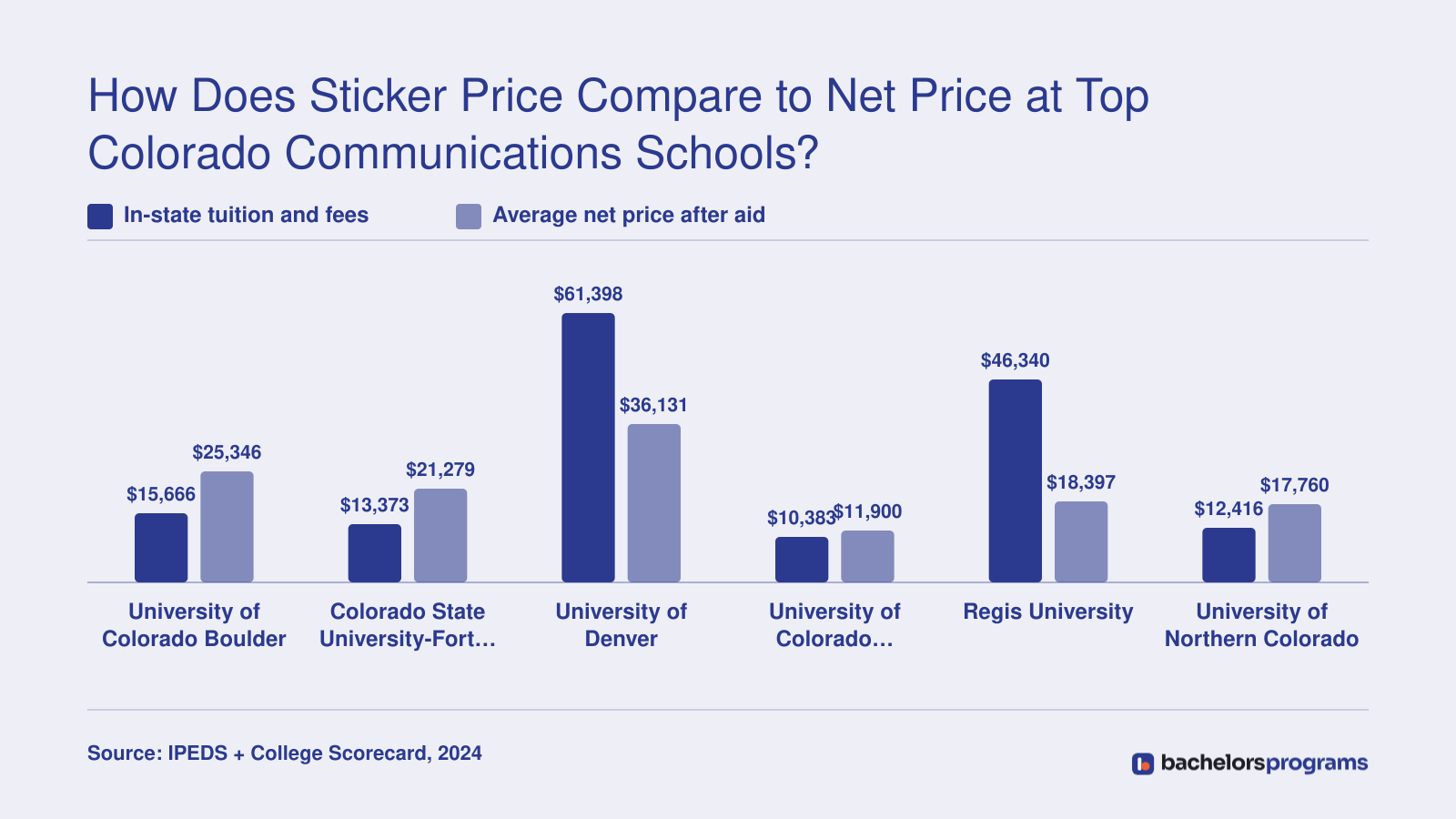
How Does Sticker Price Compare to Net Price at Top Colorado Communications Schools?
Published tuition tells only part of the story. At private schools like the University of Denver ($61,398 in tuition and fees vs. a $36,131 average net price) and Regis University ($46,340 vs. $18,397), grant aid cuts the bill sharply. At public universities, net price can exceed tuition because it counts housing, food, books and other costs of attendance, minus grants and scholarships. Net price is an institution-wide average for all undergraduates, not a figure specific to communications majors, so use it as a starting point and confirm your own aid offer.
Communications Careers in Colorado After a Bachelor's Degree
A communications bachelor's degree qualifies you for a wide range of Colorado jobs, but the tradeoff is breadth in place of a single clear path. The more general your coursework, the more you will lean on internships and a portfolio to steer you toward a specific job.
What Colorado Pays in Common Communications Roles
The Colorado figures from the Bureau of Labor Statistics are average (mean) wages, not medians. They also come from different survey years, so treat them as a rough guide rather than a side-by-side comparison.
- Market research analysts and marketing specialists: About 26,880 jobs statewide in May 2023, with a mean annual wage of $85,600 ($41.16 per hour).1 Colorado's location quotient of 1.70 means these jobs are noticeably more concentrated in the state than in the U.S. as a whole.
- Public relations specialists: Roughly 5,960 jobs and a $69,790 mean wage in the May 2020 survey.2
- Technical writers: About 1,340 jobs and a $79,490 mean wage, also from May 2020.2
- Marketing managers: About 4,050 jobs and a $172,140 mean wage in May 2020.2 These are typically experience-level roles you grow into after the bachelor's degree, not first jobs.
The 2020 figures are several years old. Read them as a sense of how these roles compare with one another, not as a benchmark for a current offer.
Where Graduates Tend to Work
Colorado communications graduates commonly work for government agencies, nonprofits, technology companies, and public relations, marketing, and advertising agencies. Students in Denver, Boulder, Fort Collins, and Colorado Springs can pursue internships in their own metro areas during the school year. Students farther from a city should plan for summer or remote placements.
Licensure and Credentials
Communications does not follow the licensed-profession model of fields like nursing or counseling, where a state exam gates entry. Hiring usually rests on writing samples, a portfolio, and internship experience. If a specific role involves regulated work, confirm any requirements directly with the employer.
Our advice: when comparing these programs, weigh internship support and portfolio-building courses as heavily as tuition. Those two factors do the most to turn a broad degree into a first job.
Common Questions About Communications Degrees in Colorado
These answers cover the questions students ask most often when comparing a bachelor's degree in communications in Colorado. Details such as formats, deadlines and credit rules vary by school, so confirm them on each program's own page.
What is the best communications school in Colorado?
Can you get a bachelor's degree in communications online in Colorado?
What is the CU Boulder communications major acceptance rate?
Do you need a license to work in communications in Colorado?
Can I transfer community college credits into a Colorado communications bachelor's program?
Compare Communications programs on the data that matters
Explore more Communications & Media majors or browse every field of study.
All Communications & Media programs Browse every field of study