Best Communications Degree Programs in Massachusetts
Compare 35 accredited Communications programs in Massachusetts at 30 colleges, with net price after aid, graduation rates, earnings and debt from IPEDS and the U.S. College Scorecard.

What does a bachelor's degree in communications cost in Massachusetts, and does the price track the payoff? The most common credential is the Bachelor of Arts (B.A.) in Communications, though some schools award a B.S. instead. Among the ranked programs, in-state tuition and fees run from about $11,800 at Worcester State University to more than $70,000 at Boston College.
That spread is the central tension. Cost, class size, internship access in Greater Boston, and the share of coursework available online vary widely, and campus programs still outnumber online ones.
The programs here are Massachusetts-based, on campus and online. Graduates often start in media, marketing, and public relations roles that cluster around Boston.
Key Points
- Massachusetts public in-state tuition for communications runs $11,346 to $15,908.
- Lasell University offers an online Bachelor of Arts in Communication.
- Test-optional admission is the norm at Massachusetts public campuses, so GPA matters.
Best Communications Schools in Massachusetts: Our Top 10 Bachelor's Programs
The ten programs below are the strongest bachelor's degree options in communications across Massachusetts, from a flagship public research university in Amherst to small private colleges in Boston, Worcester, and Easton. Each entry covers what makes the school distinct and the specifics of its major: credit requirements, concentrations, internships, and capstone expectations.
University of Massachusetts-Amherst
#1Amherst, MA · $20,000 – $25,000/yr (est.)
Best for: Students wanting a broad media studies curriculum
A flagship public research university in Amherst with a B.A. in Communication organized around five areas of study, including media and popular culture, media and technology, rhetoric and performance, and film. First-year and transfer applicants can apply directly into the major, and students admitted to the university without it can declare later through departmental advising. Majors complete at least 45 communication credits with a 2.0 GPA in the field, and the department added a Springfield Internship Program in spring 2026 for in-state experience.
- Five areas of study, from interpersonal communication to film
- At least 45 communication credits, 21 inside the department
- Minimum 2.0 GPA in the major required
- Study abroad and domestic exchange placements
- Internships to launch career, plus a Springfield program in 2026
- Direct admission for first-year and transfer applicants
Boston College
#2Chestnut Hill, MA · ~$42,000/yr (est.)
Best for: Ethics-focused communicators who want small seminars
A private Jesuit university in Chestnut Hill with a tight 34-credit Communication major that pairs communication theory with two writing-intensive seminars and four electives. Students can add an internship practicum and a senior internship seminar, and faculty advising is built into the degree. Admission is highly selective, and the program keeps transfer credit limited, so most students arrive as first-years.
- 34-credit major with 13 core credits
- Theory course plus two writing-intensive seminars
- Four electives (12 credits) with room for an internship practicum
- Senior Internship Seminar offered
- Maximum 6 transfer credits accepted
- Close faculty advising throughout the major
Worcester State University
#3Worcester, MA · ~$13,000/yr (est.)
Best for: Budget-conscious Worcester-area commuters
A public university in Worcester whose Communication major runs 39 credits, a 21-credit core plus 18 credits of communication electives, and ends in a senior capstone. Concentrations in Advertising and Public Relations and in Digital Media Production each carry 39 credits, and a Sports Communication concentration is also listed. Students entering with 45 or fewer credits must pair the major with a second program and meet an advisor each semester to review courses.
- 39-credit major: 21-credit core plus 18 elective credits
- Senior capstone required for graduation
- Concentrations in Advertising and Public Relations, Digital Media Production
- Sports Communication concentration also listed
- Optional internship course in the sample plan
- 120 credits to graduate; sample plan totals 121
- Students with 45 or fewer credits add a second program
Clark University
#4Worcester, MA · ~$29,000/yr (est.)
A private research university in Worcester where the B.S. in Communications is delivered through the School of Professional Studies, aimed at students completing a bachelor's degree. The curriculum combines major courses, liberal arts distribution requirements, electives, and a capstone, with internships and hands-on projects along the way. Transfer students can bring up to 16 course units, which makes the program unusually accommodating for people arriving with prior college credit.
- 128 total credit hours with a required capstone
- Transfer up to 16 course units
- Offered through the School of Professional Studies
- Internships and hands-on projects built into the curriculum
- Emphasis on ethical communication and critical analysis
Simmons University
#5Boston, MA · $25,000 – $30,000/yr (est.)
A private university in Boston whose B.A. in Communications sits inside the Gwen Ifill School of Media, Humanities, and Social Sciences. Majors complete 42 credits built on a three-course core, two technology courses, a concentration, and a capstone taken as an internship or at Studio 5, the student-run communications agency. Joint majors in Public Relations and Marketing Communications and in Interaction Design and Web Development let students pair the degree with a second specialty.
- 42-credit major with a three-course introductory core
- Concentrations in Design, Journalism, or Integrated Media
- Capstone via internship or Studio 5 student agency
- Joint major in Public Relations and Marketing Communications
- Joint major in Interaction Design and Web Development
- Two 1-credit technology courses required
- Internship sites include Boston Ballet, WGBH, and Harvard Medical School
Assumption University
#6Worcester, MA · ~$29,000/yr (est.)
A private Catholic university in Worcester offering a B.A. in Communication and Media that pairs traditional rhetorical skills with hands-on multimedia production. Students take gateway courses in argument, journalism, and media analysis, then choose one of three tracks: Journalism and Professional Writing, Creative Writing, or Media Studies and Production. Production courses let students build podcasts, radio shows, and TV programs, and study abroad options include the university's own Rome campus.
- Three tracks: Journalism and Professional Writing, Creative Writing, Media Studies and Production
- Production courses in podcasting, radio, and TV
- Senior capstone project presented live
- Internships and faculty-mentored research
- Study abroad, including the Rome campus
- Gateway courses in argument, journalism, and media analysis
Stonehill College
#7Easton, MA · ~$33,000/yr (est.)
A private Catholic college in Easton with a B.A. in Communication & Media Studies taught in small classes and grounded in media theory and rhetoric. Students get hands-on experience through the Digital Innovation Lab, the student newspaper, the radio station, and an extensive internship program. An alumni mentor network and an accelerated dual-degree option add career support on top of the coursework.
- Small class sizes with faculty research collaboration
- Extensive internship program with alumni mentors
- Digital Innovation Lab for podcasting and audio
- Student newspaper The Summit and radio station WSHL
- Editing lab with Adobe suite
- 108 active alumni mentors
- Accelerated dual degree option
Gordon College
#8Wenham, MA · ~$25,000/yr (est.)
A private Christian college in Wenham offering a B.A. in Communication Arts through the Adams School of Music and the Arts, delivered in person. Students choose a concentration such as Digital Media or Strategic Communications, then add experience through internships with organizations including the New England Sports Network and the Boston Bruins, plus international placements in Italy, Japan, and Britain. On-campus outlets range from podcasts and student publications to broadcast crew work and a short film competition.
- Concentrations include Digital Media and Strategic Communications
- Internships with New England Sports Network and Boston Bruins
- International internships in Italy, Japan, and Britain
- JUD Talks speech contest and Gordon Globes film competition
- Broadcast crew work, student publications, and podcasts
- In-person program with scholarships available
Springfield College
#9Springfield, MA · ~$31,000/yr (est.)
A private college in Springfield whose Communications and Creative Media B.A. is a 120-credit degree blending communication theory with production skills. The 46-credit major covers graphic design, motion graphics, social media marketing, multimedia writing and production, and public relations, with selectives in adjacent fields. Every major completes a substantive internship and a capstone portfolio built for the job market.
- 120-credit degree with 46 credits in the major
- Required substantive internship and capstone portfolio
- Coursework in motion graphics and multimedia production
- Social media marketing and public relations courses
- Selectives in graphic design, journalism, business, music technology
- Fluency with industry-standard software
- 40-credit core curriculum alongside the major
Bridgewater State University
#10Bridgewater, MA · $16,000/yr (est. net price)
A public university in Bridgewater with a B.A. in Communication offered in three concentrations: communication and media studies, film and video arts production, and public relations. The same curriculum is available fully online through the College of Continuing Studies, where part-time students can transfer up to 90 credits and finish in about three years. Students work in the television studio and editing lab with DSLR and RED cameras, and internships have placed them at WBZ-TV, WGBH, and The Boston Globe.
- Three concentrations: media studies, film and video arts, public relations
- Day classes on campus or the same curriculum fully online
- Internships at WBZ-TV, WGBH, and The Boston Globe
- Television studio and editing lab with DSLR and RED cameras
- Public Relations Student Society of America chapter
- WBIM student-led radio station
- Four communication minors also offered
Bridgewater State University
#11Bridgewater, MA · $16,000/yr (est. net price)
placeholder
Cost & outcomes by school
Federal data for the highest-earning Communications programs, independent of the ranking above. Earnings are this field's bachelor's graduates four years after completing where the Scorecard reports them, else the school's undergraduate median.
| School | Net price / yr | Grad rate | Earnings | Debt | Grads/yr | Format |
|---|---|---|---|---|---|---|
| Boston College MA | $41,704 | 91% | $83,586 | $18,000 | 207 | Campus |
| Northeastern University MA | $30,915 | 91% | $80,191 | $21,500 | 154 | Campus |
| Northeastern University MA | — | — | $80,191 | $21,500 | — | Campus |
| Assumption University MA | $29,498 | 75% | $74,895 | $27,000 | 8 | Campus |
| Western New England University MA | $27,290 | 64% | $73,157 | $25,500 | 6 | Campus |
| Simmons University MA | $25,265 | 72% | $71,138 | $23,250 | 10 | Campus |
| Stonehill College MA | $33,016 | 76% | $70,618 | $25,000 | 25 | Campus |
| University of Massachusetts-Dartmouth MA | $20,927 | 52% | $68,804 | $25,000 | 12 | Campus |
| Endicott College MA | $40,654 | 76% | $62,840 | $27,000 | 14 | Campus |
| Clark University MA | $28,714 | 77% | $62,381 | $26,759 | 1 | Campus |
| University of Massachusetts-Amherst MA | $22,383 | 83% | $60,891 | $20,500 | 203 | Campus |
| University of Massachusetts-Boston MA | $17,707 | 49% | $60,411 | $24,258 | 67 | Campus |
Sources: U.S. Department of Education. Net price, graduation rate, earnings and debt: College Scorecard (earnings and debt for this field's bachelor's graduates where reported, else school-wide); graduates: IPEDS. A dash means no figure is reported.
Cost, debt & payoff
Median earnings of this field's bachelor's graduates (4 yrs after completing, else the school's undergraduate median) vs. their median federal loan debt · U.S. College Scorecard
Across these programs the median graduate earns about $59,202 and finishes with roughly $24,847 in debt — a ratio that clears a common rule of thumb (keep debt below first-year salary). Net price and debt vary widely school to school, so check the per-school figures in the table above before you shortlist.
Most Affordable Bachelor's in Communications Programs in Massachusetts
These public universities offer the lowest average net price for a bachelor's degree in communications among the Massachusetts schools we track, based on 2024 U.S. Department of Education data from IPEDS and the College Scorecard. Worcester State University has the lowest net price at $13,381 a year. Bridgewater State University adds a fully online option alongside its campus program. In-state tuition and fees at every school below fall between $11,346 and $12,436, so net price after aid is the better measure of what you will actually pay.
| School | City | Format | In-State Tuition & Fees | Average Net Price | Graduation Rate | Communications Graduates' Median Earnings (1 Year After Graduation) | Median Earnings 10 Years After Entry (All Programs) |
|---|---|---|---|---|---|---|---|
| Worcester State University | Worcester | Campus | $11,786 | $13,381 | 61% | $34,235 | $60,624 |
| Fitchburg State University | Fitchburg | Campus | $11,346 | $14,262 | 55% | $30,662 | $53,874 |
| Salem State University | Salem | Campus | $12,338 | $15,996 | 50% | $34,302 | $56,662 |
| Massachusetts College of Liberal Arts | North Adams | Campus | $12,436 | $16,068 | 56% | N/A | $48,102 |
| Bridgewater State University | Bridgewater | Hybrid | $11,808 | $16,383 | 53% | $34,146 | $57,466 |
Online and Hybrid Communications Bachelor's Options at Massachusetts Schools
Yes, you can earn a communications degree online in Massachusetts
Online and hybrid bachelor's degrees in communications do exist at Massachusetts-based schools, but campus programs still dominate the field. Most of the programs covered here, including those at University of Massachusetts-Amherst, Boston College, Worcester State University, Clark University, Assumption University, Stonehill College, Gordon College, and Springfield College, are delivered on campus. If you want a studio, a student radio station, or face-to-face internships arranged through faculty, pick a campus program.
Fully online vs. degree completion
These two formats serve different students, and the distinction matters before you apply.
- Degree completion (Simmons University, Boston): The fully online Communications, B.A. is built for students who already have 30 or more college credits or an associate degree. It accepts up to 96 transfer credits, runs part time, and combines live online sessions with self-paced coursework at $500 per credit. Simmons is a women's college, so eligibility is limited accordingly.
- Online, part-time at a public school (Bridgewater State University): The Communication Studies program with a Communication and Media Studies concentration is offered online on a part-time, roughly three-year track, accepting up to 90 transfer credits. Bridgewater State's main Bachelor of Arts in Communication is hybrid, with a fully online option available. Bridgewater State does not publish a separate online per-credit rate, so ask admissions directly.
- Fully online, out-of-state provider (UMass Global): The B.A. in Communications and Media is 120 credits, fully online, at $500 per credit, with up to 90 transfer credits (or 75 percent of the degree). Qualifying transfer students can finish in as few as 10 courses. This is not a Massachusetts campus, so weigh that if studying in-state is part of your plan.
Check the price tag before you commit
Online tuition is not automatically the same as the on-campus sticker price, and at public schools it is often billed per credit rather than per semester, which changes the math for part-time students. Before you enroll, confirm three things in writing: the per-credit rate for online sections, whether in-state residency affects that rate, and what online or technology fees apply.
Transfer credit is the other lever. A degree-completion format that accepts 90 or more prior credits can cut your remaining coursework dramatically, so get a credit evaluation before you pay a deposit.
Questions to Ask Yourself
Do you need hands-on access to campus media and Boston-area internships?
How many college credits are you bringing with you?
Will you commute, relocate, or keep working full time?
Admissions: GPA, Test Policy, and Transfer Credit for Communications Majors
Test-optional admission has become the norm at Massachusetts public campuses, which leaves GPA doing most of the sorting. The details below come from the schools' own admissions information, and where a policy is not published, we say so.
Public Campuses: GPA and Test Rules
- UMass Amherst: No minimum GPA, holistic review, and tests are optional for every major.2 About 60 percent of applicants are admitted, and roughly 41 percent of students receive Pell grants.
- Worcester State University: A 3.0 is recommended.1 Applicants at 2.99 or below submit one teacher or counselor recommendation plus a personal essay. The admission rate is about 88 percent and the Pell share about 50 percent.
- Bridgewater State University: A 3.0 is recommended and tests are optional for all programs.1 Applicants below 3.0 submit scores. The admission rate is about 88 percent, with a Pell share near 50 percent.
- Others in our directory: UMass Boston expects a 3.2 and is test optional except for nursing.1 Fitchburg State looks for a 3.0, and applicants below it need a recommendation. Salem State recommends a 2.5. UMass Dartmouth is fully test optional,4 and its 2.5 minimum applies only to international applicants.3
Private Colleges: Selectivity and Gaps
Boston College is the most selective school here, admitting about 16 percent of applicants. Clark admits about 40 percent, Simmons and Gordon about 70 percent, Springfield about 72 percent, Stonehill about 66 percent, and Assumption about 83 percent. Pell shares run from about 25 percent at Stonehill to 54 percent at Springfield, a sign of how differently these campuses draw students.
We did not find a published minimum GPA or test policy for Boston College, Clark, Simmons, Assumption, Stonehill, Gordon, or Springfield. Do not assume one. Confirm each school's current rules on its admissions page before you apply.
Transfer Credit and Portfolios
Transfer limits are rarely stated in general admissions material. Boston College's communication major lists a maximum of 6 transfer credits, and Clark's degree-completion communications program lists up to 16 course units. UMass Dartmouth waives the SAT for applicants with 24 or more transferable credits or three or more years out of high school.5 For the other schools, no limit was established, so ask an advisor for a written credit evaluation.
None of the schools reviewed lists a portfolio or writing sample as an admission requirement for communications majors. Capstone or portfolio work shows up later, in the coursework itself.
Starting at a Community College
Community college students heading to a Massachusetts public campus should look at MassTransfer, the state's transfer pathway. That pathway can cut your total cost.
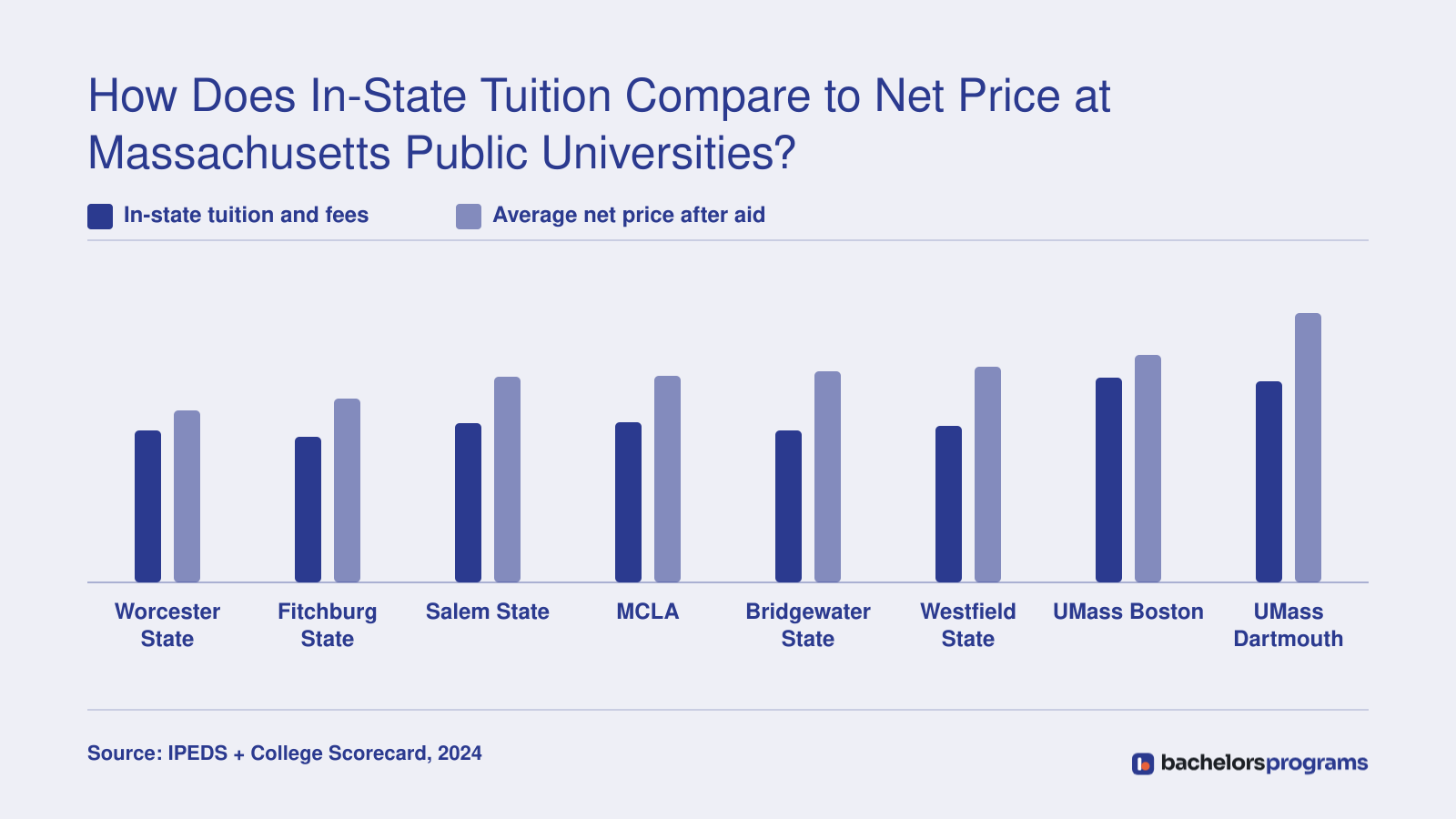
How Does In-State Tuition Compare to Net Price at Massachusetts Public Universities?
At Massachusetts public universities offering communications bachelor's programs, in-state tuition and fees run from $11,346 to $15,908, while average net price after aid ranges from $13,381 to $20,927. Net price is higher than tuition here because it counts housing, books, and other living costs after grants are subtracted. Private colleges such as Boston College or Simmons University rely more on their own grants, so check each school's net price calculator.
Questions to Ask Yourself
Would you qualify for state aid or a transfer pathway that lowers your first-year cost?
Does the program's median debt look manageable against the earnings figures shown earlier?
Is a lower-cost public school with a strong concentration a better fit than a pricier private option?
Communications Careers and Salaries in Massachusetts
A bachelor's degree in communications leads to a wide range of Massachusetts jobs, and Greater Boston holds most of them. The degree is a general credential, so the career picture is better read by occupation than by job title.
Roles Communications Majors Commonly Enter
The occupations most closely tied to the major are public relations specialists, market research analysts and marketing specialists, and writing and editing roles such as technical writers and editors. With experience, graduates move into public relations and fundraising management.1 Entry-level pay and responsibilities differ a great deal across these paths, so compare them one at a time.
Where the Work Is in the Boston Area
The regional economy shapes what these jobs look like day to day:
- Higher education: Development, alumni relations, admissions marketing, and campus communications offices.
- Healthcare: Hospital and health-system public affairs, patient communications, and internal messaging.
- Biotech: Technical writing, regulatory and scientific communications, and investor relations.
- Finance: Corporate communications, client reporting, and market research.
- Media: Publishing, broadcast, digital content, and agency work.
Reading the Wage Data Correctly
The Bureau of Labor Statistics publishes median annual wages and employment for these occupations in its Occupational Employment and Wage Statistics program. The most recent release is May 2025.2 Statewide figures are on the Massachusetts page, and the Boston-Cambridge-Newton, MA-NH metro area has its own page. Median wages sit in downloadable spreadsheets, so check the current number for each occupation rather than trusting a rounded figure from a secondary source. Compare the statewide and Boston-area columns, since they can differ.
Two definitions matter. Employment counts wage-and-salary workers, full and part time. Wages reflect straight-time gross pay, which leaves out premium pay such as overtime.3 Most important, these numbers describe the occupation across all workers. They are not what a graduate of any single program earns, and they should not be used to rank schools against each other.
No Massachusetts License Required
Communications is not a licensed field. Massachusetts requires no state license or exam to work as a public relations specialist, marketer, writer, or editor. Employers instead look at your portfolio, writing samples, internships, and demonstrated skills, which is why hands-on coursework and local internship access matter when you compare programs.
Related Articles
Common Questions About Communications Degrees in Massachusetts
These answers draw on the findings in the sections above. Check each school's own program page for current details before you apply.
What is the best college in Massachusetts for a communications degree?
Are there online communications degree programs in Massachusetts?
How much does a communications degree cost in Massachusetts?
What can you do with a bachelor's degree in communications?
Which Massachusetts colleges are best for public relations or journalism?
Compare Communications programs on the data that matters
Explore more Communications & Media majors or browse every field of study.
All Communications & Media programs Browse every field of study