Best Communications Degree Programs in Missouri
Compare 47 accredited Communications programs in Missouri at 25 colleges, with net price after aid, graduation rates, earnings and debt from IPEDS and the U.S. College Scorecard.
Net of grants, a bachelor's degree in communications in Missouri costs $13,310 a year at the University of Missouri-Kansas City and $24,398 at Saint Louis University, a gap that rarely matches the difference in what graduates are offered. The standard credential is the Bachelor of Arts (B.A.) in Communications, though Missouri State lists a Bachelor of Science in communication studies.
No state license governs the field here. What separates programs is format (Mizzou and UMSL list the degree online, Rockhurst and Northwest stay residential), internship placement, and whether the school's aid package survives the second year.
Key Points
- The University of Missouri charges $14,837 in-state versus $36,056 out-of-state.
- Saint Louis University, Rockhurst and Maryville charge every student one rate.
- The flagship University of Missouri also offers its communications bachelor's online.
Best Bachelor's Degree in Communications Programs in Missouri, Ranked
Missouri's communications programs stretch from a flagship research university that also teaches the degree online to small private colleges that put an internship in every student's plan. The ten schools below cover flagship, regional and private campuses in residential, hybrid and fully online formats. Graduation rates on each card are institution-wide, meaning they reflect how many students at that school finish a bachelor's degree of any kind, and net price figures are averages after grant aid rather than a firm quote.
University of Missouri
#1Columbia, MO · ~$20,000/yr (est.)
Best for: Traditional undergrads wanting a flagship campus
The University of Missouri is the state's flagship public research university, and its Columbia campus runs one of the broadest communication programs in Missouri. The BA in Communication covers public speaking, persuasion, research methods and business communication, with capstone options that include professional internships and senior projects. Students can enroll on campus or online, and coursework extends into health communication, cultural communication and digital production. Graduates move into public relations, marketing, advertising, sales, political consulting and event planning.
- 120 total credit hours with a capstone requirement
- Capstone options include internships and senior projects
- Coursework in persuasion, public speaking and research methods
- Electives in health communication and digital production
- Study abroad and undergraduate research available
- Offered on campus and online
Saint Louis University
#2Saint Louis, MO · $24,000/yr (est. net price)
Best for: Media students wanting portfolio-building work
Saint Louis University is a private Jesuit university in midtown St. Louis with a communication department organized into distinct tracks rather than one general major. Students choose communication studies, integrated strategic communication, or journalism and media studies, and a media production, journalism and culture track runs at the Madrid campus. The strategic communication concentration builds a client campaign portfolio and can include the national advertising competition, and majors need a 2.00 GPA in the field after 18 credits.
- 39 credits in the major inside a 120-credit degree
- Tracks: communication studies, integrated strategic communication, journalism and media studies
- Media production, journalism and culture track at the Madrid campus
- Strategic communication track builds a client campaign portfolio
- National Student Advertising Competition experience
- 2.00 GPA required in the major after 18 credits
- KSLU radio and The University News
- Priority scholarship deadline of December 1
Rockhurst University
#3Kansas City, MO · ~$26,000/yr (est.)
Best for: Kansas City students eyeing business communication
Rockhurst University is a private Jesuit campus in Kansas City where communication is taught as a liberal art grounded in ethics, writing and speaking. Majors study interpersonal, small group, organizational, public and mass communication, and can add a track in Public Relations and Advertising or Business Communication. Students with a 3.0 GPA in the major and 2.0 overall can take on internships or directed research. The university also offers a separate Bachelor of Arts in Strategic Communication and a strategic communication certificate.
- Tracks in Public Relations and Advertising, or Business Communication
- Internships and directed research for qualified majors
- 3.0 GPA in the major and 2.0 overall required for internships
- Coursework across interpersonal, organizational, public and mass communication
- Separate B.A. in Strategic Communication also offered
- Strategic Communication certificate available
University of Missouri-Kansas City
#4Kansas City, MO · $13,000 – $30,000/yr (est.)
The University of Missouri-Kansas City is the urban campus of the UM System, and its communication degree is built around strategic work: market research, data analysis, communication planning and consumer research for advertising and public relations campaigns. Students can study in person, hybrid or fully online, and the Mercury Association student organization plus resume and interview workshops tie them to Kansas City employers. Domestic undergraduates pay no application fee, and ACT or SAT scores are optional.
- 120 credit hours, roughly four years at 4 to 5 courses per term
- Study in person, hybrid or fully online
- ACT and SAT scores optional, no entrance exam required
- No application fee for domestic undergraduates
- Coursework in market research, data analysis and campaign planning
- Mercury Association student organization
- Resume workshops and mock interview sessions with area employers
Maryville University
#5Saint Louis, MO · ~$22,000/yr (est.)
Maryville University is a private university in west St. Louis County that has shaped its communication degree around digital and strategic work, with an internship required of every major. Recent placements have included Energizer Holdings, Nestlé Purina, the St. Louis Cardinals and the St. Louis Blues, and average class sizes sit near 14 students. Students pick between Emerging Media Strategy and Social Media, or Strategic Communication, and the degree can be completed on campus or fully online.
- Tracks in Emerging Media Strategy and Social Media, or Strategic Communication
- Internship required of every major
- Host sites include Energizer, Nestlé Purina, the Cardinals and the Blues
- Average class size of about 14 students
- No application fee
- Offered on campus or fully online
- Terms start in January and August
University of Missouri-St Louis
#6Saint Louis, MO · $15,000 – $20,000/yr (est.)
The University of Missouri-St. Louis is a public campus in north St. Louis County whose communication department runs a student-staffed public relations agency, the Barnett Agency, where majors work with real clients. Four emphasis areas let students tilt the degree toward visual work, interpersonal relationships, mass media or strategy, and the whole program can be finished on campus or 100% online. An accelerated dual-degree pathway lets strong students begin graduate work while finishing the bachelor's.
- Tracks: applied visual communication, interpersonal, mass and strategic communication
- Finish 100% online or on campus
- Capstone public relations course working with real clients
- Internships at the student-run Barnett Agency
- Accelerated dual-degree pathway available
- Communication scholarships available
Southeast Missouri State University
#7Cape Girardeau, MO · $16,000/yr (est. net price)
Southeast Missouri State University is a public regional university in Cape Girardeau, and its communication major is unusually lean: 48 hours in the field with no minor required inside a 120-credit degree. Coursework covers interpersonal and intercultural communication, ethics, visual rhetoric, public address and research methods, closing with an internship or a senior research project. Students can join an award-winning debate team, the CCO organization and the Lambda Pi Eta honor society, and the major qualifies for the state Fast Track grant.
- 48-hour major with no minor required
- 120 total credit hours, including 39 senior division hours
- 2.0 GPA required in the major and overall
- Internship or senior research project to finish
- Coursework in ethics, visual rhetoric and public address
- Redhawk Speech and Debate, CCO and Lambda Pi Eta
- Fast Track grant eligible
Missouri State University
#8Springfield, MO · $18,000/yr (est. net price)
Missouri State University is the largest public university in southwest Missouri, and its communication studies department leans on practice: internships, service learning and electives that pair with a second major or minor. The degree is offered on the Springfield campus and fully online with health communication or public relations concentrations, taught by full-time faculty. Graduates head into human resources, marketing, advertising, sales, training, health care management and nonprofit administration.
- Flexible electives and room for a complementary major or minor
- Internships and service learning built into the curriculum
- Coursework in message analysis and ethical communication
- Prepares for human resources, marketing, sales and nonprofit work
Evangel University
#9Springfield, MO · ~$19,000/yr (est.)
Evangel University is a private Christian university in Springfield where communication studies is taught through a values-driven lens, with small classes and personal instruction from faculty. Coursework spans strategic communication, public speaking, rhetoric and digital arts, along with advertising, public relations, copywriting and web design. Internships and volunteer placements give students practical experience before graduation, and the program prepares students both for direct entry into the field and for graduate study.
- Coursework in strategic communication, public speaking, rhetoric and digital arts
- Classes in advertising, public relations, copywriting and web design
- Internships and volunteer placements
- Small class sizes with personal instruction
- Christian worldview integrated into the curriculum
- Preparation for graduate study or direct entry into the field
Northwest Missouri State University
#10Maryville, MO · $15,000 – $20,000/yr (est.)
Northwest Missouri State University is a public university in Maryville with a communication major split into interpersonal, organizational and rhetoric specializations, each with a published four-year plan. The School of Communication and Mass Media runs a forensics team with 42 national championships since 2009, plus AdInk and Knacktive, a team-based digital marketing course that builds a campaign for a real client. Students can earn either a Bachelor of Arts or a Bachelor of Science.
- Specializations in interpersonal, organizational and rhetoric
- Interpersonal and rhetoric tracks require a minor
- Published four-year plans for each track
- Forensics team with 42 national championships since 2009
- AdInk agency tours and the Knacktive digital marketing course
- Bachelor of Arts or Bachelor of Science available
- Rhetoric coursework in argumentation, debate and American issues
Cost & outcomes by school
Federal data for the highest-earning Communications programs, independent of the ranking above. Earnings are this field's bachelor's graduates four years after completing where the Scorecard reports them, else the school's undergraduate median.
| School | Net price / yr | Grad rate | Earnings | Debt | Grads/yr | Format |
|---|---|---|---|---|---|---|
| Washington University in St Louis MO | $21,786 | 94% | $86,182 | $17,500 | — | Campus |
| Rockhurst University MO | $25,884 | 75% | $67,102 | $18,250 | 5 | Campus |
| Maryville University MO | $22,066 | 66% | $62,105 | $22,000 | 13 | Campus |
| University of Missouri MO | $20,268 | 75% | $61,007 | $19,500 | 208 | Online |
| Saint Louis University MO | $24,398 | 80% | $57,787 | $21,500 | 46 | Campus |
| Park University MO | $21,032 | 38% | $56,309 | $21,685 | 5 | Campus |
| Missouri Western State University MO | $13,251 | 39% | $55,059 | $19,968 | 8 | Campus |
| Lindenwood University MO | $19,638 | 49% | $54,917 | $24,492 | 26 | Campus |
| University of Central Missouri MO | $14,462 | 54% | $52,463 | $19,750 | 16 | Hybrid |
| Missouri State University MO | $17,613 | 58% | $50,065 | $22,563 | 86 | Campus |
| Northwest Missouri State University MO | $16,244 | 54% | $50,012 | $25,000 | 46 | Campus |
| University of Missouri-Kansas City MO | $13,310 | 56% | $49,135 | $17,750 | 49 | Hybrid |
Sources: U.S. Department of Education. Net price, graduation rate, earnings and debt: College Scorecard (earnings and debt for this field's bachelor's graduates where reported, else school-wide); graduates: IPEDS. A dash means no figure is reported.
Cost, debt & payoff
Median earnings of this field's bachelor's graduates (4 yrs after completing, else the school's undergraduate median) vs. their median federal loan debt · U.S. College Scorecard
Across these programs the median graduate earns about $48,991 and finishes with roughly $21,983 in debt — a ratio that clears a common rule of thumb (keep debt below first-year salary). Net price and debt vary widely school to school, so check the per-school figures in the table above before you shortlist.
Most Affordable Bachelor's in Communications Programs in Missouri
These are the lowest-cost bachelor's in communications programs in our Missouri data, ordered by average annual net price after grants and scholarships, drawn from 2024 U.S. Department of Education figures (IPEDS and the College Scorecard). University of Missouri-Kansas City also appears in our ranking, while the other schools are in our directory. Debt and earnings figures describe communications graduates at each school, not the whole student body, and earnings four years after finishing range from $41,771 at Missouri Southern State University to $55,059 at Missouri Western State University.
| School | Format | Net Price After Aid (per year) | Median Debt (communications graduates) | Median Earnings, 1 Year After Finishing | Median Earnings, 4 Years After Finishing |
|---|---|---|---|---|---|
| Missouri Southern State University | Campus | $12,007 | $18,686 | $30,201 | $41,771 |
| Missouri Western State University | Campus | $13,251 | N/A | N/A | $55,059 |
| University of Missouri-Kansas City | Hybrid | $13,310 | $17,750 | $38,786 | $49,135 |
| University of Central Missouri | Campus and online | $14,462 | $19,750 | N/A | $52,463 |
| Central Methodist University-College of Graduate and Extended Studies | Online | $14,601 | N/A | N/A | N/A |
Questions to Ask Yourself
Would you take on more debt for a school with stronger early-career earnings in St. Louis or Kansas City?
Do you plan to stay in Missouri after you graduate?
Does a campus, hybrid or fully online format fit your work and family schedule?
Online and Hybrid Bachelor's in Communications Options at Missouri Schools
In communications, online study can mean a fully remote bachelor's degree or a campus program that adds web-delivered courses. Missouri's public universities do not price those two arrangements the same way.
Fully Online Options
The University of Missouri offers its BA in Communication on campus and fully online. The degree takes 120 credit hours, and a typical transfer student enters with 60. The online rate is $621.50 per credit for 1 to 11 credits, then a flat $7,453 per semester at 12 to 18 credits. University of Missouri-St Louis describes its Bachelor of Arts in Communication as 100% online or on campus. Maryville University lists a fully online option alongside its campus communication degree.
Hybrid and Campus-First Programs
The University of Missouri-Kansas City teaches strategic communication in a hybrid format and also lists a fully online option. Missouri State University adds a $30 per credit online course fee on top of its seated rate: Tier 1 Missouri residents pay $201 per credit online versus $171 seated, and nonresidents $372 online versus $342 seated. Rates shift by course tier, so confirm the rate for the specific course.
Who Each Format Suits
- Working adults: Fully online delivery at Mizzou, UMSL and Maryville removes the commute and lets you keep a job.
- Military-connected students: Maryville accepts military benefits, and online formats generally travel well across moves.
- Transfer students: Mizzou's 60-credit transfer path is built for students arriving with college credit already earned.
- Traditional first-years: Campus programs offer the fullest access to student media and internships.
Trade-offs to Weigh
Online students often line up internships with employers near them, while campus students walk into operations such as KSLU radio and The University News at Saint Louis University, the Barnett Agency at UMSL, the Mercury Association at UMKC, and debate and forensics at Southeast Missouri State University. Those outlets build clips and references that a purely remote student has to pursue deliberately.
Admission Requirements for Missouri Communications Bachelor's Programs
Freshman admission and transfer admission work differently at Missouri schools, and the transfer rules are the better documented of the two.
How Selective the Schools Are
Most of the schools here admit a large majority of applicants. Maryville University (95.1%) and Missouri State University (90.5%) are the most open, followed by Northwest Missouri State University (86.1%) and the University of Missouri (78.5%). Saint Louis University admits 75.0%, Southeast Missouri State University 73.5%, University of Missouri-Kansas City 72.2%, Evangel University 71.6% and Rockhurst University 69.6%. The University of Missouri-St Louis is the tightest at 62.7%, still a clear majority.
Pell share shows who enrolls. It is highest at UMSL (67.2%), Southeast Missouri State (62.9%) and UMKC (60.6%), and lowest at Rockhurst (32.7%).
GPA and Test Policy
- University of Missouri: No minimum freshman GPA or class rank appears on its admissions pages, and no undergraduate test policy is published. A test-optional note applies only to its graduate program.
- UMKC: The program lists no entrance exam and a test-optional approach.
- Saint Louis University: Accepts the Common and Coalition Applications and expects a 2.00 GPA in the major once enrolled.
- Southeast Missouri State: Its program page lists a 2.0 GPA minimum.
- Rockhurst, Maryville, UMSL, Missouri State, Evangel and Northwest: None of them publishes a GPA or test policy on its program page. Confirm with each admissions office before applying.
Transfer Credit at Mizzou
Mizzou publishes its transfer rules in more detail than any other school here. Coursework from an accredited institution generally transfers when each grade is a C or better. Credits from out-of-state schools may need faculty review, which can slow evaluation. Grades of D and F do not transfer as credit, but they still count in the Mizzou GPA.
Students with an associate of arts from a regionally accredited Missouri institution and a certified 2.0 GPA are admitted with junior standing. More than 64 lower-division hours can transfer from Missouri schools if they apply to the degree or to upper-division prerequisites. General education counts as complete with an AA or CORE 42 completion; other students are evaluated course by course. The BA in Communication requires 120 credit hours, and a typical admitted transfer student needs 60 more.1
Practical Guidance for Transfer Students
Finish the associate degree before you transfer, since a completed AA or CORE 42 block clears general education. Aim for C or better in every course, but keep your overall GPA high, because Mizzou counts every grade. Ask each school for a course-by-course evaluation before enrolling, and expect extra review time for out-of-state credits. Dual credit, AP, IB, CLEP and similar credit can also reduce your remaining hours at Mizzou.2
What a Bachelor's in Communications Costs in Missouri
The sticker price and what you actually pay are two different numbers, and Missouri's aid programs only narrow the gap if you qualify for them. Start with the published rates, then see what state aid can offset.
Tuition vs. Net Price
Among the ranked schools, in-state tuition and fees run from $9,502 at Missouri State University to $14,112 at the University of Missouri-St Louis. The University of Missouri-Kansas City charges $12,587, Northwest Missouri State University $10,611, and Southeast Missouri State University $9,903. Average net price after aid runs higher, from $13,310 at UMKC to $17,613 at Missouri State. That figure is a sector-based average that folds in non-tuition costs, so treat it as a planning guide rather than a personal quote.
Missouri Aid Programs
- Access Missouri: For Missouri residents who are U.S. citizens or permanent residents, enrolled full-time as undergraduates, with a Student Aid Index of $12,000 or less and no prior bachelor's degree. For 2027-2028, the FAFSA priority deadline is February 1, 2027, the final deadline is April 1, 2027, and corrections are due by July 31, 2027.1 Filing by the priority date guarantees an award if you are eligible.
- Bright Flight: Merit-based, for residents whose composite ACT or SAT score lands in the top 5% of Missouri test takers.2 The score must come from a national or approved test date no later than the June date after graduation. A July date does not count.
- A+ Program: Administered through the state's FAMOUS system, which shows whether an A+ student has filed a FAFSA.3 Confirm current award terms with your high school's A+ coordinator.
The Missouri Department of Higher Education and Workforce Development posts current award amounts, and they change, so check there before budgeting. The state's dual credit scholarship requires financial need and has not been tied to A+ since 2022.4
School Scholarships and Out-of-State Costs
UMKC, UMSL and Northwest Missouri State all advertise scholarships. Ask each communication department about awards specific to the major.
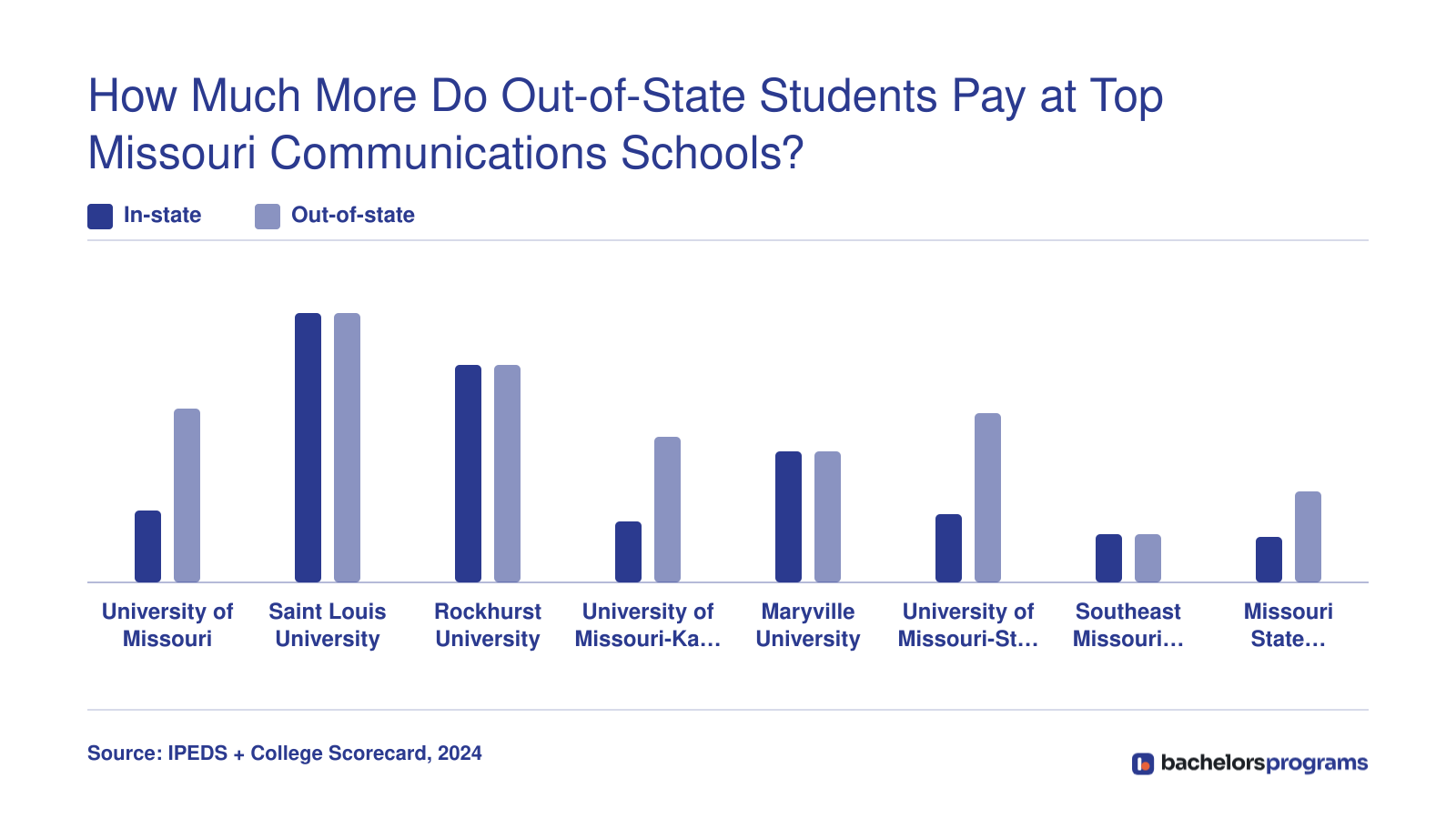
Out-of-state tuition changes the math. UMKC rises to $30,227 and UMSL to $35,112, while Southeast Missouri State lists the same $9,903 for everyone. Access Missouri, Bright Flight and A+ are for Missouri residents only.
How Much More Do Out-of-State Students Pay at Top Missouri Communications Schools?
Public universities in Missouri charge residents far less than nonresidents. The University of Missouri lists $14,837 in-state against $36,056 out-of-state. Private schools such as Saint Louis University, Rockhurst University and Maryville University charge one rate to every student, so the gap is zero and their bars match. Southeast Missouri State University also posts a single rate of $9,903, the lowest out-of-state figure among the schools ranked here. These are published tuition and fees before financial aid, so your actual net price will usually be lower.
Questions to Ask Yourself
Do you want to report and produce media, or shape messages for organizations?
Does each program you are considering list the concentration you want?
Would a B.A. or a B.S. track better match the electives and internships you want?
Related Articles
Frequently Asked Questions About Missouri Communications Degrees
These answers cover the questions prospective students ask most about bachelor's degrees in communications in Missouri. Costs and program details reflect 2026 information and can change, so confirm specifics with each school.
Which Missouri schools offer a fully online bachelor's degree in communications?
How much does a communications degree cost in Missouri?
Are Missouri communications programs accredited?
What is the difference between communication, mass communication, and public relations degrees?
Do I need a license to work in communications in Missouri?
Compare Communications programs on the data that matters
Explore more Communications & Media majors or browse every field of study.
All Communications & Media programs Browse every field of study