Best Communications Degree Programs in North Carolina
Compare 54 accredited Communications programs in North Carolina at 32 colleges, with net price after aid, graduation rates, earnings and debt from IPEDS and the U.S. College Scorecard.
A bachelor's degree in communications at UNC Chapel Hill costs North Carolina residents $8,994 a year in tuition and fees, and nonresidents $41,203. Residency often shapes the choice of school more than any program detail does.
The Bachelor of Arts (B.A.) in Communications is the common credential, though some schools award a B.S. The programs below are campus and online bachelor's options at North Carolina-based schools, drawn from internal rankings and College Scorecard data.
Major titles vary: communication studies, mass communication, strategic communications. The curriculum and internship access matter more than the label.
Key Points
- UNC Chapel Hill charges residents $8,994 yearly versus $41,203 for nonresidents.
- Public universities cost least; UNC Pembroke's in-state tuition is just $3,648.
- Most students specialize within broad majors, like UNC Charlotte's health communication concentration.
Best Bachelor's Degree in Communications Programs in North Carolina
Ten North Carolina colleges and universities offer a bachelor's degree in communications, from a 30-credit major at the state's flagship to a strategic communications program built around a semester abroad. Schools offering this program have graduation rates of 56% to 91%, so completion odds vary widely across the list. Net prices shown for each campus are sector-conditional averages, so read them as approximate rather than as a quote.
University of North Carolina at Chapel Hill
#1Chapel Hill, NC · ~$12,000/yr (est.)
Best for: Students wanting broadcast and Hollywood internships
North Carolina's flagship puts a 30-credit Communication Studies major inside a large research university, with five pathways spanning interpersonal communication, media art, and rhetoric and advocacy. The extras are unusually strong for a public campus: a Hollywood internship program, work with WUNC Radio and TV, student-run STV, and an honors track.
- Five pathways, from interpersonal communication to media art
- 30 credit hours with a 2.0 GPA minimum
- New Media Track and an honors program in communication
- Hollywood internship program plus shifts at WUNC Radio and TV
- Student-run television station (STV) and independent study
- Tracks: Communication and Everyday Life; Media Arts, Performance, and Critical Practice
North Carolina State University at Raleigh
#2Raleigh, NC · $9,000 – $33,000/yr (est.)
Best for: Raleigh-area students building PR networks
A campus-based B.A. in Communication in Raleigh, built around communication theory plus applied research collaborations with faculty. Internships are emphasized throughout, study abroad reaches Africa, China, and Europe, and Lambda Pi Eta and PRSSA give students a professional foothold before graduation.
- Student groups include Lambda Pi Eta and PRSSA
- Study abroad in Africa, China, and Europe
- Numerous internships and faculty research collaborations
- Prepares students for business, media, government, and nonprofits
Davidson College
#3Davidson, NC · ~$17,000/yr (est.)
Best for: Liberal arts students wanting small seminar classes
A small liberal arts college where communication studies is deliberately interdisciplinary, mixing mass communication, intercultural communication, and rhetoric with coursework in other fields. Students can serve as peer tutors in the Speaking Center, and advanced seminars focus on the theory and criticism of public and mediated communication.
- Interdisciplinary major with courses across other fields
- Subfields include mass communication, intercultural communication, and rhetoric
- Peer tutor roles in the college's Speaking Center
- Advanced seminars in communication theory and criticism
- Major and minor both offered
University of North Carolina at Charlotte
#4Charlotte, NC · $15,000 – $20,000/yr (est.)
Charlotte's public research university offers five concentrations under one Communication Studies B.A., which makes it easy to specialize without changing majors. Internships, independent study, an honors program, and the Charlotte Speech Team give students room to build a portfolio in the state's largest corporate market.
- Five concentrations, from health communication to public relations
- Internships, independent study, and an honors program
- Student organizations include PRSSA and the Charlotte Speech Team
- Tracks: Health Communication, Media & Technology Studies
Wake Forest University
#5Winston-Salem, NC · $25,000 – $30,000/yr (est.)
A private university in Winston-Salem where communication has been the most popular major for a decade, taught through three lenses: communication science, rhetorical studies, and media and film studies. The department houses a nationally acclaimed debate program, and courses such as Debate and Advocacy and Media Production keep the work applied.
- Three concentration areas: communication science, rhetoric, media and film
- Most popular major at the university for a decade
- Nationally acclaimed debate program on campus
- Courses include Debate and Advocacy, Public Speaking, Media Production
- 30 credit hours, including at least 12 at the 300 level
- 2.0 minimum GPA required
- Four concentration courses and community-based research
- Prepares students for health care and public health advocacy
- Concentration coursework in film studies and media production
- Covers social media effects and empirical research methods
- Study abroad options and transfer credit accepted
- Internships and practicum experiences available
University of North Carolina Wilmington
#6Wilmington, NC · $7,000 – $24,000/yr (est.)
A 42-credit Communication Studies major built around strategic communication, with a student-run integrated marketing agency, the Digital Drip program, and a storytelling initiative that give students client-facing work before they graduate. Custom internships and study abroad are supported, and the major is structured to fit a double major.
- 42-credit major in public speaking, digital creativity, research methods
- Student-run integrated marketing agency serving local clients
- Award-winning Digital Drip program and storytelling initiative
- Custom internships and study abroad supported
- Fully equipped audio-visual lab on campus
Appalachian State University
#7Boone, NC · $8,000 – $25,000/yr (est.)
Appalachian State's Communication Studies program can be completed on the Boone campus or fully online, which makes it one of the few in the state with a genuine distance option. A required minor in marketing, business, or sociology widens the degree, and an accelerated Bachelor's to Master's route is available for students who want to continue.
- Complete on campus or fully online
- Communication Ethics, Public Speaking, and Mass Media coursework
- Required minor; marketing, business, and sociology are popular
- Accelerated Bachelor's to Master's option
- Real-world internships and scholarship support
East Carolina University
#8Greenville, NC · ~$16,000/yr (est.)
East Carolina's BS in Communication splits into four concentrations, from interpersonal and organizational communication to journalism, media studies, and public relations. The School of Communication runs a learning community and a Center for Communication Excellence, and the journalism track adds investigative reporting, video production, and web design.
- Coursework in persuasion, conflict, culture, and small group dynamics
- Journalism track covers investigative reporting, video, and web design
- Media studies track focuses on critical analysis and media effects
- Center for Communication Excellence and a learning community
- Tracks: Interpersonal/Organizational Communication, Journalism, Media Studies, Public Relations
University of North Carolina at Greensboro
#9Greensboro, NC · $11,000/yr (est. net price)
UNC Greensboro treats communication as a tool for connection, change, and justice, and lets students pull electives from anthropology, media studies, and business to build a custom degree. Internships in public relations, marketing, political campaigns, and nonprofits are common, and an accelerated BA to MA option shortens the path to graduate study.
- Electives drawn from anthropology, media studies, and business
- Internships in PR, marketing, political campaigns, and nonprofits
- Accelerated BA to MA option
- Affiliated minor in videogaming and esports
- Community engagement and service learning built in
Elon University
#10Elon, NC · ~$42,000/yr (est.)
Elon's strategic communications major is unusually structured: 52 credit hours in communications, a business course, and at least 72 credit hours outside the major through a minor, double major, or semester abroad. Alumni land at agencies such as APCO Worldwide, FleishmanHillard, Golin, and Ketchum.
- 52 credit hours in communications plus a 4-hour business course
- At least 72 credit hours outside communications
- Minor, double major, or approved semester abroad
- Alumni at APCO Worldwide, FleishmanHillard, Golin, Ketchum
- Public speaking requirement met in a 2-hour course
Cost & outcomes by school
Federal data for the highest-earning Communications programs, independent of the ranking above. Earnings are this field's bachelor's graduates four years after completing where the Scorecard reports them, else the school's undergraduate median.
| School | Net price / yr | Grad rate | Earnings | Debt | Grads/yr | Format |
|---|---|---|---|---|---|---|
| Davidson College NC | $17,379 | 91% | $81,400 | $18,688 | 24 | Campus |
| Wake Forest University NC | $28,719 | 89% | $77,984 | $22,250 | 156 | Campus |
| Elon University NC | $41,555 | 84% | $73,750 | $21,999 | 35 | Campus |
| University of North Carolina at Chapel Hill NC | $11,655 | 91% | $70,240 | $14,625 | 592 | Campus |
| Queens University of Charlotte NC | $30,857 | 61% | $65,985 | $26,975 | 17 | Campus |
| North Carolina State University at Raleigh NC | $17,303 | 85% | $62,039 | $20,000 | 207 | Campus |
| University of North Carolina at Charlotte NC | $15,435 | 69% | $60,407 | $20,500 | 251 | Campus |
| East Carolina University NC | $15,739 | 63% | $59,432 | $21,250 | 237 | Campus |
| Appalachian State University NC | $16,836 | 75% | $55,307 | $19,500 | 105 | Online |
| Campbell University NC | $24,516 | 61% | $54,886 | $22,500 | 9 | Campus |
| University of North Carolina Wilmington NC | $20,109 | 71% | $54,315 | $19,000 | 179 | Campus |
| Pfeiffer University NC | $19,076 | 35% | $51,562 | $26,163 | 2 | Campus |
Sources: U.S. Department of Education. Net price, graduation rate, earnings and debt: College Scorecard (earnings and debt for this field's bachelor's graduates where reported, else school-wide); graduates: IPEDS. A dash means no figure is reported.
Cost, debt & payoff
Median earnings of this field's bachelor's graduates (4 yrs after completing, else the school's undergraduate median) vs. their median federal loan debt · U.S. College Scorecard
Across these programs the median graduate earns about $48,181 and finishes with roughly $23,611 in debt — a ratio that clears a common rule of thumb (keep debt below first-year salary). Net price and debt vary widely school to school, so check the per-school figures in the table above before you shortlist.
Most Affordable Communications Bachelor's Programs in North Carolina
These North Carolina communications programs post the lowest average annual net price after grant and scholarship aid, based on 2024 U.S. Department of Education data from IPEDS and the College Scorecard. Every low-cost option is a public university, so budget-focused students will find the strongest value in the UNC System and its partner campuses. Net price is an average for aid recipients that combines tuition, fees, housing, and books, minus grants and scholarships. It does not subtract student loans, and for public schools it reflects in-state students, so your own figure will shift with family income and residency.
| School | City | Type | Program | Avg. Net Price After Aid (per year) | In-State Tuition & Fees | Out-of-State Tuition & Fees |
|---|---|---|---|---|---|---|
| Fayetteville State University | Fayetteville | Public (HBCU) | Communication and Media Studies | $7,892 | $4,353 | $8,353 |
| University of North Carolina at Pembroke | Pembroke | Public | Mass Communication, Communication Studies Track, B.S. | $10,260 | $3,648 | $7,648 |
| University of North Carolina at Greensboro | Greensboro | Public | Communication Studies | $10,965 | $7,661 | $24,012 |
| University of North Carolina at Chapel Hill | Chapel Hill | Public | Communication Studies | $11,655 | $8,994 | $41,203 |
| University of North Carolina Asheville | Asheville | Public | Mass Communication | $12,250 | $7,501 | $24,849 |
Communications Concentrations: Journalism, Public Relations, Broadcasting, and Media Studies
A narrow track can sharpen your job search, while a broad major leaves more options. North Carolina schools lean toward the broad option, so most students pick a focus inside a general communication studies degree.
What each track prepares you to do
- Journalism: Reporting, writing, and storytelling for news outlets. UNC Chapel Hill points to internships at WUNC Radio and TV, and Wake Forest lists the student paper Old Gold and Black.
- Public relations: Messaging, persuasion, and client work. Elon's Strategic Communications major targets PR and advertising, and UNCW runs a student-run agency with local clients.
- Broadcasting: Audio and video production. UNC Chapel Hill has student-run television, and UNCW has a fully equipped AV lab. Mass communication majors at Winston-Salem State, North Carolina Central, UNC Pembroke, and UNC Asheville also fit this path.
- Media studies: How media and technology shape audiences and culture. UNC Charlotte offers a Media & Technology Studies concentration, UNC Chapel Hill has a New Media Track, and Fayetteville State pairs communication with media studies.
Common versus rare
The umbrella communication studies degree with several concentrations is the norm. UNC Chapel Hill lists six concentration options, UNC Charlotte five, East Carolina four, and Wake Forest three. Rarer are specialized tracks, such as Health Communication at UNC Charlotte or East Carolina's Interpersonal/Organizational Communication. Davidson keeps its major interdisciplinary, with mass, intercultural, and rhetoric subfields rather than separate tracks. A standalone journalism or broadcasting concentration is less visible in the program data, so expect those skills to come through electives, student media, and internships.
A quick rule of thumb
- Want a newsroom or production job? Choose a program with student media and internships.
- Aiming at agencies or corporate work? Pick a strategic communication or PR-focused program.
- Interested in digital culture or policy? Look for media studies or new media options.
- Unsure? Start broad and let your internships decide.
Online and Hybrid Bachelor's Degree in Communications Options at North Carolina Schools
A fully online bachelor's degree in communications lets you take every class at a distance, while a hybrid one blends online coursework with scheduled trips to campus. At North Carolina schools, delivery varies enough from program to program that the word "online" on a marketing page rarely tells you the whole story. Read the department's own page, then confirm the details in writing before you apply.
Where online or hybrid delivery is listed
- Appalachian State University: Communication Studies appears as an online offering in program listings. The university's own page does not spell out whether the bachelor's is fully online, hybrid, or requires any in-person attendance, so ask the department directly.
- Winston-Salem State University: Mass Communications is described as hybrid. Available sources do not specify how often students come to campus, which courses meet in person, or whether any activities are mandatory.
- University of North Carolina at Chapel Hill: the university supports hybrid distance learning with some on-campus requirements, plus self-paced correspondence formats. No source ties a specific format to the Communication Studies major, so verify with the department.
Programs listed as campus-based
The communications majors at NC State, UNC Wilmington, UNC Charlotte, UNC Greensboro, Elon, Davidson, and Wake Forest are published as campus programs; East Carolina's B.S. in Communication is listed as an online option. UNC Charlotte tied for fourth in a 2026 national ranking of online bachelor's degrees1, but that recognition covers its online undergraduate offerings as a whole and does not establish that Communication Studies can be finished online.
Residency, practicum, and tuition
Ask three questions before you enroll: whether any course requires a campus visit, whether an internship or practicum must be completed in North Carolina, and whether the online rate matches the on-campus rate. The program pages reviewed do not post an online-versus-campus tuition comparison for the communications major, so request that figure in writing from the department or the bursar's office, along with any fee that applies only to distance students.
Are North Carolina Communications Programs Accredited?
Institutional accreditation and program accreditation answer different questions: one covers the whole university, the other covers only the journalism or mass communication unit where you would actually study.
Institutional Accreditation: SACSCOC
Institutional accreditation for North Carolina schools comes from the Southern Association of Colleges and Schools Commission on Colleges (SACSCOC). This is the status that makes you eligible for federal financial aid and keeps credits portable if you transfer. UNC-Chapel Hill's SACSCOC accreditation covers its baccalaureate through doctoral programs and is listed as continuing through 2027. Elon University holds SACSCOC accreditation for its bachelor's and master's degrees.
ACEJMC: Optional and Program-Level
ACEJMC accreditation is voluntary and applies to the communications unit, not the entire university. Among the schools ranked here, two hold it. UNC-Chapel Hill's Hussman School has been accredited since 1958 and was fully reaccredited in May 2024 for its B.A. Media and Journalism. Elon's School of Communications holds unit-level accreditation covering sequences such as journalism and strategic communications. Coverage follows the sequences submitted for review, so another track at the same school may sit outside it. A communications bachelor's without ACEJMC is still regionally accredited, and many programs in the state do not hold it.
How to Verify
Search the SACSCOC member directory for the institution, then check ACEJMC's accredited programs database for the specific unit and the date of its most recent review.
Related Articles
Admission Requirements for North Carolina Communications Bachelor's Programs
What GPA and test scores do you actually need to get into a communications program in North Carolina? The answer differs by school and changes yearly, so the most reliable move is to check each school's official admissions page rather than a third-party summary that may be out of date.
What to Look For on Each Admissions Page
For every school you are considering, find these items and write them down:
- First-year requirements: Required high school courses and any GPA the school states.
- Test policy: Whether the SAT or ACT is required, optional, or superscored.
- Admitted student profile: The typical GPA, test range, and admit rate of enrolled students.
- Transfer credit rules: How credits are evaluated and whether the major caps them.
- Deadlines: Dates for first-year and transfer applicants, which often differ.
If a school does not publish a figure, say so in your notes and ask admissions directly instead of guessing.
Minimum GPA vs. Typical GPA
A stated minimum is the cutoff to be considered. The admitted-student profile shows who actually gets in, and it is usually higher at competitive schools such as UNC Chapel Hill, NC State, and Wake Forest. Compare your own record to the profile, not just the minimum.
Transferring From a Community College
The state's Comprehensive Articulation Agreement, effective Spring 2026, covers Associate in Arts and Associate in Science degrees only.2 Graduates who finish 60 semester hours of approved coursework with a C or better and at least a 2.0 GPA are guaranteed at least 60 hours of credit at a public university.1 Transfer Assured Admissions uses a 2.0 minimum, but competitive programs may expect more.3 Credit does not equal admission to a specific communications major, and transfer guides do not exist for every major at every campus.
Majors can also cap what counts. NC State's Communication B.A. allows no more than 12 of its 39 required concentration hours to come from transfer credit. UNC Charlotte notes possible bilateral agreements for AAS degrees, so ask about those directly.3
Action Checklist
- Confirm the SAT/ACT policy for your entry year.
- Separate minimum GPA from admitted-student GPA.
- Verify transfer credit rules, major caps, and deadlines.
- Contact admissions or a community college transfer advisor to confirm eligibility before you enroll.
For career context beyond admissions, BLS.gov, O*NET, and professional communications associations are solid references.
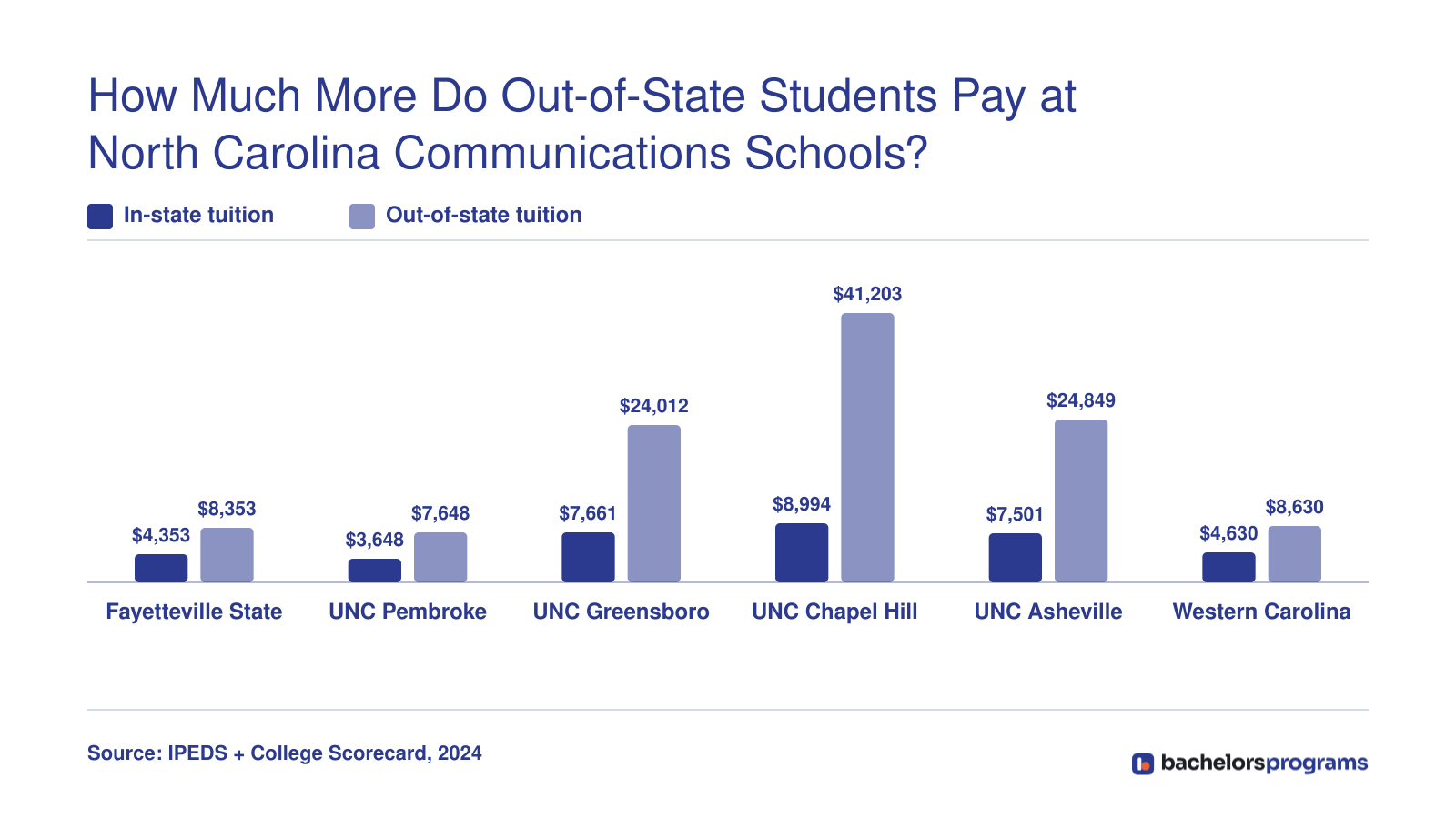
How Much More Do Out-of-State Students Pay at North Carolina Communications Schools?
Residency changes the bill more than any other factor at North Carolina's public universities. At UNC Chapel Hill, tuition and fees run $8,994 a year for residents and $41,203 for nonresidents. At Western Carolina, UNC Pembroke and Fayetteville State, the out-of-state charge is $4,000 higher. Sticker price is only the starting point: Chapel Hill's average net price after aid is $11,655, a figure that also counts housing and other costs, and it sits far below the school's out-of-state tuition.
Cost of a Communications Bachelor's Degree in North Carolina
Sticker price and net price can differ sharply in North Carolina. Published in-state tuition and fees at the public universities in our data run from $3,648 at UNC Pembroke to $8,994 at the University of North Carolina at Chapel Hill. Average net price after grants and scholarships runs from about $7,892 at Fayetteville State University to about $15,739 at East Carolina University. Net price is an approximate average that includes living costs, so your own figure will depend on your aid package.
UNC System Tuition and NC Promise
For 2026-27, the UNC System's approved average resident undergraduate tuition is $4,809 per year, up $125 from $4,684.2 The increase is capped at 3% systemwide and applies only to new students, so continuing students see no change.2 This is an average, not one rate every campus charges.
NC Promise campuses, which include Fayetteville State University, UNC Pembroke and Western Carolina University, charge North Carolina residents $500 per semester, or $1,000 for fall and spring.1 The rate covers full-time, part-time (prorated), transfer and online undergraduates, with no separate application. New nonresidents pay $3,500 per semester in 2026-27.1 Nonresidents enrolled before 2026 who stay continuously enrolled keep $2,500 per semester, and new nonresidents starting in 2027-28 will pay $4,000 per semester. NC Promise covers tuition only. Fees, housing and meals are billed separately.
NC Need-Based Scholarship
This state award provides up to $1,000 per semester.3 Current 2026 rules call for:
- Enrollment: Full-time study in an undergraduate degree program.
- Progress: Satisfactory academic progress and at least 60 credit hours completed, or on track to reach 60 by the end of the term.
- FAFSA: A current-year FAFSA on file.
- Need: An unpaid balance for direct costs such as tuition, fees, room or board.
Income and priority rules are still being settled, so confirm details with your school's financial aid office.
Tips for Lowering Your Cost
- File the FAFSA early: State and institutional aid is often awarded first to students who file on time.
- Compare net price, not sticker price: A school with higher tuition can cost less after aid.
- Protect your enrollment status: Nonresidents at NC Promise schools keep the lower rate only with continuous enrollment, and Western Carolina treats three consecutive missed terms, including summer, as a break.
Communications Careers and Salaries in North Carolina
What does a communications career in North Carolina actually pay?
The Bureau of Labor Statistics sets the benchmark through its Occupational Employment and Wage Statistics, most recently for May 2025. Those figures are national medians, and North Carolina pay varies by metro, employer, and role, with Charlotte and the Research Triangle typically holding the deepest pool of openings.
Median wages for communications occupations
- Public relations specialists: a median annual wage of $84,120, with about 283,380 jobs nationwide.
- Writers and authors: a median of $86,090, across roughly 47,940 jobs.
- News analysts, reporters, and journalists: a median of $49,260, across about 39,250 jobs.
These are occupation-wide medians, not starting salaries for a new graduate, and they cover workers at every experience level. Marketing managers appear on the same BLS list and are a common promotion path for communications graduates who move into brand, campaign, or corporate messaging work. BLS wage data describes occupations; graduate earnings reported by universities describe alumni of specific programs. The two measure different things and are not interchangeable.
Where North Carolina employers cluster
Hiring concentrates in a few regions. Charlotte's banking, insurance, and financial services sector supports corporate communications, public relations, and agency roles. Research Triangle employers in technology, life sciences, and higher education hire writers, content strategists, and media relations staff. Hospital systems, television and radio stations, newspapers, and universities across the state also employ communications professionals, though those roles often pay less than corporate positions in the largest metros.
No license is required
North Carolina issues no license for communications work. There is no state board, no exam, and no continuing education requirement to work as a public relations specialist, writer, or broadcaster. Employers screen on portfolios, writing samples, and internships instead, which is why the clips and bylines you build during a bachelor's degree carry more weight than any credential earned after it.
Demand shifts with the economy and with how audiences consume media. Digital and social content, internal communications, and reputation management have expanded as newsroom employment has tightened, so graduates who write clearly and handle data and publishing platforms tend to have the widest options.
Common Questions About Communications Degrees in North Carolina
These answers draw on the school details and earnings comparisons covered earlier in this article. Where the data is limited or varies by school, we say so and point you to the source that can confirm current policy.
What is the best communications school in North Carolina?
Which North Carolina schools offer an online bachelor's degree in communications?
Do I need a license to work in communications in North Carolina?
Can community college credits transfer toward a communications bachelor's degree in North Carolina?
Compare Communications programs on the data that matters
Explore more Communications & Media majors or browse every field of study.
All Communications & Media programs Browse every field of study