Best Online Journalism Degree Programs
Compare 50+ accredited online Journalism programs, with net price after aid, graduation rates, earnings and debt from IPEDS and the U.S. College Scorecard.

A journalism degree earned on campus and one earned online can lead to the same Bachelor of Arts (B.A.) in Journalism, but the online route asks more of you: you file stories remotely, build sources by phone and video call, and shoot your own footage without a student newsroom down the hall.
Every program ranked here is an undergraduate bachelor's degree in journalism delivered fully online; hybrid and in-person formats are excluded. Expect wide spreads in per-credit cost and in transfer credit accepted, and read the curriculum closely, since some "journalism" degrees are communication degrees with a new label.
Key Points
- An associate degree can cover about 60 of roughly 120 required credits.
- The lowest-cost programs here are public universities enrolling many Pell recipients.
- Check course lists for reporting, media law, and ethics before enrolling.
Best Fully Online Journalism Degree Programs at a Glance
Every program below is a fully online bachelor's degree, with hybrid and in-person routes left out. Order reflects a mixed composite that weighs online delivery, cost, completion and outcomes, so a low sticker price on its own will not lift a school to the top.
University of Florida
#1Gainesville, FL · ~$4,800/yr (est.)
Best for: Sports-media hopefuls wanting a brand-name online degree
The University of Florida's College of Journalism and Communications awards a B.S. in Journalism with a Sports & Media concentration, and UF Online delivers the same degree students earn on campus. The sports core covers multimedia sports reporting, sports communication and sports media law, and the college's WRUF partnership with the Jacksonville Jaguars opens professional production work. Average net price after aid is about $4,800 and the school's graduation rate is 85%; upper-division transfer applicants need 60 credits and five prerequisites.
- Sports & Media concentration inside the journalism major
- Upper-division transfers need 60 credits and five prerequisites
- 2.5 GPA considered competitive for admission
- Accelerated B.S. to M.A. in Mass Communication option
- Coursework in data literacy and multimedia sports reporting
- Same degree awarded as the on-campus UF program
Utah State University
#2Logan, UT · $9,000 – $25,000/yr (est.)
Best for: Cost-conscious transfers with prior college credit
Utah State's Department of Journalism and Communication offers B.A. and B.S. degrees built on six foundation courses plus four areas of mastery, with online journalism and media literacy in the mix. Average net price after aid is about $14,900 and the school's graduation rate is 59%.
- Six foundation courses plus four areas of mastery
- Available on any USU campus and partially or fully online
- BA track requires foreign language proficiency
- 2.50 GPA required for transfer applicants
- Coursework in video production and media literacy
Utah State University
#3Logan, UT · $9,000 – $25,000/yr (est.)
Best for: Cost-conscious transfers with prior college credit
Utah State's Department of Journalism and Communication offers B.A. and B.S. degrees built on six foundation courses plus four areas of mastery, with online journalism and media literacy in the mix. Average net price after aid is about $14,900 and the school's graduation rate is 59%.
- Fully online option with a journalistic writing concentration
- Prepares for news reporter, investigative reporter and editor roles
- Builds a writing portfolio through reporting and interviewing
- JCOM students win state and national awards
Colorado State University-Fort Collins
#4Fort Collins, CO · ~$21,000/yr (est.)
Colorado State's online B.A. in Journalism and Media Communication runs 120 credits with 40 in journalism and media courses, a required internship and a senior capstone that builds a web portfolio. Students add a minor of 21 to 24 credits to specialize, and current materials point to sports journalism, data journalism, documentary film and immersive media. Average net price after aid is about $21,300 and the school's graduation rate is 67%; discussion, live chat and video are used, and no required campus visit is identified.
- 120 credits, including 42 upper-division credits
- 40 credits in journalism and media communication courses
- Internship of 1 to 4 credits required
- Senior capstone builds a web-based portfolio
- Minor of 21 to 24 credits chosen to specialize
- $490 per credit; rolling admissions with a 2.5 GPA minimum
- 30 upper-division credits must be completed at CSU
University of Illinois Springfield
#5Springfield, IL · ~$10,000/yr (est.)
UIS awards a B.A. in Communication with a Journalism and Media Studies specialization, one of four tracks in a 120-credit degree taught by the same faculty on campus and online. Students can apply up to 12 undergraduate credits toward the MA in Public Affairs Reporting, and UIS cites a 95% job placement rate for graduates. Average net price after aid is about $9,800 and the school's graduation rate is 53%; the next application deadline is December 28, 2026.
- 120 credit hours; four concentration options
- Journalism and Media Studies is one of the four tracks
- Same degree and faculty on campus or online
- Up to 12 undergraduate credits count toward the MA
- UIS cites a 95% job placement rate
- $50 application fee; December 28, 2026 deadline
Southern Illinois University-Carbondale
#6Carbondale, IL · $10,000 – $15,000/yr (est.)
Southern Illinois Carbondale offers a B.S. in Journalism with five specializations, including advertising and integrated marketing communications, and online sections are taught by the same full-time faculty as on-campus classes. Journalism majors share in $90,000 to $160,000 in school scholarships each year and can work paid Daily Egyptian and Saluki AdLab positions. Average net price after aid is about $13,300 and the school's graduation rate is 62%.
- Five specializations, including advertising and integrated marketing
- 33 hours in specialization coursework plus an approved minor
- Online sections taught by full-time faculty
- Paid Daily Egyptian positions and the Saluki AdLab agency
- $90,000 to $160,000 in scholarships awarded to majors yearly
- Mentors include Pulitzer Prize winners
Ohio University
#7Athens, OH · ~$22,000/yr (est.)
Ohio University's Carr Van Anda journalism program is offered in a completely online format, and students customize coursework toward news reporting, magazine or online journalism, public relations or advertising. Transfer applicants need a 2.0 cumulative GPA, and the journalism program is fully accredited. Average net price after aid is about $21,600 and the school's graduation rate is 65%.
- Completely online format
- Customize coursework toward news, magazine, PR or advertising
- Transfer applicants need a 2.0 cumulative GPA
- Fully accredited journalism program
- Online bachelor's degrees ranked by U.S. News & World Report
Loyola University New Orleans
#8New Orleans, LA · ~$24,000/yr (est.)
Loyola New Orleans awards a B.A. in Mass Communication with concentrations in journalism, strategic communication and visual communication, plus minors in mass communication, social media and environmental communication. A multimedia center serves as a working media lab where students produce real projects for the industry. Average net price after aid is about $23,700 and the school's graduation rate is 59%; the mass communication degree is also available online.
- Concentrations in journalism, strategic communication and visual communication
- Minors in mass communication, social media and environmental communication
- Multimedia center doubles as a working media lab
- BA in Mass Communication available online
University of Michigan-Dearborn
#9Dearborn, MI · ~$9,000/yr (est.)
UM-Dearborn's B.A. in Journalism and Media Production covers print reporting, podcasting and documentary work, with a required internship, co-op or senior thesis for every major. Students train in a full-service TV studio and audio production facility, and instructors include Pulitzer Prize and Telly Award winners. Average net price after aid is about $9,500 and the school's graduation rate is 58%; admissions are rolling and the program is listed as an online option.
- Internship, co-op or senior thesis required of all majors
- Full-service TV studio and audio production studio on campus
- Instructors include Pulitzer Prize and Telly Award winners
- Rolling admissions
- Print journalism through podcasting and feature films
- Go Blue Guarantee covers tuition for qualifying in-state students
University of Nevada-Las Vegas
#10Las Vegas, NV · ~$10,000/yr (est.)
UNLV's Hank Greenspun School of Journalism and Media Studies awards a B.A. in Journalism and Media Studies requiring 120 credits, 48 of them in the major, with a 15-credit journalism concentration covering reporting, digital newsroom work, photojournalism and media law. Every JOUR course requires a C or better, and the JOUR 499 internship satisfies the culminating experience. Average net price after aid is about $10,400 and the school's graduation rate is 51%; the journalism track runs in person or blended, and only media studies is fully online.
- 120 credits, 48 of them in the major
- 15-credit journalism concentration on top of a 21-credit core
- C or better required in every JOUR course
- JOUR 499 internship satisfies the culminating experience
- Journalism track runs in person or blended; media studies is online
- Home to KUNV Radio and UNLV-TV
University of Missouri-Kansas City
#11Kansas City, MO · $13,000 – $30,000/yr (est.)
UMKC's B.A. in Communication with a digital journalism and media emphasis runs 120 credits and accepts up to 60 transfer credits, with coursework in media ethics, interactive and social media advertising, and an internship or research seminar. Students finish with a capstone course or an internship, and online courses run both synchronously and asynchronously. Average net price after aid is about $13,300 and the school's graduation rate is 55%.
- 120 credit hours; up to 60 transfer credits accepted
- Synchronous and asynchronous online courses
- 18 credit hours of digital journalism electives
- Capstone course or internship to finish
- $487.95 per credit; about $58,554 estimated total
- June 15 fall deadline; no application fee for domestic applicants
None of the ranked Journalism programs match the online lens yet. The full ranking is at the link above.
Cost, debt & payoff
Median earnings of this field's bachelor's graduates (4 yrs after completing, else the school's undergraduate median) vs. their median federal loan debt · U.S. College Scorecard
Across these programs the median graduate earns about $54,549 and finishes with roughly $23,000 in debt — a ratio that clears a common rule of thumb (keep debt below first-year salary). Net price and debt vary widely school to school, so check the per-school figures in the table above before you shortlist.
How We Ranked Fully Online Journalism Schools
Online journalism programs now range from newsroom-style curricula to general communication degrees with a journalism label, so a program description alone is a weak basis for comparison.
Who Was Eligible
Only bachelor's-level journalism programs delivered fully online were considered. Hybrid and campus-supported formats were excluded, and we checked each program's delivery format directly rather than relying on a school's marketing page.
What Went Into the Ranking
Each school's position reflects a composite of four inputs:
- Online delivery: Whether the journalism degree can be completed entirely at a distance.
- Net price after aid: What students pay on average once grants and scholarships are subtracted from the sticker price.
- Graduation and retention: How many students finish and how many return after the first year, measured across the whole institution.
- Earnings and debt: College Scorecard figures for the journalism program itself, where they are published.
What the Numbers Can't Tell You
The graduation and retention numbers cover the whole institution, not journalism majors alone. Those net-price figures are averages across students rather than a quote, so your own cost depends on your aid package and transfer credits. Program earnings come from small cohorts of graduates and are missing for some schools, so read them as a signal rather than a promise.
How This Differs From Review-Only Lists
Many rankings rest on reviews and program descriptions. Every school ranked here is backed by federal outcome data, so a program earns its place on more than its own say-so.
What an Online Bachelor's Degree in Journalism Costs
Whether an online journalism bachelor's degree is affordable depends less on the sticker price than on the per-credit rate you pay after transfer credits, aid, and fees.
Net Price After Aid
The average annual net price after grant aid at the schools ranked on this page runs from about $4,815 at the University of Florida to about $15,699 at Commonwealth University of Pennsylvania. That spread reflects aid packages and family income mix as much as tuition, so treat the figure as a starting reference rather than a quote.
Doing the Math
Per-credit rates for fully online journalism programs vary just as widely. A full bachelor's is typically about 120 credits. At Liberty University's $410 per credit for 2026-27, a student starting from zero pays about $49,200; with 60 credits already earned, the remaining half comes to about $24,600. Liberty's part-time rate is $475 per credit, with a $250 military rate. Penn State World Campus charges $644 to $692 per credit for 2026-27, roughly $77,280 to $83,040 across 120 credits. Arizona State's $580 per credit works out to about $69,6001, while Oregon State Ecampus at $409 per credit lands near $49,0803. San José State Online's $525 to $575 per unit translates to $63,000 to $69,0002.
Fees, Gear, and Residency
Arizona State adds an advanced technology fee of $50 to $1001. Programs built around photography or video may expect you to own a camera and audio kit; if you buy, budget roughly $300 to $700 for a used DSLR or mirrorless body, $100 to $250 for a starter microphone and headset, and $250 to $400 a year for Adobe Creative Cloud at student pricing. Residency rules matter too: published in-state and out-of-state rates differ by thousands at some schools (Florida lists $3,876 against $16,579), while flat-rate online arms such as Oregon State Ecampus charge no nonresident surcharge. Confirm which rate applies to your online seat before you commit.
Transfer credit moves the total more than any other choice: clear general-education requirements at a community college, then apply student software discounts to the production tools.
Three Lowest-Cost Fully Online Journalism Programs
All three of these programs are offered by public universities, and each enrolls a large share of Pell Grant recipients, so federal grant aid pulls the average net price after aid well below the published tuition. The University of Florida pairs the lowest price, $4,815, with the strongest graduation rate in the group, 84.7 percent. UM-Dearborn and the University of Illinois Springfield cost roughly twice as much and graduate students at rates in the mid-50s, according to 2024 IPEDS and College Scorecard data from the U.S. Department of Education.
| School | Location | Program | Sector | Average Net Price After Aid | Graduation Rate | Students Receiving Pell Grants |
|---|---|---|---|---|---|---|
| University of Florida | Gainesville, FL | Journalism: Sports & Media | Public | $4,815 | 84.7% | 66.7% |
| University of Michigan-Dearborn | Dearborn, MI | Journalism and Media Production, BA | Public | $9,492 | 58.0% | 73.9% |
| University of Illinois Springfield | Springfield, IL | Communication, BA (Journalism and Media Studies concentration) | Public | $9,833 | 53.2% | 63.2% |
Related Articles
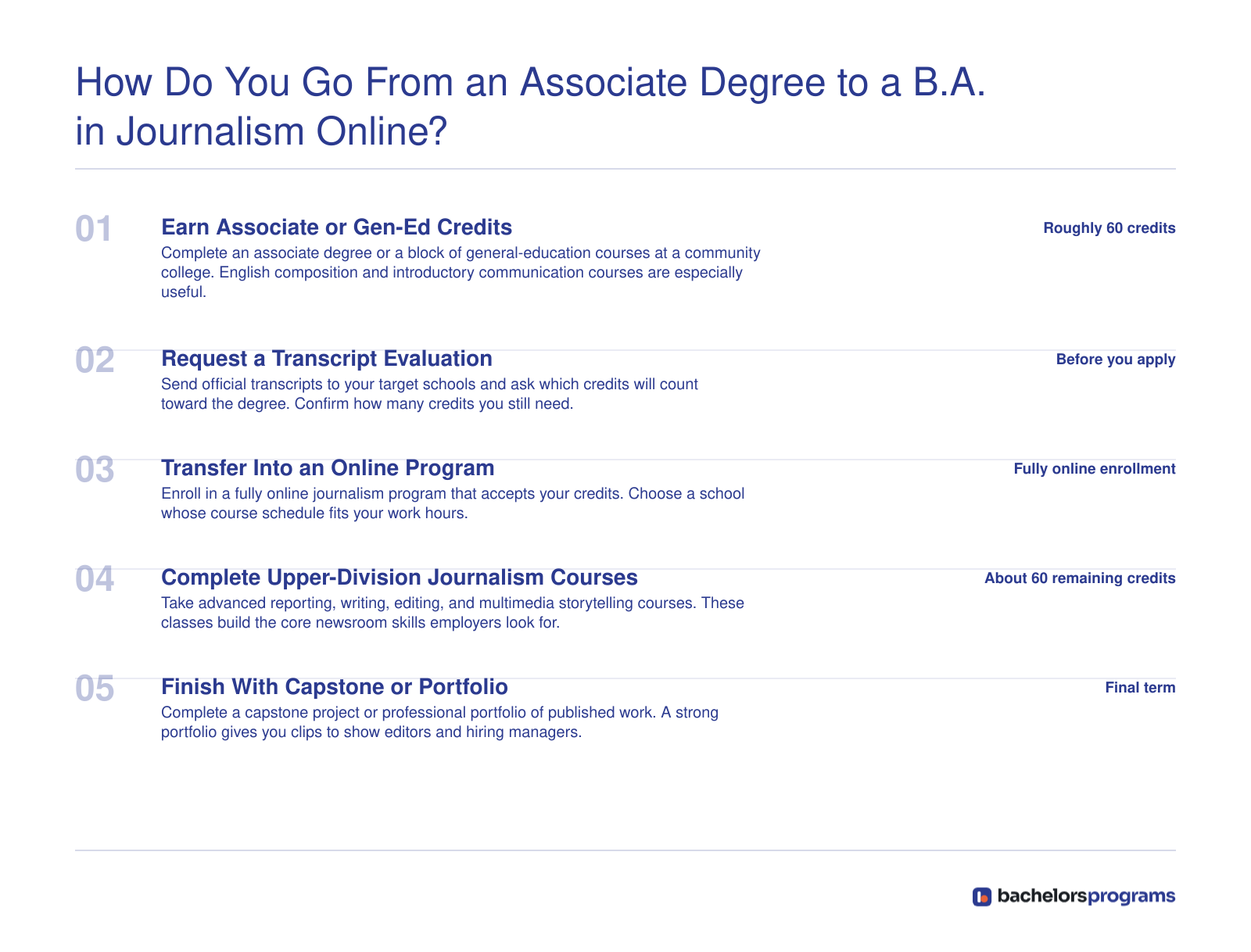
How Do You Go From an Associate Degree to a B.A. in Journalism Online?
For working adults, transferring in with an associate degree is the fastest common route to a bachelor's degree in journalism online. A typical bachelor's degree requires about 120 credits, and an associate degree can cover roughly 60 of them, so you start at the upper-division level.
What Reporters and Journalists Earn
An online bachelor's degree in journalism prepares you for a field where pay is modest and competition for jobs is real.
Journalism vs. Communication, English, and Digital Media Degrees
Many online "journalism" listings are really concentrations inside a broader communication or media degree. That usually means fewer reporting courses and more theory, strategy, and production electives, so check the course list for reporting, media law, and ethics before you enroll. The Bureau of Labor Statistics names journalism, communications, or a related field such as English as the typical entry degree for reporters, who earned a median of $62,200 in 2025.
| Factor | Journalism | Communication | English | Digital Media |
|---|---|---|---|---|
| Core focus | Reporting and news writing | Messaging across audiences | Writing, literature, analysis | Multimedia content and design |
| Typical coursework | Reporting, media law, ethics | Public speaking, PR, media theory | Composition, literature, rhetoric | Video, audio, web production |
| Portfolio and clip emphasis | High: published clips expected | Moderate: campaigns, projects | Moderate: writing samples | High: multimedia work samples |
| Common career paths | Reporter, editor, producer | PR, marketing, management | Writer, editor, technical writer | Content creator, producer, web media |
| Related occupation median pay (2025) | Reporters $62,200; editors $77,920 | PR specialists $74,750 | Writers and authors $76,910 | Media and communication workers $74,250 |
| Best fit for | Aspiring news reporters | Students wanting broad career options | Students who love writing and reading | Students drawn to visual and web storytelling |
Journalism programs by state
Online Journalism Degree FAQs
These answers cover the questions prospective students ask most about earning a bachelor's degree in journalism online. Details vary by school, so confirm specifics with an admissions office before you apply.
What is the best online journalism degree program?
Can you get a journalism degree completely online?
How many transfer credits can I use toward an online journalism degree?
What jobs can you get with an online bachelor's degree in journalism?
Compare Journalism programs on the data that matters
Explore more Communications & Media majors or browse every field of study.
All Communications & Media programs Browse every field of study