Best Communications Degree Programs in Ohio
Compare 80 accredited Communications programs in Ohio at 50 colleges, with net price after aid, graduation rates, earnings and debt from IPEDS and the U.S. College Scorecard.

Ohio's communications programs come in two shapes: the flagship campus with its full media ecosystem, and the regional campus where the same credential costs less and runs on a hybrid schedule. Both award a bachelor's degree in communication, and both rest on writing, persuasion and audience analysis.
In-state tuition at Ohio's public universities runs from about $12,000 to $14,200 a year before aid; private tuition starts near $35,500. Net price after grants narrows that gap unevenly, and graduation rates and graduate earnings spread wider still.
Hiring managers in public relations and corporate communication weigh portfolios more heavily than program names.
Key Points
- Regional campuses like Ohio University-Eastern Campus offer the cheapest communications bachelor's degrees.
- Kent State and Ohio University let you finish entirely online.
- Transfer applicants to Ohio University's communication program need a 2.0 GPA.
Best Schools for a Bachelor's Degree in Communications in Ohio
Ohio awards hundreds of communications bachelor's degrees every year, and the programs behind those numbers look very different: a large research university in Columbus, a co-op driven campus in Cincinnati, a hybrid regional option in Athens. Each entry below describes the formats a school offers, the concentrations it publishes and what students typically pay after aid. Prices are approximate averages for the sector, and graduation rates describe the whole institution rather than any single major.
Ohio State University
#1Columbus, OH · $17,000/yr (est. net price)
Best for: Students targeting strategic communication and media analytics
Ohio State's Columbus campus runs the largest communication program in the state, built around audience analysis and message strategy. Undergraduates pick from three specializations and work in multimedia labs and a podcasting studio, with internships and alumni mentoring built in. The university's graduation rate is 88% and average net price after aid is about $17,300.
- Tracks: Communication Analysis and Engagement, Communication Technology, Strategic Communication
- Bachelor of Arts through the School of Communication
- State-of-the-art multimedia classrooms and multiplatform labs
- Podcasting studio access for student work
- Internships and mentoring from internationally known faculty
University of Cincinnati
#2Cincinnati, OH · ~$26,000/yr (est.)
Best for: Co-op seekers adding public relations certificates
Cincinnati's B.A. in Communication sits in the College of Arts and Sciences and offers an optional co-op track with at least two placements noted on the transcript. Students can add a Public Relations or Applied Communication certificate, or pair the degree with a UC law degree in six years. The university's graduation rate is 75% and average net price after aid is about $25,600.
- 120 credit hours; 2.0 GPA minimum in UC courses
- Optional co-op track with at least two co-op experiences
- Public Relations Certificate and Applied Communication Certificate options
- Student-run public relations firm, UC Influence
- Combined bachelor's and UC law degree in six years
- More than 5,000 alumni mentors
- 11:1 student-faculty ratio
University of Dayton
#3Dayton, OH · ~$30,000/yr (est.)
Best for: Journalism hopefuls wanting newsroom experience
Dayton spreads its B.A. in Communication across five concentrations, from journalism and media production to public relations, and adds a teacher licensure option. A required capstone and the student outlets Flyer TV and Flyer News supply portfolio work. The university's graduation rate is 80% and average net price after aid is about $29,500.
- Five concentrations, from journalism and media production to public relations
- 120 credit hours, with about 40 in the major
- Capstone course required
- Student-run Flyer TV and Flyer News
- Optional teacher licensure track
- Internship available; writing-intensive coursework
Ohio University
#4Athens, OH · ~$22,000/yr (est.)
Ohio University teaches communication studies across its regional campuses in a hybrid format, so students can finish the degree without relocating. The Southern campus adds public advocacy and health communication concentrations, and the Scripps College of Communication offers a fully online B.S. in Communication. The university's graduation rate is 65% and average net price after aid is about $21,600.
- Hybrid format: on-campus and online courses
- Complete the degree at the Eastern campus without relocating
- 2.8 GPA minimum for the major
- Requires a minor or related area
- Service learning courses and internships built in
- 120 credit hours, 42 in communication courses
- 18 credit hours in a related area
- Core includes public speaking, interpersonal and theory
- Capstone seminar required
- Offered at the Southern campus
- Health communication concentration at the Southern campus
- 120 total credit hours
- Rolling admissions; high school diploma or GED accepted
- Fixed tuition rates through the OHIO Guarantee
- Fully online, with no face-to-face meetings
- 120 credit hours with a capstone project
- Standardized tests not required for admission
- Open to high school graduates and transfer students
- Housed in the Scripps College of Communication
Bowling Green State University
#5Bowling Green, OH · ~$24,000/yr (est.)
BGSU's communication bachelor's asks students to choose a professional, interpersonal or advocacy and social justice emphasis, then finish with a capstone and an internship. Falcon Media gives students newsroom and production experience, and an accelerated pathway can carry them into a master's in five years. The university's graduation rate is 64% and average net price after aid is about $24,000.
- Tracks: Professional Communication, Interpersonal Communication, Advocacy and Social Justice
- 120 credit hours with a capstone or research project
- Internships integrated into the major
- Student-run Falcon Media outlets
- Accelerated B.A. to M.A. pathway in five years
- Minor or area of emphasis required
Ohio Northern University
#6Ada, OH · $24,000/yr (est. net price)
Ohio Northern's B.A. in Communication & Media is a liberal arts program in the School of Arts, Humanities and Social Sciences, designed to be tailored toward a profession or paired with a second major. Small classes and campus media resources keep the work hands-on. The university's graduation rate is 75% and average net price after aid is about $24,500.
- B.A. in Communication & Media, offered as a major and minor
- Blends theory, analysis and practice
- Core courses plus room to tailor the major
- Small class sizes with media resources on campus
- Can be combined with another major
Kent State University
#7Kent, OH · ~$21,000/yr (est.)
Kent State's B.A. in Communication Studies is deliberately flexible: students build a plan of study across advocacy, social media, corporate communication and intercultural coursework. It runs online as well as at the Kent and Stark campuses. The university's graduation rate is 64% and average net price after aid is about $20,800.
- Offered in person at Kent or Stark, or fully online
- 120 credit hours; 2.0 GPA minimum
- General concentration designed for a flexible plan of study
- Internship or senior seminar option
- Study abroad and combined bachelor's/master's options
Otterbein University
#8Westerville, OH · ~$19,000/yr (est.)
Otterbein's B.A. in Communication Studies leans on argumentation, advocacy and intercultural coursework, taught by faculty with professional practice behind them. Students work on persuasive speaking, conflict mediation and full communication plans. The university's graduation rate is 68% and average net price after aid is about $19,200.
- Coursework in interpersonal, argumentation and intercultural communication
- Builds persuasive speaking and conflict mediation skills
- Practice analyzing organizations and writing communication plans
- Faculty with real-world professional experience
University of Toledo
#9Toledo, OH · $13,000 – $22,000/yr (est.)
Toledo's B.A. in Communication splits into digital, interpersonal, media, and organization and strategic communication concentrations, each ending in a capstone. Students can work at the campus television studio, the Collegian newspaper and WXUT-FM, or join PRSSA and the Society of Professional Journalists. The university's graduation rate is 57% and average net price after aid is about $17,200.
- Tracks: Digital, Interpersonal, Media, Organization and Strategic Communication
- 18-credit core, with a C- minimum in each core course
- Capstone required in every concentration
- PRSSA, SPJ and Lambda Pi Eta chapters
- Campus television studio, Collegian newspaper and WXUT-FM
- 120 credit hours across eight terms
The College of Wooster
#10Wooster, OH · ~$23,000/yr (est.)
Wooster's Communication Studies major is ten courses, spread across rhetoric and politics, culture, relational communication and media studies, and capped by a senior independent study thesis. It is a small liberal arts program with a 10:1 student-faculty ratio. The college's graduation rate is 74% and average net price after aid is about $23,500.
- Ten-course major
- Four subareas: rhetoric and politics, culture, relational, media studies
- Two research methods courses required
- Senior Independent Study thesis
- Public speaking proficiency required
- Only grades of C- or better count toward the major
Cost & outcomes by school
Federal data for the highest-earning Communications programs, independent of the ranking above. Earnings are this field's bachelor's graduates four years after completing where the Scorecard reports them, else the school's undergraduate median.
| School | Net price / yr | Grad rate | Earnings | Debt | Grads/yr | Format |
|---|---|---|---|---|---|---|
| Ohio Northern University OH | $24,478 | 76% | $80,928 | $27,000 | 10 | Campus |
| University of Dayton OH | $29,533 | 80% | $67,231 | $25,000 | 159 | Campus |
| Denison University OH | $40,007 | 79% | $66,730 | $25,000 | 62 | Campus |
| John Carroll University OH | $28,746 | 79% | $62,270 | $27,000 | 36 | Campus |
| Ohio State University OH | $17,339 | 88% | $62,096 | $19,822 | 459 | Campus |
| The College of Wooster OH | $23,458 | 74% | $60,884 | $22,111 | 23 | Campus |
| Marietta College OH | $21,083 | 61% | $57,180 | $27,000 | 7 | Campus |
| The University of Findlay OH | $27,221 | 58% | $56,996 | $25,439 | — | Online |
| University of Cincinnati OH | $25,648 | 75% | $56,818 | $21,644 | 165 | Campus |
| Wittenberg University OH | $18,649 | 53% | $56,711 | $27,000 | 17 | Campus |
| Miami University OH | $28,384 | 80% | $55,919 | $19,750 | 63 | Campus |
| Miami University-Middletown OH | $10,809 | 32% | $55,919 | $19,750 | 2 | Campus |
Sources: U.S. Department of Education. Net price, graduation rate, earnings and debt: College Scorecard (earnings and debt for this field's bachelor's graduates where reported, else school-wide); graduates: IPEDS. A dash means no figure is reported.
Cost, debt & payoff
Median earnings of this field's bachelor's graduates (4 yrs after completing, else the school's undergraduate median) vs. their median federal loan debt · U.S. College Scorecard
Across these programs the median graduate earns about $53,800 and finishes with roughly $23,860 in debt — a ratio that clears a common rule of thumb (keep debt below first-year salary). Net price and debt vary widely school to school, so check the per-school figures in the table above before you shortlist.
Most Affordable Communications Bachelor's Programs in Ohio
The lowest-cost routes to a bachelor's degree in communications in Ohio run through regional campuses rather than flagship schools, based on 2024 IPEDS and College Scorecard data from the U.S. Department of Education. Ohio University-Eastern Campus, in our directory, posts the lowest average net price at $3,925 a year. Ohio University's Lancaster, Chillicothe and Southern campuses, which sit outside the main ranking, follow at under $6,000, and Miami University-Middletown rounds out the group. Net price reflects what students paid on average after grants and scholarships, so it can differ from the published tuition shown alongside it.
| School | Location | Program | Format | In-State Tuition and Fees | Average Net Price | Median Earnings 1 Year After Graduation |
|---|---|---|---|---|---|---|
| Ohio University-Eastern Campus | Saint Clairsville, OH | Communication Studies | Hybrid | $6,362 | $3,925 | $36,666 |
| Ohio University-Lancaster Campus | Lancaster, OH | Online B.S. in Communication | Online | $6,362 | $5,650 | $36,666 |
| Ohio University-Chillicothe Campus | Chillicothe, OH | Communication (B.S.) | Online | $6,362 | $5,755 | $36,666 |
| Ohio University-Southern Campus | Ironton, OH | Communication Studies | Campus | $6,362 | $5,993 | $36,666 |
| Miami University-Middletown | Middletown, OH | Communication Studies | Campus | $7,491 | $10,809 | $34,959 |
Online and Hybrid Communications Bachelor's Options at Ohio Schools
Kent State University and Ohio University both offer a communications bachelor's degree you can finish without coming to campus, which makes Ohio a workable state for studying the field online. Every other school on this list teaches its communications major on campus, so format comes down to your schedule.
Which Formats Exist
- Fully online: Ohio University's online Bachelor of Science in Communication requires no face-to-face meetings. Kent State's Communication Studies major is offered in person or fully online.
- Hybrid: Ohio University's Communication Studies program at its Eastern campus mixes on-campus and online courses, a fit for students near a campus who still want some in-person instruction.
- Campus: Ohio State, Cincinnati, Dayton, Bowling Green, Ohio Northern, Otterbein, Toledo and Wooster run their communications majors on campus, where student media outlets and internships sit.
What You Can Study Online
Ohio University's online degree spans journalism, media production, web and print design, communication studies and telecommunication systems. The school does not publish a fixed roster of online-only concentrations; students can pair the major with a journalism minor or a social media certificate. Kent State's degree carries two concentration options.
Cost and Scheduling
Ohio University's 2026-2027 online undergraduate tuition is $349 per credit for Ohio residents and $359 for out-of-state students, covering tuition and the general fee, with additional fees possible. For comparison, in-state tuition and fees at its Athens campus run $14,158 a year, while 30 credits at the online rate comes to about $10,470. Kent State lists $12,920 for Ohio residents on campus.
Ohio University builds its online schedule around working adults and requires no face-to-face meetings. Its public materials do not state that every course is asynchronous, so ask an advisor about live sessions before you enroll.
Related Articles
Admissions Requirements: GPA, Test Policy and Transfer Credit
Ohio University publishes a 2.0 cumulative GPA for transfer applicants to its communication program, the same threshold it applies to online transfers and to the Athens campus. Together with open admission at the regional campuses that award the Communication B.S., that threshold gives transfer students a stated, predictable route into the degree.
The Published Rules at Ohio University
- Transfer GPA: 2.0 cumulative for the online B.S.C. and for Athens, where the catalog frames it as a 4.0-scale GPA in academic coursework from a regionally accredited institution. Regional campuses admit high school graduates without a selective review.
- Tests: ACT or SAT is not required for transfer admission, though Accuplacer, ACT or SAT scores may be used for placement. No first-year test requirement is published on the online B.S.C. page.
- Transfer credit: College-level courses at D- or better from a CHEA-recognized institution generally transfer. AP scores of 3 or higher and IB higher-level scores of 5 or higher are accepted.
- Transcript threshold: Applicants with fewer than 20 semester hours (30 quarter hours) also submit a high school transcript.
Ohio University's communication program page does not publish a first-year GPA minimum or a program-specific maximum on transfer credits, so the university-wide policies above are the ones to plan around.
What Selectivity Looks Like
Scorecard admission rates at the schools ranked here run from about 60% at Ohio State and Wooster to roughly 92% at Toledo. Cincinnati and Kent State sit in the middle at about 85% and 86%. The spread is not a measure of program standards: a high admit rate does not mean no expectations for transfer students, and a low one does not mean a communications applicant needs a perfect record. Use the rate as a signal of overall competition, then check the program page for the actual GPA and credit rules.
Transfer-Friendliness, Plainly
On the published record, Ohio University is the clearest transfer-friendly option among the schools ranked here: open admission at its regional campuses, a stated 2.0 transfer GPA, and a D- transfer-credit floor. Where another school does not publish a first-year GPA or transfer-credit maximum, do not infer one. Ask admissions and keep the written answer with your application materials.
Questions to Ask Yourself
Are you applying as a first-year student or transferring in credits?
Does your GPA change which of these schools are realistic?
Will you submit test scores or apply test-optional?
Do you have college credit earned in high school?
Published In-State Tuition vs. Net Price at Top Ohio Schools
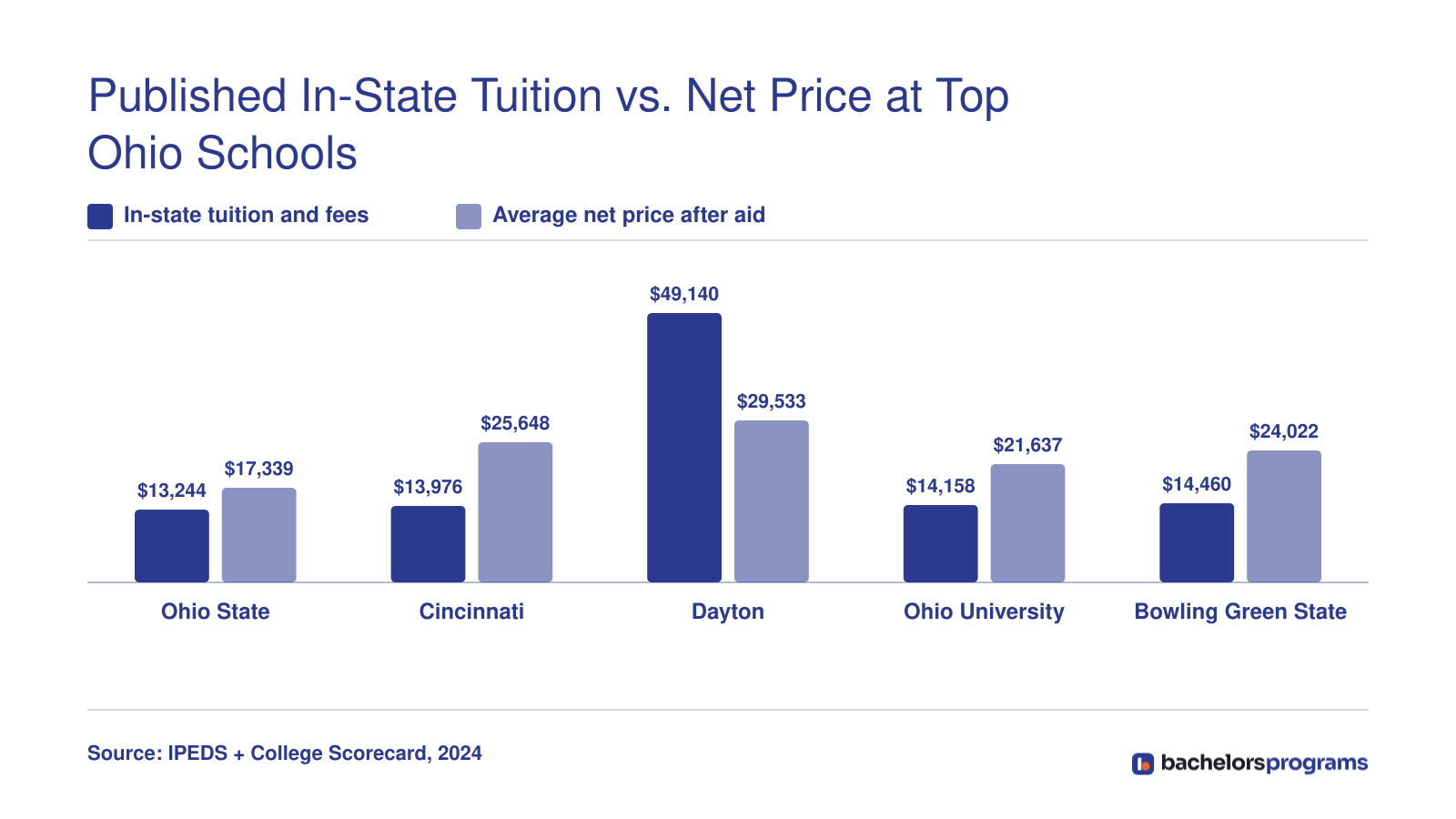
Published tuition and what students actually pay rarely match. Net price is the average yearly cost after grants and scholarships, and it includes housing, food and books along with tuition. That is why it can sit above the in-state tuition figure at Ohio State, Cincinnati, Ohio University and Bowling Green State, where the full annual net price runs from $17,339 to $25,648. At the University of Dayton, a private school, aid cuts a $49,140 tuition bill to a $29,533 net price, about $19,600 less. For in-state students at public schools, the net price is the better budget figure. At private schools, it shows how much aid can close the sticker gap.
What Ohio Public Relations Specialists Earn
Public relations is a common path for graduates with a bachelor's degree in communications, and Ohio wages are a useful benchmark when weighing program cost.
Common Questions About Communications Degrees in Ohio
These answers draw on the program details and findings covered above. Where the available information does not give a single definitive answer, we say so and point you to the step to confirm with the school.
What is the best college for communications in Ohio?
Can you get a bachelor's degree in communications online from an Ohio school?
Do you need a license to work in communications in Ohio?
Do you have to choose a concentration in a communications bachelor's program?
Can high school students earn communications credit through College Credit Plus?
Compare Communications programs on the data that matters
Explore more Communications & Media majors or browse every field of study.
All Communications & Media programs Browse every field of study