Best Computer Science Schools in Ohio
Compare 67 accredited Computer Science programs in Ohio at 48 colleges, with net price after aid, graduation rates, earnings and debt from IPEDS and the U.S. College Scorecard.

A bachelor's degree in computer science is a four-year undergraduate program, typically 120 to 128 credit hours, that teaches programming, algorithms, data structures and systems. Ohio schools offer it as either a Bachelor of Science (B.S.) or a Bachelor of Arts (B.A.) in Computer Science; the two differ mainly in how technical the coursework is and how many electives sit outside computing.
The choice usually comes down to studying in Ohio or online at an Ohio-based school. The tension is clear in the numbers: private campuses such as Case Western Reserve and the University of Dayton carry sticker tuition of $66,608 and $49,140, while public options like Youngstown State charge under $12,000 a year in-state.
For most employers, ABET accreditation and internship or co-op experience count for more than a school's name.
Key Points
- Wilberforce University posts the lowest average net price here: $5,567.
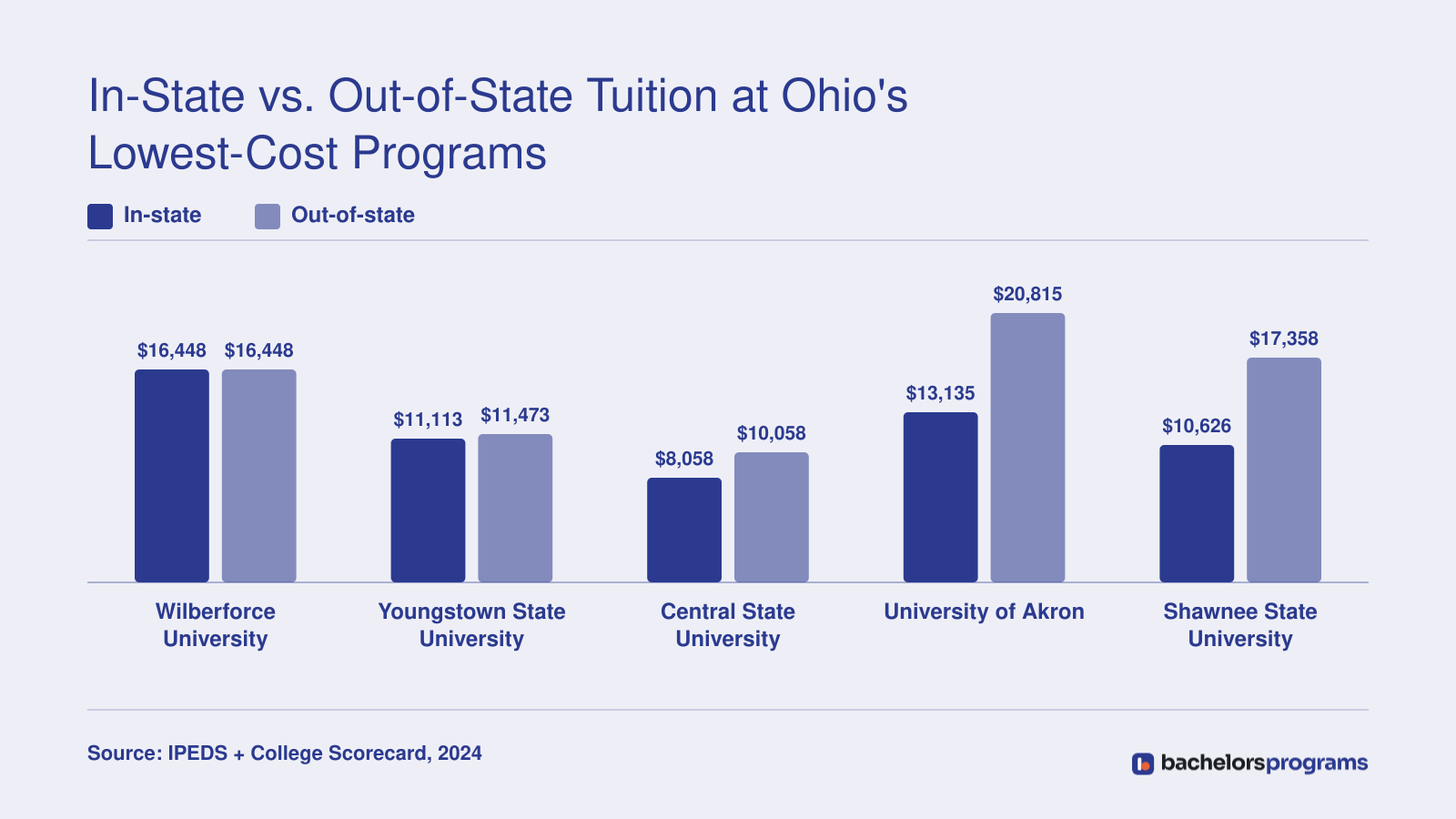
- University of Akron charges $13,135 in-state versus $20,815 out-of-state.
- Ohio software developers earned a $114,090 median salary in May 2025.
Best Computer Science Schools in Ohio: Top 10 Ranked
Ohio's strongest computer science options for undergraduates are not all the same kind of place: a Catholic liberal arts campus in Steubenville, a research university in Cleveland, and a co-op driven engineering school in Toledo all sit alongside one another. What they share is a technical core in programming, data structures, and algorithms, a capstone or senior project, and coursework that reaches into artificial intelligence, security, and software engineering. Schools offering this program report institution-wide graduation rates of roughly 50% to 87%, and the cards below set out each program's format, price, and strengths.
University of Dayton
#1Dayton, OH · ~$30,000/yr (est.)
Best for: Hands-on learners drawn to cybersecurity labs
Dayton offers a hands-on computer science B.S. with unusual undergraduate lab access: virtual and augmented reality, intelligent systems security, and computer networks. Three concentrations let students specialize in AI and data science, cyber defense, or software engineering, and a two-semester capstone teams them with Dayton-area companies. Admission is test optional with no application fee, and every applicant is considered for merit scholarships.
- ABET-accredited B.S. requiring 120 credit hours
- Three concentrations: AI and data science, cyber defense, software engineering
- Cyber Defense designated an NSA National Center of Academic Excellence
- Two-semester senior capstone with real Dayton-area companies
- Test-optional admission with no application fee
- Labs in VR and AR, intelligent systems security, and networks
- AI Engineering co-major available alongside the CS degree
- Accelerated five-year path combining the B.S. with graduate study
Case Western Reserve University
#2Cleveland, OH · ~$41,000/yr (est.)
Best for: Students pairing computing with a second major
Case Western Reserve, in Cleveland's University Circle, awards its computer science degree as a Bachelor of Arts, a deliberately flexible route for students who want computing plus a second field. More than a third of the coursework is open electives, and many students finish a double major in four years. The program keeps a full technical core in programming, data structures, algorithms, and computer organization while adding a senior project and required work on ethics and professionalism.
- B.A. combines a liberal arts education with a professional computing major
- Over a third of coursework is open electives
- Double major commonly completed within four years
- 120 credit hours with a required senior project
- Electives in AI, security, databases, and networks
- Required work in ethics, professionalism, and leadership
Ohio Northern University
#3Ada, OH · $24,000/yr (est. net price)
Best for: Small-campus students wanting co-op experience
Ohio Northern teaches computer science inside its College of Engineering on a residential campus in Ada, with an ABET-accredited 128-credit curriculum. Four concentrations (artificial intelligence, cybersecurity, robotics, and biomedical engineering) let students shape the degree, and an immersive co-op can connect them with employers such as Microsoft, Raytheon, and Honda. A two-part capstone has teams solving real client problems in the 105,000-square-foot Kennedy Engineering Building.
- ABET-accredited by the Computing Accreditation Commission
- 128 total credit hours, typically finished in four years
- Four concentrations: AI, cybersecurity, robotics, biomedical engineering
- Co-op placements at employers including Microsoft, Raytheon, and Honda
- Two-part capstone solving real client challenges
- Test-optional admission with no entrance exam
- Upsilon Pi Epsilon honor society chapter and programming competitions
Franciscan University of Steubenville
#4Steubenville, OH · ~$24,000/yr (est.)
Franciscan University of Steubenville teaches computer science within a Catholic liberal arts framework, asking students to weigh how technology affects human dignity alongside standard technical training. Classes are small and project-based, coursework covers AI, cybersecurity, and software engineering, and a senior thesis caps the degree. Internships with Ohio companies often convert into job offers, and students can add a double major or minor in business, another STEM field, or theology.
- Coursework in AI, cybersecurity, web programming, and software engineering
- Senior thesis required alongside hands-on projects
- Small class sizes with a faith-based Catholic curriculum
- Internships with Ohio companies frequently lead to job offers
- Double majors or minors in STEM, business, or theology
- Average starting salary above $44,000 for graduates
Ohio University
#5Athens, OH · ~$22,000/yr (est.)
Ohio University's Russ College of Engineering and Technology runs a Bachelor of Science in Computer Science built on 15 required core courses plus technical electives, with a senior design sequence and internship experience built in. Fixed tuition through the Guarantee+ program makes costs predictable for families. The Athens campus anchors the program, with some online classes and regional campus options widening access, and undergraduates can pursue research and an honors tutorial route.
- 15 required core courses plus technical electives
- ABET-accredited program in the Russ College of Engineering
- Senior design sequence and internship experience included
- Fixed tuition under the Guarantee+ program
- Tracks: Honors Tutorial Program in Advanced Computing, AR/VR development projects
- Some online classes and regional campus options
- Admission expects four years of college-prep math plus chemistry or physics
- Undergraduate research encouraged, with access to the Avionics Engineering Center
John Carroll University
#6University Heights, OH · ~$29,000/yr (est.)
John Carroll is a liberal arts university in suburban Cleveland where computer science students learn Java, Python, and SQL, then move into data structures, software engineering, operating systems, and security. Small classes and faculty mentorship are the pitch, backed by hands-on labs, projects, and internships tied to Cleveland's tech employers. A capstone and a liberal arts core round out a degree that also supports related minors and regional programming competitions.
- Programming in Java, Python, and SQL
- Coursework in data structures, algorithms, operating systems, and networks
- Software engineering and database systems required
- Capstone project plus internships with Cleveland tech employers
- Small classes with faculty mentorship
- Technical writing proficiency emphasized
- Related minors available and participation in regional competitions
University of Toledo
#7Toledo, OH · $13,000 – $22,000/yr (est.)
Toledo runs computer science and engineering as an ABET-accredited program with three mandatory co-op semesters, so students graduate with paid industry experience on the record. Labs stay open around the clock, and a microelectronics security concentration plus an entrepreneurship-focused first-year program give the degree a practical bent. A separate computer science and engineering technology degree covers hardware, networking, and information security for students who want a more applied path.
- Accredited by both the engineering and computing ABET commissions
- Three mandatory co-op semesters with paid industry experience
- Microelectronics Security concentration available
- 24-hour lab access plus a virtual reality lab and digital logic lab
- Choose Ohio First scholarship for eligible Ohio residents
- Honors College option with thesis requirement
- ABET-accredited applied program focused on hardware and software
- Optional co-op for paid industry experience
- Cyber Security concentration available
- Coursework in website design, local and wide area networks, and information security
- Choose Ohio First scholarship available to eligible residents
Cleveland State University
#8Cleveland, OH · $15,000/yr (est. net price)
Cleveland State's computer science B.S. is ABET-accredited, requires at least 120 credit hours, and finishes with a senior capstone. Electives let students build depth in artificial intelligence, data science, software engineering, cybersecurity, or database systems. The downtown Cleveland location supports industry partnerships and undergraduate research opportunities.
- ABET-accredited, minimum 120 credit hours
- Senior capstone required
- Electives in AI, data science, software engineering, cybersecurity, and databases
- Core coverage of algorithms, data structures, computer systems, and programming languages
- Industry partnerships with Cleveland-area employers
- Undergraduate research opportunities available
Ashland University
#9Ashland, OH · ~$22,000/yr (est.)
Ashland offers computer science as both a Bachelor of Arts and a Bachelor of Science, a 120-credit program with a capstone software development project built around a real company's problem. Internships and research placements with regional employers carry college credit and pay, and graduates have landed at employers such as FirstEnergy, J.M. Smucker, and Mettler Toledo. Choose Ohio First scholarships support STEM students, and a renewable Dean's Scholarship is available in the College of Arts and Sciences.
- Offered as both a Bachelor of Arts and a Bachelor of Science
- 120 total credit hours with a capstone software development project
- Paid internships and research placements with regional companies
- Coursework in programming, networks, system administration, and cybersecurity
- Renewable $1,500 Dean's Scholarship for new Arts and Sciences students
- Choose Ohio First scholarships available to STEM students
- Students work across Linux, Solaris, MacOS, and Windows environments
Youngstown State University
#10Youngstown, OH · ~$13,000/yr (est.)
Youngstown State awards a Bachelor of Science in Computer Science on campus and as a fully online degree, both built around programming, data structures, algorithms, and operating systems with a required mathematics minor. The campus version runs 120 to 124 semester hours and can be finished in eight full-time semesters. The online version uses accelerated seven-week courses and accepts up to 90 transfer credits, which suits students arriving with prior college work.
- 120 to 124 semester hours, completable in eight full-time semesters
- Mathematics minor built into the degree
- Coursework in data structures, algorithms, software engineering, and operating systems
- Computer projects requirement plus professional ethics
- Campus-based program with a defined plan of study and learning outcomes
- Solid foundation for graduate study in computing
- 100% online with accelerated seven-week courses
- Up to 90 transfer credits accepted
- Minimum 2.0 GPA required for admission with official transcripts
- $460 per credit hour for in-state students, pay-as-you-go tuition
- Multiple start dates throughout the year
- Mathematics minor and CSIS core courses required
Cost & outcomes by school
Federal data for the highest-earning Computer Science programs, independent of the ranking above. Earnings are this field's bachelor's graduates four years after completing where the Scorecard reports them, else the school's undergraduate median.
| School | Net price / yr | Grad rate | Earnings | Debt | Grads/yr | Format |
|---|---|---|---|---|---|---|
| Case Western Reserve University OH | $41,190 | 87% | $143,580 | $25,391 | 192 | Campus |
| Franklin University OH | $25,243 | 11% | $111,131 | $28,291 | 32 | Online |
| Cedarville University OH | $24,468 | 73% | $109,817 | $27,000 | 38 | Campus |
| Xavier University OH | $32,997 | 69% | $104,908 | $27,000 | 30 | Campus |
| University of Dayton OH | $29,533 | 80% | $102,468 | $25,000 | 31 | Campus |
| Cleveland State University OH | $14,764 | 51% | $100,385 | $22,115 | 54 | Campus |
| Ohio University OH | $21,637 | 66% | $93,282 | $21,490 | 59 | Campus |
| Kent State University OH | $20,787 | 64% | $91,614 | $22,500 | 98 | Campus |
| Kent State University at Stark OH | $10,897 | 37% | $91,614 | $22,500 | — | Campus |
| John Carroll University OH | $28,746 | 79% | $88,824 | $24,625 | 20 | Campus |
| Youngstown State University OH | $12,767 | 51% | $85,028 | $20,930 | 43 | Campus |
| Ohio Northern University OH | $24,478 | 76% | $80,928 | $27,000 | 16 | Campus |
Sources: U.S. Department of Education. Net price, graduation rate, earnings and debt: College Scorecard (earnings and debt for this field's bachelor's graduates where reported, else school-wide); graduates: IPEDS. A dash means no figure is reported.
Cost, debt & payoff
Median earnings of this field's bachelor's graduates (4 yrs after completing, else the school's undergraduate median) vs. their median federal loan debt · U.S. College Scorecard
Across these programs the median graduate earns about $55,076 and finishes with roughly $25,000 in debt — a ratio that clears a common rule of thumb (keep debt below first-year salary). Net price and debt vary widely school to school, so check the per-school figures in the table above before you shortlist.
Most Affordable Computer Science Schools in Ohio
Net price, meaning what students pay after grants and scholarships, can differ sharply from sticker tuition. Wilberforce University lists $16,448 in tuition and fees but posts the lowest average net price below at $5,567, while Youngstown State University, a ranked school, charges out-of-state students only about $360 more than Ohio residents. Figures come from IPEDS and College Scorecard (2024) data from the U.S. Department of Education and are institution-wide, not specific to the computer science major.
| School | City | Type | In-State Tuition & Fees | Out-of-State Tuition & Fees | Average Net Price | Graduation Rate | Median Federal Debt at Graduation |
|---|---|---|---|---|---|---|---|
| Wilberforce University | Wilberforce | Private nonprofit (HBCU) | $16,448 | $16,448 | $5,567 | 12% | $26,468 |
| Miami University-Middletown | Middletown | Public | $7,491 | $19,407 | $10,809 | 32% | $23,000 |
| Youngstown State University | Youngstown | Public | $11,113 | $11,473 | $12,767 | 50% | $24,000 |
| Central State University | Wilberforce | Public (HBCU) | $8,058 | $10,058 | $13,096 | 23% | $30,739 |
| University of Akron | Akron | Public | $13,135 | $20,815 | $13,946 | 52% | $23,250 |
How to Get Into an Ohio Bachelor's Degree in Computer Science Program
Test-optional policies have shifted the deciding weight in an Ohio computer science application away from the SAT and onto the transcript, and, above all, onto calculus.
Admission rates across the bachelor's degree in computer science programs ranked here run from 36.5% at Case Western Reserve University to 92.0% at the University of Toledo, so selectivity is a spectrum rather than a single bar to clear.
Where the Bar Sits
Case Western Reserve University is the clear outlier on selectivity. Franciscan University of Steubenville, the University of Dayton, and Ohio Northern University form a middle band at roughly 58% to 74%, while Ashland University, John Carroll University, Youngstown State University, and Ohio University admit somewhere between about 76% and 85% of applicants. Cleveland State University and the University of Toledo are the most open, both above 90%.
GPA and Test Policy: What Is Published
Case Western Reserve publishes the most transfer detail: test-optional status, a minimum 3.00 cumulative GPA plus a 3.00 math and science GPA for the transfer applicants it describes, at least 90 semester hours earned at the first college, and transfer credit for coursework graded C or better once a final transcript arrives.1 Its first-year test policy and first-year GPA floor are not published.
The other programs here publish no computer science-specific GPA cutoff, so general university admission standards govern, and the program page usually states the math and science preparation expected. Ohio University says directly that admission requires math and science coursework.
Transfer Credit and the Statewide Pathway
Ohio's statewide Computer Science Transfer Pathway maps the Ohio Transfer 36 general education categories and adds Calculus I and II, science, communication, and electives, for 36 to 42 credits. Completing the pathway at a community college is the most reliable way in, but each university still applies individual courses differently, so request a written evaluation before you commit.
Three Practical Tips
- Take calculus early: it is the single course that most often delays a computer science start, so finish it in high school or your first college semester.
- Apply by the early deadline: an early file leaves room to fix a missing prerequisite before the term begins.
- Get credit in writing: ask for a transfer credit evaluation by email so you know which courses count before you enroll.
Related Articles
Online and Hybrid Bachelor's Degrees in Computer Science at Ohio Schools
What the Ranked Programs Offer
Every ranked program on this list is campus-based, and none is labeled fully online or hybrid. A few come close. Ohio University's B.S. in Computer Science is residential in Athens, with some online classes and certain courses at regional campuses. Its published list of fully online bachelor's degrees does not include computer science. Youngstown State University appears in a 2026 listing as having computer science completions offered online. That listing does not say whether the online option is a full bachelor's or a partial format, so confirm with the department. Cleveland State University and the University of Akron show no online computer science completions in 2024 listings.
How Online Differs From On-Campus
Fully online programs, where they exist, typically run shorter terms with more start dates, while campus programs follow a fall and spring semester calendar. Tuition can also differ. Ohio University's institution-level online tuition is $9,930 for in-state and out-of-state students alike, but that figure is not specific to computer science, so check the per-credit rate for your program.
Co-ops, Internships and Master's Pathways
- University of Toledo: Its program highlights a mandatory co-op with three semesters of work experience.
- Ohio Northern University: Co-op placements are listed, and choosing co-op extends the degree to five years.
- University of Dayton: A Bachelor's Plus Master's option lets students finish both in five years.
- Ohio University: Many graduates continue into its own M.S. in Computer Science, but no formal accelerated pathway is confirmed.
- Franciscan University of Steubenville: Internships with Ohio companies are listed, with no co-op or accelerated pathway stated.
Check each school's current catalog before relying on any of these options.
A Quick Rule of Thumb
Online study suits working adults and transfer students who need flexible pacing and cannot relocate; confirming which Ohio-based schools currently offer it takes some digging. On-campus study suits students who want co-op access, in-person recruiting and campus labs. For most of the schools here, that is the format you will get.
In-State vs. Out-of-State Tuition at Ohio's Lowest-Cost Programs
Residency status changes the bill most at Ohio's public universities. The University of Akron shows the widest gap here: $13,135 a year in-state versus $20,815 out-of-state, a $7,680 difference, with Shawnee State close behind at $6,732. Youngstown State, ranked on this page, charges nonresidents only $360 more, and Wilberforce University, a private school, charges every student the same $16,448.
Questions to Ask Yourself
Do you want to build software products, secure systems, or work with data and AI?
Does the Ohio employer you want to work for recruit from ABET-accredited programs or from schools with co-op pipelines?
Would you rather specialize now or keep a general CS degree and choose electives later?
What Software Developers Earn in Ohio
Software developers in Ohio earned a median of $114,090 a year in May 2025, the most recent federal estimate available.
Common Questions About Computer Science Schools in Ohio
These answers draw on the figures and caveats covered earlier on this page. Admissions rules, tuition and accreditation status change, so confirm details with each school before you apply.
What is the best college for computer science in Ohio?
Which Ohio schools offer ABET-accredited computer science bachelor's degrees?
How hard is it to get into a computer science program in Ohio?
What is the cheapest computer science degree in Ohio?
Can you earn a bachelor's degree in computer science online from an Ohio school?
Compare Computer Science programs on the data that matters
Explore more Computers & IT majors or browse every field of study.
All Computers & IT programs Browse every field of study