Best Communications Degree Programs in Oregon
Compare 13 accredited Communications programs in Oregon at 10 colleges, with net price after aid, graduation rates, earnings and debt from IPEDS and the U.S. College Scorecard.

Which Oregon schools award a bachelor's degree in communications, and what does one actually cost? The answers to both vary widely. Average net price after grant aid runs from about $9,552 at Portland State University to $31,679 at George Fox University. Median earnings for graduates ten years after enrollment range from roughly $49,175 to $82,804 across those same schools. Most confer the Bachelor of Arts (B.A.) in Communications.
Cost and payoff do not move together neatly, which is why the comparison has to happen school by school. Figures come from College Scorecard and each institution's own published pages.
Key Points
- Portland State University charges about $11,118 in in-state tuition and fees.
- Willamette University lists $51,156 tuition but averages $25,121 net price.
- Eastern Oregon, Oregon State (Ecampus) and Southern Oregon offer online degrees.
Best Bachelor's Degree in Communications Schools in Oregon, Ranked
Every school below awards a bachelor's degree in communications in Oregon, but they differ sharply in setting, price, and how much of the major is hands-on work. The strongest few combine deep curricula with completion rates near or above 70 percent, while others earn their place on flexibility, price, or a specialized focus such as civic media, journalism, or strategic communication. Graduation rates shown for each entry describe the institution as a whole, not the communication major alone.
Oregon State University
#1Corvallis, OR · $15,000 – $20,000/yr (est.)
Best for: Students wanting a research university setting
The state's largest public research university, and the broadest program here on the theory side, with coursework spanning interpersonal, organizational, and intercultural communication plus argumentation and rhetorical theory. The institution-wide graduation rate is about 70 percent.
- 53 credit hours in the major within a 180-credit degree
- Coursework in public speaking, argumentation, and rhetorical theory
- Covers interpersonal, small group, organizational, and societal contexts
- Qualitative and quantitative research methods required
- 2.0 GPA minimum for the major
- Four-year sample plan and academic advising provided
- Prepares students for MA and PhD study in communication
University of Portland
#2Portland, OR · $28,000/yr (est. net price)
Best for: Small liberal arts classes with close advising
A private university with a liberal arts approach, organizing the major around three study areas: organizational and relational communication, culture and communication, and environmental communication. A senior capstone and community-based internships are built into the degree, and advisors help students shape upper-division electives. The institution-wide graduation rate is close to 80 percent, among the strongest of the private schools here.
- 45 credit hours in the major
- Tracks: Organizational and Relational, Culture, and Environmental Communication
- Senior capstone project required
- Community-based academic internships available
- Coursework in interpersonal, organizational, cultural, and mediated communication
- Upper-division electives chosen with an advisor
- Research methods courses included in the core
Portland State University
#3Portland, OR · ~$10,000/yr (est.)
Best for: Budget-conscious commuters
A large urban public university with a deliberately flexible 56-credit communication major: a 12-credit core in principles, research methods, and theory, then wide latitude for upper-division electives. Small classes and internships give the work an applied edge, and graduates move into public relations, marketing, media, and nonprofit roles. The institution-wide graduation rate is about 53 percent.
- 56 total credit hours, including a 12-credit required core
- At least 28 upper-division credits, 16 of them at the 400 level
- Core covers communication principles, research methods, and theory
- Small classes with internship opportunities
- Electives tailored to public relations, media, or nonprofit work
- Built around four undergraduate learning outcomes
Willamette University
#4Salem, OR · $25,000 – $30,000/yr (est.)
A private liberal arts university whose Civic Communication and Media major centers on public discourse: political communication, rhetoric, media studies, and digital media. Students practice what they study through a Debate Union, a senior seminar capstone, and internships with organizations such as Oregon state government offices, and the campus sits across from the Oregon State Capitol. The institution-wide graduation rate is about 71 percent.
- 124 total credit hours for the degree
- Coursework in political communication, media studies, rhetoric, and digital media
- Senior seminar capstone required
- Internships with organizations such as Oregon state government offices
- Debate Union for applied argumentation practice
- Study abroad opportunities available
- Small class sizes with dedicated faculty
Linfield University
#5McMinnville, OR · $25,000 – $30,000/yr (est.)
A private university with a Communication Arts major that pairs a traditional liberal arts core (interpersonal communication, public speaking, persuasion, rhetorical theory) with electives in intercultural, gendered, nonverbal, and performance communication. A senior seminar and small classes keep the work discussion-based, and the program stresses ethical, culturally aware messaging. The institution-wide graduation rate is about 70 percent.
- 40 total credit hours in the major
- Core includes interpersonal communication, public speaking, persuasion, and rhetorical theory
- Electives in intercultural, gendered, nonverbal, and performance communication
- Senior seminar required
- Emphasizes ethical, reasoned, culturally aware messaging
- Small class sizes
Oregon Institute of Technology
#6Klamath Falls, OR · $15,000 – $20,000/yr (est.)
A public polytechnic where the Communication Studies degree is largely self-designed: students declare a professional goal after year two and build a plan of study with faculty and an advisory committee. Small classes, a required externship, and a technology-forward core push the work toward applied communication, and the program reports 81 percent employment after graduation. The institution-wide graduation rate is about 54 percent.
- Students declare a professional goal after year two
- Individualized plan of study approved by faculty and an advisory committee
- Required externship before graduation
- Four core areas: technology, relationships, adaptive communication, conflict management
- Small classes taught by experienced professors
- Program reports 81% employment after graduation
- Career paths include digital media management and corporate communication
George Fox University
#7Newberg, OR · $30,000 – $35,000/yr (est.)
A private Christian university with a tightly structured 48-credit communication major: a 27-credit core plus a 21-credit concentration in human, organizational, or public relations communication. A field experience internship runs every term with up to six hours counting toward the major, and the senior capstone includes a portfolio, work samples, and a department exit exam. The institution-wide graduation rate is about 72 percent.
- 48 semester hours: 27-credit core plus a 21-credit concentration
- Concentrations in human communication, organizational communication, and public relations
- Field experience internship offered each term; up to 6 hours count toward the major
- Minimum grade of C- required in all major courses
- Senior capstone includes portfolio, work samples, and department exit exam
Corban University
#8Salem, OR · ~$28,000/yr (est.)
A private Christian university offering a 120-credit communication major with two concentration choices: a general track in speaking, writing, and creativity, or a journalism track covering print and digital reporting in AP style. Courses such as Media and Society, Digital Storytelling, and Journalistic Writing sit alongside faculty-supported internships. The institution-wide graduation rate is about 61 percent.
- 120 credit hours completed over four years
- Two concentrations: general communication or journalism
- Journalism track covers print and digital reporting in AP style
- Courses include Media and Society, Digital Storytelling, and Journalistic Writing
- Faculty-supported internships
- Small class sizes in a close-knit humanities department
Eastern Oregon University
#9La Grande, OR · $15,000 – $20,000/yr (est.)
A public regional university whose Communication and Media Studies degree runs on campus and fully online, with BA or BS options and an optional public relations concentration. The curriculum stretches from media literacy and strategic communication to filmmaking, podcasting, and visual communication, and a Film Studies minor is available. The institution-wide graduation rate is about 43 percent.
- Fully online option available
- Optional Public Relations concentration
- Film Studies minor available alongside the major
- Skills in filmmaking, digital audio and podcasting, and visual communication
- Coursework in media literacy, strategic communication, and health communication
- Assessed through applied public relations projects and research
Southern Oregon University
#10Ashland, OR · ~$17,000/yr (est.)
A public university whose communication degree leans into social media strategy and public engagement, offered as a BA or BS with a fully online route. The work covers interpersonal, group, and organizational communication with hands-on media projects, and admissions review academic records and personal statements. The institution-wide graduation rate is about 43 percent.
- Available as a Bachelor of Arts or Bachelor of Science
- Concentration in Social Media and Public Engagement
- 100% online option for working professionals
- Covers interpersonal, group, and organizational communication
- Hands-on learning in social media strategy and public engagement
- Admissions review academic records and personal statements
Cost & outcomes by school
Federal data for the highest-earning Communications programs, independent of the ranking above. Earnings are this field's bachelor's graduates four years after completing where the Scorecard reports them, else the school's undergraduate median.
| School | Net price / yr | Grad rate | Earnings | Debt | Grads/yr | Format |
|---|---|---|---|---|---|---|
| University of Portland OR | $28,210 | 80% | $82,804 | $21,370 | 9 | Campus |
| Oregon Institute of Technology OR | $15,706 | 54% | $72,273 | $22,500 | 11 | Campus |
| Willamette University OR | $25,121 | 71% | $70,412 | $21,500 | 12 | Campus |
| Oregon State University OR | $19,604 | 70% | $61,096 | $19,828 | 21 | Campus |
| George Fox University OR | $31,679 | 72% | $59,761 | $24,250 | 4 | Campus |
| Portland State University OR | $9,552 | 53% | $59,232 | $20,499 | 55 | Campus |
| Eastern Oregon University OR | $17,148 | 43% | $56,013 | $20,612 | 11 | Hybrid |
| Linfield University OR | $26,536 | 71% | $54,091 | $27,000 | 14 | Campus |
| Southern Oregon University OR | $16,732 | 43% | $49,511 | $20,363 | 32 | Online |
| Corban University OR | $28,035 | 61% | $48,917 | $22,625 | 6 | Campus |
Sources: U.S. Department of Education. Net price, graduation rate, earnings and debt: College Scorecard (earnings and debt for this field's bachelor's graduates where reported, else school-wide); graduates: IPEDS. A dash means no figure is reported.
Cost, debt & payoff
Median earnings of this field's bachelor's graduates (4 yrs after completing, else the school's undergraduate median) vs. their median federal loan debt · U.S. College Scorecard
Across these programs the median graduate earns about $61,096 and finishes with roughly $21,370 in debt — a ratio that clears a common rule of thumb (keep debt below first-year salary). Net price and debt vary widely school to school, so check the per-school figures in the table above before you shortlist.
Cheapest Communications Bachelor's Programs in Oregon
The published tuition rate is rarely what a family pays. Average net price subtracts grants and scholarships from the full cost of attendance, so it is a better guide to what a bachelor's degree in communications will cost each year. The figures below come from the U.S. Department of Education's IPEDS and College Scorecard data (2024). Net price is a school-wide average for students receiving aid, not a quote, and median debt is the typical federal loan balance for each school's communications graduates. Portland State University has the lowest average net price of these programs, and graduate debt sits near $20,000 at every school where it is reported. Oregon Tech's communications program is too small for a debt figure to be published.
| School | City | Communications Program | Format | Average Net Price per Year | Median Debt (Communications Graduates) |
|---|---|---|---|---|---|
| Portland State University | Portland | Communication | Campus | $9,552 | $20,499 |
| Oregon Institute of Technology | Klamath Falls | Communication Studies | Campus | $15,706 | N/A |
| Southern Oregon University | Ashland | Communication (Social Media and Public Engagement concentration) | Online | $16,732 | $20,363 |
| Eastern Oregon University | La Grande | Communication and Media Studies | Hybrid | $17,148 | $20,612 |
| Oregon State University | Corvallis | Speech Communication | Campus (Ecampus option from Fall 2026) | $19,604 | $19,828 |
How Much a Bachelor's Degree in Communications Costs in Oregon
Public vs. Private Costs
The gap between public and private schools in Oregon is large. In-state tuition and fees come to roughly $11,118 at Portland State University, $12,762 at Southern Oregon University and $13,260 at Oregon Institute of Technology, against $14,400 at Oregon State University.1 The private schools here, including Corban University, George Fox University, Linfield University, Willamette University and the University of Portland, post sticker prices from roughly $40,000 to $58,100 a year.
Aid narrows that gap. Average net price after grants is about $9,552 at Portland State and $15,706 at Oregon Tech.1 It is $16,732 at Southern Oregon, $17,148 at Eastern Oregon University and $19,604 at Oregon State. Among the private schools, averages run from $25,121 at Willamette to $31,679 at George Fox. Net price is an average across aided students, so your own award could land well above or below it.
Online study can cut costs further. Oregon State's Ecampus lists $409 per credit with no nonresident surcharge, and Eastern Oregon's online program is $338 per credit (2025-26) plus a one-time $250 matriculation fee for fully online students.2
State and School Aid
The Oregon Opportunity Grant is need-based aid for Oregon residents pursuing a first associate or bachelor's degree at an eligible Oregon public or private institution.3 Requirements for 2026-27 include:
- Residency: at least 12 months in Oregon before attending.
- Need: a Student Aid Index of 8,000 or lower.
- Standing: no federal loan default and no owed grant refunds.
There is no separate application. You apply by filing the FAFSA, or the ORSAA if you are not eligible for federal aid. Awards go first-come, first-served to those with the greatest need, so filing early matters.3 Award amounts are not fixed and vary by need and institution type.
School scholarships matter most at private campuses. Willamette, for example, advertises merit scholarships starting at $28,000.
Practical Tips
- File as soon as the FAFSA or ORSAA opens each October 1. The 2026-27 priority deadline was May 15, 2026, so check Oregon Student Aid for the next cycle's dates.
- Confirm residency early. In-state rates and Opportunity Grant eligibility both depend on it.
- If you live in another western state, ask each school's admissions office about regional tuition discounts. We could not confirm which programs here offer one.
- Compare net price calculators on each school's site rather than relying on sticker prices.
How Far Does Aid Pull Down Sticker Prices at Oregon Communications Schools?
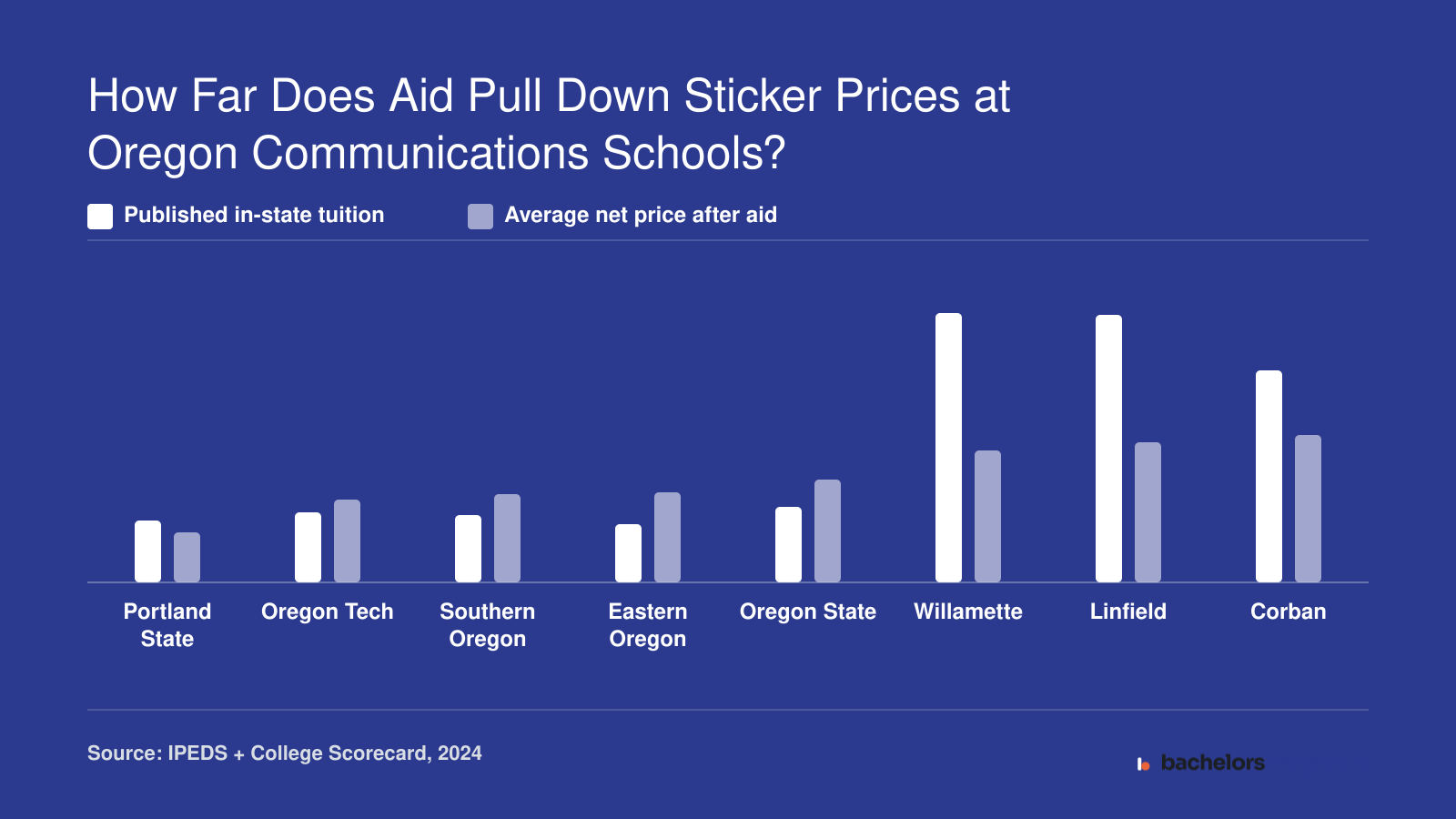
Willamette University shows the widest gap between sticker price and real cost: published tuition of $51,156 against an average net price of $25,121, a difference of $26,035. Net price is a federal average for students who receive grant aid, reported on each school's sector basis (public or private nonprofit). It covers the full cost of attendance, including housing, minus grants. That is why net price at public schools such as Oregon State and Southern Oregon runs above their in-state tuition.
Related Articles
Online and Hybrid Communications Bachelor's Options at Oregon Schools
You can earn a communications bachelor's degree online from an Oregon school. Eastern Oregon University, Oregon State University (through Ecampus), and Southern Oregon University all offer online routes. Portland State University offers a hybrid format. "Online" means something different at each school, so check the details before you apply.
Fully Online Programs
- Eastern Oregon University: Communication and Media Studies (B.A. or B.S.) is offered online or on campus, with no on-campus requirements and 180 credits total. EOU accepts up to 135 transfer credits, but at least 20 credits must be earned at EOU. Its separate online Public Relations bachelor's is asynchronous, uses 11-week courses, and can be taken full- or part-time. It includes in-person field experiences and project-based learning, but no campus attendance.
- Oregon State University: Ecampus offers Communication Studies and Digital Communication Arts2, each requiring 180 quarter credits, including at least 60 upper-division. At least 45 of your last 75 credits must come through OSU, online or on campus.1
- Southern Oregon University: Its Communication program lists a 100% online option within the Social Media and Public Engagement concentration, aimed at working professionals and place-bound students. Confirm the format and credit structure with the program.
Hybrid and Technology-Assisted Options
Portland State University mixes online, in-person, and hybrid courses each term. Hybrid classes generally meet once a week for about two hours, and you choose the day.3 Oregon Tech teaches its Communication Studies B.S. at Klamath Falls and Portland-Metro, with courses also available over Zoom in a synchronous format. Its catalog does not describe the degree as fully online, and the 12 required extern credits vary by term, so ask about in-person expectations.4
The other schools here, including University of Portland, Willamette University, Linfield University, George Fox University, and Corban University, deliver their communication programs on campus.
Who Online Suits Best
Online study fits working adults, transfer students with existing credits, and rural Oregonians far from a campus. If you already hold an associate degree or substantial credits, compare EOU's transfer allowance with OSU's Ecampus structure. If you want some face-to-face contact without a daily commute, PSU's once-a-week hybrid meeting is the middle path.
Questions to Ask Yourself
Do you want to tell stories, shape an organization's message, or study how media and audiences work?
Do you need a specific concentration, like public relations, at the school you're considering?
Do you need a fully online schedule, or can you attend classes on an Oregon campus?
Median Oregon Pay for Public Relations Specialists
Public relations is one of the most common career paths for graduates with a bachelor's degree in communications. It offers a useful benchmark for what Oregon employers pay.
Common Questions About Communications Degrees in Oregon
These answers draw on the school data and program details used throughout this page. Confirm current requirements with each school before you apply.
What is the best college for communications in Oregon?
Can you get a communications degree online from an Oregon school?
Which Oregon schools offer a bachelor's in communications with a public relations concentration?
Can community college credits count toward a communications bachelor's in Oregon?
Is a communications degree worth it in Oregon?
Compare Communications programs on the data that matters
Explore more Communications & Media majors or browse every field of study.
All Communications & Media programs Browse every field of study