Best Communications Degree Programs in South Carolina
Compare 23 accredited Communications programs in South Carolina at 18 colleges, with net price after aid, graduation rates, earnings and debt from IPEDS and the U.S. College Scorecard.
What does a bachelor's degree in communications in South Carolina cost after aid, and does the cheaper program hold up?
Among public universities, resident tuition and fees start at $11,588 at the University of South Carolina-Upstate and reach $12,978 at the College of Charleston; Furman University lists $59,770. Net price after aid compresses that spread. The credential itself is consistent: the Bachelor of Arts (B.A.) in Communications. Delivery is not. USC Upstate runs a fully online option, Coastal Carolina requires an 18-credit minor, and Lander builds in a required internship.
Media, marketing, and public relations employers in Columbia, Charleston, and Greenville hire on portfolios as much as transcripts.
Key Points
- Francis Marion University posts the lowest average net price: $11,386 yearly.
- Coastal Carolina University charges residents $11,640, versus $29,628 for nonresidents.
- At Furman University, only about 43 percent of applicants are admitted.
Best Bachelor's Degree in Communications Programs in South Carolina: Top 10 Ranked
Ten South Carolina schools award a bachelor's degree in communications, and they range from a flagship university in Columbia to small private colleges with production labs and required internships. Below, each entry pairs the school's program structure with the outcomes and hands-on experiences that separate it. Figures come from federal data and school catalogs.
University of South Carolina
#1Columbia, SC · ~$23,000/yr (est.)
Best for: Research-minded students near Columbia
The state's flagship public university in Columbia, where the B.A. in Communication sits in the College of Information and Communications and treats the field through a social science lens. Students work in small groups to design and execute a research study, complete internships with industry partners, and finish a senior capstone. The program feeds roles such as market research analyst, public relations specialist, and technical writer, and graduates leave with a 78.8 percent completion rate behind them.
- Coursework approaches communication as a social science
- Small-group research study spanning a semester
- Internships with industry partners plus senior capstone
- Focus areas include corporate, interpersonal, and family communication
- Prepares students for market research and public relations roles
- Advanced study paths in data and communication or journalism
College of Charleston
#2Charleston, SC · $13,000 – $38,000/yr (est.)
Best for: Coastal students drawn to media studies
A public liberal arts and sciences college in downtown Charleston whose Communication B.A. blends media studies, identity, and strategic communication. Core courses cover digital media, research methods, message design, and ethics, with electives in political communication. Students finish with either a two-course capstone sequence or a bachelor's essay for honors, and every major course counts toward the GPA.
- Core work in digital media, research methods, and ethics
- Electives include political communication and problem solving
- Capstone sequence or bachelor's essay for honors students
- Minimum C- grade required in all major courses
- All major coursework counts toward the GPA
- Largest program on this list by completions
Bob Jones University
#3Greenville, SC · ~$17,000/yr (est.)
Best for: Faith-driven students seeking media experience
A private Christian university in Greenville with a B.A. in Communication built on a biblically grounded curriculum and an others-focused approach to messaging. Courses such as Conflict Management, Intercultural Communication, and Persuasion sit alongside electives in public speaking and crisis communication, and a capstone ties the work together. Students gain experience through internships, the debate team, and student media including The Collegian newspaper and the Vintage yearbook.
- Biblically grounded curriculum with a capstone requirement
- Courses in conflict management, intercultural communication, and persuasion
- Electives in public speaking and crisis communication
- Hands-on outlets include The Collegian and the Vintage yearbook
- Lambda Pi Eta honors society membership available
- Faculty combine corporate experience with doctoral credentials
Furman University
#4Greenville, SC · ~$30,000/yr (est.)
A private liberal arts university in Greenville that offers Communication Studies through two tracks, Media Studies and Rhetoric and Advocacy, with over 200 majors enrolled. Students build skills in public speaking, digital production, and cross-cultural communication, take part in internships within a top-40 media market, and can study away in Brussels and Edinburgh. Independent research for credit is available, including projects on broadcasting history in South Carolina.
- Two tracks: Media Studies and Rhetoric and Advocacy
- Study away options in Brussels and Edinburgh
- Internships in a top-40 media market
- Independent research for credit with faculty
- Coursework in public speaking and digital production
- Engaged learning built into the major
Anderson University
#5Anderson, SC · ~$24,000/yr (est.)
A private university in Anderson offering a B.A. in Communication with a Digital Media concentration built on a 30-credit major core. Students take 12 credits specific to digital media and 12 credits of major electives that can include marketing courses in advertising, promotion, and internet marketing, with at least six hours at the 300 or 400 level. The degree prepares graduates for video content development, social media management, and digital content creation.
- 30-credit major core with 18 credits shared by all majors
- 12 credits specific to the Digital Media concentration
- Marketing courses count toward major electives
- At least six elective hours at the 300 or 400 level
- Training in video content and social media management
- Covers public relations, advertising, and corporate communication
Coastal Carolina University
#6Conway, SC · $10,000 – $15,000/yr (est.)
A public university in Conway whose B.A. in Communication and Media requires 120 credits and lets students choose seven courses across communication, journalism, public relations, and health and sport offerings. Suggested focus areas include Communication Studies, Health Communication, and Sport and Popular Culture. A capstone thesis or project is required, and students can gain experience through a student-run public relations agency and internships worth up to six credits.
- 120 credits including 24 in major requirements
- Focus areas in communication studies, health, and sport culture
- Capstone thesis or project required
- Internships available for up to six credits
- Student-run public relations agency on campus
- C or better required in major courses
Claflin University
#7Orangeburg, SC · ~$18,000/yr (est.)
A private historically Black university in Orangeburg whose B.A. in Mass Communications with a Digital Media concentration trains students for production work. Courses in web design, television production, sound production, and social media run alongside hands-on time in Macintosh classrooms, a television studio, an audio lab, and a podcast studio. Student media outlets and practicum courses give students published and broadcast work before graduation.
- Digital Media concentration within mass communications
- Television studio, audio lab, and podcast studio access
- Courses in web design, TV production, and sound production
- Internship and practicum courses built into the program
- Student-run television, radio, and social media outlets
- Prepares for broadcast, audio, and agency media roles
Lander University
#8Greenwood, SC · $15,000/yr (est. net price)
A public university in Greenwood offering a B.S. in Media and Communication with core coursework in media skills, radio and video production, public relations, media law, and emerging media. Every student completes a required internship, and the degree requires a minor chosen from options such as Film Studies, Media Writing, Public Relations, Speech and Performance, or Sports Media. Graduates move into journalism, broadcasting, public relations, digital media, and film.
- 120 credit hours with a required internship
- Core courses in radio and video production and media law
- Minor required, with five department options
- Choices among writing, visual communication, and internship electives
- Minors include Film Studies, Sports Media, and Public Relations
- Prepares for journalism, broadcasting, and digital media roles
University of South Carolina-Upstate
#9Spartanburg, SC · ~$14,000/yr (est.)
A public university in Spartanburg whose B.A. in Communications offers concentrations in Communication Studies, Mass Media, and Public Relations across 120 credit hours, available in person or fully online. Small classes support collaborative work, and students take internships with local agencies, television studios, and companies such as BMW and Milliken. Public relations students complete real client projects that build a portfolio.
- Three concentrations: Communication Studies, Mass Media, Public Relations
- Available fully online as well as in person
- 120 credit hours required for the degree
- Internships with agencies, studios, BMW, and Milliken
- Real client projects in the public relations concentration
- Small collaborative class sizes
- Concentration in Communication Studies
- Offered in person and online
- Coursework in organizational, intercultural, and interpersonal communication
- Emphasis on ethical communication and analysis
- Prepares students for law school or graduate study
- Concentration in Mass Media
- On-campus and online delivery
- Media production courses included
- Internship opportunities available
- Focus on new media technologies
- Concentration in Public Relations
- Hands-on client projects with real organizations
- Local internship placements
- Builds writing, speaking, and analytical skills
- Covers traditional tools and emerging industry strategies
Southern Wesleyan University
#10Central, SC · $15,000/yr (est. net price)
A private Christian university in Central offering a B.A. in Media Communication with coursework in advertising, broadcasting, digital media, journalism, public relations, strategic communication, and studio production. Students choose a concentration in Film Production, Media Production Principles, or Mass Media Studies and work with industry-standard equipment in the Crawford Strategy Media Production Lab. Majors build client projects, websites, and video products, graduating with a portfolio.
- Concentrations in Film Production, Media Production Principles, and Mass Media Studies
- Crawford Strategy Media Production Lab on campus
- Client work in branding, campaigns, graphics, and video
- Internships with local businesses and media outlets
- Graduates leave with a portfolio of multimedia work
- Covers advertising, broadcasting, journalism, and public relations
Cost & outcomes by school
Federal data for the highest-earning Communications programs, independent of the ranking above. Earnings are this field's bachelor's graduates four years after completing where the Scorecard reports them, else the school's undergraduate median.
| School | Net price / yr | Grad rate | Earnings | Debt | Grads/yr | Format |
|---|---|---|---|---|---|---|
| Furman University SC | $30,308 | 79% | $64,014 | $22,631 | 48 | Campus |
| College of Charleston SC | $18,960 | 66% | $58,371 | $21,500 | 221 | Campus |
| University of South Carolina Aiken SC | $11,641 | 40% | $58,203 | $25,802 | 18 | Hybrid |
| University of South Carolina SC | $22,811 | 79% | $53,247 | $22,500 | 110 | Campus |
| Coastal Carolina University SC | $13,966 | 49% | $51,010 | $22,333 | 123 | Campus |
| Charleston Southern University SC | $21,666 | 47% | $50,824 | $24,375 | 17 | Campus |
| University of South Carolina Beaufort SC | $14,656 | 34% | $49,545 | $24,750 | 13 | Campus |
| Newberry College SC | $21,656 | 45% | $48,040 | $26,805 | — | Campus |
| Southern Wesleyan University SC | $15,464 | 52% | $47,756 | $26,000 | 6 | Campus |
| University of South Carolina-Upstate SC | $13,557 | 43% | $45,298 | $25,200 | 30 | Campus |
| Bob Jones University SC | $16,641 | 65% | $44,354 | $16,585 | 6 | Campus |
| Francis Marion University SC | $11,386 | 43% | $43,888 | $27,000 | 9 | Campus |
Sources: U.S. Department of Education. Net price, graduation rate, earnings and debt: College Scorecard (earnings and debt for this field's bachelor's graduates where reported, else school-wide); graduates: IPEDS. A dash means no figure is reported.
Cost, debt & payoff
Median earnings of this field's bachelor's graduates (4 yrs after completing, else the school's undergraduate median) vs. their median federal loan debt · U.S. College Scorecard
Across these programs the median graduate earns about $45,298 and finishes with roughly $25,200 in debt — a ratio that clears a common rule of thumb (keep debt below first-year salary). Net price and debt vary widely school to school, so check the per-school figures in the table above before you shortlist.
Cheapest Bachelor's in Communications Programs in South Carolina
Average net price after aid runs from $11,386 a year at Francis Marion University to $14,656 at the University of South Carolina Beaufort, a gap of about $3,270. These figures come from 2024 U.S. Department of Education data (IPEDS and College Scorecard) and are institution-wide averages for students who receive aid, so your own cost will depend on your family income and aid package. Every school in this table is a public university, so the price differences come from each campus's own tuition, fees, and aid rather than a public versus private split.
| School | City | Program | Control | Format | Average Net Price After Aid (per year) | In-State Tuition and Fees (per year) |
|---|---|---|---|---|---|---|
| Francis Marion University | Florence | Mass Communication | Public | Campus | $11,386 | $11,160 |
| University of South Carolina Aiken | Aiken | B.A. in Communication | Public | Hybrid (fully online option available) | $11,641 | $10,760 |
| University of South Carolina-Upstate | Spartanburg | Communications | Public | Campus (100% online option available) | $13,557 | $11,588 |
| Coastal Carolina University | Conway | Communication and Media, B.A. | Public | Campus | $13,966 | $11,640 |
| University of South Carolina Beaufort | Bluffton | Communication Studies | Public | Campus | $14,656 | $10,730 |
Communications Degree Cost in South Carolina: Tuition, Net Price, and Aid
Sticker Price vs. Net Price
Published tuition is where most families start, but it rarely matches what a student actually pays. At Coastal Carolina University, annual tuition and fees run $11,640 for South Carolina residents and $29,628 for out-of-state students. University of South Carolina-Upstate charges $11,588 in-state and $23,090 out-of-state, and Lander University lists $11,700 and $21,300.
Net price is the better planning number because it subtracts the grants and scholarships students typically receive. USC Upstate's average net price is $13,557, Coastal Carolina's is $13,966, and Lander's is $15,363. Among other South Carolina publics, Francis Marion University reports a net price of $11,386 and the University of South Carolina Aiken $11,641.
Public vs. Private Schools
Private colleges post much higher sticker prices, but aid narrows the gap considerably. Southern Wesleyan University lists tuition of $29,800, yet its average net price falls to $15,464, close to Lander's figure. Bob Jones University ($16,641) and Claflin University ($17,800) land a few thousand dollars above the public schools after aid. For an in-state student, the public option is usually still cheaper. For an out-of-state student, a generously discounted private school can cost less than a public university's nonresident rate.
South Carolina Scholarship Programs for 2026-27
The state's lottery-funded scholarships can cut costs further for residents.1 You can hold only one of these awards in a given academic year.2
- Palmetto Fellows: For a first bachelor's at an eligible four-year South Carolina school. One route requires a 3.5 GPA, a 1200 SAT or 25 ACT, and a top 6% class rank. Awards reach $6,700 the first year and $7,500 in years two through four, with a 3.0 college GPA and 30 credits per year required to keep it.1
- LIFE Scholarship: At a four-year school, students must meet two of three criteria: a 3.0 GPA, a 1100 SAT or 22 ACT, or a top 30% class rank. It pays up to $5,000 a year and renews with a 3.0 LIFE GPA and an average of 30 credits per year.1
- HOPE Scholarship: For four-year freshmen with a 3.0 high school GPA who miss LIFE and Palmetto Fellows. It pays up to $2,800 for the first year only, but strong grades can move a student onto LIFE the following year.2
- Lottery Tuition Assistance: Limited to two-year public and independent colleges, at $80 per credit hour for students taking at least six credits.3 It does not apply to students enrolled in a bachelor's program at a four-year school.
Palmetto Fellows, LIFE and HOPE all apply to bachelor's students at four-year institutions, and all require South Carolina residency and U.S. citizenship or eligible permanent residency.2
A Practical Tip
File the FAFSA as early as possible each year: it is the route to federal grants and is required for some state aid.3 Then confirm how each school classifies South Carolina residency. That classification determines both your in-state tuition rate and your eligibility for every state scholarship above.
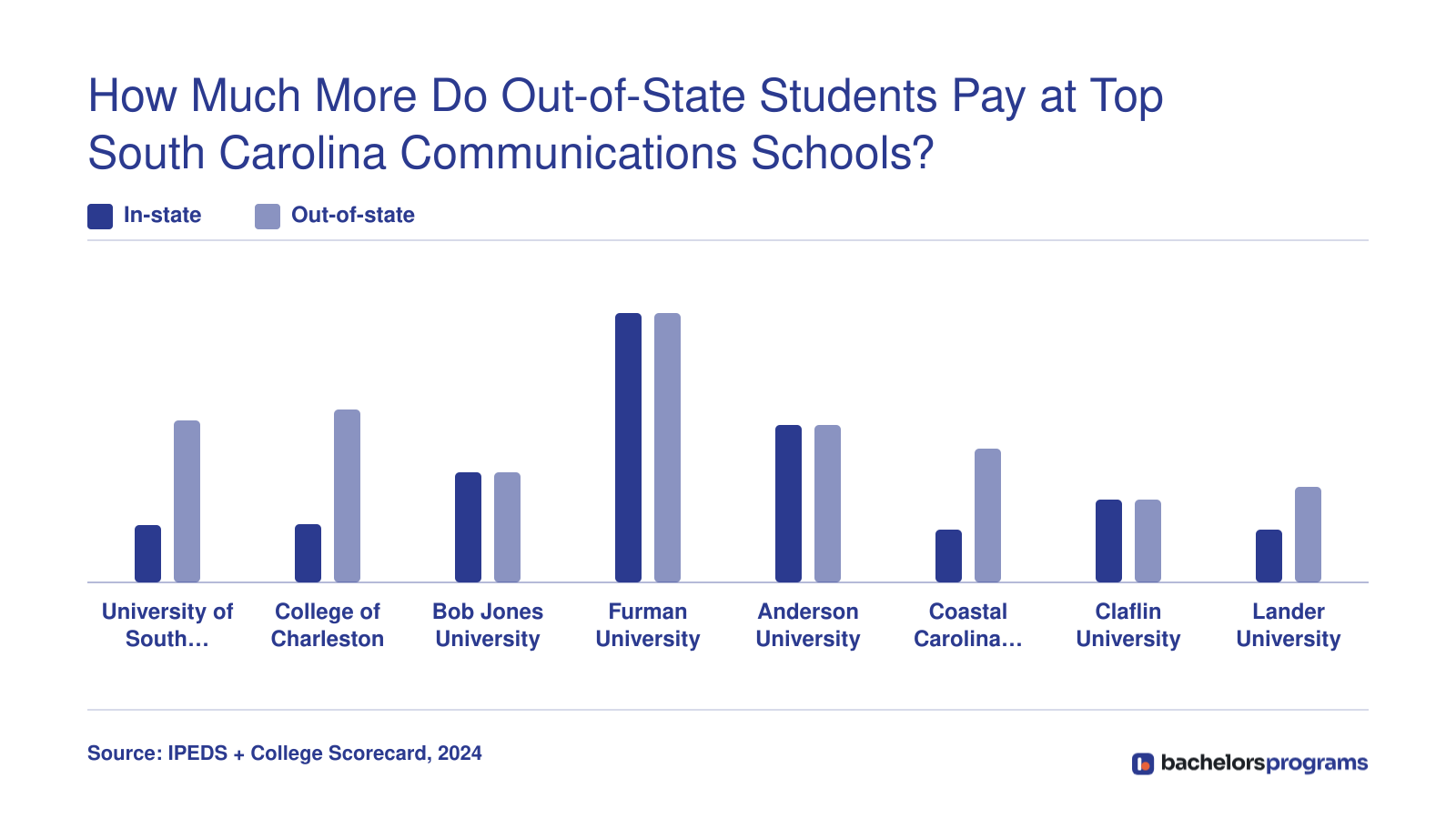
How Much More Do Out-of-State Students Pay at Top South Carolina Communications Schools?
Public universities such as the University of South Carolina, College of Charleston, Coastal Carolina University and Lander University charge out-of-state students roughly two to three times their in-state tuition and fees. Private schools like Furman University, Anderson University, Bob Jones University and Claflin University charge one rate for everyone, no matter where you live. These are published sticker prices, not what most families pay: Furman's average net price after aid was $30,308, about half its $59,770 published cost.
Online and Hybrid Bachelor's in Communications Options at South Carolina Schools
Degree-completion programs have become a common route into communications for South Carolina transfer students and working adults who cannot relocate. Formats and prices vary sharply by school, so check both before you apply.
Fully Online Completion Programs
USC Aiken delivers its B.A. in Communication fully online as a degree-completion program. Applicants generally need 45 to 60 credit hours from a regionally accredited institution, plus specified prerequisites. The 2026 online rate is $450 per credit, and the school's page does not say whether residency changes it.
USC Upstate offers a Communication B.A. with Communication Studies, Mass Media and Public Relations concentrations. Communication Studies is the concentration described as fully online. Upstate lists 2026-27 online bachelor's-completion tuition at $433.25 per credit for South Carolina residents and $869.00 for nonresidents, so residency clearly matters there. If you are leaning toward Mass Media or Public Relations, ask which courses can be taken online before you enroll.
Hybrid and Flexible Formats
Anderson University is listed among online or hybrid options, and its Communication: Digital Media B.A. focuses on video, social media and digital content. Confirm the exact delivery mode and per-credit rate with admissions, since those details vary by course.
Campus-Only Programs
USC Columbia's Communication B.A., the College of Charleston's Communication B.A. and Claflin University's Mass Communications program are campus-based. Those are the formats to choose if you want daily access to faculty and facilities.
The Practical Tradeoff
Online study buys scheduling flexibility and, at the public schools above, a clear per-credit price. Campus study buys hands-on experience. Claflin has a television studio and a podcast studio. Bob Jones University runs The Collegian student newspaper. Coastal Carolina University has a student-run public relations agency. Online students can usually still complete internships, but they have to arrange them locally and build a portfolio without those outlets. Working adults with prior credits often do well online. Students starting from scratch who want media production experience usually get more from a campus.
Related Articles
Admission Requirements for South Carolina Communications Bachelor's Programs
Furman University admits about 43 percent of applicants, the lowest rate among the South Carolina communications programs ranked here, while Southern Wesleyan University admits nearly everyone who applies. That spread sorts these schools faster than any GPA rule.
Two selectivity tiers
Furman (about 43 percent) and Anderson University (about 55 percent) sit at the more selective end, with the University of South Carolina and College of Charleston close behind at roughly 60 percent each. Claflin University (about 65 percent), USC Upstate (about 67 percent), Coastal Carolina University (about 75 percent) and Lander University (about 81 percent) admit a wider share, and Southern Wesleyan is close to open admission. These are university-wide rates, so the communication major may be tighter than the headline number.
Pell share tells a different story and is not a difficulty measure. Claflin enrolls the highest share of Pell recipients (about 84 percent); Furman the lowest (about 35 percent). Read admission rate for your odds, Pell share for who actually enrolls.
GPA, tests, and transfer credit
South Carolina publishes the most concrete rules: a 2.00 institutional GPA to enter the communication major, 2.25 to stay in it, and a 2.50 GPA plus 30 degree-applicable hours for transfer applicants. No more than 12 semester hours of journalism and mass communications coursework from outside the university apply, and at least half of the major must be finished in residence at Columbia. Its bulletins do not state an SAT or ACT requirement for the major. Staying in the major is a separate checkpoint from getting in, so keep both numbers in view.
For the rest, expect to dig. Several schools here review applicants holistically and post no single minimum GPA, and test rules move year to year, so confirm the current SAT or ACT policy with each admissions office. Where no policy is published, ask for the answer in writing before you apply.
A transfer tip
Get a course-by-course credit evaluation before you enroll, not after. Major-specific caps, like South Carolina's limit on outside journalism credit, are where transfers lose the most ground, and a written answer early lets you sequence technical college courses around them. Ask which courses count as major credit and which as electives. Starting at a South Carolina technical college can lower your total cost, but only if those credits land in the right places.
Questions to Ask Yourself
Do you need a campus media outlet or internship pipeline, or does a flexible online or hybrid schedule matter more?
Do you want a broad communications degree or a focused track such as journalism, public relations, advertising, or sports media?
Would in-state aid such as Palmetto Fellows or LIFE change which school is cheapest for you?
Compare Communications programs on the data that matters
Explore more Communications & Media majors or browse every field of study.
All Communications & Media programs Browse every field of study